

Automotive Market Report 2026
Global Outlook – By Vehicle Type (Passenger Vehicles, Commercial Vehicles, Electric Vehicles, Two-Wheelers, Three-Wheelers), By Fuel Type (Petrol, Diesel, Electric, Hybrid), By Component (Engine And Powertrain, Electrical And Electronics, Interior Components, Exterior Components), By Distribution Channel (Original Equipment Manufacturer (OEM), Aftermarket), By Application (Personal, Commercial, Industrial, Other Applications) – Market Size, Trends, Strategies, and Forecast to 2030
Automotive Market Overview
• Automotive market size has reached to $84.47 billion in 2025 • Expected to grow to $90.38 billion in 2030 at a compound annual growth rate (CAGR) of 7.2% • Growth Driver: Increasing Demand For Electric Vehicles (Evs) Driving The Market Growth Due To Rising Focus On Sustainable Transportation • Market Trend: Next-Generation Electric Vehicle Platforms Driving Efficiency, Range, And Smart Mobility Innovation • Asia-Pacific was the largest region and fastest growing region.What Is Covered Under Automotive Market?
Automotive refers to the industry involved in the design, development, and manufacturing of motor vehicles and their associated systems and parts. It encompasses activities related to vehicle engineering, assembly processes, and performance optimization, supporting efficient mobility and transportation. The industry focuses on ensuring durability, safety, and operational reliability through standardized production and continuous innovation in materials and manufacturing techniques. The main vehicle types in automotive include passenger vehicles, commercial vehicles, electric vehicles, two-wheelers, and three-wheelers. Passenger vehicles refer to automobiles designed primarily for personal transportation, focusing on comfort, safety, and efficiency for individual and family use. The fuel types include petrol, diesel, electric, and hybrid, and the components include engine and powertrain, electrical and electronics, interior components, and exterior components, and the distribution channels include original equipment manufacturer (OEM) and aftermarket, and the key applications include personal, commercial, industrial, and others.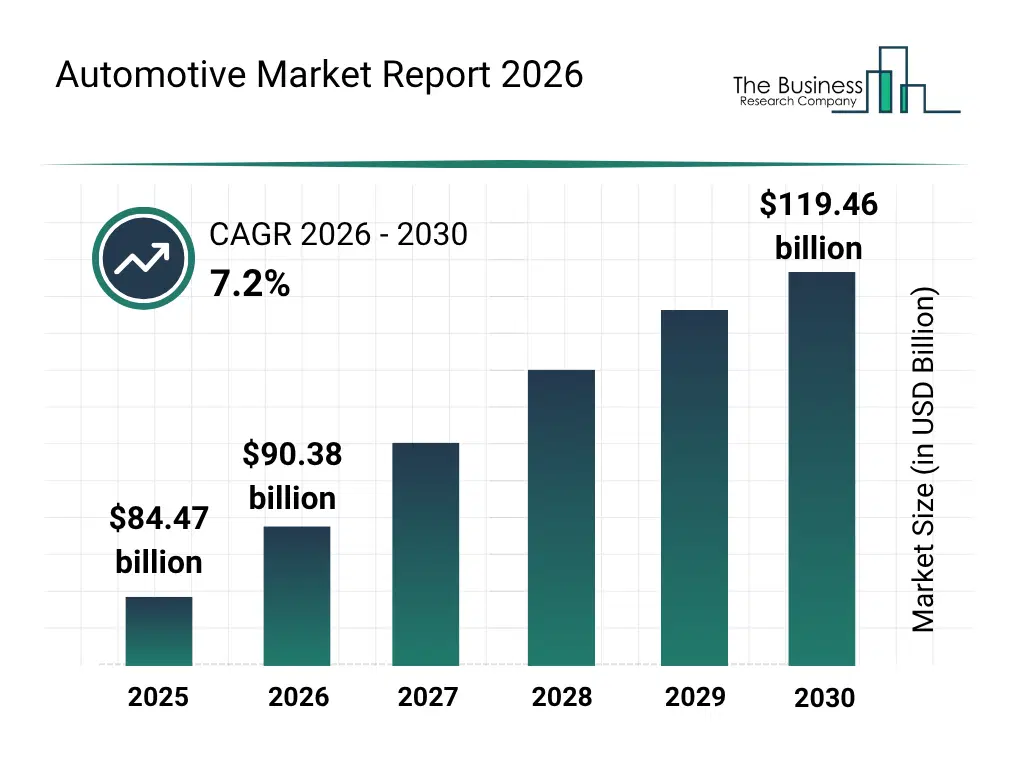
What Is The Automotive Market Size and Share 2026?
The automotive market size has grown strongly in recent years. It will grow from $84.47 billion in 2025 to $90.38 billion in 2026 at a compound annual growth rate (CAGR) of 7.0%. The growth in the historic period can be attributed to growth of mass vehicle production systems, rising global urbanization and mobility demand, increasing fuel efficiency regulations, expansion of automotive supply chains, rising consumer preference for personal mobility.What Is The Automotive Market Growth Forecast?
The automotive market size is expected to see strong growth in the next few years. It will grow to $119.46 billion by 2030 at a compound annual growth rate (CAGR) of 7.2%. The growth in the forecast period can be attributed to accelerating shift toward electric and hybrid vehicles, increasing adoption of autonomous driving technologies, rising demand for connected and software driven vehicles, tightening emission and sustainability regulations, growth in shared and mobility as a service models. Major trends in the forecast period include software defined vehicle architecture adoption, connected vehicle and telematics integration expansion, advanced driver assistance systems (adas) proliferation, lightweight materials and sustainable vehicle manufacturing, ev battery innovation and charging infrastructure development.
Global Automotive Market Segmentation
1) By Vehicle Type: Passenger Vehicles, Commercial Vehicles, Electric Vehicles, Two-Wheelers, Three-Wheelers 2) By Fuel Type: Petrol, Diesel, Electric, Hybrid 3) By Component: Engine And Powertrain, Electrical And Electronics, Interior Components, Exterior Components 4) By Distribution Channel: Original Equipment Manufacturer (OEM), Aftermarket 5) By Application: Personal, Commercial, Industrial, Other Applications Subsegments: 1) By Passenger Vehicles: Hatchback Vehicles, Sedan Vehicles, Sport Utility Vehicles, Multi Purpose Vehicles 2) By Commercial Vehicles: Light Commercial Vehicles, Medium Commercial Vehicles, Heavy Commercial Vehicles, Buses And Coaches, Pickup Trucks 3) By Electric Vehicles: Battery Electric Vehicles, Plug In Hybrid Electric Vehicles, Hybrid Electric Vehicles, Fuel Cell Electric Vehicles 4) By Three-Wheelers: Passenger Three Wheelers, Cargo Three Wheelers, Electric Three Wheelers, Hybrid Three Wheelers 5) By Two-Wheelers: Motorcycles, Scooters, Mopeds, Electric Two Wheelers, Sports Two WheelersWhat Is The Driver Of The Automotive Market?
The increasing demand for electric vehicles (EVs) is expected to propel the growth of the automotive market going forward. Electric vehicles (EVs) refer to vehicles that are powered fully or partially by electricity instead of traditional internal combustion engines, using energy stored in rechargeable batteries. The demand for electric vehicles (EVs) is rising due to increasing environmental concerns and the push to reduce greenhouse gas emissions, which is encouraging consumers and governments to adopt cleaner and more sustainable transportation options. Demand for electric vehicles (EVs) drives innovation, increases production of advanced vehicle technologies, and accelerates the shift from traditional combustion engine vehicles to more sustainable and energy-efficient mobility solutions in the automotive sector. For instance, in January 2025, according to the Cox Automotive, a US-based system software company, electric vehicle sales totaled 1.3 million units, reflecting a 7.3% increase compared to the revised figures for 2023. Therefore, the increasing demand for electric vehicles (EVs) is driving the growth of the automotive industry.Key Players In The Global Automotive Market
Major companies operating in the automotive market are Volkswagen Aktiengesellschaft; Toyota Motor Corporation; Stellantis N.V.; Ford Motor Company; General Motors Company; Bayerische Motoren Werke Aktiengesellschaft; Mercedes-Benz Group AG; Honda Motor Co. Ltd.; Hyundai Motor Company; BYD Company Limited; SAIC Motor Corporation Limited; Tesla Inc.; Nissan Motor Co. Ltd.; China FAW Group Co. Ltd.; Renault S.A.; Tata Motors Limited; Suzuki Motor Corporation; Mazda Motor Corporation; Subaru Corporation; Geely Automobile Holdings Limited; Mitsubishi Motors Corporation; Ferrari N.V.
This chart is for illustrative purposes; the full report includes a detailed competitor analysis and comprehensive overview of the top 10 companies in the market.
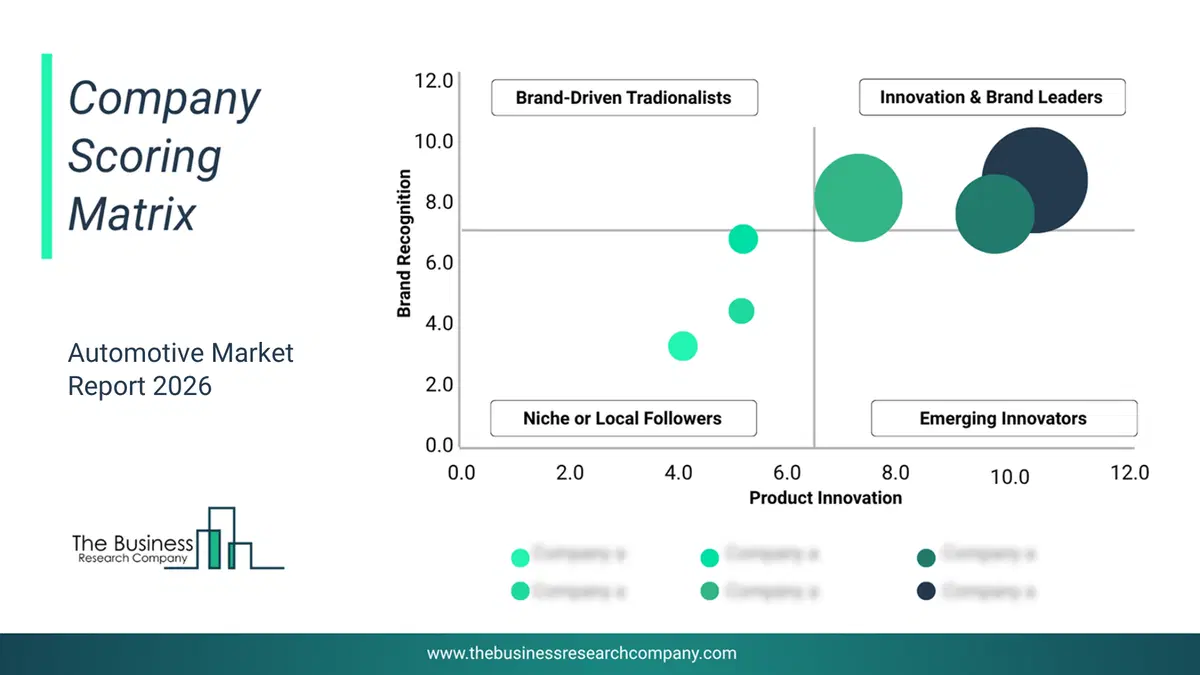
This chart maps companies by product innovation and brand strength, with bubble size indicating relative revenue, helping identify market leaders, challengers, and niche players. This is an illustrative chart; the full report provides a complete and accurate competitive analysis.
Global Automotive Market Trends and Insights
Major companies operating in the automotive market are focusing on developing innovative platforms such as, next-generation electric vehicle (EV) architectures to improve vehicle efficiency, extend driving range, reduce emissions, and support advanced connected and autonomous driving technologies. Next-generation electric vehicle (EV) architectures are advanced vehicle platforms that integrate battery systems, electric drivetrains, and software-controlled electronic systems into a unified structure, helping to improve energy efficiency, increase driving range, reduce emissions, enable faster charging, and support advanced connectivity and autonomous driving features. For instance, in January 2026, BMW Group, a Germany-based automotive manufacturing company, launched the BMW iX3 at CES 2026, introducing a next-generation electric SUV designed to showcase advanced mobility innovation. The BMW iX3 is built on an advanced electric vehicle architecture that integrates high-efficiency battery systems and optimized electric drivetrains to enhance driving range and performance. It features a software-defined cockpit with AI-enabled user interaction, allowing real-time personalization of driving and infotainment settings through over-the-air updates. The model incorporates advanced driver-assistance technologies aimed at improving safety, including enhanced sensor fusion and semi-autonomous driving capabilities. It also emphasizes sustainability through improved energy efficiency, lightweight materials, and reduced lifecycle emissions compared to conventional internal combustion engine vehicles.What Are Latest Mergers And Acquisitions In The Automotive Market?
In January 2023, Ideanomics Inc., a US-based technology company, acquired VIA Motors Inc. for an undisclosed amount. With this acquisition, Ideanomics aimed to strengthen its position in the commercial electric vehicle market by expanding its portfolio of medium- and heavy-duty electric delivery vehicles and accelerating its end-to-end EV ecosystem strategy. VIA Motors Inc. is a US-based automotive manufacturing company that specializes in designing and producing electric commercial vans and trucks for fleet and last-mile delivery applications.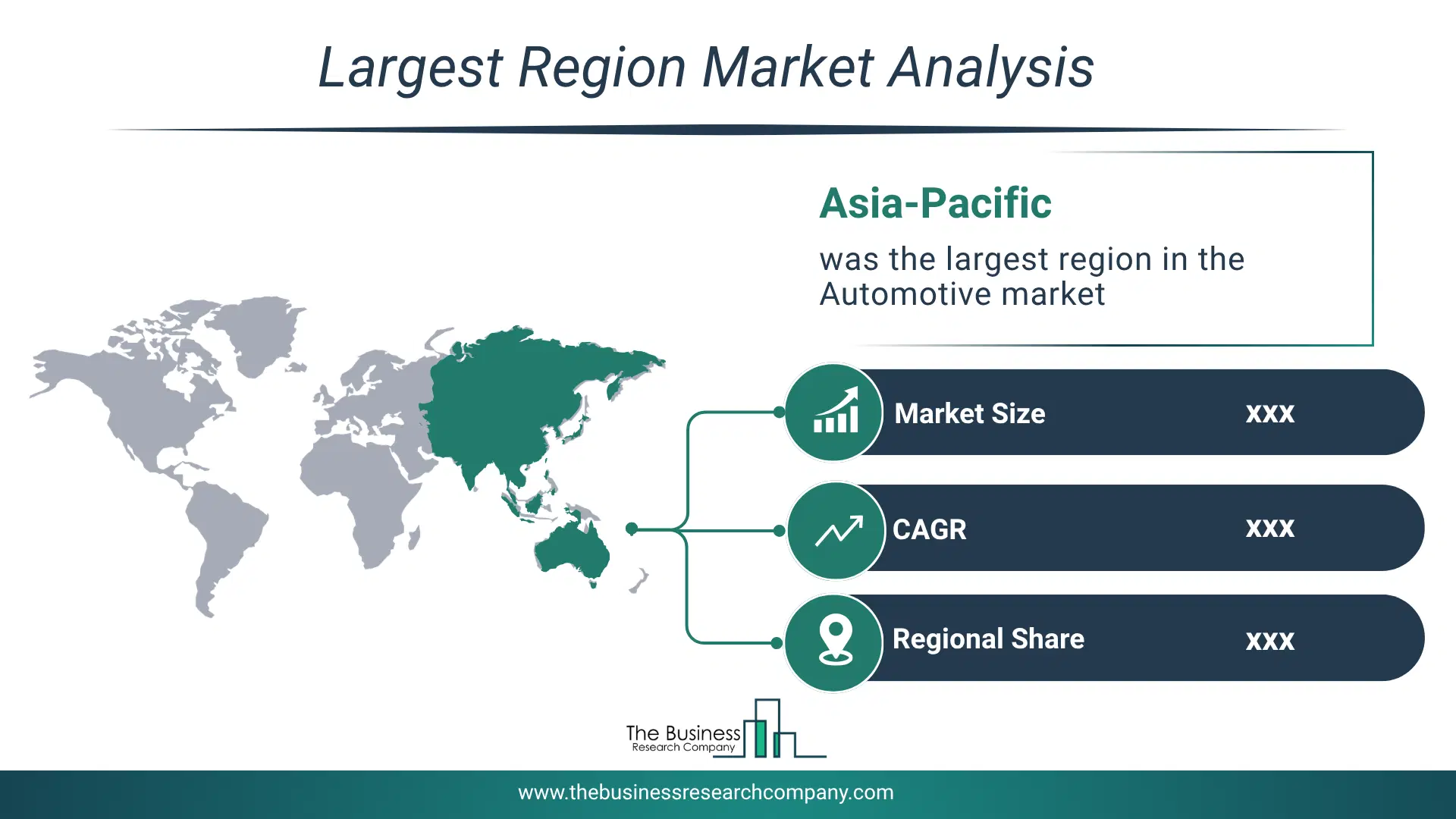
Regional Insights
Asia-Pacific was the largest region in the automotive market in 2025. Asia-Pacific is expected to be the fastest-growing region in the forecast period. The regions covered in this market report are Asia-Pacific, South East Asia, Western Europe, Eastern Europe, North America, South America, Middle East, Africa. The countries covered in this market report are Australia, Brazil, China, France, Germany, India, Indonesia, Japan, Taiwan, Russia, South Korea, UK, USA, Canada, Italy, Spain.What Defines the Automotive Market?
The automotive market consists of sales of chassis systems, braking systems, suspension systems, steering systems, drivetrain components, structural assemblies, vehicle frames, axles, wheels, tires, and fastening systems. Values in this market are ‘factory gate’ values, that is, the value of goods sold by the manufacturers or creators of the goods, whether to other entities (including downstream manufacturers, wholesalers, distributors, and retailers) or directly to end customers. The value of goods in this market includes related services sold by the creators of the goods.How is Market Value Defined and Measured?
The market value is defined as the revenues that enterprises gain from the sale of goods and/or services within the specified market and geography through sales, grants, or donations in terms of the currency (in USD unless otherwise specified). The revenues for a specified geography are consumption values that are revenues generated by organizations in the specified geography within the market, irrespective of where they are produced. It does not include revenues from resales along the supply chain, either further along the supply chain or as part of other products.
This chart presents market attractiveness based on a quantitative evaluation of growth, competition, strategic alignment, and risk, offering a clear view of opportunity areas for decision-making. This chart is for illustrative purposes; the full report contains the complete analysis.

This chart highlights the Total Addressable Market (TAM) by estimating the maximum revenue opportunity using an assumption-driven approach, supporting strategic planning and opportunity sizing across markets. The chart is illustrative; the full report provides a more comprehensive analysis.
What Key Data and Analysis Are Included in the Automotive Market Report 2026?
The automotive market research report is one of a series of new reports from The Business Research Company that provides market statistics, including industry global market size, regional shares, competitors with the market share, detailed market segments, market trends and opportunities, and any further data you may need to thrive in the automotive industry. The market research report delivers a complete perspective of everything you need, with an in-depth analysis of the current and future state of the industry.Automotive Market Report Forecast Analysis
| Report Attribute | Details |
|---|---|
| Market Size Value In 2026 | $90.38 billion |
| Revenue Forecast In 2030 | $119.46 billion |
| Growth Rate | CAGR of 7.20% from 2026 to 2030 |
| Base Year For Estimation | 2025 |
| Actual Estimates/Historical Data | 2020-2025 |
| Forecast Period | 2026 - 2030 |
| Market Representation | Revenue in USD Billion and CAGR from 2026 to 2030 |
| Segments Covered | Vehicle Type, Fuel Type, Component, Distribution Channel, Application |
| Regional Scope | Asia-Pacific, Western Europe, Eastern Europe, North America, South America, Middle East, Africa |
| Country Scope | The countries covered in the report are Australia, Brazil, China, France, Germany, India, Indonesia, Japan, Taiwan, Russia, South Korea, UK, USA, Canada, Italy, Spain. |
| Key Companies Profiled | Volkswagen Aktiengesellschaft; Toyota Motor Corporation; Stellantis N.V.; Ford Motor Company; General Motors Company; Bayerische Motoren Werke Aktiengesellschaft; Mercedes-Benz Group AG; Honda Motor Co. Ltd.; Hyundai Motor Company; BYD Company Limited; SAIC Motor Corporation Limited; Tesla Inc.; Nissan Motor Co. Ltd.; China FAW Group Co. Ltd.; Renault S.A.; Tata Motors Limited; Suzuki Motor Corporation; Mazda Motor Corporation; Subaru Corporation; Geely Automobile Holdings Limited; Mitsubishi Motors Corporation; Ferrari N.V. |
| Customization Scope | Request for Customization |
| Pricing And Purchase Options | Explore Purchase Options |