
Automotive Self-Healing Coatings Market Report 2026
Global Outlook – By Type (Macromolecular Compounds Coatings, Ceramics Coatings, Composites Coatings), By Material Type (Polyurethane-Based Self-Healing Coatings, Epoxy-Based Self-Healing Coatings, Acrylic-Based Self-Healing Coatings, Polymer Composite Self-Healing Coatings, Microcapsule-Embedded Coatings, Nanotechnology-Enabled Coatings), By Vehicle Type (Passenger Vehicles, Commercial Vehicles, Two-Wheelers, Aerial Vehicles), By Sales Channel (Original Equipment Manufacturers, Aftermarket Service Providers, Automotive Detailing Studios, Authorized Dealership Workshops), By Application (Automotive, Aerospace, Electronics, Other Applications) – Market Size, Trends, Strategies, and Forecast to 2030
Automotive Self-Healing Coatings Market Overview
• Automotive Self-Healing Coatings market size has reached to $1.58 billion in 2025 • Expected to grow to $2.78 billion in 2030 at a compound annual growth rate (CAGR) of 11.9% • Growth Driver: Surge In Vehicle Production Fueling The Growth Of The Market Due To Rising Need For Durable And Long-Lasting Automotive Surface Protection • Market Trend: Advanced Self-Healing Films Enhance Vehicle Paint Protection • North America was the largest region in 2025 and Asia-Pacific is the fastest growing region.What Is Covered Under Automotive Self-Healing Coatings Market?
Automotive self-healing coatings are advanced protective layers designed to automatically repair minor scratches, abrasions, and surface damage on vehicle exteriors. These coatings use innovative materials and chemical reactions that restore the surface without requiring manual intervention. They help maintain a vehicle’s appearance, extend the lifespan of the paint, and reduce maintenance efforts. The main types of automotive self-healing coatings include macromolecular compounds coatings, ceramics coatings, and composites coatings. Macromolecular compounds coatings refer to polymer-based protective layers designed to autonomously repair minor scratches or abrasions through mechanisms such as heat activation, reversible chemical bonding, or intrinsic polymer chain mobility. There are material types such as polyurethane-based self-healing coatings, epoxy-based self-healing coatings, acrylic-based self-healing coatings, polymer composite self-healing coatings, microcapsule-embedded coatings, and nanotechnology-enabled coatings. The vehicle types include passenger vehicles, commercial vehicles, two-wheelers, and aerial vehicles. The sales channels include original equipment manufacturers, aftermarket service providers, automotive detailing studios, and authorized dealership workshops, and they are used by several applications such as automotive, aerospace, electronics, and others.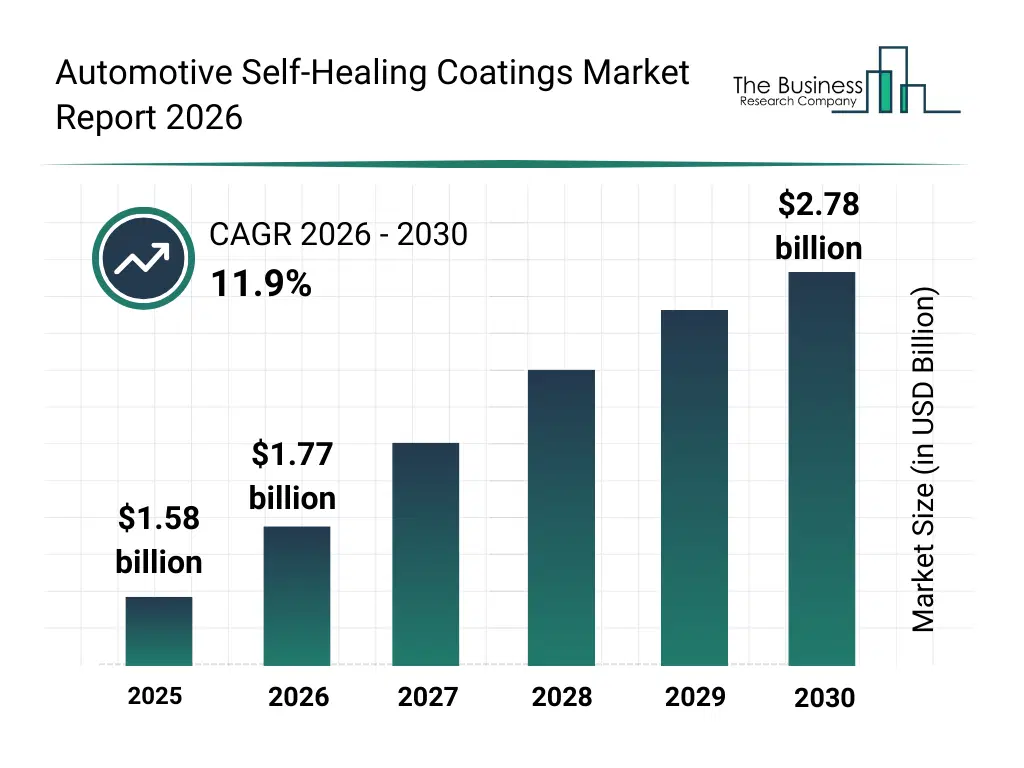
What Is The Automotive Self-Healing Coatings Market Size and Share 2026?
The automotive self-healing coatings market size has grown rapidly in recent years. It will grow from $1.58 billion in 2025 to $1.77 billion in 2026 at a compound annual growth rate (CAGR) of 12.1%. The growth in the historic period can be attributed to growing demand for vehicle appearance protection, increasing adoption of premium automotive coatings, rising urban traffic leading to more surface damage, expanding automotive production volumes, and growing investments in coating formulation testing services.What Is The Automotive Self-Healing Coatings Market Growth Forecast?
The automotive self-healing coatings market size is expected to see rapid growth in the next few years. It will grow to $2.78 billion in 2030 at a compound annual growth rate (CAGR) of 11.9%. The growth in the forecast period can be attributed to increasing integration of self-healing coatings in oem manufacturing, growing demand for long-term low-maintenance vehicle protection, rising adoption of advanced coatings in electric vehicles, expansion of aftermarket detailing and application services, and increasing consumer preference for smart protective automotive materials. Major trends in the forecast period include advancements in smart polymer healing technologies, innovations in uv-activated and heat-activated coatings, developments in multifunctional protective coating systems, research and development in eco-friendly low-voc formulations, and technological improvements in automated and robotic coating applications.
Global Automotive Self-Healing Coatings Market Segmentation
1) By Type: Macromolecular Compounds Coatings, Ceramics Coatings, Composites Coatings 2) By Material Type: Polyurethane-Based Self-Healing Coatings, Epoxy-Based Self-Healing Coatings, Acrylic-Based Self-Healing Coatings, Polymer Composite Self-Healing Coatings, Microcapsule-Embedded Coatings, Nanotechnology-Enabled Coatings 3) By Vehicle Type: Passenger Vehicles, Commercial Vehicles, Two-Wheelers, Aerial Vehicles 4) By Sales Channel: Original Equipment Manufacturers, Aftermarket Service Providers, Automotive Detailing Studios, Authorized Dealership Workshops 5) By Application: Automotive, Aerospace, Electronics, Other Applications Subsegments: 1) By Macromolecular Compounds Coatings: Polymer Based Coatings, Elastomer Based Coatings, Polyurethane Based Coatings, Epoxy Based Coatings, Silicone Based Coatings 2) By Ceramics Coatings: Oxide Ceramic Coatings, Carbide Ceramic Coatings, Nitride Ceramic Coatings, Zirconia Based Coatings, Alumina Based Coatings 3) By Composites Coatings: Fiber Reinforced Coatings, Polymer Matrix Composite Coatings, Metal Matrix Composite Coatings, Ceramic Matrix Composite Coatings, Hybrid Composite CoatingsWhat Is The Driver Of The Automotive Self-Healing Coatings Market?
The increasing vehicle production is expected to propel the growth of the automotive self-healing coatings market going forward. Vehicle production refers to the manufacturing of passenger cars, commercial vehicles, and other automobiles that require protective exterior coatings to maintain aesthetics and extend surface lifespan. The rise in vehicle production is due to surging electric vehicle demand driven by government incentives, improved affordability and expanding charging infrastructure. Automotive self-healing coatings help address the resulting need for enhanced vehicle protection by automatically repairing minor scratches, abrasions, and surface damage, thereby improving durability, reducing maintenance costs, and preserving vehicle appearance over time. For instance, in March 2025, according to the European Automobile Manufacturers Association, a Belgium-based automobile industry association, worldwide car sales reached 74.6 million units in 2024, marking a 2.5% increase compared to 2023. Therefore, the increasing vehicle production is driving the growth of the automotive self-healing coatings industry.Key Players In The Global Automotive Self-Healing Coatings Market
Major companies operating in the automotive self-healing coatings market are Nissan Motor Co. Ltd., 3M Company, The Sherwin-Williams Company, PPG Industries Inc., Toray Industries Inc., Akzo Nobel N.V., Nippon Paint Holdings Co. Ltd., Clariant AG, Axalta Coating Systems LLC, Kansai Paint Co. Ltd., Hempel A/S, GSI Creos Corporation, ADLER-Werk Lackfabrik Johann Berghofer GmbH & Co KG, NATOCO Co.Ltd., PremiumShield Limited, Cidetec Surface Engineering, NEI Corporation, Feynlab Inc., SupraPolix B.V., Autonomic Materials Inc., ISHINE World Ltd., Sensor Coating Systems Ltd.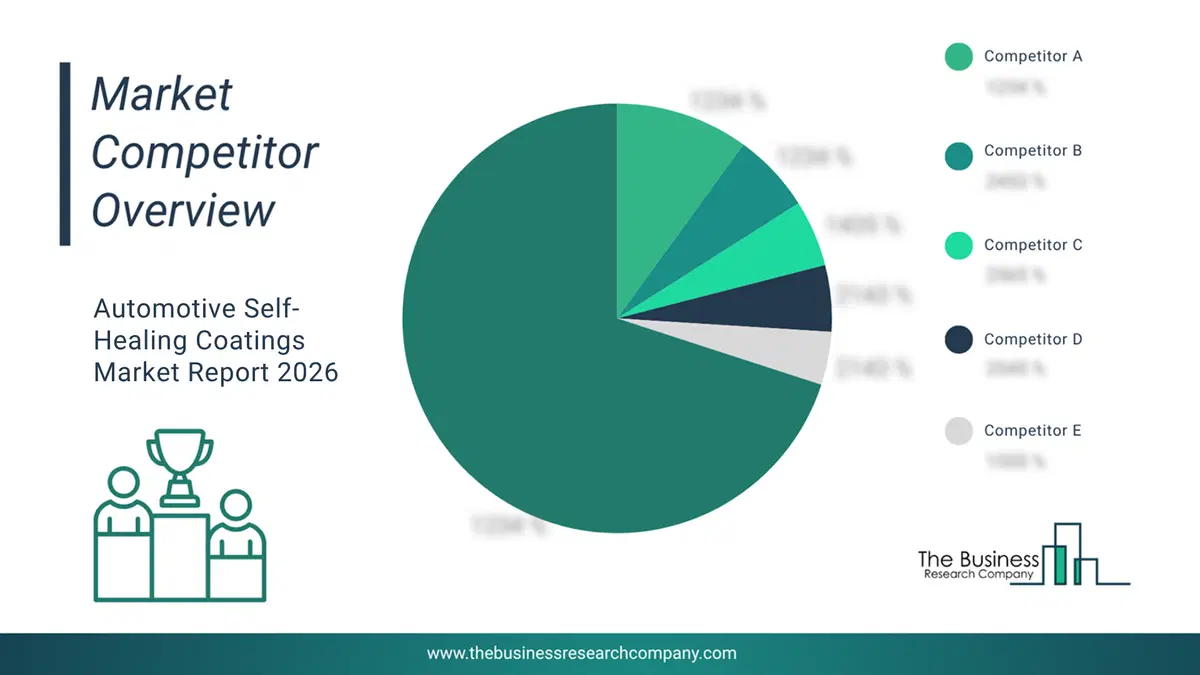
This chart is for illustrative purposes; the full report includes a detailed competitor analysis and comprehensive overview of the top 10 companies in the market.
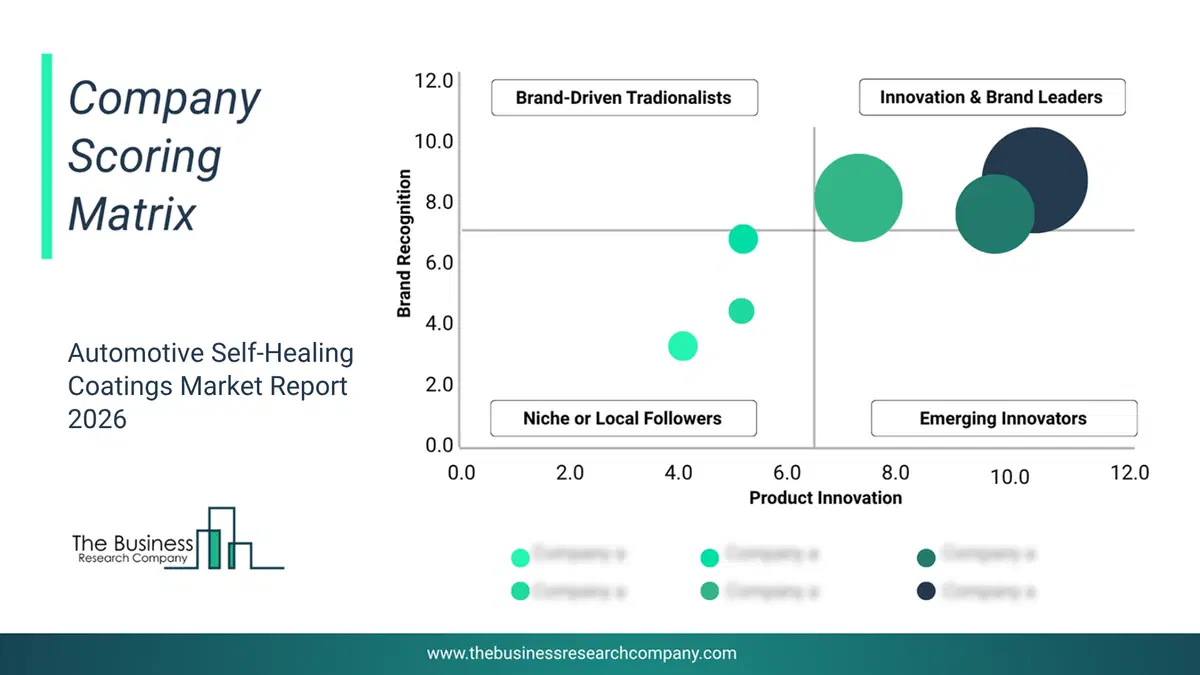
This chart maps companies by product innovation and brand strength, with bubble size indicating relative revenue, helping identify market leaders, challengers, and niche players. This is an illustrative chart; the full report provides a complete and accurate competitive analysis.
Global Automotive Self-Healing Coatings Market Trends and Insights
Major companies operating in the automotive self-healing coatings market are focusing on developing advanced, sustainable products, such as paint protection films, to meet environmental standards and customer demand for eco-friendly solutions. Paint protection films refer to transparent, durable layers applied to vehicles to shield the paint from scratches, chips, and environmental damage. For instance, in May 2024, RideWrap, a Canada-based manufacturer of vehicle protection solutions, launched the Lotus Pro Paint Protection Film. It is a high-performance film engineered with 50% recycled materials, significantly reducing its environmental footprint while maintaining premium durability and clarity. It incorporates a patented ClearFusion adhesive technology that ensures bubble-free installation and long-term resistance to yellowing. The film also features ScratchGuard healing technology, which allows minor surface scratches to self-repair with heat, maintaining a flawless appearance and reducing the need for replacements.What Are Latest Mergers And Acquisitions In The Automotive Self-Healing Coatings Market?
In March 2025, BASF Coatings GmbH is a Germany-based coatings manufacturer, partnered with NIO Inc. to advance automotive exterior coatings for electric vehicles. This partnership aims to develop durable, sustainable, and high-performance coatings that enhance EV aesthetics, improve corrosion resistance, and support eco-friendly manufacturing practices. NIO Inc. is a China-based electric vehicle manufacturer known for high-performance smart vehicles.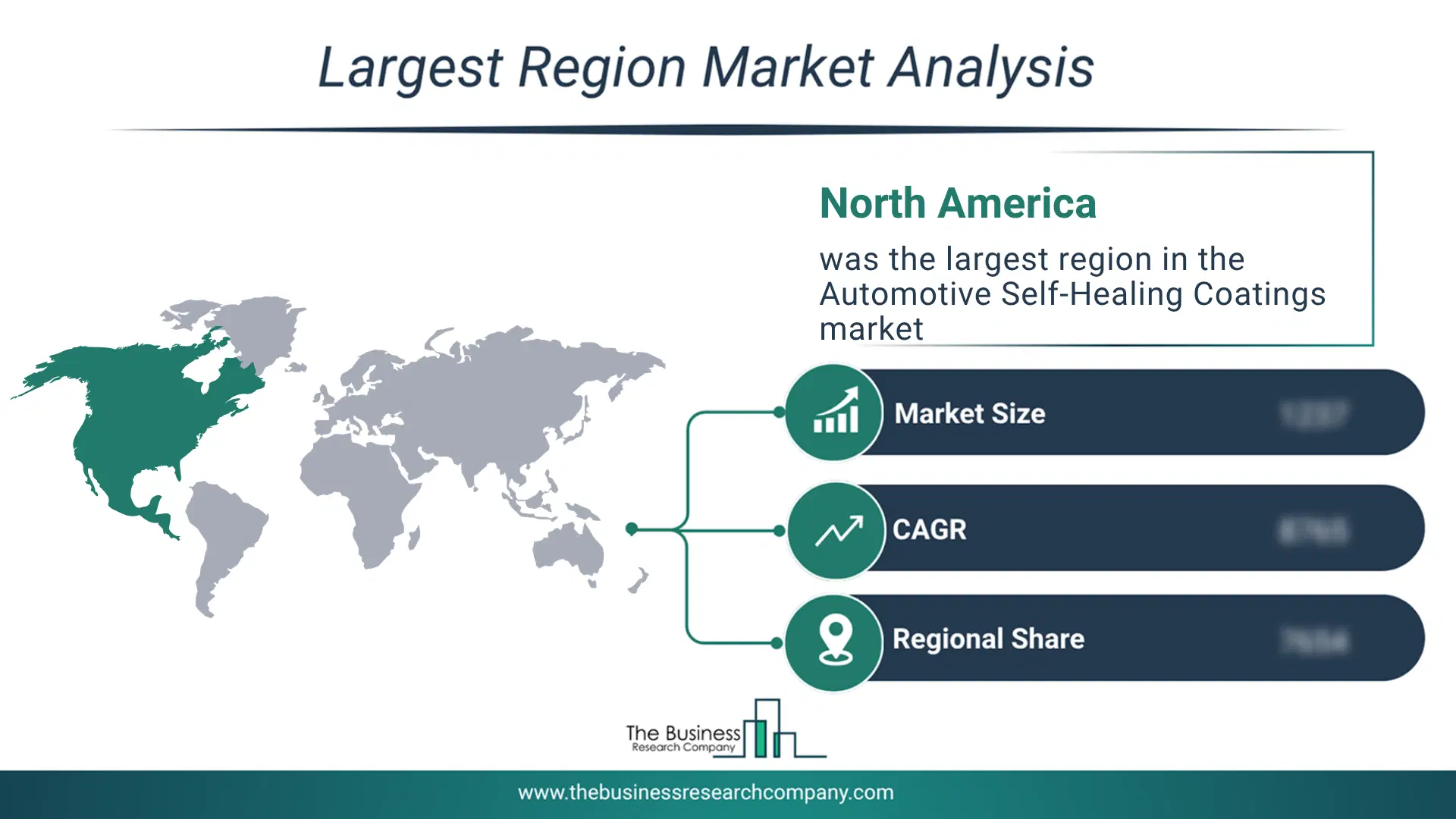
Regional Insights
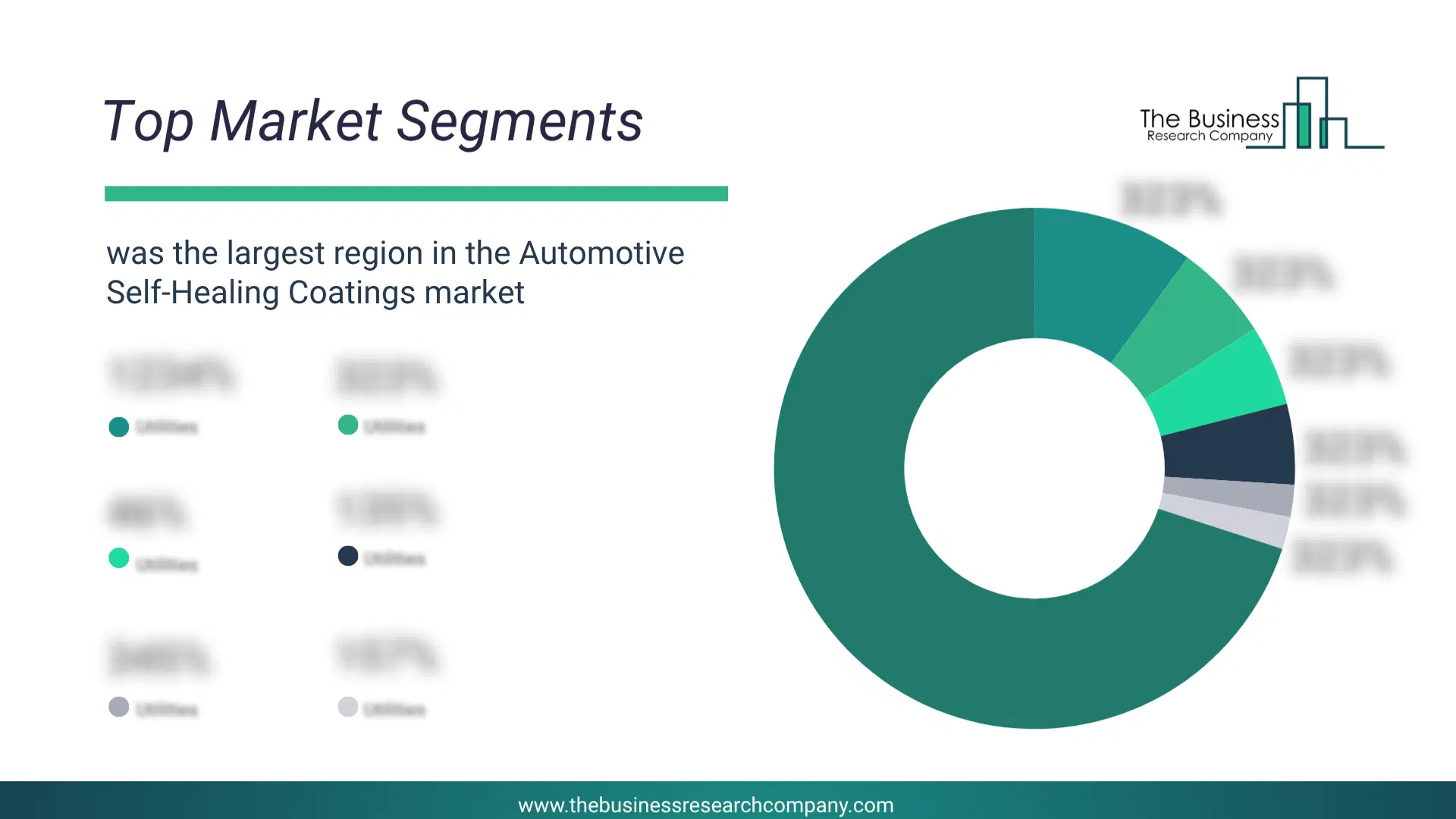
North America was the largest region in the automotive self-healing coatings in 2025. Asia-Pacific is expected to be the fastest-growing region in the forecast period. The regions covered in this market report are Asia-Pacific, South East Asia, Western Europe, Eastern Europe, North America, South America, Middle East, Africa. The countries covered in this market report are Australia, Brazil, China, France, Germany, India, Indonesia, Japan, Taiwan, Russia, South Korea, UK, USA, Canada, Italy, Spain.What Defines the Automotive Self-Healing Coatings Market?
The automotive self-healing coatings market consists of sales of self-healing paint films, protective coating sprays, microcapsule additives, polymer repair sheets, and nanocoating applicator pads. The market value includes the value of related goods sold by the service provider or included within the service offering. Values in this market are ‘factory gate’ values, that is, the value of goods sold by the manufacturers or creators of the goods, whether to other entities (including downstream manufacturers, wholesalers, distributors, and retailers) or directly to end customers. The value of goods in this market includes related services sold by the creators of the goods.How is Market Value Defined and Measured?
The market value is defined as the revenues that enterprises gain from the sale of goods and/or services within the specified market and geography through sales, grants, or donations in terms of the currency (in USD unless otherwise specified). The revenues for a specified geography are consumption values that are revenues generated by organizations in the specified geography within the market, irrespective of where they are produced. It does not include revenues from resales along the supply chain, either further along the supply chain or as part of other products.
This chart presents market attractiveness based on a quantitative evaluation of growth, competition, strategic alignment, and risk, offering a clear view of opportunity areas for decision-making. This chart is for illustrative purposes; the full report contains the complete analysis.

This chart highlights the Total Addressable Market (TAM) by estimating the maximum revenue opportunity using an assumption-driven approach, supporting strategic planning and opportunity sizing across markets. The chart is illustrative; the full report provides a more comprehensive analysis.
What Key Data and Analysis Are Included in the Automotive Self-Healing Coatings Market Report 2026?
The automotive self-healing coatings market research report is one of a series of new reports from The Business Research Company that provides market statistics, including industry global market size, regional shares, competitors with the market share, detailed market segments, market trends and opportunities, and any further data you may need to thrive in the automotive self-healing coatings industry. The market research report delivers a complete perspective of everything you need, with an in-depth analysis of the current and future state of the industry.Automotive Self-Healing Coatings Market Report Forecast Analysis
| Report Attribute | Details |
|---|---|
| Market Size Value In 2026 | $1.77 billion |
| Revenue Forecast In 2030 | $2.78 billion |
| Growth Rate | CAGR of 12.1% from 2026 to 2030 |
| Base Year For Estimation | 2025 |
| Actual Estimates/Historical Data | 2020-2025 |
| Forecast Period | 2026 - 2030 |
| Market Representation | Revenue in USD Billion and CAGR from 2026 to 2030 |
| Segments Covered | Type, Material Type, Vehicle Type, Sales Channel, Application |
| Regional Scope | Asia-Pacific, Western Europe, Eastern Europe, North America, South America, Middle East, Africa |
| Country Scope | The countries covered in this market report are Australia, Brazil, China, France, Germany, India, Indonesia, Japan, Taiwan, Russia, South Korea, UK, USA, Canada, Italy, Spain |
| Key Companies Profiled | Nissan Motor Co. Ltd., 3M Company, The Sherwin-Williams Company, PPG Industries Inc., Toray Industries Inc., Akzo Nobel N.V., Nippon Paint Holdings Co. Ltd., Clariant AG, Axalta Coating Systems LLC, Kansai Paint Co. Ltd., Hempel A/S, GSI Creos Corporation, ADLER-Werk Lackfabrik Johann Berghofer GmbH & Co KG, NATOCO Co.Ltd., PremiumShield Limited, Cidetec Surface Engineering, NEI Corporation, Feynlab Inc., SupraPolix B.V., Autonomic Materials Inc., ISHINE World Ltd., Sensor Coating Systems Ltd. |
| Customization Scope | Request for Customization |
| Pricing And Purchase Options | Explore Purchase Options |