
Automotive Simulation Software Market Report 2026
Global Outlook – By Component (Software, Services), By Software Type (Design Simulation Software, Performance Simulation Software, Crash Simulation Software, Multibody Dynamics Simulation Software, Thermal Simulation Software), By Deployment Type (On-Premises Software, Cloud-Based Software), By Application (Vehicle Dynamics, Powertrain Simulation, Fuel Efficiency Simulation, Noise, Vibration, And Harshness Simulation, Electronics Simulation), By End-User Industry (Original Equipment Manufacturers, Automotive Suppliers, Academic Institutions, Research Organizations) – Market Size, Trends, Strategies, and Forecast to 2030
Automotive Simulation Software Market Overview
• Automotive Simulation Software market size has reached to $4.98 billion in 2025 • Expected to grow to $9.34 billion in 2030 at a compound annual growth rate (CAGR) of 13.5% • Growth Driver: The Rising Demand For Virtual Testing Is Driving The Market Due To Increasing Adoption Of Virtual Reality And Immersive Technologies • Market Trend: Artificial Intelligence-Driven Simulation Accelerates Virtual Automotive Engineering And Design Innovation • Asia-Pacific was the largest region and fastest growing region.Market Gains By 2030 – Top Opportunities By Segment
Market Gain identifies the most promising market opportunities by highlighting the segments or products expected to generate the highest incremental revenue growth over the next five years.
What Is Covered Under Automotive Simulation Software Market?
Automotive simulation software refers to a specialized class of software that enables engineers to create virtual models of vehicle systems and components for design, analysis, testing, and optimization in a digital environment. It allows simulation of real-world conditions such as dynamics, performance, and interactions to reduce reliance on physical prototypes and accelerate vehicle development. It helps to reduce development time and costs while improving vehicle quality, safety, and innovation. The main components of automotive simulation software include software and services. Software refers to computer-based simulation tools used to model, analyze, and optimize vehicle systems and components under virtual environments, enabling automotive stakeholders to evaluate design performance, safety, and efficiency before physical prototyping. The software types include design simulation software, performance simulation software, crash simulation software, multibody dynamics simulation software, and thermal simulation software. The solutions are deployed through on-premises software and cloud-based software depending on computational requirements and data security preferences. The various applications involved are vehicle dynamics, powertrain simulation, fuel efficiency simulation, noise, vibration, and harshness simulation, and electronics simulation. The end-user industries utilizing automotive simulation software include original equipment manufacturers, automotive suppliers, academic institutions, and research organizations.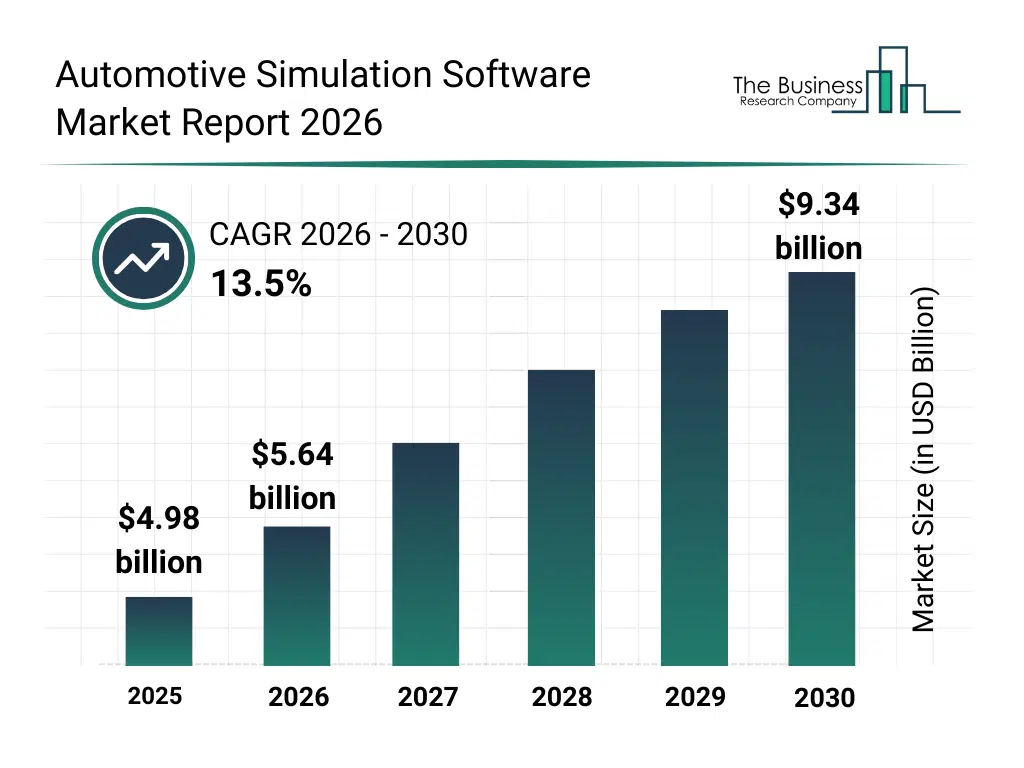
What Is The Automotive Simulation Software Market Size and Share 2026?
The automotive simulation software market size has grown rapidly in recent years. It will grow from $4.98 billion in 2025 to $5.64 billion in 2026 at a compound annual growth rate (CAGR) of 13.2%. The growth in the historic period can be attributed to rising prototype costs, early CAE software adoption, safety validation requirements, OEM R&D digitalization, testing cycle reduction.What Is The Automotive Simulation Software Market Growth Forecast?
The automotive simulation software market size is expected to see rapid growth in the next few years. It will grow to $9.34 billion in 2030 at a compound annual growth rate (CAGR) of 13.5%. The growth in the forecast period can be attributed to software-defined vehicles growth, AI-driven simulation adoption, cloud-native development, EV platform diversification, virtual homologation demand. Major trends in the forecast period include virtual vehicle prototyping, autonomous driving simulation, cloud-based simulation platforms, multi-physics vehicle modeling, real-time performance validation.
Global Automotive Simulation Software Market Segmentation
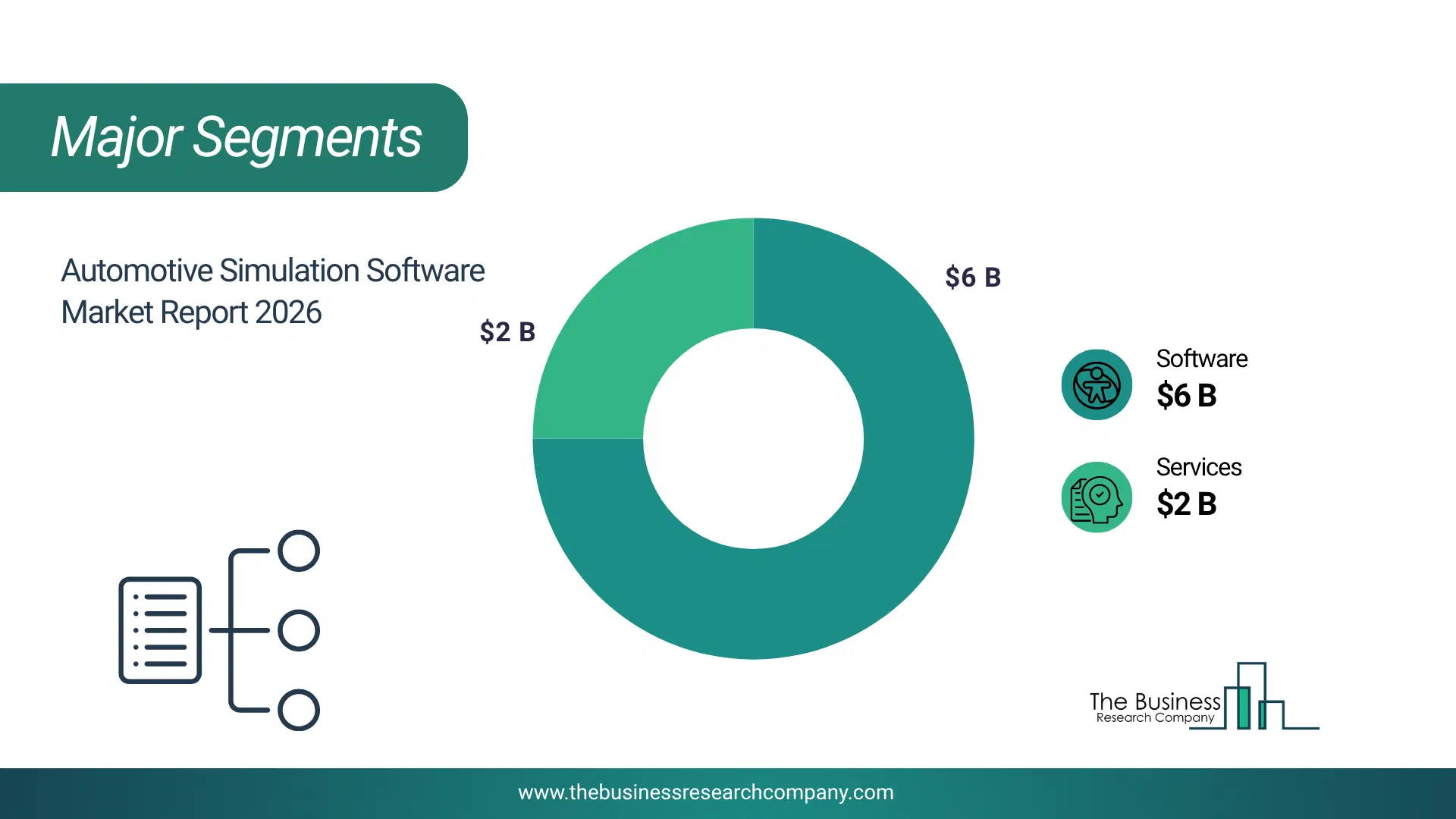
1) By Component: Software, Services 2) By Software Type: Design Simulation Software, Performance Simulation Software, Crash Simulation Software, Multibody Dynamics Simulation Software, Thermal Simulation Software 3) By Deployment Type: On-Premises Software, Cloud-Based Software 4) By Application: Vehicle Dynamics, Powertrain Simulation, Fuel Efficiency Simulation, Noise, Vibration, And Harshness Simulation, Electronics Simulation 5) By End-User Industry: Original Equipment Manufacturers, Automotive Suppliers, Academic Institutions, Research Organizations Subsegments: 1) By Software: Design Simulation Software, Performance Simulation Software, Crash Simulation Software, Multibody Dynamics Simulation Software, Thermal Simulation Software 2) By Services: Consulting And Workflow Optimization Services, Integration And Implementation Services, Support And Maintenance Services, Training And Certification Services, Customization And Development Services, Managed Simulation And Outsourcing Services The top segments in the automotive simulation software market will be: • Software will reach $6.46 Billion by 2030. • Services will reach $2.27 Billion by 2030.What Is The Driver Of The Automotive Simulation Software Market?
The rising demand for virtual testing is expected to propel the growth of the automotive simulation software market going forward. Virtual testing refers to the use of virtual reality-enabled simulation environments to digitally test, validate, and optimize vehicle design, performance, and safety systems without relying entirely on physical prototypes. The demand for virtual testing is rising due to the rapid expansion of virtual reality adoption across industries, enabling organizations to conduct complex testing and visualization activities more efficiently and cost-effectively. Automotive simulation software supports this demand by integrating VR-based simulation tools that allow automotive manufacturers to perform immersive vehicle testing, scenario analysis, and system validation in controlled virtual environments. For instance, in April 2025, according to Remo USA, Inc., a US-based virtual event platform, event strategies increasingly favor hybrid and virtual formats, with 74.5% of planners adopting hybrid models and 63% boosting virtual investments, while artificial intelligence tools are used by 70% for personalization and logistics. Therefore, the rising demand for virtual testing is driving the growth of the automotive simulation software industry.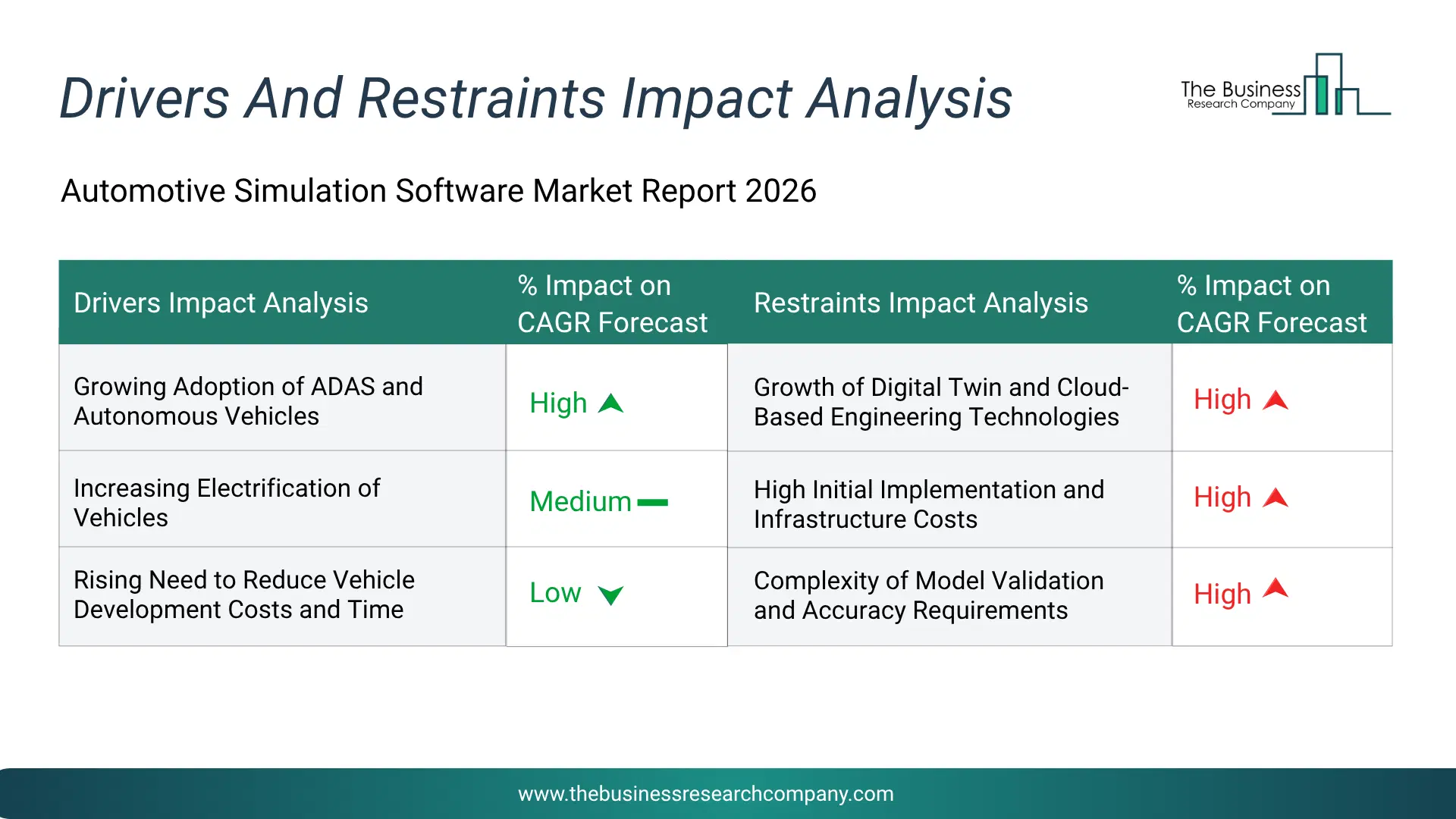
Infographic Chart Showing Key Market Drivers Analysis And Restraints For Automotive Simulation Software Market
The chart presents an impact analysis of key drivers and restraints, quantifying their relative influence on the market's growth rate and helping assess the balance between growth enablers and limiting factors. This chart offers a high-level perspective; the full report contains more detailed insights.
How Will The Drivers Impact Growth In The Global Automotive Simulation Software Market?
• Growing Adoption of ADAS and Autonomous Vehicles (High) – During the forecast period, the growing adoption of ADAS and autonomous vehicles is expected to become a key growth driver for the automotive simulation software market by 2030. The development of Advanced Driver Assistance Systems (ADAS) and autonomous vehicles requires extensive virtual testing across millions of driving scenarios. Simulation software enables validation of perception systems, sensor fusion, and vehicle decision-making in a safe and cost-effective environment. Automotive companies use simulation to reduce real-world testing requirements and accelerate certification processes. As autonomous driving complexity increases, reliance on high-fidelity simulation platforms continues to grow. This trend is creating sustained demand for automotive simulation software and associated services. • Increasing Electrification of Vehicles (Medium) – During the forecast period, the increasing electrification of vehicles is expected to emerge as a major factor driving the expansion of the automotive simulation software market by 2030. The rapid expansion of electric vehicle (EV) production is driving demand for simulation tools used in battery, thermal management, power electronics, and powertrain optimization. Automotive manufacturers rely on virtual models to improve vehicle range, efficiency, and safety before physical prototypes are built. Simulation helps reduce development cycles and engineering costs for new EV platforms. The growing number of EV launches worldwide is expanding software adoption across OEMs and suppliers. This is a major growth catalyst for the market. • Rising Need to Reduce Vehicle Development Costs and Time (Low) – During the forecast period, the rising need to reduce vehicle development costs and time is expected to act as a key growth catalyst for the automotive simulation software market by 2030. Automotive simulation software enables virtual prototyping, reducing the number of expensive physical prototypes required during vehicle development. Engineers can identify design issues early and optimize performance before manufacturing begins. This shortens development timelines and improves product quality. Increasing pressure on automakers to launch vehicles faster is encouraging greater use of digital engineering tools.How Will The Restraints Impact Growth In The Global Automotive Simulation Software Market?
• Growth of Digital Twin and Cloud-Based Engineering Technologies (High) – During the forecast period, the automotive companies are increasingly adopting digital twins and cloud-based simulation platforms to support collaborative engineering and real-time vehicle analysis. These technologies enable large-scale simulations without requiring extensive on-premise computing infrastructure. Cloud deployment improves scalability, accessibility, and computational efficiency. Digital twins also support predictive maintenance and lifecycle optimization. The ongoing digital transformation of the automotive industry is therefore boosting simulation software demand. • High Initial Implementation and Infrastructure Costs (Medium) – During the forecast period, the advanced automotive simulation platforms often require significant investment in software licenses, high-performance computing infrastructure, simulation servers, and specialized personnel. Small and mid-sized suppliers may find these costs difficult to justify. Integration with existing engineering workflows can further increase implementation expenses. The high upfront investment creates adoption barriers, particularly in cost-sensitive markets. This can slow market penetration despite the long-term benefits of simulation technologies. • Complexity of Model Validation and Accuracy Requirements (Low) – During the forecast period, the accurate simulation depends on high-quality models, reliable data inputs, and rigorous validation processes. Developing and maintaining complex vehicle models requires specialized expertise and significant engineering effort. Inaccurate simulations can lead to design errors, safety concerns, and costly rework. Regulatory and safety-critical applications demand extensive verification before simulation results can be trusted. These challenges can increase deployment time and limit adoption among organizations with limited simulation expertise.Key Players In The Global Automotive Simulation Software Market
Major companies operating in the automotive simulation software market are Siemens AG, NVIDIA Corporation, Dassault Systèmes SE, Hexagon AB, Synopsys Inc, Autodesk Inc, Keysight Technologies Inc, Moog Inc, AVL List GmbH, PTC Inc, The MathWorks Inc, dSPACE GmbH, ETAS GmbH, IPG Automotive GmbH, FAAC Inc, Applied Intuition Inc, Foretellix Ltd, Gamma Technologies LLC, VI-grade S.r.l., Simerics Inc, and Cognata Ltd.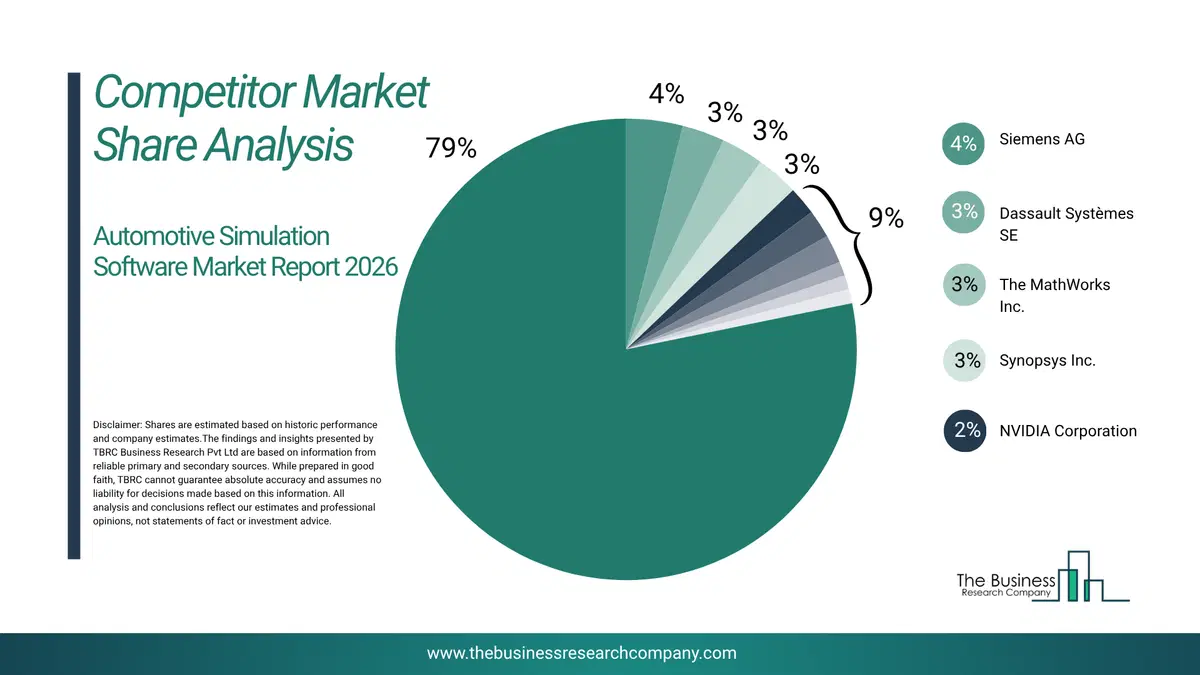
This chart is for illustrative purposes; the full report includes a detailed competitor analysis and comprehensive overview of the top 10 companies in the market.
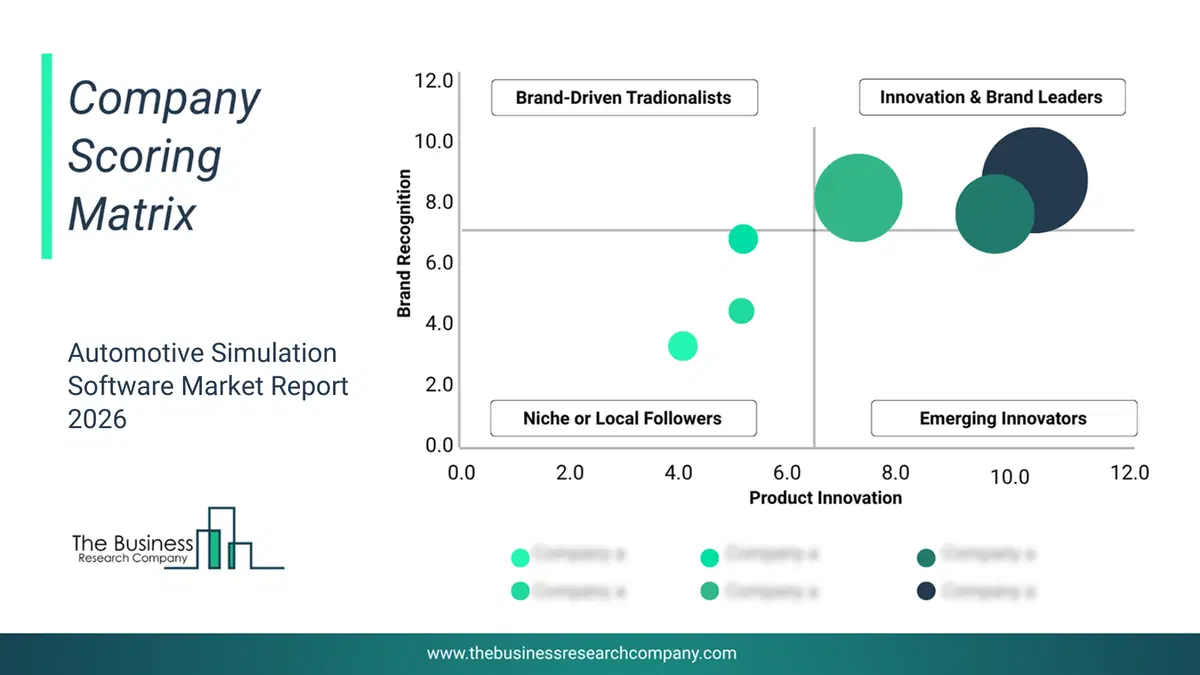
This chart maps companies by product innovation and brand strength, with bubble size indicating relative revenue, helping identify market leaders, challengers, and niche players. This is an illustrative chart; the full report provides a complete and accurate competitive analysis.
Global Automotive Simulation Software Market Trends and Insights
Major companies operating in the automotive simulation software market are focusing on developing advanced, AI-driven simulation platforms to improve virtual prototyping accuracy, accelerate design cycles, and enhance engineering productivity for automotive manufacturers and suppliers. AI-driven simulation platform solutions integrate artificial intelligence and machine learning directly into simulation workflows to enable predictive modeling, automated design exploration, and scalable cloud-based performance. For instance, in February 2025, Altair Engineering, a US-based engineering software company, launched Altair HyperWorks 2025, an advanced simulation suite featuring AI-powered engineering capabilities, machine learning–driven predictive models embedded within simulation workflows, enhanced automation for complex design exploration, and cloud-enabled scalability. The solution is designed to accelerate virtual prototyping and improve overall design efficiency for automotive original equipment manufacturers and suppliers.What Are Latest Mergers And Acquisitions In The Automotive Simulation Software Market?
In July 2025, Synopsys Inc., a US-based engineering solutions company, acquired Ansys for an undisclosed amount. With this acquisition, Synopsys aims to enhance its technological capabilities by integrating multiphysics simulation and analysis with electronic design automation, enabling end-to-end virtual testing and accelerating innovation in artificial intelligence–driven, automotive, and complex intelligent systems development. Ansys is a US-based provider of multiphysics simulation, engineering analysis, and virtual testing software used extensively across automotive, aerospace, electronics, and industrial engineering applications.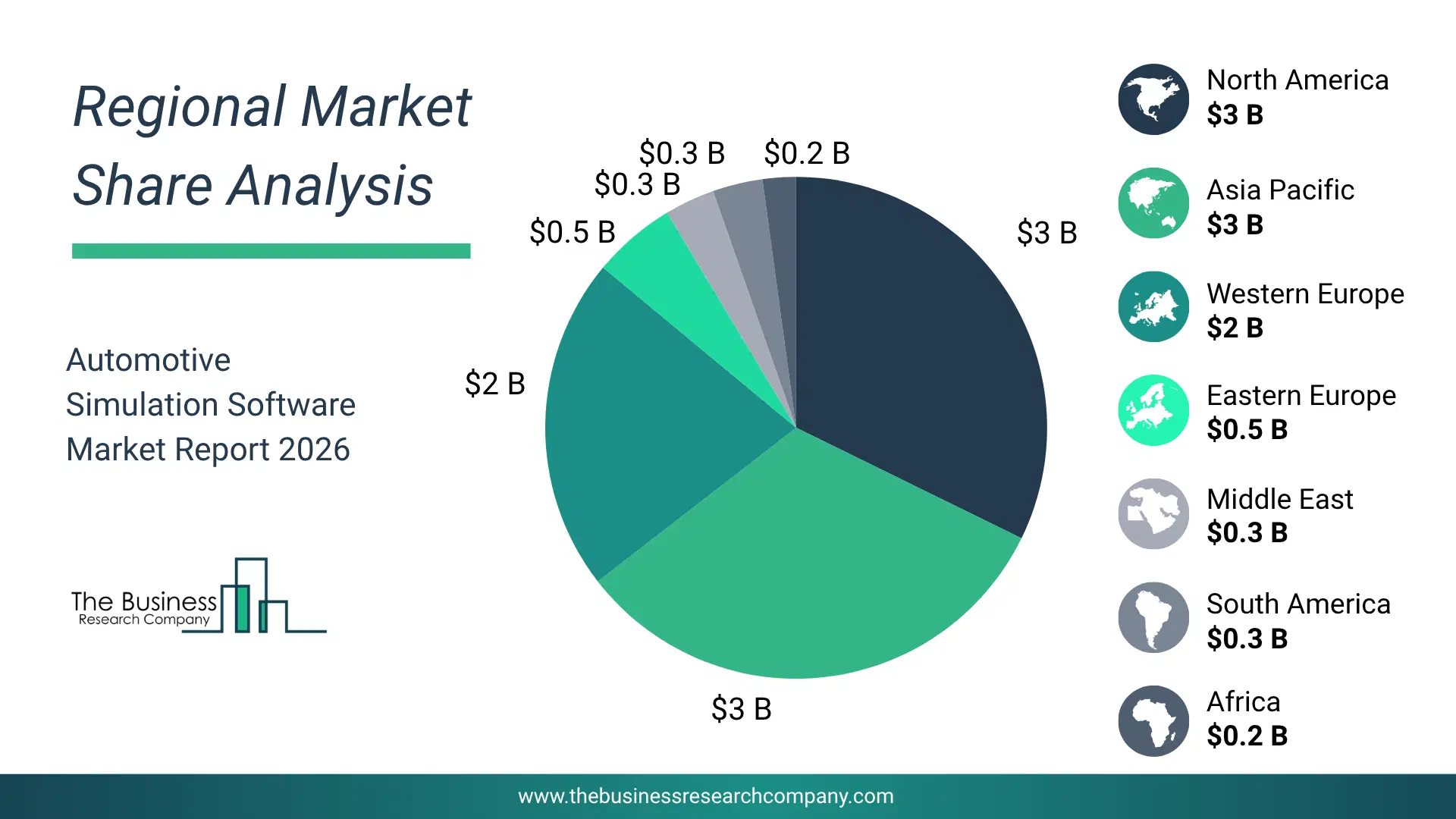
Regional Outlook
Asia-Pacific was the largest region in the automotive simulation software market in 2025. Asia-Pacific is expected to be the fastest-growing region in the forecast period. The regions covered in this market report are Asia-Pacific, South East Asia, Western Europe, Eastern Europe, North America, South America, Middle East, Africa. The countries covered in this market report are Australia, Brazil, China, France, Germany, India, Indonesia, Japan, Taiwan, Russia, South Korea, UK, USA, Canada, Italy, Spain.What Defines the Automotive Simulation Software Market?
The automotive simulation software market includes revenues earned by entities through vehicle system modeling, virtual prototyping, autonomous driving simulation, software integration services, cloud-based simulation, model validation and verification services, simulation consulting services, and training and technical support services. The market value includes the value of related goods sold by the service provider or included within the service offering. Only goods and services traded between entities or sold to end consumers are included.How is Market Value Defined and Measured?
The market value is defined as the revenues that enterprises gain from the sale of goods and/or services within the specified market and geography through sales, grants, or donations in terms of the currency (in USD unless otherwise specified). The revenues for a specified geography are consumption values that are revenues generated by organizations in the specified geography within the market, irrespective of where they are produced. It does not include revenues from resales along the supply chain, either further along the supply chain or as part of other products.
This chart presents market attractiveness based on a quantitative evaluation of growth, competition, strategic alignment, and risk, offering a clear view of opportunity areas for decision-making. This chart is for illustrative purposes; the full report contains the complete analysis.

This chart highlights the Total Addressable Market (TAM) by estimating the maximum revenue opportunity using an assumption-driven approach, supporting strategic planning and opportunity sizing across markets. The chart is illustrative; the full report provides a more comprehensive analysis.
What Key Data and Analysis Are Included in the Automotive Simulation Software Market Report 2026?
The automotive simulation software market research report is one of a series of new reports from The Business Research Company that provides market statistics, including industry global market size, regional shares, competitors with the market share, detailed market segments, market trends and opportunities, and any further data you may need to thrive in the automotive simulation software industry. The market research report delivers a complete perspective of everything you need, with an in-depth analysis of the current and future state of the industry.Automotive Simulation Software Market Report Forecast Analysis
| Report Attribute | Details |
|---|---|
| Market Size Value In 2026 | $5.64 billion |
| Revenue Forecast In 2030 | $9.34 billion |
| Growth Rate | CAGR of 13.2% from 2026 to 2030 |
| Base Year For Estimation | 2025 |
| Actual Estimates/Historical Data | 2020-2025 |
| Forecast Period | 2026 - 2030 |
| Market Representation | Revenue in USD Billion and CAGR from 2026 to 2030 |
| Segments Covered | Component, Software Type, Deployment Type, Application, End-User Industry |
| Regional Scope | Asia-Pacific, Western Europe, Eastern Europe, North America, South America, Middle East, Africa |
| Country Scope | The countries covered in the report are Australia, Brazil, China, France, Germany, India, Indonesia, Japan, Taiwan, Russia, South Korea, UK, USA, Canada, Italy, Spain. |
| Key Companies Profiled | Siemens AG, NVIDIA Corporation, Dassault Systèmes SE, Hexagon AB, Synopsys Inc, Autodesk Inc, Keysight Technologies Inc, Moog Inc, AVL List GmbH, PTC Inc, The MathWorks Inc, dSPACE GmbH, ETAS GmbH, IPG Automotive GmbH, FAAC Inc, Applied Intuition Inc, Foretellix Ltd, Gamma Technologies LLC, VI-grade S.r.l., Simerics Inc, and Cognata Ltd. |
| Customization Scope | Request for Customization |
| Pricing And Purchase Options | Explore Purchase Options |