
Automotive Smart Cruise Control (SCC) Market Report 2026
Global Outlook – By Vehicle Type (Passenger Cars, Light Commercial Vehicles, Heavy Commercial Vehicles), By Component (Sensors, Control Interface, Software, Actuators), By Technology (Adaptive Cruise Control, Predictive Cruise Control, Dynamic Radar Cruise Control, Semi-Automated Cruise Control), By End Use (Personal Use, Ride Sharing, Fleet Management) – Market Size, Trends, Strategies, and Forecast to 2030
Automotive Smart Cruise Control (SCC) Market Overview
• Automotive Smart Cruise Control (SCC) market size has reached to $8.32 billion in 2025 • Expected to grow to $15.16 billion in 2030 at a compound annual growth rate (CAGR) of 12.8% • Growth Driver: Rising Traffic Congestion Driving The Market Growth Due To Increasing Demand For Automated Adaptive Speed Control Systems • Market Trend: Advancements In Autonomous Rear-End Collision Prevention Technology Strengthen Smart Cruise Control (SCC) System Capabilities • North America was the largest region in 2025 and Asia-Pacific is the fastest growing region.What Is Covered Under Automotive Smart Cruise Control (SCC) Market?
Automotive smart cruise control (scc) is an advanced driver assistance system that automatically maintains a set vehicle speed while dynamically adjusting it to keep a safe distance from vehicles ahead. It uses sensors such as radar, cameras, or lidar combined with onboard control algorithms to monitor traffic conditions and regulate acceleration and braking in real time. The automotive smart cruise control enhances driving comfort, improves road safety, and reduces driver fatigue, particularly during highway and long-distance travel. The main vehicle types of automotive smart cruise control (SCC) include passenger cars, light commercial vehicles, and heavy commercial vehicles. Passenger cars refer to privately owned vehicles equipped with smart cruise control systems to assist in maintaining speed and safe following distance. These consist of components including sensors, control interface, software, and actuators and operate using technologies including adaptive cruise control, predictive cruise control, dynamic radar cruise control, and semi-automated cruise control. These are used for personal use, ride sharing, and fleet management.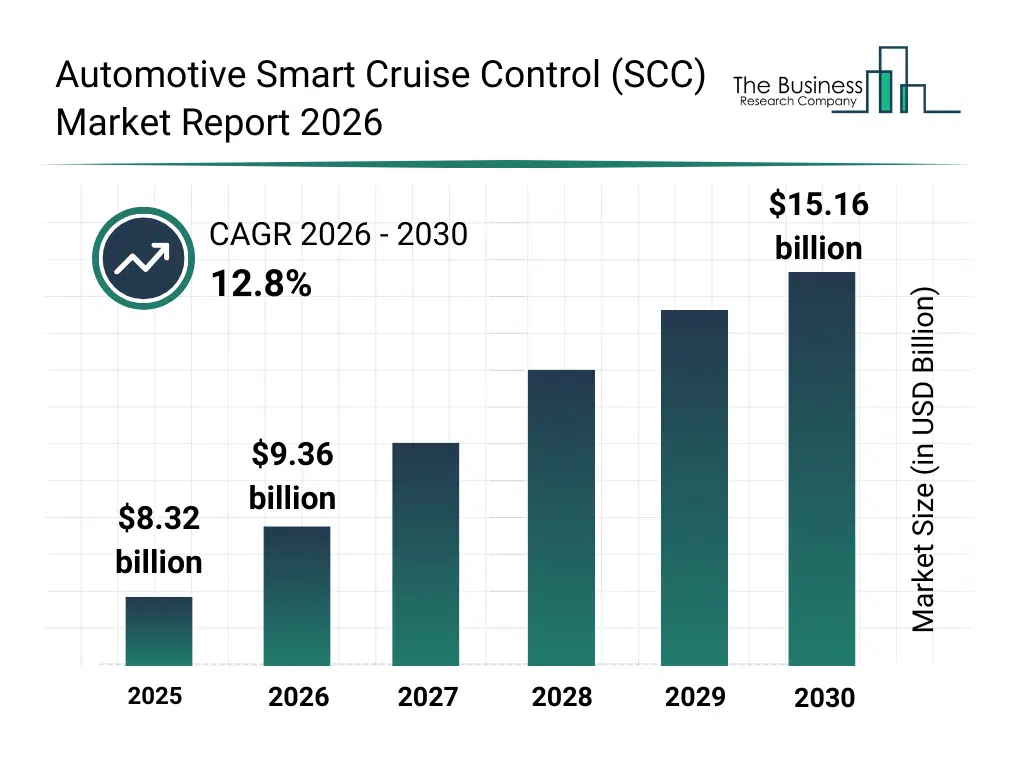
What Is The Automotive Smart Cruise Control (SCC) Market Size and Share 2026?
The automotive smart cruise control (scc) market size has grown rapidly in recent years. It will grow from $8.32 billion in 2025 to $9.36 billion in 2026 at a compound annual growth rate (CAGR) of 12.6%. The growth in the historic period can be attributed to rising demand for driver assistance features, increasing highway and long-distance travel, adoption of radar-based vehicle monitoring systems, growth in passenger car and commercial vehicle sales, rising awareness of road safety and accident reduction.What Is The Automotive Smart Cruise Control (SCC) Market Growth Forecast?
The automotive smart cruise control (scc) market size is expected to see rapid growth in the next few years. It will grow to $15.16 billion in 2030 at a compound annual growth rate (CAGR) of 12.8%. The growth in the forecast period can be attributed to growing adoption of electric vehicles with advanced driver assistance, expansion of fleet management and ride-sharing services, increasing integration of predictive and semi-automated cruise control technologies, rising government regulations on vehicle safety standards, growth in connected car infrastructure and smart mobility solutions. Major trends in the forecast period include integration of advanced radar and lidar sensors, growth in stop-and-go traffic assistance systems, increasing adoption of forward collision mitigation features, expansion of semi-automated cruise control solutions, rising focus on human-machine interface (hmi) displays and sensor mounting systems.
Global Automotive Smart Cruise Control (SCC) Market Segmentation
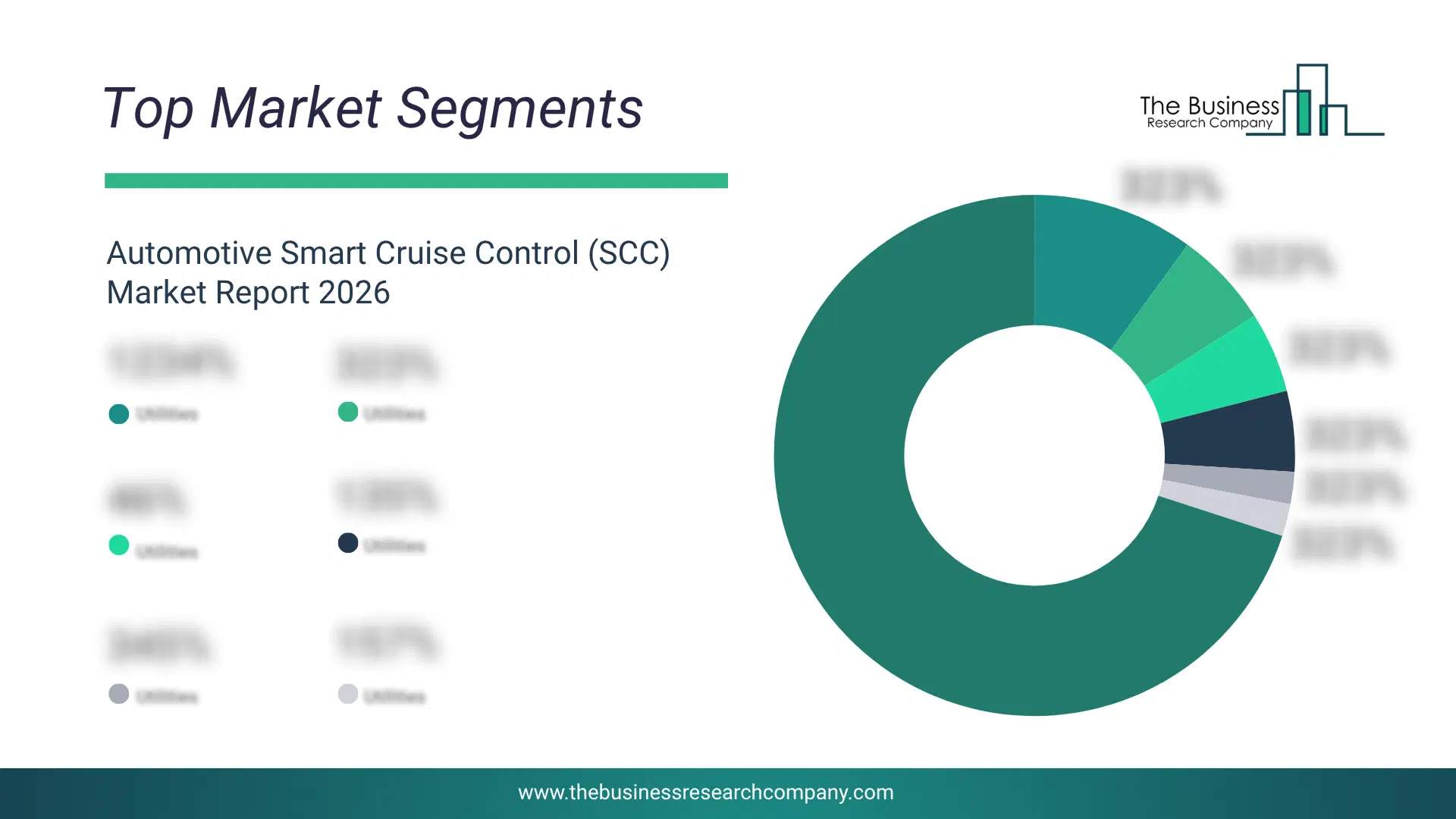
1) By Vehicle Type: Passenger Cars, Light Commercial Vehicles, Heavy Commercial Vehicles 2) By Component: Sensors, Control Interface, Software, Actuators 3) By Technology: Adaptive Cruise Control, Predictive Cruise Control, Dynamic Radar Cruise Control, Semi-Automated Cruise Control 4) By End Use: Personal Use, Ride Sharing, Fleet Management Subsegments: 1) Passenger Cars: Sedan, Hatchback, Sport Utility Vehicle, Multi Purpose Vehicle, Luxury Passenger Car 2) Light Commercial Vehicles: Pickup Truck, Cargo Van, Mini Truck, Light Duty Van 3) Heavy Commercial Vehicles: Heavy Duty Truck, Articulated Truck, Intercity Bus, Coach BusWhat Is The Driver Of The Automotive Smart Cruise Control (SCC) Market?
The rising traffic congestion is expected to propel the growth of the automotive smart cruise control (SCC) market going forward. Traffic congestion refers to the condition when vehicle traffic on roadways slows down or stops due to excessive demand relative to road capacity. The increasing prevalence of traffic congestion is primarily driven by growing urbanization, as expanding metropolitan populations lead to higher vehicle ownership and greater roadway utilization, creating density that exceeds infrastructure capacity during peak travel periods. Rising traffic congestion drives automotive smart cruise control (SCC) growth as drivers seek automated adaptive speed control systems that reduce the stress and fatigue of constant manual braking and acceleration in stop-and-go conditions. For instance, in August 2024, according to the Federal Highway Administration, a US-based government agency responsible for transportation infrastructure, the Travel Time Index increased from 1 hour 22 minutes in 2022 to 1 hour 24 minutes in 2023, indicating a rise in traffic congestion levels year over year. Therefore, rising traffic congestion is driving the growth of the automotive smart cruise control (SCC) industry.Key Players In The Global Automotive Smart Cruise Control (SCC) Market
Major companies operating in the automotive smart cruise control (SCC) market are Volkswagen AG, Toyota Motor Corporation, Ford Motor Company, General Motors Company, Bayerische Motoren Werke AG (BMW AG), Mercedes-Benz Group AG, Honda Motor Co. Ltd., Tesla Inc., Robert Bosch GmbH, Nissan Motor Co. Ltd., Denso Corporation, ZF Friedrichshafen AG, HyundAI Mobis Co. Ltd., Magna International Inc., Subaru Corporation, Valeo SA, Autoliv Inc., Mando Corporation, Visteon Corporation, and Luminar Technologies Inc.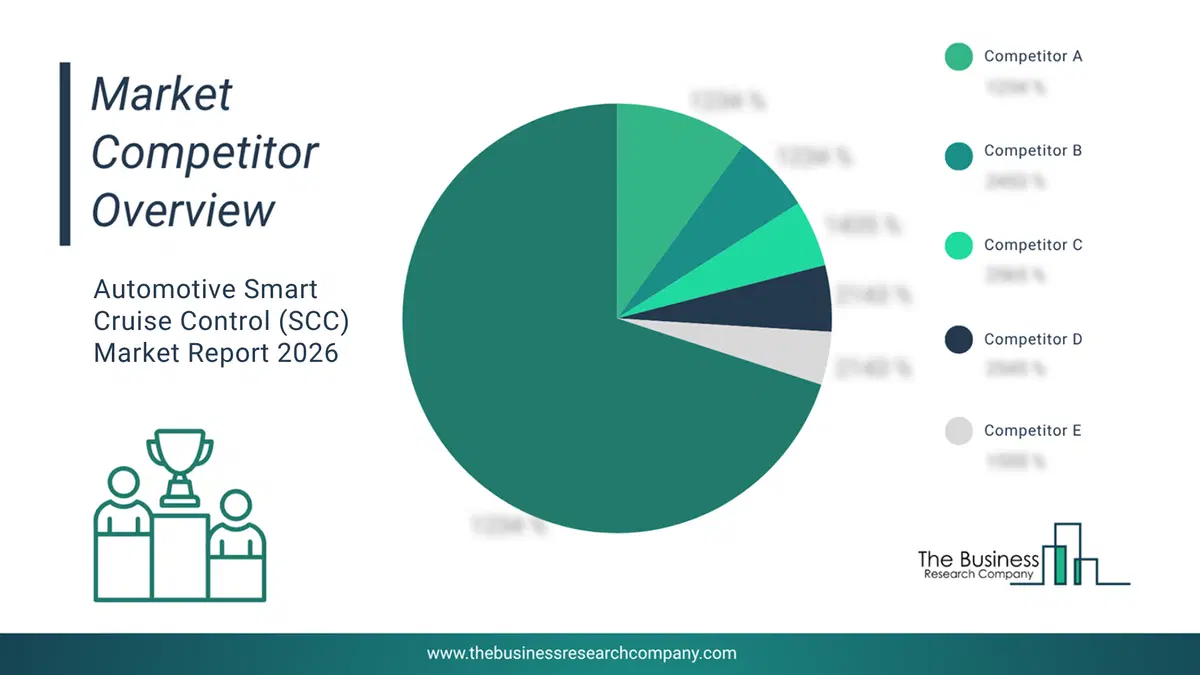
This chart is for illustrative purposes; the full report includes a detailed competitor analysis and comprehensive overview of the top 10 companies in the market.
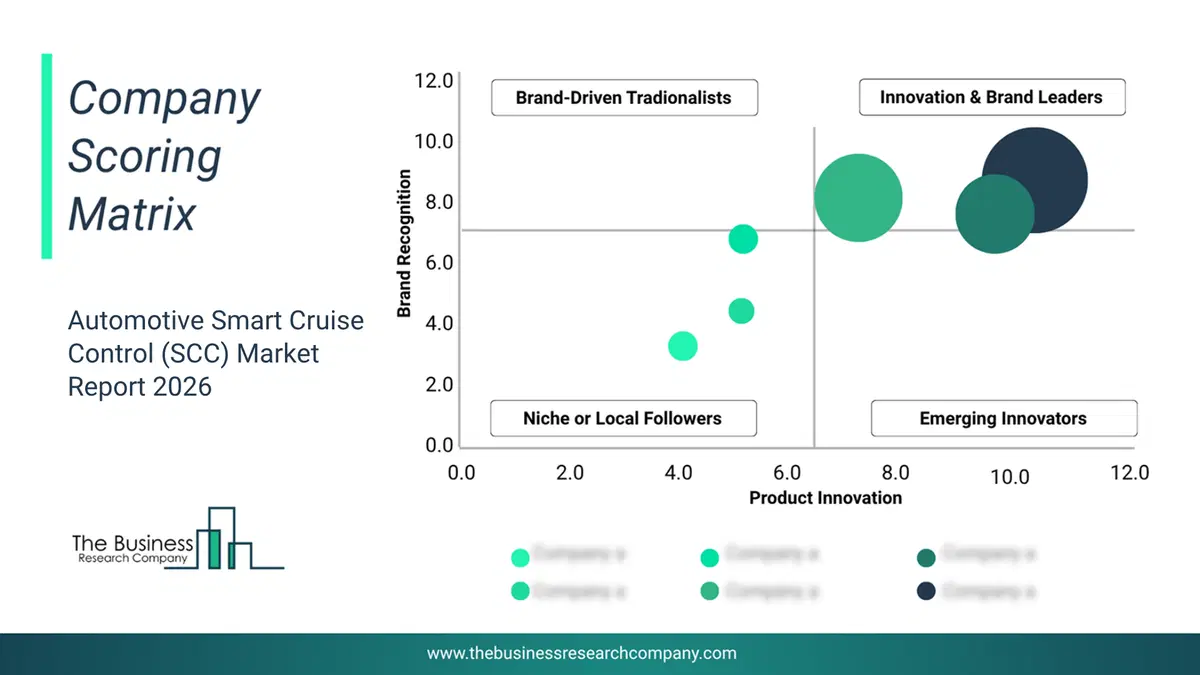
This chart maps companies by product innovation and brand strength, with bubble size indicating relative revenue, helping identify market leaders, challengers, and niche players. This is an illustrative chart; the full report provides a complete and accurate competitive analysis.
Global Automotive Smart Cruise Control (SCC) Market Trends and Insights
Major companies operating in the automotive smart cruise control (SCC) market are focusing on developing advanced safety-enhancement technologies to improve adaptive driving performance and support next-generation driver assistance architectures. Safety-enhancement technologies refer to advanced systems and features integrated into vehicles or equipment to prevent accidents, reduce risks, protect users from potential hazards, and improve overall safety and reliability. For instance, in June 2025, HyundAI Mobis, a South Korea-based automotive technology company, developed an autonomous rear-end collision prevention technology designed to complement smart cruise control systems. The solution leverages advanced sensor fusion and real-time control algorithms to enable proactive hazard detection and rapid response, supporting modern vehicle safety architectures and enhancing scalability for advanced driver assistance systems (ADAS) and autonomous driving applications.What Are Latest Mergers And Acquisitions In The Automotive Smart Cruise Control (SCC) Market?
In June 2023, Magna International Inc., a Canada-based manufacturing and mobility technology company, acquired Veoneer Active Safety for an undisclosed amount. Through this acquisition, Magna strengthened and broadened its advanced driver assistance systems (ADAS) portfolio by enhancing its sensor, perception, and active safety capabilities, supporting the development and deployment of Smart Cruise Control technologies as vehicles progress toward higher levels of automated driving. Veoneer Active Safety is a Sweden-based automotive technology company that provides radar, camera, sensor, and perception software solutions for active safety and advanced driver assistance systems.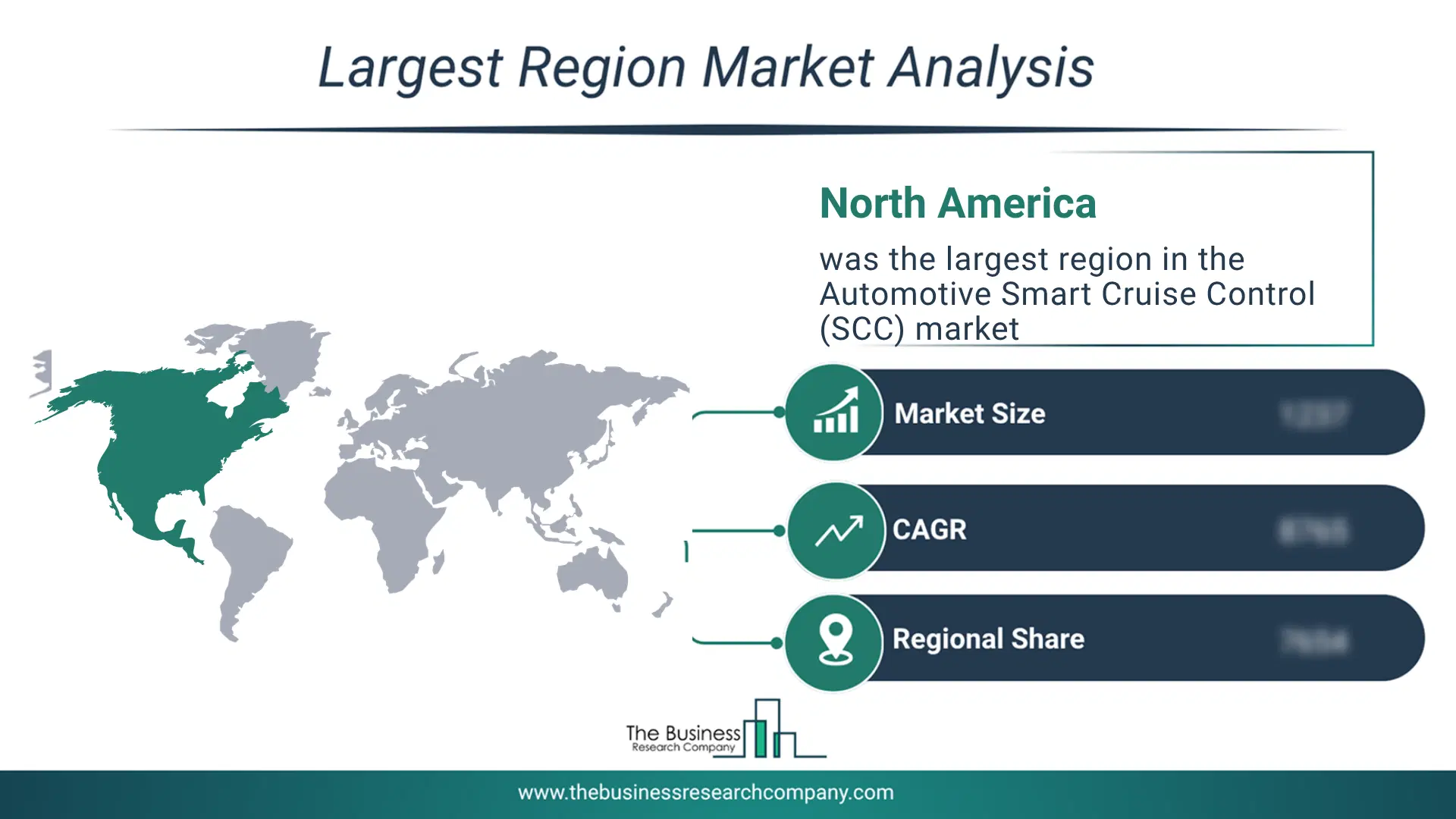
Regional Insights
North America was the largest region in the automotive smart cruise control (SCC) market in 2025. Asia-Pacific is expected to be the fastest-growing region in the forecast period. The regions covered in this market report are Asia-Pacific, South East Asia, Western Europe, Eastern Europe, North America, South America, Middle East, Africa. The countries covered in this market report are Australia, Brazil, China, France, Germany, India, Indonesia, Japan, Taiwan, Russia, South Korea, UK, USA, Canada, Italy, Spain.What Defines the Automotive Smart Cruise Control (SCC) Market?
The automotive smart cruise control (SCC) market consists of revenues earned by entities by providing services such as adaptive speed control, automatic distance maintenance from preceding vehicles, stop-and-go traffic assistance, and forward collision mitigation support. The market value includes the value of related goods sold by the service provider or included within the service offering. The automotive smart cruise control market also includes sales of ultrasonic sensors, steering angle sensors, wiring harnesses, human-machine interface displays, and sensor mounting brackets. Values in this market are ‘factory gate’ values, that is, the value of goods sold by the manufacturers or creators of the goods, whether to other entities (including downstream manufacturers, wholesalers, distributors, and retailers) or directly to end customers. The value of goods in this market includes related services sold by the creators of the goods.How is Market Value Defined and Measured?
The market value is defined as the revenues that enterprises gain from the sale of goods and/or services within the specified market and geography through sales, grants, or donations in terms of the currency (in USD unless otherwise specified). The revenues for a specified geography are consumption values that are revenues generated by organizations in the specified geography within the market, irrespective of where they are produced. It does not include revenues from resales along the supply chain, either further along the supply chain or as part of other products.
This chart presents market attractiveness based on a quantitative evaluation of growth, competition, strategic alignment, and risk, offering a clear view of opportunity areas for decision-making. This chart is for illustrative purposes; the full report contains the complete analysis.

This chart highlights the Total Addressable Market (TAM) by estimating the maximum revenue opportunity using an assumption-driven approach, supporting strategic planning and opportunity sizing across markets. The chart is illustrative; the full report provides a more comprehensive analysis.
What Key Data and Analysis Are Included in the Automotive Smart Cruise Control (SCC) Market Report 2026?
The automotive smart cruise control (SCC) market research report is one of a series of new reports from The Business Research Company that provides automotive smart cruise control (SCC) market statistics, including automotive smart cruise control (SCC) industry global market size, regional shares, competitors with a automotive smart cruise control (SCC) market share, detailed automotive smart cruise control (SCC) market segments, market trends and opportunities, and any further data you may need to thrive in the automotive smart cruise control (SCC) industry. This automotive smart cruise control (SCC) market research report delivers a complete perspective of everything you need, with an in-depth analysis of the current and future scenario of the industry.Automotive Smart Cruise Control (SCC) Market Report Forecast Analysis
| Report Attribute | Details |
|---|---|
| Market Size Value In 2026 | $9.36 billion |
| Revenue Forecast In 2030 | $15.16 billion |
| Growth Rate | CAGR of 12.6% from 2026 to 2030 |
| Base Year For Estimation | 2025 |
| Actual Estimates/Historical Data | 2020-2025 |
| Forecast Period | 2026 - 2030 - 2030 |
| Market Representation | Revenue in USD Billion and CAGR from 2026 to 2030 |
| Segments Covered | Vehicle Type, Component, Technology, End Use |
| Regional Scope | Asia-Pacific, Western Europe, Eastern Europe, North America, South America, Middle East, Africa |
| Country Scope | The countries covered in the report are Australia, Brazil, China, France, Germany, India, Indonesia, Japan, Taiwan, Russia, South Korea, UK, USA, Canada, Italy, Spain. |
| Key Companies Profiled | Volkswagen AG, Toyota Motor Corporation, Ford Motor Company, General Motors Company, Bayerische Motoren Werke AG (BMW AG), Mercedes-Benz Group AG, Honda Motor Co. Ltd., Tesla Inc., Robert Bosch GmbH, Nissan Motor Co. Ltd., Denso Corporation, ZF Friedrichshafen AG, HyundAI Mobis Co. Ltd., Magna International Inc., Subaru Corporation, Valeo SA, Autoliv Inc., Mando Corporation, Visteon Corporation, and Luminar Technologies Inc. |
| Customization Scope | Request for Customization |
| Pricing And Purchase Options | Explore Purchase Options |