

Light Commercial Vehicle Market Report 2026
Global Outlook – By Vehicle Type (Passenger Van, Cargo Van, Pickup Trucks), By Fuel (Electric, Diesel, Gasoline), By Tonnage Capacity Type (Less Than 2.5 Tons, 2.5 To 3.5 Tons) – Market Size, Trends, Strategies, and Forecast to 2030
Light Commercial Vehicle Market Overview
• Light Commercial Vehicle market size has reached to $969.03 billion in 2025 • Expected to grow to $1452.54 billion in 2030 at a compound annual growth rate (CAGR) of 8.6% • Growth Driver: Rising Fuel Consumption And Its Impact On The Future Of The Light Commercial Vehicle Market • Market Trend: Increasing Focus On Product Innovations To Drive Revenues In The Market • North America was the largest region in 2025 and Asia-Pacific is the fastest growing region.What Is Covered Under Light Commercial Vehicle Market?
A light commercial vehicle (LCV) is a vehicle designed for transporting goods or passengers, with a payload capacity of up to 3.5 tons. This category includes vans, pickups, and small trucks, often used in urban areas due to their fuel efficiency and easy maneuverability. LCVs are employed in sectors like logistics, retail, and construction for light-duty transportation. The main types in the light commercial market are passenger vans, cargo vans, pickup trucks, light trucks, minibuses, and other types. Trucks carrying the highest gross vehicle weight of 3.5 metric tons and above 15 metric tons could be classified as light commercial vehicles (LCVs). The various fuel types are electric, diesel, and gasoline. The various tonnage capacities include less than 2.5 tons, 2.5 to 3.5 tons, and more than 3.5 tons.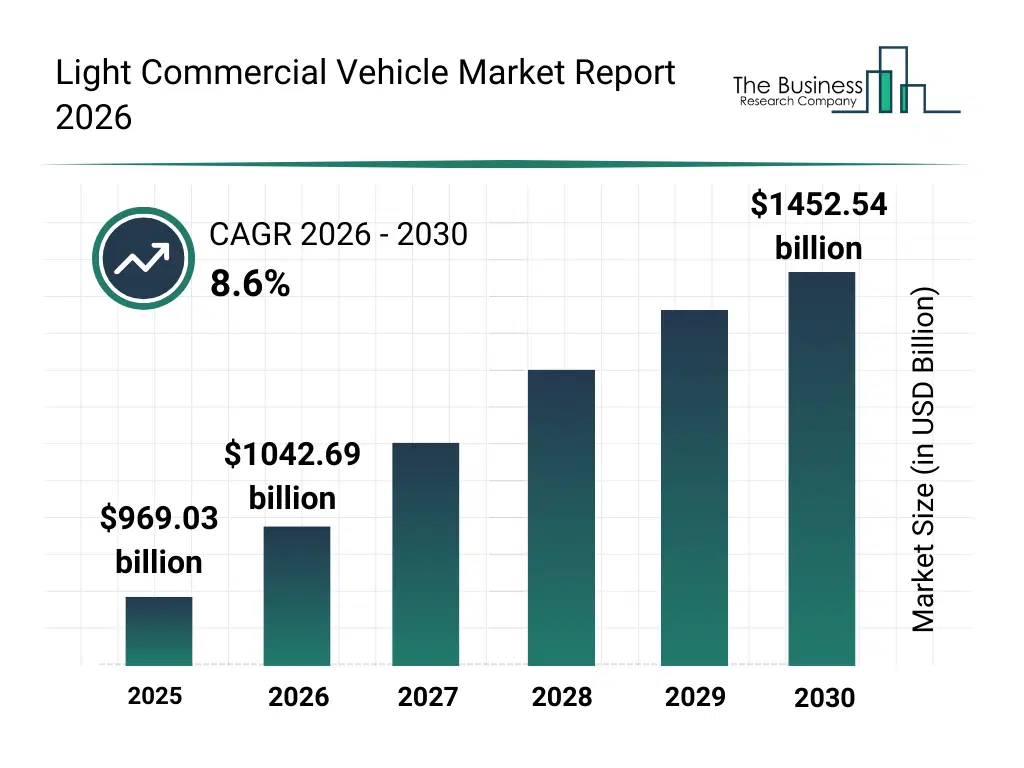
What Is The Light Commercial Vehicle Market Size and Share 2026?
The light commercial vehicle market size has grown strongly in recent years. It will grow from $969.03 billion in 2025 to $1042.69 billion in 2026 at a compound annual growth rate (CAGR) of 7.6%. The growth in the historic period can be attributed to e commerce growth, urbanization trends, demand for fuel efficient transport, expansion of retail logistics, growth of construction activities.What Is The Light Commercial Vehicle Market Growth Forecast?
The light commercial vehicle market size is expected to see strong growth in the next few years. It will grow to $1452.54 billion in 2030 at a compound annual growth rate (CAGR) of 8.6%. The growth in the forecast period can be attributed to electric vehicle incentives, smart city logistics, growth of cold chain transport, stricter emission norms, fleet digitization adoption. Major trends in the forecast period include rising demand for last mile delivery vehicles, growing adoption of electric lcvs, expansion of urban logistics fleets, integration of telematics and fleet management, improvement in fuel efficiency standards.
Global Light Commercial Vehicle Market Segmentation
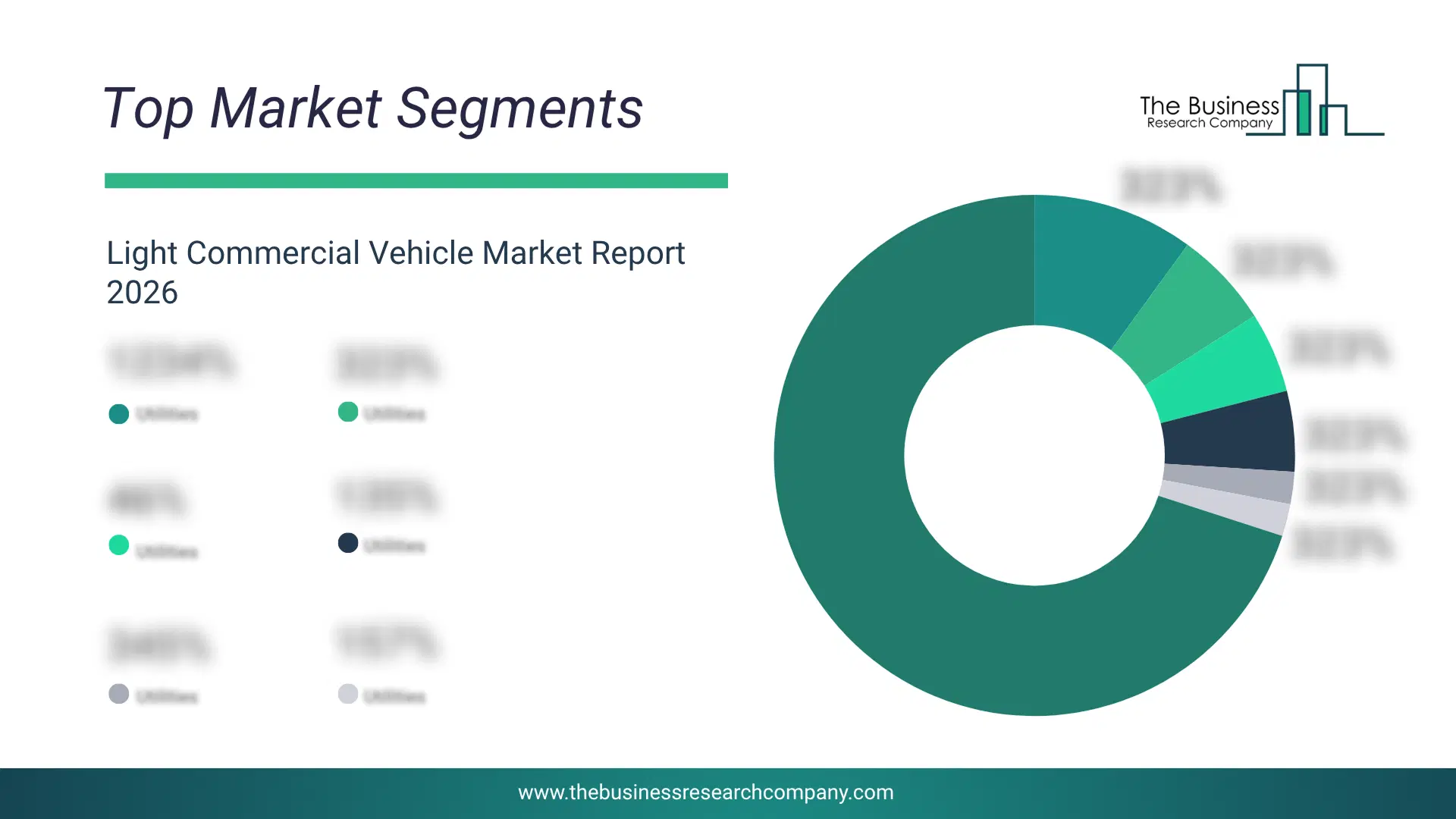
1) By Vehicle Type: Passenger Van, Cargo Van, Pickup Trucks 2) By Fuel: Electric, Diesel, Gasoline 3) By Tonnage Capacity Type: Less Than 2.5 Tons, 2.5 To 3.5 Tons Subsegments: 1) By Passenger Van: Minivan, Microvan, Compact Van 2) By Cargo Van: Panel Van, Window Van, High Roof Van 3) By Pickup Trucks: Compact Pickup Trucks, Mid-size Pickup Trucks, Full-size Pickup TrucksWhat Is The Driver Of The Light Commercial Vehicle Market?
The increasing fuel consumption is expected to propel the growth of the light commercial vehicle market going forward. Fuel consumption refers to the rate at which a vehicle, machine, or any combustion engine consumes fuel, typically measured in terms of a specific unit of fuel per distance or time. Fuel consumption by light commercial vehicles offers demand for fuel efficient vehicles, improved fuel economy, reduced environmental impact, greater efficiency and sustainability. This will create huge demand for light commercial vehicle which consume less fuel or electric light commercial vehicle, overall driving the market. For instance, in September 2023, according to the gov.UK (assets publishing service), a UK-based government body, the amount of fuel consumed by cars, taxis, and LGVs (large goods vehicle) increased by 1.0 mtoe (millions of tons of oil equivalent) (12%). Therefore, the increasing fuel consumption is driving the growth of the light commercial vehicle industry.Key Players In The Global Light Commercial Vehicle Market
Major companies operating in the light commercial vehicle market report include Daimler AG, Ford Motor Company, Renault Group, Volkswagen AG, Ashok Leyland Limited, Tata Motors Limited, SML Isuzu Limited, Toyota Motor Corporation, Groupe PSA, Nissan Motor Co. Ltd., Anhui Jianghuai Automobile Co. Ltd., Mahindra & Mahindra Limited, VE Commercial Vehicles Limited, AvtoVAZ, General Motors Company, GAZ Group, Hyundai Motor Company, Mitsubishi Motors Corporation, Workhorse Group Inc., Dongfeng Motor Corporation, Mazda Motor Corporation, Force Motors Limited, Piaggio Vehicles Private Limited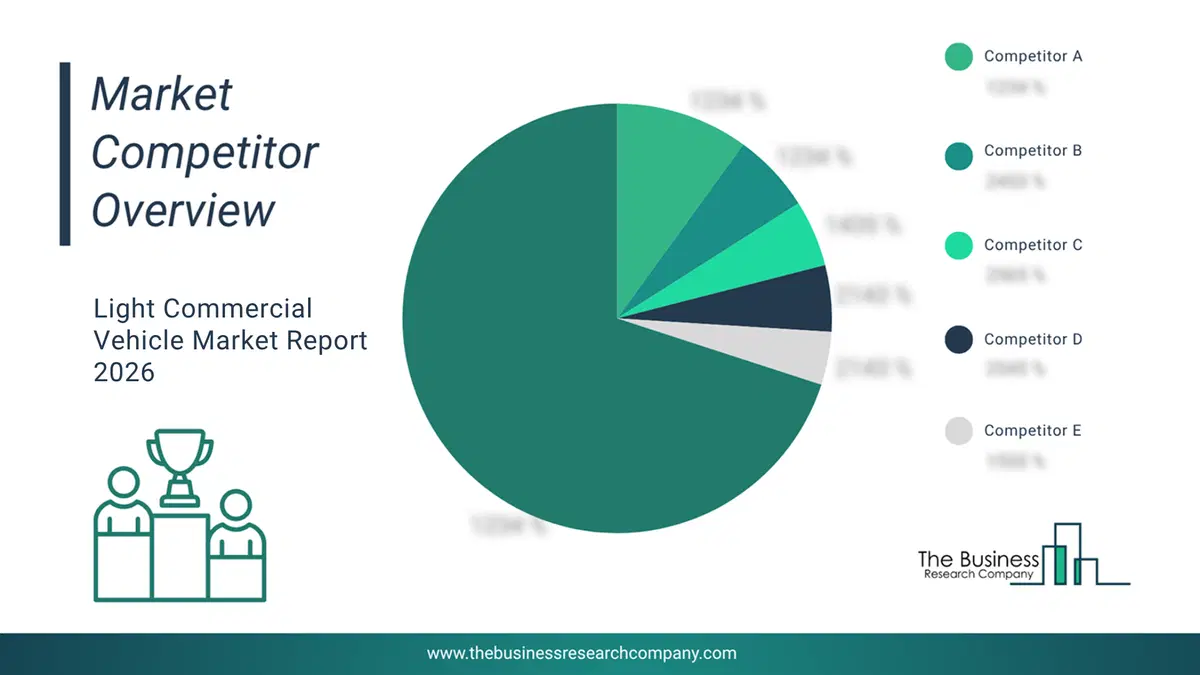
This chart is for illustrative purposes; the full report includes a detailed competitor analysis and comprehensive overview of the top 10 companies in the market.
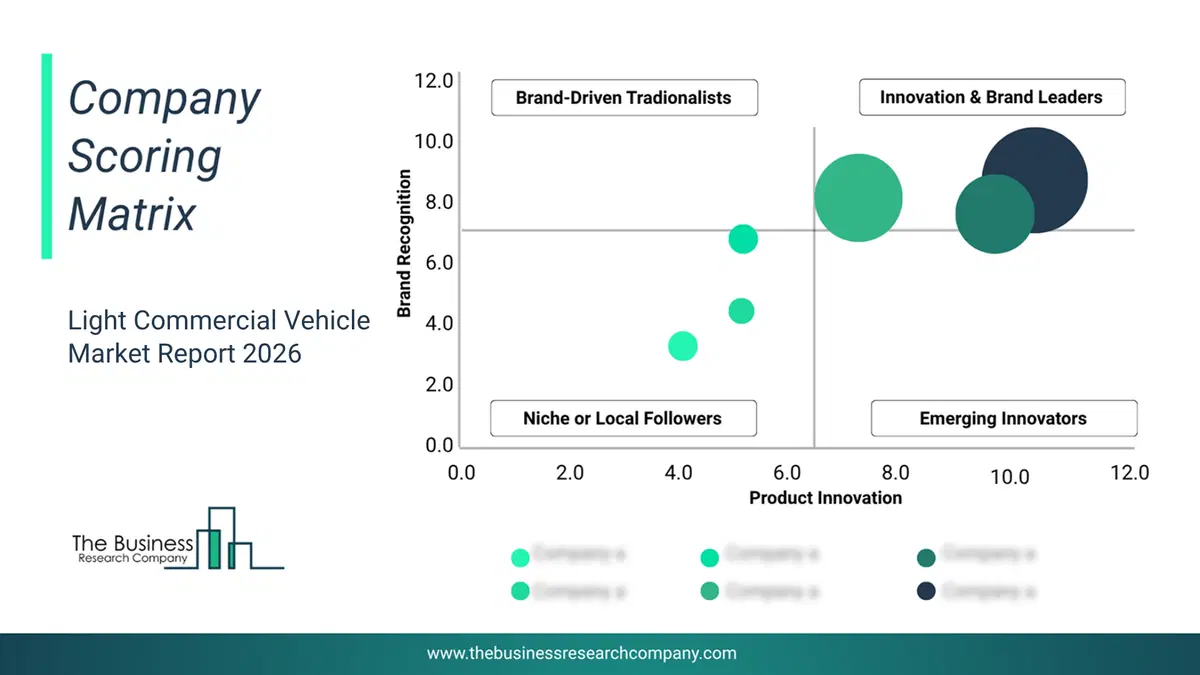
This chart maps companies by product innovation and brand strength, with bubble size indicating relative revenue, helping identify market leaders, challengers, and niche players. This is an illustrative chart; the full report provides a complete and accurate competitive analysis.
Global Light Commercial Vehicle Market Trends and Insights
Major companies operating in the light commercial vehicle market are focusing on innovative products such as super carry LCV (Light Commercial Vehicle) to drive their revenues in the market. Super carry LCV is a specific model of light commercial vehicle (LCV) designed for the transportation of goods or passengers. For instance, in April 2023, Maruti Suzuki India Limited, an India-based automobile manufacturer launched super carry LCV. The 4-cylinder engine in Maruti Suzuki's Super Carry mini-truck now produces better performance with a maximum output of 59.4 kW (80.7 PS) at 6000 rpm and 104.4 Nm of maximum torque at 2900 rpm in the petrol type. The new engine is coupled to an enhanced five-speed manual transmission that gives better gradeability, allowing users to travel up hills that are steeper than before.What Are Latest Mergers And Acquisitions In The Light Commercial Vehicle Market?
In August 2023, Hyundai Motor Company, a South Korea-based automotive manufacturing company acquired General Motors Company’s Talegaon plant for an undisclosed amount. With this acquisition, the South Korean auto giant hopes to double the number of vehicles it can produce annually in the nation to 1 million and the factory will start producing goods in 2025. General Motors Company is a US-based automobile manufacturing company including light commercial vehicles.
Regional Outlook
North America was the largest region in the light commercial vehicles market in 2025. Asia-Pacific was the second-largest region in the light commercial vehicle market. The regions covered in this market report include Asia-Pacific, South East Asia, Western Europe, Eastern Europe, North America, South America, Middle East, Africa. The countries covered in this market report include Australia, Brazil, China, France, Germany, India, Indonesia, Japan, Taiwan, Russia, South Korea, UK, USA, Canada, Italy, SpainWhat Defines the Light Commercial Vehicle Market?
The light commercial vehicle market consists of sales of cars and vans. Values in this market are factory gate values, that is the value of goods sold by the manufacturers or creators of the goods, whether to other entities (including downstream manufacturers, wholesalers, distributors and retailers) or directly to end customers. The value of goods in this market includes related services sold by the creators of the goods.How is Market Value Defined and Measured?
The market value is defined as the revenues that enterprises gain from the sale of goods and/or services within the specified market and geography through sales, grants, or donations in terms of the currency (in USD unless otherwise specified). The revenues for a specified geography are consumption values that are revenues generated by organizations in the specified geography within the market, irrespective of where they are produced. It does not include revenues from resales along the supply chain, either further along the supply chain or as part of other products.
This chart presents market attractiveness based on a quantitative evaluation of growth, competition, strategic alignment, and risk, offering a clear view of opportunity areas for decision-making. This chart is for illustrative purposes; the full report contains the complete analysis.

This chart highlights the Total Addressable Market (TAM) by estimating the maximum revenue opportunity using an assumption-driven approach, supporting strategic planning and opportunity sizing across markets. The chart is illustrative; the full report provides a more comprehensive analysis.
What Key Data and Analysis Are Included in the Light Commercial Vehicle Market Report 2026?
The light commercial vehicle market research report is one of a series of new reports from The Business Research Company that provides market statistics, including industry global market size, regional shares, competitors with the market share, detailed market segments, market trends and opportunities, and any further data you may need to thrive in the light commercial vehicle industry. The market research report delivers a complete perspective of everything you need, with an in-depth analysis of the current and future state of the industry.Light Commercial Vehicle Market Report Forecast Analysis
| Report Attribute | Details |
|---|---|
| Market Size Value In 2026 | $1042.69 billion |
| Revenue Forecast In 2030 | $1452.54 billion |
| Growth Rate | CAGR of 7.6% from 2026 to 2030 |
| Base Year For Estimation | 2025 |
| Actual Estimates/Historical Data | 2020-2025 |
| Forecast Period | 2026 - 2030 - 2030 |
| Market Representation | Revenue in USD Billion and CAGR from 2026 to 2030 |
| Segments Covered | Vehicle Type, Fuel, Tonnage Capacity Type |
| Regional Scope | Asia-Pacific, Western Europe, Eastern Europe, North America, South America, Middle East, Africa |
| Country Scope | The countries covered in the report are Australia, Brazil, China, France, Germany, India, Indonesia, Japan, Taiwan, Russia, South Korea, UK, USA, Canada, Italy, Spain. |
| Key Companies Profiled | Daimler AG, Ford Motor Company, Renault Group, Volkswagen AG, Ashok Leyland Limited, Tata Motors Limited, SML Isuzu Limited, Toyota Motor Corporation, Groupe PSA, Nissan Motor Co. Ltd., Anhui Jianghuai Automobile Co. Ltd., Mahindra & Mahindra Limited, VE Commercial Vehicles Limited, AvtoVAZ, General Motors Company, GAZ Group, Hyundai Motor Company, Mitsubishi Motors Corporation, Workhorse Group Inc., Dongfeng Motor Corporation, Mazda Motor Corporation, Force Motors Limited, Piaggio Vehicles Private Limited |
| Customization Scope | Request for Customization |
| Pricing And Purchase Options | Explore Purchase Options |