
Luxury Electric Vehicles Market Report 2026
Global Outlook – By Type (Battery Electric Vehicle (BEV), Plug-In Hybrid Electric Vehicles (PHEVs), Fuel Cell Electric Vehicles (FCEVs), Hybrid), By Battery Type (Lead-Acid, Lithium-Ion ), By Range (High-End Luxury, Mid-Range Luxury), By Application (Personal, Government) – Market Size, Trends, Strategies, and Forecast to 2030
Luxury Electric Vehicles Market Overview
• Luxury Electric Vehicles market size has reached to $246.02 billion in 2025 • Expected to grow to $537.75 billion in 2030 at a compound annual growth rate (CAGR) of 17.1% • Growth Driver: Environmental Safety Standards And Regulations Fueling Growth In The Luxury Electric Vehicle Market • Market Trend: Innovative Advancements In The Luxury Electric Vehicle Market • Asia-Pacific was the largest region in 2025.What Is Covered Under Luxury Electric Vehicles Market?
A luxury electric vehicle is often a high-end automobile with luxurious features and aesthetics driven by an electric motor that takes energy from a battery and can be charged externally. Luxury electric vehicles are often more expensive than standard automobiles offering higher comfort, aesthetics, and performance. The main types of luxury electric vehicles are battery electric vehicles (BEV), plug-in hybrid electric vehicles (PHEVs), fuel cell electric vehicles (FCEVs), and hybrid. Plug-in hybrid electric vehicles have a motor that runs on electricity and is recharged via an external socket. The various battery types include lead-acid, and lithium-ion with various ranges that include high-end luxury, and mid-range luxury. The various vehicle types include cars, buses, vans, and trucks and are used in various applications such as personal, and government.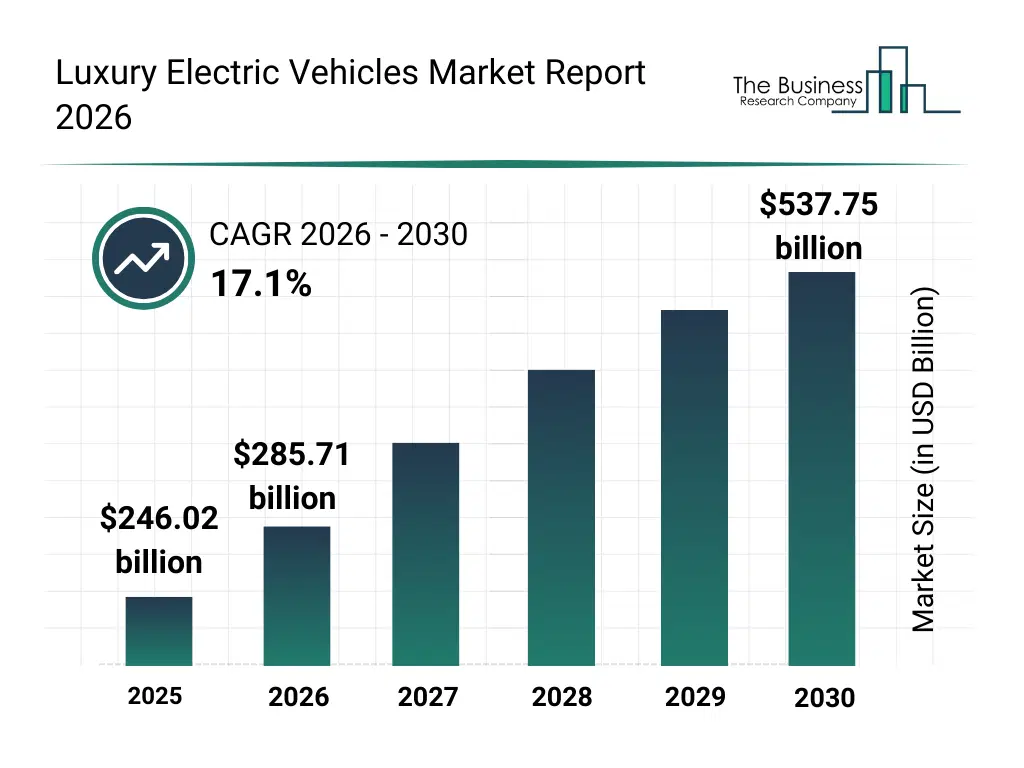
What Is The Luxury Electric Vehicles Market Size and Share 2026?
The luxury electric vehicles market size has grown rapidly in recent years. It will grow from $246.02 billion in 2025 to $285.71 billion in 2026 at a compound annual growth rate (CAGR) of 16.1%. The growth in the historic period can be attributed to early adoption of electric luxury sedans, government incentives for evs, rising environmental awareness among premium buyers, advancements in lithium ion batteries, entry of luxury ev brands.What Is The Luxury Electric Vehicles Market Growth Forecast?
The luxury electric vehicles market size is expected to see rapid growth in the next few years. It will grow to $537.75 billion in 2030 at a compound annual growth rate (CAGR) of 17.1%. The growth in the forecast period can be attributed to expansion of fast charging infrastructure, demand for zero emission luxury transport, advancements in solid state batteries, growth of autonomous luxury vehicles, premium consumer shift toward evs. Major trends in the forecast period include expansion of high performance electric luxury cars, growing demand for long range luxury evs, integration of autonomous driving features, focus on premium interior and smart technologies, rising adoption of sustainable luxury materials.
Global Luxury Electric Vehicles Market Segmentation
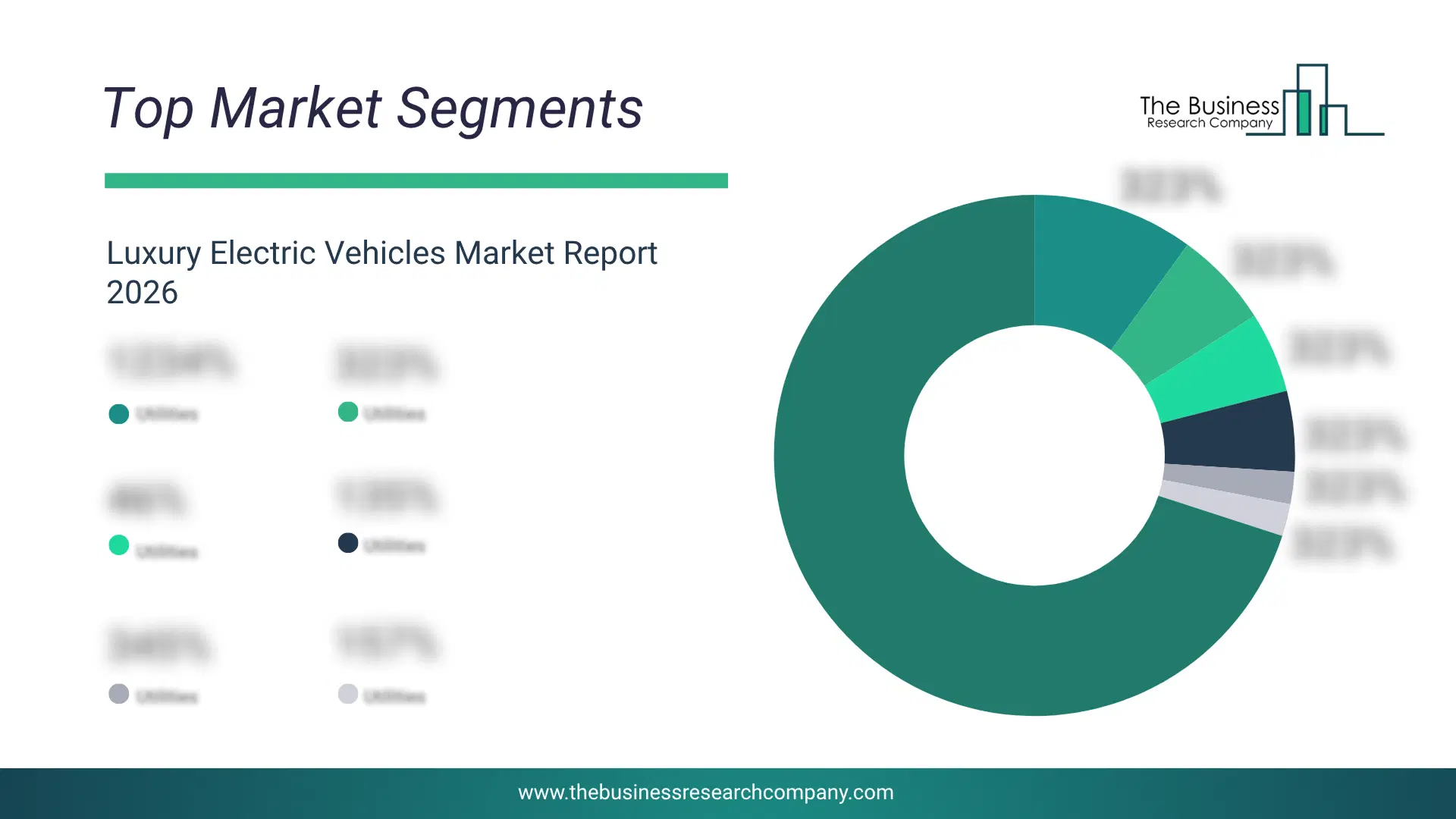
1) By Type: Battery Electric Vehicle (BEV), Plug-In Hybrid Electric Vehicles (PHEVs), Fuel Cell Electric Vehicles (FCEVs), Hybrid 2) By Battery Type: Lead-Acid, Lithium-Ion 3) By Range: High-End Luxury, Mid-Range Luxury 5) By Application: Personal, Government Subsegments: 1) By Battery Electric Vehicle (BEV): Compact BEVs, Sedan BEVs, SUV BEVs, Luxury Sports BEVs 2) By Plug-In Hybrid Electric Vehicles (PHEVs): Compact PHEVs, Sedan PHEVs, SUV PHEVs 3) By Fuel Cell Electric Vehicles (FCEVs): Hydrogen Fuel Cell Sedans, Hydrogen Fuel Cell SUVs 4) By Hybrid: Mild Hybrids, Full Hybrids, Performance HybridsWhat Is The Driver Of The Luxury Electric Vehicles Market?
The implementation of environmental safety standards and regulations is expected to propel the growth of the luxury electric vehicle market going forward. The environmental, health, and safety regulations include details on environmental, health, and safety problems that might be pertinent to all business sectors. The implementation of environmental safety standards and regulations aids in minimizing greenhouse gas emissions and adopting the electrification of vehicles. For instance, in April 2023, the United States Environmental Protection Agency, a US-based government agency, regulated a few regulations to significantly cut hazardous air emissions of pollutants from light-duty and medium-duty cars beginning with the model year 2027. These include advances in clean car technology, reducing climate pollution, improving public health, and saving drivers money through reduced fuel and maintenance costs. Therefore, the implementation of environmental safety standards and regulations is driving the luxury electric vehicle industry.Key Players In The Global Luxury Electric Vehicles Market
Major companies operating in the luxury electric vehicles market report include Tesla Inc., Lucid Motors Inc., Rivian Automotive LLC, Porsche AG, BMW AG, Audi AG, Mercedes-Benz Group AG, Jaguar Land Rover Automotive PLC, Fisker Inc., Polestar Automotive Holding UK PLC, Bentley Motors Limited, Rolls-Royce Motor Cars Limited, Genesis Motor LLC, NIO Inc., Faraday Future Intelligent Electric Inc., General Motors Company, Aston Martin Lagonda Global Holdings PLC, Karma Automotive LLC, Lotus Cars Limited, Maserati S.p.A., XPeng Inc., VinFast LLC, Canoo Inc., Drako Motors Inc., Lightyear One, Automobili Pininfarina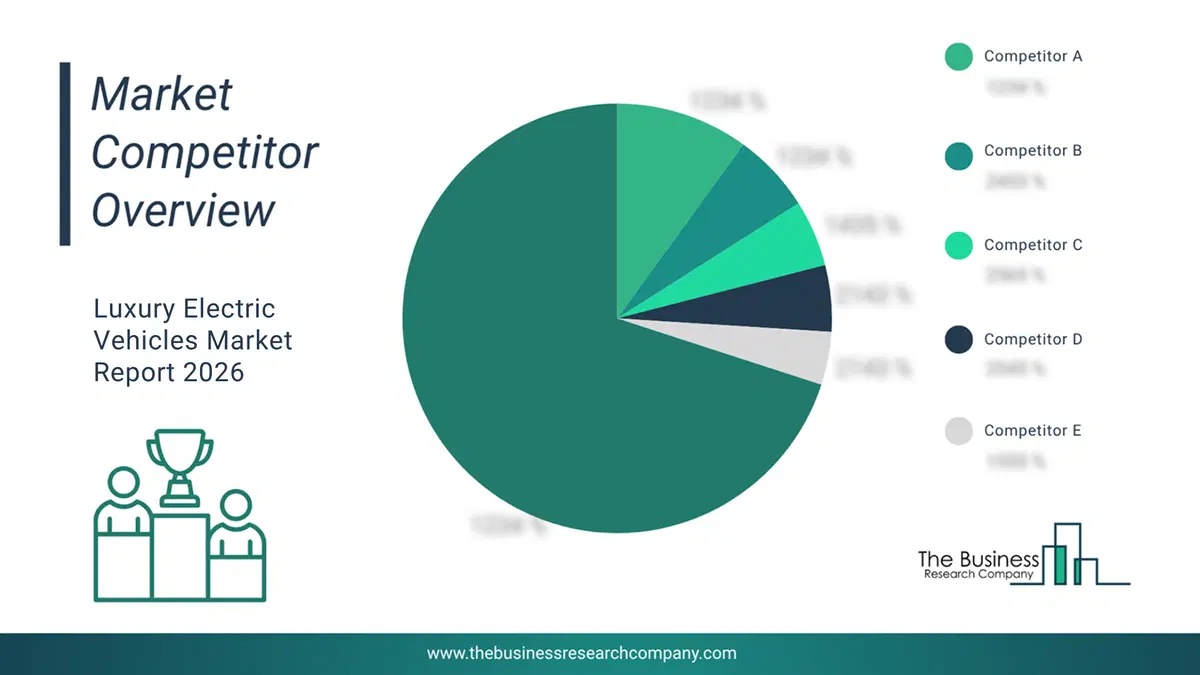
This chart is for illustrative purposes; the full report includes a detailed competitor analysis and comprehensive overview of the top 10 companies in the market.
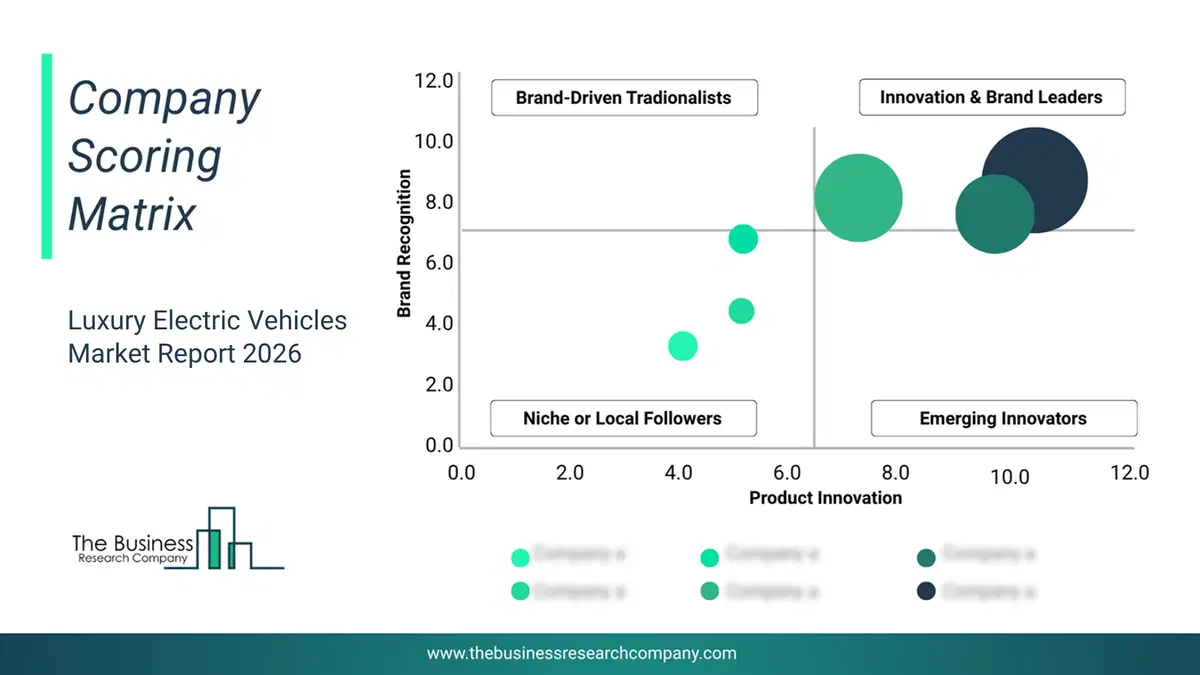
This chart maps companies by product innovation and brand strength, with bubble size indicating relative revenue, helping identify market leaders, challengers, and niche players. This is an illustrative chart; the full report provides a complete and accurate competitive analysis.
Global Luxury Electric Vehicles Market Trends and Insights
Major companies operating in the luxury electric vehicle (EV) market are focusing on developing innovative solutions, such as high-performance electric powertrains and advanced driver-assistance technologies, to meet the rising demand for premium, efficient, and feature-rich electric mobility. These next-generation EVs integrate powerful dual-motor systems, intelligent parking technologies, and upgraded battery chemistries that outperform traditional internal-combustion luxury vehicles in acceleration, efficiency, and automation. For instance, in June 2023, AB Volvo, a Sweden-based manufacturer of luxury cars, trucks, buses, and construction equipment, launched the EX30, a fully electric small SUV designed to deliver high performance and advanced automation. The model features a twin-motor all-wheel-drive configuration paired with an NMC battery, generating 315 kW (428 hp) and achieving 0–100 km/h in 3.6 seconds. It comes equipped with an enhanced Volvo Park Pilot Assist system capable of handling all types of parking scenarios, including parallel, curved, perpendicular, and diagonal spaces while offering compact design, strong acceleration, improved energy efficiency, and intelligent driver-assistance functionality.What Are Latest Mergers And Acquisitions In The Luxury Electric Vehicles Market?
In May 2024, Huawei Technologies Co., Ltd., a China-based technology company, partnered with Jianghuai Automobile Group, to develop a new luxury car aimed at competing with high-end models like Maybach and Phantom. With this partnership, Huawei and Jianghuai Automobile Group aim to combine Huawei’s advanced smart automotive technologies with Jianghuai’s vehicle manufacturing expertise to create a premium electric vehicle offering enhanced connectivity, intelligent driving features, and luxury design. Jianghuai Automobile Group is a China-based automotive company that specializes in manufacturing electric and conventional vehicles across passenger and commercial segments.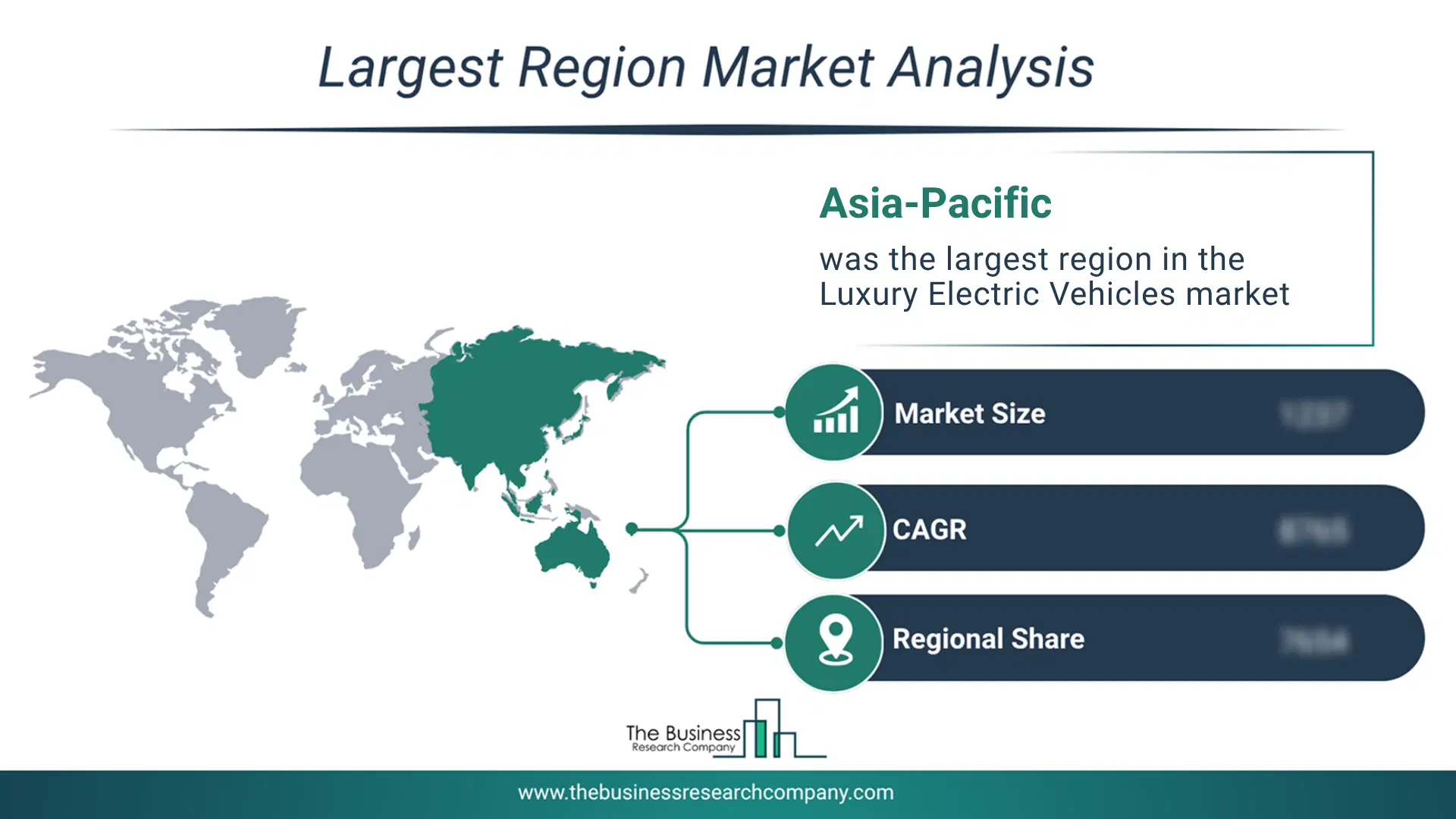
Regional Outlook
Asia-Pacific was the largest region in the luxury electric vehicle market in 2025. The regions covered in this market report include Asia-Pacific, South East Asia, Western Europe, Eastern Europe, North America, South America, Middle East, Africa. The countries covered in this market report include Australia, Brazil, China, France, Germany, India, Indonesia, Japan, Taiwan, Russia, South Korea, UK, USA, Canada, Italy, SpainWhat Defines the Luxury Electric Vehicles Market?
The luxury electric vehicles market consists of sales of electric sports utility vehicles (SUV), and sedans. Values in this market are ‘factory gate’ values, that is the value of goods sold by the manufacturers or creators of the goods, whether to other entities (including downstream manufacturers, wholesalers, distributors, and retailers) or directly to end customers. The value of goods in this market includes related services sold by the creators of the goods.How is Market Value Defined and Measured?
The market value is defined as the revenues that enterprises gain from the sale of goods and/or services within the specified market and geography through sales, grants, or donations in terms of the currency (in USD unless otherwise specified). The revenues for a specified geography are consumption values that are revenues generated by organizations in the specified geography within the market, irrespective of where they are produced. It does not include revenues from resales along the supply chain, either further along the supply chain or as part of other products.
This chart presents market attractiveness based on a quantitative evaluation of growth, competition, strategic alignment, and risk, offering a clear view of opportunity areas for decision-making. This chart is for illustrative purposes; the full report contains the complete analysis.

This chart highlights the Total Addressable Market (TAM) by estimating the maximum revenue opportunity using an assumption-driven approach, supporting strategic planning and opportunity sizing across markets. The chart is illustrative; the full report provides a more comprehensive analysis.
What Key Data and Analysis Are Included in the Luxury Electric Vehicles Market Report 2026?
The luxury electric vehicles market research report is one of a series of new reports from The Business Research Company that provides market statistics, including industry global market size, regional shares, competitors with the market share, detailed market segments, market trends and opportunities, and any further data you may need to thrive in the luxury electric vehicles industry. The market research report delivers a complete perspective of everything you need, with an in-depth analysis of the current and future state of the industry.Luxury Electric Vehicles Market Report Forecast Analysis
| Report Attribute | Details |
|---|---|
| Market Size Value In 2026 | $285.71 billion |
| Revenue Forecast In 2030 | $537.75 billion |
| Growth Rate | CAGR of 16.1% from 2026 to 2030 |
| Base Year For Estimation | 2025 |
| Actual Estimates/Historical Data | 2020-2025 |
| Forecast Period | 2026 - 2030 - 2030 |
| Market Representation | Revenue in USD Billion and CAGR from 2026 to 2030 |
| Segments Covered | Type, Battery Type, Range, Application |
| Regional Scope | Asia-Pacific, Western Europe, Eastern Europe, North America, South America, Middle East, Africa |
| Country Scope | The countries covered in the report are Australia, Brazil, China, France, Germany, India, Indonesia, Japan, Taiwan, Russia, South Korea, UK, USA, Canada, Italy, Spain. |
| Key Companies Profiled | Tesla Inc., Lucid Motors Inc., Rivian Automotive LLC, Porsche AG, BMW AG, Audi AG, Mercedes-Benz Group AG, Jaguar Land Rover Automotive PLC, Fisker Inc., Polestar Automotive Holding UK PLC, Bentley Motors Limited, Rolls-Royce Motor Cars Limited, Genesis Motor LLC, NIO Inc., Faraday Future Intelligent Electric Inc., General Motors Company, Aston Martin Lagonda Global Holdings PLC, Karma Automotive LLC, Lotus Cars Limited, Maserati S.p.A., XPeng Inc., VinFast LLC, Canoo Inc., Drako Motors Inc., Lightyear One, Automobili Pininfarina |
| Customization Scope | Request for Customization |
| Pricing And Purchase Options | Explore Purchase Options |