
Autonomous Farm Equipment Market Report 2026
Global Outlook – By Product Type (Tractors, Harvesters, Unmanned Aerial Vehicles (UAVs), Other Product Types ), By Technology (Partially Autonomous, Fully Autonomous ), By Application (Agriculture, Horticulture, Animal husbandry, Forestry, Other Applications ) – Market Size, Trends, Strategies, and Forecast to 2030
Autonomous Farm Equipment Market Overview
• Autonomous Farm Equipment market size has reached to $86.54 billion in 2025 • Expected to grow to $113.47 billion in 2030 at a compound annual growth rate (CAGR) of 5.6% • Growth Driver: Government Initiatives Fueling Growth In The Autonomous Farm Equipment Market • Market Trend: Advanced Automation Platform Transforming Precision Agriculture And Grower Productivity • Asia-Pacific was the largest region in 2025 and North America is the fastest growing region.Market Gains By 2030 – Top Opportunities By Segment
Market Gain identifies the most promising market opportunities by highlighting the segments or products expected to generate the highest incremental revenue growth over the next five years.
What Is Covered Under Autonomous Farm Equipment Market?
The autonomous farm equipment refers to the equipment used for agriculture, horticulture, animal husbandry, and forestry. Within a unified framework, autonomous farming is the modelling and regulation of agricultural machinery. These farming technologies use the on-farm sensing and control power of automated farming equipment to reach agronomy-based targets. The main product types of autonomous farm equipment are tractors, harvesters, unmanned aerial vehicles (UAVs), and other product types. Harvesters refer to a machine for harvesting crops. The technologies used in autonomous farm equipment are partially autonomous and fully autonomous. The various applications involved are agriculture, horticulture, animal husbandry, forestry, and other applications.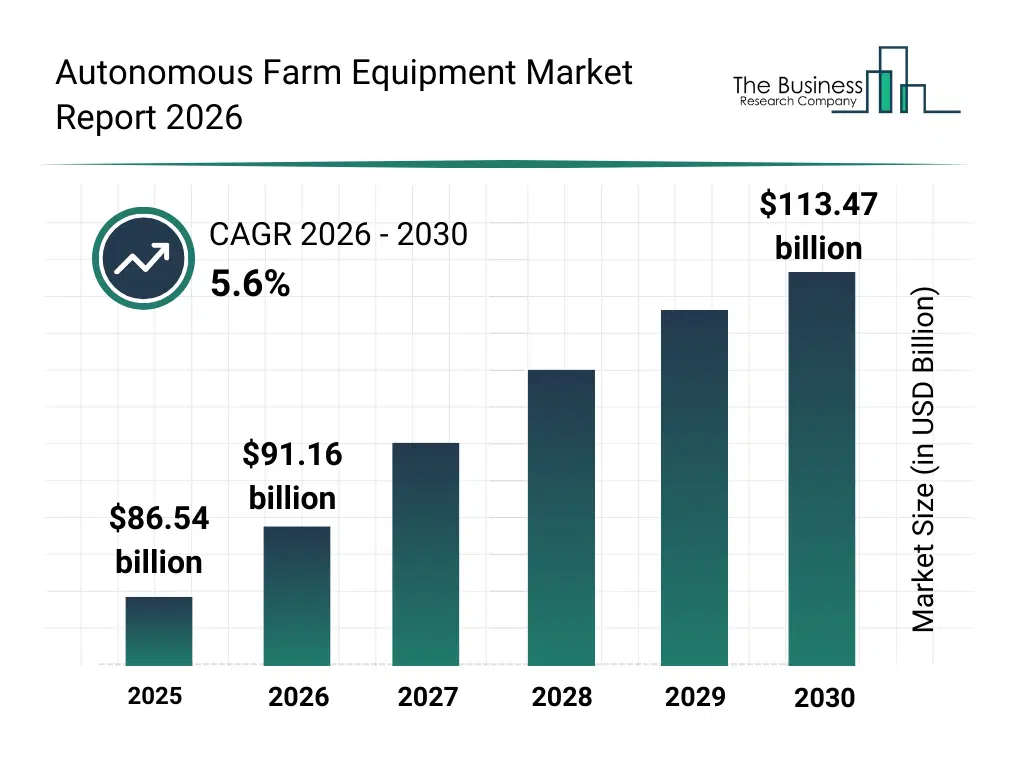
What Is The Autonomous Farm Equipment Market Size and Share 2026?
The autonomous farm equipment market size has grown strongly in recent years. It will grow from $86.54 billion in 2025 to $91.16 billion in 2026 at a compound annual growth rate (CAGR) of 5.3%. The growth in the historic period can be attributed to growth of large-scale commercial farming, rising farm labor shortages, adoption of gps-enabled farm equipment, increasing use of mechanized harvesting, early integration of farm automation.What Is The Autonomous Farm Equipment Market Growth Forecast?
The autonomous farm equipment market size is expected to see strong growth in the next few years. It will grow to $113.47 billion in 2030 at a compound annual growth rate (CAGR) of 5.6%. The growth in the forecast period can be attributed to increasing investments in smart agriculture, rising demand for sustainable farming practices, expansion of fully autonomous farm equipment, growing adoption of data-driven agronomy, increasing focus on yield optimization. Major trends in the forecast period include increasing adoption of autonomous tractors and harvesters, rising use of precision agriculture technologies, growing integration of sensor-based farm management systems, expansion of uav-based agricultural operations, enhanced focus on resource optimization.
Global Autonomous Farm Equipment Market Segmentation
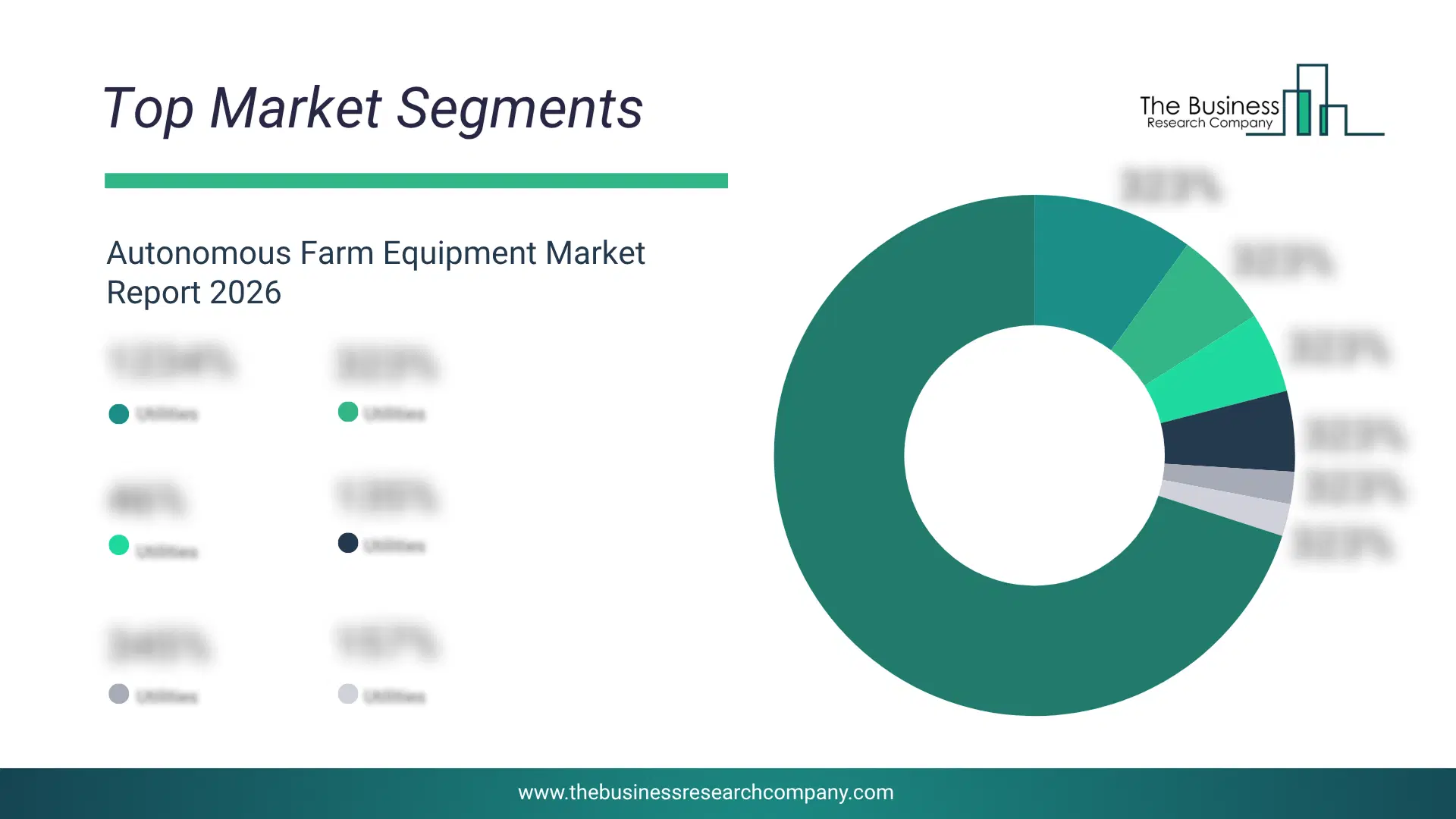
1) By Product Type: Tractors, Harvesters, Unmanned Aerial Vehicles (UAVs), Other Product Types 2) By Technology: Partially Autonomous, Fully Autonomous 3) By Application: Agriculture, Horticulture, Animal husbandry, Forestry, Other Applications Subsegments: 1) By Tractors: Autonomous Tractors For Tilling, Autonomous Tractors For Planting, Autonomous Tractors For Spraying 2) By Harvesters: Autonomous Combine Harvesters, Autonomous Forage Harvesters 3) By Unmanned Aerial Vehicles (UAVs): Crop Surveillance UAVs, UAVs For Precision Agriculture, UAVs For Crop Spraying 4) By Other Product Types: Autonomous Seed Planters, Autonomous Irrigation Systems, Autonomous Soil Monitoring Equipment The top segments in the autonomous farm equipment market will be: • Tractors will reach $58.11 Billion by 2030. • Harvesters will reach $36.24 Billion by 2030. • Unmanned Aerial Vehicles (UAVs) will reach $26.03 Billion by 2030. • Other Product Types will reach $12.38 Billion by 2030.What Is The Driver Of The Autonomous Farm Equipment Market?
Government initiatives are expected to propel the growth of the autonomous farm equipment market. A government initiative is a plan or action taken to address a specific problem or issue that various sources, including taxes, grants, and donations, can fund. Government initiatives are used in autonomous farm equipment to provide financial assistance to farmers to help them purchase autonomous farm equipment and accelerate the development of new autonomous farm equipment technologies. For instance, in September 2023, according to the Department for Environment, Food & Rural Affairs, a UK-based government department, government support for agricultural innovation was reinforced as nineteen automation and robotics projects secured £12.5 million (approximately $15.3 million) in funding on 28 September 2023, contributing to a total of £120 million (approximately $147 million) committed to industry-led research and development in agriculture and horticulture. Therefore, government initiatives drive the growth of the autonomous farm equipment industry.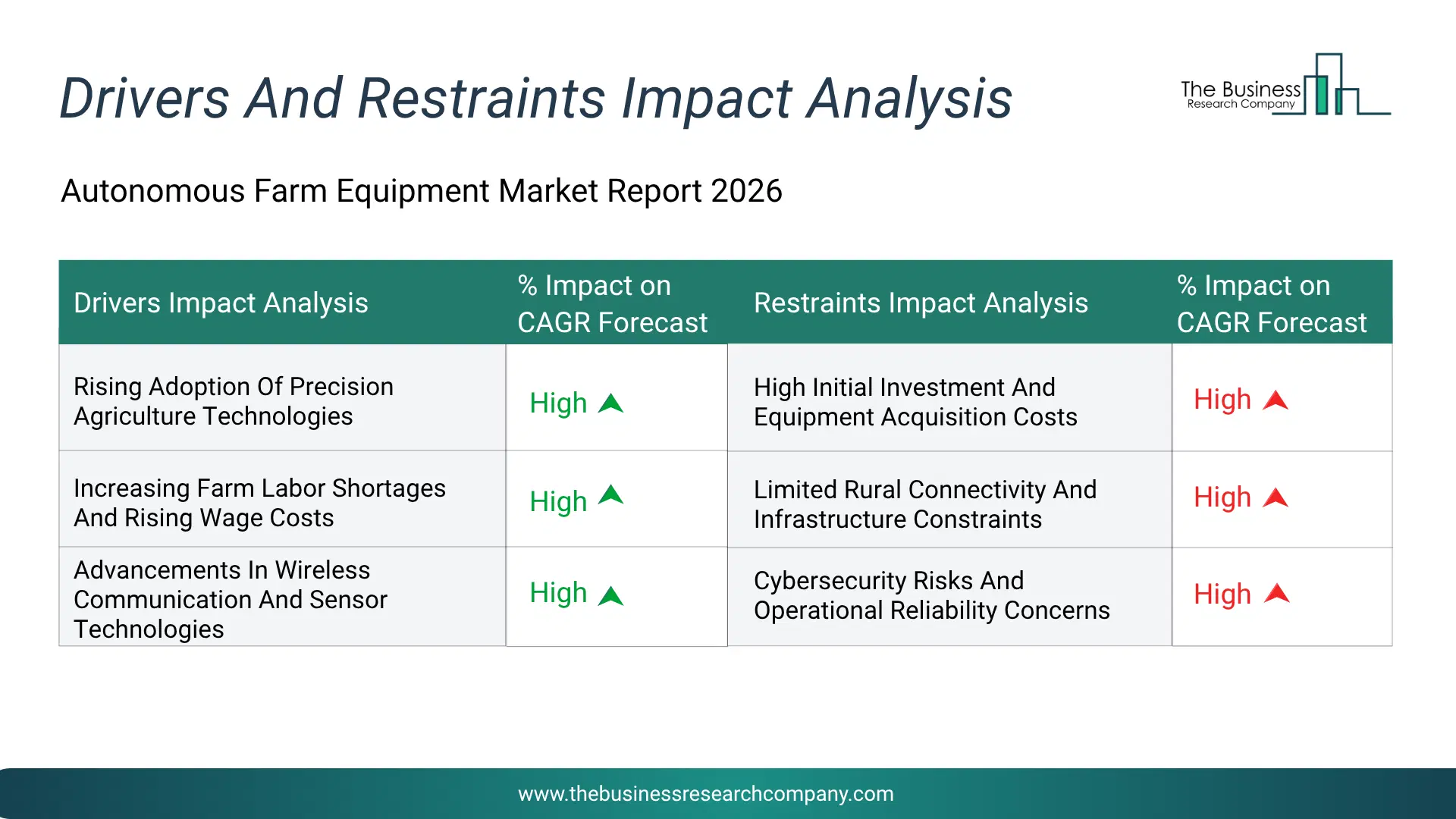
Infographic Chart Showing Key Market Drivers Analysis And Restraints For Autonomous Farm Equipment Market
The chart presents an impact analysis of key drivers and restraints, quantifying their relative influence on the market's growth rate and helping assess the balance between growth enablers and limiting factors. This chart offers a high-level perspective; the full report contains more detailed insights.
How Will The Drivers Impact Growth In The Global Autonomous Farm Equipment Market?
• Rising Adoption Of Precision Agriculture Technologies (High) – During the forecast period, the rising adoption of precision agriculture technologies is expected to become a key growth driver for the autonomous farm equipment market by 2030. Rising adoption of precision agriculture technologies is accelerating the demand for autonomous farm equipment as farmers increasingly focus on optimizing crop yield, reducing input costs, and improving operational efficiency. Autonomous tractors, harvesters, and sprayers integrated with sensors and wireless communication systems enable real-time field monitoring and data-driven farming operations. The growing use of GPS guidance, artificial intelligence, and machine learning in agricultural machinery further enhances automation capabilities. Large-scale commercial farms are adopting autonomous equipment to achieve higher productivity with minimal human intervention. Additionally, increasing awareness regarding sustainable farming practices is encouraging the deployment of technologically advanced agricultural machinery. • Increasing Farm Labor Shortages And Rising Wage Costs (High) – During the forecast period, the increasing farm labor shortages and rising wage costs is expected to emerge as a major factor driving the expansion of the autonomous farm equipment market by 2030. Increasing farm labor shortages and rising wage costs is significantly driving the autonomous farm equipment market as agricultural producers seek alternatives to manual labor-intensive farming operations. Aging farming populations and declining availability of skilled agricultural workers are creating operational challenges across major agricultural economies. Autonomous machinery reduces dependence on seasonal labor by enabling continuous and efficient field operations with minimal supervision. The capability of remotely operated equipment to perform repetitive agricultural tasks with high precision improves overall farm productivity. Rising labor costs are encouraging farmers to invest in automated systems that offer long-term cost optimization. • Advancements In Wireless Communication And Sensor Technologies (High) – During the forecast period, the advancements in wireless communication and sensor technologies is expected to act as a key growth catalyst for the autonomous farm equipment market by 2030. Advancements in wireless communication and sensor technologies is strengthening the growth potential of the autonomous farm equipment market by enabling seamless machine connectivity, remote monitoring, and real-time decision-making capabilities. Modern autonomous equipment utilizes advanced sensors, cameras, radar systems, and communication networks to improve navigation accuracy and operational safety. Enhanced connectivity technologies support efficient coordination between multiple autonomous machines operating within agricultural fields. Continuous innovation in hardware retrofits and process feedback systems is improving machine intelligence and equipment reliability. These technological developments are enabling autonomous machinery to function effectively under diverse agricultural conditions.How Will The Restraints Impact Growth In The Global Autonomous Farm Equipment Market?
• High Initial Investment And Equipment Acquisition Costs (High) – During the forecast period, the high initial investment and equipment acquisition costs is restricting the widespread adoption of autonomous farm equipment, particularly among small and medium-sized agricultural enterprises. Autonomous tractors, robotic harvesters, and sensor-enabled machinery involve substantial capital expenditure due to the integration of advanced hardware, software, and communication technologies. Additional costs associated with retrofitting conventional equipment with autonomous systems further increase financial burden for farmers. Many agricultural producers in developing regions face limited access to financing options and government subsidies for advanced farming machinery. The long return-on-investment period may discourage adoption among cost-sensitive end users. Furthermore, ongoing expenses related to maintenance, software upgrades, and technical support create additional operational challenges for market growth. • Limited Rural Connectivity And Infrastructure Constraints (High) – During the forecast period, the limited rural connectivity and infrastructure constraints is hindering the efficient deployment of autonomous farm equipment, particularly in remote agricultural regions with inadequate digital infrastructure. Autonomous systems rely heavily on stable wireless communication networks, GPS connectivity, and real-time data transmission for optimal performance. Poor internet penetration and unreliable network coverage reduce the effectiveness of remote monitoring and machine coordination capabilities. Inadequate infrastructure may also impact equipment interoperability and cloud-based farm management integration. Farmers operating in underdeveloped rural areas often face difficulties in implementing advanced autonomous technologies due to inconsistent power supply and limited technical support availability. These infrastructure-related challenges are slowing the adoption rate of autonomous agricultural machinery across several emerging economies. • Cybersecurity Risks And Operational Reliability Concerns (High) – During the forecast period, the cybersecurity risks and operational reliability concerns is limiting market expansion as autonomous farm equipment increasingly depends on connected digital systems and wireless communication technologies. The risk of signal interference, data breaches, and unauthorized system access raises concerns regarding equipment safety and operational continuity. Farmers may hesitate to adopt autonomous machinery due to fears of system malfunction, navigation errors, or connectivity disruptions during critical farming activities. Dependence on software-driven operations also increases vulnerability to technical failures and cyberattacks. Additionally, concerns regarding data privacy and secure transmission of operational information may reduce confidence in connected agricultural equipment. These reliability and security challenges are creating barriers to large-scale commercialization and adoption of autonomous farming solutions.Key Players In The Global Autonomous Farm Equipment Market
Major companies operating in the autonomous farm equipment market are CLAAS KGaA mbH, DEUTZ-FAHR S.p.A., AGCO Corporation, Deere & Company, CNH Industrial N.V., Agrobot S.L., Autonomous Tractor Corporation, Yanmar Co. Ltd., Iseki & Co. Ltd., Kubota Corporation, Bobcat Company, Agribotix LLC, Agricultural Solutions Ltd., Harvest Automation Inc., Mahindra & Mahindra Limited, Energid Technologies Corporation, Autonomous Solutions Inc., Agritronics Corporation, Kinze Manufacturing Inc., SDF S.p.A., Rowbot Systems LLC, Robotic Harvesting LLC, Jaybridge Robotics LLC, Agrobotics AutoProbe Inc., Naio Technologies, CNH Industrial America LLC, Ted Corporation, Dino Autonomous Robot Inc., Swift Navigation Inc.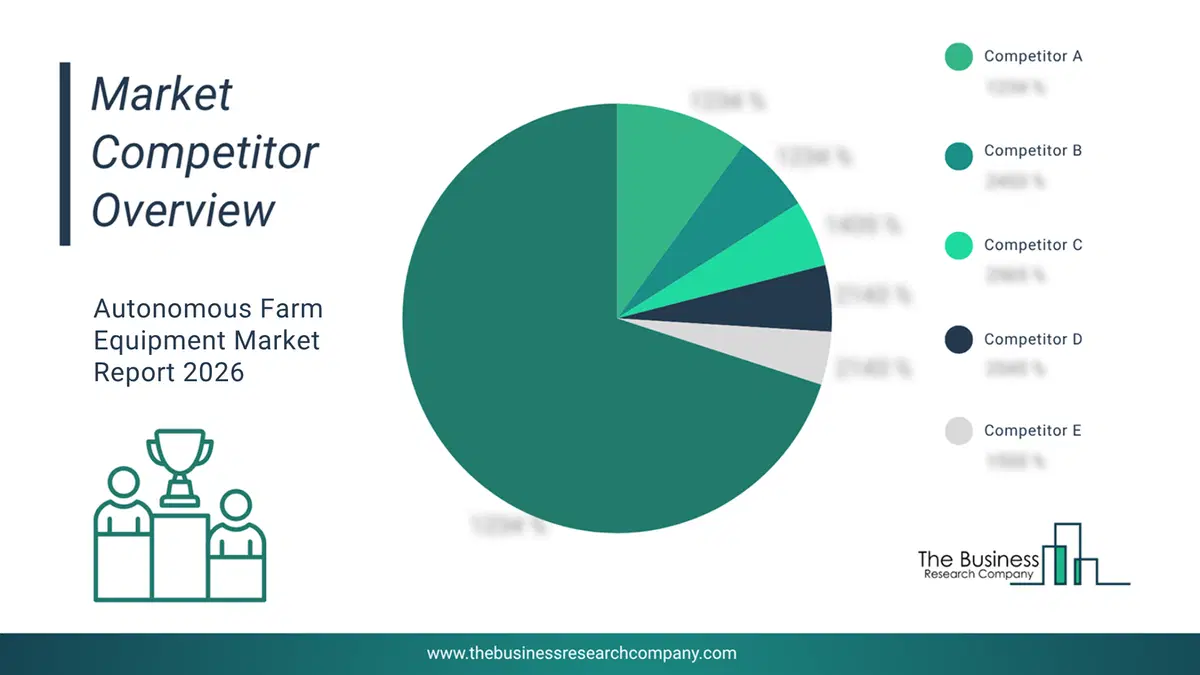
This chart is for illustrative purposes; the full report includes a detailed competitor analysis and comprehensive overview of the top 10 companies in the market.
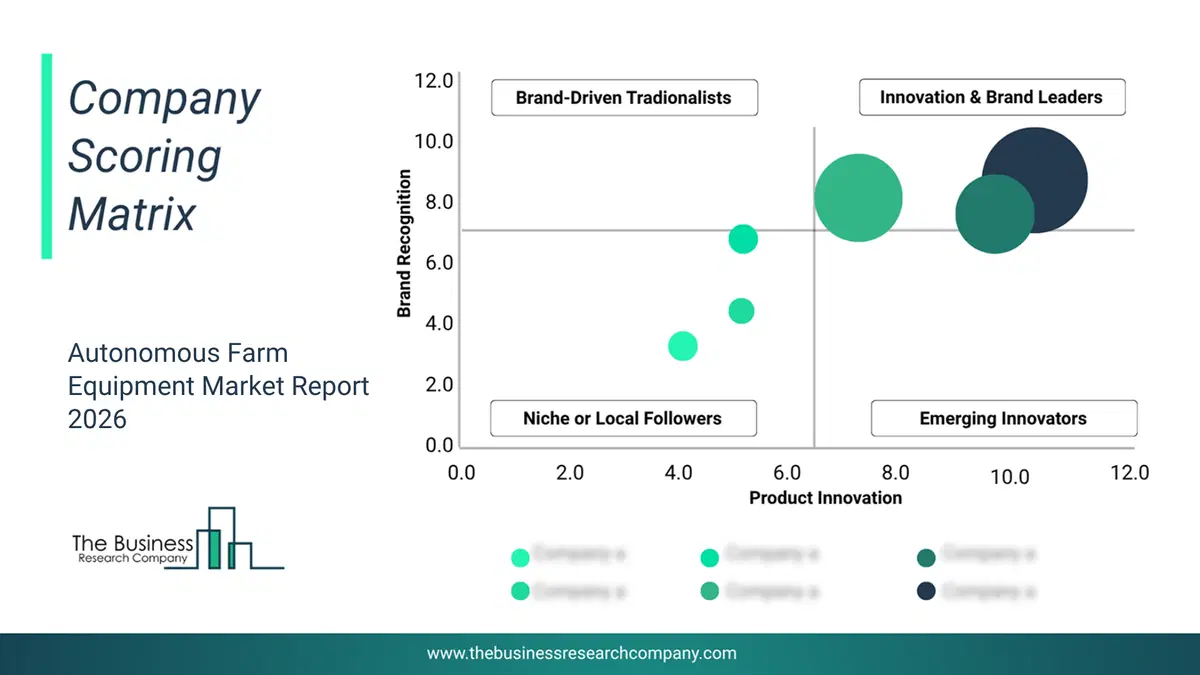
This chart maps companies by product innovation and brand strength, with bubble size indicating relative revenue, helping identify market leaders, challengers, and niche players. This is an illustrative chart; the full report provides a complete and accurate competitive analysis.
Global Autonomous Farm Equipment Market Trends and Insights
Major companies operating in the autonomous farm equipment market are focusing on developing innovative advancements such as autonomous farming platforms to improve operational efficiency, reduce labor dependency, and enable data-driven precision agriculture. An autonomous farming platform is an integrated solution that combines automated field machinery with advanced analytics to perform agricultural tasks and optimize crop management. For instance, in February 2025, Yamaha Motor Co., Ltd., a Japan-based manufacturer of mobility products, robotics systems, and industrial technologies, launched Yamaha Agriculture, Inc., following its acquisitions of Robotics Plus and The Yield. The new platform delivers autonomous vehicles capable of spraying, weeding, and other field operations, paired with artificial intelligence–powered models for yield prediction and resource optimization. This integrated approach allows growers to enhance productivity, address labor shortages, and improve sustainability through precise, data-informed farm management.What Are Latest Mergers And Acquisitions In The Autonomous Farm Equipment Market?
In March 2023, John Deere, a US-based agricultural, construction, and forestry machinery manufacturer, acquired SparkAI Inc. for an undisclosed amount. Through this acquisition, John Deere aims to enhance its autonomous tractors by integrating SparkAI's human-in-the-loop technology, enabling real-time decision-making in challenging environments and improving operational efficiency in agricultural practices. SparkAI Inc. is a US-based software company that involves autonomous farm equipment.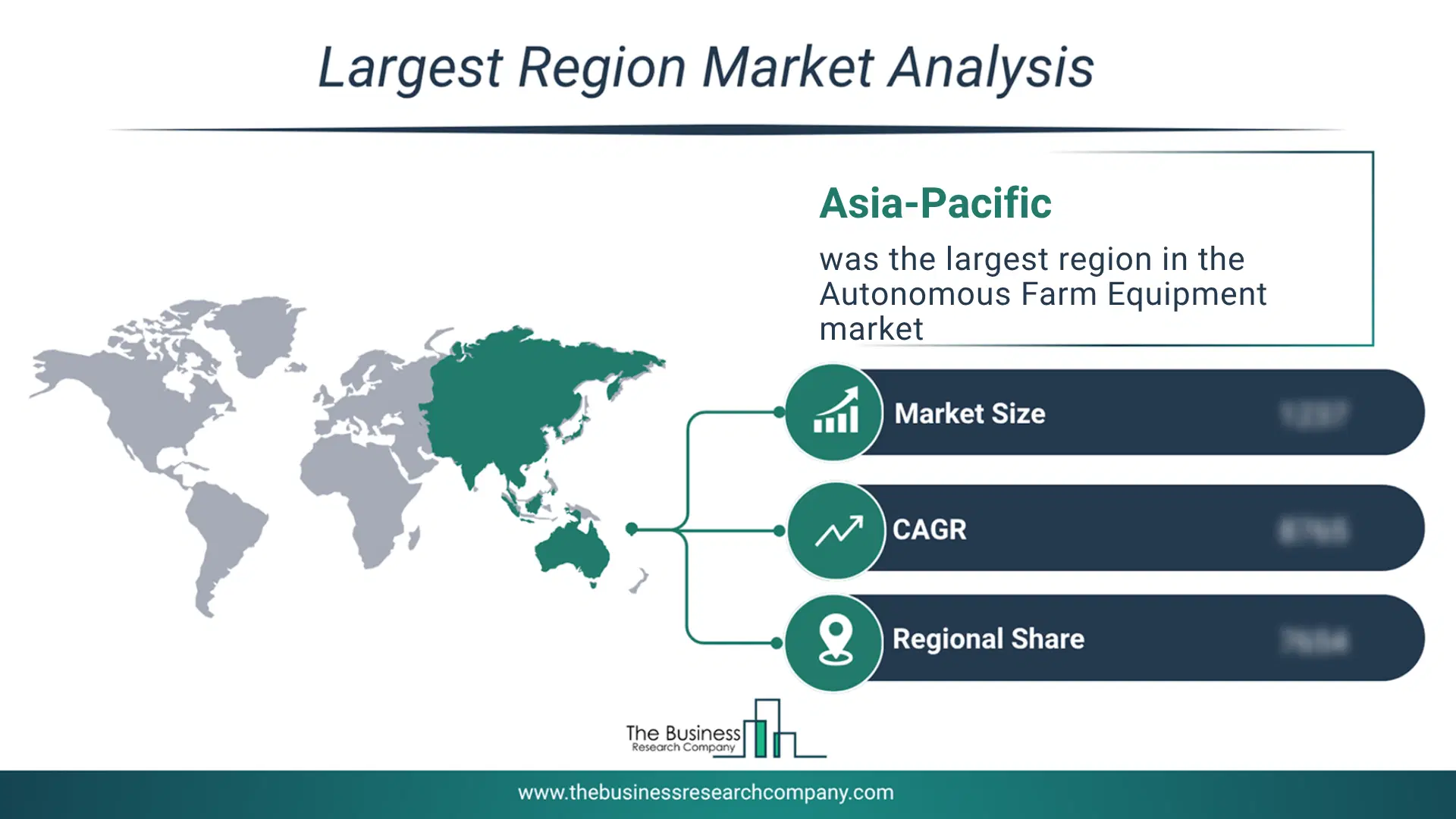
Regional Outlook
Asia-Pacific was the largest region in the autonomous farm equipment market in 2025. North America was the second largest region in the autonomous farm equipment market. The regions covered in this market report are Asia-Pacific, South East Asia, Western Europe, Eastern Europe, North America, South America, Middle East, Africa The countries covered in this market report are Australia, Brazil, China, France, Germany, India, Indonesia, Japan, Taiwan, Russia, South Korea, UK, USA, Canada, Italy, Spain.What Defines the Autonomous Farm Equipment Market?
The autonomous farm equipment market consists of sales of tractor mounted vertical conveyor reaper, tractor mounted combine harvester, self-propelled combine harvester, self-propelled reaper binder, groundnut digger shaker/harvester, turmeric harvester, and sugarcane harvester. Values in this market are factory gate values, that is the value of goods sold by the manufacturers or creators of the goods, whether to other entities (including downstream manufacturers, wholesalers, distributors, and retailers) or directly to end customers. The value of goods in this market includes related services sold by the creators of the goods.How is Market Value Defined and Measured?
The market value is defined as the revenues that enterprises gain from the sale of goods and/or services within the specified market and geography through sales, grants, or donations in terms of the currency (in USD unless otherwise specified). The revenues for a specified geography are consumption values that are revenues generated by organizations in the specified geography within the market, irrespective of where they are produced. It does not include revenues from resales along the supply chain, either further along the supply chain or as part of other products.
This chart presents market attractiveness based on a quantitative evaluation of growth, competition, strategic alignment, and risk, offering a clear view of opportunity areas for decision-making. This chart is for illustrative purposes; the full report contains the complete analysis.

This chart highlights the Total Addressable Market (TAM) by estimating the maximum revenue opportunity using an assumption-driven approach, supporting strategic planning and opportunity sizing across markets. The chart is illustrative; the full report provides a more comprehensive analysis.
What Key Data and Analysis Are Included in the Autonomous Farm Equipment Market Report 2026?
The autonomous farm equipment market research report is one of a series of new reports from The Business Research Company that provides market statistics, including industry global market size, regional shares, competitors with the market share, detailed market segments, market trends and opportunities, and any further data you may need to thrive in the autonomous farm equipment industry. The market research report delivers a complete perspective of everything you need, with an in-depth analysis of the current and future state of the industry.Autonomous Farm Equipment Market Report Forecast Analysis
| Report Attribute | Details |
|---|---|
| Market Size Value In 2026 | $91.16 billion |
| Revenue Forecast In 2030 | $113.47 billion |
| Growth Rate | CAGR of 5.3% from 2026 to 2030 |
| Base Year For Estimation | 2025 |
| Actual Estimates/Historical Data | 2020-2025 |
| Forecast Period | 2026 - 2030 |
| Market Representation | Revenue in USD Billion and CAGR from 2026 to 2030 |
| Segments Covered | Product Type, Technology, Application |
| Regional Scope | Asia-Pacific, Western Europe, Eastern Europe, North America, South America, Middle East, Africa |
| Country Scope | The countries covered in the report are Australia, Brazil, China, France, Germany, India, Indonesia, Japan, Taiwan, Russia, South Korea, UK, USA, Canada, Italy, Spain. |
| Key Companies Profiled | CLAAS KGaA mbH, DEUTZ-FAHR S.p.A., AGCO Corporation, Deere & Company, CNH Industrial N.V., Agrobot S.L., Autonomous Tractor Corporation, Yanmar Co. Ltd., Iseki & Co. Ltd., Kubota Corporation, Bobcat Company, Agribotix LLC, Agricultural Solutions Ltd., Harvest Automation Inc., Mahindra & Mahindra Limited, Energid Technologies Corporation, Autonomous Solutions Inc., Agritronics Corporation, Kinze Manufacturing Inc., SDF S.p.A., Rowbot Systems LLC, Robotic Harvesting LLC, Jaybridge Robotics LLC, Agrobotics AutoProbe Inc., Naio Technologies, CNH Industrial America LLC, Ted Corporation, Dino Autonomous Robot Inc., Swift Navigation Inc. |
| Customization Scope | Request for Customization |
| Pricing And Purchase Options | Explore Purchase Options |