
Autonomous Rocket Flight Market Report 2026
Global Outlook – By Component (Hardware, Software, Services), By Application (Commercial, Military, Research And Development, Space Exploration, Other Applications), By End-User (Aerospace, Defense, Space Agencies, Other Users) – Market Size, Trends, Strategies, and Forecast to 2030
Autonomous Rocket Flight Market Overview
• Autonomous Rocket Flight market size has reached to $9.21 billion in 2025 • Expected to grow to $15.17 billion in 2030 at a compound annual growth rate (CAGR) of 10.4% • Growth Driver: Rising Demand For Satellite Launches Fueling The Growth Of The Market Due To Expanding Telecommunications And Need For Efficient Launch Solutions • Market Trend: Innovations In Reusable Shepard Suborbital Rockets Driving Market Growth • North America was the largest region in 2025.What Is Covered Under Autonomous Rocket Flight Market?
Autonomous rocket flight refers to the ability of a rocket to operate, navigate, and complete its mission using onboard sensors, software, and control systems without real-time human input. It enables the rocket to make critical decisions during flight, such as adjusting its trajectory or executing landings, through pre-programmed instructions and real-time data processing. The main types of components in autonomous rocket flight are hardware, software, and services. Hardware refers to the physical components of a computer system, such as the processor, memory, storage devices, and peripherals. It is used for various applications, such as commercial, military, research and development, space exploration, and others, serving a range of end users, including aerospace, defense, space agencies, and others.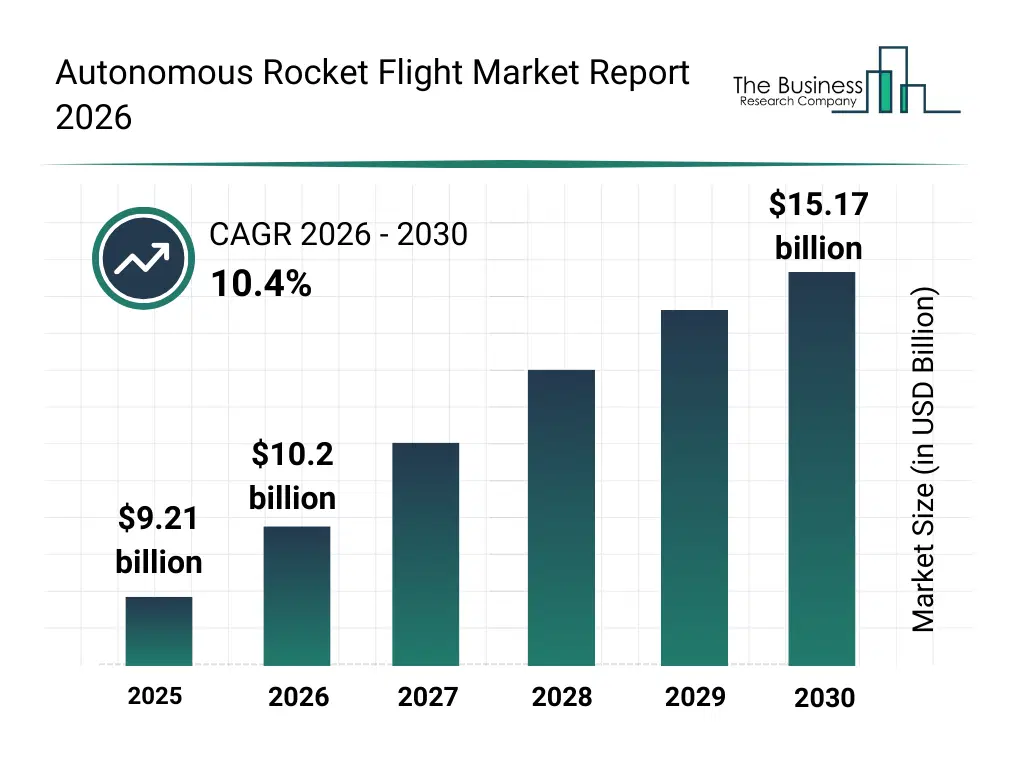
What Is The Autonomous Rocket Flight Market Size and Share 2026?
The autonomous rocket flight market size has grown rapidly in recent years. It will grow from $9.21 billion in 2025 to $10.2 billion in 2026 at a compound annual growth rate (CAGR) of 10.7%. The growth in the historic period can be attributed to development of early autonomous navigation and guidance systems for rockets, adoption of onboard control units for flight stability, deployment of automated launch operations to reduce human intervention, integration of propulsion modules with autonomous control capabilities, rising use of AI-powered flight software for trajectory adjustments and mission execution.What Is The Autonomous Rocket Flight Market Growth Forecast?
The autonomous rocket flight market size is expected to see rapid growth in the next few years. It will grow to $15.17 billion in 2030 at a compound annual growth rate (CAGR) of 10.4%. The growth in the forecast period can be attributed to growing demand for fully autonomous rockets with advanced in-flight decision-making, expansion of autonomous landing and recovery systems, rising adoption of AI-driven payload deployment and mission optimization, focus on modular and scalable autonomous rocket systems, increasing procurement for commercial space missions and defense applications. Major trends in the forecast period include expansion of reusable autonomous launch vehicles, growth of automated trajectory correction systems, increased adoption of precision autonomous landing technologies, advancements in autonomous in-flight decision-making, rising demand for autonomous payload deployment mechanisms.
Global Autonomous Rocket Flight Market Segmentation
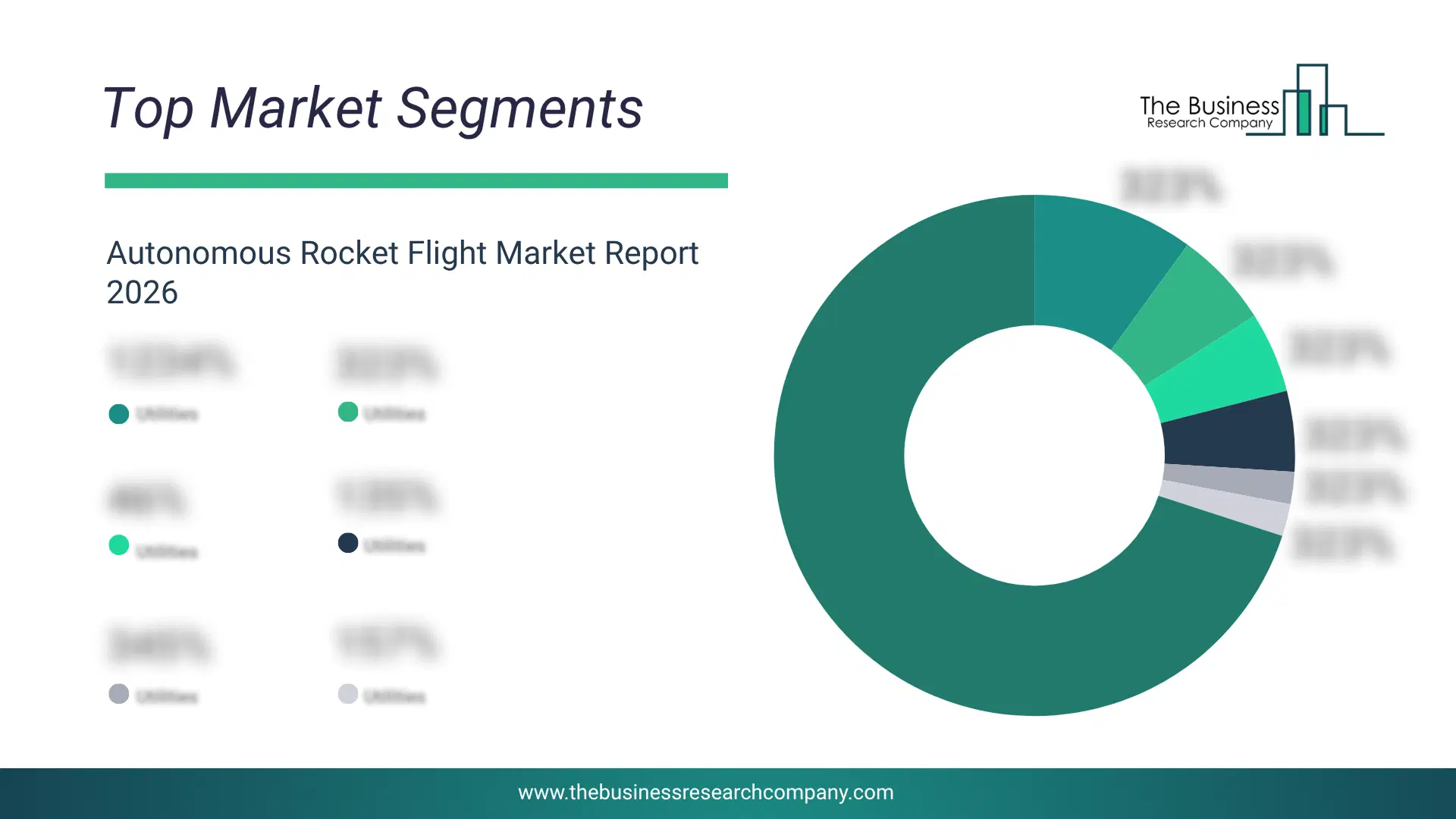
1) By Component: Hardware, Software, Services 2) By Application: Commercial, Military, Research And Development, Space Exploration, Other Applications 3) By End-User: Aerospace, Defense, Space Agencies, Other Users Subsegments: 1) By Hardware: Navigation And Guidance Systems, Propulsion Systems, Sensors And Cameras, Communication Modules, Onboard Computers And Processors, Actuators And Control Systems 2) By Software: Flight Control Software, Autonomous Navigation Algorithms, Mission Planning Software, Data Processing And Analytics Software, Simulation And Testing Software 3) By Services: Launch And Flight Support Services, Maintenance And Repair Services, Software Update And Integration Services, Consulting And System Integration Services, Training And Technical Support ServicesWhat Is Driver Of The Autonomous Rocket Flight Market?
The growing demand for satellite launches is expected to propel the growth of the autonomous rocket flight market going forward. Satellite launches refer to the process of sending artificial satellites into space using rockets to place them into designated orbits for communication, navigation, or scientific research purposes. The growing demand for satellite launches is due to increasing applications in telecommunications because satellites enable wide-area and global communication coverage, especially in remote or underserved regions where terrestrial infrastructure is limited. Autonomous rocket flight helps satellite launches by enabling precise, efficient, and cost-effective delivery of satellites into orbit through real-time trajectory adjustments and reduced human intervention. For instance, in July 2024, according to the Foreign Policy Research Institute, a US-based non-profit think tank, Russia aims to expand its satellite constellation from around 160 satellites in 2023 to 1,000 satellites by 2030. Therefore, the growing demand for satellite launches is driving the growth of the autonomous rocket flight industry.Key Players In The Global Autonomous Rocket Flight Market
Major companies operating in the autonomous rocket flight market are Space Exploration Technologies Corp., Blue Origin Enterprises L.P., Rocket Lab USA Inc., Relativity Space Inc., Firefly Aerospace Inc., Aevum Inc., Stoke Space Technologies Inc., Deep Blue Aerospace Co. Ltd., Virgin Orbit Inc., The Exploration Company GmbH, Isar Aerospace Technologies GmbH, Stratolaunch LLC, ABL Space Systems Inc., Astrobotic Technology Inc., Elecnor Deimos S.L.U., LandSpace Technology Corporation, iRocket Space Systems Inc., Exos Aerospace Systems & Technologies Inc., SpaceWalker Inc., Payload Aerospace S.L.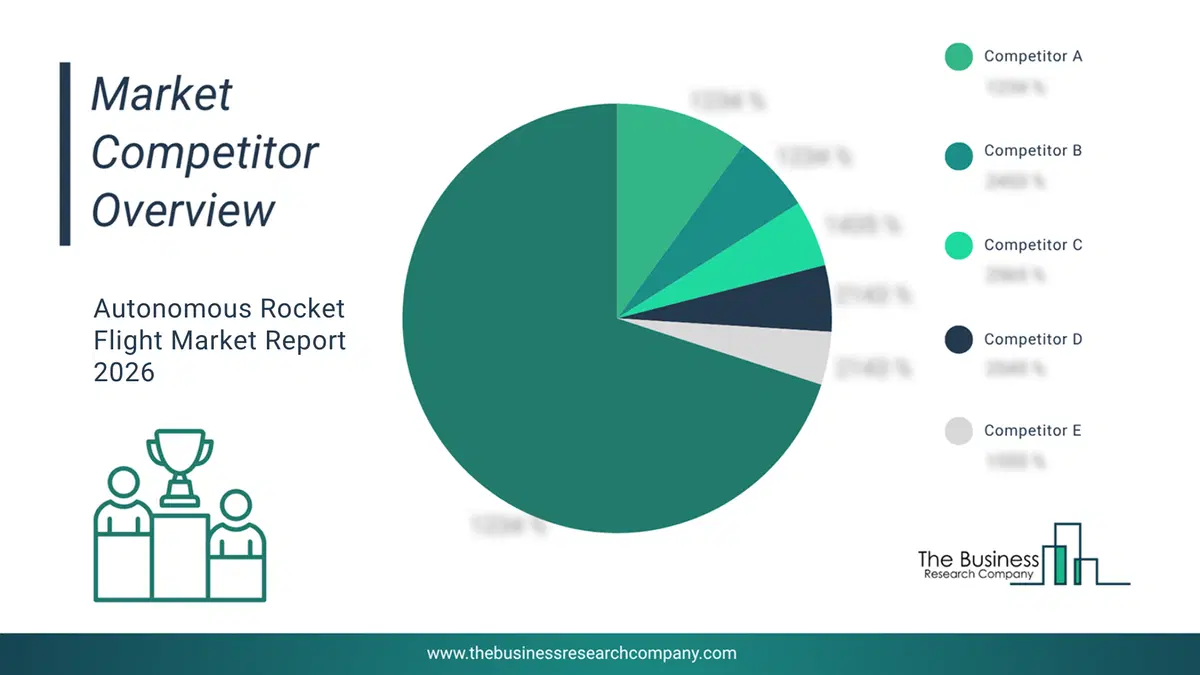
This chart is for illustrative purposes; the full report includes a detailed competitor analysis and comprehensive overview of the top 10 companies in the market.
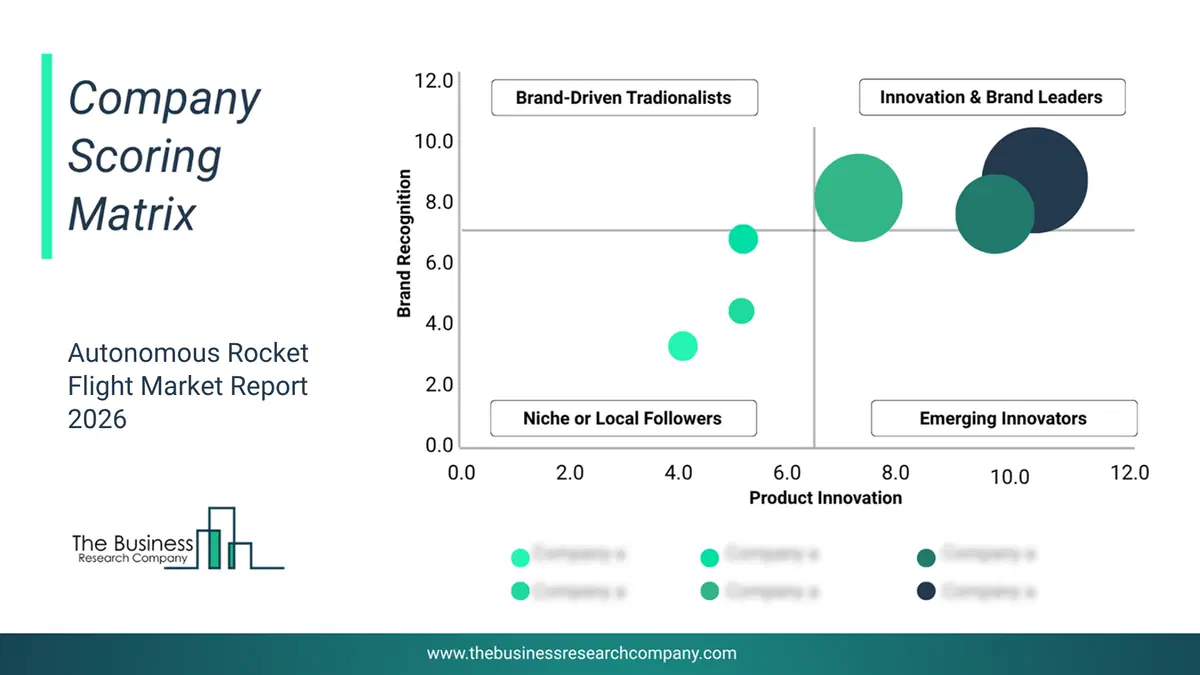
This chart maps companies by product innovation and brand strength, with bubble size indicating relative revenue, helping identify market leaders, challengers, and niche players. This is an illustrative chart; the full report provides a complete and accurate competitive analysis.
Global Autonomous Rocket Flight Market Trends and Insights
Major companies operating in the autonomous rocket flight market are focusing on developing technologically innovative solutions, such as reusable shepard suborbital rockets, to reduce launch costs and increase flight frequency for commercial space missions. The reusable shepard suborbital rocket refers to a fully autonomous, vertically launching and landing vehicle developed and designed for multiple suborbital missions with the same hardware to reduce costs and improve sustainability in spaceflight. For instance, in May 2025, Blue Origin Enterprises L.P., a US-based space technology company, launched six people aboard its New Shepard suborbital rocket for the NS-32 mission. The rocket system, powered by a BE-3PM engine using liquid hydrogen and oxygen, is designed for minimal environmental impact, emitting only water vapor as exhaust. This fully autonomous, single-stage reusable rocket carried six civilian passengers aboard the RSS First Step crew capsule, reaching an altitude just beyond the Kármán Line (100 km), officially entering space. The booster executed a precise vertical landing, while the capsule returned safely via parachutes and retro-thrust cushioning.What Are Latest Mergers And Acquisitions In The Autonomous Rocket Flight Market? Intuitive Machines Strengthens Autonomous Navigation Capabilities With Acquisition of KinetX Aerospace
In August 2025, Intuitive Machines, a US-based space exploration company, acquired KinetX Aerospace for $30 million. With this acquisition, Intuitive Machines aims to strengthen its capabilities in space navigation and mission operations by integrating KinetX’s expertise in deep space flight dynamics, autonomous navigation, and ground software technologies. KinetX Aerospace is a US-based aerospace engineering company specializing in precision navigation, flight dynamics, and mission design for lunar and interplanetary missions, and is the only private company certified by NASA for deep space navigation.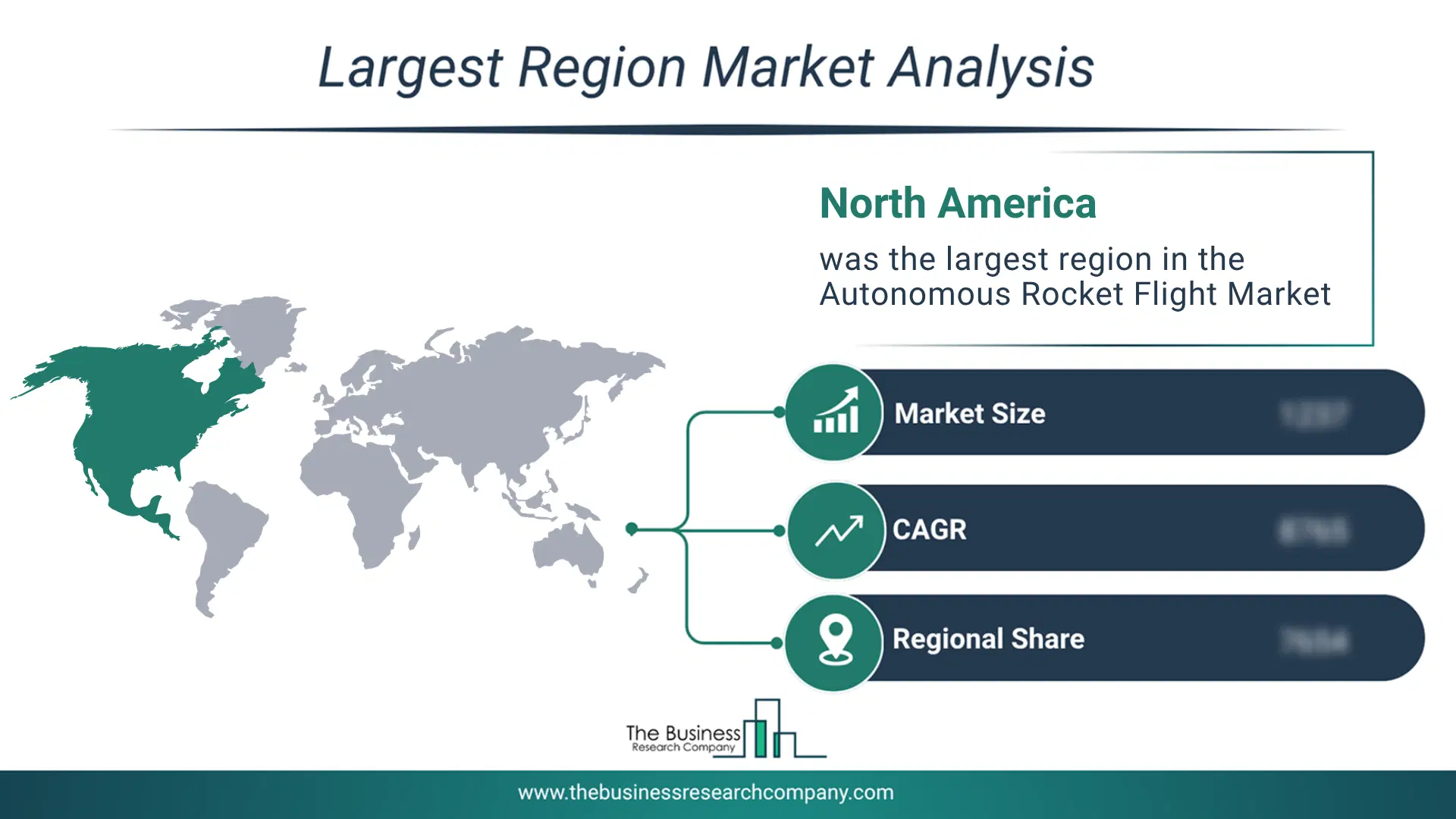
Regional Insights
North America was the largest region in the autonomous rocket flight market in 2025. The regions covered in this market report are Asia-Pacific, South East Asia, Western Europe, Eastern Europe, North America, South America, Middle East, Africa. The countries covered in this market report are Australia, Brazil, China, France, Germany, India, Indonesia, Japan, Taiwan, Russia, South Korea, UK, USA, Canada, Italy, SpainWhat Defines the Autonomous Rocket Flight Market?
The autonomous rocket flight market consists of revenues earned by entities by providing services such as automated launch operations, in-flight guidance and navigation, autonomous landing systems, and payload deployment. The market value includes the value of related goods sold by the service provider or included within the service offering. The autonomous rocket flight market also includes sales of products, including autonomous rocket systems, onboard navigation and control units, propulsion modules, and AI-powered flight software. Values in this market are ‘factory gate’ values, that is the value of goods sold by the manufacturers or creators of the goods, whether to other entities (including downstream manufacturers, wholesalers, distributors and retailers) or directly to end customers. The value of goods in this market includes related services sold by the creators of the goods.How is Market Value Defined and Measured?
The market value is defined as the revenues that enterprises gain from the sale of goods and/or services within the specified market and geography through sales, grants, or donations in terms of the currency (in USD unless otherwise specified). The revenues for a specified geography are consumption values that are revenues generated by organizations in the specified geography within the market, irrespective of where they are produced. It does not include revenues from resales along the supply chain, either further along the supply chain or as part of other products.
This chart presents market attractiveness based on a quantitative evaluation of growth, competition, strategic alignment, and risk, offering a clear view of opportunity areas for decision-making. This chart is for illustrative purposes; the full report contains the complete analysis.

This chart highlights the Total Addressable Market (TAM) by estimating the maximum revenue opportunity using an assumption-driven approach, supporting strategic planning and opportunity sizing across markets. The chart is illustrative; the full report provides a more comprehensive analysis.
What Key Data and Analysis Are Included in the Autonomous Rocket Flight Market Report 2026?
The autonomous rocket flight market research report is one of a series of new reports from The Business Research Company that provides market statistics, including industry global market size, regional shares, competitors with the market share, detailed market segments, market trends and opportunities, and any further data you may need to thrive in the autonomous rocket flight industry. The market research report delivers a complete perspective of everything you need, with an in-depth analysis of the current and future state of the industry.Autonomous Rocket Flight Market Report Forecast Analysis
| Report Attribute | Details |
|---|---|
| Market Size Value In 2026 | $10.2 billion |
| Revenue Forecast In 2030 | $15.17 billion |
| Growth Rate | CAGR of 10.4% from 2026 to 2030 |
| Base Year For Estimation | 2025 |
| Actual Estimates/Historical Data | 2020-2025 |
| Forecast Period | 2026 - 2030 |
| Market Representation | Revenue in USD Billion and CAGR from 2026 to 2030 |
| Segments Covered | Component, Application, End-User |
| Regional Scope | Asia-Pacific, Western Europe, Eastern Europe, North America, South America, Middle East, Africa |
| Country Scope | The countries covered in the autonomous rocket flight market report are Australia, Brazil, China, France, Germany, India, Indonesia, Japan, Taiwan, Russia, South Korea, UK, USA, Canada, Italy, Spain |
| Key Companies Profiled | Space Exploration Technologies Corp., Blue Origin Enterprises L.P., Rocket Lab USA Inc., Relativity Space Inc., Firefly Aerospace Inc., Aevum Inc., Stoke Space Technologies Inc., Deep Blue Aerospace Co. Ltd., Virgin Orbit Inc., The Exploration Company GmbH, Isar Aerospace Technologies GmbH, Stratolaunch LLC, ABL Space Systems Inc., Astrobotic Technology Inc., Elecnor Deimos S.L.U., LandSpace Technology Corporation, iRocket Space Systems Inc., Exos Aerospace Systems & Technologies Inc., SpaceWalker Inc., Payload Aerospace S.L. |
| Customization Scope | Request for Customization |
| Pricing And Purchase Options | Explore Purchase Options |