
Autonomous Space Tug Market Report 2026
Global Outlook – By Type (Reusable Space Tugs, Single-Use Space Tugs), By Propulsion System (Chemical Propulsion, Electric Propulsion, Hybrid Propulsion), By Application (Satellite Deployment, Satellite Servicing, Orbital Transfer, Debris Removal, Other Applications), By End-User (Commercial, Government And Defense, Research Organizations) – Market Size, Trends, Strategies, and Forecast to 2030
Autonomous Space Tug Market Overview
• Autonomous Space Tug market size has reached to $1.53 billion in 2025 • Expected to grow to $3.31 billion in 2030 at a compound annual growth rate (CAGR) of 16.6% • Growth Driver: Rising Demand For In-Orbit Servicing Due To Increasing Satellite Deployments And Operational Risks • Market Trend: Advancements In High-Performance Kick Stages For Precision Orbital Delivery • North America was the largest region in 2025 and Asia-Pacific is the fastest growing region.What Is Covered Under Autonomous Space Tug Market?
An autonomous space tug is a spacecraft equipped with advanced propulsion, navigation, and control systems designed to operate independently in orbit. It is primarily used for transporting, repositioning, or servicing satellites and other space assets without requiring human intervention. By enabling precise maneuvering and in-space mobility, it enhances operational efficiency and extends mission capabilities. The main types of autonomous space tugs are reusable space tugs and single-use space tugs. A reusable space tug is a spacecraft designed to transfer satellites between different orbits, enhancing mission flexibility and reducing launch costs. The different propulsion systems include chemical propulsion, electric propulsion, and hybrid propulsion. The various applications include satellite deployment, satellite servicing, orbital transfer, debris removal, and others and are used by several end-users, including commercial, government and defense, and research organizations.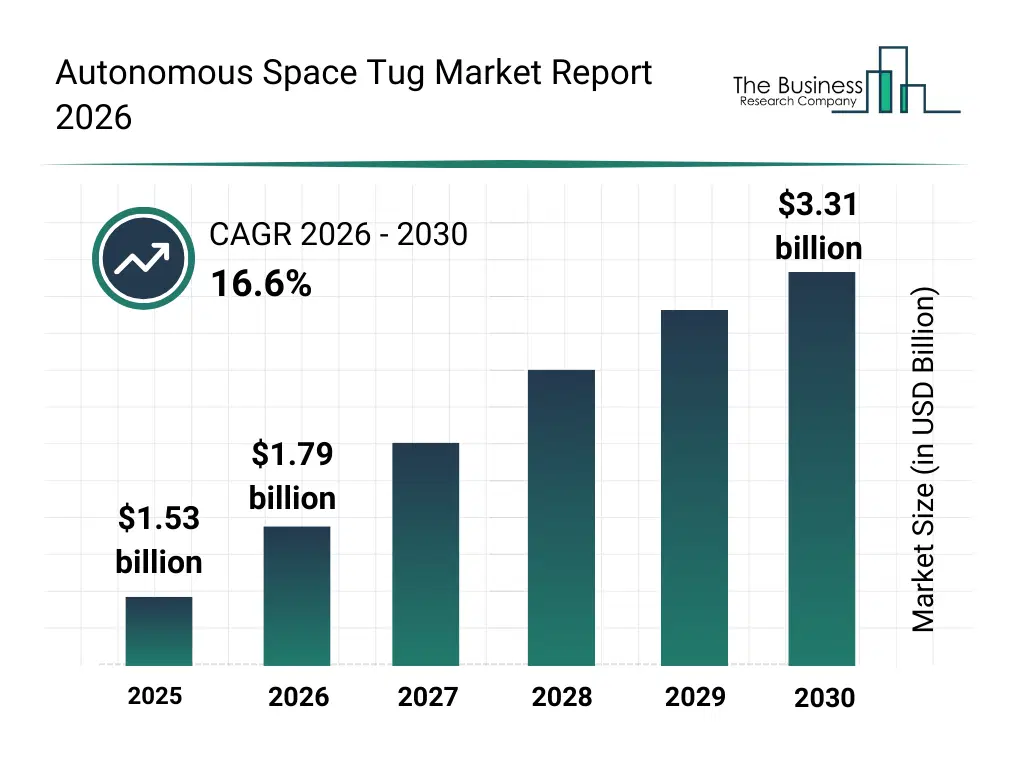
What Is The Autonomous Space Tug Market Size and Share 2026?
The autonomous space tug market size has grown rapidly in recent years. It will grow from $1.53 billion in 2025 to $1.79 billion in 2026 at a compound annual growth rate (CAGR) of 17.0%. The growth in the historic period can be attributed to increasing number of satellite launches requiring orbital management, advancements in autonomous spacecraft navigation and propulsion technologies, early adoption of in-orbit servicing missions, collaborations between satellite operators and aerospace technology providers, rising investment in space logistics and debris mitigation solutions.What Is The Autonomous Space Tug Market Growth Forecast?
The autonomous space tug market size is expected to see rapid growth in the next few years. It will grow to $3.31 billion in 2030 at a compound annual growth rate (CAGR) of 16.6%. The growth in the forecast period can be attributed to development of multifunctional autonomous tugs for satellite repositioning and refueling, integration with AI for autonomous mission planning and collision avoidance, rising demand for end-of-life deorbiting and space debris removal, expansion of commercial in-orbit servicing and logistics services, emphasis on modular, reusable, and cost-efficient tug platforms. Major trends in the forecast period include in-orbit servicing and refueling expansion, space debris mitigation and removal technologies, modular and reconfigurable space tug architectures, cost optimization through reusability and rapid turnaround, cross-orbit transfer and multi-mission capability,,.
Global Autonomous Space Tug Market Segmentation
1) By Type: Reusable Space Tugs, Single-Use Space Tugs 2) By Propulsion System: Chemical Propulsion, Electric Propulsion, Hybrid Propulsion 3) By Application: Satellite Deployment, Satellite Servicing, Orbital Transfer, Debris Removal, Other Applications 4) By End-User: Commercial, Government And Defense, Research Organizations Subsegments: 1) Reusable Space Tugs: Modular Reusable Tugs, Heavy-Lift Reusable Tugs, Long-Duration Orbital Tugs, Rapid Turnaround Tugs 2) Single-Use Space Tugs: Dedicated Mission Tugs, Small Payload Delivery Tugs, High-Energy Orbit Transfer Tugs, De-Orbit Or Disposal TugsWhat Is Driver Of The Autonomous Space Tug Market?
The increasing demand for in-orbit servicing is expected to propel the growth of the autonomous space tug market going forward. In-orbit servicing refers to activities such as refueling, repairing, repositioning, and extending the lifespan of satellites to ensure continuity of operations. The rise in in-orbit servicing is due to the growing need to extend the operational lifespan of expensive satellites through maintenance, refueling, and upgrades, reducing replacement costs. In-orbit servicing supports the growth of the autonomous space tug market by requiring advanced tugs to perform tasks such as satellite repositioning, refueling, and debris removal efficiently. For instance, in July 2025, according to the Government Accountability Office (GAO), a US-based federal agency, the number of active satellites in orbit, which stood at around 11,000 in 2025, is projected to surpass 18,000 by 2030. Therefore, increasing demand for in-orbit servicing is driving the growth of the autonomous space tug industry.Key Players In The Global Autonomous Space Tug Market
Major companies operating in the autonomous space tug market are Maxar Technologies Inc., Sierra Space Corporation, Astroscale Holdings Inc., Impulse Space Inc., ClearSpace SA, D-Orbit S.p.A., Starfish Space Inc., Space Machines Company Pty Ltd., Exotrail SAS, Orbit Fab Inc., Skycorp Inc., Infinite Orbits SAS, Rogue Space Systems Corporation, TransAstra Corporation, Momentus Inc., Kurs Orbital S.r.l., Obruta Space Solutions Inc., Viridian Space Corp., Neumann Space Pty Ltd., Bellatrix Aerospace Private Limited
This chart is for illustrative purposes; the full report includes a detailed competitor analysis and comprehensive overview of the top 10 companies in the market.
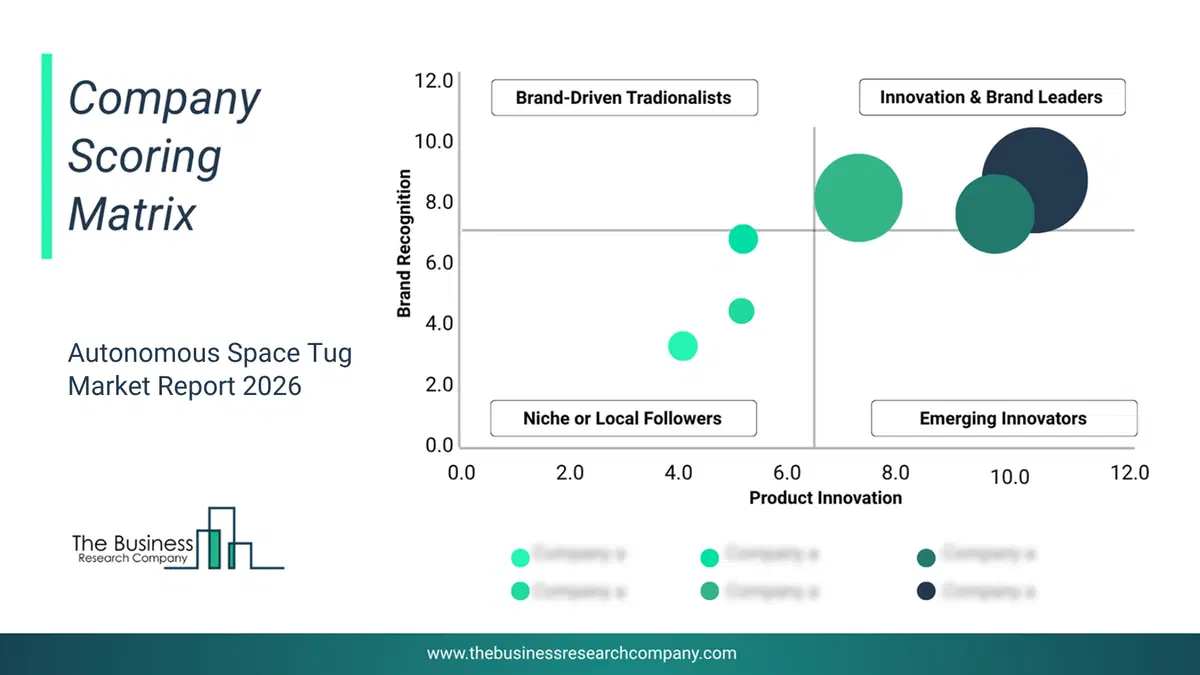
This chart maps companies by product innovation and brand strength, with bubble size indicating relative revenue, helping identify market leaders, challengers, and niche players. This is an illustrative chart; the full report provides a complete and accurate competitive analysis.
Global Autonomous Space Tug Market Trends and Insights
Major companies operating in the autonomous space tug market are focusing on developing technological advancements such as high-performance kick stages to enhance last-mile orbital delivery. A high-performance kick stage is an additional propulsion stage integrated into a launch vehicle or space tug that provides extra thrust and maneuvering capability after the primary rocket has delivered its payload to orbit. For instance, in January 2024, Impulse Space Inc., a US-based in-space transportation company, unveiled Helios, a high-performance kick stage designed to enhance precision payload deployment and orbital transfer efficiency. Helios is built with high-thrust chemical propulsion, advanced avionics, and large propellant capacity, enabling it to perform complex maneuvers such as orbit raising, plane changes, and multiple satellite deployments. Its key uses include last-mile orbital delivery, rideshare mission optimization, and payload transfer to higher orbits such as GEO or lunar trajectories. The main advantages of Helios lie in its mission flexibility, improved accuracy in orbital insertion, cost-effectiveness by reducing the need for dedicated launches, and extended operational capabilities for diverse payloads.What Are Latest Mergers And Acquisitions In The Autonomous Space Tug Market? Vast Acquires Launcher To Boost Orbital Transport And Space Station Development
In February 2023, Vast Space LLC, a US-based company developing artificial gravity space stations, acquired Launcher Inc. for an undisclosed amount. With this acquisition, Vast integrated Launcher's propulsion and orbital transport technologies into its portfolio to strengthen capabilities in spacecraft development and in-orbit logistics. Launcher Inc. is a US-based provider of space tug services and small launch vehicles.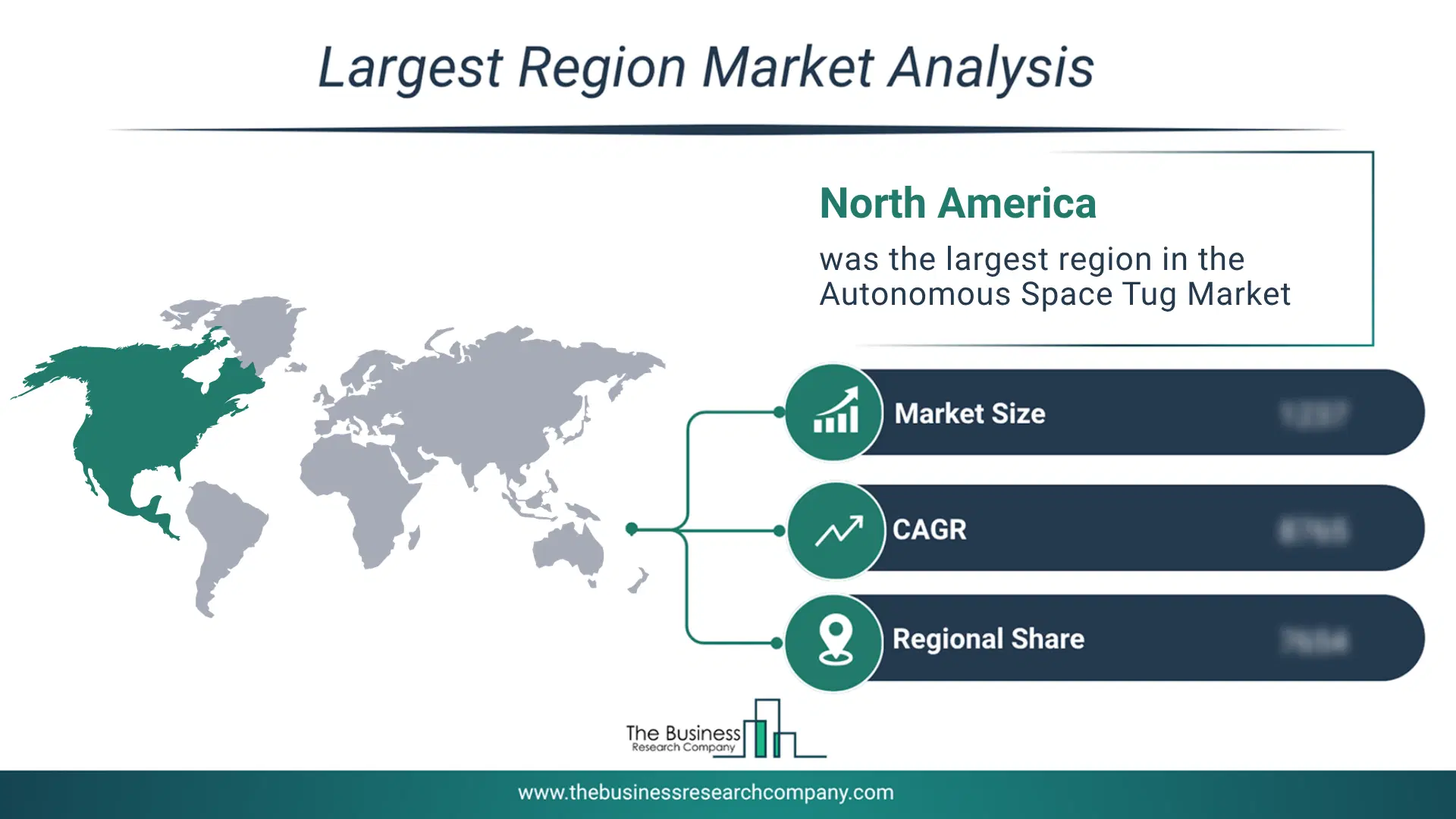
Regional Insights
North America was the largest region in the autonomous space tug market in 2025. Asia-Pacific is expected to be the fastest-growing region in the forecast period. The regions covered in this market report are Asia-Pacific, South East Asia, Western Europe, Eastern Europe, North America, South America, Middle East, Africa. The countries covered in this market report are Australia, Brazil, China, France, Germany, India, Indonesia, Japan, Taiwan, Russia, South Korea, UK, USA, Canada, Italy, SpainWhat Defines the Autonomous Space Tug Market?
The autonomous space tug market consists of revenues earned by entities by providing services such as orbital transfer, satellite repositioning, in-orbit refueling, debris removal, and end-of-life deorbiting operations. The market value includes the value of related goods sold by the service provider or included within the service offering. The autonomous space tug market also includes sales of spacecraft platforms, propulsion modules, docking systems, and navigation and control units. Values in this market are ‘factory gate’ values; that is, the value of goods sold by the manufacturers or creators of the goods, whether to other entities (including downstream manufacturers, wholesalers, distributors, and retailers) or directly to end customers. The value of goods in this market includes related services sold by the creators of the goods.How is Market Value Defined and Measured?
The market value is defined as the revenues that enterprises gain from the sale of goods and/or services within the specified market and geography through sales, grants, or donations in terms of the currency (in USD unless otherwise specified). The revenues for a specified geography are consumption values that are revenues generated by organizations in the specified geography within the market, irrespective of where they are produced. It does not include revenues from resales along the supply chain, either further along the supply chain or as part of other products.
This chart presents market attractiveness based on a quantitative evaluation of growth, competition, strategic alignment, and risk, offering a clear view of opportunity areas for decision-making. This chart is for illustrative purposes; the full report contains the complete analysis.

This chart highlights the Total Addressable Market (TAM) by estimating the maximum revenue opportunity using an assumption-driven approach, supporting strategic planning and opportunity sizing across markets. The chart is illustrative; the full report provides a more comprehensive analysis.
What Key Data and Analysis Are Included in the Autonomous Space Tug Market Report 2026?
The autonomous space tug market research report is one of a series of new reports from The Business Research Company that provides market statistics, including industry global market size, regional shares, competitors with the market share, detailed market segments, market trends and opportunities, and any further data you may need to thrive in the autonomous space tug industry. The market research report delivers a complete perspective of everything you need, with an in-depth analysis of the current and future state of the industry.Autonomous Space Tug Market Report Forecast Analysis
| Report Attribute | Details |
|---|---|
| Market Size Value In 2026 | $1.79 billion |
| Revenue Forecast In 2030 | $3.31 billion |
| Growth Rate | CAGR of 16.6% from 2026 to 2030 |
| Base Year For Estimation | 2025 |
| Actual Estimates/Historical Data | 2020-2025 |
| Forecast Period | 2026 - 2030 |
| Market Representation | Revenue in USD Billion and CAGR from 2026 to 2030 |
| Segments Covered | Type, Propulsion System, Application, End-User |
| Regional Scope | Asia-Pacific, Western Europe, Eastern Europe, North America, South America, Middle East, Africa |
| Country Scope | The countries covered in the autonomous space tug market report are Australia, Brazil, China, France, Germany, India, Indonesia, Japan, Taiwan, Russia, South Korea, UK, USA, Canada, Italy, Spain |
| Key Companies Profiled | Maxar Technologies Inc., Sierra Space Corporation, Astroscale Holdings Inc., Impulse Space Inc., ClearSpace SA, D-Orbit S.p.A., Starfish Space Inc., Space Machines Company Pty Ltd., Exotrail SAS, Orbit Fab Inc., Skycorp Inc., Infinite Orbits SAS, Rogue Space Systems Corporation, TransAstra Corporation, Momentus Inc., Kurs Orbital S.r.l., Obruta Space Solutions Inc., Viridian Space Corp., Neumann Space Pty Ltd., Bellatrix Aerospace Private Limited |
| Customization Scope | Request for Customization |
| Pricing And Purchase Options | Explore Purchase Options |