
Non-Chemical Space Propulsion System Market Report 2026
Global Outlook – By Type (Nuclear Propulsion, Laser Propulsion), By Application (Commercial, Satellite Operators And Owners, Space Launch Service Providers, Government And Defense, Departments Of Defense, National Space Agencies, Other Applications), By End User (Civil And Earth Observation, Government And Military, Commercial) – Market Size, Trends, Strategies, and Forecast to 2030
Non-Chemical Space Propulsion System Market Overview
• Non-Chemical Space Propulsion System market size has reached to $1.32 billion in 2025 • Expected to grow to $2.52 billion in 2030 at a compound annual growth rate (CAGR) of 13.7% • Growth Driver: The Surge In Space Exploration Missions Driving The Growth Of The Market Due To Increasing Demand For Efficient Long-Duration Space Travel • Market Trend: Next-Gen Electric Propulsion Boosts Efficiency And Sustainability For Small Satellites • North America was the largest region in 2025 and Asia-Pacific is the fastest growing region.What Is Covered Under Non-Chemical Space Propulsion System Market?
A non-chemical space propulsion system refers to any method of propelling a spacecraft that does not rely on chemical reactions (such as combustion) to generate thrust. Instead, these systems use physical, electrical, or nuclear principles to move spacecraft, often enabling more efficient and longer-duration missions. The main types of non-chemical space propulsion systems include nuclear propulsion and laser propulsion. Nuclear propulsion involves using a nuclear reactor to produce energy that powers the movement of vehicles, particularly spacecraft or ships. It is applied for commercial satellite operators and owners, space launch service providers, government and defense organizations, national space agencies, and others, and serves various end-uses such as civil and earth observation, military and government missions, and commercial space activities.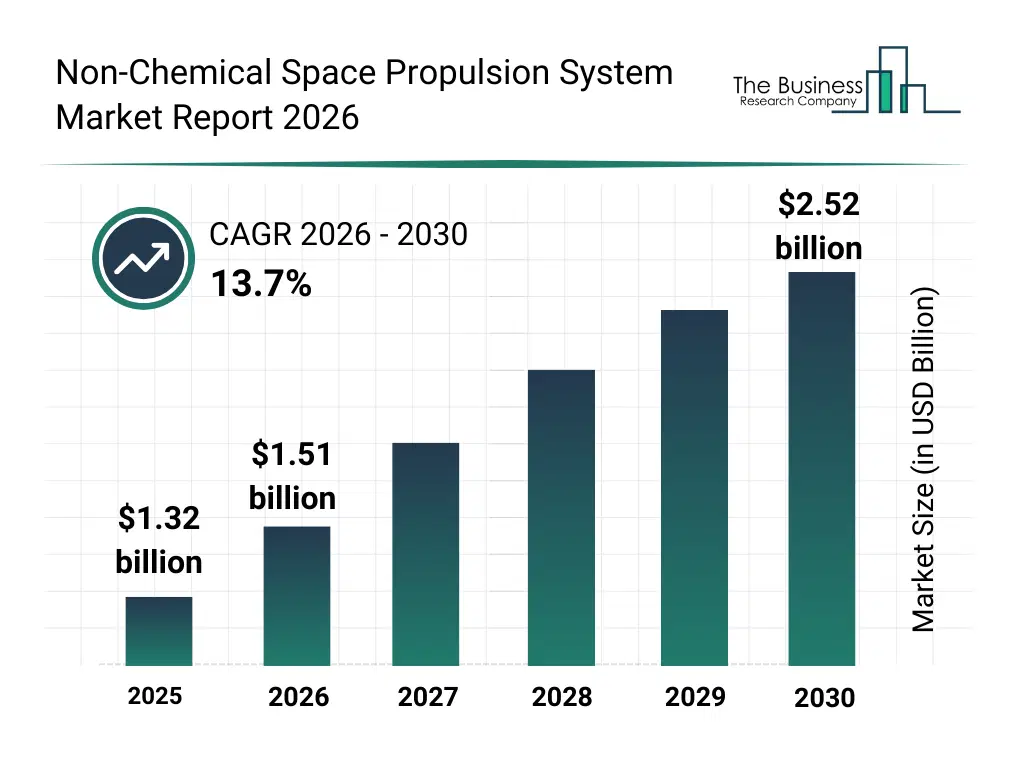
What Is The Non-Chemical Space Propulsion System Market Size and Share 2026?
The non-chemical space propulsion system market size has grown rapidly in recent years. It will grow from $1.32 billion in 2025 to $1.51 billion in 2026 at a compound annual growth rate (CAGR) of 14.0%. The growth in the historic period can be attributed to increasing adoption of electric propulsion systems for satellite station-keeping and orbit raising, advancements in power processing units improving efficiency and thrust control, rising deployment of deep-space missions requiring long-duration propulsion solutions, growth in small satellite launches driving demand for compact non-chemical thrusters, expansion of research in ion and hall-effect propulsion technologies.What Is The Non-Chemical Space Propulsion System Market Growth Forecast?
The non-chemical space propulsion system market size is expected to see rapid growth in the next few years. It will grow to $2.52 billion in 2030 at a compound annual growth rate (CAGR) of 13.7%. The growth in the forecast period can be attributed to growing investment in high-power electric propulsion for interplanetary and lunar missions, increasing demand for scalable propulsion systems for large satellite constellations, rising development of nuclear-based and plasma propulsion concepts for next-generation exploration, expansion of commercial space activities requiring efficient in-space mobility systems, accelerating innovation in thermal management and propellant feed technologies to enhance propulsion performance. Major trends in the forecast period include miniaturization and modularization of non-chemical propulsion systems for small satellites and mega-constellations, integration of power and propulsion subsystems (pps) for higher system efficiency and mass savings, rising adoption of high-specific-impulse propulsion for deep space and long-duration interplanetary missions, standardization of non-chemical propulsion interfaces for rideshare missions and orbital transfer vehicles, growing demand for propulsion solutions for in-orbit servicing, debris removal, and active life-extension missions.
Global Non-Chemical Space Propulsion System Market Segmentation
1) By Type: Nuclear Propulsion, Laser Propulsion 2) By Application: Commercial, Satellite Operators And Owners, Space Launch Service Providers, Government And Defense, Departments Of Defense, National Space Agencies, Other Applications 3) By End User: Civil And Earth Observation, Government And Military, Commercial Subsegments: 1) By Nuclear Propulsion: Nuclear Thermal Propulsion, Nuclear Electric Propulsion, Radioisotope Thermoelectric Propulsion, Fission Fragment Propulsion, Fusion-Based Propulsion 2) By Laser Propulsion: Photon Pressure Propulsion, Laser Ablation Propulsion, Beamed Energy Propulsion, Laser Thermal Propulsion, Direct Energy Transfer SystemsWhat Is Driver Of The Non-Chemical Space Propulsion System Market?
The surge in space exploration missions is expected to propel the growth of the non-chemical space propulsion system market going forward. Space exploration missions are organized efforts by humans or robotic spacecraft to investigate and gather information about outer space beyond Earth's atmosphere. The surge in space exploration missions is due to scientific curiosity to understand the universe, technological advancements that make deep-space travel feasible, and the desire to discover new resources and potential habitats beyond Earth. Surge in space exploration missions supports ongoing and future space initiatives by driving technological advancements, fostering international collaboration, and expanding scientific understanding. For instance, in May 2024, according to the National Space Operations Centre (NSpOC), a UK-based government agency, the number of active satellites in orbit, as of April 2024, reached over 9,000 and some reports suggest that by 2030, we could have more than 60,000 active satellites in space. Therefore, the surge in space exploration missions is driving the growth of the non-chemical space propulsion system industry.Key Players In The Global Non-Chemical Space Propulsion System Market
Major companies operating in the non-chemical space propulsion system market are Airbus SE, Northrop Grumman Corporation, Safran SA, Thales Group, L3Harris Technologies Inc., IHI Corporation, Space Exploration Technologies Corp., Hanwha Aerospace Co. Ltd., Moog Inc., ArianeGroup, Sierra Space Corp., Benchmark Space Systems, Dawn Aerospace, Bradford Space, Busek Co. Inc., Comat Aerospace Corp., CU Aerospace LLC, Ad Astra Rocket Company, Enpulsion GmbH, LIA Aerospace Ltd., ThrustMe.
This chart is for illustrative purposes; the full report includes a detailed competitor analysis and comprehensive overview of the top 10 companies in the market.
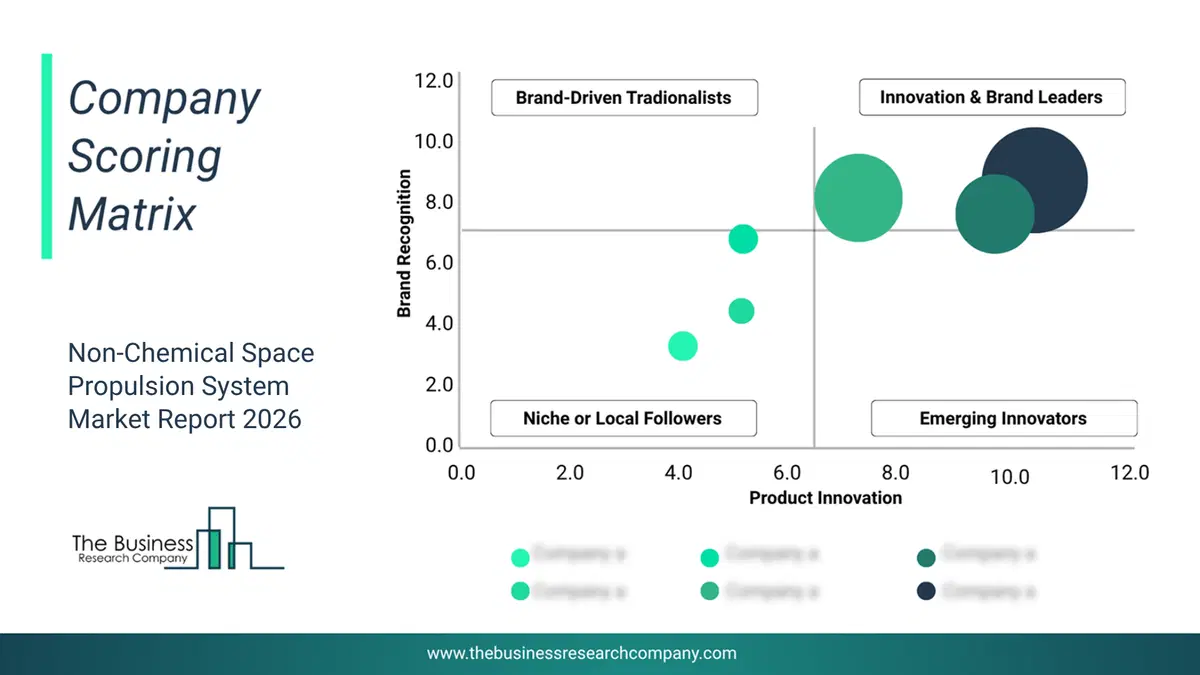
This chart maps companies by product innovation and brand strength, with bubble size indicating relative revenue, helping identify market leaders, challengers, and niche players. This is an illustrative chart; the full report provides a complete and accurate competitive analysis.
Global Non-Chemical Space Propulsion System Market Trends and Insights
Major companies operating in the non-chemical space propulsion system market are focusing on developing advanced technologies, such as electric propulsion systems, to enhance efficiency and sustainability. Electric propulsion systems use electrical energy to generate thrust, enabling quieter, more efficient, and cleaner movement of vehicles or spacecraft without traditional chemical fuels. For instance, in May 2025, Enpulsion GmbH, an Austria-based aerospace and defense company, launched Nexus, an advanced propulsion system. Engineered for spacecraft weighing up to 500 kilograms, Nexus offers significantly higher thrust and improved orbit-raising capabilities to meet the increasing demand for responsive, high-performance electric propulsion in small satellite missions. The system features a compact, modular design that delivers up to 7.1 mN of thrust and a specific impulse of 4,500 seconds, utilizing a safe, non-toxic indium propellant. With plug-and-play integration, no pressurized tanks, and a scalable architecture, Nexus ensures exceptional performance, safety, and flexibility across a variety of satellite applications.What Are Latest Mergers And Acquisitions In The Non-Chemical Space Propulsion System Market? L3Harris Technologies Acquires Aerojet Rocketdyne To Boost Innovation In Advanced Space Propulsion Systems
In July 2023, L3Harris Technologies Inc., a US-based defense contractor company, acquired Aerojet Rocketdyne for an undisclosed amount. With this acquisition, L3Harris aims to strengthen the defense industrial base, enhance competition, and accelerate innovation in propulsion systems for national security and civil space customers. Aerojet Rocketdyne Holdings Inc. is a US-based manufacturer of non-chemical space propulsion systems.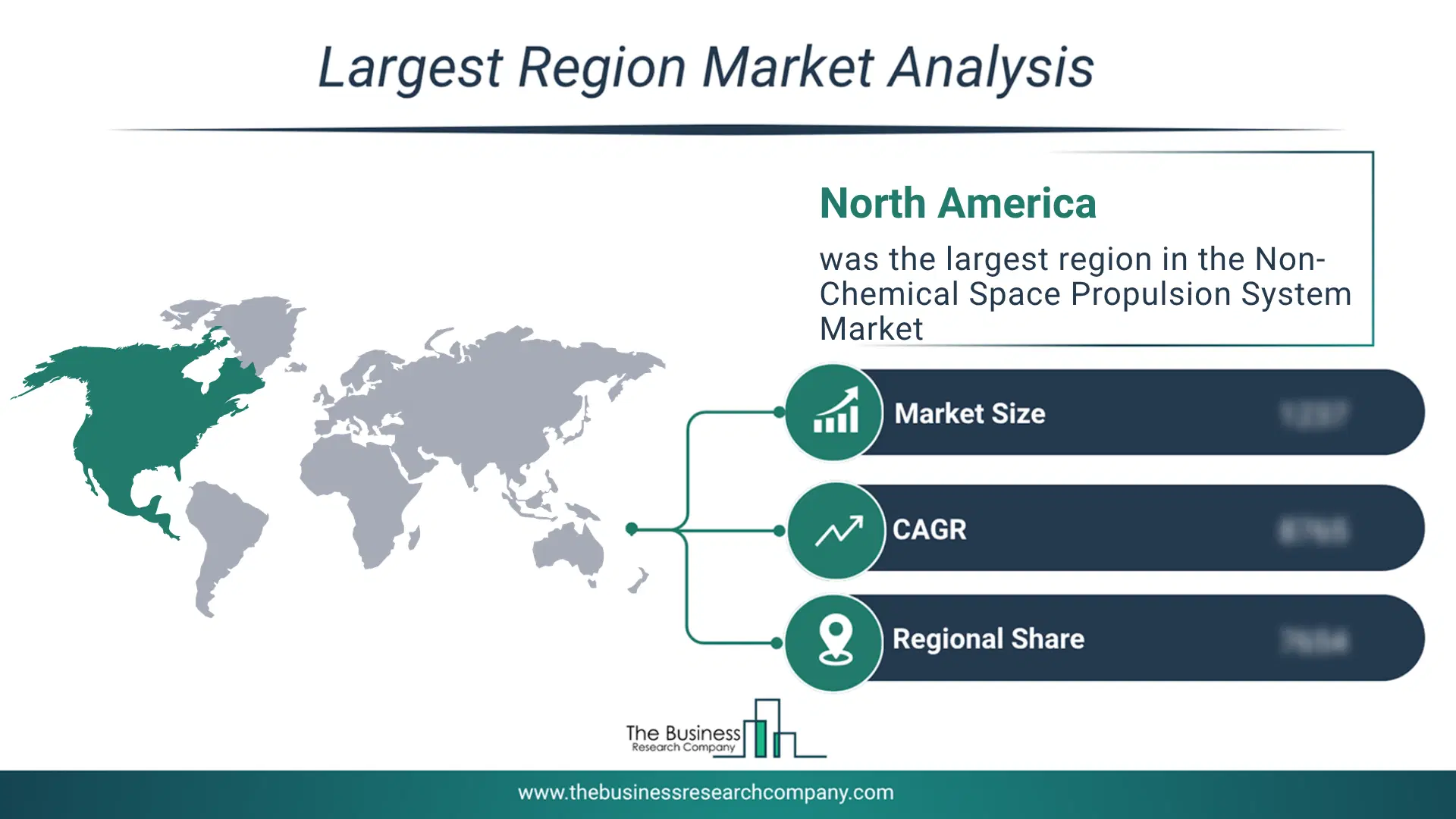
Regional Insights
North America was the largest region in the non-chemical space propulsion system market in 2025. Asia-Pacific is expected to be the fastest-growing region in the forecast period. The regions covered in this market report are Asia-Pacific, South East Asia, Western Europe, Eastern Europe, North America, South America, Middle East, Africa. The countries covered in this market report are Australia, Brazil, China, France, Germany, India, Indonesia, Japan, Taiwan, Russia, South Korea, UK, USA, Canada, Italy, SpainWhat Defines the Non-Chemical Space Propulsion System Market?
The non-chemical space propulsion system market consists of sales of electric propulsion thrusters, power processing units, propellant feed systems, and thermal management systems. Values in this market are ‘factory gate’ values, that is the value of goods sold by the manufacturers or creators of the goods, whether to other entities (including downstream manufacturers, wholesalers, distributors and retailers) or directly to end customers. The value of goods in this market includes related services sold by the creators of the goods.How is Market Value Defined and Measured?
The market value is defined as the revenues that enterprises gain from the sale of goods and/or services within the specified market and geography through sales, grants, or donations in terms of the currency (in USD unless otherwise specified). The revenues for a specified geography are consumption values that are revenues generated by organizations in the specified geography within the market, irrespective of where they are produced. It does not include revenues from resales along the supply chain, either further along the supply chain or as part of other products.
This chart presents market attractiveness based on a quantitative evaluation of growth, competition, strategic alignment, and risk, offering a clear view of opportunity areas for decision-making. This chart is for illustrative purposes; the full report contains the complete analysis.

This chart highlights the Total Addressable Market (TAM) by estimating the maximum revenue opportunity using an assumption-driven approach, supporting strategic planning and opportunity sizing across markets. The chart is illustrative; the full report provides a more comprehensive analysis.
What Key Data and Analysis Are Included in the Non-Chemical Space Propulsion System Market Report 2026?
The non-chemical space propulsion system market research report is one of a series of new reports from The Business Research Company that provides market statistics, including industry global market size, regional shares, competitors with the market share, detailed market segments, market trends and opportunities, and any further data you may need to thrive in the non-chemical space propulsion system industry. The market research report delivers a complete perspective of everything you need, with an in-depth analysis of the current and future state of the industry.Non-Chemical Space Propulsion System Market Report Forecast Analysis
| Report Attribute | Details |
|---|---|
| Market Size Value In 2026 | $1.51 billion |
| Revenue Forecast In 2030 | $2.52 billion |
| Growth Rate | CAGR of 13.7% from 2026 to 2030 |
| Base Year For Estimation | 2025 |
| Actual Estimates/Historical Data | 2020-2025 |
| Forecast Period | 2026 - 2030 |
| Market Representation | Revenue in USD Billion and CAGR from 2026 to 2030 |
| Segments Covered | Type, Application, End User |
| Regional Scope | Asia-Pacific, Western Europe, Eastern Europe, North America, South America, Middle East, Africa |
| Country Scope | The countries covered in the non-chemical space propulsion system market report are Australia, Brazil, China, France, Germany, India, Indonesia, Japan, Taiwan, Russia, South Korea, UK, USA, Canada, Italy, Spain |
| Key Companies Profiled | Airbus SE, Northrop Grumman Corporation, Safran SA, Thales Group, L3Harris Technologies Inc., IHI Corporation, Space Exploration Technologies Corp., Hanwha Aerospace Co. Ltd., Moog Inc., ArianeGroup, Sierra Space Corp., Benchmark Space Systems, Dawn Aerospace, Bradford Space, Busek Co. Inc., Comat Aerospace Corp., CU Aerospace LLC, Ad Astra Rocket Company, Enpulsion GmbH, LIA Aerospace Ltd., ThrustMe. |
| Customization Scope | Request for Customization |
| Pricing And Purchase Options | Explore Purchase Options |