
Barium Fluoride Market Report 2026
Global Outlook – By Product Type (Optical Grade Barium Fluoride, Industrial Grade Barium Fluoride, High Purity Barium Fluoride), By Form (Powder, Single Crystal, Lumps, Other Forms), By Application (Chemical, Mining And Metallurgical, Military, Electronics, Construction, Pharmaceuticals, Other Applications) – Market Size, Trends, Strategies, and Forecast to 2035
Barium Fluoride Market Overview
• Barium Fluoride market size has reached to $11.77 billion in 2025 • Expected to grow to $14.33 billion in 2030 at a compound annual growth rate (CAGR) of 4.1% • Growth Driver: Expansion Of Aerospace, Defense, And Electronics Sectors Fueling The Growth Of The Market Due To Increasing Demand For High-performance Optical Components • Market Trend: Improved Crystal Growth Techniques For Enhanced Optical Performance • North America was the largest region in 2025 and Asia-Pacific is the fastest growing region.What Is Covered Under Barium Fluoride Market?
Barium fluoride refers to an inorganic compound composed of barium and fluorine with the chemical formula BaF₂, typically appearing as a colorless, crystalline solid. It is known for its high transparency across a wide spectral range, particularly in ultraviolet and infrared regions, and exhibits low refractive index and good optical transmission properties. The main product types of barium fluoride include optical grade barium fluoride, industrial grade barium fluoride, and high purity barium fluoride. Optical grade barium fluoride refers to high transparency crystalline material used in optical applications requiring excellent UV and infrared transmission properties. These products are available in forms such as powder, single crystal, lumps, and others and are used applications across chemical, mining and metallurgical, military, electronics, construction, pharmaceuticals, and others.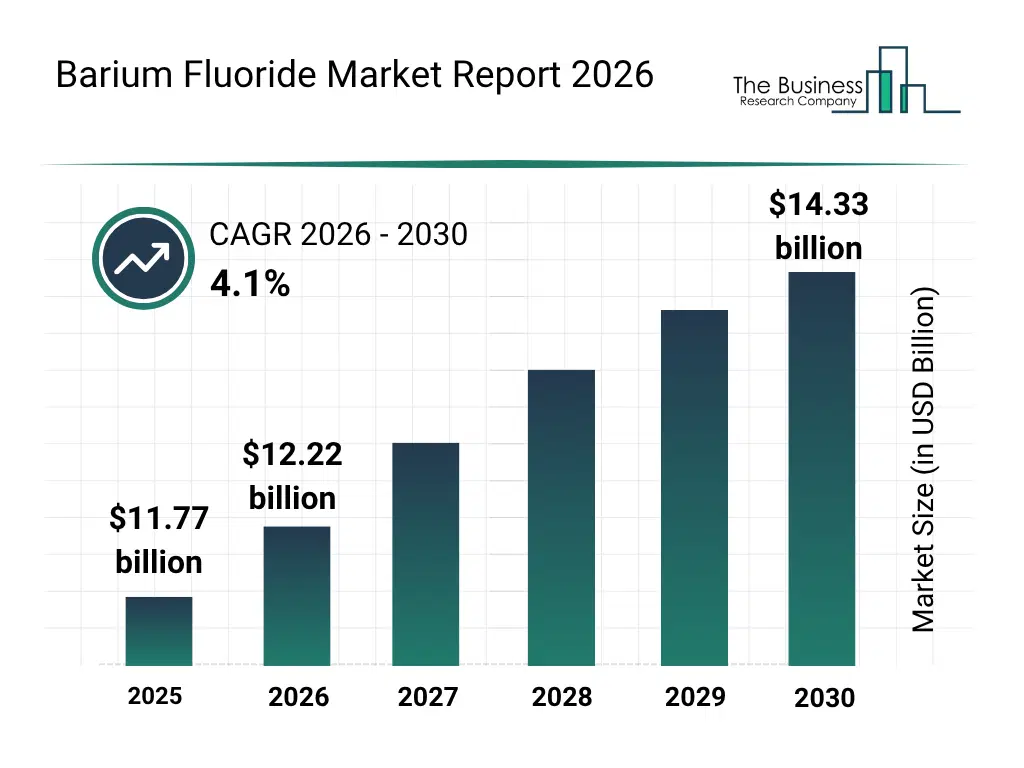
What Is The Barium Fluoride Market Size and Share 2026?
The barium fluoride market size has grown steadily in recent years. It will grow from $11.77 billion in 2025 to $12.22 billion in 2026 at a compound annual growth rate (CAGR) of 3.8%. The growth in the historic period can be attributed to growth in demand for optical materials in scientific instrumentation, expansion of metallurgy and glass manufacturing industries, increasing use of fluoride compounds in chemical processing, rising adoption of infrared optical components in defense systems, development of spectroscopy and laboratory research applications.What Is The Barium Fluoride Market Growth Forecast?
The barium fluoride market size is expected to see steady growth in the next few years. It will grow to $14.33 billion in 2030 at a compound annual growth rate (CAGR) of 4.1%. The growth in the forecast period can be attributed to expansion of semiconductor and photonics industries, increasing demand for advanced infrared and ultraviolet optical systems, growth in nuclear and medical imaging applications, rising adoption of high purity crystal materials in electronics, increasing investment in aerospace and defense optical technologies. Major trends in the forecast period include high purity optical crystal development for ultraviolet and infrared transmission applications, increased adoption of barium fluoride in laser window and spectroscopy components, growing demand for semiconductor-grade crystalline materials in advanced electronics, expansion of fluorides in radiation detection and scintillation systems, rising utilization of optical ceramics in defense and aerospace imaging systems.
Global Barium Fluoride Market Segmentation
1) By Product Type: Optical Grade Barium Fluoride, Industrial Grade Barium Fluoride, High Purity Barium Fluoride 2) By Form: Powder, Single Crystal, Lumps, Other Forms 3) By Application: Chemical, Mining And Metallurgical, Military, Electronics, Construction, Pharmaceuticals, Other Applications Subsegments: 1) By Optical Grade Barium Fluoride: Infrared Optical Components, Laser Window Materials, Spectroscopy Optical Elements, Ultraviolet Transmission Components 2) By Industrial Grade Barium Fluoride: Metallurgical Flux Materials, Ceramic Glazing Additives, Welding Flux Components, Glass Manufacturing Additives 3) By High Purity Barium Fluoride: Semiconductor Crystal Materials, Scintillation Detector Crystals, Electronic Grade Substrates, Advanced Research Grade MaterialsWhat Are The Drivers Of The Barium Fluoride Market?
The expansion of aerospace, defense, and electronics sectors is expected to propel the growth of the barium fluoride market going forward. The aerospace, defense, and electronics sectors refer to industries involved in the design, production, and maintenance of aircraft, spacecraft, military systems, electronic devices, and advanced communication technologies used for security, monitoring, and data processing. The expansion of these sectors is driven by increasing government investments in defense modernization, and rapid growth in semiconductor and telecommunications technologies. Barium fluoride is used in aerospace, defense, and electronics applications to enable high-performance optical systems with excellent ultraviolet and infrared transmission, making it suitable for lenses, windows, and scintillation detectors used in imaging, spectroscopy, and radiation detection systems. For instance, in October 2025, according to the House of Commons Library, a UK-based research and information service that provides impartial analysis, the United Kingdom is projected to allocate approximately 2.4% of its GDP to defense expenditure in 2025. In February 2025, the government announced a strategic commitment to increase defense spending, as defined by NATO standards, to 2.5% of GDP by 2027, with total security and intelligence-related expenditure expected to reach around 2.6% of GDP when additional components are included. Therefore, the expansion of aerospace, defense, and electronics sectors is driving the growth of the barium fluoride industry. The rising demand for optical and photonics applications is expected to propel the growth of the barium fluoride market going forward. Optical and photonics applications refer to technologies that generate, manipulate, and detect light across ultraviolet, visible, and infrared spectra for use in systems such as laser instruments, infrared optics, spectroscopy equipment, and imaging devices. Demand in optical and photonics applications is rising due to accelerating adoption of light-based technologies across high-growth end-use industries which require increasingly precise and high-performance optical components. Barium Fluoride supports these applications by providing exceptional broadband transparency across ultraviolet to infrared wavelengths, enabling its use as a critical material in optical windows, lenses, prisms, and scintillation detectors that require low absorption and high optical clarity. For instance, in March 2026, according to the Society of Photo-Optical Instrumentation Engineers (SPIE), a US-based international society dedicated to advancing light-based technologies in optics and photonics, global annual revenues from the production of optics and photonics core components reached $381 billion in 2024, up from $345 billion in 2023, representing a growth of approximately 10.4%. Therefore, the rising demand for optical and photonics applications is expected to drive the growth of the barium fluoride industry.Key Players In The Global Barium Fluoride Market
Major companies operating in the barium fluoride market are Solvay Fluor GmbH, Thorlabs Inc., Edmund Optics Inc., Fujian Castech Crystals Inc., OptoSigma Corporation, Red Optronics Co. Ltd., Hellma Materials GmbH, UAB EKSMA Optics, Shanghai Optics Inc., American Elements Corporation, Laser Components GmbH, Foctek Photonics Inc., Alkor Technologies LLC, Wavelength Opto-Electronic (S) Pte. Ltd., Union Optic Inc., Crystran Limited, Knight Optical (UK) Ltd., Newlight Photonics Inc., Madras Fluorine Private Limited, Korth Kristalle GmbH.Global Barium Fluoride Market Trends and Insights
Major companies operating in the barium fluoride market are focusing on developing advanced solutions, such as the modified bridgman-stockbarger technique, to enhance crystal purity, improve optical performance, and enable the production of large, defect-free crystals for advanced optical and photonics applications. The modified bridgman–stockbarger technique refers to a crystal growth method in which a molten material is slowly cooled under a controlled temperature gradient, with process refinements that minimize defects and produce high-purity, uniform single crystals. For instance, in August 2024, Fairfield Crystal, a US-based optical materials company, introduced enhanced large-diameter Barium Fluoride monocrystalline ingots. The specialized growth process produces crystals with diameters up to 100mm, featuring zero grain boundaries and high resistance to ionizing radiation for aerospace surveillance systems. This advancement significantly improves thermal stability and optical throughput in the ultraviolet to infrared range. While the high energy requirements of vacuum-based growth increase operational costs, the resulting material provides superior durability for deep-space and high-energy physics applications.Regional Outlook/Insights
North America was the largest region in the barium fluoride market in 2025. Asia-Pacific is expected to be the fastest-growing region in the forecast period. The regions covered in this market report are Asia-Pacific, South East Asia, Western Europe, Eastern Europe, North America, South America, Middle East, Africa. The countries covered in this market report are Australia, Brazil, China, France, Germany, India, Indonesia, Japan, Taiwan, Russia, South Korea, UK, USA, Canada, Italy, Spain.What Defines the Barium Fluoride Market?
The barium fluoride market consists of sales of optical lenses, optical prisms, scintillation crystals, spectroscopy components, welding rod coating materials, and glass manufacturing additives. Values in this market are ‘factory gate’ values, that is, the value of goods sold by the manufacturers or creators of the goods, whether to other entities (including downstream manufacturers, wholesalers, distributors, and retailers) or directly to end customers. The value of goods in this market includes related services sold by the creators of the goods.How is Market Value Defined and Measured?
The market value is defined as the revenues that enterprises gain from the sale of goods and/or services within the specified market and geography through sales, grants, or donations in terms of the currency (in USD unless otherwise specified). The revenues for a specified geography are consumption values that are revenues generated by organizations in the specified geography within the market, irrespective of where they are produced. It does not include revenues from resales along the supply chain, either further along the supply chain or as part of other products.What Key Data and Analysis Are Included in the Barium Fluoride Market Report 2026?
The barium fluoride market research report is one of a series of new reports from The Business Research Company that provides market statistics, including industry global market size, regional shares, competitors with the market share, detailed market segments, market trends and opportunities, and any further data you may need to thrive in the barium fluoride industry. The market research report delivers a complete perspective of everything you need, with an in-depth analysis of the current and future state of the industry.Barium Fluoride Market Report Forecast Analysis
| Report Attribute | Details |
|---|---|
| Market Size Value In 2026 | $12.22 billion |
| Revenue Forecast In 2035 | $14.33 billion |
| Growth Rate | CAGR of 4.1% from 2026 to 2035 |
| Base Year For Estimation | 2025 |
| Actual Estimates/Historical Data | 2020-2025 |
| Forecast Period | 2026 - 2030 - 2035 |
| Market Representation | Revenue in USD Billion and CAGR from 2026 to 2035 |
| Segments Covered | Product Type, Form, Application |
| Regional Scope | Asia-Pacific, Western Europe, Eastern Europe, North America, South America, Middle East, Africa |
| Country Scope | The countries covered in the report are Australia, Brazil, China, France, Germany, India, Indonesia, Japan, Taiwan, Russia, South Korea, UK, USA, Canada, Italy, Spain. |
| Key Companies Profiled | Solvay Fluor GmbH, Thorlabs Inc., Edmund Optics Inc., Fujian Castech Crystals Inc., OptoSigma Corporation, Red Optronics Co. Ltd., Hellma Materials GmbH, UAB EKSMA Optics, Shanghai Optics Inc., American Elements Corporation, Laser Components GmbH, Foctek Photonics Inc., Alkor Technologies LLC, Wavelength Opto-Electronic (S) Pte. Ltd., Union Optic Inc., Crystran Limited, Knight Optical (UK) Ltd., Newlight Photonics Inc., Madras Fluorine Private Limited, Korth Kristalle GmbH. |
| Customization Scope | Request for Customization |
| Pricing And Purchase Options | Explore Purchase Options |