
Battery Leasing-As-A-Service Market Report 2026
Global Outlook – By Battery Type (Lithium-Ion, Nickel Metal Hydride, Solid-State Batteries, Lithium Iron Phosphate, Sodium-Ion Batteries), By Energy Storage Capacity (Less Than 50 kWh, 50–100 kWh, 100–200 kWh), By Service Model (Subscription-Based Leasing, Pay-Per-Use Leasing, Battery Swapping Services, Hybrid Models), By End-User Industry (Automotive, Telecommunications, Energy And Utilities, Residential, Commercial And Industrial, Consumer Electronics, Military And Defense, Healthcare) – Market Size, Trends, Strategies, and Forecast to 2030
Battery Leasing-As-A-Service Market Overview
• Battery Leasing-As-A-Service market size has reached to $3.54 billion in 2025 • Expected to grow to $9.64 billion in 2030 at a compound annual growth rate (CAGR) of 22.2% • Growth Driver: Rising Adoption Of Electric Vehicles Is Fueling The Growth Of The Market Due To Increasing Demand For Cost-effective, Low-emission Mobility Solutions • Market Trend: Advancing Energy Flexibility And Grid Performance Through Subscription-Based Battery Storage Solutions • North America was the largest region in 2025 and Asia-Pacific is the fastest growing region.What Is Covered Under Battery Leasing-As-A-Service Market?
Battery leasing as a service refers to business models and service frameworks that enable electric vehicle (EV) owners or users to lease the battery component of an electric vehicle separately from the vehicle itself, thereby converting battery ownership into a subscription or usage based service. Its primary purpose is to make electric mobility and energy storage more affordable, flexible, and scalable while reducing battery ownership risks. The main battery types of battery leasing-as-a-service include lithium-ion, nickel metal hydride, solid-state batteries, lithium iron phosphate, and sodium-ion batteries. Lithium-ion batteries refer to rechargeable energy storage systems widely used due to their high energy density, long cycle life, and efficiency, making them suitable for a broad range of leased energy applications. Based on energy storage capacity, battery leasing-as-a-service offerings include less than 50 kWh, 50–100 kWh, and 100–200 kWh categories to meet varying power requirements. The service models adopted include subscription-based leasing, pay-per-use leasing, battery swapping services, and hybrid models that combine multiple pricing and usage approaches. The end-user industries utilizing battery leasing-as-a-service include automotive, telecommunications, energy and utilities, residential, commercial and industrial, consumer electronics, military and defense, and healthcare.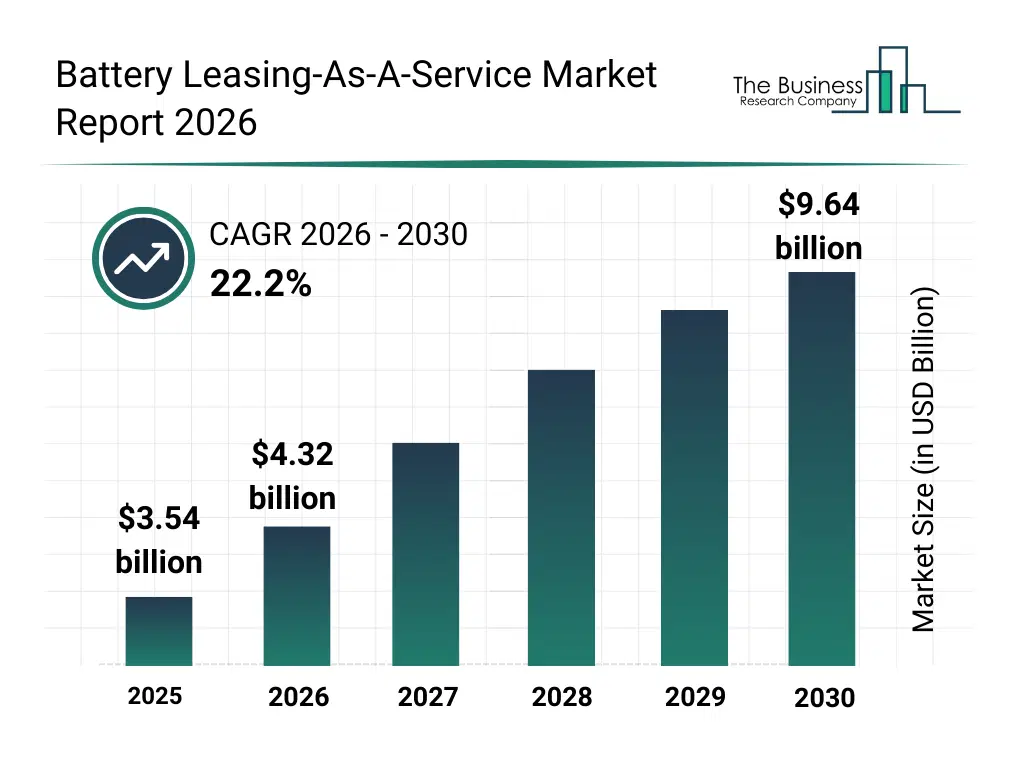
What Is The Battery Leasing-As-A-Service Market Size and Share 2026?
The battery leasing-as-a-service market size has grown exponentially in recent years. It will grow from $3.54 billion in 2025 to $4.32 billion in 2026 at a compound annual growth rate (CAGR) of 22.0%. The growth in the historic period can be attributed to high EV upfront costs, early battery swapping pilots, consumer range anxiety, EV adoption incentives, battery cost volatility.What Is The Battery Leasing-As-A-Service Market Growth Forecast?
The battery leasing-as-a-service market size is expected to see exponential growth in the next few years. It will grow to $9.64 billion in 2030 at a compound annual growth rate (CAGR) of 22.2%. The growth in the forecast period can be attributed to mass EV adoption, standardized battery platforms, smart energy storage demand, circular economy regulations, battery-as-an-asset models. Major trends in the forecast period include subscription-based battery leasing, battery swapping business models, battery lifecycle management platforms, usage-based pricing models, second-life battery utilization.
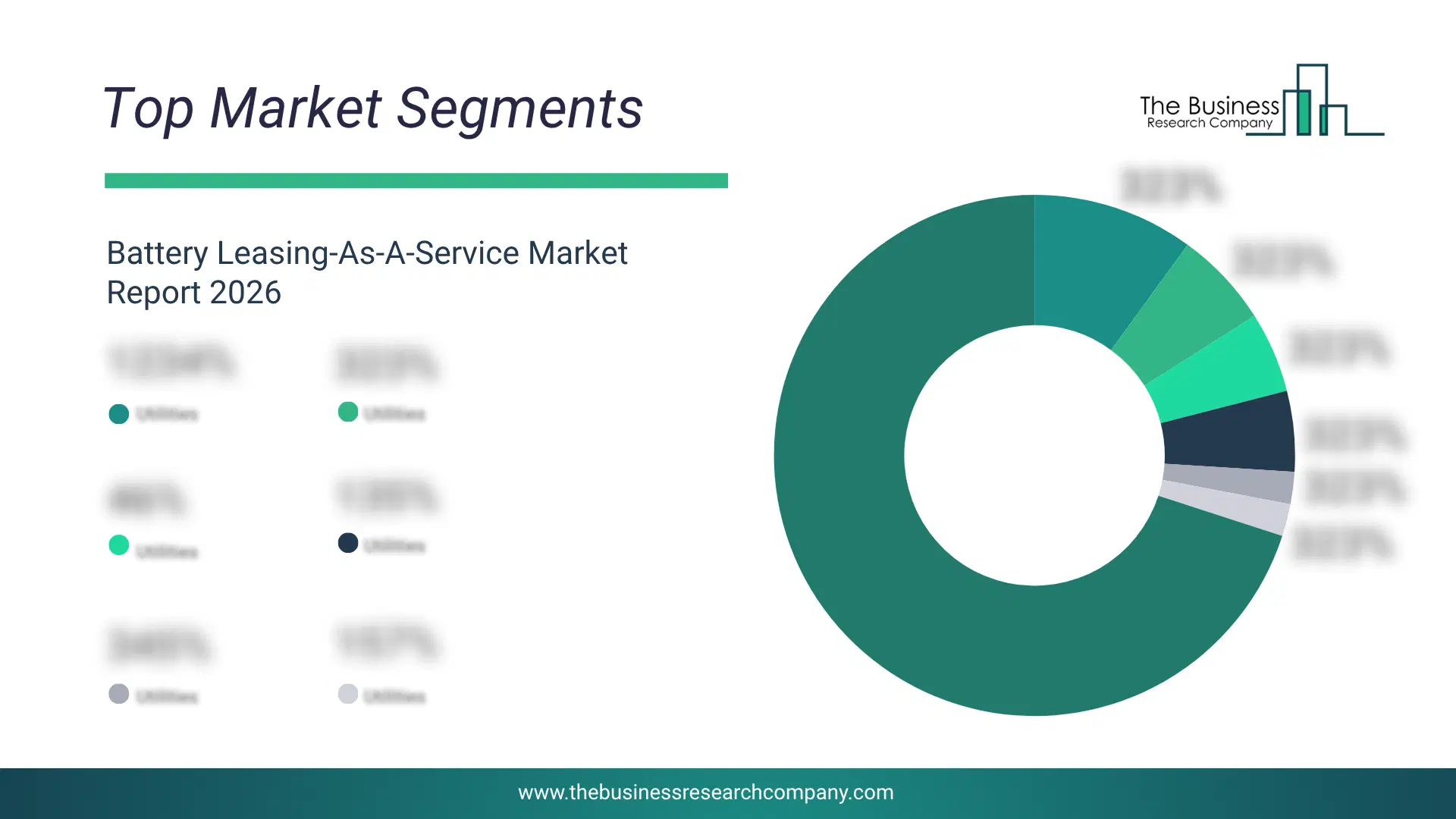
Global Battery Leasing-As-A-Service Market Segmentation
1) By Battery Type: Lithium-Ion, Nickel Metal Hydride, Solid-State Batteries, Lithium Iron Phosphate, Sodium-Ion Batteries 2) By Energy Storage Capacity: Less Than 50 kWh, 50–100 kWh, 100–200 kWh 3) By Service Model: Subscription-Based Leasing, Pay-Per-Use Leasing, Battery Swapping Services, Hybrid Models 4) By End-User Industry: Automotive, Telecommunications, Energy And Utilities, Residential, Commercial And Industrial, Consumer Electronics, Military And Defense, Healthcare Subsegments: 1) By Lithium-Ion: High Energy Density, Fast Charging, Long Cycle Life, Portable Applications 2) By Nickel Metal Hydride: Hybrid Vehicles, Consumer Electronics, Industrial Equipment, Backup Power 3) By Solid-State Batteries: High Safety, High Energy Density, Flexible Form Factor, Long Lifespan 4) By Lithium Iron Phosphate: Electric Vehicles, Renewable Energy Storage, Grid Storage, Low Cost 5) By Sodium-Ion Batteries: Grid Storage, Stationary Energy Storage, Low Temperature Operation, High Cycle StabilityWhat Is The Driver Of The Battery Leasing-As-A-Service Market?
The increasing adoption of electric vehicles is expected to drive the growth of the battery leasing-as-a-service market in the coming years. Electric vehicles (EVs) are automobiles that operate fully or partially on electric motors powered by rechargeable batteries or other electrical energy storage systems, replacing traditional internal combustion engines. The surge in EV adoption is largely driven by the need to reduce greenhouse gas emissions, as EVs produce zero tailpipe emissions and promote cleaner, more sustainable transportation. Battery leasing-as-a-service supports electric vehicle adoption by reducing upfront purchase costs, alleviating concerns related to battery degradation and replacement, and offering greater affordability and flexibility for both individual consumers and fleet operators. For instance, in January 2024, according to the US Energy Information Administration, a US-based government agency, hybrid, plug-in hybrid, and battery electric vehicles accounted for 16.3% of total light-duty vehicle sales in the United States in 2023, up from 12.9% in 2022, highlighting the rapid increase in electric and hybrid vehicle adoption. Therefore, the growing adoption of electric vehicles is fueling the growth of the battery leasing-as-a-service industry.Key Players In The Global Battery Leasing-As-A-Service Market
Major companies operating in the battery leasing-as-a-service market are Shell Plc, SAIC Motor Corporation Limited, Renault S.A., NIO Inc., XPENG Inc., VinFast Auto Ltd., Enel X Way S.r.l., Gogoro Inc., Blink Charging Co. Inc., Ather Energy Private Limited, Sun Mobility Private Limited, Bounce Infinity Private Limited, Swobbee, Battery Smart India Private Limited, Nuvve Holding Corp., Ample Inc., Oyika Pte. Ltd., Octillion Power Systems Inc., Vidyut, and Lithium Urban Technologies Private Limited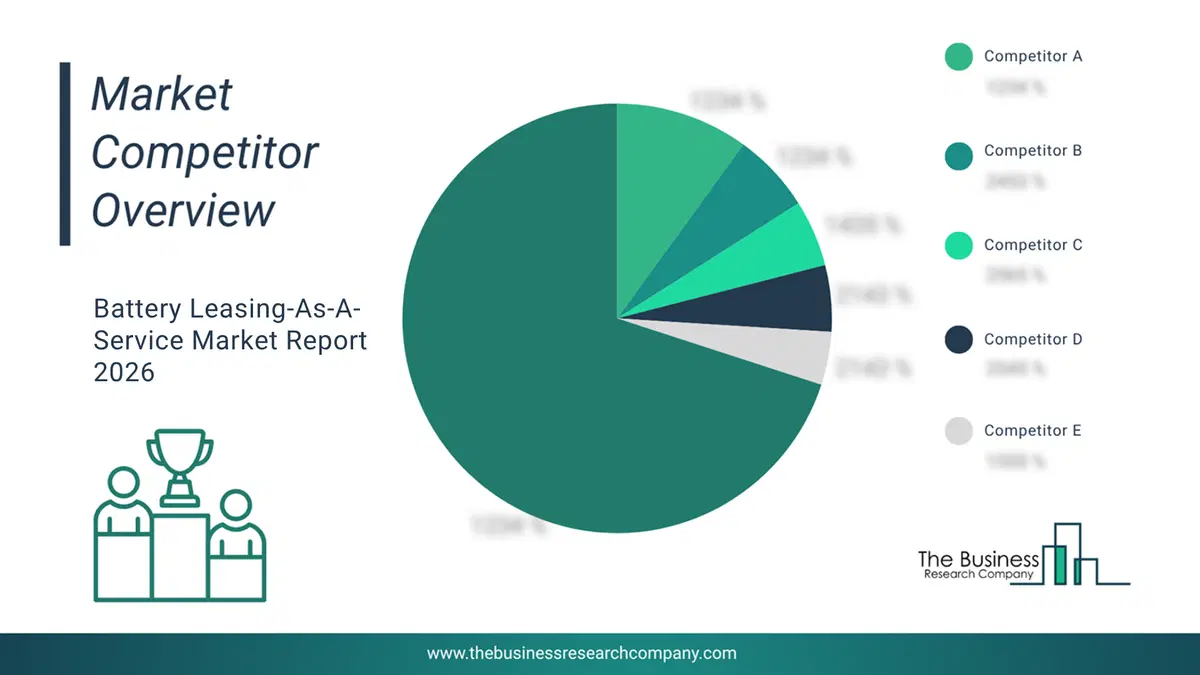
This chart is for illustrative purposes; the full report includes a detailed competitor analysis and comprehensive overview of the top 10 companies in the market.
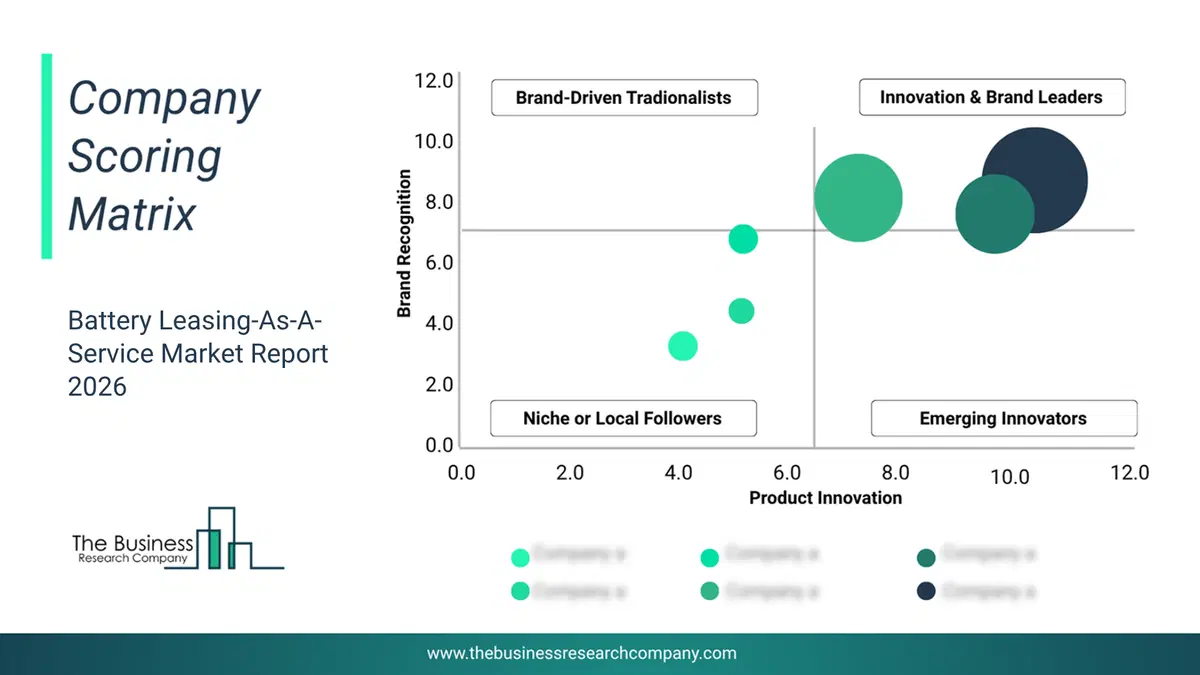
This chart maps companies by product innovation and brand strength, with bubble size indicating relative revenue, helping identify market leaders, challengers, and niche players. This is an illustrative chart; the full report provides a complete and accurate competitive analysis.
Global Battery Leasing-As-A-Service Market Trends and Insights
Major companies operating in the battery leasing-as-a-service market are focusing on launching advanced energy storage deployment models, such as subscription-based battery storage solutions, to reduce upfront capital costs, improve grid performance, and enhance energy flexibility for utilities and energy providers. Subscription-based battery storage solutions are energy storage offerings in which customers pay a recurring fee to access, use, and manage battery systems without owning them, with the provider handling installation, maintenance, and performance management. For instance, in March 2025, Nuvve Holding Corp., a US-based grid modernization and vehicle-to-grid (V2G) solutions provider, launched its Battery-as-a-Service (BaaS) offering targeted at electric cooperatives and load-serving entities. This subscription-based solution enables scalable deployment of battery energy storage systems across commercial, industrial, and utility-scale applications through 10–12-year service agreements, supporting peak demand management, grid resilience, and cost-effective infrastructure modernization.What Are Latest Mergers And Acquisitions In The Battery Leasing-As-A-Service Market?
In December 2024, Mahindra Last Mile Mobility Limited, an India-based commercial electric vehicle manufacturer, partnered with Vidyut to introduce battery-as-a-service financing for electric vehicles. Through this partnership, Mahindra Last Mile Mobility Limited aims to make electric vehicle ownership more affordable and flexible by separating battery ownership from the vehicle and offering a subscription-based battery leasing model. Vidyut is an India-based electric vehicle startup that provides battery leasing-as-a-service (BaaS) solutions, enabling flexible battery rentals and reducing upfront costs for EV owners.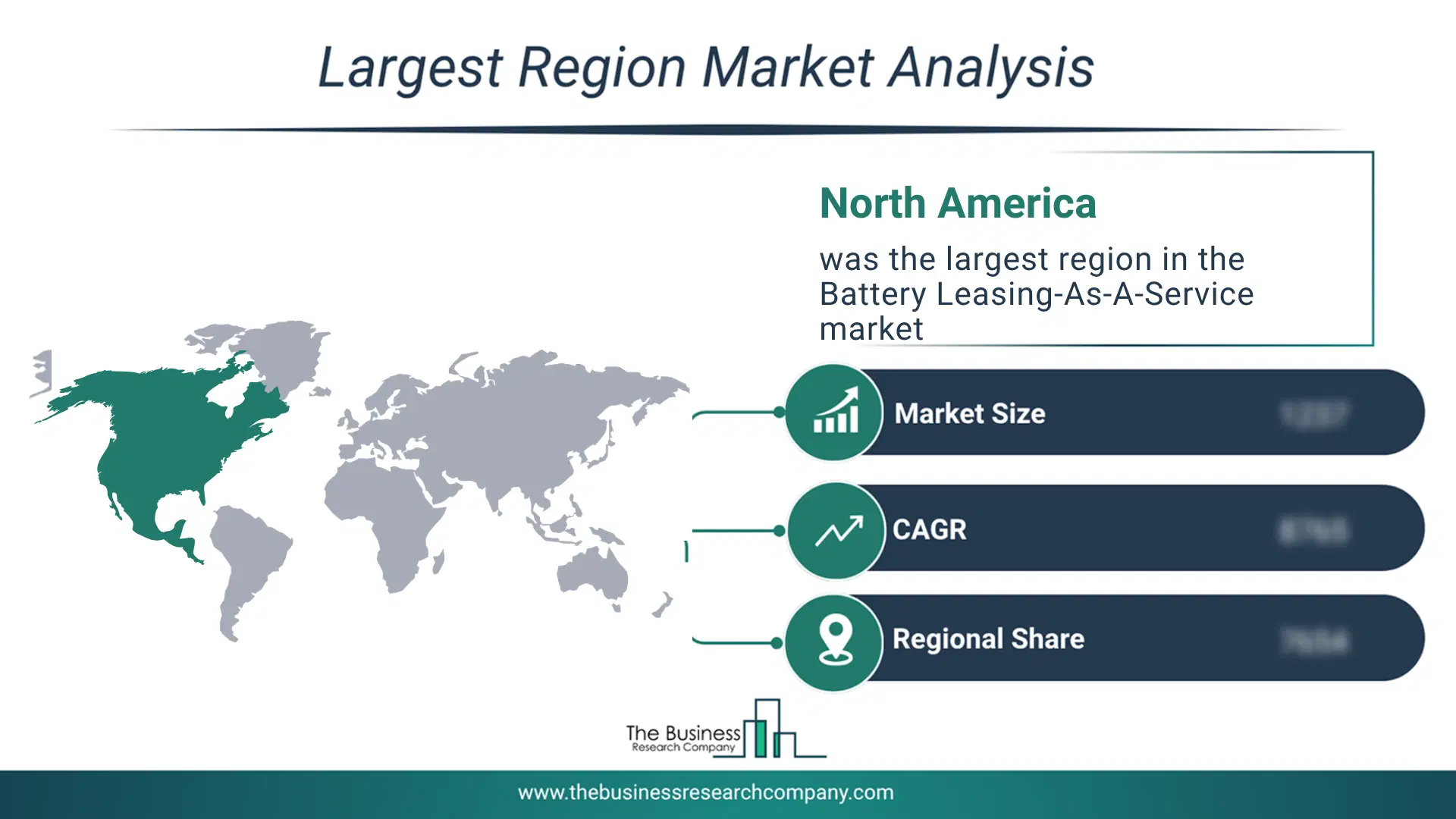
Regional Outlook
North America was the largest region in the battery leasing-as-a-service market in 2025. Asia-Pacific is expected to be the fastest-growing region in the forecast period. The regions covered in this market report are Asia-Pacific, South East Asia, Western Europe, Eastern Europe, North America, South America, Middle East, Africa. The countries covered in this market report are Australia, Brazil, China, France, Germany, India, Indonesia, Japan, Taiwan, Russia, South Korea, UK, USA, Canada, Italy, Spain.What Defines the Battery Leasing-As-A-Service Market?
The battery leasing‑as‑a‑service market includes revenues earned by entities through subscription-based battery access, battery asset management, battery lifecycle management, battery monitoring services, battery maintenance and repair, battery swapping services, battery recycling coordination, end-of-life battery management, and billing and payment services. The market value includes the value of related goods sold by the service provider or included within the service offering. Only goods and services traded between entities or sold to end consumers are included.How is Market Value Defined and Measured?
The market value is defined as the revenues that enterprises gain from the sale of goods and/or services within the specified market and geography through sales, grants, or donations in terms of the currency (in USD unless otherwise specified). The revenues for a specified geography are consumption values that are revenues generated by organizations in the specified geography within the market, irrespective of where they are produced. It does not include revenues from resales along the supply chain, either further along the supply chain or as part of other products.
This chart presents market attractiveness based on a quantitative evaluation of growth, competition, strategic alignment, and risk, offering a clear view of opportunity areas for decision-making. This chart is for illustrative purposes; the full report contains the complete analysis.

This chart highlights the Total Addressable Market (TAM) by estimating the maximum revenue opportunity using an assumption-driven approach, supporting strategic planning and opportunity sizing across markets. The chart is illustrative; the full report provides a more comprehensive analysis.
What Key Data and Analysis Are Included in the Battery Leasing-As-A-Service Market Report 2026?
The battery leasing-as-a-service market research report is one of a series of new reports from The Business Research Company that provides market statistics, including industry global market size, regional shares, competitors with the market share, detailed market segments, market trends and opportunities, and any further data you may need to thrive in the battery leasing-as-a-service industry. The market research report delivers a complete perspective of everything you need, with an in-depth analysis of the current and future state of the industry.Battery Leasing-As-A-Service Market Report Forecast Analysis
| Report Attribute | Details |
|---|---|
| Market Size Value In 2026 | $4.32 billion |
| Revenue Forecast In 2030 | $9.64 billion |
| Growth Rate | CAGR of 22.0% from 2026 to 2030 |
| Base Year For Estimation | 2025 |
| Actual Estimates/Historical Data | 2020-2025 |
| Forecast Period | 2026 - 2030 - 2030 |
| Market Representation | Revenue in USD Billion and CAGR from 2026 to 2030 |
| Segments Covered | Battery Type, Energy Storage Capacity, Service Model, End-User Industry |
| Regional Scope | Asia-Pacific, Western Europe, Eastern Europe, North America, South America, Middle East, Africa |
| Country Scope | The countries covered in the report are Australia, Brazil, China, France, Germany, India, Indonesia, Japan, Taiwan, Russia, South Korea, UK, USA, Canada, Italy, Spain. |
| Key Companies Profiled | Shell Plc, SAIC Motor Corporation Limited, Renault S.A., NIO Inc., XPENG Inc., VinFast Auto Ltd., Enel X Way S.r.l., Gogoro Inc., Blink Charging Co. Inc., Ather Energy Private Limited, Sun Mobility Private Limited, Bounce Infinity Private Limited, Swobbee, Battery Smart India Private Limited, Nuvve Holding Corp., Ample Inc., Oyika Pte. Ltd., Octillion Power Systems Inc., Vidyut, and Lithium Urban Technologies Private Limited |
| Customization Scope | Request for Customization |
| Pricing And Purchase Options | Explore Purchase Options |