

Big Data Analytics In Banking, Financial Services, And Insurance (BFSI) Market Report 2026
Global Outlook – By Type Of Big Data Analytics (Descriptive Analytics, Predictive Analytics, Prescriptive Analytics, Diagnostic Analytics, Real-Time Analytics), By Deployment Mode (On-premises, Cloud-based, Hybrid), By Size Of Organization (Small Enterprises, Medium Enterprises, Large Enterprises), By Application (Customer Relationship Management (CRM), Fraud Detection, Risk Management, Operation Optimization, Customer Analytics, Other Applications), By End User (Banks, Insurance Companies, Investment Firms, Regulatory Bodies, Financial Technology (FinTech) Companies) – Market Size, Trends, Strategies, and Forecast to 2030
Big Data Analytics In Banking, Financial Services, And Insurance (BFSI) Market Overview
• Big Data Analytics In Banking, Financial Services, And Insurance (BFSI) market size has reached to $30.67 billion in 2025 • Expected to grow to $62.5 billion in 2030 at a compound annual growth rate (CAGR) of 15.2% • Growth Driver: Surge In Digital Transactions Fueling The Growth Of The Market Due To Rising Smartphone Adoption • Market Trend: Advancements In Unified Customer Data Platforms Driving Real-Time Insights And Enhanced Decision-Making • North America was the largest region in 2025 and Asia-Pacific is the fastest growing region.Market Gains By 2030 – Top Opportunities By Segment
Market Gain identifies the most promising market opportunities by highlighting the segments or products expected to generate the highest incremental revenue growth over the next five years.
What Is Covered Under Big Data Analytics In Banking, Financial Services, And Insurance (BFSI) Market?
Big data analytics in banking, financial services, and insurance (BFSI) involves processing and analyzing vast volumes of data generated across financial operations to extract meaningful insights. It enables organizations to understand patterns, predict trends, and make informed decisions that improve efficiency, manage risks, and support strategic growth, all while handling complex and dynamic financial information in real time. The main types of big data analytics in banking, financial services, and insurance (BFSI) are descriptive analytics, predictive analytics, prescriptive analytics, diagnostic analytics, and real-time analytics. Descriptive analytics refers to the process of analyzing historical data to summarize and understand what has happened in the past. These analytics can be deployed in various modes, including on-premises, cloud-based, and hybrid, and are applicable to organizations of different sizes, including small, medium, and large enterprises. Big data analytics is used in various applications such as customer relationship management (CRM), fraud detection, risk management, operational optimization, customer analytics, and others. The key end users include banks, insurance companies, investment firms, regulatory bodies, and financial technology (FinTech) companies.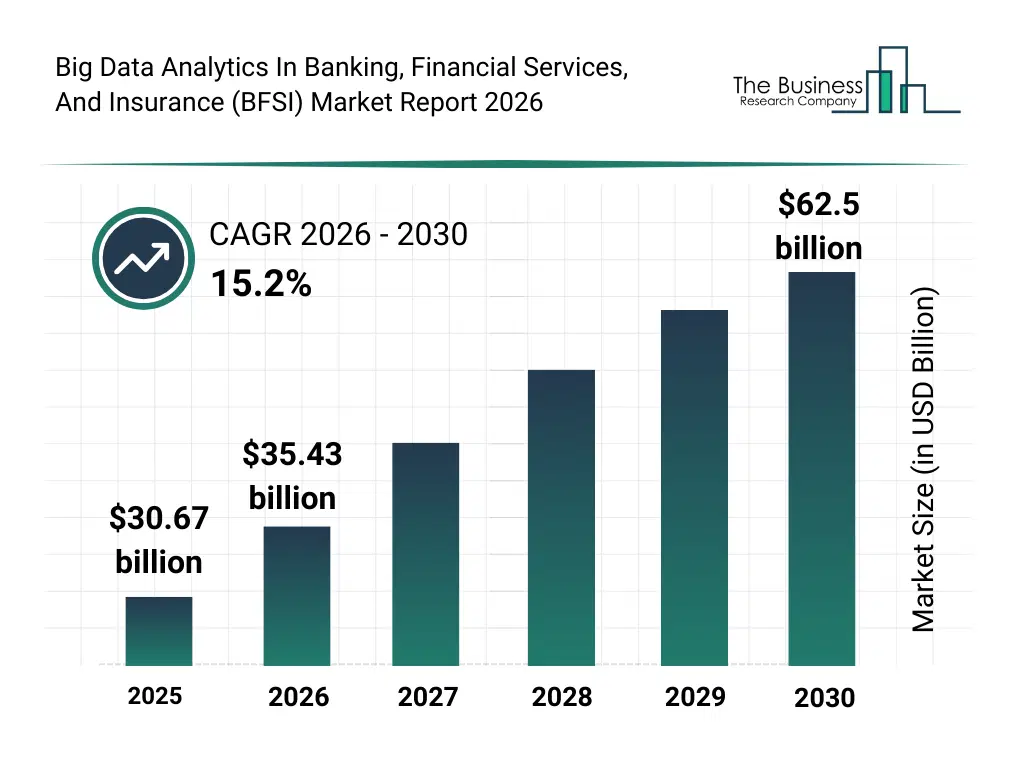
What Is The Big Data Analytics In Banking, Financial Services, And Insurance (BFSI) Market Size and Share 2026?
The big data analytics in banking, financial services, and insurance (bfsi) market size has grown rapidly in recent years. It will grow from $30.67 billion in 2025 to $35.43 billion in 2026 at a compound annual growth rate (CAGR) of 15.5%. The growth in the historic period can be attributed to increasing digital banking transactions, rising volumes of structured and unstructured financial data, expansion of online banking services, growing demand for data-driven risk management, early adoption of analytics for fraud detection.What Is The Big Data Analytics In Banking, Financial Services, And Insurance (BFSI) Market Growth Forecast?
The big data analytics in banking, financial services, and insurance (bfsi) market size is expected to see rapid growth in the next few years. It will grow to $62.5 billion in 2030 at a compound annual growth rate (CAGR) of 15.2%. The growth in the forecast period can be attributed to increasing integration of AI-driven analytics tools, rising focus on personalized financial services, expansion of real-time decision-making systems, growing investments in cloud-native analytics platforms, increasing regulatory emphasis on data transparency. Major trends in the forecast period include increasing adoption of real-time fraud analytics, rising use of predictive risk modeling, growing deployment of cloud-based analytics platforms, expansion of customer-centric data insights, enhanced focus on regulatory analytics automation.
Global Big Data Analytics In Banking, Financial Services, And Insurance (BFSI) Market Segmentation
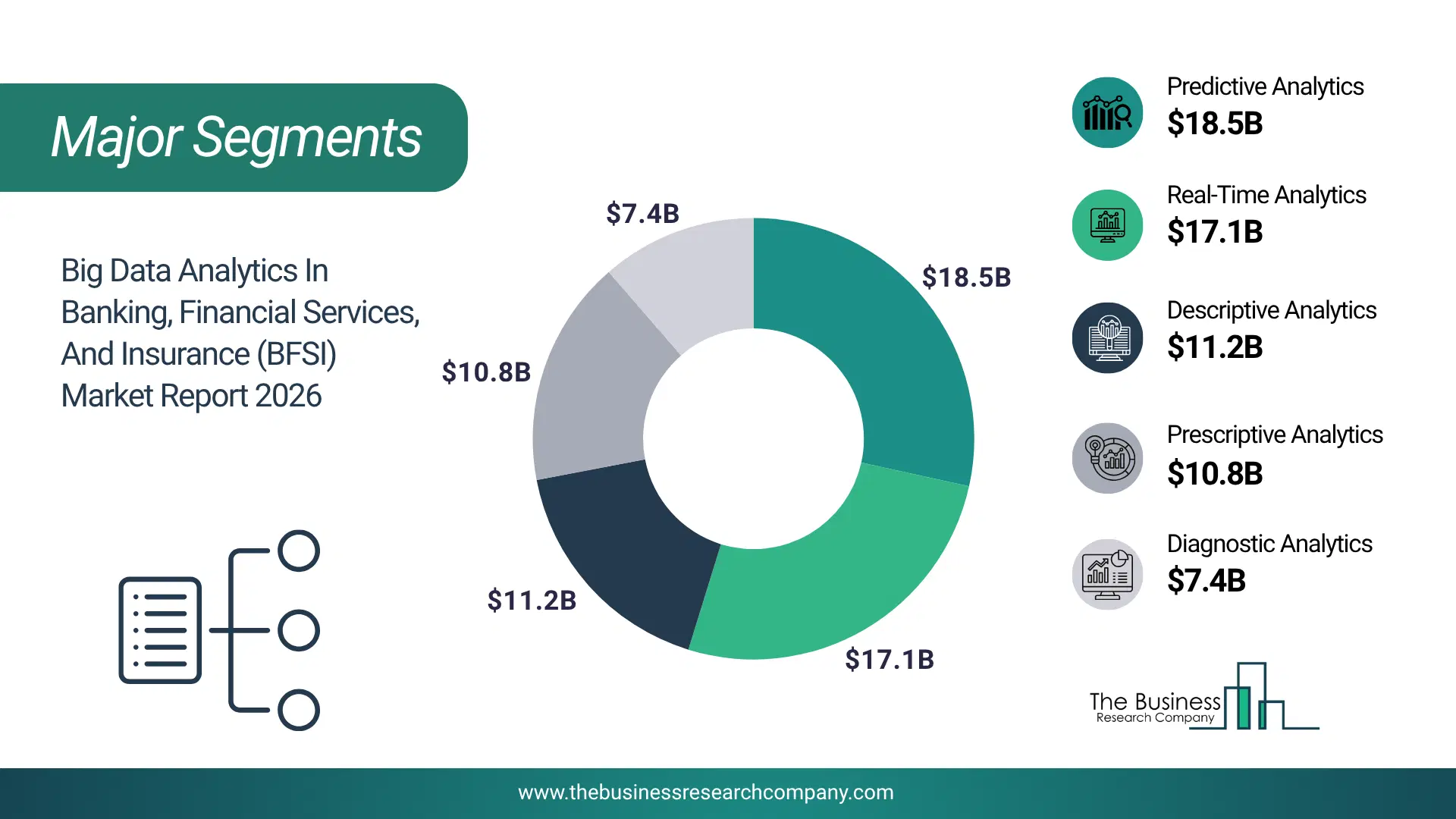
1) By Type Of Big Data Analytics: Descriptive Analytics, Predictive Analytics, Prescriptive Analytics, Diagnostic Analytics, Real-Time Analytics 2) By Deployment Mode: On-premises, Cloud-based, Hybrid 3) By Size Of Organization: Small Enterprises, Medium Enterprises, Large Enterprises 4) By Application: Customer Relationship Management (CRM), Fraud Detection, Risk Management, Operation Optimization, Customer Analytics, Other Applications 5) By End User: Banks, Insurance Companies, Investment Firms, Regulatory Bodies, Financial Technology (FinTech) Companies Subsegments: 1) By Descriptive Analytics: Customer Behavior Analysis, Transaction Trend Analysis, Financial Performance Reporting, Risk Exposure Summarization, Market Segmentation Analysis 2) By Predictive Analytics: Credit Risk Forecasting, Fraud Detection Modeling, Customer Churn Prediction, Investment Return Forecasting, Loan Default Prediction 3) By Prescriptive Analytics: Portfolio Optimization Recommendations, Risk Mitigation Strategies, Personalized Product Offering Suggestions, Regulatory Compliance Advisory, Pricing Strategy Optimization 4) By Diagnostic Analytics: Fraud Incident Investigation, Loss Causation Analysis, Compliance Breach Analysis, Customer Complaint Root Cause Analysis, Failed Transaction Analysis 5) By Real-Time Analytics, By Type: Instant Fraud Detection, Real-Time Credit Scoring, Live Transaction Monitoring, Immediate Risk Alerts, Dynamic Market Pricing The top segments in the big data analytics in banking, financial services, and insurance (bfsi) market will be: • Predictive Analytics will reach $18.43 billion by 2030. • Real-Time Analytics will reach $17 billion by 2030. • Descriptive Analytics will reach $11.13 billion by 2030. • Prescriptive Analytics will reach $10.71 billion by 2030. • Diagnostic Analytics will reach $7.37 billion by 2030.What Is The Driver Of The Big Data Analytics In Banking, Financial Services, And Insurance (BFSI) Market?
A surge in digital transactions is expected to propel the growth of big data analytics in banking, financial services, and insurance (BFSI) market going forward. Digital transactions refer to the exchange of money or value electronically, while interactions refer to the communication or engagement between users and digital platforms during such processes. Growth in digital transactions is due to widespread smartphone adoption as more people own smartphones, digital transactions are increasing due to easier and faster access to financial services. Big data analytics in BFSI supports digital transactions by delivering real-time insights that enhance security, personalize services, and optimize customer experiences. For instance, in January 2024, according to the European Central Bank, a Germany-based central bank, the volume of contactless card transactions surged by 24.3% in the first half of 2023, reaching 20.9 billion transactions compared to the same period in 2022. Therefore, the surge in digital transactions and interactions is driving the growth of the big data analytics in banking, financial services, and insurance (BFSI) industry.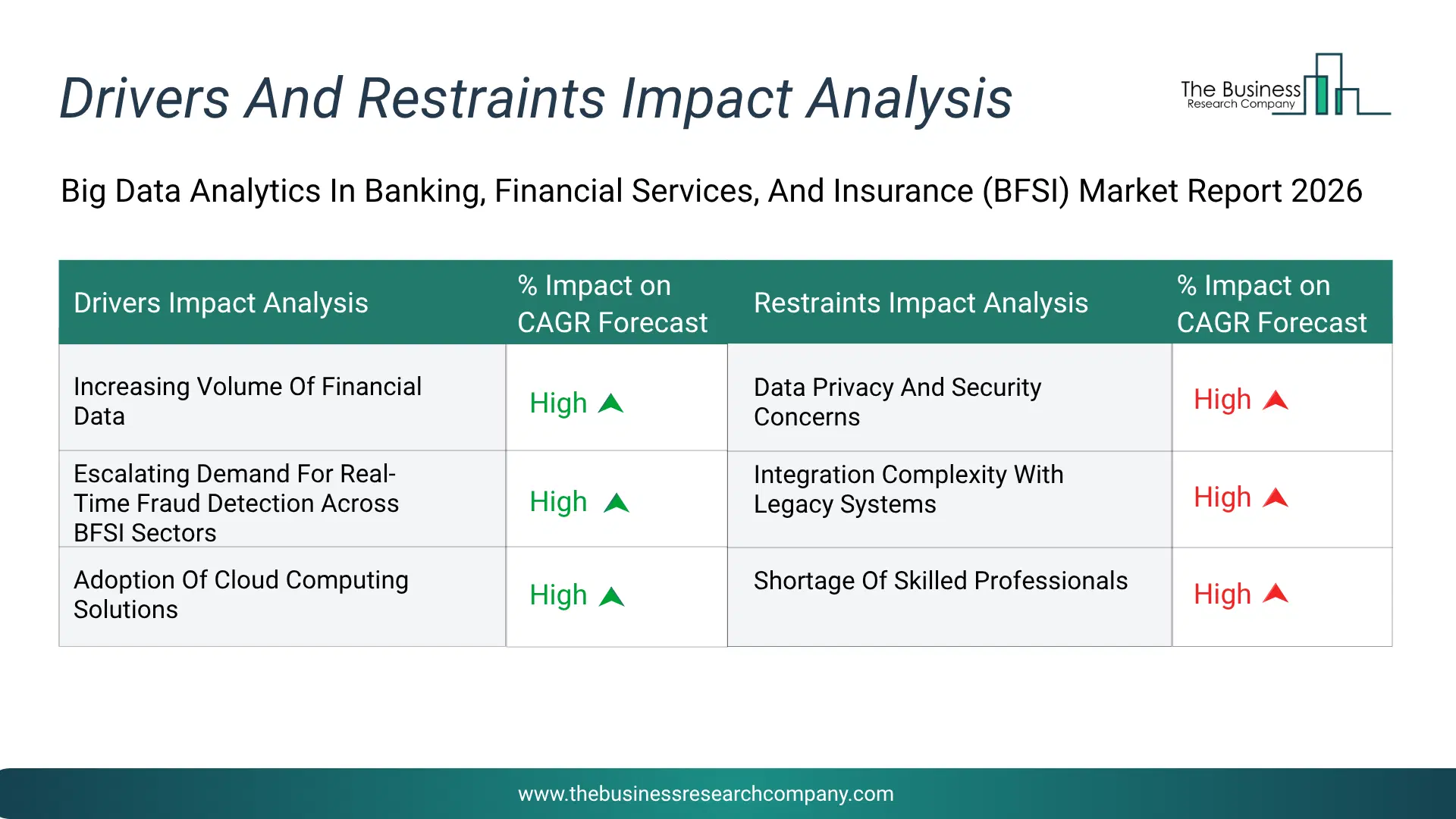
Infographic Chart Showing Key Market Drivers Analysis And Restraints For Big Data Analytics In Banking, Financial Services, And Insurance (Bfsi) Market
The chart presents an impact analysis of key drivers and restraints, quantifying their relative influence on the market's growth rate and helping assess the balance between growth enablers and limiting factors. This chart offers a high-level perspective; the full report contains more detailed insights.
How Will The Drivers Impact Growth In The Global Big Data Analytics In Banking, Financial Services, And Insurance (BFSI) Market?
• Increasing Volume Of Financial Data (High) – During the forecast period, the increasing volume of financial data is expected to become a key growth driver for the big data analytics in bfsi market by 2030. Financial institutions are generating massive amounts of structured and unstructured data through digital banking transactions, payment platforms, trading systems, and customer interactions across multiple channels. This surge in financial data requires advanced analytics platforms capable of processing, storing, and analyzing large datasets in real time. Banks and insurance companies are therefore investing in scalable big data infrastructure and analytics tools to extract actionable insights, enhance customer personalization, and improve operational efficiency. • Escalating Demand For Real-Time Fraud Detection Across BFSI Sectors (High) – During the forecast period, the escalating demand for real-time fraud detection across bfsi sectors is expected to emerge as a major factor driving the expansion of the big data analytics in bfsi market by 2030. Financial institutions are increasingly deploying advanced analytics, machine learning, and ai-based monitoring systems to identify suspicious transactions, prevent cyber fraud, and strengthen financial security frameworks. With the rapid growth of digital payments, online banking, and cross-border transactions, the need for real-time fraud detection and risk assessment capabilities has become critical. As a result, financial organizations are investing in predictive analytics and real-time monitoring platforms to protect customer assets and ensure regulatory compliance. • Adoption Of Cloud Computing Solutions (High) – During the forecast period, the adoption of cloud computing solutions is expected to act as a key growth catalyst for the big data analytics in bfsi market by 2030. Cloud-based analytics platforms provide financial institutions with scalable infrastructure, flexible data processing capabilities, and cost-efficient deployment models that support large-scale financial analytics workloads. These solutions enable faster data integration, improved collaboration across financial organizations, and seamless deployment of advanced ai and machine learning tools for risk modeling, customer analytics, and regulatory reporting. As bfsi institutions increasingly transition toward digital and cloud-first strategies, the demand for cloud-based big data analytics platforms is expected to rise significantly.How Will The Restraints Impact Growth In The Global Big Data Analytics In Banking, Financial Services, And Insurance (BFSI) Market?
• Data Privacy And Security Concerns (High) – During the forecast period, the data privacy and security concerns act as a major restraint for big data analytics in the bfsi sector because financial institutions handle highly sensitive customer and transaction data that must be protected from breaches and misuse. Strict data protection regulations and compliance requirements limit how organizations can store, process, and share data for analytics. Any vulnerability or cyberattack can result in severe financial loss and reputational damage. These risks make firms cautious in adopting advanced analytics solutions. As a result, organizations often face delays or restrictions in fully leveraging big data for decision-making. • Integration Complexity With Legacy Systems (High) – During the forecast period, the integration complexity with legacy systems acts as a major restraint for big data analytics in the bfsi sector because most financial institutions still rely on outdated core systems that are incompatible with modern data platforms. These legacy infrastructures make it difficult to consolidate and process large volumes of structured and unstructured data efficiently. As a result, implementation becomes costly, time-consuming, and prone to operational disruptions. The lack of interoperability also limits real-time analytics and slows digital transformation initiatives. Consequently, organizations struggle to fully leverage data-driven insights for faster and more accurate decision-making. • Shortage Of Skilled Professionals (High) – During the forecast period, the the shortage of skilled professionals acts as a major restraint for big data analytics in the bfsi sector because the industry requires experts proficient in data science, machine learning, and regulatory analytics to manage complex financial datasets. A lack of qualified talent limits organizations’ ability to effectively implement and maintain advanced analytics systems. This gap slows down innovation, increases project costs, and leads to dependence on external vendors. Moreover, insufficient expertise can result in poor data interpretation and flawed decision-making. Consequently, it hampers the overall efficiency and competitiveness of bfsi institutions adopting big data solutions.Key Players In The Global Big Data Analytics In Banking, Financial Services, And Insurance (BFSI) Market
Major companies operating in the big data analytics in banking, financial services, and insurance (bfsi) market are Microsoft Corporation, Dell Technologies Inc., Accenture plc, International Business Machines Corporation, Oracle Corporation, Salesforce Inc., Hewlett Packard Enterprise Company, Tata Consultancy Services Limited, Capgemini SE, Cognizant Technology Solutions Corporation, Infosys Limited, Wipro Limited, Genpact Limited, SAS Institute Inc., Hitachi Vantara LLC, Clarivate Plc, Snowflake Inc., Palantir Technologies Inc., Teradata Corporation, Informatica LLC, Fair Isaac Corporation, MicroStrategy Incorporated, Cloudera Inc.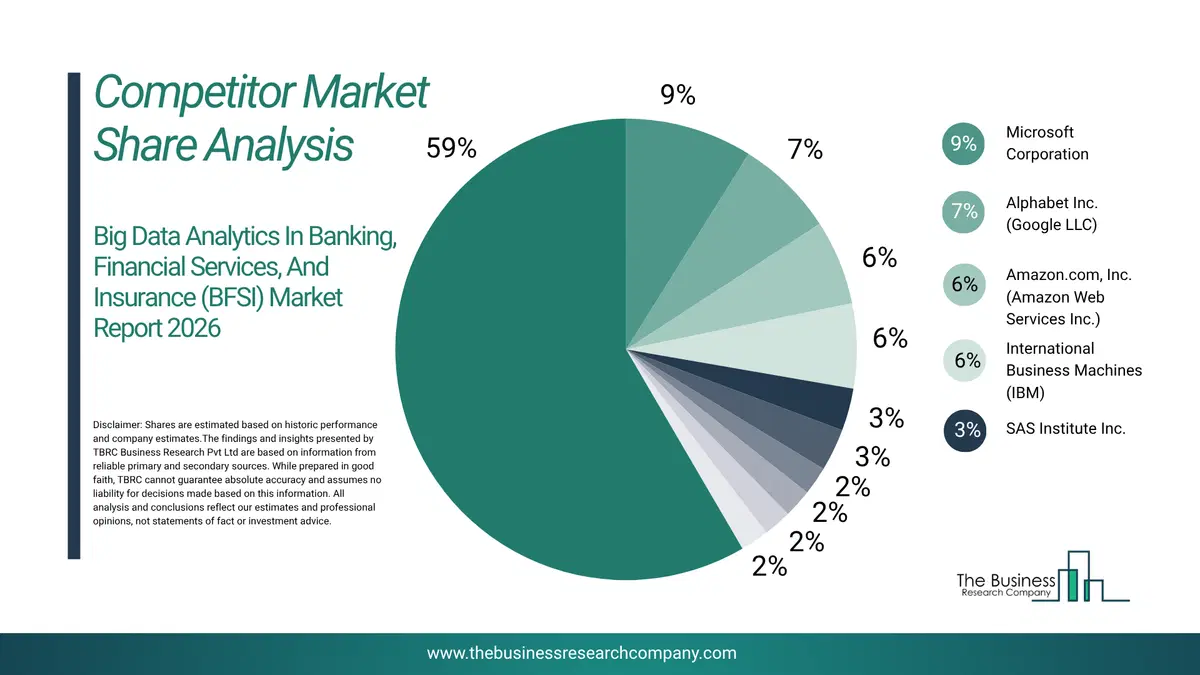
This chart is for illustrative purposes; the full report includes a detailed competitor analysis and comprehensive overview of the top 10 companies in the market.
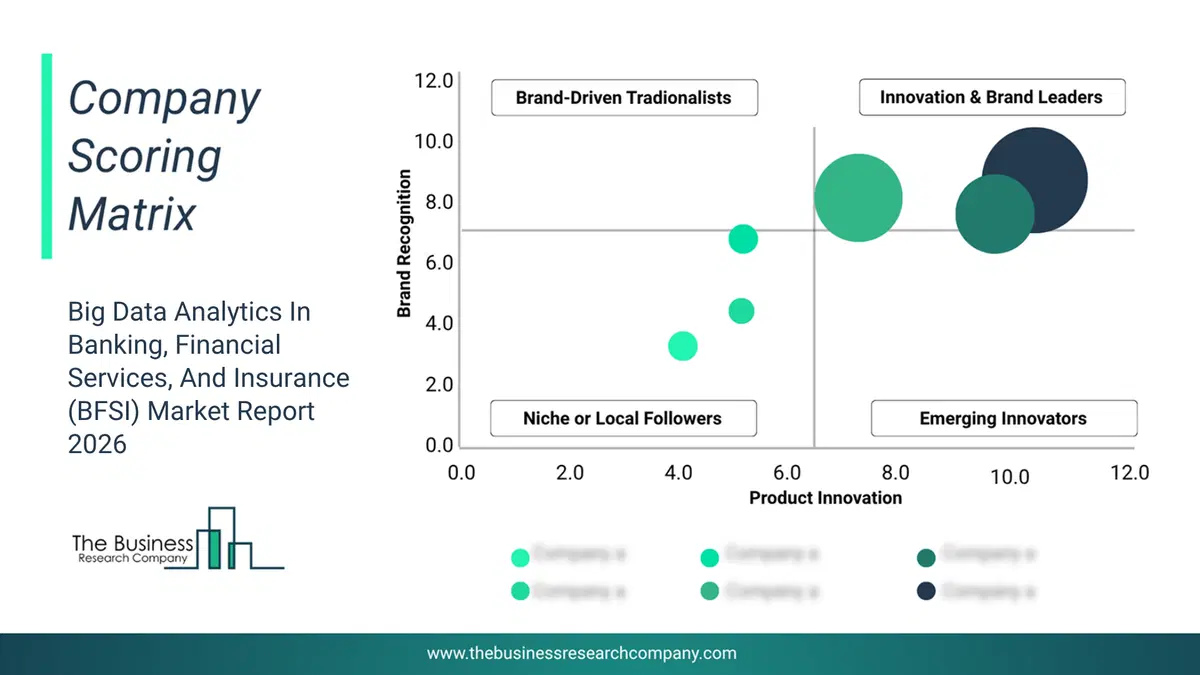
This chart maps companies by product innovation and brand strength, with bubble size indicating relative revenue, helping identify market leaders, challengers, and niche players. This is an illustrative chart; the full report provides a complete and accurate competitive analysis.
Global Big Data Analytics In Banking, Financial Services, And Insurance (BFSI) Market Trends and Insights
Major companies operating in the big data analytics in banking, financial services, and insurance (BFSI) market are focusing on developing advanced solutions, such as customer data platforms (CDPs), to unify customer data from multiple sources and deliver real-time insights for personalization, risk management, and enhanced decision-making. Customer data platforms (CDPs) are software systems that aggregate customer data from multiple sources, unify it into a single profile, and make it accessible for analytics, personalization, and customer engagement. For instance, in November 2024, FinBox Tech Private Limited, an India-based fintech company, launched the Account Aggregator-based Customer Data Platform (CDP) to provide banks and non-banking financial companies (NBFCs) with real-time, unified customer insights. By overcoming fragmented and outdated data locked in silos, the platform enhances precision in assessing financial health and supports diverse use cases beyond underwriting. Lenders can automate rules, create customer cohorts, and unlock applications such as early warning systems, portfolio monitoring, credit line management, and personalized cross-sell and up-sell strategies.What Are Latest Mergers And Acquisitions In The Big Data Analytics In Banking, Financial Services, And Insurance (BFSI) Market?
In December 2023, M2P Fintech, an India-based system software company, acquired Goals101 for $30 million. Following the acquisition, M2P will merge Goals101’s technology with its existing financial services portfolio, expanding its capabilities and allowing the company to offer more comprehensive and integrated solutions. This integration is set to enhance operational efficiency, improve service delivery, and support the development of innovative financial products for its clients. Goals101 is an India-based provider of big data analytics in the banking, financial services, and insurance (BFSI) sector.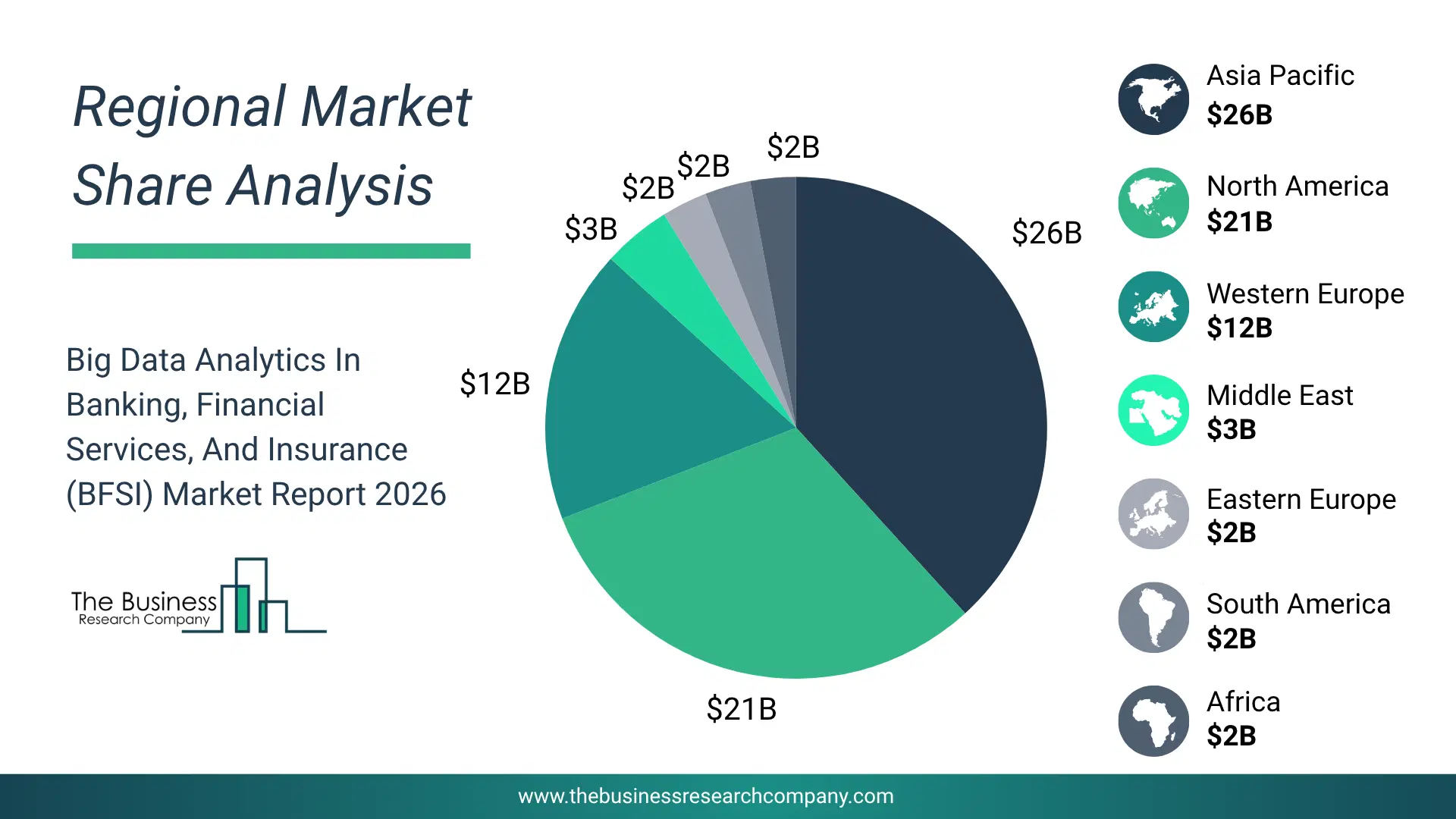
Regional Outlook
North America was the largest region in the big data analytics in banking, financial services, and insurance (BFSI) market in 2025. Asia-Pacific is expected to be the fastest-growing region in the forecast period. The regions covered in this market report are Asia-Pacific, South East Asia, Western Europe, Eastern Europe, North America, South America, Middle East, Africa. The countries covered in this market report are Australia, Brazil, China, France, Germany, India, Indonesia, Japan, Taiwan, Russia, South Korea, UK, USA, Canada, Italy, Spain.What Defines the Big Data Analytics In Banking, Financial Services, And Insurance (BFSI) Market?
The big data analytics in banking, financial services, and insurance (BFSI) market consists of revenues earned by entities by providing services such as credit scoring and loan analytics, portfolio management analytics, customer segmentation, and real-time transaction monitoring. The market value includes the value of related goods sold by the service provider or included within the service offering. The big data analytics in banking, financial services, and insurance (BFSI) market also includes sales of data storage systems, real-time data processing systems, fraud detection appliances, and data visualization appliances. Values in this market are ‘factory gate’ values, that is the value of goods sold by the manufacturers or creators of the goods, whether to other entities (including downstream manufacturers, wholesalers, distributors and retailers) or directly to end customers. The value of goods in this market includes related services sold by the creators of the goods.How is Market Value Defined and Measured?
The market value is defined as the revenues that enterprises gain from the sale of goods and/or services within the specified market and geography through sales, grants, or donations in terms of the currency (in USD unless otherwise specified). The revenues for a specified geography are consumption values that are revenues generated by organizations in the specified geography within the market, irrespective of where they are produced. It does not include revenues from resales along the supply chain, either further along the supply chain or as part of other products.
This chart presents market attractiveness based on a quantitative evaluation of growth, competition, strategic alignment, and risk, offering a clear view of opportunity areas for decision-making. This chart is for illustrative purposes; the full report contains the complete analysis.

This chart highlights the Total Addressable Market (TAM) by estimating the maximum revenue opportunity using an assumption-driven approach, supporting strategic planning and opportunity sizing across markets. The chart is illustrative; the full report provides a more comprehensive analysis.
What Key Data and Analysis Are Included in the Big Data Analytics In Banking, Financial Services, And Insurance (BFSI) Market Report 2026?
The big data analytics in banking, financial services, and insurance (bfsi) market research report is one of a series of new reports from The Business Research Company that provides market statistics, including Market Report 2026?global market size, regional shares, competitors with the market share, detailed market segments, market trends and opportunities, and any further data you may need to thrive in the big data analytics in banking, financial services, and insurance (bfsi) Market Report 2026? The market research report delivers a complete perspective of everything you need, with an in-depth analysis of the current and future state of the Market Report 2026?Big Data Analytics In Banking, Financial Services, And Insurance (BFSI) Market Report Forecast Analysis
| Report Attribute | Details |
|---|---|
| Market Size Value In 2026 | $35.43 billion |
| Revenue Forecast In 2030 | $62.5 billion |
| Growth Rate | CAGR of 15.2% from 2026 to 2030 |
| Base Year For Estimation | 2025 |
| Actual Estimates/Historical Data | 2020-2025 |
| Forecast Period | 2026 - 2030 |
| Market Representation | Revenue in USD Billion and CAGR from 2026 to 2030 |
| Segments Covered | Type Of Big Data Analytics, Deployment Mode, Size Of Organization, Application, End User |
| Regional Scope | Asia-Pacific, Western Europe, Eastern Europe, North America, South America, Middle East, Africa |
| Country Scope | The countries covered in the report are Australia, Brazil, China, France, Germany, India, ... |
| Key Companies Profiled | Microsoft Corporation, Dell Technologies Inc., Accenture plc, International Business Machines Corporation, Oracle Corporation, Salesforce Inc., Hewlett Packard Enterprise Company, Tata Consultancy Services Limited, Capgemini SE, Cognizant Technology Solutions Corporation, Infosys Limited, Wipro Limited, Genpact Limited, SAS Institute Inc., Hitachi Vantara LLC, Clarivate Plc, Snowflake Inc., Palantir Technologies Inc., Teradata Corporation, Informatica LLC, Fair Isaac Corporation, MicroStrategy Incorporated, Cloudera Inc. |
| Customization Scope | Request for Customization |
| Pricing And Purchase Options | Explore Purchase Options |