

Customer Data Platforms Market Report 2026
Global Outlook – By Type (Analytics, Access, Campaign), By Component (Solutions, Services), By Deployment Mode (Cloud, On-Premises), By Organization Size (Large Enterprises, Small And medium-Sized Enterprises (SMEs)), By End-User (Banking, Financial Services And Insurance (BFSI), Retail And E-commerce, IT And Telecom, Healthcare, Manufacturing, Media And Entertainment, Other End-Users) – Market Size, Trends, Strategies, and Forecast to 2030
Customer Data Platforms Market Overview
• Customer Data Platforms market size has reached to $7.37 billion in 2025 • Expected to grow to $31.64 billion in 2030 at a compound annual growth rate (CAGR) of 33.8% • Growth Driver: Rise In The Penetration Of Smartphones Drives The Market • Market Trend: AI-Driven Customer Data Platform Is Gaining Popularity • North America was the largest region in 2025 and Asia-Pacific is the fastest growing region.Market Gains By 2030 – Top Opportunities By Segment
Market Gain identifies the most promising market opportunities by highlighting the segments or products expected to generate the highest incremental revenue growth over the next five years.
What Is Covered Under Customer Data Platforms Market?
Customer data platforms refer to software that gathers and organizes first-party customer data from many sources to provide a single, coherent, and comprehensive view of each customer to generate more personalized marketing campaigns by integrating data from several platforms to produce a single, consolidated customer database with information on all contact points and engagements. The main types of customer data platforms are analytics, access, and campaigns. The analytics customer data platforms are used to analyze customer behavior and patterns. Analytics is the process of discovering, interpreting, and communicating significant patterns in data. The various components include solutions and services that are deployed on the cloud and on-premises. The several organizations for the customer data platform are large enterprises and small and medium-sized enterprises that have various end users, including BFSI, retail and ecommerce, healthcare, manufacturing, media and entertainment, IT and telecom, and others.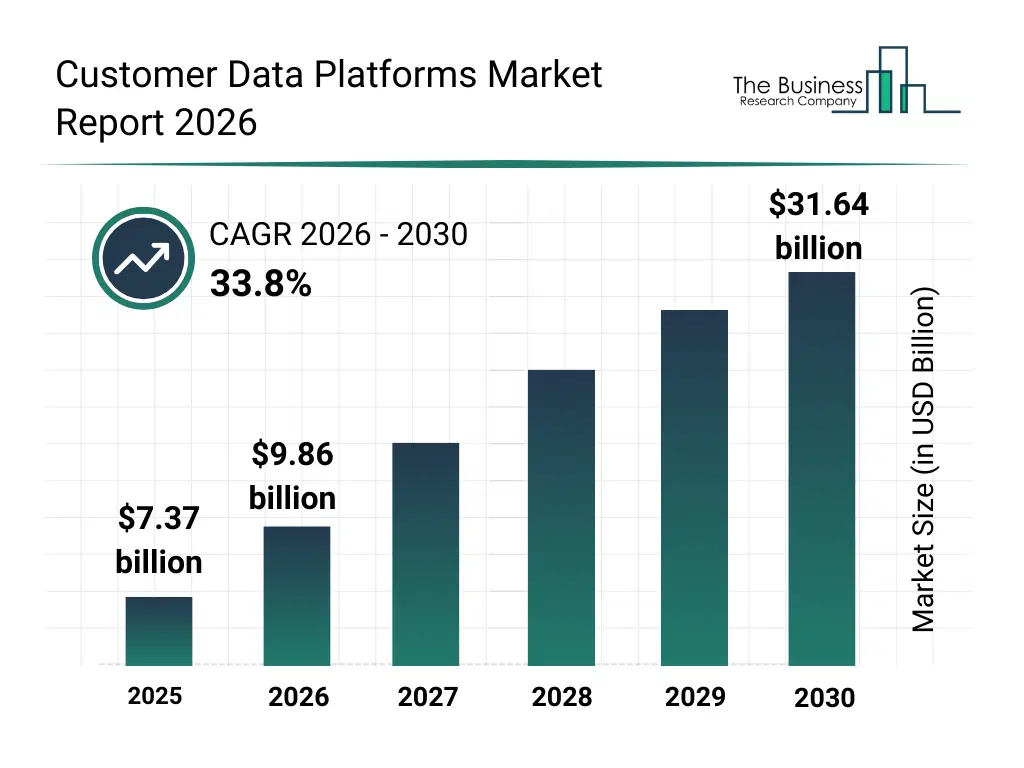
What Is The Customer Data Platforms Market Size and Share 2026?
The customer data platforms market size has grown exponentially in recent years. It will grow from $7.37 billion in 2025 to $9.86 billion in 2026 at a compound annual growth rate (CAGR) of 33.9%. The growth in the historic period can be attributed to increasing fragmentation of customer data sources, early adoption of marketing automation platforms, growth of data-driven marketing strategies, rising demand for personalized campaigns, expansion of cloud data storage.What Is The Customer Data Platforms Market Growth Forecast?
The customer data platforms market size is expected to see exponential growth in the next few years. It will grow to $31.64 billion in 2030 at a compound annual growth rate (CAGR) of 33.8%. The growth in the forecast period can be attributed to increasing investments in predictive customer intelligence, rising adoption of privacy-first data platforms, expansion of real-time personalization use cases, growing integration with crm and marketing tools, increasing demand for scalable customer data solutions. Major trends in the forecast period include increasing adoption of unified customer data architectures, rising use of ai-driven customer analytics, growing integration of real-time data ingestion tools, expansion of cross-channel customer profiling, enhanced focus on data privacy and governance.
Global Customer Data Platforms Market Segmentation
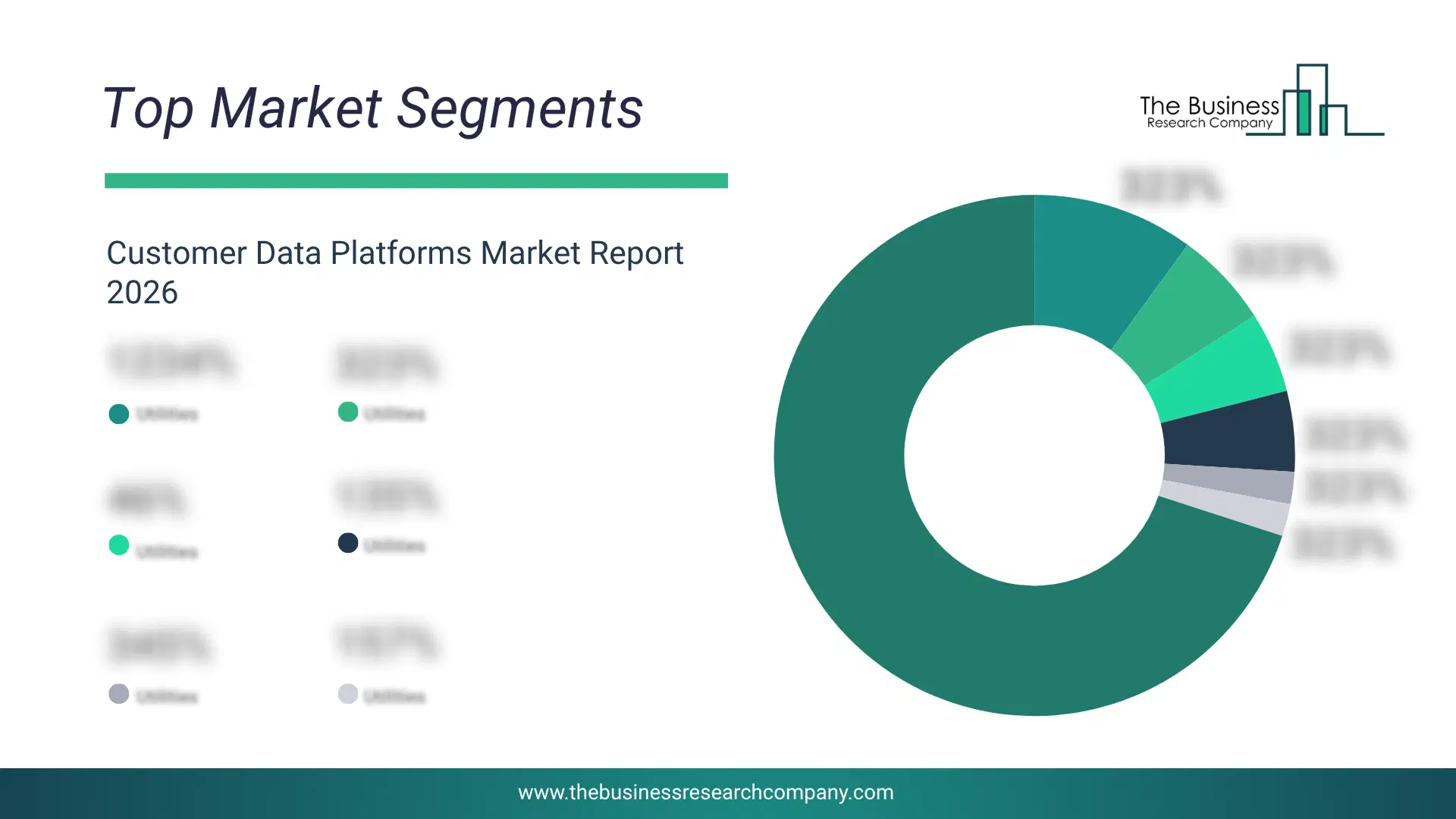
1) By Type: Analytics, Access, Campaign 2) By Component: Solutions, Services 3) By Deployment Mode: Cloud, On-Premises 4) By Organization Size: Large Enterprises, Small And medium-Sized Enterprises (SMEs) 5) By End-User: Banking, Financial Services And Insurance (BFSI), Retail And E-commerce, IT And Telecom, Healthcare, Manufacturing, Media And Entertainment, Other End-Users Subsegments: 1) By Analytics: Predictive Analytics, Descriptive Analytics, Prescriptive Analytics 2) By Access: Data Integration Tools, Data Management Tools, Data Security Tools 3) By Campaign: Campaign Management Tools, Customer Journey Mapping Tools, A Or B Testing Tools The top segments in the customer data platforms market will be: • Analytics will reach $14.41 Billion by 2030. • Access will reach $9.69 Billion by 2030. • Campaign will reach $7.45 Billion by 2030.What Is The Driver Of The Customer Data Platforms Market?
The rise in the penetration of smartphones is expected to drive the growth of the customer data platforms market. Smartphones are multifunctional handheld devices that combine communication, computing, and various other features, typically equipped with a touchscreen interface. Customer data platforms can seamlessly integrate and analyze diverse customer data from smartphones. Companies are increasingly recognizing the value of this comprehensive customer data in tailoring personalized experiences. The demand for CDPs is thus propelled by the imperative to harness smartphone-generated data for targeted marketing, customer engagement, and informed decision-making, positioning them at the forefront of the evolving landscape of data-driven marketing strategies. For example, in March 2023, according to Zippia, a US-based company that provides online recruitment services, there were 307 million smartphone users in the USA and nearly 85% of American adults use smartphones. Therefore, the rise in the penetration of smartphones propelled the customer data platforms industry.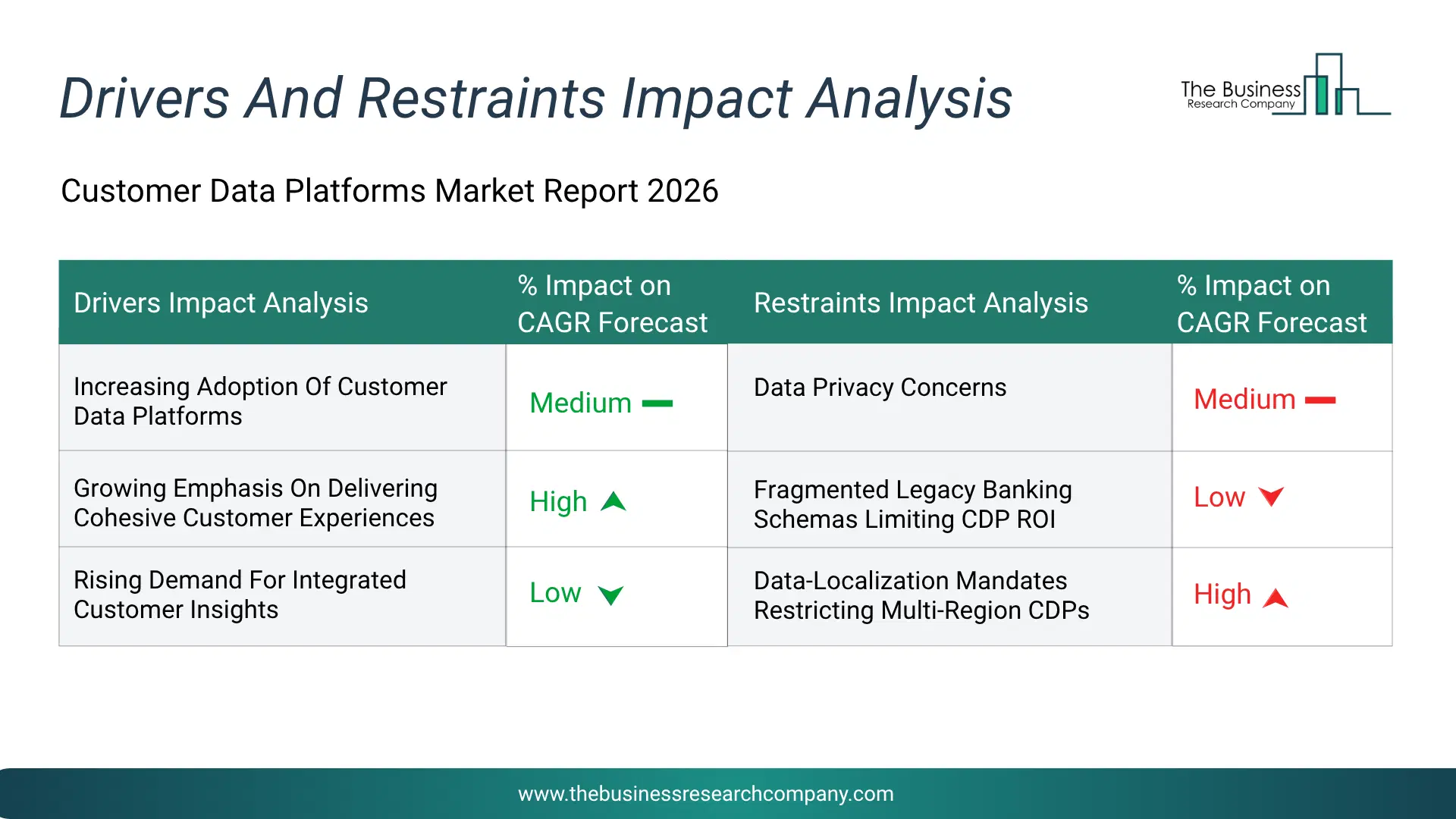
Infographic Chart Showing Key Market Drivers Analysis And Restraints For Customer Data Platforms Market
The chart presents an impact analysis of key drivers and restraints, quantifying their relative influence on the market's growth rate and helping assess the balance between growth enablers and limiting factors. This chart offers a high-level perspective; the full report contains more detailed insights.
How Will The Drivers Impact Growth In The Global Customer Data Platforms Market?
• Increasing Adoption Of Customer Data Platforms (Medium) – During the forecast period, the increasing adoption of customer data platforms is expected to become a key growth driver for the customer data platforms market by 2030. Enterprises across multiple industries are deploying customer data platforms to unify fragmented customer information collected from websites, mobile applications, CRM systems, and digital interaction channels into centralized data environments. Organizations are increasingly focusing on improving customer targeting accuracy, optimizing campaign effectiveness, and enhancing retention strategies through consolidated customer intelligence. Vendors are therefore investing in scalable and AI-enabled platform capabilities that support advanced segmentation, automation, and identity resolution functions. This accelerating enterprise adoption of centralized customer data solutions is reinforcing strong market expansion. • Growing Emphasis On Delivering Cohesive Customer Experiences (High) – During the forecast period, the growing emphasis on delivering cohesive customer experiences is expected to emerge as a major factor driving the expansion of the customer data platforms market by 2030. Businesses are increasingly prioritizing seamless and consistent customer interactions across online, mobile, in-store, and social media channels to strengthen customer loyalty and brand engagement. Customer data platforms enable enterprises to create unified customer profiles that support personalized recommendations, synchronized messaging, and real-time engagement strategies across touchpoints. Rising competition in digital commerce and service industries is further accelerating investments in technologies that enhance customer experience management capabilities. • Rising Demand For Integrated Customer Insights (Low) – During the forecast period, the rising demand for integrated customer insights is expected to act as a key growth catalyst for the customer data platforms market by 2030. Organizations are increasingly seeking advanced analytical capabilities that combine transactional, behavioral, demographic, and engagement data into comprehensive customer intelligence frameworks. Integrated customer insights help enterprises improve strategic decision-making, identify emerging customer trends, and optimize sales and marketing performance through data-driven approaches. Businesses are also adopting predictive analytics and machine learning technologies to derive actionable insights from large-scale customer datasets. As demand for centralized and insight-driven customer management continues to expand globally, deployment of customer data platforms is expected to accelerate significantly.How Will The Restraints Impact Growth In The Global Customer Data Platforms Market?
• Data Privacy Concerns (Medium) – During the forecast period, the data Privacy Concerns are acting as a major restraint for the Customer Data Platform market because customer data platforms collect, store, and process large volumes of sensitive personal information from multiple sources. Organizations are becoming increasingly cautious about data handling practices due to rising regulatory requirements related to consumer privacy and data protection. Strict regulations such as GDPR, CCPA, and other regional privacy laws are increasing compliance costs and operational complexities for businesses deploying CDPs. Companies also face growing risks associated with data breaches, unauthorized access, and cyberattacks, which can damage brand reputation and customer trust. Consumers are becoming more aware of how their personal information is used, forcing enterprises to implement stronger security and consent management systems. In addition, failure to comply with privacy regulations can result in heavy financial penalties and legal liabilities. These concerns are slowing adoption among organizations that are hesitant to centralize large-scale customer data within unified platforms. • Fragmented Legacy Banking Schemas Limiting CDP ROI (High) – During the forecast period, the fragmented Legacy Banking Schemas Limiting CDP ROI are restraining the growth of the Customer Data Platform market because many financial institutions continue operating on outdated and disconnected data infrastructures. Legacy banking systems often store customer information in isolated databases with inconsistent formats, making integration with modern customer data platforms highly complex and resource-intensive. The lack of standardized data architecture reduces the effectiveness of unified customer profiling and limits the ability of CDPs to generate accurate analytics and personalization outcomes. Financial institutions may also experience high implementation costs, extended deployment timelines, and operational disruptions during migration from legacy systems to centralized platforms. In many cases, poor interoperability between traditional banking applications and modern CDP solutions lowers the expected return on investment for enterprises. Additionally, data inconsistencies and duplicate customer records can negatively affect campaign performance and decision-making accuracy. These technological limitations are slowing the adoption of customer data platforms within highly regulated banking environments. • Data-Localization Mandates Restricting Multi-Region CDPs (Low) – During the forecast period, the data-Localization Mandates Restricting Multi-Region CDPs are creating challenges for the Customer Data Platform market because governments across various countries are implementing regulations that require customer data to be stored and processed within national borders. These regulations limit the ability of multinational organizations to operate centralized global customer data platforms efficiently across multiple regions. Businesses are often forced to establish separate regional data infrastructures, increasing operational costs and reducing scalability advantages associated with cloud-based CDP deployments. Data-localization requirements also complicate cross-border customer analytics, making it more difficult for enterprises to achieve a unified global customer view. Organizations operating in multiple countries may face compliance complexities, legal uncertainties, and additional cybersecurity obligations while managing localized data systems. Furthermore, restricted data movement can reduce the effectiveness of real-time personalization and integrated marketing strategies across international markets. As a result, stringent data-localization policies are slowing the seamless expansion of customer data platform solutions worldwide.Key Players In The Global Customer Data Platforms Market
Major companies operating in the customer data platforms market are Oracle Corporation; SAP SE; Adobe Inc.; Salesforce Inc.; Microsoft Corporation; SAS Institute; Teradata; Nice Systems Ltd.; Dun & Bradstreet; Leadspace; BlueVenn; BlueConic Inc.; Terminus; Tealium Inc.; Agilone LLC; mParticle Inc.; Segment. Io Inc.; CaliberMind; Celebrus; Ascent360 Inc.; Lytics Inc.; ActionIQ Inc.; Optimove; Exponea Ltd.; Ensighten Inc.; Twilio Inc.; Acquia Inc.; Zeta Global Corp; Totango; Insider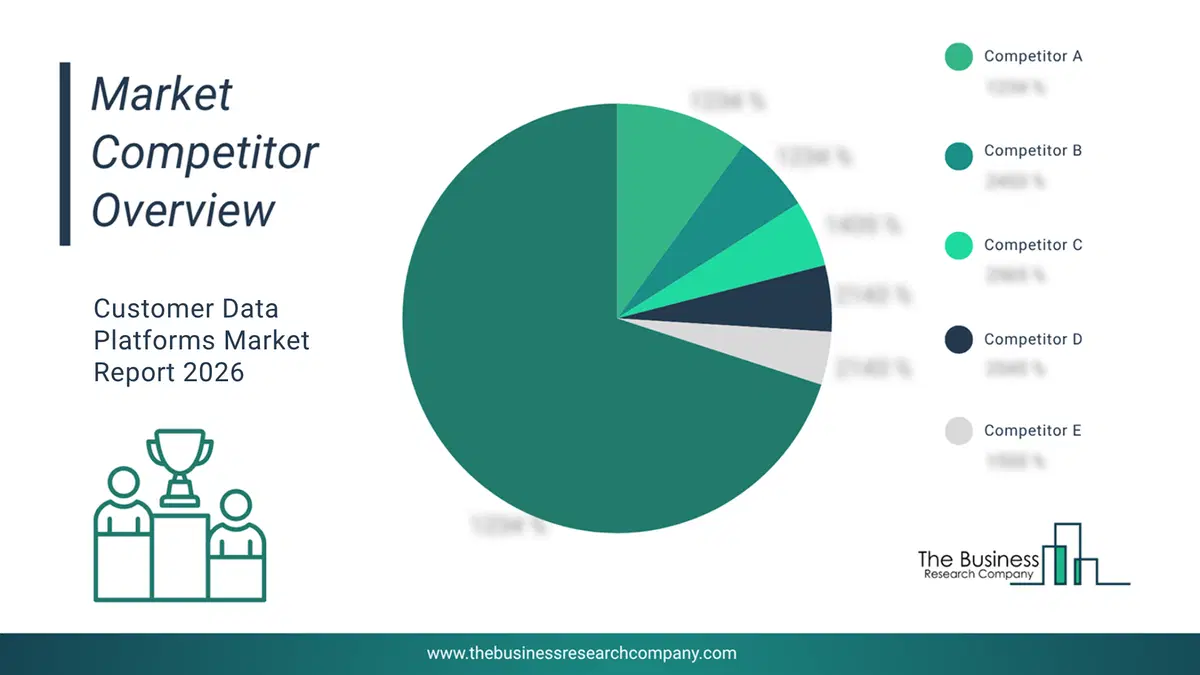
This chart is for illustrative purposes; the full report includes a detailed competitor analysis and comprehensive overview of the top 10 companies in the market.
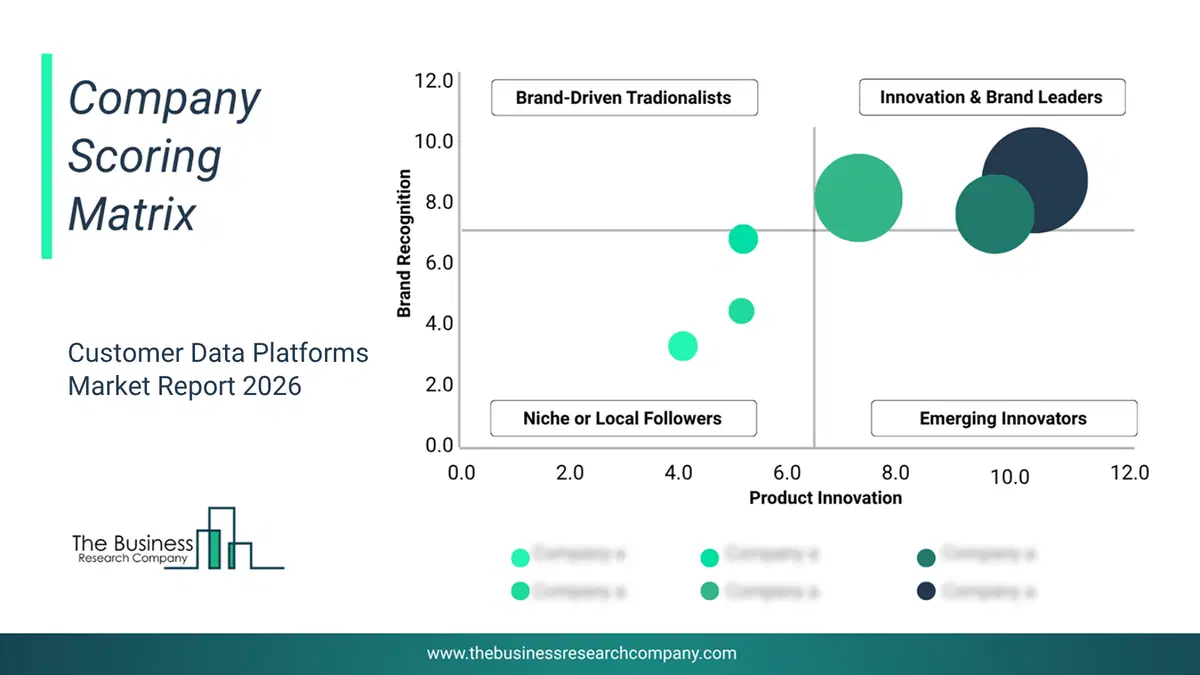
This chart maps companies by product innovation and brand strength, with bubble size indicating relative revenue, helping identify market leaders, challengers, and niche players. This is an illustrative chart; the full report provides a complete and accurate competitive analysis.
Global Customer Data Platforms Market Trends and Insights
Major companies operating in the customer data platform (CDP) market are increasingly prioritizing AI-driven customer data platforms to enhance personalization, strengthen customer loyalty, and drive business growth. Advanced data architectures combined with robust AI and analytics capabilities enable organizations to deliver more meaningful, tailored customer experiences. For instance, in June 2023, Salesforce, a US-based provider of customer relationship management software, launched AI Cloud, a comprehensive suite designed to elevate customer engagement through artificial intelligence. The platform integrates a wide range of AI functionalities across Salesforce’s ecosystem, allowing businesses to analyze large volumes of customer data and deliver personalized interactions at scale.What Are Latest Mergers And Acquisitions In The Customer Data Platforms Market?
In July 2024, BlueConic, Inc., a US-based provider of customer data platform (CDP) solutions that enable real-time customer profile unification and activation, acquired Jebbit, Inc. for an undisclosed amount. Through this acquisition, BlueConic, Inc. aims to enhance its first-party data collection and enrichment capabilities by integrating Jebbit, Inc.’s interactive experience-creation and data-capture technology, enabling marketers to gather consented, preference-based data and improve personalization. Jebbit, Inc. is a US-based provider of first-party data capture and experience-building software that helps brands collect and activate customer insights to drive marketing engagement.Regional Insights
North America was the largest region in the customer data platform market in 2025.Asia-Pacific is expected to be the fastest-growing region in the forecast period. The regions covered in this market report are Asia-Pacific, South East Asia, Western Europe, Eastern Europe, North America, South America, Middle East, Africa. The countries covered in this market report are Australia, Brazil, China, France, Germany, India, Indonesia, Japan, Taiwan, Russia, South Korea, UK, USA, Canada, Italy, SpainWhat Defines the Customer Data Platforms Market?
The customer data platform market includes revenues earned by entities by gathering and integrating first-party customer information from various sources to create a single, coherent, and comprehensive picture of each customer. The market value includes the value of related goods sold by the service provider or included within the service offering. Only goods and services traded between entities or sold to end consumers are included.How is Market Value Defined and Measured?
The market value is defined as the revenues that enterprises gain from the sale of goods and/or services within the specified market and geography through sales, grants, or donations in terms of the currency (in USD unless otherwise specified). The revenues for a specified geography are consumption values that are revenues generated by organizations in the specified geography within the market, irrespective of where they are produced. It does not include revenues from resales along the supply chain, either further along the supply chain or as part of other products.
This chart presents market attractiveness based on a quantitative evaluation of growth, competition, strategic alignment, and risk, offering a clear view of opportunity areas for decision-making. This chart is for illustrative purposes; the full report contains the complete analysis.

This chart highlights the Total Addressable Market (TAM) by estimating the maximum revenue opportunity using an assumption-driven approach, supporting strategic planning and opportunity sizing across markets. The chart is illustrative; the full report provides a more comprehensive analysis.
What Key Data and Analysis Are Included in the Customer Data Platforms Market Report 2026?
The customer data platforms market research report is one of a series of new reports from The Business Research Company that provides market statistics, including industry global market size, regional shares, competitors with the market share, detailed market segments, market trends and opportunities, and any further data you may need to thrive in the customer data platforms industry. The market research report delivers a complete perspective of everything you need, with an in-depth analysis of the current and future state of the industry.Customer Data Platforms Market Report Forecast Analysis
| Report Attribute | Details |
|---|---|
| Market Size Value In 2026 | $9.86 billion |
| Revenue Forecast In 2030 | $31.64 billion |
| Growth Rate | CAGR of 33.9% from 2026 to 2030 |
| Base Year For Estimation | 2025 |
| Actual Estimates/Historical Data | 2020-2025 |
| Forecast Period | 2026 - 2030 |
| Market Representation | Revenue in USD Billion and CAGR from 2026 to 2030 |
| Segments Covered | Type, Component, Deployment Mode, Organization Size, End-User |
| Regional Scope | Asia-Pacific, Western Europe, Eastern Europe, North America, South America, Middle East, Africa |
| Country Scope | The countries covered in the report are Australia, Brazil, China, France, Germany, India, Indonesia, Japan, Taiwan, Russia, South Korea, UK, USA, Canada, Italy, Spain. |
| Key Companies Profiled | Oracle Corporation; SAP SE; Adobe Inc.; Salesforce Inc.; Microsoft Corporation; SAS Institute; Teradata; Nice Systems Ltd.; Dun & Bradstreet; Leadspace; BlueVenn; BlueConic Inc.; Terminus; Tealium Inc.; Agilone LLC; mParticle Inc.; Segment. Io Inc.; CaliberMind; Celebrus; Ascent360 Inc.; Lytics Inc.; ActionIQ Inc.; Optimove; Exponea Ltd.; Ensighten Inc.; Twilio Inc.; Acquia Inc.; Zeta Global Corp; Totango; Insider |
| Customization Scope | Request for Customization |
| Pricing And Purchase Options | Explore Purchase Options |