

Bioconjugation Reagents Market Report 2026
Global Outlook – By Product (Crosslinkers And Coupling Agents, Activated Esters, Thiol-Reactive Reagents, Amine-Reactive Reagents, Click Chemistry Reagents, Labeling Reagents And Linkers, Conjugation Kits, Covalent Conjugation, Click Chemistry-Based), By Chemistry Type (Amine-Based Chemistry, Sulfhydryl-Based Chemistry, Carboxyl-Based Chemistry, Azide-Alkyne Chemistry, Photoreactive Chemistry), By Sales Channel, By Application (Drug Development, Antibody Drug Conjugates, Diagnostics, Molecular Imaging, Proteomics Research, Genomics Research), By End-User (Pharmaceutical And Biotechnology Companies, Academic And Research Institutes, Diagnostic Laboratories, Other End Users) – Market Size, Trends, Strategies, and Forecast to 2030
Bioconjugation Reagents Market Overview
• Bioconjugation Reagents market size has reached to $2.52 billion in 2025 • Expected to grow to $3.87 billion in 2030 at a compound annual growth rate (CAGR) of 9% • Growth Driver: Growing Demand For Personalized Medicine Driving The Market Growth Due To Advances In Genomic Technologies And Molecular Diagnostics • Market Trend: Innovative Antibody-Dye Conjugation Kits Transform High-Plex Protein Detection And Multiplexed Fluorescent Analysis • North America was the largest region in 2025 and Asia-Pacific is the fastest growing region.What Is Covered Under Bioconjugation Reagents Market?
Bioconjugation reagents are specialized chemical agents designed to form stable covalent bonds between two biomolecules, including proteins, peptides, antibodies, nucleic acids, or small molecules, in a precise and regulated way. Their main function is to modify, tag, or functionalize biomolecules to improve their stability, targeting accuracy, and overall biological effectiveness. The main products of bioconjugation reagents include crosslinkers and coupling agents, activated esters, thiol-reactive reagents, amine-reactive reagents, click chemistry reagents, labeling reagents and linkers, conjugation kits, covalent conjugation, and click chemistry-based reagents. Crosslinkers and coupling agents refer to molecules that enable the attachment of biomolecules for research, diagnostic, or therapeutic purposes. The chemistry types include amine-based chemistry, sulfhydryl-based chemistry, carboxyl-based chemistry, azide-alkyne chemistry, and photoreactive chemistry with different sales channels including direct sales, distributors and wholesalers, online platforms and e-commerce, and specialty retailers. The various applications involved are drug development, antibody drug conjugates, diagnostics, molecular imaging, proteomics research, and genomics research, and they are used by several end users, such as pharmaceutical and biotechnology companies, academic and research institutes, diagnostic laboratories, and other end users.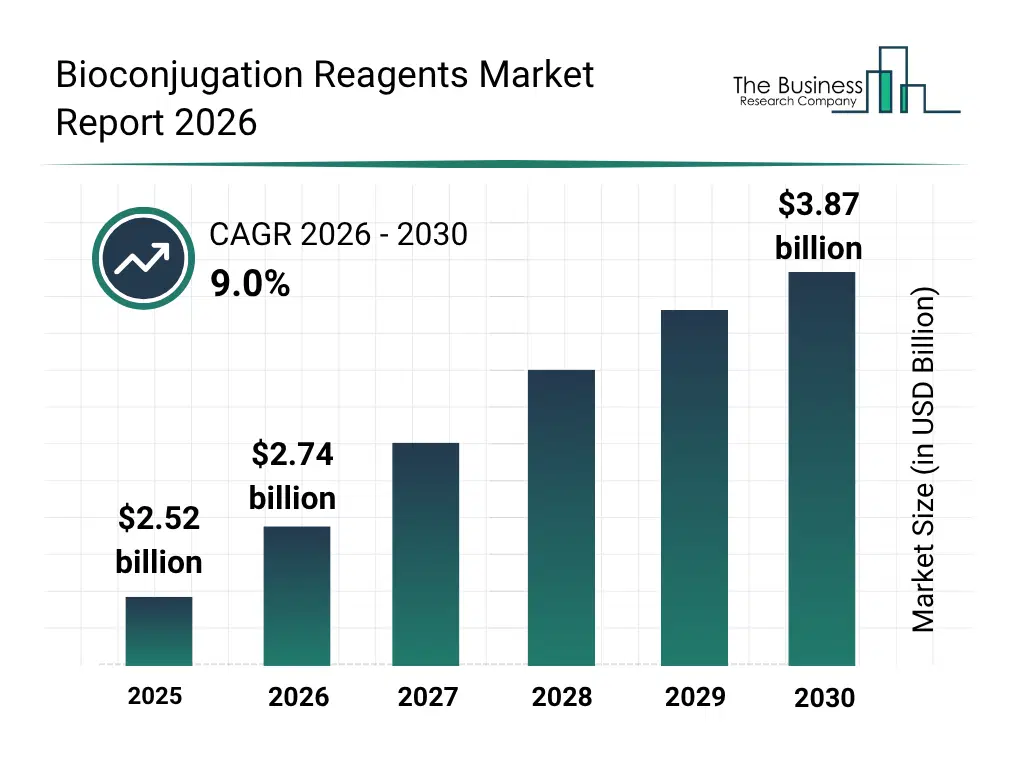
What Is The Bioconjugation Reagents Market Size and Share 2026?
The bioconjugation reagents market size has grown strongly in recent years. It will grow from $2.52 billion in 2025 to $2.74 billion in 2026 at a compound annual growth rate (CAGR) of 8.8%. The growth in the historic period can be attributed to increasing pharmaceutical and biotech R&D, adoption of conventional bioconjugation reagents, rising demand for proteomics and genomics research, growth in academic and research institutes, expansion of diagnostics and molecular imaging applications.What Is The Bioconjugation Reagents Market Growth Forecast?
The bioconjugation reagents market size is expected to see strong growth in the next few years. It will grow to $3.87 billion in 2030 at a compound annual growth rate (CAGR) of 9.0%. The growth in the forecast period can be attributed to growing demand for antibody drug conjugates, increasing adoption of click chemistry and covalent conjugation techniques, rising focus on precision medicine applications, expansion of bioconjugation kits for oligonucleotide and enzyme research, integration of AI-driven reagent design and analytics. Major trends in the forecast period include increasing adoption of click chemistry-based conjugation, rising demand for antibody drug conjugates (adc) applications, growing use of biotinylation and fluorescent labeling reagents, expansion of covalent conjugation kits for protein and enzyme research, rising focus on high-precision molecular imaging and diagnostics.
Global Bioconjugation Reagents Market Segmentation
1) By Product: Crosslinkers And Coupling Agents, Activated Esters, Thiol-Reactive Reagents, Amine-Reactive Reagents, Click Chemistry Reagents, Labeling Reagents And Linkers, Conjugation Kits, Covalent Conjugation, Click Chemistry-Based 2) By Chemistry Type: Amine-Based Chemistry, Sulfhydryl-Based Chemistry, Carboxyl-Based Chemistry, Azide-Alkyne Chemistry, Photoreactive Chemistry 3) By Sales Channel: Direct Sales, Distributors And Wholesalers, Online Platforms And Ecommerce, Specialty Retailers 4) By Application: Drug Development, Antibody Drug Conjugates, Diagnostics, Molecular Imaging, Proteomics Research, Genomics Research 5) By End-User: Pharmaceutical And Biotechnology Companies, Academic And Research Institutes, Diagnostic Laboratories, Other End Users Subsegments: 1) By Crosslinkers And Coupling Agents: Homobifunctional Crosslinkers, Heterobifunctional Crosslinkers, Zero Length Crosslinkers, Cleavable Crosslinkers, Non Cleavable Crosslinkers 2) By Activated Esters: N Hydroxysuccinimide Esters, Sulfo N Hydroxysuccinimide Esters, Tetrafluorophenyl Esters, Pentafluorophenyl Esters 3) By Thiol-Reactive Reagents: Maleimide Reagents, Iodoacetyl Reagents, Pyridyl Disulfide Reagents, Bromoacetyl Reagents 4) By Amine-Reactive Reagents: Isothiocyanate Reagents, Succinimidyl Ester Reagents, Carbodiimide Reagents, Imidoester Reagents 5) By Click Chemistry Reagents: Azide Reagents, Alkyne Reagents, Strained Alkyne Reagents, Tetrazine Reagents 6) By Labeling Reagents And Linkers: Fluorescent Labeling Reagents, Biotinylation Reagents, Enzyme Labeling Reagents, Polyethylene Glycol Linkers 7) By Conjugation Kits: Antibody Conjugation Kits, Protein Conjugation Kits, Oligonucleotide Conjugation Kits, Enzyme Conjugation Kits 8) By Covalent Conjugation: Amide Bond Formation, Thioether Bond Formation, Disulfide Bond Formation, Hydrazone Bond Formation 9) By Click Chemistry-Based: Copper Catalyzed Azide Alkyne Cycloaddition, Strain Promoted Azide Alkyne Cycloaddition, Inverse Electron Demand Diels Alder ReactionWhat Is The Driver Of The Bioconjugation Reagents Market?
The growing demand for personalized medicine is expected to propel the growth of the bioconjugation reagents market going forward. Personalized medicine refers to medical treatments and therapies tailored to individual patients based on their genetic makeup, biomarkers, and specific disease characteristics. The demand for personalized medicine is rising due to advances in genomic technologies and molecular diagnostics, which allow doctors to tailor treatments specifically to a patient’s genetic profile and improve therapeutic outcomes. Bioconjugation reagents enable the development of personalized medicine by allowing precise attachment of drugs, biomarkers, or imaging agents to specific molecules, facilitating targeted therapies and accurate diagnostics tailored to an individual’s unique genetic and molecular profile. For instance, in February 2024, according to the Personalized Medicine Coalition, a US-based non-profit organization, in 2023, the U.S. Food and Drug Administration approved 16 new personalized treatments for rare disease patients, up from six in 2022, including seven cancer drugs and three treatments for other diseases and conditions. Therefore, the growing demand for personalized medicine is driving the growth of the bioconjugation reagents industry.Key Players In The Global Bioconjugation Reagents Market
Major companies operating in the bioconjugation reagents market are Thermo Fisher Scientific Inc., Merck KGaA, Danaher Corporation, Lonza Group Ltd, Bio-Rad Laboratories Inc., GenScript Biotech Corporation, Maravai LifeSciences, Santa Cruz Biotechnology Inc., Rockland Immunochemicals Inc., Amerigo Scientific, Creative Biolabs Inc., Bio-Synthesis Inc., TriLink BioTechnologies, Tonbo Biosciences, Lumiprobe Corporation, Biotium Inc., Jena Bioscience GmbH, Promega Corporation, SETA BioMedicals Srl, Dojindo Laboratories Inc., CellMosaic Inc.
This chart is for illustrative purposes; the full report includes a detailed competitor analysis and comprehensive overview of the top 10 companies in the market.
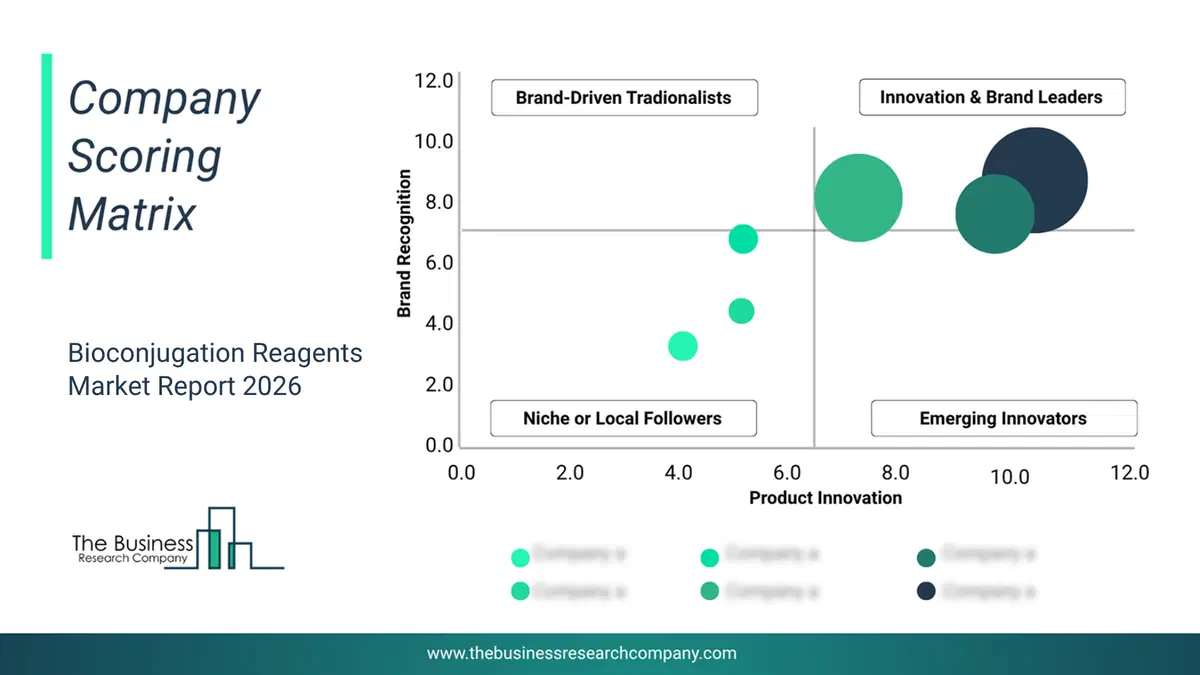
This chart maps companies by product innovation and brand strength, with bubble size indicating relative revenue, helping identify market leaders, challengers, and niche players. This is an illustrative chart; the full report provides a complete and accurate competitive analysis.
Global Bioconjugation Reagents Market Trends and Insights
Major companies operating in the bioconjugation reagents market are focusing on developing innovative products such as antibody-dye conjugation kits to enable customizable, high-precision protein detection and multiplexed analysis. Antibody-dye conjugation kits allow researchers to attach fluorescent dyes to antibodies for targeted protein detection and help enable customizable, high-precision, and multiplexed analysis in assays such as flow cytometry and fluorescent western blots. For instance, in January 2025, Bio-Rad Laboratories Inc., a US-based life sciences and diagnostics company, launched the Trailblazer Tag and Trailblazer StarBright Dye Label Kits, antibody-dye conjugation kits that use SpyTag and SpyCatcher chemistry to covalently link StarBright Blue and StarBright Violet dyes to virtually any antibody. These antibody-dye conjugation kits provide rapid, efficient conjugation with minimal antibody loss, enabling researchers to design bespoke high-plex panels for flow cytometry and streamline multiplex integration in fluorescent western blots. It offers flexibility in dye selection and compatibility with a wide range of antibodies, enhancing experimental customization while maintaining consistent fluorescence performance.What Are Latest Mergers And Acquisitions In The Bioconjugation Reagents Market?
In December 2023, Danaher Corporation, a US-based life sciences and technology company, acquired Abcam plc for $5.7 billion. With this acquisition, Danaher aimed to expand its life sciences portfolio and enhance its capabilities in supplying research tools and consumables critical to drug discovery, diagnostics, and biological research. Abcam plc is a UK-based biotechnology company that specializes in providing bioconjugation reagents, highly validated antibodies, assays, and other research tools to support life science research and clinical applications.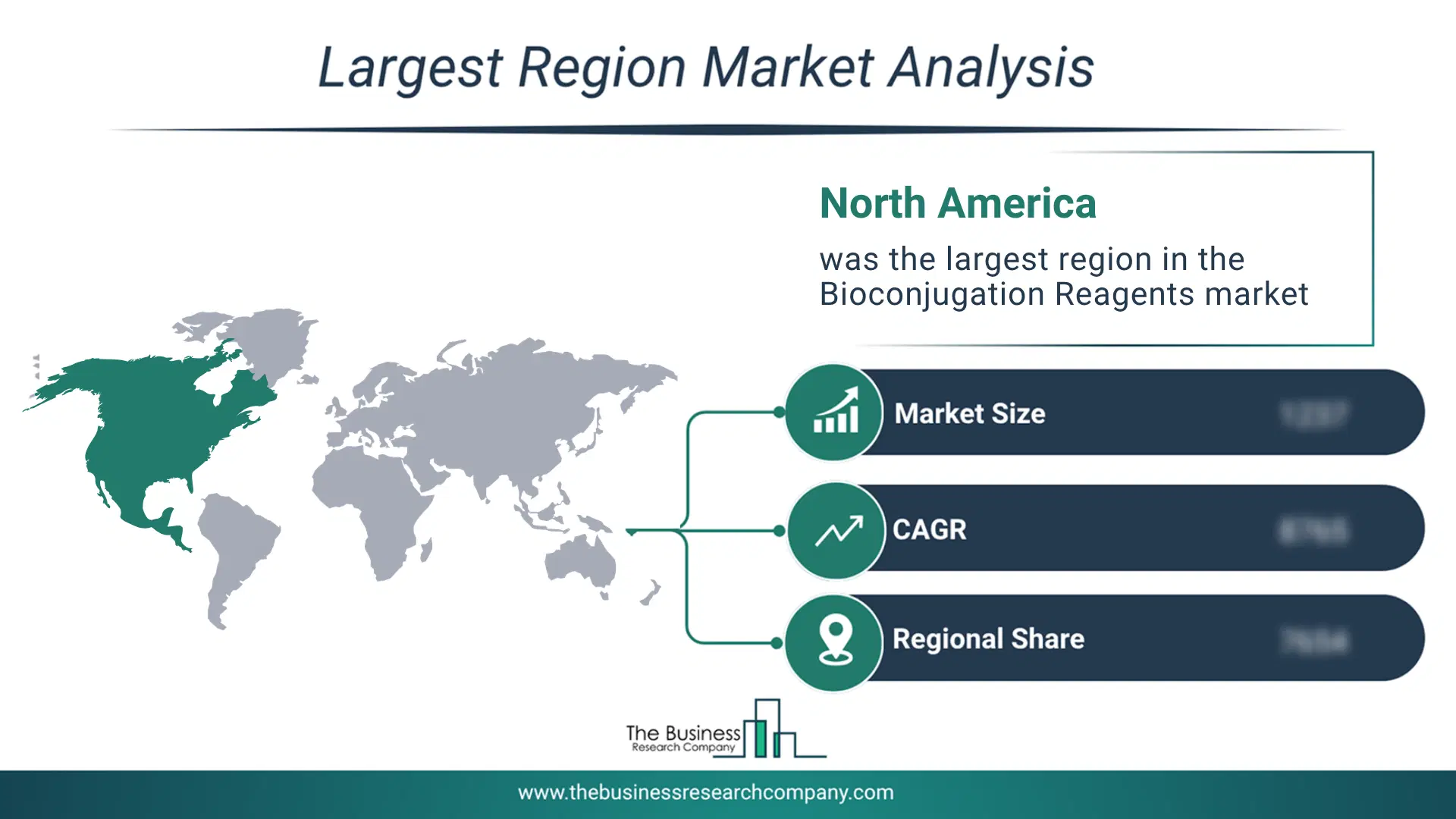
Regional Insights
North America was the largest region in the bioconjugation reagents market in 2025. Asia-Pacific is expected to be the fastest-growing region in the forecast period. The regions covered in this market report are Asia-Pacific, South East Asia, Western Europe, Eastern Europe, North America, South America, Middle East, Africa. The countries covered in this market report are Australia, Brazil, China, France, Germany, India, Indonesia, Japan, Taiwan, Russia, South Korea, UK, USA, Canada, Italy, Spain.What Defines the Bioconjugation Reagents Market?
The bioconjugation reagents market consists of sales of enzyme substrates, fluorescent dyes, affinity tags, nucleic acid labeling kits, and polymer-based carriers. Values in this market are ‘factory gate’ values, that is, the value of goods sold by the manufacturers or creators of the goods, whether to other entities (including downstream manufacturers, wholesalers, distributors, and retailers) or directly to end customers. The value of goods in this market includes related services sold by the creators of the goods.How is Market Value Defined and Measured?
The market value is defined as the revenues that enterprises gain from the sale of goods and/or services within the specified market and geography through sales, grants, or donations in terms of the currency (in USD unless otherwise specified). The revenues for a specified geography are consumption values that are revenues generated by organizations in the specified geography within the market, irrespective of where they are produced. It does not include revenues from resales along the supply chain, either further along the supply chain or as part of other products.
This chart presents market attractiveness based on a quantitative evaluation of growth, competition, strategic alignment, and risk, offering a clear view of opportunity areas for decision-making. This chart is for illustrative purposes; the full report contains the complete analysis.

This chart highlights the Total Addressable Market (TAM) by estimating the maximum revenue opportunity using an assumption-driven approach, supporting strategic planning and opportunity sizing across markets. The chart is illustrative; the full report provides a more comprehensive analysis.
What Key Data And Analysis Are Included In The Bioconjugation Reagents Market Report 2026?
The bioconjugation reagents market research report is one of a series of new reports from The Business Research Company that provides market statistics, including industry global market size, regional shares, competitors with the market share, detailed market segments, market trends and opportunities, and any further data you may need to thrive in the bioconjugation reagents industry. The market research report delivers a complete perspective of everything you need, with an in-depth analysis of the current and future state of the industry.Bioconjugation Reagents Market Report Forecast Analysis
| Report Attribute | Details |
|---|---|
| Market Size Value In 2026 | $2.74 billion |
| Revenue Forecast In 2030 | $3.87 billion |
| Growth Rate | CAGR of 8.8% from 2026 to 2030 |
| Base Year For Estimation | 2025 |
| Actual Estimates/Historical Data | 2020-2025 |
| Forecast Period | 2026 - 2030 |
| Market Representation | Revenue in USD Billion and CAGR from 2026 to 2030 |
| Segments Covered | Product, Chemistry Type, Sales Channel, Application, End-User |
| Regional Scope | Asia-Pacific, Western Europe, Eastern Europe, North America, South America, Middle East, Africa |
| Country Scope | The countries covered in the report are Australia, Brazil, China, France, Germany, India, Indonesia, Japan, Taiwan, Russia, South Korea, UK, USA, Canada, Italy, Spain. |
| Key Companies Profiled | Thermo Fisher Scientific Inc., Merck KGaA, Danaher Corporation, Lonza Group Ltd, Bio-Rad Laboratories Inc., GenScript Biotech Corporation, Maravai LifeSciences, Santa Cruz Biotechnology Inc., Rockland Immunochemicals Inc., Amerigo Scientific, Creative Biolabs Inc., Bio-Synthesis Inc., TriLink BioTechnologies, Tonbo Biosciences, Lumiprobe Corporation, Biotium Inc., Jena Bioscience GmbH, Promega Corporation, SETA BioMedicals Srl, Dojindo Laboratories Inc., CellMosaic Inc. |
| Customization Scope | Request for Customization |
| Pricing And Purchase Options | Explore Purchase Options |