
Bionematicides Market Report 2026
Global Outlook – By Type (Microbials, Biochemical), By Form (Dry Bionematicides, Liquid Bionematicides), By Crop (Cotton, Corn, Soybean, Fruits And Vegetables, Other Crops), By Application (Foliar Spray, Soil Treatment, Seed Treatment, Others Applications) – Market Size, Trends, Strategies, and Forecast to 2030
Bionematicides Market Overview
• Bionematicides market size has reached to $0.54 billion in 2025 • Expected to grow to $0.98 billion in 2030 at a compound annual growth rate (CAGR) of 12.5% • Growth Driver: Rising Greenhouse Farming To Boost Bionematicides Market Growth • Market Trend: Innovative Products In The Bionematicides Market • North America was the largest region in 2025 and Asia-Pacific is the fastest growing region.What Is Covered Under Bionematicides Market?
Bionematicides are biological products derived from microorganisms such as fungi and bacteria and act as bio-controlling agents against plant-parasitic nematodes. These microorganisms can capture, parasitize, disorient, and even paralyze nematodes at different stages of their development, providing a natural and environmentally friendly means of nematode control. The main types of bionematicides are microbial and biochemical. Microbial bionematicides are a type of bionematicide that utilizes naturally occurring microorganisms, such as bacteria, fungi, or protozoa, to control nematodes and promote plant health. It is available in forms such as dry bionematicides, and liquid bionematicides, for crops including cotton, corn, soybean, fruits and vegetables, and others. Various applications are foliar spray, soil treatment, seed treatment, and others.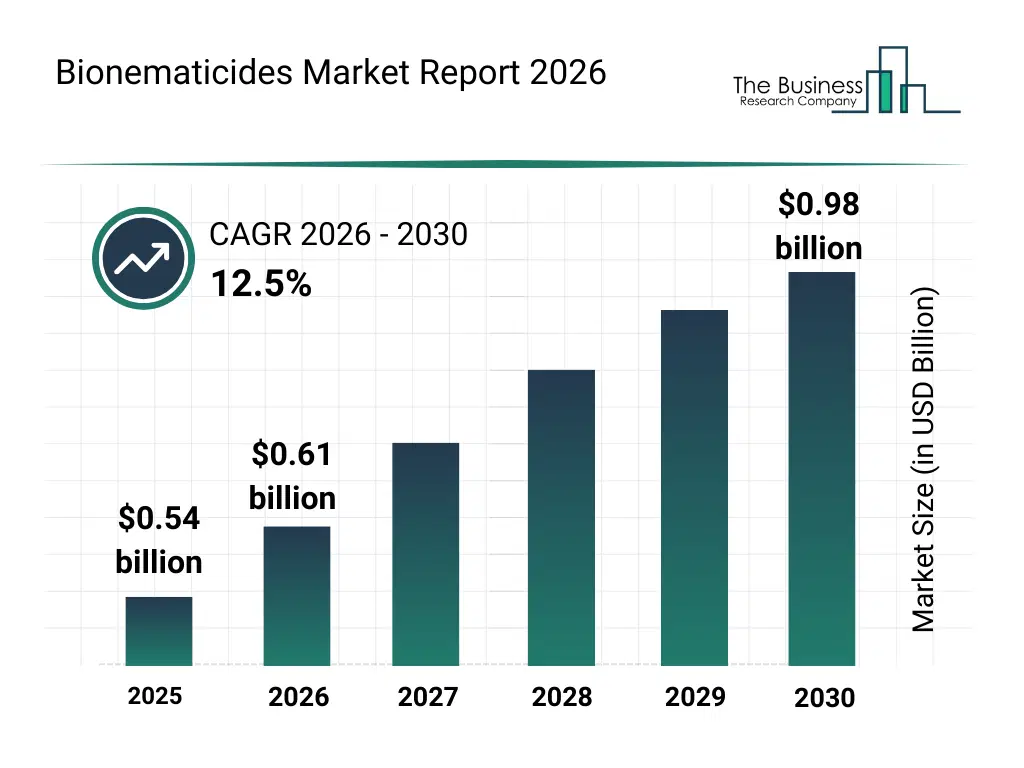
What Is The Bionematicides Market Size and Share 2026?
The bionematicides market size has grown rapidly in recent years. It will grow from $0.54 billion in 2025 to $0.61 billion in 2026 at a compound annual growth rate (CAGR) of 14.0%. The growth in the historic period can be attributed to increasing awareness of chemical nematicide toxicity, early development of microbial biocontrol agents, rising crop losses from nematode infestation, regulatory restrictions on synthetic nematicides, expansion of sustainable farming programs.What Is The Bionematicides Market Growth Forecast?
The bionematicides market size is expected to see rapid growth in the next few years. It will grow to $0.98 billion in 2030 at a compound annual growth rate (CAGR) of 12.5%. The growth in the forecast period can be attributed to growing demand for eco-friendly crop protection, accelerated investment in microbial strain innovation, rising adoption of biological soil management practices, technological improvements in formulation stability, increasing emphasis on residue-free agricultural production. Major trends in the forecast period include growing adoption of microbial-based nematode control, expansion of biochemical bionematicide formulations, rising development of crop-specific nematode management solutions, increased use of soil and seed treatment biological agents, advancements in multi-mechanism nematode suppression technologies.
Global Bionematicides Market Segmentation
1) By Type: Microbials, Biochemical 2) By Form: Dry Bionematicides, Liquid Bionematicides 3) By Crop: Cotton, Corn, Soybean, Fruits And Vegetables, Other Crops 4) By Application: Foliar Spray, Soil Treatment, Seed Treatment, Others Applications Subsegments: 1) By Microbials: Bacteria-Based, Fungi-Based, Actinomycetes-Based, Virus-Based, Protozoa-Based 2) By Biochemical: Natural Plant Extracts, Organic Acids, Biochemical Enzymes, Phytoalexins, Other Biochemical CompoundsWhat Is Driver Of The Bionematicides Market?
The increasing adoption of greenhouse farming is expected to propel the growth of the bionematicides market going forward. Greenhouse farming refers to cultivating crops in protected structures that are either fully or partially covered by transparent materials. Greenhouse farming is rising due to its ability to enhance crop yields and ensure year-round production regardless of external climate conditions. Bionematicides offer a solution for managing plant-parasitic nematodes (PPNs) in greenhouse farming, providing a sustainable and environmentally friendly alternative to chemical nematicides. For instance, in October 2024, according to the Agriculture and Agri-Food Canada, a Canada-based federal department, in 2023, Canada had 920 commercial greenhouse vegetable operations that collectively produced 802,163 metric tons of vegetables, marking a 7% increase in production compared to 2022. Therefore, the increasing adoption of greenhouse farming is expected to drive the growth of the bionematicides industry.Key Players In The Global Bionematicides Market
Major companies operating in the bionematicides market are BASF SE, Bayer AG, Syngenta AG, Corteva Agriscience, UPL Limited, FMC Corporation, Adama Agricultural Solutions Ltd., Novozymes A/S, Nufarm Limited, Chr. Hansen Holding A/S, Brandt, Isagro S.p.A., Koppert Biological Systems, T. Stanes and Company Limited, Certis USA LLC, Valent BioSciences Corporation, Marrone Bio Innovations Inc., The Real IPM Company, Andermatt Biocontrol AG, Bioworks Inc., Bio Huma Netics Inc., Horizon Agrotech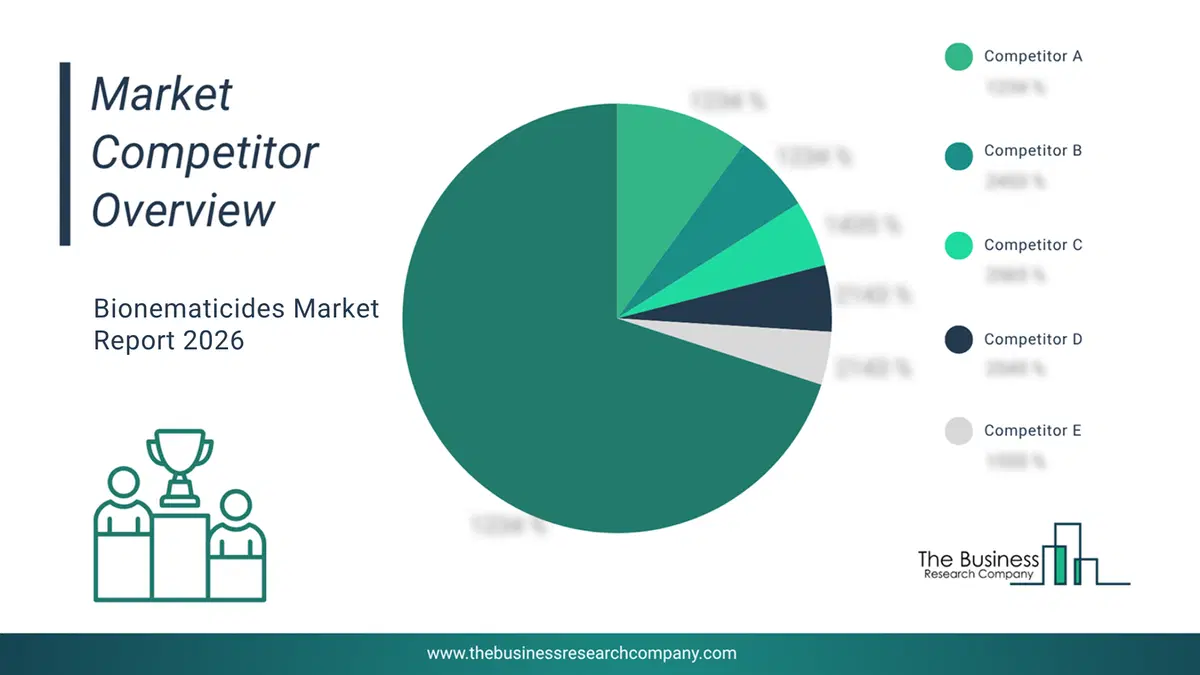
This chart is for illustrative purposes; the full report includes a detailed competitor analysis and comprehensive overview of the top 10 companies in the market.
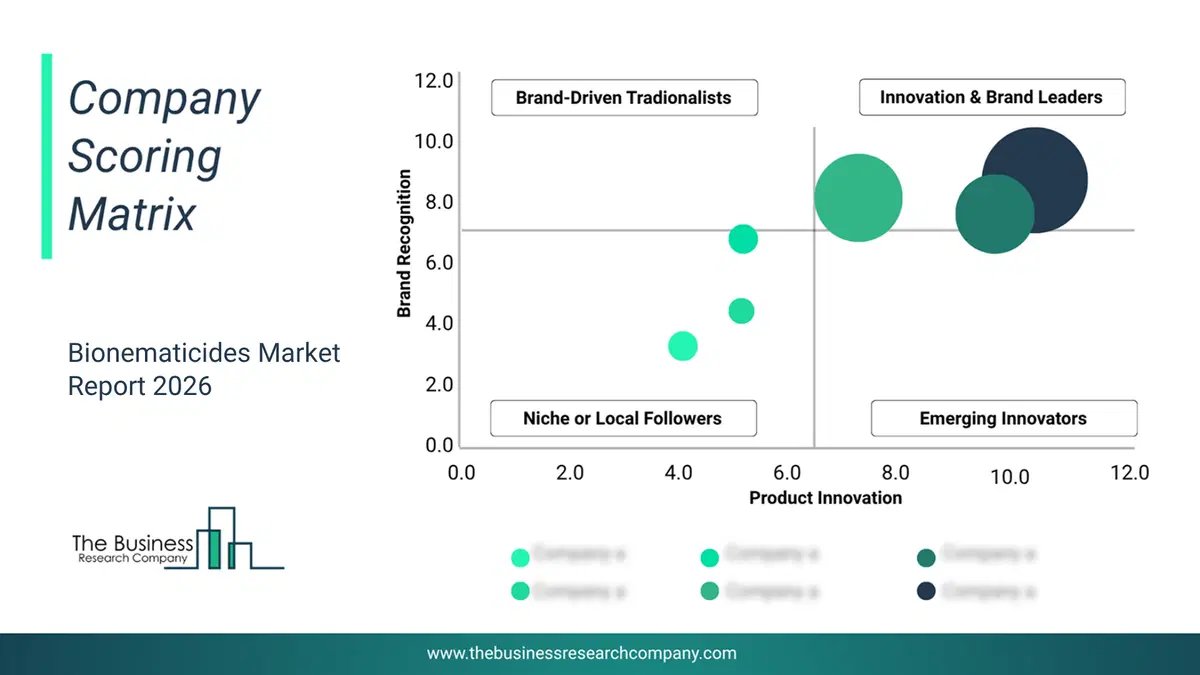
This chart maps companies by product innovation and brand strength, with bubble size indicating relative revenue, helping identify market leaders, challengers, and niche players. This is an illustrative chart; the full report provides a complete and accurate competitive analysis.
Global Bionematicides Market Trends and Insights
Major companies operating in the bionematicides market are developing innovative products, such as plant-parasitic nematicide, to better serve customers with advanced features. A plant-parasitic nematicide refers to a type of pesticide specifically designed to target and control plant-parasitic nematodes, which are microscopic roundworms that parasitize plants and cause significant damage to crops. For instance, in September 2023, Corteva Inc., a US-based agriculture chemical company, launched Reklemel Active, a new nematicide to help protect a wide variety of food and row crops from plant-parasitic nematode damage without disrupting the healthy balance of beneficial organisms in the soil. It is one of the first new active ingredients to be registered under the EPA’s updated policy, incorporating Endangered Species Act assessments into the pesticide registration process.What Are Latest Mergers And Acquisitions In The Bionematicides Market? CBC Europe Acquired Ecospray Ltd. To Open A New Formulations Plant
In July 2023, CBC Europe Srl., an Italy-based international trade and development company, acquired a stake in Ecospray Ltd. For an undisclosed amount. This acquisition enabled Ecospray Ltd. To strengthen CBC Europe’s position in the biocontrol market and expand its product offerings. Ecospray Ltd. Is a UK-based biopesticide company that specializes in providing bionematicides.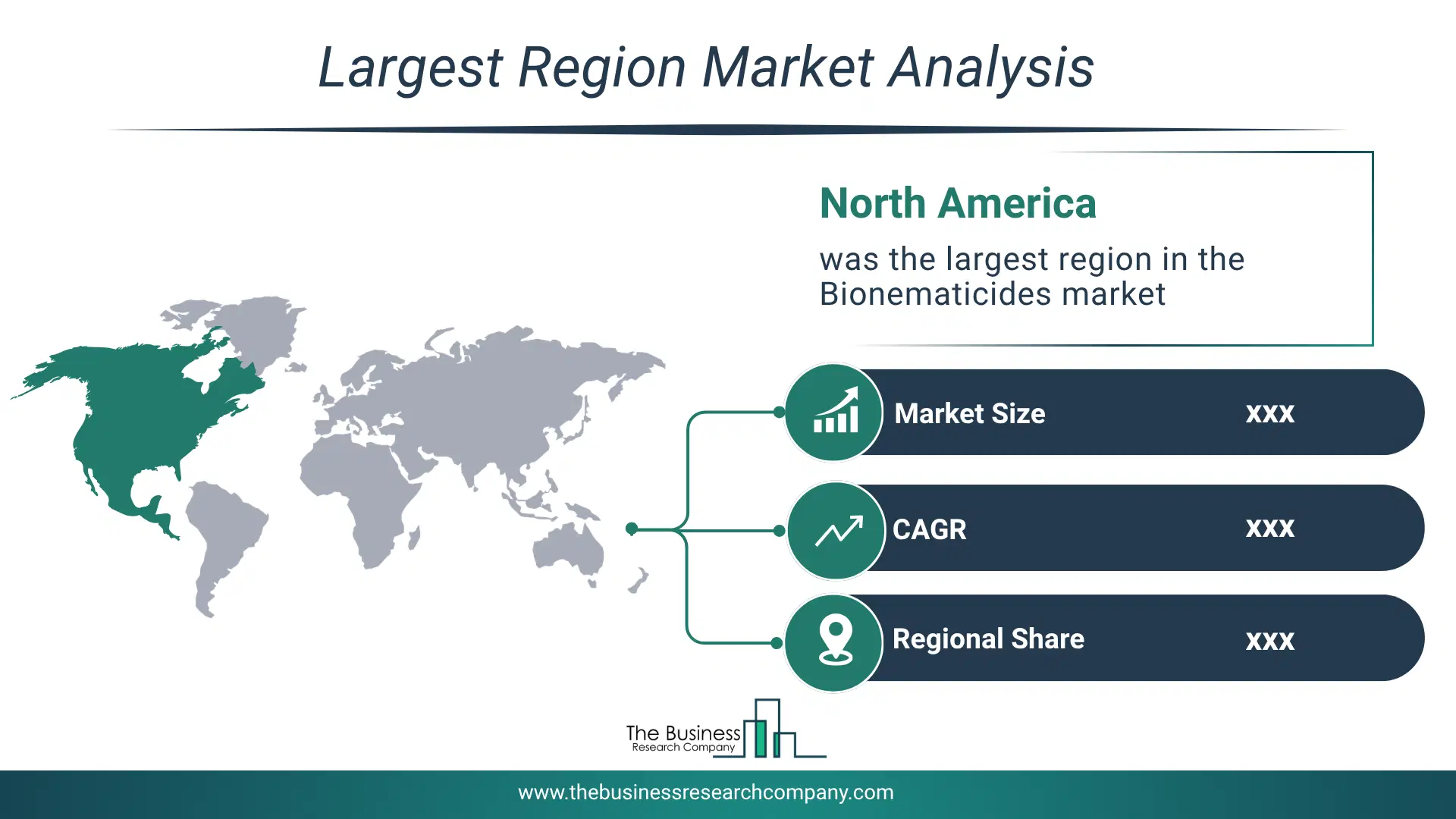
Regional Outlook
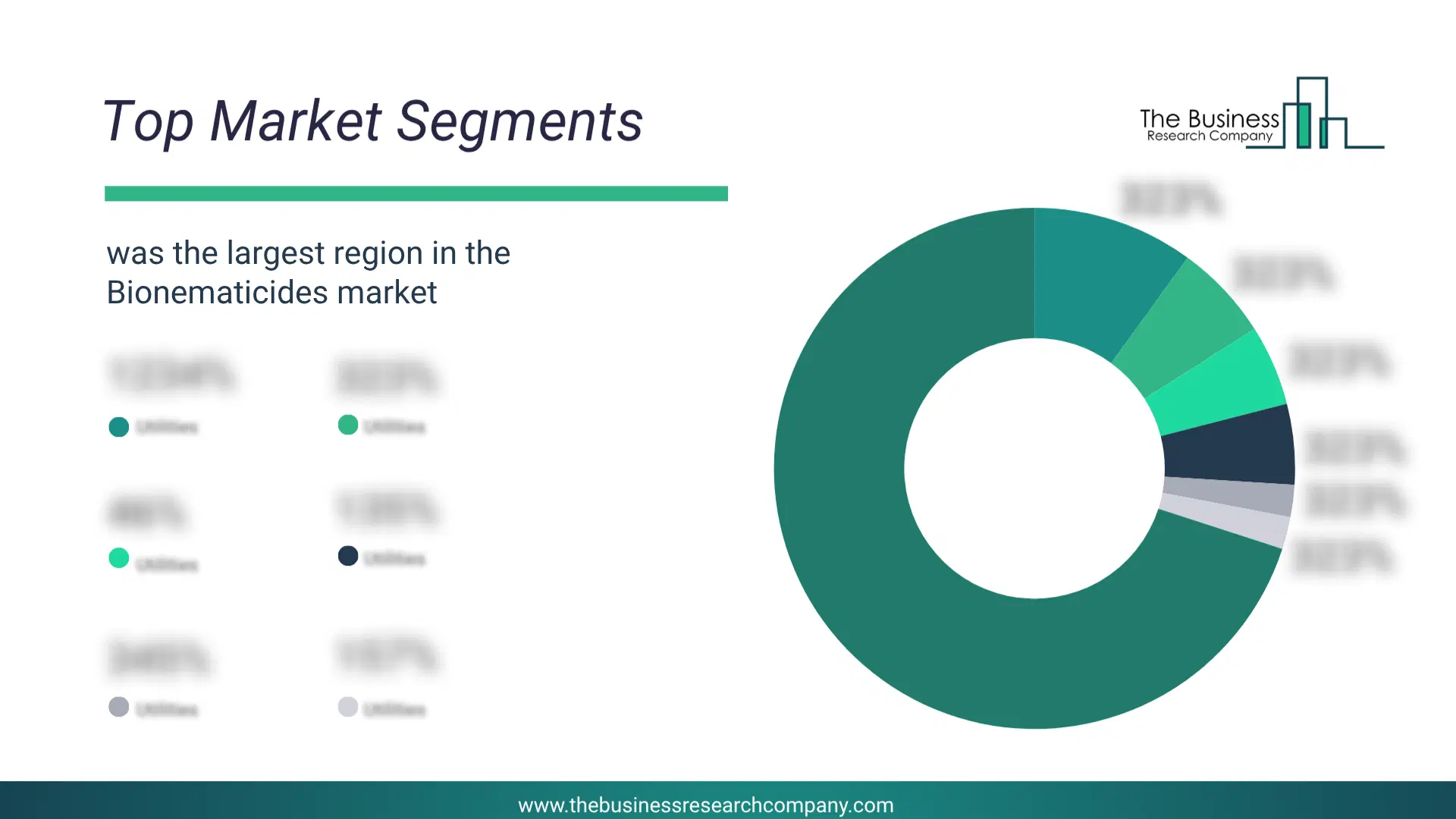
North America was the largest region in the bionematicides market in 20255. Asia-Pacific is expected to be the fastest-growing region in the forecast period. The regions covered in this market report are Asia-Pacific, South East Asia, Western Europe, Eastern Europe, North America, South America, Middle East, Africa. The countries covered in this market report are Australia, Brazil, China, France, Germany, India, Indonesia, Japan, Taiwan, Russia, South Korea, UK, USA, Canada, Italy, SpainWhat Defines the Bionematicides Market?
The bionematicides market consists of sales of bacillus-based bionematicides, paecilimyes, and lilacinus-based bionematicides. Values in this market are ‘factory gate’ values, that is the value of goods sold by the manufacturers or creators of the goods, whether to other entities (including downstream manufacturers, wholesalers, distributors and retailers) or directly to end customers. The value of goods in this market includes related services sold by the creators of the goods.How is Market Value Defined and Measured?
The market value is defined as the revenues that enterprises gain from the sale of goods and/or services within the specified market and geography through sales, grants, or donations in terms of the currency (in USD unless otherwise specified). The revenues for a specified geography are consumption values that are revenues generated by organizations in the specified geography within the market, irrespective of where they are produced. It does not include revenues from resales along the supply chain, either further along the supply chain or as part of other products.
This chart presents market attractiveness based on a quantitative evaluation of growth, competition, strategic alignment, and risk, offering a clear view of opportunity areas for decision-making. This chart is for illustrative purposes; the full report contains the complete analysis.

This chart highlights the Total Addressable Market (TAM) by estimating the maximum revenue opportunity using an assumption-driven approach, supporting strategic planning and opportunity sizing across markets. The chart is illustrative; the full report provides a more comprehensive analysis.
What Key Data and Analysis Are Included in the Bionematicides Market Report 2026?
The bionematicides market research report is one of a series of new reports from The Business Research Company that provides market statistics, including industry global market size, regional shares, competitors with the market share, detailed market segments, market trends and opportunities, and any further data you may need to thrive in the bionematicides industry. The market research report delivers a complete perspective of everything you need, with an in-depth analysis of the current and future state of the industry.Bionematicides Market Report Forecast Analysis
| Report Attribute | Details |
|---|---|
| Market Size Value In 2026 | $0.61 billion |
| Revenue Forecast In 2030 | $0.98 billion |
| Growth Rate | CAGR of 12.5% from 2026 to 2030 |
| Base Year For Estimation | 2025 |
| Actual Estimates/Historical Data | 2020-2025 |
| Forecast Period | 2026 - 2030 |
| Market Representation | Revenue in USD Billion and CAGR from 2026 to 2030 |
| Segments Covered | Type, Form, Crop, Application |
| Regional Scope | Asia-Pacific, Western Europe, Eastern Europe, North America, South America, Middle East, Africa |
| Country Scope | The countries covered in the report are Australia, Brazil, China, France, Germany, India, Indonesia, Japan, Taiwan, Russia, South Korea, UK, USA, Canada, Italy, Spain |
| Key Companies Profiled | BASF SE, Bayer AG, Syngenta AG, Corteva Agriscience, UPL Limited, FMC Corporation, Adama Agricultural Solutions Ltd., Novozymes A/S, Nufarm Limited, Chr. Hansen Holding A/S, Brandt, Isagro S.p.A., Koppert Biological Systems, T. Stanes and Company Limited, Certis USA LLC, Valent BioSciences Corporation, Marrone Bio Innovations Inc., The Real IPM Company, Andermatt Biocontrol AG, Bioworks Inc., Bio Huma Netics Inc., Horizon Agrotech |
| Customization Scope | Request for Customization |
| Pricing And Purchase Options | Explore Purchase Options |