
Blockchain In Agriculture And Food Supply Chain Market Report 2026
Global Outlook – By Type (Public Blockchain, Private Blockchain, Consortium Or Hybrid Blockchain), By Stakeholder (Growers, Food Manufacturers Or Processors, Retailers), By Application (Product Traceability, Tracking, And Visibility, Payment And Settlement, Smart Contracts, Governance, Risk And Compliance Management) – Market Size, Trends, Strategies, and Forecast to 2030
Blockchain In Agriculture And Food Supply Chain Market Overview
• Blockchain In Agriculture And Food Supply Chain market size has reached to $0.83 billion in 2025 • Expected to grow to $5.83 billion in 2030 at a compound annual growth rate (CAGR) of 47.5% • Growth Driver: Surge In Small And Medium Enterprises Fueling The Growth Of The Market Due To Rising Innovation And Tailored Solution Development • Market Trend: Advancements in Agricultural Supply Chain: The Role of Digital Frameworks and Blockchain Technology • North America was the largest region in 2025.What Is Covered Under Blockchain In Agriculture And Food Supply Chain Market?
Blockchain in agriculture and food supply chain refers to a technology that enables information traceability throughout the food supply chain to enhance food safety. Additionally, it gives users a safe way to store and manage data, which makes it easier to create and use data-driven innovations for smart farming and smart index-based crop insurance. The blockchain in agriculture and food supply chain market covered in the report is segmented by type into the public blockchain, private blockchain, consortium/hybrid blockchain; by stakeholder into growers, food manufacturers/processors, and retailers, by application into product traceability, tracking, and visibility, payment and settlement, smart contracts, governance, risk and compliance management.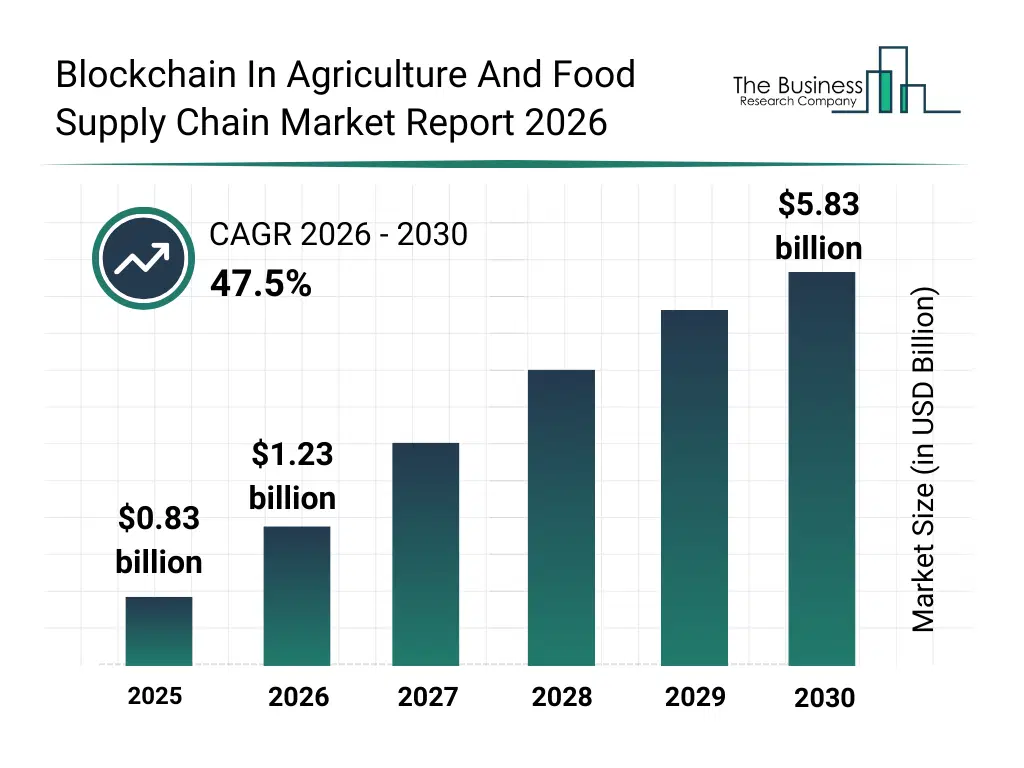
What Is The Blockchain In Agriculture And Food Supply Chain Market Size and Share 2026?
The blockchain in agriculture and food supply chain market size has grown exponentially in recent years. It will grow from $0.83 billion in 2025 to $1.23 billion in 2026 at a compound annual growth rate (CAGR) of 48.1%. The growth in the historic period can be attributed to increasing food safety incidents, rising complexity of global food supply chains, early adoption of digital traceability tools, increasing demand for transparency in agri-trade, pilot blockchain projects by agri-enterprises.What Is The Blockchain In Agriculture And Food Supply Chain Market Growth Forecast?
The blockchain in agriculture and food supply chain market size is expected to see exponential growth in the next few years. It will grow to $5.83 billion in 2030 at a compound annual growth rate (CAGR) of 47.5%. The growth in the forecast period can be attributed to expansion of smart agriculture ecosystems, rising demand for trusted food provenance data, increasing adoption of index-based crop insurance, growth of digital marketplaces for farm produce, stronger regulatory focus on food traceability. Major trends in the forecast period include increasing adoption of end-to-end food traceability platforms, rising use of smart contracts for crop insurance, growing integration of blockchain with iot sensors, expansion of transparent farm-to-fork supply chains, enhanced focus on data integrity and food safety compliance.
Global Blockchain In Agriculture And Food Supply Chain Market Segmentation
1) By Type: Public Blockchain, Private Blockchain, Consortium Or Hybrid Blockchain 2) By Stakeholder: Growers, Food Manufacturers Or Processors, Retailers 3) By Application: Product Traceability, Tracking, And Visibility, Payment And Settlement, Smart Contracts, Governance, Risk And Compliance Management Subsegments: 1) By Public Blockchain: Fully Decentralized Public Blockchain, Open Source Blockchain Solutions 2) By Private Blockchain: Permissioned Private Blockchain, Centralized Blockchain Solutions 3) By Consortium Or Hybrid Blockchain: Consortium Blockchains, Hybrid BlockchainsWhat Are The Drivers Of The Blockchain In Agriculture And Food Supply Chain Market?
The growing role of small and medium enterprises (SMEs) is expected to propel the growth of the blockchain in agriculture and food supply chain market going forward. SMEs are businesses with limited workforce size and revenue compared to large enterprises, and they serve as a key driver of innovation, competitiveness, and economic activity across various sectors. The rise in SME participation is due to larger businesses investing significantly in enhancing their existing blockchain solutions, while newer and smaller companies are introducing specialized offerings tailored to national and regional market needs. Blockchain adoption among SMEs supports sectoral development by enabling improved traceability, enhancing operational transparency, and strengthening supply chain efficiency across agriculture and food systems. For instance, in October 2025, according to the Department for Business and Trade is a UK-based government department reported that SME employment increased from 16.6 million to 16.9 million year over year, while their share of the private-sector workforce remained steady at 60%. Therefore, the growing role of small and medium enterprises is driving the growth of the blockchain in agriculture and food supply chain industry. The integration of Internet of Things (IoT) devices is expected to propel the growth of the blockchain-in-agriculture and food-supply-chain market going forward. IoT networks of interconnected devices with unique identities (UIDs) that transfer data without human mediation enhances real-time monitoring and data collection in agricultural and food-supply-chain contexts, improving transparency, traceability, quality control and overall supply-chain efficiency. or instance, in April 2025, according to the United Nations Commission on Science and Technology for Development is a Switzerland-based Economic and Social Council reported that connected IoT devices grew past 18 billion in 2024 and are set to exceed 40 billion by 2030, strengthening the data backbone for blockchain-based traceability. Therefore, the growth in IoT device integration supports and drives the expansion of blockchain applications in agriculture and food supply chains.Key Players In The Global Blockchain In Agriculture And Food Supply Chain Market
Major companies operating in the blockchain in agriculture and food supply chain market are International Business Machines Corporation; Microsoft Corporation; SAP SE; Ambrosus AG; Arc-net; OriginTrail Ltd.; Rip. io; Provenance Ltd.; Chainvine Limited (ChainVine); AgriDigital Pty Ltd.; Riiot Labs SA; VeChain Foundation; BlockGrain; AgriChain Pty Ltd.; TE-FOOD International GmbH; Agri 10x LLC; AgriLedger Ltd.; AgroChain Ltd.; Bext Holdings Inc.; Cargill Incorporated; CropIn Technology Solutions Pvt. Ltd.; Deere & Company; Eka Software Solutions Pvt. Ltd.; Emerson Electric Co.; FoodLogiQ LLC; Full Profile Pty Ltd; GrainChain Inc.; Kisan Network; Modi Infosol Pvt. Ltd.; Nestlé S. A.; Ripe Technology Inc.; The Seam LLC; Topl LLC; Trace Genomics Inc.; Unilever PLC; Viant Technology LLC; Walmart Inc.; Yara International ASA; Zume Inc.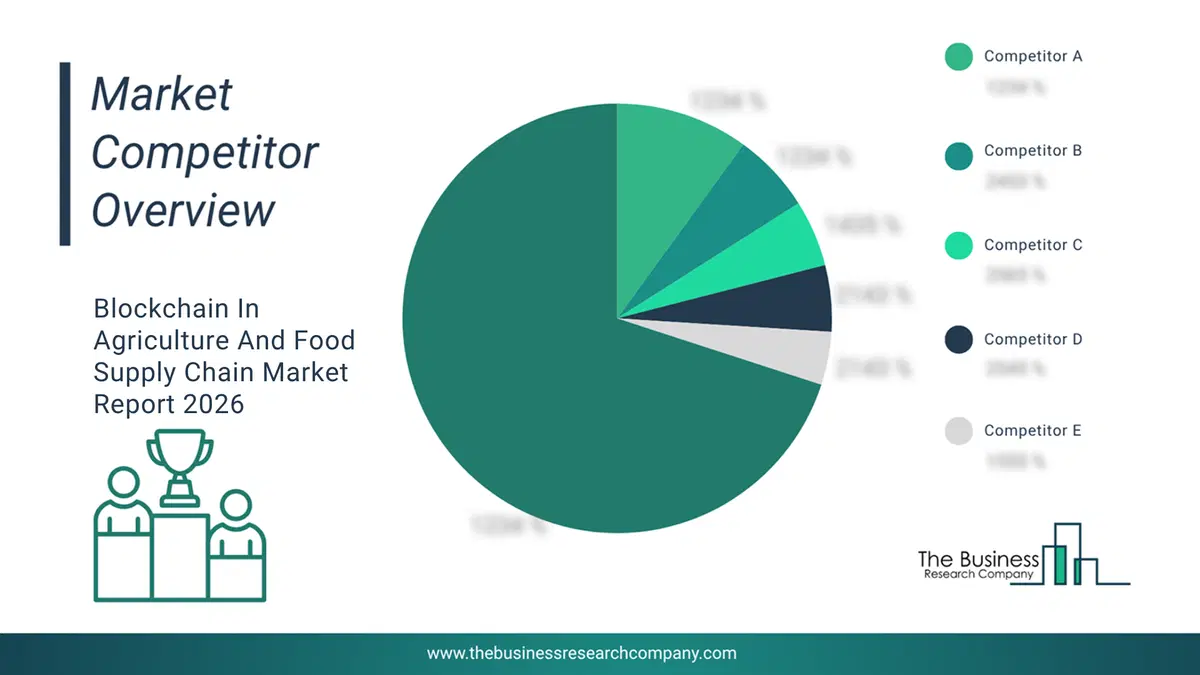
This chart is for illustrative purposes; the full report includes a detailed competitor analysis and comprehensive overview of the top 10 companies in the market.
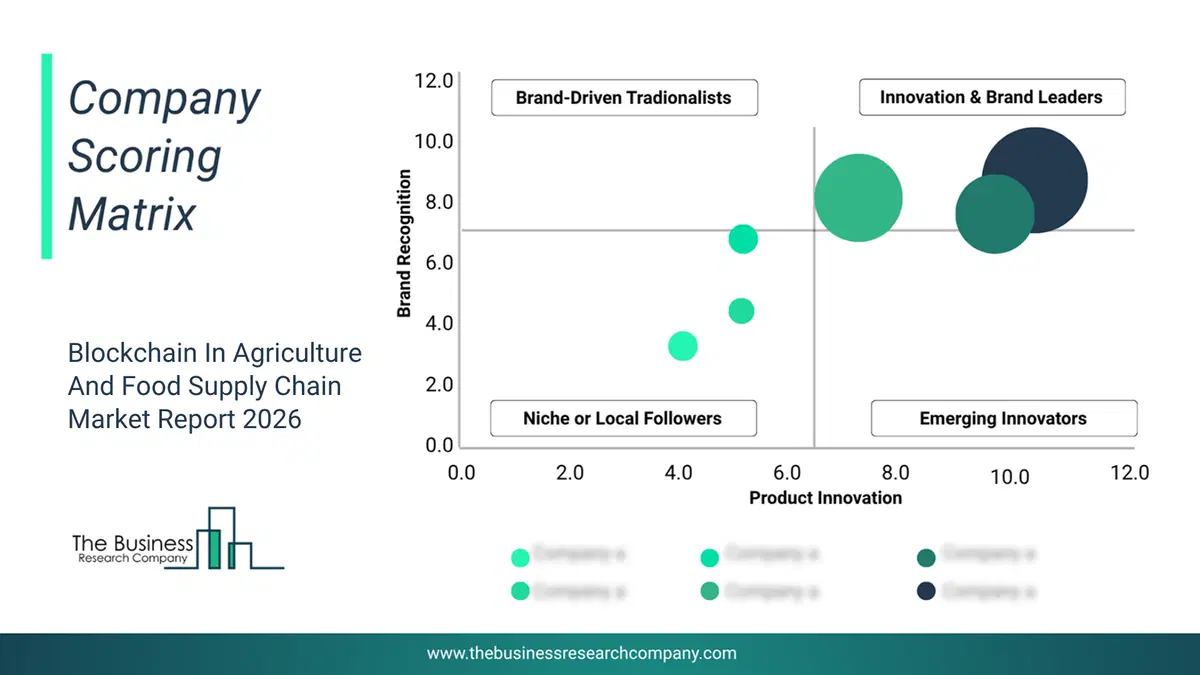
This chart maps companies by product innovation and brand strength, with bubble size indicating relative revenue, helping identify market leaders, challengers, and niche players. This is an illustrative chart; the full report provides a complete and accurate competitive analysis.
Global Blockchain In Agriculture And Food Supply Chain Market Trends and Insights
Major companies operating in the blockchain in agriculture and food supply chain market are focusing on developing advanced solutions, such as blockchain-enabled crop traceability systems, to enhance transparency, strengthen consumer trust, and improve the integrity of agricultural supply chains. Blockchain-enabled crop traceability refers to a digital mechanism that records immutable data at every stage of the agricultural production and distribution process, allowing stakeholders and consumers to verify the origin, quality, and handling of food products in real time. For instance, in October 2023, Silal, a UAE-based agri-food company, introduced a breakthrough blockchain technology designed to improve crop transparency by securely tracking produce from farm to retailer. The solution enables end-to-end visibility across the supply chain, supports data-driven quality assurance, and enhances consumer confidence by providing verifiable information on farming practices and product provenance. Therefore, the introduction of blockchain-enabled crop traceability systems is driving innovation and elevating transparency standards across the agriculture and food supply chain ecosystem.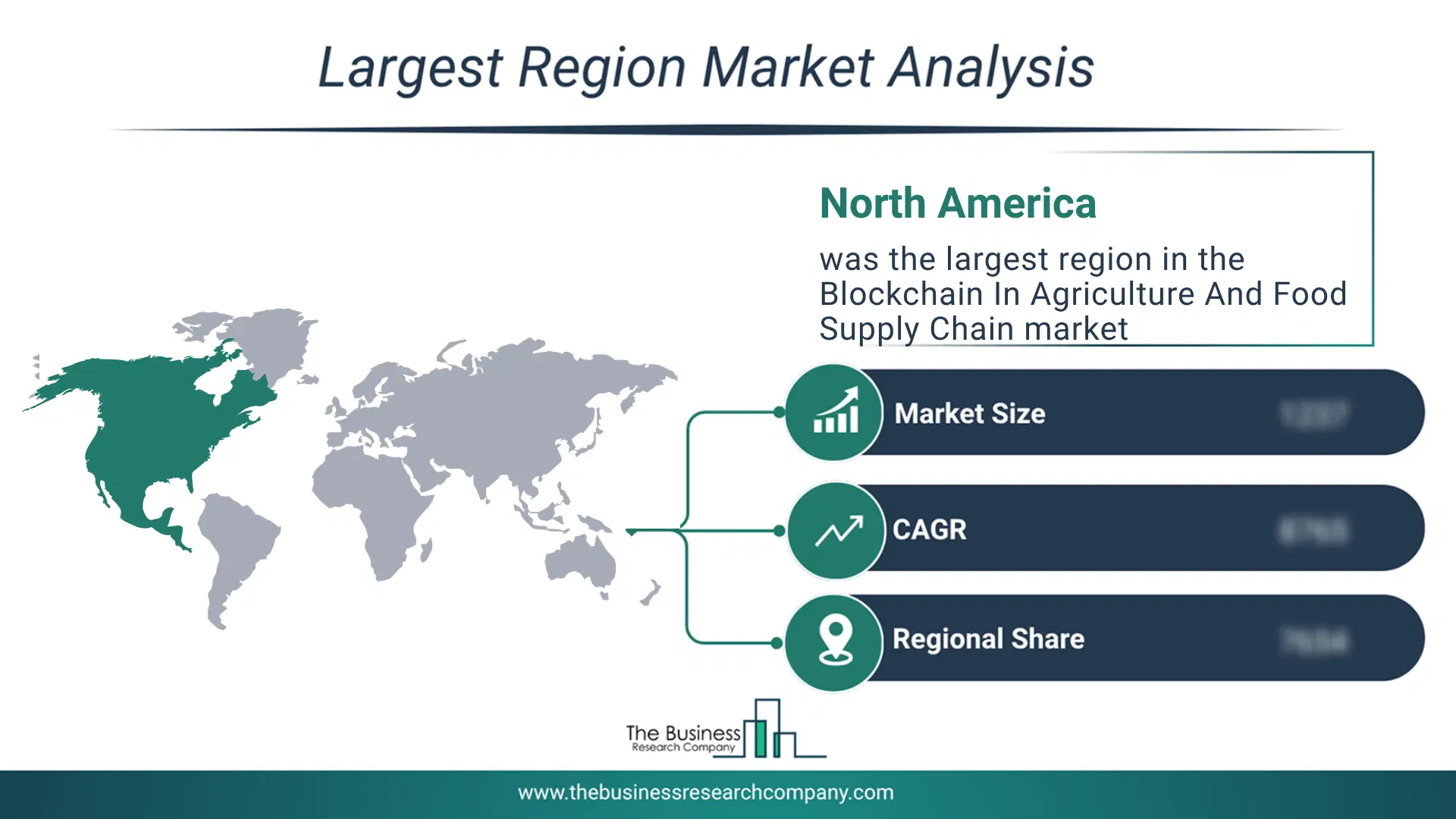
Regional Insights
North America was the largest region in the blockchain in agriculture and food supply chain market in 2025. The regions covered in this market report are Asia-Pacific, South East Asia, Western Europe, Eastern Europe, North America, South America, Middle East, Africa. The countries covered in this market report are Australia, Brazil, China, France, Germany, India, Indonesia, Japan, Taiwan, Russia, South Korea, UK, USA, Canada, Italy, SpainWhat Defines the Blockchain In Agriculture And Food Supply Chain Market?
The blockchain in agriculture and food supply chain market includes revenues earned by entities by tracking ownership records and providing tamper-resistant data. The market value includes the value of related goods sold by the service provider or included within the service offering. Only goods and services traded between entities or sold to end consumers are included.How is Market Value Defined and Measured?
The market value is defined as the revenues that enterprises gain from the sale of goods and/or services within the specified market and geography through sales, grants, or donations in terms of the currency (in USD unless otherwise specified). The revenues for a specified geography are consumption values that are revenues generated by organizations in the specified geography within the market, irrespective of where they are produced. It does not include revenues from resales along the supply chain, either further along the supply chain or as part of other products.
This chart presents market attractiveness based on a quantitative evaluation of growth, competition, strategic alignment, and risk, offering a clear view of opportunity areas for decision-making. This chart is for illustrative purposes; the full report contains the complete analysis.

This chart highlights the Total Addressable Market (TAM) by estimating the maximum revenue opportunity using an assumption-driven approach, supporting strategic planning and opportunity sizing across markets. The chart is illustrative; the full report provides a more comprehensive analysis.
What Key Data and Analysis Are Included in the Blockchain In Agriculture And Food Supply Chain Market Report 2026?
The blockchain in agriculture and food supply chain market research report is one of a series of new reports from The Business Research Company that provides market statistics, including industry global market size, regional shares, competitors with the market share, detailed market segments, market trends and opportunities, and any further data you may need to thrive in the blockchain in agriculture and food supply chain industry. The market research report delivers a complete perspective of everything you need, with an in-depth analysis of the current and future state of the industry.Blockchain In Agriculture And Food Supply Chain Market Report Forecast Analysis
| Report Attribute | Details |
|---|---|
| Market Size Value In 2026 | $1.23 billion |
| Revenue Forecast In 2030 | $5.83 billion |
| Growth Rate | CAGR of 47.5% from 2026 to 2030 |
| Base Year For Estimation | 2025 |
| Actual Estimates/Historical Data | 2020-2025 |
| Forecast Period | 2026 - 2030 |
| Market Representation | Revenue in USD Billion and CAGR from 2026 to 2030 |
| Segments Covered | Type, Stakeholder, Application |
| Regional Scope | Asia-Pacific, Western Europe, Eastern Europe, North America, South America, Middle East, Africa |
| Country Scope | The Countries Covered In This Market Report Are Australia, Brazil, China, France, Germany, India, Indonesia, Japan, Taiwan, Russia, South Korea, Uk, Usa, Canada, Italy, Spain. |
| Key Companies Profiled | International Business Machines Corporation, Microsoft Corporation, SAP SE, Ambrosus AG, Arc-net, OriginTrail Ltd., Rip. io, Provenance Ltd., Chainvine Limited (ChainVine), AgriDigital Pty Ltd., Riiot Labs SA, VeChain Foundation, BlockGrain, AgriChain Pty Ltd., TE-FOOD International GmbH, Agri 10x LLC, AgriLedger Ltd., AgroChain Ltd., Bext Holdings Inc., Cargill Incorporated, CropIn Technology Solutions Pvt. Ltd., Deere & Company, Eka Software Solutions Pvt. Ltd., Emerson Electric Co., FoodLogiQ LLC, Full Profile Pty Ltd, GrainChain Inc., Kisan Network, Modi Infosol Pvt. Ltd., Nestlé S. A., Ripe Technology Inc., The Seam LLC, Topl LLC, Trace Genomics Inc., Unilever PLC, Viant Technology LLC, Walmart Inc., Yara International ASA, Zume Inc. |
| Customization Scope | Request for Customization |
| Pricing And Purchase Options | Explore Purchase Options |