
Broadcast Communications Equipment Market Report 2026
Global Outlook – By Product Type (Transmitting Antennas, GPS Equipment, Transceivers, Satellite Communications Equipment, Other Product Types), By Technology (Analog Broadcasting, Digital Broadcasting), By Application (Military, Civilian) – Market Size, Trends, Strategies, and Forecast to 2030
Broadcast Communications Equipment Market Overview
• Broadcast Communications Equipment market size has reached to $592.48 billion in 2025 • Expected to grow to $820.11 billion in 2030 at a compound annual growth rate (CAGR) of 6.9% • Growth Driver: 5G Expansion Drives The Broadcast Communications Equipment • Market Trend: Strategic Partnership To Expand Offerings • Asia-Pacific was the largest region in 2025.What Is Covered Under Broadcast Communications Equipment Market?
Broadcast communication equipment refers to hardware used in a communication network that uses broadcasting for inter-node communication. Products made by these establishments include transmitting and receiving antennas, cable television equipment, GPS equipment, cellular phones, and more. The main product types of broadcast communication equipment are transmitting antennas, GPS equipment, transceivers, satellite communications equipment, and others. A transceiver is a transmitter/receiver that comes in one package. The primary function of this electronic device is to transmit and receive various signals. The various technologies used are analog broadcasting and digital broadcasting, which are used for both military and civilian applications.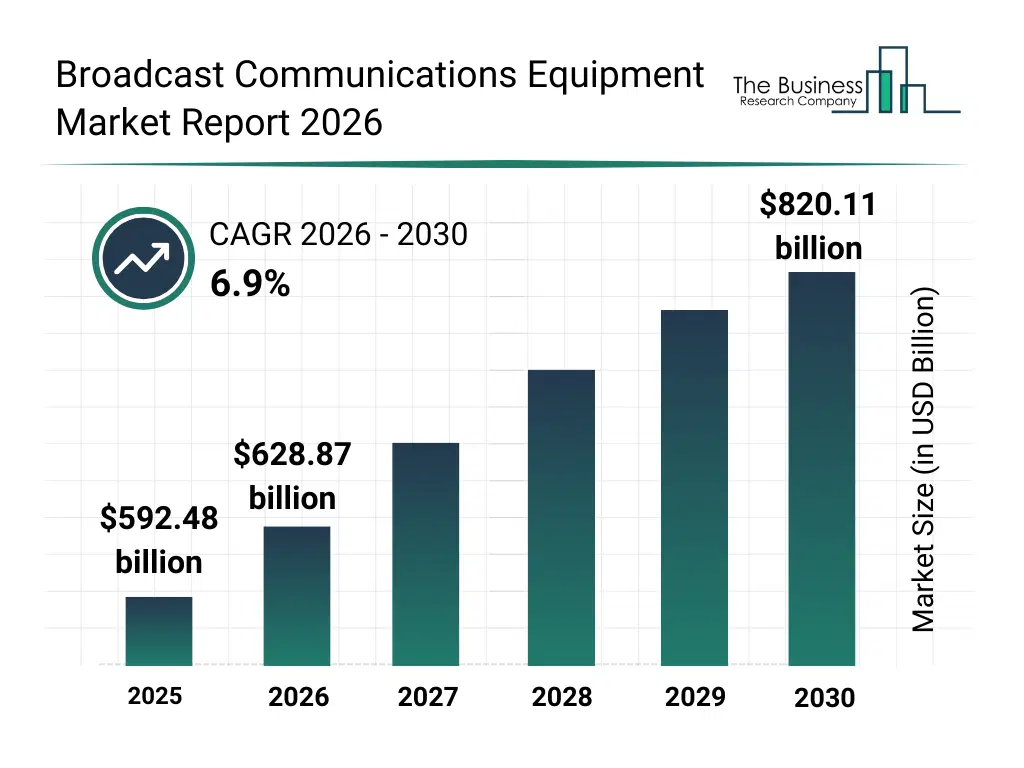
What Is The Broadcast Communications Equipment Market Size and Share 2026?
The broadcast communications equipment market size has grown strongly in recent years. It will grow from $592.48 billion in 2025 to $628.87 billion in 2026 at a compound annual growth rate (CAGR) of 6.1%. The growth in the historic period can be attributed to growth of television and radio broadcasting, expansion of satellite communication networks, rising defense communication needs, increasing civilian broadcast infrastructure, demand for reliable transmission equipment.What Is The Broadcast Communications Equipment Market Growth Forecast?
The broadcast communications equipment market size is expected to see strong growth in the next few years. It will grow to $820.11 billion in 2030 at a compound annual growth rate (CAGR) of 6.9%. The growth in the forecast period can be attributed to adoption of digital broadcasting technologies, expansion of military communication modernization programs, growth of satellite based services, demand for advanced rf components, integration of broadcasting with broadband networks. Major trends in the forecast period include shift from analog to digital broadcasting, growth of software defined radio equipment, expansion of satellite communication infrastructure, rising demand for high efficiency antennas, integration of broadcast and ip networks.
Global Broadcast Communications Equipment Market Segmentation
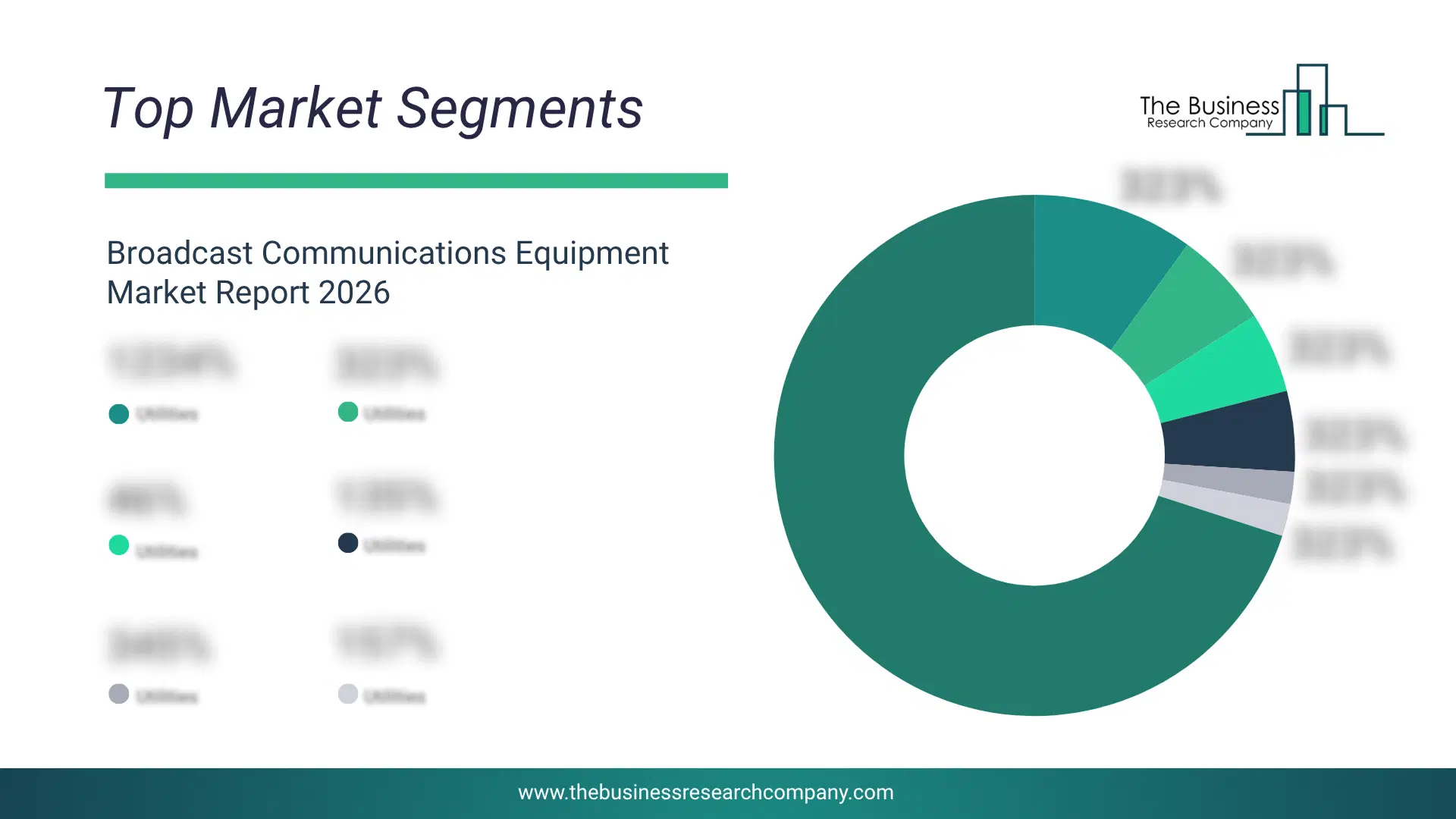
1) By Product Type: Transmitting Antennas, GPS Equipment, Transceivers, Satellite Communications Equipment, Other Product Types 2) By Technology: Analog Broadcasting, Digital Broadcasting 3) By Application: Military, Civilian Subsegments: 1) By Transmitting Antennas: Directional Antennas, Omnidirectional Antennas, Sector Antennas 2) By GPS Equipment: GPS Receivers, GPS Signal Amplifiers, GPS Tracking Devices 3) By Transceivers: Analog Transceivers, Digital Transceivers, Software-Defined Radio (SDR) Transceivers 4) By Satellite Communications Equipment: Satellite Modems, Satellite Routers, Ground Stations 5) By Other Product Types: Signal Processors, Broadcast Monitors, RF AmplifiersWhat Is The Driver Of The Broadcast Communications Equipment Market?
A rise in the deployment of 5G is expected to propel the growth of the broadcast communications equipment market going forward. 5G, short for ‘fifth generation,’ refers to the latest generation of wireless cellular network technology. It represents a significant advancement in telecommunications standards and capabilities compared to its predecessors, such as 4G (fourth generation) and 3G (third generation). Broadcast communications equipment plays a critical role in 5G deployment by supporting the transmission and reception of high-frequency signals for wireless communication. This equipment includes antennas, transmitters, and receivers that ensure seamless connectivity between 5G base stations and user devices. They enable the delivery of high-speed data, low latency, and reliable connections, all essential for the success of 5G networks. For instance, in March 2024, according to 5G Americas, a US-based wireless industry trade association, by the end of 2023, there were 1.76 billion 5G connections worldwide, reflecting an addition of 700 million connections during the year, a 66% growth compared to 2022. Global 5G connections are projected to reach 7.9 billion by 2028. Therefore, a rise in the deployment of 5G is driving the broadcast communications equipment industry.Key Players In The Global Broadcast Communications Equipment Market
Major companies operating in the broadcast communications equipment market are Telefonaktiebolaget LM Ericsson, L3Harris Technologies Inc., Motorola Solutions Inc., Lockheed Martin Corporation, Raytheon Technologies Corporation, L3 Technologies Inc., Datapath Inc., Datron World Communications Inc., CalAmp Corp., Sierra Wireless Inc., Orbcomm Inc., Queclink Wireless Solutions Co. Ltd., Laird PLC, TomTom International BV, Teltonika UAB, Atrack Technology Inc., Geotab Inc., Meitrack Group, Trackimo LLC, Shenzhen Coban Electronics Co. Ltd., Xirgo Technologies Inc., Maestro Wireless Solutions Ltd., Ruptela UAB, Sony Corporation, Panasonic Corporation, Cisco Systems Inc., Huawei Technologies Co. Ltd., Grass Valley USA LLC, Imagine Communications Corp., Evertz Technologies Limited, Comtech Telecommunications Corp., GatesAir Inc., Rohde & Schwarz GmbH & Co KG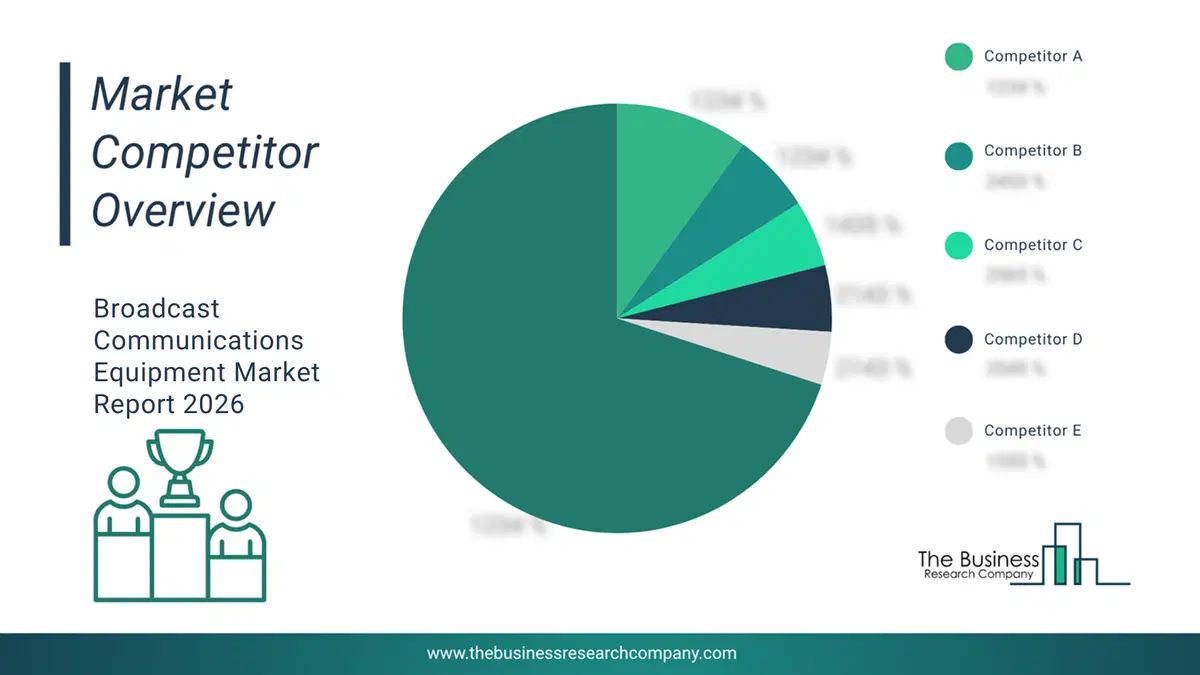
This chart is for illustrative purposes; the full report includes a detailed competitor analysis and comprehensive overview of the top 10 companies in the market.
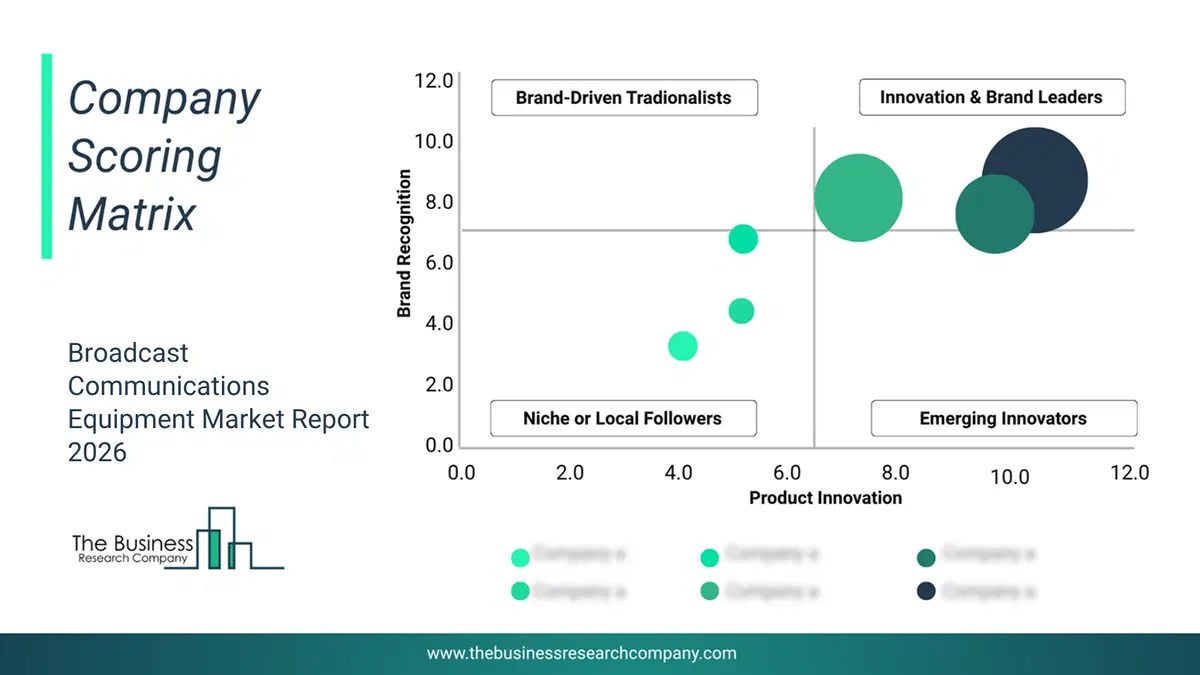
This chart maps companies by product innovation and brand strength, with bubble size indicating relative revenue, helping identify market leaders, challengers, and niche players. This is an illustrative chart; the full report provides a complete and accurate competitive analysis.
Global Broadcast Communications Equipment Market Trends and Insights
Major companies operating in the nitrogenous fertilizer market are adopting a strategic partnership approach to expand offerings. Strategic partnerships refer to a process in which companies leverage each other's strengths and resources to achieve mutual benefits and success. For instance, in October 2023, BridgeCom Systems, a US-based company that develops, markets, and sells equipment for the land mobile radio industry, partnered with C & L Service Inc., a California-based land mobile radio equipment and services provider. The partnership is expected to benefit local businesses and improve communication in the region. The partnership is also intended to yield a variety of benefits, including greater communication, higher efficiency, and increased safety.What Are Latest Mergers And Acquisitions In The Broadcast Communications Equipment Market?
In September 2024, Grass Valley, a Canada-based broadcast technology company, entered into a strategic partnership with ES Broadcast to drive global innovation and expansion in next-generation broadcast production. The partnership aims to strengthen global reach, deepen long-term collaboration, and accelerate the worldwide adoption of Grass Valley’s advanced media production technologies, particularly through expanding the AMPP Platform with ES Broadcast’s multi-million-dollar annual investment. ES Broadcast is a UK-based provider of broadcast equipment, integration services, and technology solutions for media and live production environments.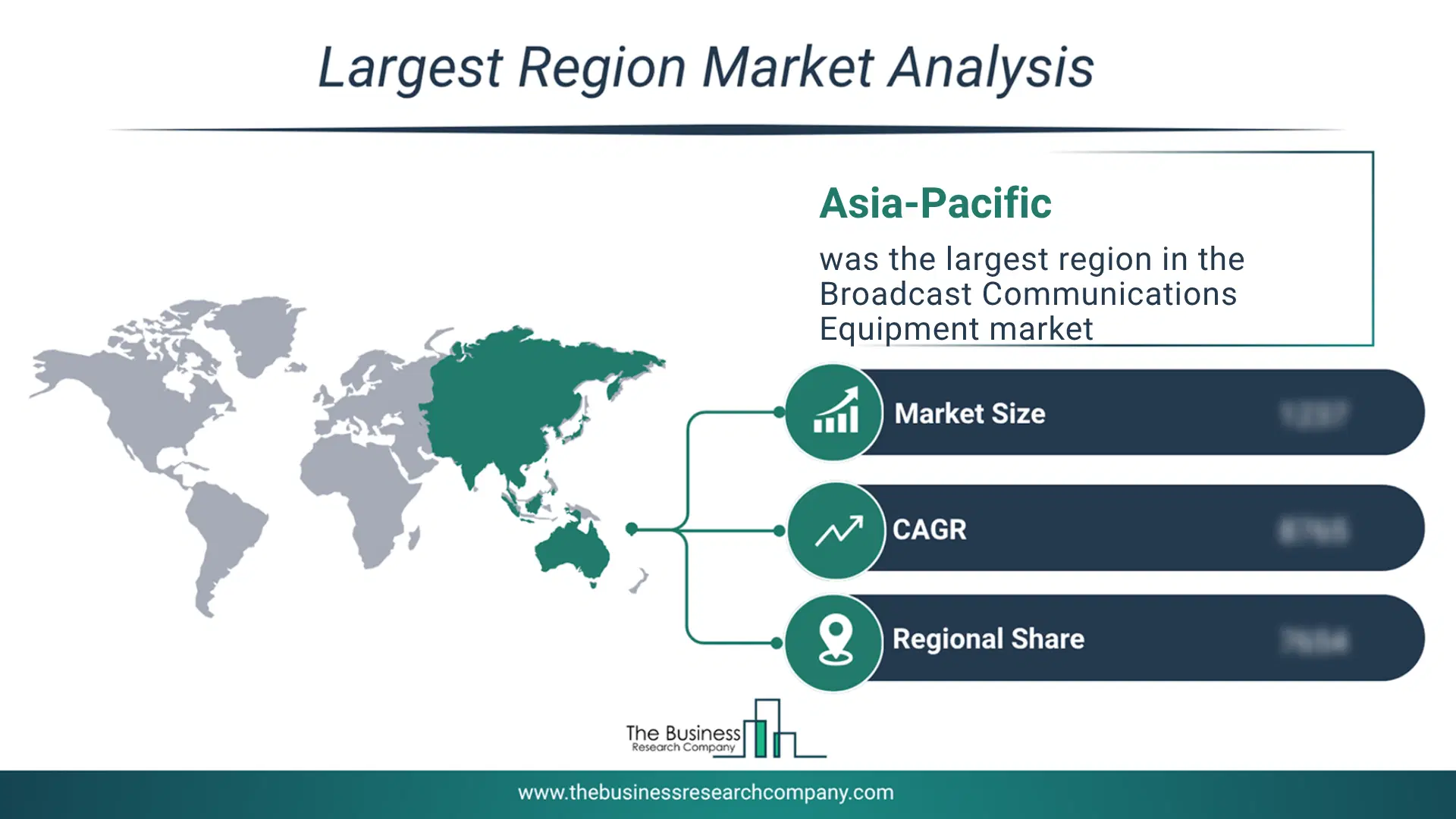
Regional Insights
Asia-Pacific was the largest region in the broadcast communications equipment market in 2025. The regions covered in this market report are Asia-Pacific, South East Asia, Western Europe, Eastern Europe, North America, South America, Middle East, Africa. The countries covered in this market report are Australia, Brazil, China, France, Germany, India, Indonesia, Japan, Taiwan, Russia, South Korea, UK, USA, Canada, Italy, Spain.What Defines the Broadcast Communications Equipment Market?
The broadcast communication equipment market consists of sales of mobile communications hardware, radio and television studios, and broadcasting hardware. Values in this market are ‘factory gate’ values, that is the value of goods sold by the manufacturers or creators of the goods, whether to other entities (including downstream manufacturers, wholesalers, distributors and retailers) or directly to end customers. The value of goods in this market includes related services sold by the creators of the goods.How is Market Value Defined and Measured?
The market value is defined as the revenues that enterprises gain from the sale of goods and/or services within the specified market and geography through sales, grants, or donations in terms of the currency (in USD unless otherwise specified). The revenues for a specified geography are consumption values that are revenues generated by organizations in the specified geography within the market, irrespective of where they are produced. It does not include revenues from resales along the supply chain, either further along the supply chain or as part of other products.
This chart presents market attractiveness based on a quantitative evaluation of growth, competition, strategic alignment, and risk, offering a clear view of opportunity areas for decision-making. This chart is for illustrative purposes; the full report contains the complete analysis.

This chart highlights the Total Addressable Market (TAM) by estimating the maximum revenue opportunity using an assumption-driven approach, supporting strategic planning and opportunity sizing across markets. The chart is illustrative; the full report provides a more comprehensive analysis.
What Key Data and Analysis Are Included in the Broadcast Communications Equipment Market Report 2026?
The broadcast communications equipment market research report is one of a series of new reports from The Business Research Company that provides market statistics, including industry global market size, regional shares, competitors with the market share, detailed market segments, market trends and opportunities, and any further data you may need to thrive in the broadcast communications equipment industry. The market research report delivers a complete perspective of everything you need, with an in-depth analysis of the current and future state of the industry.Broadcast Communications Equipment Market Report Forecast Analysis
| Report Attribute | Details |
|---|---|
| Market Size Value In 2026 | $628.87 billion |
| Revenue Forecast In 2030 | $820.11 billion |
| Growth Rate | CAGR of 6.9% from 2026 to 2030 |
| Base Year For Estimation | 2025 |
| Actual Estimates/Historical Data | 2020-2025 |
| Forecast Period | 2026 - 2030 |
| Market Representation | Revenue in USD Billion and CAGR from 2026 to 2030 |
| Segments Covered | Product Type, Technology, Application |
| Regional Scope | Asia-Pacific, Western Europe, Eastern Europe, North America, South America, Middle East, Africa |
| Country Scope | The Countries Covered In This Market Report Are Australia, Brazil, China, France, Germany, India, Indonesia, Japan, Taiwan, Russia, South Korea, Uk, Usa, Canada, Italy, Spain. |
| Key Companies Profiled | Telefonaktiebolaget LM Ericsson, L3Harris Technologies Inc., Motorola Solutions Inc., Lockheed Martin Corporation, Raytheon Technologies Corporation, L3 Technologies Inc., Datapath Inc., Datron World Communications Inc., CalAmp Corp., Sierra Wireless Inc., Orbcomm Inc., Queclink Wireless Solutions Co. Ltd., Laird PLC, TomTom International BV, Teltonika UAB, Atrack Technology Inc., Geotab Inc., Meitrack Group, Trackimo LLC, Shenzhen Coban Electronics Co. Ltd., Xirgo Technologies Inc., Maestro Wireless Solutions Ltd., Ruptela UAB, Sony Corporation, Panasonic Corporation, Cisco Systems Inc., Huawei Technologies Co. Ltd., Grass Valley USA LLC, Imagine Communications Corp., Evertz Technologies Limited, Comtech Telecommunications Corp., GatesAir Inc., Rohde & Schwarz GmbH & Co KG |
| Customization Scope | Request for Customization |
| Pricing And Purchase Options | Explore Purchase Options |