
Business Continuity Market Report 2026
Global Outlook – By Component (Solutions, Services, Platforms), By Deployment Mode (Cloud Based, On Premises, Hybrid), By Application (Business Continuity Planning, Disaster Recovery Management, Risk Management And Assessment, Data Backup And Recovery, Incident Management), By Organization Size (Small And Medium Enterprises, Large Enterprises, Startups), By End Use Industry (Banking Financial Services And Insurance, Information Technology And Telecommunications, Healthcare And Life Sciences, Retail And E Commerce, Manufacturing Industry) – Market Size, Trends, Strategies, and Forecast to 2030
Business Continuity Market Overview
• Business Continuity market size has reached to $52.76 billion in 2025 • Expected to grow to $56.2 billion in 2030 at a compound annual growth rate (CAGR) of 6.7% • Growth Driver: Surge In Demand For Disaster Recovery As A Service Fueling The Growth Of The Market Due To Rising Ransomware Threats And Increasing Need For Operational Resilience • Market Trend: Intelligent Risk Analytics Platforms Enable Proactive Disruption Mitigation • North America was the largest region in 2025 and Asia-Pacific is the fastest growing region.What Is Covered Under Business Continuity Market?
Business continuity is a specialized offering provided by companies to help organizations prepare for, manage, and sustain critical business operations during and after unexpected disruptions such as natural disasters, cyberattacks, equipment failures, or other crises, involving activities such as risk assessment, business impact analysis, continuity strategy development, planning, testing, and recovery procedures to maintain operational resilience and minimize downtime. The main component of business continuity includes solutions, services and platforms. Solutions refers to integrated platforms and tools that enable organizations to ensure operational resilience, disaster recovery, risk mitigation, and continuity of critical business functions through planning, monitoring, and automated response capabilities.The deployment mode includes cloud-based, on-premises, and hybrid models, and the organization size categories include startups, small and medium enterprises (SMEs), and large enterprises. They are widely used across applications such as business continuity planning, disaster recovery management, risk management and assessment, data backup and recovery, and incident management, and the key end-user industries include banking, financial services, and insurance (BFSI), information technology and telecommunications, healthcare and life sciences, retail and e-commerce, and manufacturing industry.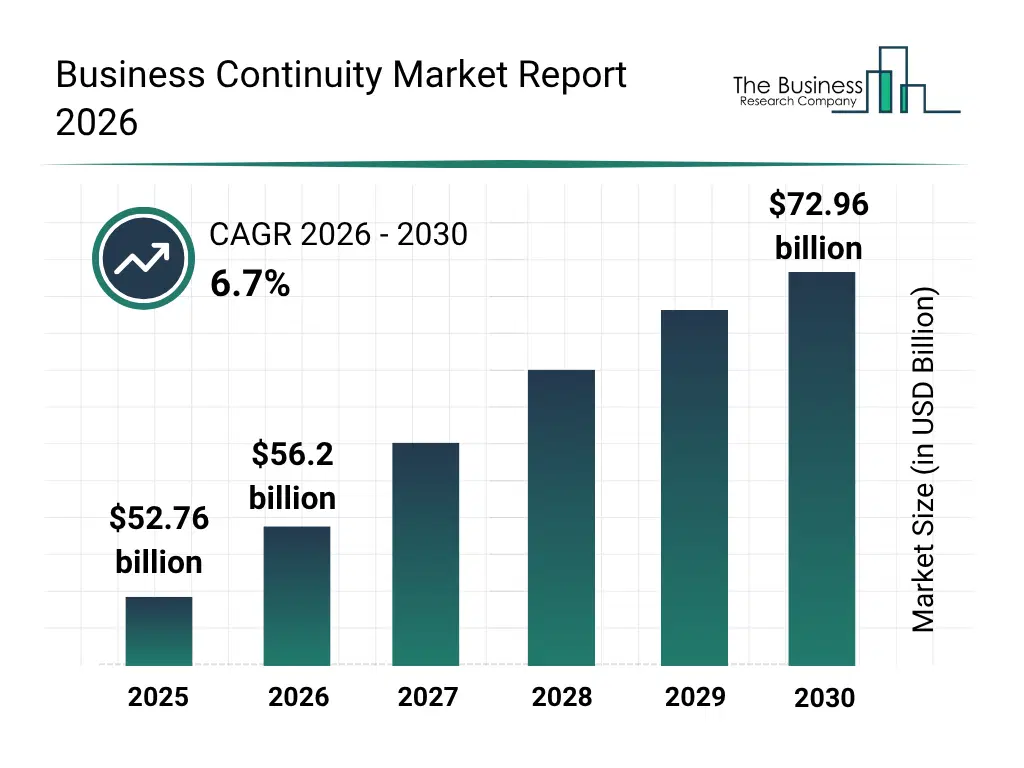
What Is The Business Continuity Market Size and Share 2026?
The business continuity market size has grown strongly in recent years. It will grow from $52.76 billion in 2025 to $56.2 billion in 2026 at a compound annual growth rate (CAGR) of 6.5%. The growth in the historic period can be attributed to increase in natural disaster occurrences, rising cybersecurity threats, growth in enterprise it infrastructure, regulatory compliance requirements, expansion of global business operations.What Is The Business Continuity Market Growth Forecast?
The business continuity market size is expected to see strong growth in the next few years. It will grow to $72.96 billion by 2030 at a compound annual growth rate (CAGR) of 6.7%. The growth in the forecast period can be attributed to growing reliance on digital infrastructure, increasing frequency of cyberattacks, rising adoption of cloud based recovery solutions, demand for real time risk monitoring, expansion of remote and hybrid work environments. Major trends in the forecast period include increasing focus on enterprise wide risk assessment and business impact analysis, growing adoption of integrated continuity planning frameworks, rising demand for real time incident response and recovery solutions, enhanced focus on regulatory compliance and governance requirements, increasing importance of resilience testing and simulation exercises.
Global Business Continuity Market Segmentation
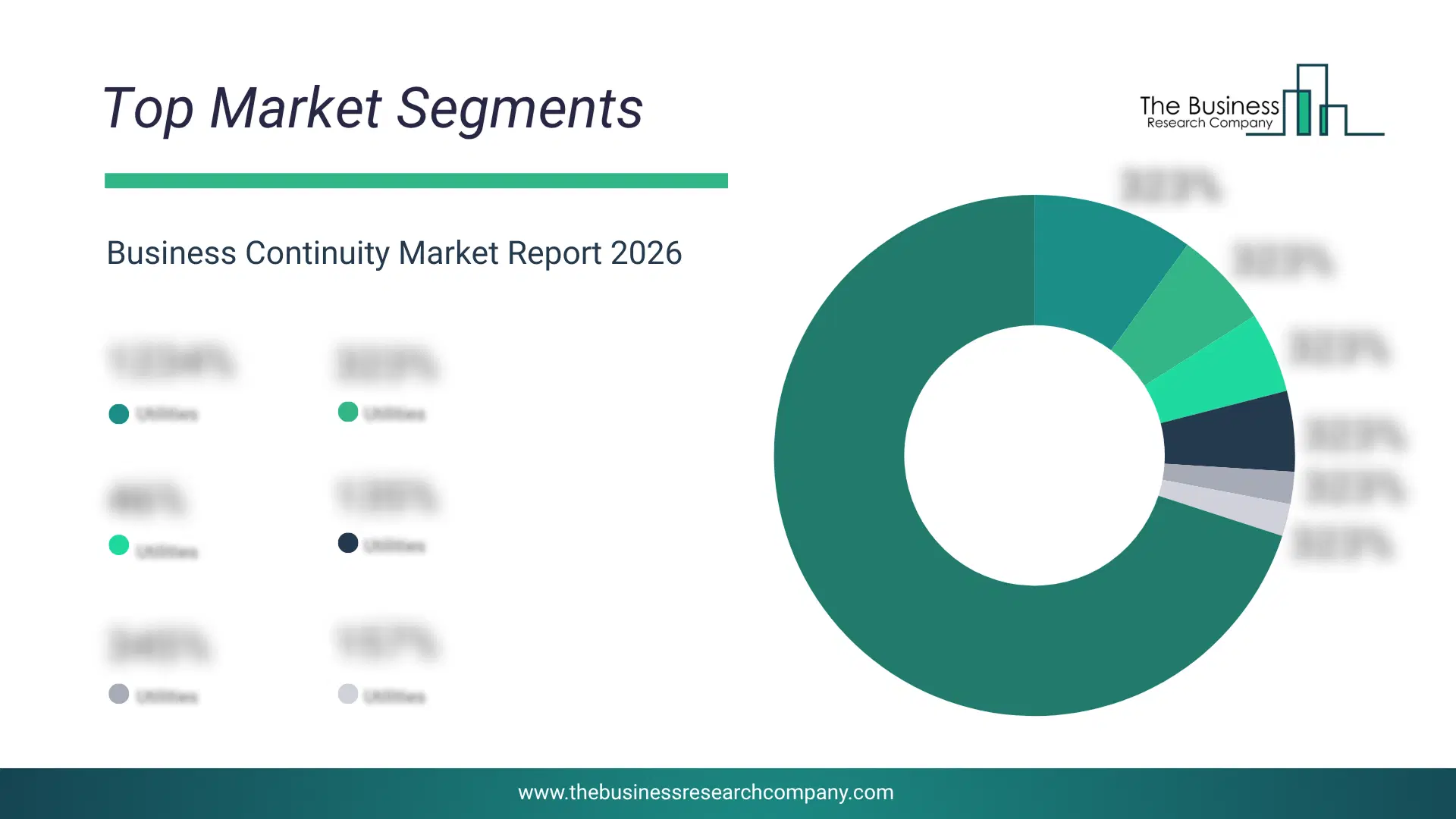
1) By Component: Solutions, Services, Platforms 2) By Deployment Mode: Cloud Based, On Premises, Hybrid 3) By Application: Business Continuity Planning, Disaster Recovery Management, Risk Management And Assessment, Data Backup And Recovery, Incident Management 4) By Organization Size: Small And Medium Enterprises, Large Enterprises, Startups 5) By End Use Industry: Banking Financial Services And Insurance, Information Technology And Telecommunications, Healthcare And Life Sciences, Retail And E Commerce, Manufacturing Industry Subsegments: 1) By Solutions: Business Impact Analysis Solutions, Risk Assessment Solutions, Disaster Recovery Solutions, Crisis Management Solutions, Compliance Management Solutions 2) By Services: Consulting Services, Implementation Services, Training And Education Services, Managed Services, Support And Maintenance Services 3) By Platforms: Cloud Based Platforms, On Premise Platforms, Hybrid Platforms, Integrated Risk Management Platforms, Continuity Planning PlatformsWhat Is The Driver Of The Business Continuity Market?
The rising demand for disaster recovery as a service is expected to propel the growth of the business continuity market going forward. Disaster recovery as a service refers to a cloud-based solution that replicates and restores an organization’s data, applications, and IT infrastructure to ensure rapid recovery and operational continuity following disruptions such as cyberattacks, system failures, or natural disasters. The increasing demand for disaster recovery as a service is driven by the growing prevalence of ransomware incidents and cyber threats, as organizations seek to enable rapid data restoration, minimize downtime, and maintain continuous operations. Business continuity requirements further reinforce the adoption of disaster recovery as a service by emphasizing the need for resilient IT infrastructure, uninterrupted operations, and efficient recovery mechanisms. For instance, in 2023, according to America's Cyber Defense Agency, a US-based government department, more than 1,200 pre-ransomware alerts were issued across sectors, including healthcare, education, government, and critical infrastructure, along with 294 notifications shared with 27 international partners to mitigate early-stage ransomware threats. Therefore, the rising demand for disaster recovery as a service is driving the growth of the business continuity industry.Key Players In The Global Business Continuity Market
Major companies operating in the business continuity market are Google LLC; Microsoft Corporation; Amazon Web Services Inc.; Dell Technologies Inc.; International Business Machines Corporation; Oracle Corporation; HCL Technologies Limited; Tata Communications Limited; Veeam Software Group GmbH; Cohesity Inc.; Commvault Systems Inc.; Flexential Corp.; Acronis International GmbH; Druva Inc.; CtrlS Datacenters Limited; TierPoint LLC; InterVision Systems LLC; Arcserve LLC; Expedient Holdings USA LLC; Unitrends Inc.; Recovery Point Systems Inc.; Cyfuture India Private Limited; phoenixNAP Global IT Services; Evolve IP LLC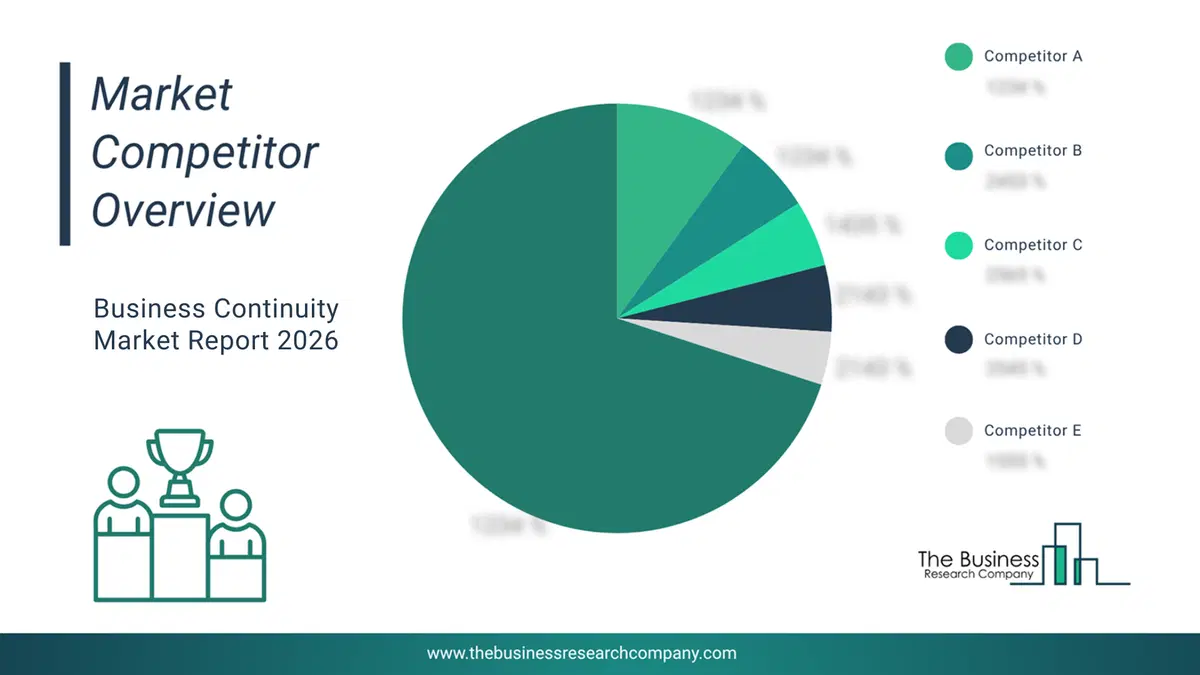
This chart is for illustrative purposes; the full report includes a detailed competitor analysis and comprehensive overview of the top 10 companies in the market.
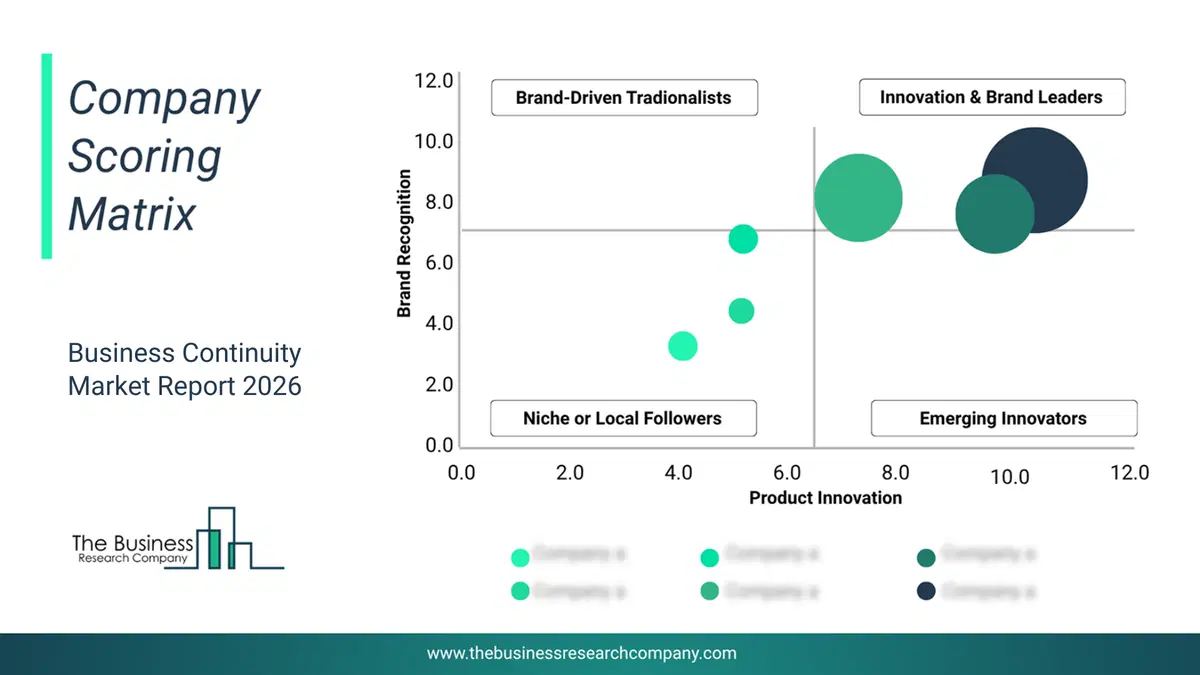
This chart maps companies by product innovation and brand strength, with bubble size indicating relative revenue, helping identify market leaders, challengers, and niche players. This is an illustrative chart; the full report provides a complete and accurate competitive analysis.
Global Business Continuity Market Trends and Insights
Major companies operating in the business continuity market are focusing on developing advanced solutions, such as artificial intelligence (AI)-driven operational risk intelligence platforms, to enhance resilience, improve real-time risk visibility, and ensure uninterrupted business operations across complex IT environments. AI-driven operational risk intelligence platforms refer to integrated solutions that combine analytics, automation, and artificial intelligence to continuously monitor application ecosystems, identify vulnerabilities, and prioritize risks impacting business continuity. For instance, in June 2025, International Business Machines Corporation, a US-based technology company, introduced IBM Concert, an AI-powered solution designed to deliver comprehensive insights into operational health and risk across the application lifecycle. The platform aggregates data from source code repositories, operational environments, and system components to map application topology and identify risks related to vulnerabilities, compliance gaps, expiring certificates, and software dependencies. It enables organizations to proactively mitigate potential disruptions, strengthen governance frameworks, and enhance overall business continuity strategies.What Are Latest Mergers And Acquisitions In The Business Continuity Market?
In July 2024, Thoma Bravo, a US-based private equity firm, acquired Everbridge, Inc. for $18 billion. Through this acquisition, Thoma Bravo aims to strengthen and expand Everbridge’s critical event management and operational resilience capabilities to enhance business continuity solutions for organizations facing increasing disruption risks. Everbridge, Inc. is a US-based company that provides comprehensive business continuity, crisis management, and operational resilience solutions.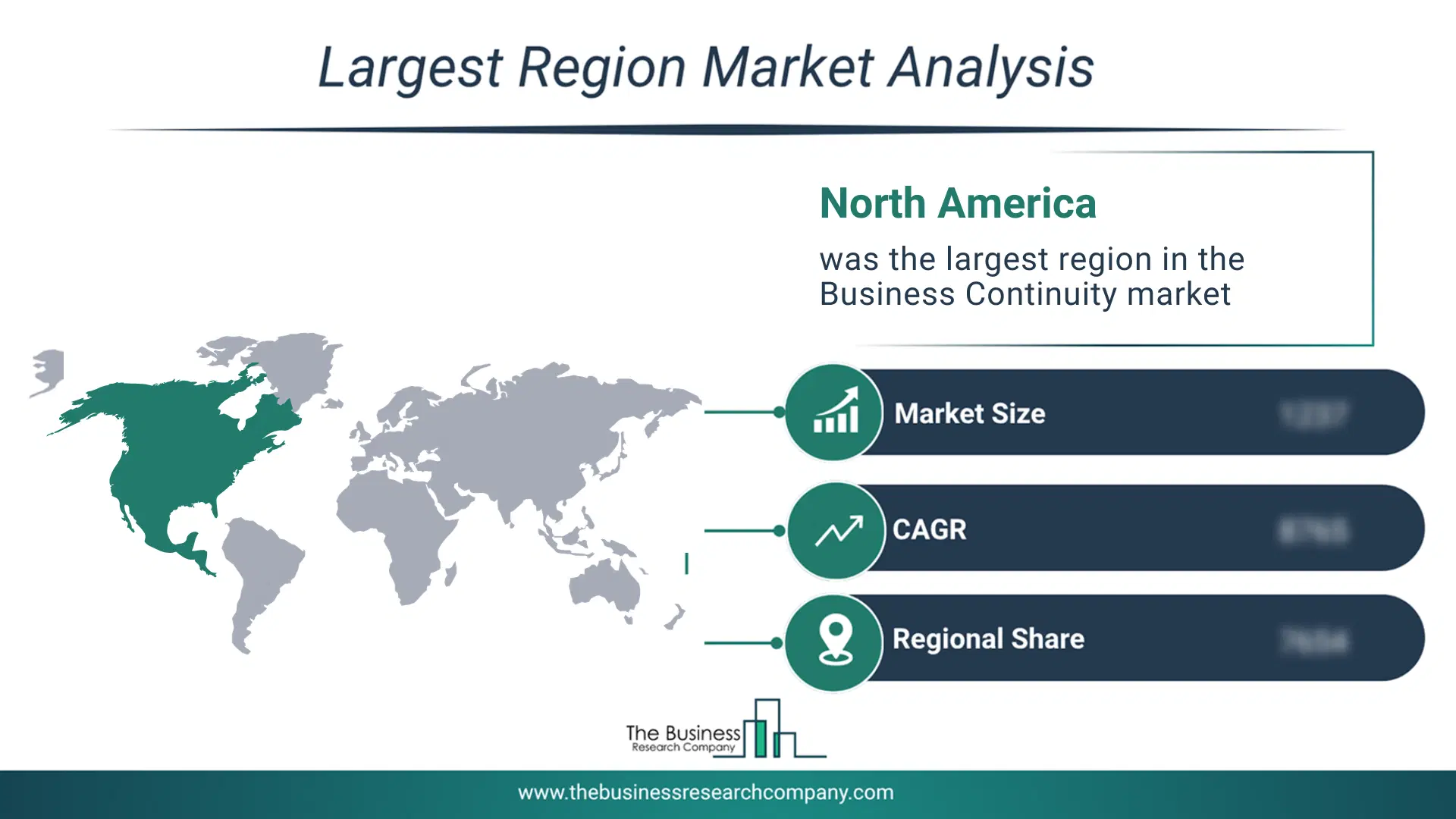
Regional Insights
North America was the largest region in the business continuity market in 2025) Asia-Pacific is expected to be the fastest-growing region in the forecast period. The regions covered in this market report are Asia-Pacific, South East Asia, Western Europe, Eastern Europe, North America, South America, Middle East, Africa. The countries covered in this market report are Australia, Brazil, China, France, Germany, India, Indonesia, Japan, Taiwan, Russia, South Korea, UK, USA, Canada, Italy, Spain.What Defines the Business Continuity Market?
The business continuity market includes revenues earned by entities through business continuity planning services, risk and impact assessment, continuity strategy consulting, implementation of continuity frameworks, training and testing exercises, incident response support. The market value includes the value of related goods sold by the service provider or included within the service offering. Only goods and services traded between entities or sold to end consumers are included.How is Market Value Defined and Measured?
The market value is defined as the revenues that enterprises gain from the sale of goods and/or services within the specified market and geography through sales, grants, or donations in terms of the currency (in USD unless otherwise specified). The revenues for a specified geography are consumption values that are revenues generated by organizations in the specified geography within the market, irrespective of where they are produced. It does not include revenues from resales along the supply chain, either further along the supply chain or as part of other products.
This chart presents market attractiveness based on a quantitative evaluation of growth, competition, strategic alignment, and risk, offering a clear view of opportunity areas for decision-making. This chart is for illustrative purposes; the full report contains the complete analysis.

This chart highlights the Total Addressable Market (TAM) by estimating the maximum revenue opportunity using an assumption-driven approach, supporting strategic planning and opportunity sizing across markets. The chart is illustrative; the full report provides a more comprehensive analysis.
What Key Data and Analysis Are Included in the Business Continuity Market Report 2026?
The business continuity market research report is one of a series of new reports from The Business Research Company that provides market statistics, including industry global market size, regional shares, competitors with the market share, detailed market segments, market trends and opportunities, and any further data you may need to thrive in the business continuity industry. The market research report delivers a complete perspective of everything you need, with an in-depth analysis of the current and future state of the industry.Business Continuity Market Report Forecast Analysis
| Report Attribute | Details |
|---|---|
| Market Size Value In 2026 | $56.2 billion |
| Revenue Forecast In 2030 | $72.96 billion |
| Growth Rate | CAGR of 6.70% from 2026 to 2030 |
| Base Year For Estimation | 2025 |
| Actual Estimates/Historical Data | 2020-2025 |
| Forecast Period | 2026 - 2030 |
| Market Representation | Revenue in USD Billion and CAGR from 2026 to 2030 |
| Segments Covered | Component, Deployment Mode, Application, Organization Size, End Use Industry |
| Regional Scope | Asia-Pacific, Western Europe, Eastern Europe, North America, South America, Middle East, Africa |
| Country Scope | The countries covered in the report are Australia, Brazil, China, France, Germany, India, Indonesia, Japan, Taiwan, Russia, South Korea, UK, USA, Canada, Italy, Spain. |
| Key Companies Profiled | Google LLC; Microsoft Corporation; Amazon Web Services Inc.; Dell Technologies Inc.; International Business Machines Corporation; Oracle Corporation; HCL Technologies Limited; Tata Communications Limited; Veeam Software Group GmbH; Cohesity Inc.; Commvault Systems Inc.; Flexential Corp.; Acronis International GmbH; Druva Inc.; CtrlS Datacenters Limited; TierPoint LLC; InterVision Systems LLC; Arcserve LLC; Expedient Holdings USA LLC; Unitrends Inc.; Recovery Point Systems Inc.; Cyfuture India Private Limited; phoenixNAP Global IT Services; Evolve IP LLC |
| Customization Scope | Request for Customization |
| Pricing And Purchase Options | Explore Purchase Options |