
Business Rules Management Market Report 2026
Global Outlook – By Offering Type (Software, Services), By Technology Stack (Traditional BRMS with engine and repository, AI and ML-driven decision-rules engines, Cloud-native and low-code/no-code decision platforms, Event-driven and real-time decisioning architectures), By Deployment Model (Cloud based, On premises, Hybrid), By Enterprise Size (Large enterprises, Mid size enterprises, Small enterprises), By Industry Vertical (Banking, financial services, and insurance (BFSI), Government and public sector, Telecom and IT, Manufacturing, Retail and consumer goods, Healthcare and life sciences, Transportation and logistics, Energy and utilities) – Market Size, Trends, Strategies, and Forecast to 2030
Business Rules Management Market Overview
• Business Rules Management market size has reached to $23.95 billion in 2025 • Expected to grow to $26.77 billion in 2030 at a compound annual growth rate (CAGR) of 12% • Growth Driver: Surge In Investment In Digital Transformation Initiatives Driving The Market Due To Increased Digital Governance, Assurance Adoption, And Standardized Investment Evaluation • Market Trend: Advancements In AI-Driven Decision Automation Enhancing Enterprise Efficiency • North America was the largest region in 2025 and Asia-Pacific is the fastest growing region.What Is Covered Under Business Rules Management Market?
Business rules management refers to a technology framework that enables organizations to define, deploy, execute, monitor, and maintain automated business rules used to govern operational decision-making within applications and enterprise systems. It allows business users and developers to separate decision logic from application code, enabling faster changes, improved compliance, and consistent execution of policies across digital workflows. The offering type of business rules management includes software and services. Software refers to platforms and tools that enable the creation, management, execution, and optimization of business rules for automated decision-making, compliance enforcement, and operational workflow control using rule engines, logic modeling, and real-time decision processing. The technology stack includes traditional BRMS with engines and repositories, AI and ML-driven decision rules engines, cloud-native and low-code/no-code decision platforms, and event-driven real-time decisioning architectures, with deployment models spanning cloud-based, on-premises, and hybrid environments, serving enterprises of all sizes including large, mid-sized, and small organizations, and supporting key industry verticals such as banking, financial services and insurance (BFSI), government and public sector, telecom and IT, manufacturing, retail and consumer goods, healthcare and life sciences, transportation and logistics, and energy and utilities.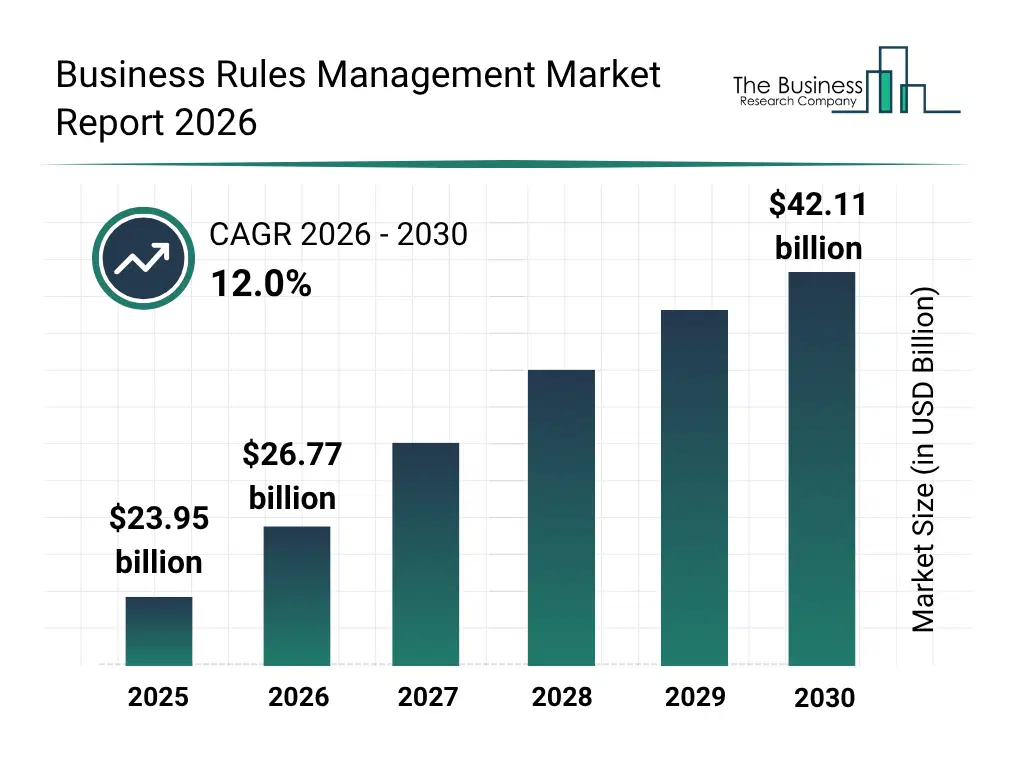
What Is The Business Rules Management Market Size and Share 2026?
The business rules management market size has grown rapidly in recent years. It will grow from $23.95 billion in 2025 to $26.77 billion in 2026 at a compound annual growth rate (CAGR) of 11.8%. The growth in the historic period can be attributed to manual decision making process inefficiencies, rise of enterprise workflow automation tools, increasing need for regulatory compliance enforcement, growth of rule based legacy systems, expansion of enterprise software adoption.What Is The Business Rules Management Market Growth Forecast?
The business rules management market size is expected to see rapid growth in the next few years. It will grow to $42.11 billion by 2030 at a compound annual growth rate (CAGR) of 12.0%. The growth in the forecast period can be attributed to surge in AI enabled decision automation adoption, increasing demand for real time business decisioning, growing focus on compliance and auditability requirements, expansion of cloud based brms platforms, rise of citizen developer and low code ecosystems. Major trends in the forecast period include AI driven decision automation in business rules management, low code and no code rule configuration platforms, real time event driven decision management systems, cloud native business rules management adoption, explainable and auditable decision intelligence systems.
Global Business Rules Management Market Segmentation
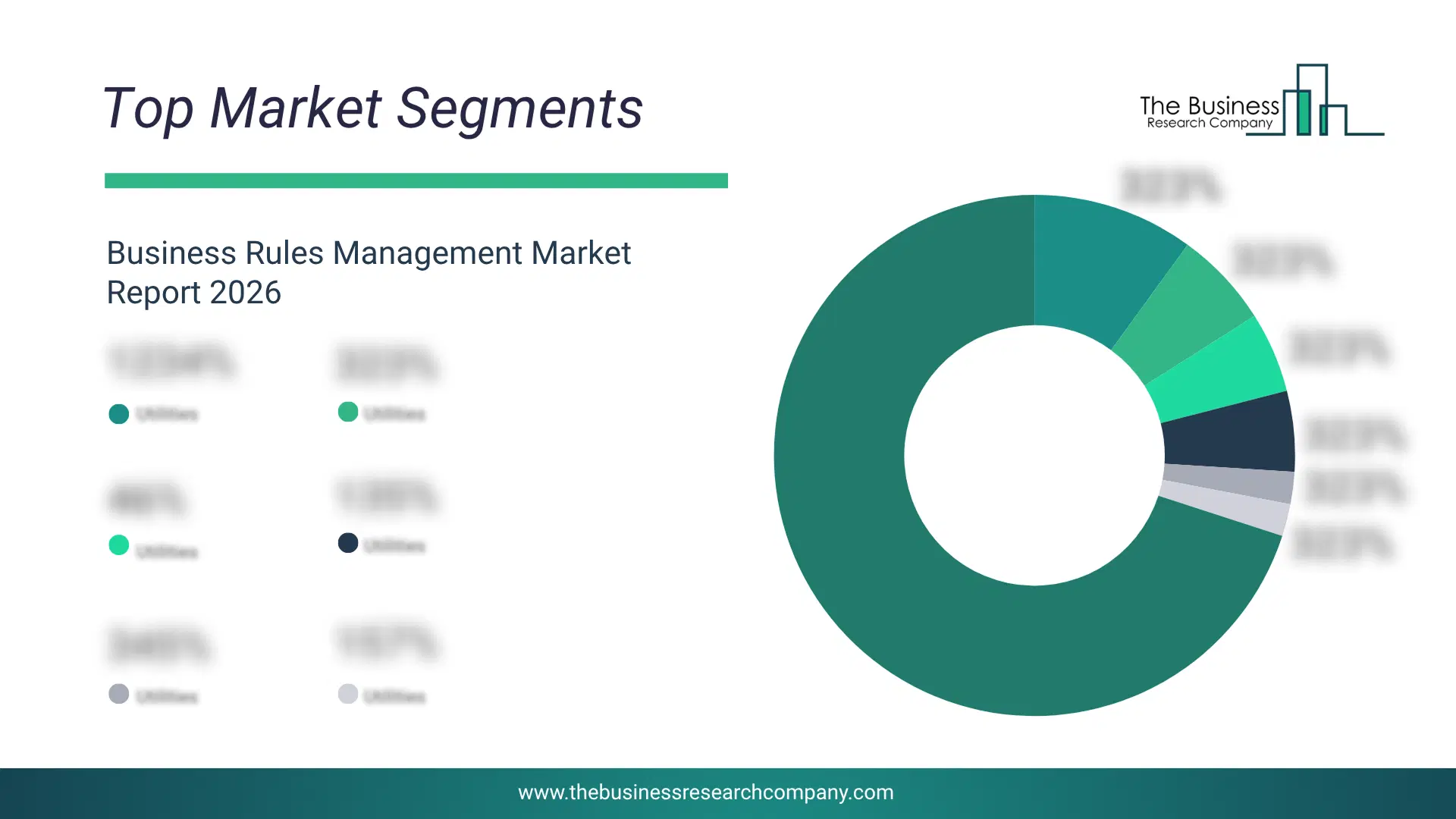
1) By Offering Type: Software, Services 2) By Technology Stack: Traditional BRMS with engine and repository, AI and ML-driven decision-rules engines, Cloud-native and low-code/no-code decision platforms, Event-driven and real-time decisioning architectures 3) By Deployment Model: Cloud based, On premises, Hybrid 4) By Enterprise Size: Large enterprises, Mid size enterprises, Small enterprises 5) By Industry Vertical: Banking, financial services, and insurance (BFSI), Government and public sector, Telecom and IT, Manufacturing, Retail and consumer goods, Healthcare and life sciences, Transportation and logistics, Energy and utilities Subsegments: 1) By Software: Business Rules Management Platforms, Business Rules Engine Software, Decision Management Software, Cloud Based Business Rules Solutions, Low Code And No Code Decision Platforms 2) By Services: Consulting Services, Implementation Services, Integration Services, Training And Support Services, Managed ServicesWhat Is The Driver Of The Business Rules Management Market?
The growing investments in digital transformation initiatives is expected to propel the growth of the business rules management market going forward. Investment in digital transformation initiatives refers to spending on digital technologies to modernize processes and improve efficiency and performance. The rise in investment in digital transformation initiatives is driven by the need for operational efficiency, as organizations adopt digital technologies to streamline processes, reduce costs, and improve productivity. Business rules management helps investment in digital transformation initiatives by enabling organizations to define, manage, and automate business logic consistently, improving decision-making, process efficiency, and agility in digital systems. For instance, in September 2025, according to the Digital Transformation Agency (DTA), an Australia-based government agency, about 75% of digital investments are expected to have assurance plans in place in 2024–25, rising to 80% by 2026–27, indicating expanding oversight coverage. Around 50% of major investment proposals are expected to apply standardized categorization in 2024–25, increasing to 75% by 2026–27, showing improving consistency in investment evaluation. Therefore, the growing investment in digital transformation initiatives is driving the growth of the business rules management industry.Key Players In The Global Business Rules Management Market
Major companies operating in the business rules management market are International Business Machines Corporation; Oracle Corporation; SAP SE; Experian plc; OpenText Corporation; Fair Isaac Corporation; Pegasystems Inc.; Newgen Software Technologies Limited; Progress Software Corporation; Appian Corporation; Sapiens International Corporation N.V.; Camunda Services GmbH; Agiloft Inc.; Decisions LLC; ACTICO GmbH; Trisotech Inc.; InRule Technology Inc.; Sparkling Logic Inc.; Rulex Inc.; FlexRule Ltd.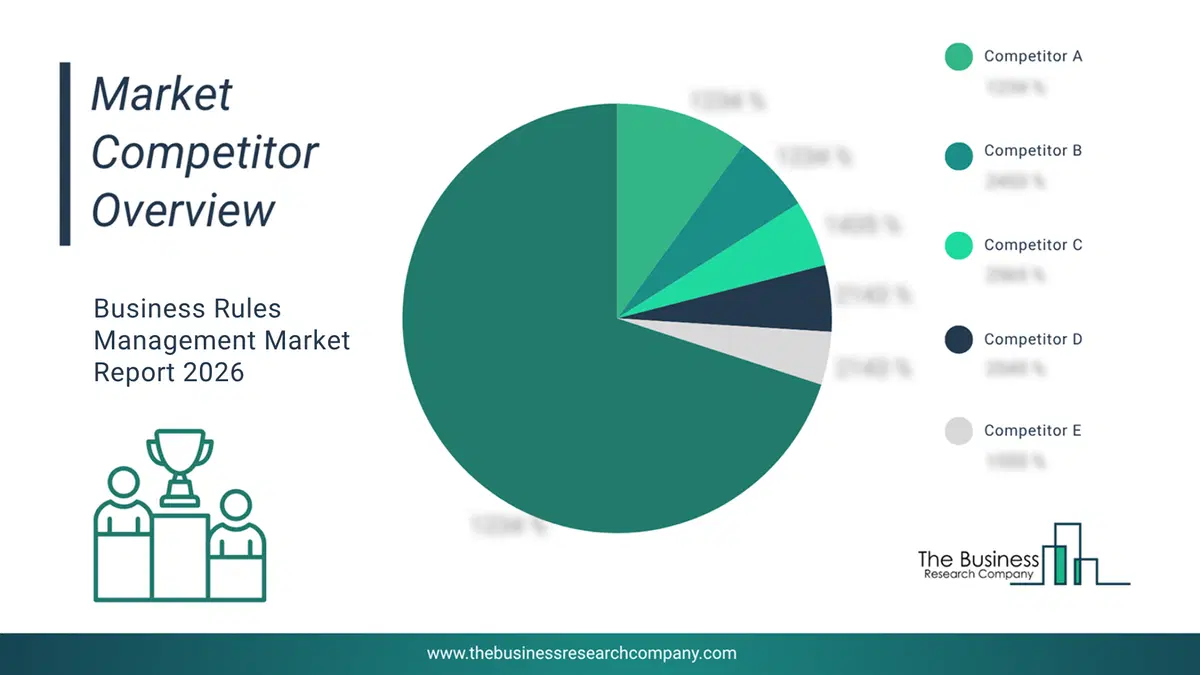
This chart is for illustrative purposes; the full report includes a detailed competitor analysis and comprehensive overview of the top 10 companies in the market.
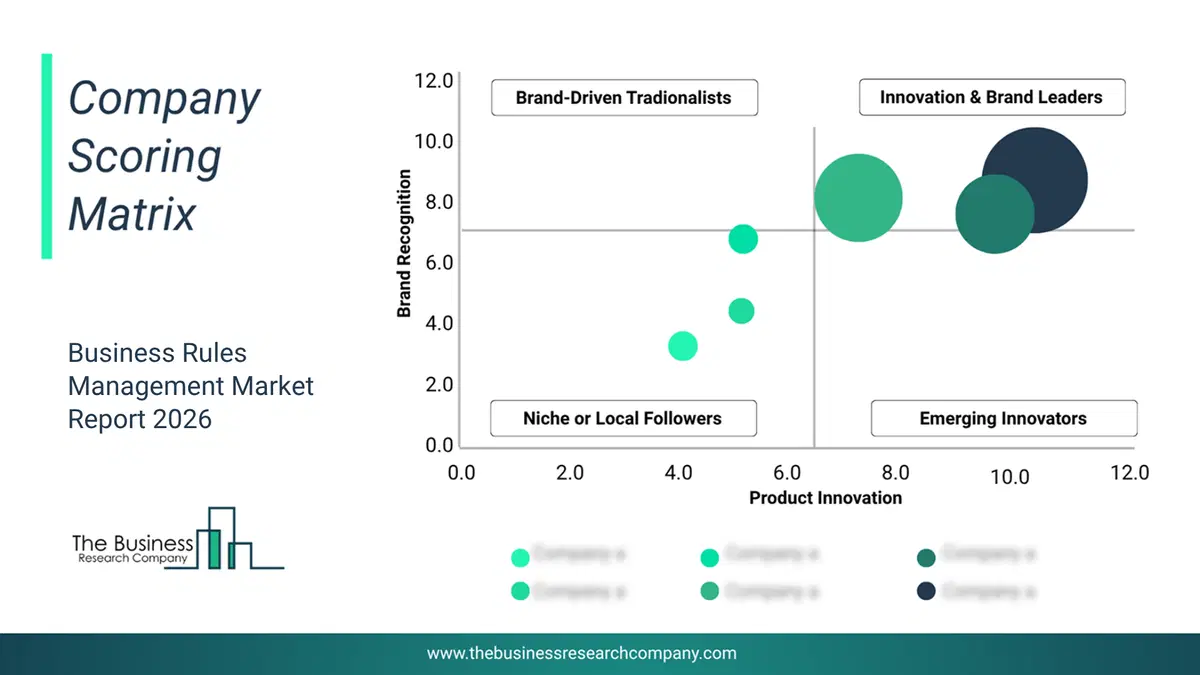
This chart maps companies by product innovation and brand strength, with bubble size indicating relative revenue, helping identify market leaders, challengers, and niche players. This is an illustrative chart; the full report provides a complete and accurate competitive analysis.
Global Business Rules Management Market Trends and Insights
Major companies operating in the business rules management market are focusing on innovation in AI-powered business rules and decision automation, such as AI-enabled rule automation platforms, to enhance real-time decision-making accuracy and operational agility. AI-enabled rule automation platforms refer to advanced software systems that combine traditional rule engines with artificial intelligence and machine learning capabilities to automate, optimize, and adapt business decision-making processes in real time. For instance, In June 2025, IBM Corporation, a US-based technology company, launched IBM Operational Decision Manager 9.5. This platform introduced AI-assisted rule authoring, real-time decision orchestration, and enhanced governance features that improve transparency and auditability. Such launches strengthen scalability and decision intelligence while enabling faster adaptation to changing business conditions, though integration with legacy systems remains a constraint at later stages.What Are Latest Mergers And Acquisitions In The Business Rules Management Market?
In July 2024, IBM Corporation, a US-based provider of cloud computing, artificial intelligence, data analytics, and enterprise software solutions, acquired StreamSets and webMethods for approximately $2.33 billion. With this acquisition, IBM aims to enhance its data integration, automation, and AI capabilities to strengthen its hybrid cloud and watsonx platform offerings while accelerating enterprise digital transformation. StreamSets and webMethods are US-based providers of data ingestion, integration, API management, and business process automation solutions including business rules management capabilities.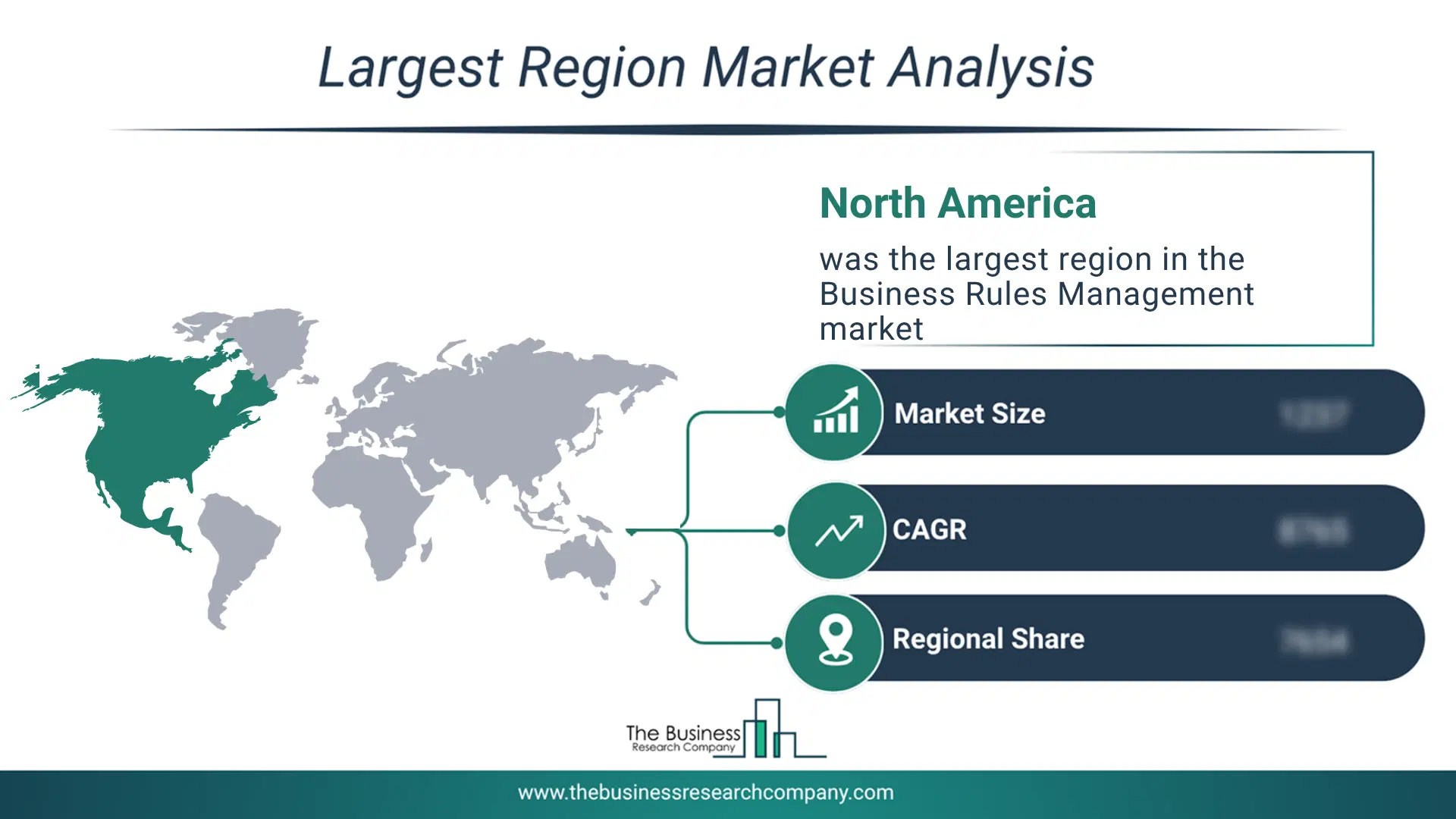
Regional Insights
North America was the largest region in the business rules management market in 2025. Asia-Pacific is expected to be the fastest-growing region in the forecast period. The regions covered in this market report are Asia-Pacific, South East Asia, Western Europe, Eastern Europe, North America, South America, Middle East, Africa. The countries covered in this market report are Australia, Brazil, China, France, Germany, India, Indonesia, Japan, Taiwan, Russia, South Korea, UK, USA, Canada, Italy, Spain.What Defines the Business Rules Management Market?
The business rules management market consists of revenues earned by entities by providing services such as business rules authoring and design, decision automation, rule engine development and integration, business rules lifecycle management, deployment and orchestration, governance and compliance management, training and support, and maintenance and optimization. The market value includes the value of related goods sold by the service provider or included within the service offering. The business rules management market also includes sales of decision management systems, rule engines, and associated middleware tools. Values in this market are ‘factory gate’ values, that is, the value of goods sold by the manufacturers or creators of the goods, whether to other entities (including downstream system integrators, distributors, and enterprise customers) or directly to end users. The value of goods in this market includes related services sold by the creators of the goods.How is Market Value Defined and Measured?
The market value is defined as the revenues that enterprises gain from the sale of goods and/or services within the specified market and geography through sales, grants, or donations in terms of the currency (in USD unless otherwise specified). The revenues for a specified geography are consumption values that are revenues generated by organizations in the specified geography within the market, irrespective of where they are produced. It does not include revenues from resales along the supply chain, either further along the supply chain or as part of other products.
This chart presents market attractiveness based on a quantitative evaluation of growth, competition, strategic alignment, and risk, offering a clear view of opportunity areas for decision-making. This chart is for illustrative purposes; the full report contains the complete analysis.

This chart highlights the Total Addressable Market (TAM) by estimating the maximum revenue opportunity using an assumption-driven approach, supporting strategic planning and opportunity sizing across markets. The chart is illustrative; the full report provides a more comprehensive analysis.
What Key Data and Analysis Are Included in the Business Rules Management Market Report 2026?
The business rules management market research report is one of a series of new reports from The Business Research Company that provides market statistics, including industry global market size, regional shares, competitors with the market share, detailed market segments, market trends and opportunities, and any further data you may need to thrive in the business rules management industry. The market research report delivers a complete perspective of everything you need, with an in-depth analysis of the current and future state of the industry.Business Rules Management Market Report Forecast Analysis
| Report Attribute | Details |
|---|---|
| Market Size Value In 2026 | $26.77 billion |
| Revenue Forecast In 2030 | $42.11 billion |
| Growth Rate | CAGR of 12% from 2026 to 2030 |
| Base Year For Estimation | 2025 |
| Actual Estimates/Historical Data | 2020-2025 |
| Forecast Period | 2026 - 2030 |
| Market Representation | Revenue in USD Billion and CAGR from 2026 to 2030 |
| Segments Covered | Offering Type, Technology Stack, Deployment Model, Enterprise Size, Industry Vertical |
| Regional Scope | Asia-Pacific, Western Europe, Eastern Europe, North America, South America, Middle East, Africa |
| Country Scope | The Countries Covered In This Market Report Are Australia, Brazil, China, France, Germany, India, Indonesia, Japan, Taiwan, Russia, South Korea, Uk, Usa, Canada, Italy, Spain. |
| Key Companies Profiled | International Business Machines Corporation, Oracle Corporation, SAP SE, Experian plc, OpenText Corporation, Fair Isaac Corporation, Pegasystems Inc., Newgen Software Technologies Limited, Progress Software Corporation, Appian Corporation, Sapiens International Corporation N.V., Camunda Services GmbH, Agiloft Inc., Decisions LLC, ACTICO GmbH, Trisotech Inc., InRule Technology Inc., Sparkling Logic Inc., Rulex Inc., FlexRule Ltd. |
| Customization Scope | Request for Customization |
| Pricing And Purchase Options | Explore Purchase Options |