
Canned Food Market Report 2026
Global Outlook – By Product Type (Canned Fruits, Canned Vegetables, Canned Meat And Seafood, Canned Ready Meals, Canned Soups And Sauces), By Packaging Type (Metal Cans, Aluminum Cans, Steel Cans), By Type Of Canned Food (Organic Canned Food, Conventional Canned Food), By Distribution Channel (Supermarkets And Hypermarkets, Convenience Stores, Online Retail, Specialty Stores), By Application (Household Consumption, Foodservice Industry, Institutional Use) – Market Size, Trends, Strategies, and Forecast to 2030
Canned Food Market Overview
• Canned Food market size has reached to $118.45 billion in 2025 • Expected to grow to $122.8 billion in 2030 at a compound annual growth rate (CAGR) of 3.9% • Growth Driver: Surge In Increasing Demand For Ready To Eat Meals Fueling The Growth Of The Market Due To Convenience-Driven Consumption • Market Trend: Localized Plant-Based Offerings Expanding Canned Food Appeal • North America was the largest region in 2025 and Asia-Pacific is the fastest growing region.What Is Covered Under Canned Food Market?
Canned food refers to processed food products that are preserved in airtight containers such as metal cans or sealed packaging to extend shelf life while maintaining nutritional value, taste, and safety. These foods undergo thermal processing to eliminate microorganisms and prevent spoilage, enabling long-term storage without refrigeration. They are designed to provide convenient, ready-to-store, and stable food options across a wide range of edible categories. The main products types of canned food comprise canned fruits, canned vegetables, canned meat and seafood, canned ready meals, and canned soups and sauces. Canned fruits refer to fruits that are processed, preserved, and sealed in airtight containers such as cans with the help of heat sterilization, enabling extended shelf life while retaining flavor, texture, and nutritional value, and offering convenience for consumption without the need for immediate refrigeration. The various packaging types include metal cans, aluminum cans, and steel cans, while the types of canned food include organic canned food and conventional canned food, and these products are distributed through multiple channels such as supermarkets and hypermarkets, convenience stores, online retail, and specialty stores, and are used in applications including household consumption, the foodservice industry, and institutional use.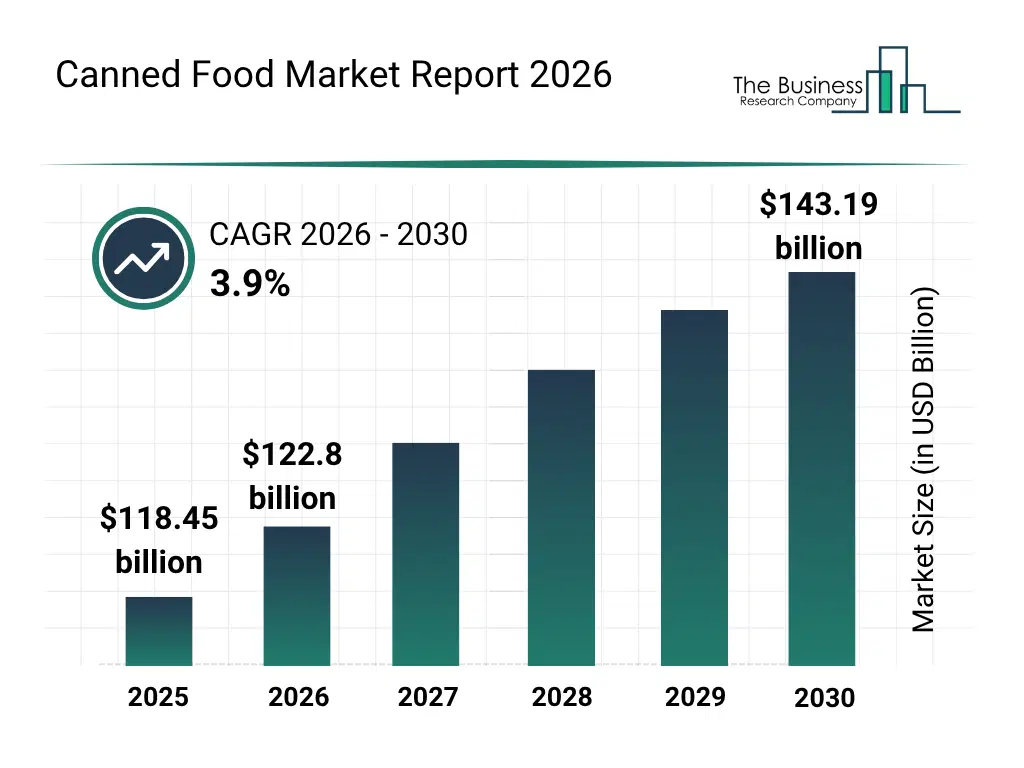
What Is The Canned Food Market Size and Share 2026?
The canned food market size has grown steadily in recent years. It will grow from $118.45 billion in 2025 to $122.8 billion in 2026 at a compound annual growth rate (CAGR) of 3.7%. The growth in the historic period can be attributed to urbanization and changing dietary habits, expansion of food processing infrastructure, rising demand for long shelf-life foods, growth of retail distribution networks, increased canned food affordability.What Is The Canned Food Market Growth Forecast?
The canned food market size is expected to see steady growth in the next few years. It will grow to $143.19 billion by 2030 at a compound annual growth rate (CAGR) of 3.9%. The growth in the forecast period can be attributed to increasing health-conscious consumption patterns, rising demand for premium and organic canned foods, expansion of emergency preparedness food stocks, innovation in flavor and product variety, growth in global trade and packaged food demand. Major trends in the forecast period include Rising demand for convenient shelf-stable meal solutions, Growth in ready-to-eat canned meal varieties, Increasing preference for fortified and nutrient-enriched canned foods, Expansion of premium and gourmet canned food offerings, Growing consumption driven by urban lifestyle and time-constrained consumers.
Global Canned Food Market Segmentation
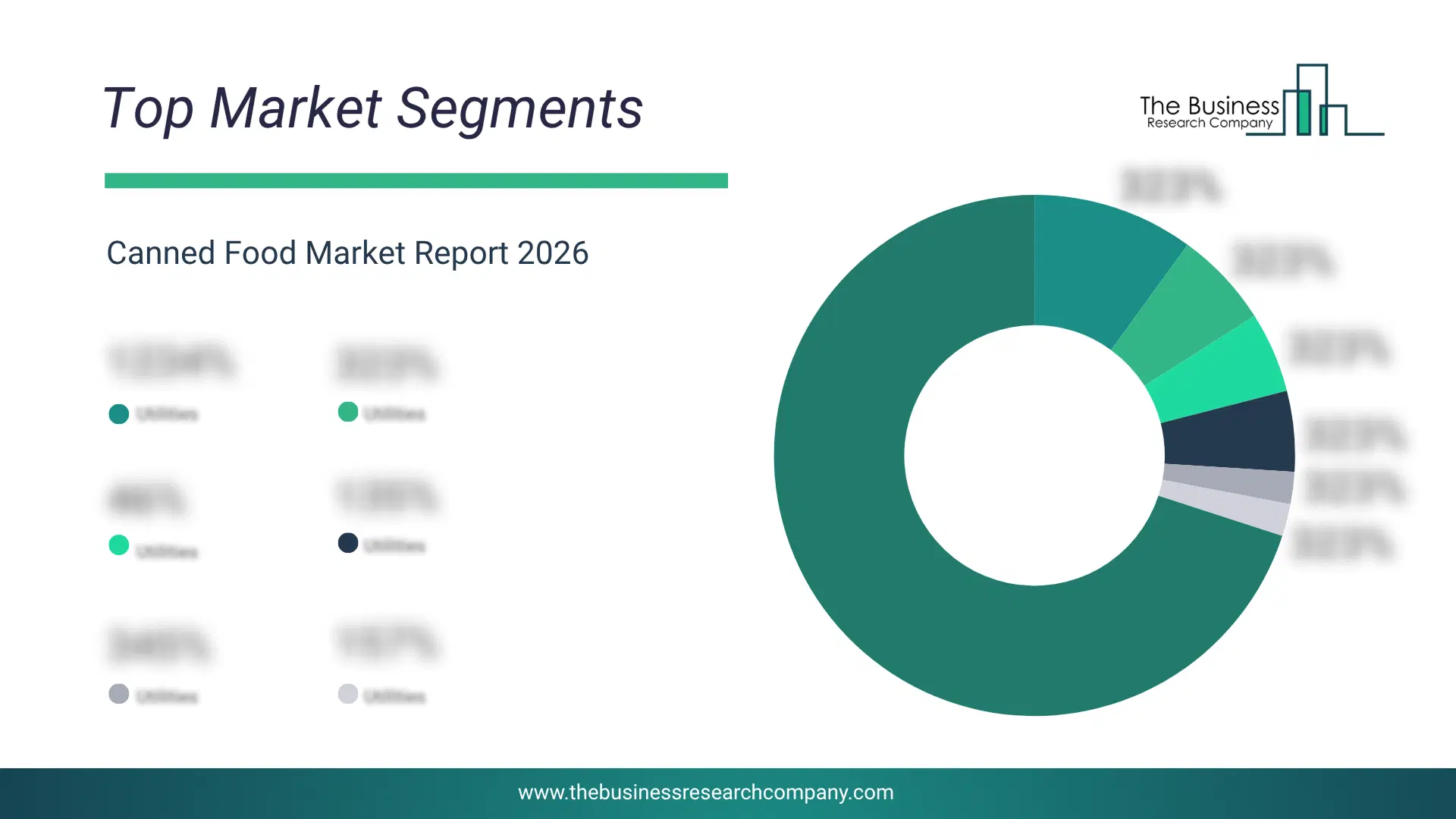
1) By Product Type: Canned Fruits, Canned Vegetables, Canned Meat And Seafood, Canned Ready Meals, Canned Soups And Sauces 2) By Packaging Type: Metal Cans, Aluminum Cans, Steel Cans 3) By Type Of Canned Food: Organic Canned Food, Conventional Canned Food 4) By Distribution Channel: Supermarkets And Hypermarkets, Convenience Stores, Online Retail, Specialty Stores 5) By Application: Household Consumption, Foodservice Industry, Institutional Use Subsegments: 1) By Canned Fruits: Citrus Fruits, Tropical Fruits, Berries, Stone Fruits, Mixed Fruits 2) By Canned Vegetables: Leafy Vegetables, Root Vegetables, Legumes, Cruciferous Vegetables 3) By Canned Meat And Seafood: Canned Poultry, Canned Red Meat, Canned Fish, Canned Shellfish, Canned Processed Meat 4) By Canned Ready Meals: Canned Pasta Meals, Canned Rice Meals, Canned Meat-Based Meals, Canned Vegetarian Meals 5) By Canned Soups And Sauces: Canned Broth And Stock, Canned Cream-Based Soups, Canned Tomato-Based Soups, Canned Cooking Sauces, Canned Pasta SaucesWhat Is The Driver Of The Canned Food Market?
The increasing demand for ready-to-eat meals is expected to propel the growth of the canned food market going forward. Ready-to-eat meals are defined as pre-prepared and portioned food products that can be consumed with minimal or no additional cooking. Demand for ready-to-eat meals is rising primarily due to urban consumers’ growing preference for time-efficient meal solutions, driven by busy work schedules and extended commuting durations. The canned food addresses this demand by offering shelf-stable, ready-to-eat formats that do not require refrigeration and can be stored for prolonged periods. For instance, in 2025, according to Statistisches Bundesamt, a Germany-based statistical office, the expansion in ready-made meal production continued, with output valued at approximately $4.9 billion during the first three quarters, representing a nominal increase of 2.8% compared to $4.8 billion recorded during the same period of 2024. Therefore, the increasing demand for ready-to-eat meals is driving the growth of the canned food industry.Key Players In The Global Canned Food Market
Major companies operating in the canned food market are Nestlé S.A., The Kraft Heinz Company, General Mills Inc., Conagra Brands Inc., Hormel Foods Corporation, Campbell Soup Company, Dole plc, Orkla ASA, Del Monte Foods Inc., Thai Union Group Public Company Limited, Bonduelle SCA, Princes Limited, Goya Foods Inc., Bumble Bee Foods LLC, Bush Brothers & Company, Dongwon Industries Co. Ltd., Bolton Group S.r.l., Ayam Brand, Crown Prince Inc., Grupo Calvo S.A.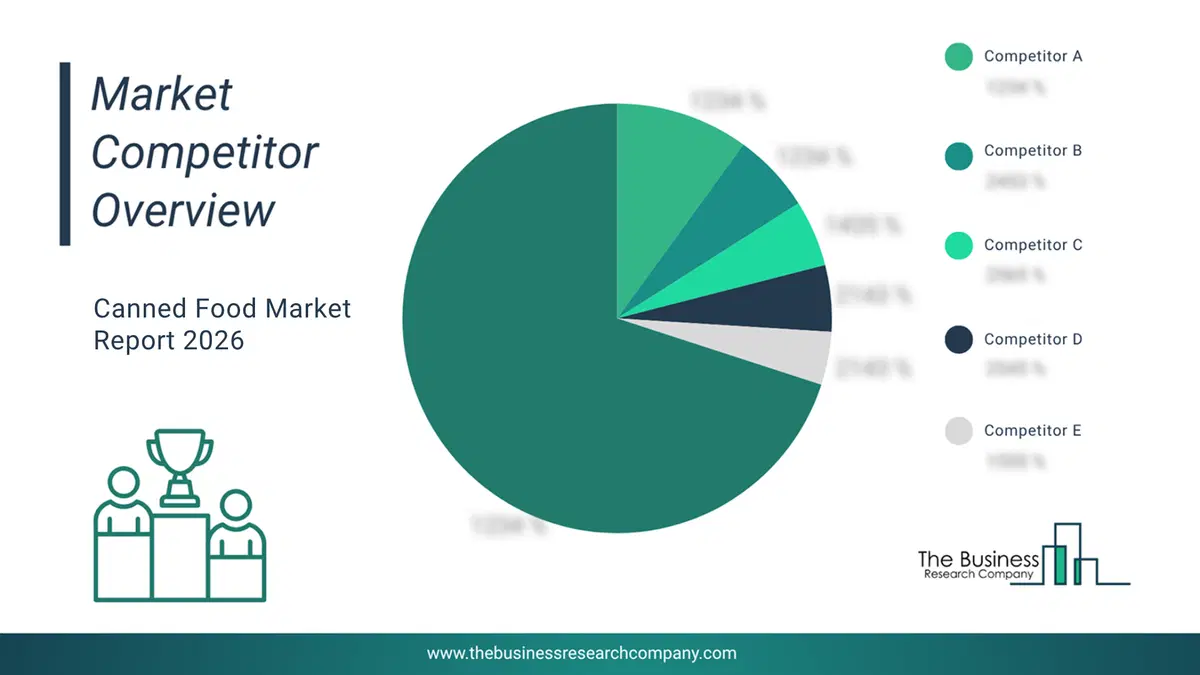
This chart is for illustrative purposes; the full report includes a detailed competitor analysis and comprehensive overview of the top 10 companies in the market.
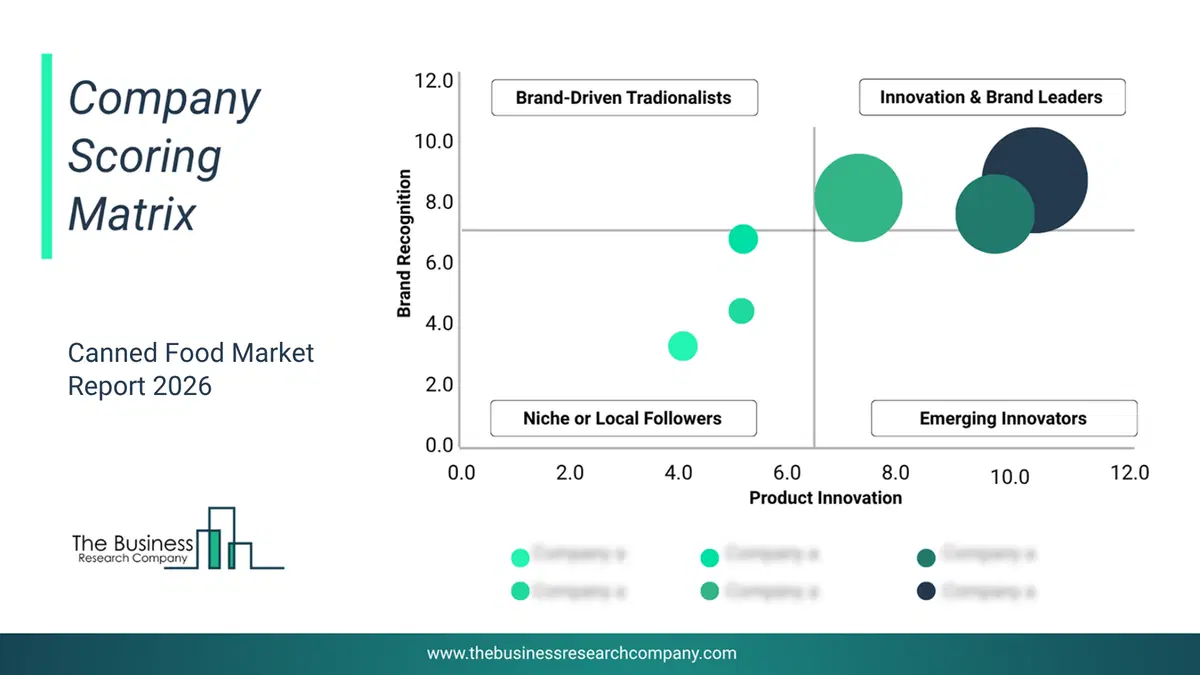
This chart maps companies by product innovation and brand strength, with bubble size indicating relative revenue, helping identify market leaders, challengers, and niche players. This is an illustrative chart; the full report provides a complete and accurate competitive analysis.
Global Canned Food Market Trends and Insights
Major companies operating in the canned food market are increasingly focusing on plant-based, shelf-stable protein innovations to cater to evolving dietary preferences and expand product versatility. These offerings leverage traditional canning expertise to deliver convenient, long-lasting, and ready-to-use alternatives that align with regional cuisines and modern consumption patterns. For instance, in December 2023, Ayam Brand, a Singapore-based food company, launched Yumeat, a plant-based protein range designed for Asian dishes and local taste preferences. The initial portfolio includes plant-based luncheon meat and minced meat with bean paste, packaged in sterilized cans for extended shelf life without refrigeration. This development supports the growing shift toward plant-based and convenient food solutions; however, long-term adoption may depend on consumer acceptance of taste, texture, and price competitiveness compared to traditional canned meat products.What Are Latest Mergers And Acquisitions In The Canned Food Market?
In March 2025, Thai Union Group, a Thailand-based provider of seafood products, acquired the remaining stake in Chicken of the Sea, increasing its ownership to 100% for an undisclosed amount. Through this acquisition, Thai Union Group aims to expand its presence in the global canned seafood segment by strengthening its brand portfolio and enhancing distribution capabilities across North America and international markets. Chicken of the Sea is a US -based provider of canned seafood products, offering tuna, salmon, and other shelf-stable protein products.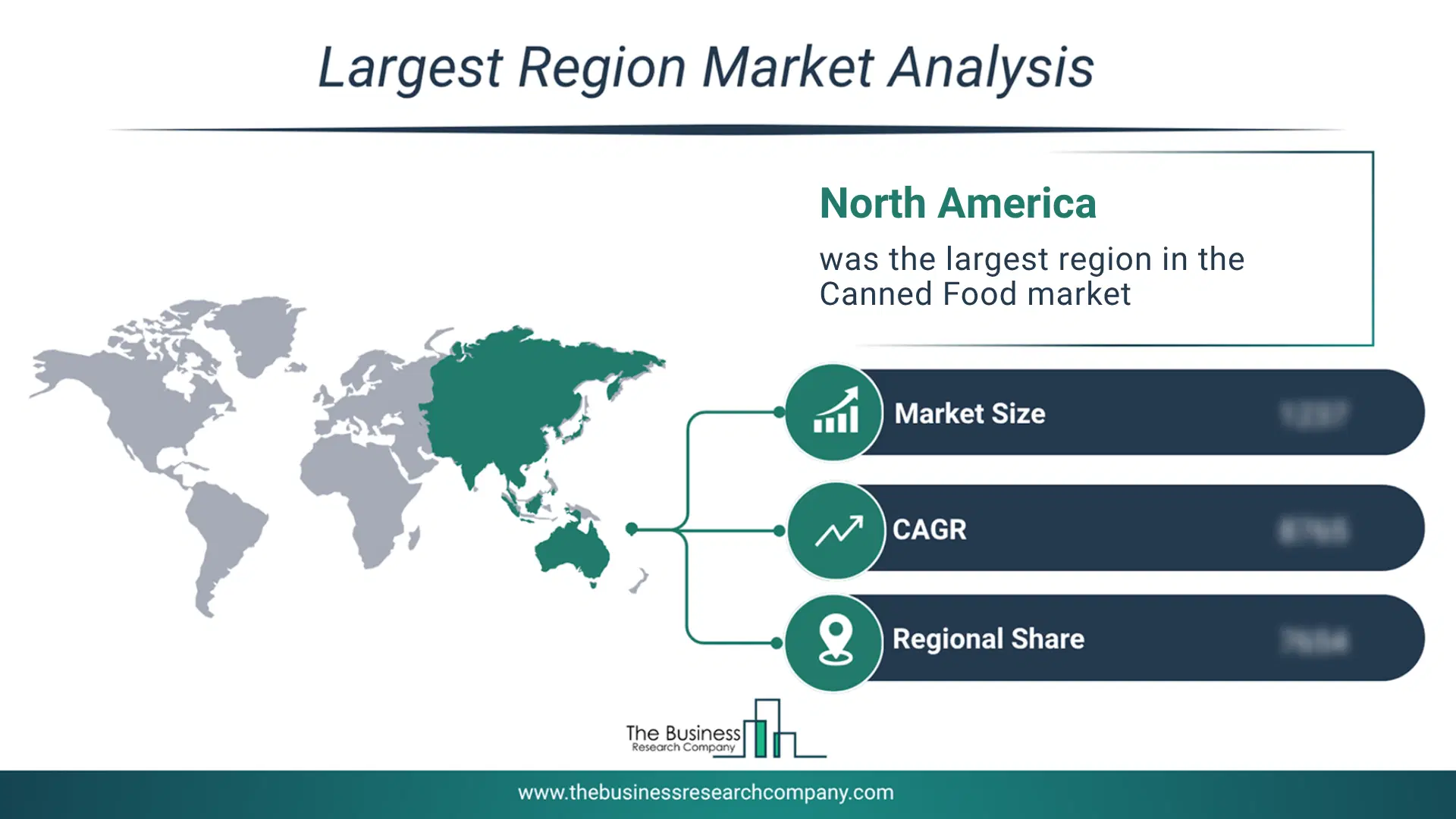
Regional Insights
North America was the largest region in the canned food market in 2025. Asia-Pacific is expected to be the fastest-growing region in the forecast period. The regions covered in this market report are Asia-Pacific, South East Asia, Western Europe, Eastern Europe, North America, South America, Middle East, Africa. The countries covered in this market report are Australia, Brazil, China, France, Germany, India, Indonesia, Japan, Taiwan, Russia, South Korea, UK, USA, Canada, Italy, Spain.What Defines the Canned Food Market?
The canned food market consists of sales of canned ready meals, canned beans and legumes, canned sauces, and canned pet food. Values in this market are ‘factory gate’ values, that is, the value of goods sold by the manufacturers or creators of the goods, whether to other entities (including downstream manufacturers, wholesalers, distributors, and retailers) or directly to end customers. The value of goods in this market includes related services sold by the creators of the goods.How is Market Value Defined and Measured?
The market value is defined as the revenues that enterprises gain from the sale of goods and/or services within the specified market and geography through sales, grants, or donations in terms of the currency (in USD unless otherwise specified). The revenues for a specified geography are consumption values that are revenues generated by organizations in the specified geography within the market, irrespective of where they are produced. It does not include revenues from resales along the supply chain, either further along the supply chain or as part of other products.
This chart presents market attractiveness based on a quantitative evaluation of growth, competition, strategic alignment, and risk, offering a clear view of opportunity areas for decision-making. This chart is for illustrative purposes; the full report contains the complete analysis.

This chart highlights the Total Addressable Market (TAM) by estimating the maximum revenue opportunity using an assumption-driven approach, supporting strategic planning and opportunity sizing across markets. The chart is illustrative; the full report provides a more comprehensive analysis.
What Key Data and Analysis Are Included in the Canned Food Market Report 2026?
The canned food market research report is one of a series of new reports from The Business Research Company that provides market statistics, including industry global market size, regional shares, competitors with the market share, detailed market segments, market trends and opportunities, and any further data you may need to thrive in the canned food industry. The market research report delivers a complete perspective of everything you need, with an in-depth analysis of the current and future state of the industry.Canned Food Market Report Forecast Analysis
| Report Attribute | Details |
|---|---|
| Market Size Value In 2026 | $122.8 billion |
| Revenue Forecast In 2030 | $143.19 billion |
| Growth Rate | CAGR of 3.90% from 2026 to 2030 |
| Base Year For Estimation | 2025 |
| Actual Estimates/Historical Data | 2020-2025 |
| Forecast Period | 2026 - 2030 |
| Market Representation | Revenue in USD Billion and CAGR from 2026 to 2030 |
| Segments Covered | Product Type, Packaging Type, Type Of Canned Food, Distribution Channel, Application |
| Regional Scope | Asia-Pacific, Western Europe, Eastern Europe, North America, South America, Middle East, Africa |
| Country Scope | The countries covered in the report are Australia, Brazil, China, France, Germany, India, Indonesia, Japan, Taiwan, Russia, South Korea, UK, USA, Canada, Italy, Spain. |
| Key Companies Profiled | Nestlé S.A., The Kraft Heinz Company, General Mills Inc., Conagra Brands Inc., Hormel Foods Corporation, Campbell Soup Company, Dole plc, Orkla ASA, Del Monte Foods Inc., Thai Union Group Public Company Limited, Bonduelle SCA, Princes Limited, Goya Foods Inc., Bumble Bee Foods LLC, Bush Brothers & Company, Dongwon Industries Co. Ltd., Bolton Group S.r.l., Ayam Brand, Crown Prince Inc., Grupo Calvo S.A. |
| Customization Scope | Request for Customization |
| Pricing And Purchase Options | Explore Purchase Options |