
Carbon Capture Chemicals Market Report 2026
Global Outlook – By Type (Post-Combustion Capture, Pre-Combustion Capture, Oxy-Fuel Combustion Capture), By Chemical Type (Amine-Based Chemicals, Sodium Hydroxide, Ammonia, Calcium Oxide, Other Chemical Types), By Application (Power Plants, Industrial Processes, Direct Air Capture, Enhanced Oil Recovery, Other Applications) – Market Size, Trends, Strategies, and Forecast to 2030
Carbon Capture Chemicals Market Overview
• Carbon Capture Chemicals market size has reached to $1.82 billion in 2025 • Expected to grow to $3.79 billion in 2030 at a compound annual growth rate (CAGR) of 15.7% • Growth Driver: Increasing Adoption Of Carbon Capture And Storage (CCS) Projects Fueling The Growth Of The Market Due To Rising Global Demand For CO2 Emission Reduction And Net-Zero Targets • Market Trend: Technologically Advanced Solutions Enabling Efficient Direct Air Carbon Capture And Storage • North America was the largest region in 2025 and Asia-Pacific is the fastest growing region.What Is Covered Under Carbon Capture Chemicals Market?
Carbon capture chemicals are specialized compounds used to capture and remove carbon dioxide (CO₂) from industrial emissions or the atmosphere. These chemicals bind CO₂ through chemical reactions or physical absorption. These help to reduce greenhouse gas emissions and mitigate climate change by preventing CO₂ from entering the atmosphere. The main types of carbon capture chemicals are post-combustion capture, pre-combustion capture, and oxy-fuel combustion capture. Post-combustion capture targets CO₂ removal from flue gases following fuel combustion through the use of chemical solvents or adsorbents. The main chemical types used include amine-based chemicals, sodium hydroxide, ammonia, calcium oxide, and others and are applied in power plants, industrial processes, direct air capture, enhanced oil recovery, and others.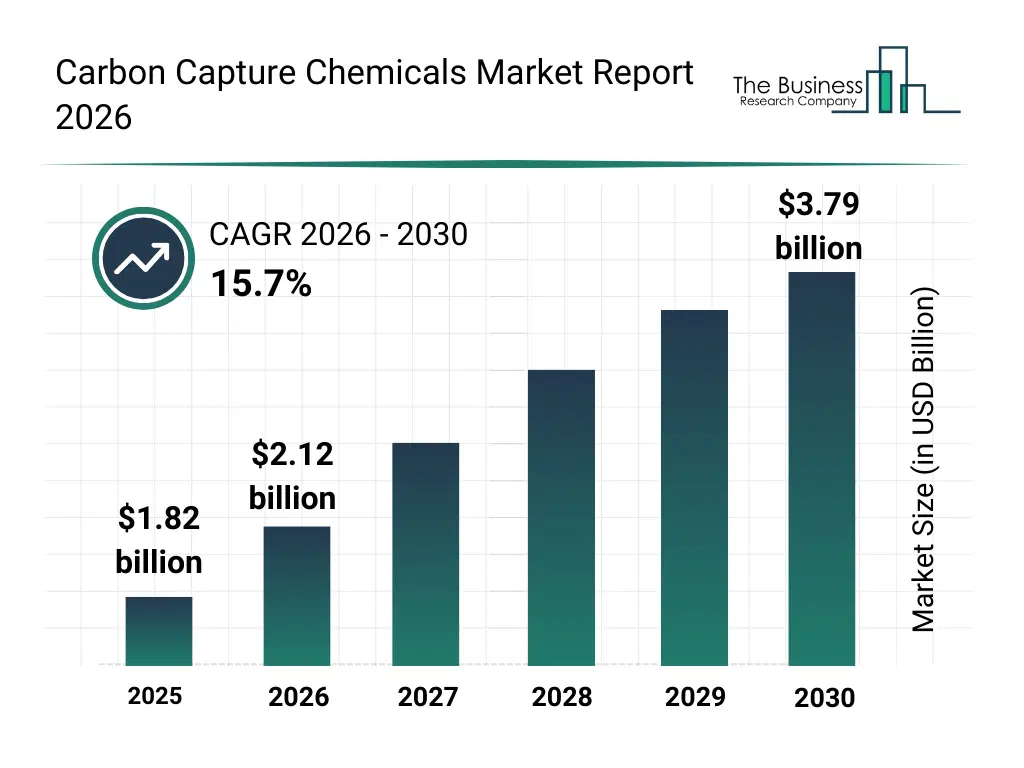
What Is The Carbon Capture Chemicals Market Size and Share 2026?
The carbon capture chemicals market size has grown rapidly in recent years. It will grow from $1.82 billion in 2025 to $2.12 billion in 2026 at a compound annual growth rate (CAGR) of 16.0%. The growth in the historic period can be attributed to industrial co2 emissions growth, fossil fuel power generation, environmental compliance needs, research in absorption chemistry, availability of capture solvents.What Is The Carbon Capture Chemicals Market Growth Forecast?
The carbon capture chemicals market size is expected to see rapid growth in the next few years. It will grow to $3.79 billion in 2030 at a compound annual growth rate (CAGR) of 15.7%. The growth in the forecast period can be attributed to climate policy enforcement, growth of carbon capture projects, investment in clean energy infrastructure, innovation in chemical absorption systems, corporate decarbonization strategies. Major trends in the forecast period include increasing deployment of amine based capture chemicals, expansion of direct air capture projects, growing adoption in industrial emission control, rising focus on high efficiency absorption solutions, development of regenerable capture chemicals.
Global Carbon Capture Chemicals Market Segmentation
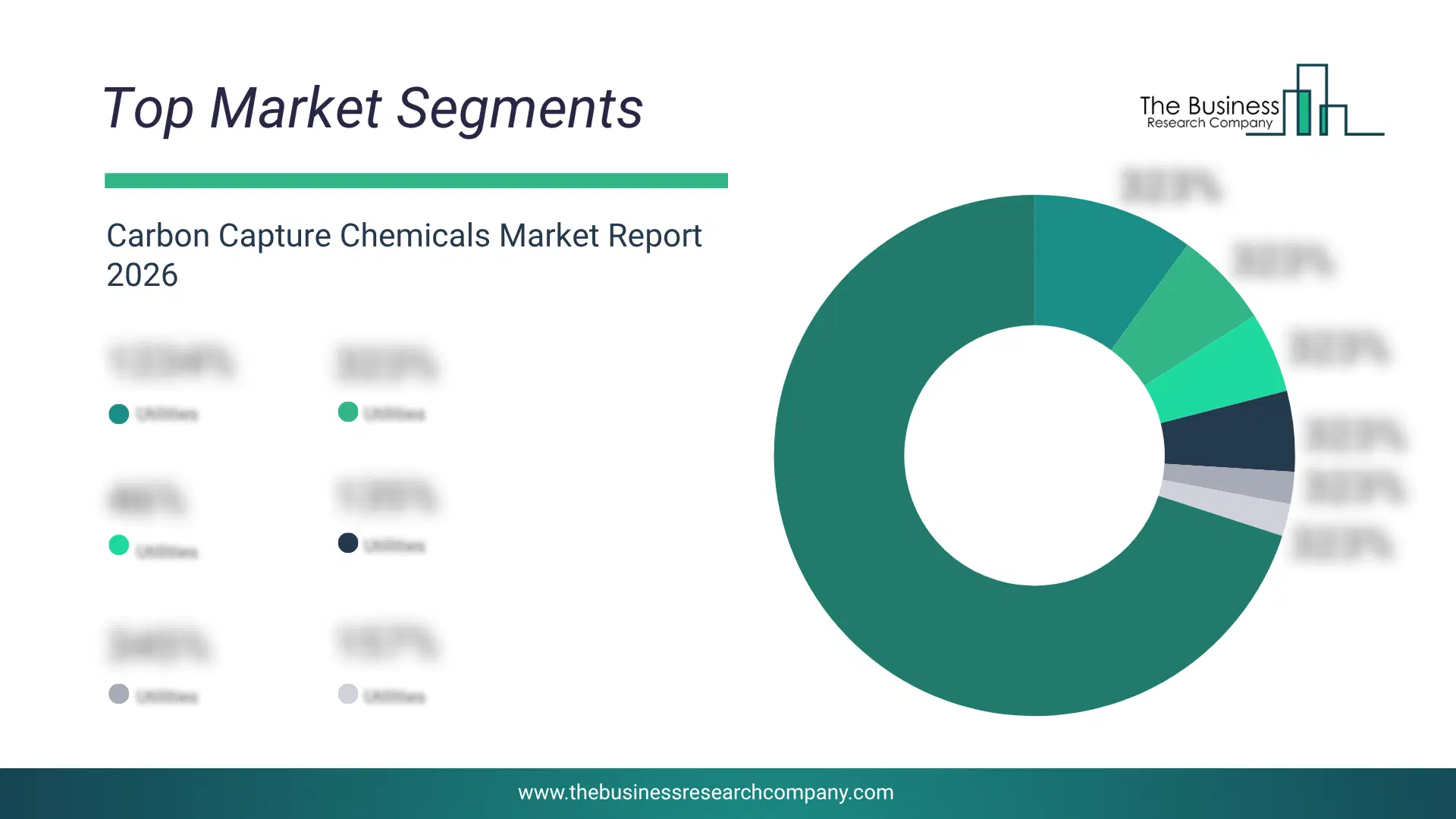
1) By Type: Post-Combustion Capture, Pre-Combustion Capture, Oxy-Fuel Combustion Capture 2) By Chemical Type: Amine-Based Chemicals, Sodium Hydroxide, Ammonia, Calcium Oxide, Other Chemical Types 3) By Application: Power Plants, Industrial Processes, Direct Air Capture, Enhanced Oil Recovery, Other Applications Subsegments: 1) By Post-Combustion Capture: Amine-Based Solvents, Carbonate-Based Solvents 2) By Pre-Combustion Capture: Physical Solvents, Chemical Solvents 3) By Oxy-Fuel Combustion Capture: Cryogenic Oxygen Production, Oxygen Carrier ChemicalsWhat Is The Driver Of The Carbon Capture Chemicals Market?
The increasing adoption of carbon capture and storage (CCS) projects is expected to propel the growth of the carbon capture chemicals market going forward. Carbon capture and storage (CCS) projects refer to initiatives that capture carbon dioxide (CO₂) emissions from industrial processes or power plants and store them safely underground to prevent them from entering the atmosphere and contributing to climate change. Carbon capture and storage (CCS) projects are increasing due to the urgent need to reduce CO₂ emissions and meet global climate targets. Carbon capture chemicals support carbon capture and storage projects by providing efficient and reliable solutions to capture CO₂ from industrial emissions and the atmosphere. They enhance the effectiveness of carbon removal processes, reduce greenhouse gas levels, and help industries achieve sustainability targets and net-zero goals. For instance, in 2023, according to the Global CCS Institute, an Australia-based non-profit think tank, as of July 2023, the development pipeline for CCS facilities has reached a record high, with 392 projects underway, marking a 102% year-on-year growth. Therefore, the increasing adoption of carbon capture and storage (CCS) projects is driving the growth of the carbon capture chemicals industry.Key Players In The Global Carbon Capture Chemicals Market
Major companies operating in the carbon capture chemicals market are ExxonMobil, Shell, BASF, Dow, Mitsubishi Heavy Industries, Air Liquide, SUEZ, Tosoh, Solvay, GEA Group, Aker Solutions, Hitachi Zosen, Honeywell UOP, Carbon Clean, Koch Engineered Solutions, Toshiba Energy Systems & Solutions, Linde plc, Siemens Energy, Fluor Corporation, Svante Inc., Climeworks AG, Carbon Engineering Ltd., Global Thermostat, CO2 Solutions (Saipem), Petrofac Limited, Chevron Corporation, Air Products and Chemicals, Inc., CarbonCure Technologies, Aker Carbon Capture ASA, Calgon Carbon Corporation, TDA Research, Inc., Koch-Glitsch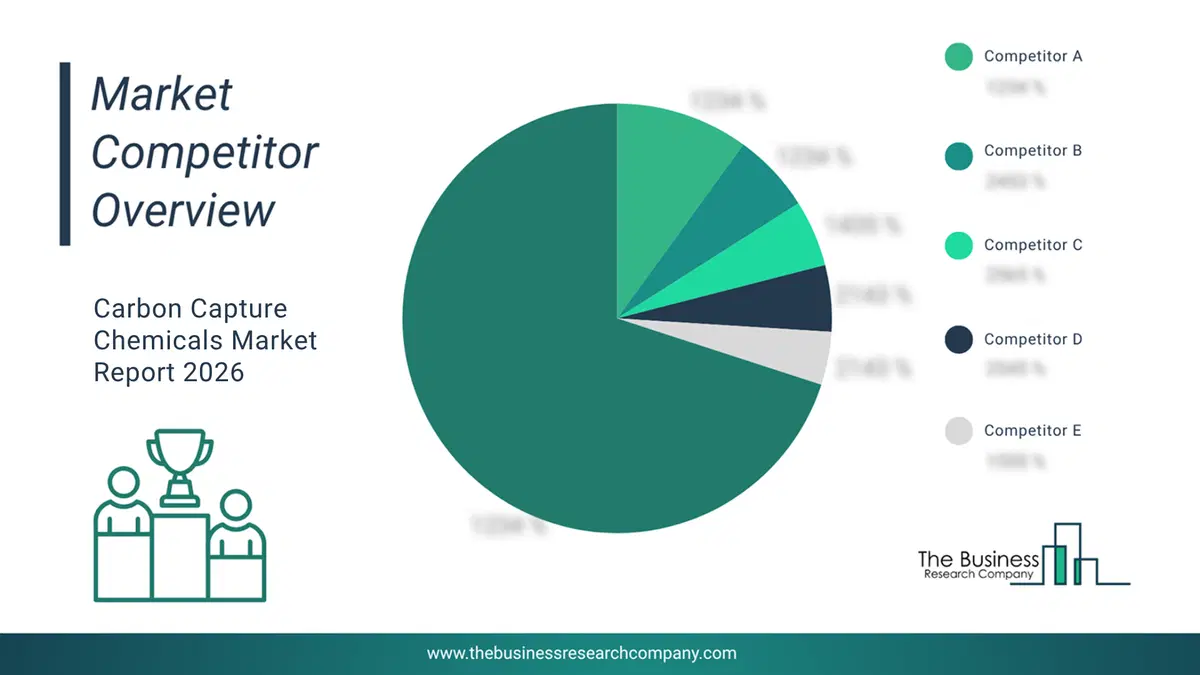
This chart is for illustrative purposes; the full report includes a detailed competitor analysis and comprehensive overview of the top 10 companies in the market.
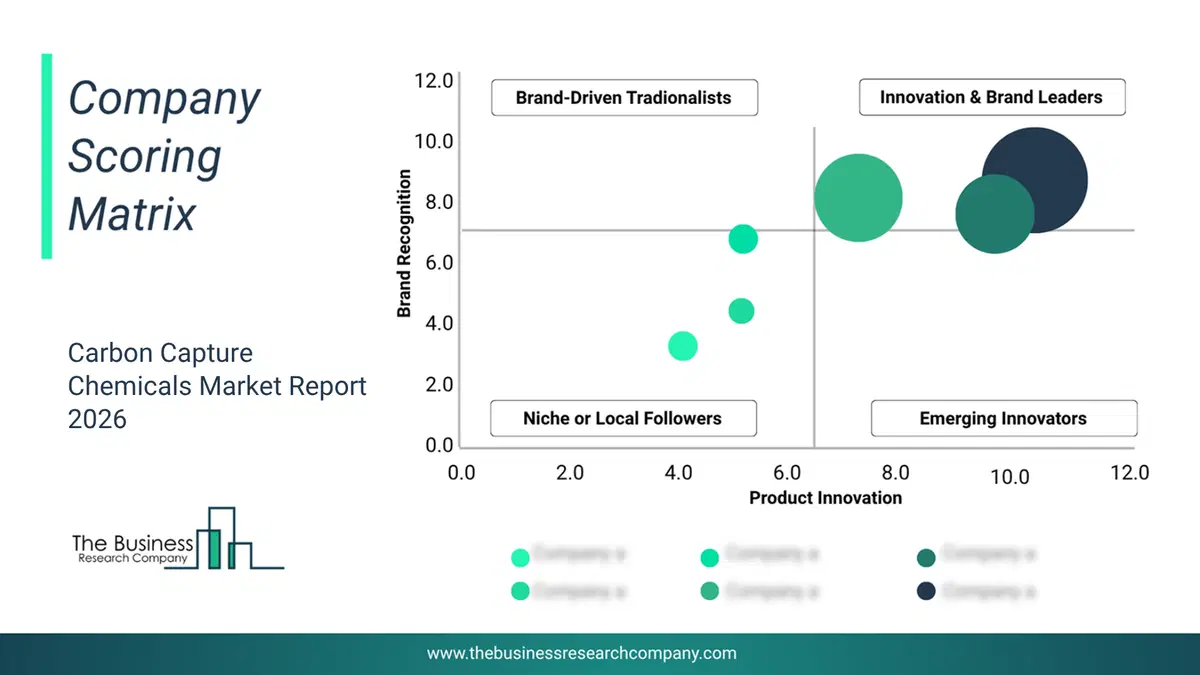
This chart maps companies by product innovation and brand strength, with bubble size indicating relative revenue, helping identify market leaders, challengers, and niche players. This is an illustrative chart; the full report provides a complete and accurate competitive analysis.
Global Carbon Capture Chemicals Market Trends and Insights
Major companies operating in the carbon capture chemicals market are focusing on developing technologically advanced solutions, such as direct air capture (DAC) technologies, to mitigate climate impact and achieve net-zero goals. Direct air capture (DAC) technologies are processes that remove CO₂ directly from the air using chemical solutions or solid sorbents, with the captured CO₂ stored underground or used in products, helping reduce atmospheric carbon and mitigate climate change. For instance, in March 2025, Saudi Aramco, a Saudi Arabia-based chemicals manufacturing company, launched a direct air capture (DAC) test unit to capture CO₂ directly from the atmosphere for testing and evaluation. It removes CO₂ directly from the atmosphere, helping to reduce greenhouse gas levels and combat climate change. They offer advantages such as scalability, precise carbon measurement, flexibility to operate anywhere, and a small land footprint compared to nature-based solutions. The technology supports hard-to-abate sectors by capturing emissions that are difficult to eliminate, making DAC a crucial tool for achieving net-zero emissions and a sustainable circular carbon economy.What Are Latest Mergers And Acquisitions In The Carbon Capture Chemicals Market?
In March 2024, SLB Ltd., a US-based technology company, acquired a majority stake in Aker Carbon Capture ASA for $380 million. SLB Ltd. aims to combine its technology and industrial expertise with Aker Carbon Capture’s solutions to accelerate the global deployment of carbon-capture technologies, lower the cost of carbon capture, and drive large-scale industrial decarbonization. Aker Carbon Capture ASA is a Norway-based technology company that offers carbon capture chemicals.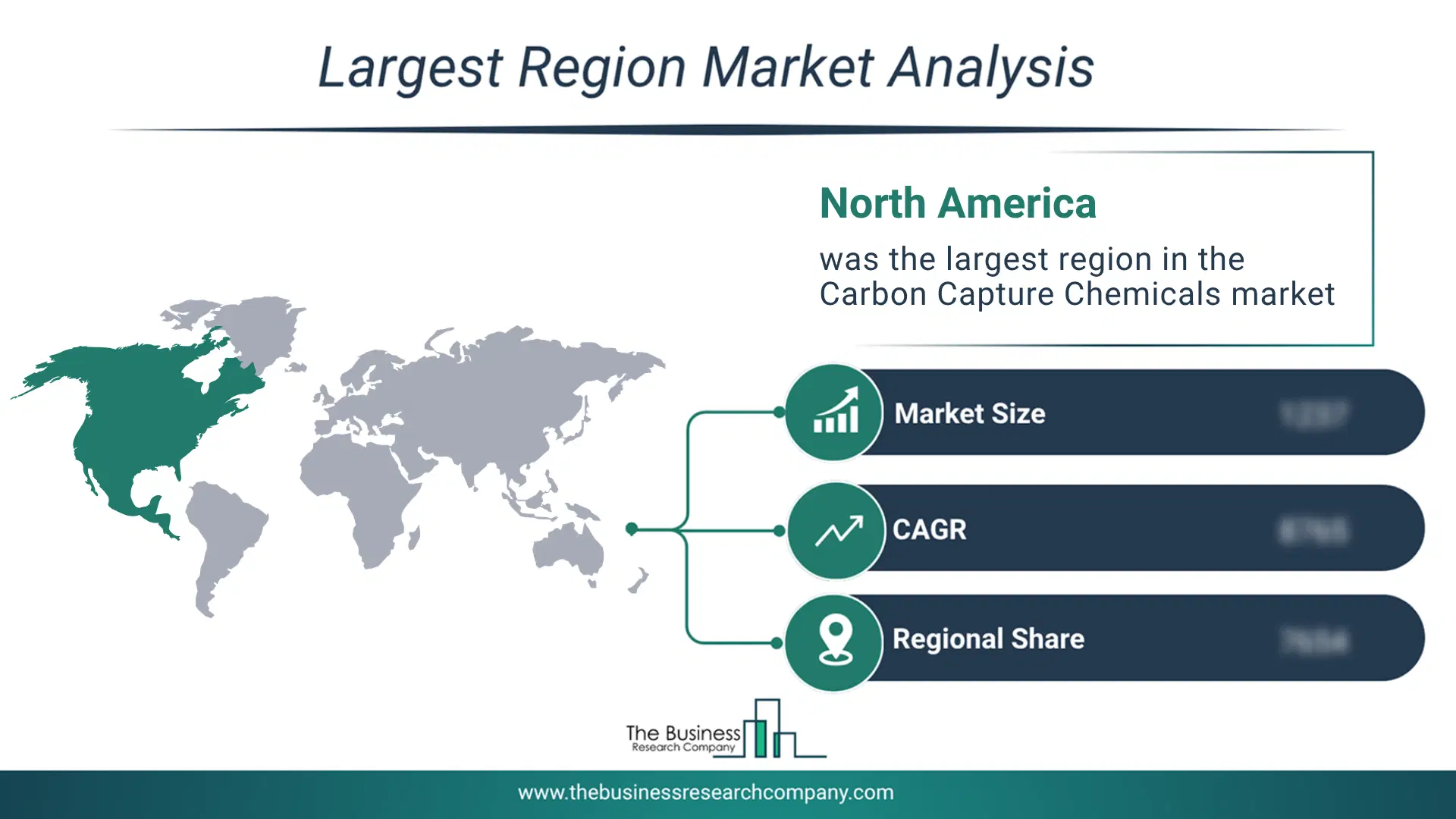
Regional Insights
North America was the largest region in the carbon capture chemicals market in 2025. The regions covered in this market report are Asia-Pacific, South East Asia, Western Europe, Eastern Europe, North America, South America, Middle East, Africa The countries covered in this market report are Australia, Brazil, China, France, Germany, India, Indonesia, Japan, Taiwan, Russia, South Korea, UK, USA, Canada, Italy, SpainWhat Defines the Carbon Capture Chemicals Market?
The carbon capture chemicals market consists of sales of amine-based solvents, carbonate-based solvents, amino acid salts, ionic liquids, enzyme-based solvents, alkali-based sorbents, and physical solvents. Values in this market are ‘factory gate’ values, that is, the value of goods sold by the manufacturers or creators of the goods, whether to other entities (including downstream manufacturers, wholesalers, distributors, and retailers) or directly to end customers. The value of goods in this market includes related services sold by the creators of the goods.How is Market Value Defined and Measured?
The market value is defined as the revenues that enterprises gain from the sale of goods and/or services within the specified market and geography through sales, grants, or donations in terms of the currency (in USD unless otherwise specified). The revenues for a specified geography are consumption values that are revenues generated by organizations in the specified geography within the market, irrespective of where they are produced. It does not include revenues from resales along the supply chain, either further along the supply chain or as part of other products.
This chart presents market attractiveness based on a quantitative evaluation of growth, competition, strategic alignment, and risk, offering a clear view of opportunity areas for decision-making. This chart is for illustrative purposes; the full report contains the complete analysis.

This chart highlights the Total Addressable Market (TAM) by estimating the maximum revenue opportunity using an assumption-driven approach, supporting strategic planning and opportunity sizing across markets. The chart is illustrative; the full report provides a more comprehensive analysis.
What Key Data and Analysis Are Included in the Carbon Capture Chemicals Market Report 2026?
The carbon capture chemicals market research report is one of a series of new reports from The Business Research Company that provides market statistics, including industry global market size, regional shares, competitors with the market share, detailed market segments, market trends and opportunities, and any further data you may need to thrive in the carbon capture chemicals industry. The market research report delivers a complete perspective of everything you need, with an in-depth analysis of the current and future state of the industry.Carbon Capture Chemicals Market Report Forecast Analysis
| Report Attribute | Details |
|---|---|
| Market Size Value In 2026 | $2.12 billion |
| Revenue Forecast In 2030 | $3.79 billion |
| Growth Rate | CAGR of 16.0% from 2026 to 2030 |
| Base Year For Estimation | 2025 |
| Actual Estimates/Historical Data | 2020-2025 |
| Forecast Period | 2026 - 2030 |
| Market Representation | Revenue in USD Billion and CAGR from 2026 to 2030 |
| Segments Covered | Type, Chemical Type, Application |
| Regional Scope | Asia-Pacific, Western Europe, Eastern Europe, North America, South America, Middle East, Africa |
| Country Scope | The countries covered in this market report are Australia, Brazil, China, France, Germany, India, Indonesia, Japan, Taiwan, Russia, South Korea, UK, USA, Canada, Italy, Spain |
| Key Companies Profiled | ExxonMobil, Shell, BASF, Dow, Mitsubishi Heavy Industries, Air Liquide, SUEZ, Tosoh, Solvay, GEA Group, Aker Solutions, Hitachi Zosen, Honeywell UOP, Carbon Clean, Koch Engineered Solutions, Toshiba Energy Systems & Solutions, Linde plc, Siemens Energy, Fluor Corporation, Svante Inc., Climeworks AG, Carbon Engineering Ltd., Global Thermostat, CO2 Solutions (Saipem), Petrofac Limited, Chevron Corporation, Air Products and Chemicals, Inc., CarbonCure Technologies, Aker Carbon Capture ASA, Calgon Carbon Corporation, TDA Research, Inc., Koch-Glitsch |
| Customization Scope | Request for Customization |
| Pricing And Purchase Options | Explore Purchase Options |