

Carbon Credit Market 2025
By Type (Compliance, Voluntary), By Project Type (Avoidance Or Reduction Projects, Removal Or Sequestration Projects.), By End-Use (Power, Energy, Aviation, Transportation, Buildings, Industrial, Other End-Uses), And By Region, Opportunities And Strategies – Global Forecast To 2035
Carbon Credit Market Definition
Carbon credits refer to tradable certificates or permit representing the right to emit one metric ton of carbon dioxide (CO₂) or an equivalent amount of other greenhouse gases. These credits are generated through verified emission reduction or removal projects, such as renewable energy, reforestation, methane capture, or energy efficiency initiatives. Carbon credits are used when organizations, governments, or individuals aim to offset their carbon footprint, meet regulatory compliance, or voluntarily support climate mitigation efforts. The carbon credit market consists of sales, by entities (organizations, sole traders, or partnerships), of carbon credit that are used either for regulatory compliance in emissions trading systems or for voluntary carbon offsetting. These credits are often purchased by corporations, governments, or financial institutions to neutralize greenhouse gas emissions, meet sustainability goals, or enhance corporate social responsibility profiles.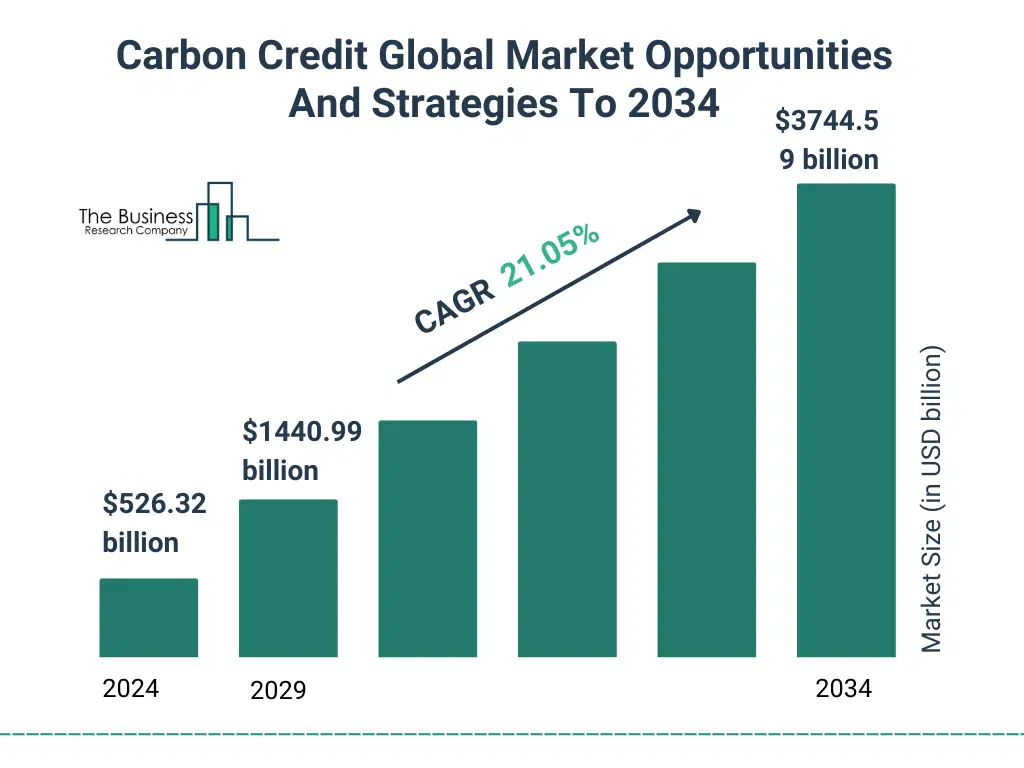
Carbon Credit Market Size
The global carbon credit market reached a value of nearly $526,317.43 million in 2024, having grown at a compound annual growth rate (CAGR) of 23.80% since 2019. The market is expected to grow from $526,317.43 million in 2024 to $1,440,987.20 million in 2029 at a rate of 22.32%. The market is then expected to grow at a CAGR of 21.05% from 2029 and reach $3,744,589.83 million in 2034. Growth in the historic period resulted from increasing public awareness of climate change, regulatory frameworks and policy reforms, rising industrial emissions boosting carbon credit demand, and rising conservation of nature-based solutions (NBS). Factors that negatively affected growth in the historic period were the risk of greenwashing and litigation and unequal carbon prices. Going forward, growing need to reduce carbon emissions, increasing investment by government, expansion of emissions trading schemes (ETS) and corporate net-zero and ESG commitments will drive growth. Factors that could hinder the growth of the carbon credit market in the future include impact of trade war and tariff, fraud and lack of integrity in offset projects and lack of standardization and coherence in credit quality.Carbon Credit Market Drivers
The key drivers of the carbon credit market include: Growing Need To Reduce Carbon Emissions During the forecast period, the growing need to reduce carbon emissions will propel the growth of the carbon credit market. Governments and industries worldwide are increasingly recognizing the urgency of mitigating climate change by curbing greenhouse gas emissions. This collective drive is reflected in the adoption of more ambitious climate targets. Such targets necessitate comprehensive strategies, including the utilization of carbon credits, to offset emissions that are challenging to eliminate entirely. As the demand for carbon credits rises, there is a corresponding emphasis on ensuring the credibility and effectiveness of offset projects. This trend is fostering innovation in carbon credit methodologies, promoting transparency, and encouraging investments in high-quality projects that deliver verifiable environmental benefits. Therefore, the evolving landscape of climate policy and the heightened focus on emission reductions are expected to significantly drive the growth of the carbon credit market. The growing need to reduce carbon emissions growth contribution during the forecast period in 2024 is 1.00%.Carbon Credit Market Restraints
The key restraints on the carbon credit market include: Lack Of Standardization And Coherence In Credit Quality During the forecast period, the lack of standardization and coherence in carbon credit quality will restrict the growth of the carbon credit market. The absence of a universally accepted methodology for assessing carbon credit quality leads to significant variability in the environmental integrity of credits. This fragmentation complicates the process for buyers to compare credits and determine their true impact, resulting in confusion and hesitancy in the market. While initiatives like the Integrity Council for the Voluntary Carbon Market (IC-VCM) aim to establish minimum quality criteria, the lack of widespread adoption and alignment among different standards continues to pose challenges. Consequently, the market faces difficulties in ensuring that carbon credits deliver on their promised emission reductions, undermining confidence and hindering the growth of the carbon credit market. Lack of standardization and coherence in carbon credit during the forecast period in 2024 is -2.50%.Carbon Credit Market Trends
Major trends shaping the carbon credit market include: Advanced Analytics Tools for Enhanced Carbon Credit Procurement Innovative programs are increasingly linking carbon credits to everyday actions such as commuting, creating new avenues for participation in carbon markets. This approach aims to encourage sustainable behavior while generating verifiable emissions reductions. For instance, in September 2025, Sylvera, a Uk-based data and ratings platform, launched a new tool designed to streamline and enhance carbon credit procurement for organizations. The tool provides buyers with advanced analytics, transparency scores, and risk assessments to help identify high-quality carbon credits and avoid low-integrity projects. By integrating real-time market data, project performance metrics, and AI-driven insights, it enables sustainability teams to make more informed purchasing decisions aligned with corporate net-zero goals. This launch strengthens Sylvera’s commitment to improving trust and accountability in the voluntary carbon market by simplifying due diligence and optimizing portfolio management for carbon offset investments. Incentivizing Sustainable Commuting Through Carbon Credit Programs Major companies in the carbon credit market is increasingly driven by advanced data-driven procurement tools that enhance transparency, project evaluation, and buyer confidence. This innovation aims to simplify due diligence and ensure the integrity of voluntary carbon credits. For instance, in September 2025, Moovit, an Isreal-based mobility-as-a-service (MaaS) company, launched a groundbreaking carbon credit program aimed at rewarding U.S. commuters for choosing sustainable travel options. The program allows users to earn carbon credits by using public transit, walking, biking, or carpooling instead of driving alone. These credits can be tracked and redeemed through the Moovit app, encouraging more eco-friendly commuting habits. By integrating real-time mobility data with verified carbon offset calculations, Moovit’s initiative bridges the gap between daily commuting and climate action, empowering individuals to actively contribute to emission reduction goals while supporting the growth of the voluntary carbon market in the transportation sector.Opportunities And Recommendations In The Carbon Credit Market
Opportunities – The top opportunities in the carbon credit market segmented by type will arise in the compliance segment, which will gain $832,202.34 million of global annual sales by 2029. The top opportunities in the carbon credit market segmented by project type will arise in the avoidance or reduction projects segment, which will gain $532,109.31 million of global annual sales by 2029. The top opportunities in the carbon credit market segmented by end-use will arise in the power segment, which will gain $282,384.98 million of global annual sales by 2029. The carbon credit market size will gain the most in China at $151,514.00 million. Recommendations- To take advantage of the opportunities, The Business Research Company recommends the carbon credit companies to focus on linking carbon credits to measurable everyday behavior, focus on data-driven procurement and commuter engagement models, focus on digital platform integration to enhance access and transparency, focus on blockchain-enabled trading platforms, focus on integrating high-integrity carbon credits into corporate decarbonization plans, focus on scaling direct air capture partnerships and project deployment, focus on voluntary carbon credit segment, focus on removal or sequestration projects to accelerate long-term growth, expand in emerging markets, focus on distribution network expansion through strategic partnerships and digital platforms, focus on transparent and value-driven pricing to build trust and scale demand, strengthen market presence through education and credibility, expand digital outreach and tailored engagement and focus on aviation segment for accelerated growth.
Carbon Credit Market Segmentation
The carbon credit market is segmented by type, by project type and by end-use.By Type –
The carbon credit market is segmented by type into:
- a) Compliance
- b) Voluntary
By Project Type –
The carbon credit market is segmented by project type into:
- a) Avoidance or Reduction Projects
- b) Removal or Sequestration Projects
By Banking Mode –
The carbon credit market is segmented by banking mode into:
- a) Power
- b) Energy
- c) Aviation
- d) Transportation
- e) Buildings
- f) Industrial
- g) Other End-Uses
By Geography - The carbon credit market is segmented by geography into:
- • China
- • India
- • Japan
- • Australia
- • Indonesia
- • South Korea
- • USA
- • Canada
- • Brazil
- • France
- • Germany
- • UK
- • Italy
- • Spain
- • Russia
-
o Asia Pacific
o Africa