
Carbon Dioxide (CO₂) Shipping Terminal Market Report 2026
Global Outlook – By Terminal Type (Onshore Terminals, Offshore Terminals), By Capacity (Small, Medium, Large), By Function (Storage, Liquefaction, Loading And Unloading, Transportation Interface), By Application (Carbon Capture And Storage, Enhanced Oil Recovery, Industrial Use, Other Applications), By End-User (Oil And Gas, Power Generation, Chemical Industry, Maritime, Other End-Users) – Market Size, Trends, Strategies, and Forecast to 2035
Carbon Dioxide (CO2) Shipping Terminal Market Overview
• Carbon Dioxide (CO2) Shipping Terminal market size has reached to $0.98 billion in 2025 • Expected to grow to $1.86 billion in 2030 at a compound annual growth rate (CAGR) of 13.6% • Growth Driver: Rising Global Decarbonization Targets And Net-Zero Commitments Is Fueling The Growth Of The Market Due To Increasing Demand For Large-Scale CO2 Transport And Storage Infrastructure • Market Trend: Expansion Of CO2 Export Infrastructure Strengthens Carbon Capture And Storage (CCUS) Value Chain • Asia-Pacific was the largest region in 2025 and North America is the fastest growing region.What Is Covered Under Carbon Dioxide (CO₂) Shipping Terminal Market?
A carbon dioxide (CO₂) shipping terminal is a dedicated facility for storing, handling, and transferring captured CO₂ for transport via ships, equipped with liquefaction units, storage tanks, and loading systems. It enables the movement of CO₂ from industrial sources to offshore or remote storage sites as part of carbon capture and storage (CCS) networks. Carbon dioxide (CO₂) shipping terminals are essential for large-scale CO₂ logistics, supporting emission reduction through efficient long-distance transport. The main terminal types of carbon dioxide (CO₂) shipping terminal include onshore terminals and offshore terminals. Onshore terminals refer to land-based facilities designed for handling, liquefying, storing, and transporting carbon dioxide for industrial and environmental applications. These terminals are categorized by capacity including small, medium, and large and perform functions such as storage, liquefaction, loading and unloading, and transportation interface. The key applications of carbon capture and storage, enhanced oil recovery, industrial use, and others, while the end-use includes oil and gas, power generation, chemical industry, maritime, and others.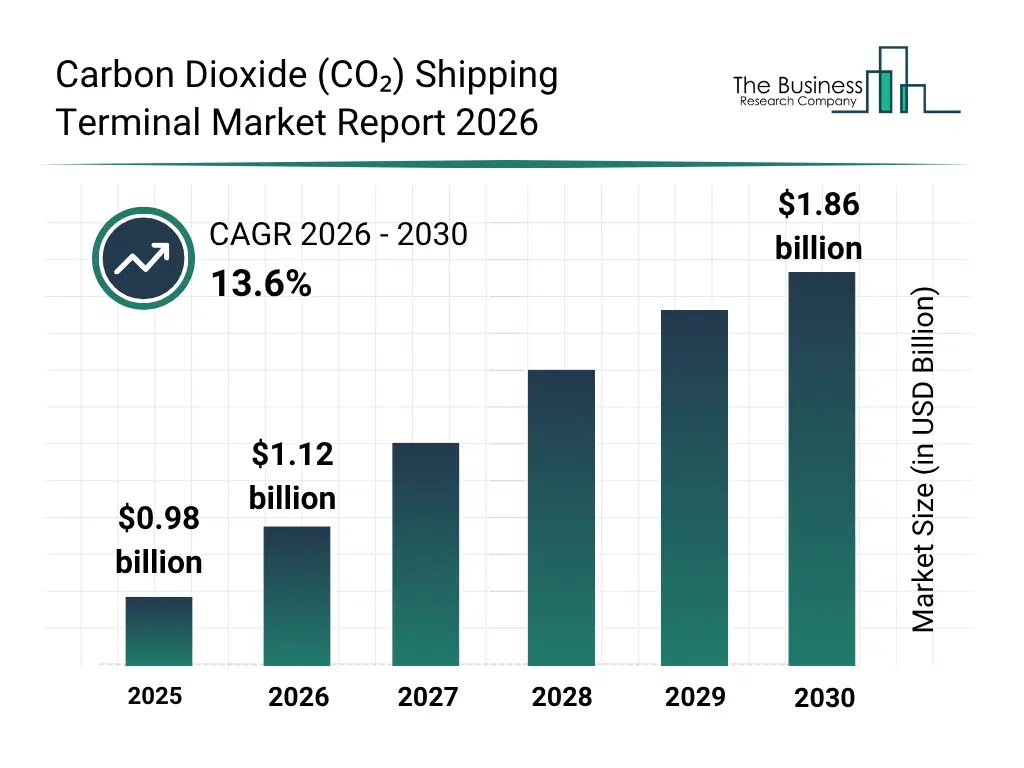
What Is The Carbon Dioxide (CO₂) Shipping Terminal Market Size and Share 2026?
The carbon dioxide (CO₂) shipping terminal market size has grown rapidly in recent years.It will grow from $0.98 billion in 2025 to $1.12 billion in 2026 at a compound annual growth rate (CAGR) of 13.4%. The growth in the historic period can be attributed to growth in industrial carbon emissions monitoring, early adoption of carbon capture and storage pilot projects, expansion of oil and gas enhanced recovery techniques, rising environmental regulations on emissions reporting, development of cryogenic gas handling infrastructure.What Is The Carbon Dioxide (CO₂) Shipping Terminal Market Growth Forecast?
The carbon dioxide (CO₂) shipping terminal market size is expected to see rapid growth in the next few years.It will grow to $1.86 billion by 2030 at a compound annual growth rate (CAGR) of 13.6%. The growth in the forecast period can be attributed to rapid expansion of carbon capture and storage infrastructure, increasing cross-border carbon trading and transport networks, growing demand for offshore sequestration projects, stricter global net zero emission targets, rising investment in large scale decarbonization logistics systems.Major trends in the forecast period include development of large-scale carbon liquefaction and cryogenic storage systems, expansion of offshore CO2 shipping hubs integrated with CCS networks, increasing adoption of modular and scalable terminal infrastructure, rising focus on safe and zero-leak CO2 transfer and loading systems, growing investment in cross-border carbon transport logistics corridors.
Global Carbon Dioxide (CO₂) Shipping Terminal Market Segmentation
1) By Terminal Type: Onshore Terminals, Offshore Terminals 2) By Capacity: Small, Medium, Large 3) By Function: Storage, Liquefaction, Loading And Unloading, Transportation Interface 4) By Application: Carbon Capture And Storage, Enhanced Oil Recovery, Industrial Use, Other Applications 5) By End-User: Oil And Gas, Power Generation, Chemical Industry, Maritime, Other End-Users Subsegments: 1) By Onshore Terminals: Industrial Onshore Storage Terminals, Liquefaction Onshore Terminals, Loading And Unloading Onshore Terminals, Transportation Interface Onshore Terminals, High Capacity Onshore Terminals 2) By Offshore Terminals: Floating Storage Offshore Terminals, Offshore Loading And Unloading Terminals, Subsea Interface Offshore Terminals, Liquefaction Offshore Terminals, Medium Capacity Offshore TerminalsWhat Is The Driver Of The Carbon Dioxide (CO₂) Shipping Terminal Market?
The growing prevalence of the global decarbonization targets and net-zero commitments is expected to propel the growth of the carbon dioxide (CO₂) shipping terminal industry going forward.Global decarbonization targets and net-zero commitments refer to internationally or nationally set goals to reduce greenhouse gas emissions to net zero, aiming to balance emitted and removed carbon to mitigate climate change.The rise in global decarbonization targets and net-zero commitments is driven by the urgent need to mitigate climate change, as they aim to balance greenhouse gas emissions and removals to limit global temperature rise.A CO₂ shipping terminal helps global decarbonization targets and net-zero commitments by enabling the safe transport, storage, and distribution of captured carbon dioxide, thereby reducing greenhouse gas emissions and supporting large-scale carbon management initiatives.For instance, in January 2025, according to the Department of Energy, a US-based government organization, net U.S.greenhouse gas emissions are expected to decline 29–46% by 2030, up from previous projections, while battery electric vehicle sales are expected to reach up to 61% of total light-duty vehicle sales by 2030.Therefore, the growing prevalence of the global decarbonization targets and net-zero commitments is driving the growth of the CO₂ shipping terminal market.Key Players In The Global Carbon Dioxide (CO₂) Shipping Terminal Market
Major companies operating in the carbon dioxide (co₂) shipping terminal market are Exxon Mobil Corporation, Shell plc, TotalEnergies SE, Equinor ASA, Siemens Energy AG, Honeywell International Inc., Linde plc, Mitsubishi Heavy Industries Ltd., Air Liquide SA, Saipem SpA, Emerson Electric Co., Air Products and Chemicals Inc., Worley Limited, McDermott International Ltd., Technip Energies NV, Alfa Laval AB, Aker Solutions ASA, Chart Industries Inc., Kongsberg Gruppen ASA, IMI plc, Burckhardt Compression Holding AG, Rotork plc, Cryostar SAS, John Wood Group plc, MAN Energy Solutions SEGlobal Carbon Dioxide (CO₂) Shipping Terminal Market Trends and Insights
Major companies operating in the carbon dioxide (CO₂) shipping terminal market are increasingly investing in CO₂ export terminals to support cross-border transportation and long-term storage of emissions. Investing in CO₂ export terminals involves developing infrastructure to capture, liquefy, store, and transport carbon dioxide, enabling efficient CO₂ transfer and supporting CCUS for long-term emissions reduction. For instance, in March 2026, HES International, a Netherlands-based provider of terminal operations and carbon management, launched an open season initiative for its CO₂ export terminals, inviting industrial emitters and stakeholders to secure capacity for future CO₂ handling and shipping services. This initiative aims to accelerate the development of CO₂ logistics infrastructure by facilitating efficient aggregation, storage, and marine transport of captured carbon, thereby strengthening the overall CCUS value chain and supporting global decarbonization efforts.What Are Latest Mergers And Acquisitions In The Carbon Dioxide (CO₂) Shipping Terminal Market?
In May 2025, Aptamus Carbon Solutions LLC, a US-based carbon management and maritime infrastructure company that is involved in developing CO₂ shipping terminals, entered into a joint development agreement with LBC Tank Terminals to establish an integrated CO₂ marine terminal network enabling efficient transportation and storage of captured carbon. The partnership aims to jointly develop and operate CO₂ loading and discharge terminals that connect capture sources with permanent sequestration sites, creating a complete and scalable CO₂ supply chain across maritime routes. LBC Tank Terminals is a Netherlands-based bulk liquid storage terminal operator.Regional Insights
Asia-Pacific was the largest region in the carbon dioxide (CO₂) shipping terminal market in 2025. North America is expected to be the fastest-growing region in the forecast period. The regions covered in the carbon dioxide (CO₂) shipping terminal market report are Asia-Pacific, South East Asia, Western Europe, Eastern Europe, North America, South America, Middle East and Africa. The countries covered in the carbon dioxide (CO₂) shipping terminal market report are Australia, Brazil, China, France, Germany, India, Indonesia, Japan, Taiwan, Russia, South Korea, UK, USA, Canada, Italy, Spain.What Defines the Carbon Dioxide (CO₂) Shipping Terminal Market?
The carbon dioxide (CO₂) shipping terminal market consists of revenues earned by entities by providing services such as CO₂ conditioning and purification, boil-off gas management, ship scheduling and berthing coordination, and emissions monitoring and reporting. The market value includes the value of related goods sold by the service provider or included within the service offering. The carbon dioxide (CO₂) shipping terminal market also includes sales of cryogenic transfer pumps, CO₂ loading arms, vapor return units, and pressure control systems. Values in this market are ‘factory gate’ values, that is, the value of goods sold by the manufacturers or creators of the goods, whether to other entities (including downstream manufacturers, wholesalers, distributors, and retailers) or directly to end customers. The value of goods in this market includes related services sold by the creators of the goods.What is the Market Assessment and Strategic Outlook for the Carbon Dioxide (CO₂) Shipping Terminal Industry?
The carbon dioxide (co₂) shipping terminal market research report is one of a series of new reports from The Business Research Company that provides market statistics, including industry global market size, regional shares, competitors with the market share, detailed market segments, market trends and opportunities, and any further data you may need to thrive in the carbon dioxide (co₂) shipping terminal industry. The market research report delivers a complete perspective of everything you need, with an in-depth analysis of the current and future state of the industry.What is the Market Assessment and Strategic Outlook for the Carbon Dioxide (CO₂) Shipping Terminal Market Report 2026?
The carbon dioxide (CO₂) shipping terminal market research report is one of a series of new reports from The Business Research Company that provides carbon dioxide (CO₂) shipping terminal market statistics, including carbon dioxide (CO₂) shipping terminal industry global market size, regional shares, competitors with a carbon dioxide (CO₂) shipping terminal market share, detailed carbon dioxide (CO₂) shipping terminal market segments, market trends and opportunities, and any further data you may need to thrive in the carbon dioxide (CO₂) shipping terminal industry. This carbon dioxide (CO₂) shipping terminal market research report delivers a complete perspective of everything you need, with an in-depth analysis of the current and future scenario of the industry.Carbon Dioxide (CO₂) Shipping Terminal Market Report Forecast Analysis
| Report Attribute | Details |
|---|---|
| Market Size Value In 2026 | $1.12 billion |
| Revenue Forecast In 2035 | $1.86 billion |
| Growth Rate | CAGR of 13.6% from 2026 to 2035 |
| Base Year For Estimation | 2025 |
| Actual Estimates/Historical Data | 2020-2025 |
| Forecast Period | 2026 - 2030 - 2035 |
| Market Representation | Revenue in USD Billion and CAGR from 2026 to 2035 |
| Segments Covered | Terminal Type, Capacity, Function, Application, End-User |
| Regional Scope | Asia-Pacific, Western Europe, Eastern Europe, North America, South America, Middle East, Africa |
| Country Scope | The countries covered in the report are Australia, Brazil, China, France, Germany, India, Indonesia, Japan, Taiwan, Russia, South Korea, UK, USA, Canada, Italy, Spain. |
| Key Companies Profiled | Exxon Mobil Corporation, Shell plc, TotalEnergies SE, Equinor ASA, Siemens Energy AG, Honeywell International Inc., Linde plc, Mitsubishi Heavy Industries Ltd., Air Liquide SA, Saipem SpA, Emerson Electric Co., Air Products and Chemicals Inc., Worley Limited, McDermott International Ltd., Technip Energies NV, Alfa Laval AB, Aker Solutions ASA, Chart Industries Inc., Kongsberg Gruppen ASA, IMI plc, Burckhardt Compression Holding AG, Rotork plc, Cryostar SAS, John Wood Group plc, MAN Energy Solutions SE |
| Customization Scope | Request for Customization |
| Pricing And Purchase Options | Explore Purchase Options |