
Cargo Handling Equipment Market Report 2026
Global Outlook – By Equipment Type (Aviation Dollies, Stacker, Pallet Jacks, Loaders, Conveyor System, Automated Guided Vehicle, Forklift Trucks, Cranes, Rubber Tired Gantry Cranes, Other Equipment Types), By Technology (Manual, Semi-Automated, Fully Automated), By Propulsion Type (Diesel, Electric, Other Propulsion Types), By Application (Air Cargo, Marine Cargo, Land Cargo), By End User (Automotive, Consumer And Retail, Energy Resources, Manufacturing, Transportation, Other End-Users) – Market Size, Trends, Strategies, and Forecast to 2030
Cargo Handling Equipment Market Overview
• Cargo Handling Equipment market size has reached to $28.68 billion in 2025 • Expected to grow to $37.47 billion in 2030 at a compound annual growth rate (CAGR) of 5.4% • Growth Driver: Impact of Rising Import and Export Activities on the Cargo Handling Equipment Market • Market Trend: Recent Innovations in the Cargo Handling Equipment Market • Asia-Pacific was the largest region in 2025.What Is Covered Under Cargo Handling Equipment Market?
Cargo handling equipment refers to machinery and tools used for loading, unloading, and transporting goods in various logistics and industrial operations. Cargo handling equipment streamlines supply chain operations by enhancing productivity and ensuring the safe and efficient handling of goods across different stages of transportation and storage. This equipment is essential for optimizing logistics processes, reducing turnaround times, and minimizing the risk of damage to goods during handling and transit. The main types of equipment in cargo handling equipment market are aviation dollies, stacker, pallet jacks, loaders, conveyor system, automated guided vehicle, forklift trucks, cranes, rubber-tired gantry cranes, and others. Aviation dollies are specialized ground handling equipment used in airports to transport baggage, cargo containers, and other materials between aircraft and terminal buildings or cargo areas. The various technologies span across manual, semi-automated, and fully automated categories, utilizing several propulsion methods such as diesel, electric, and others. They serve different applications across air, marine, and land cargo handling for automotive, consumer and retail, energy resources, manufacturing, transportation, and others.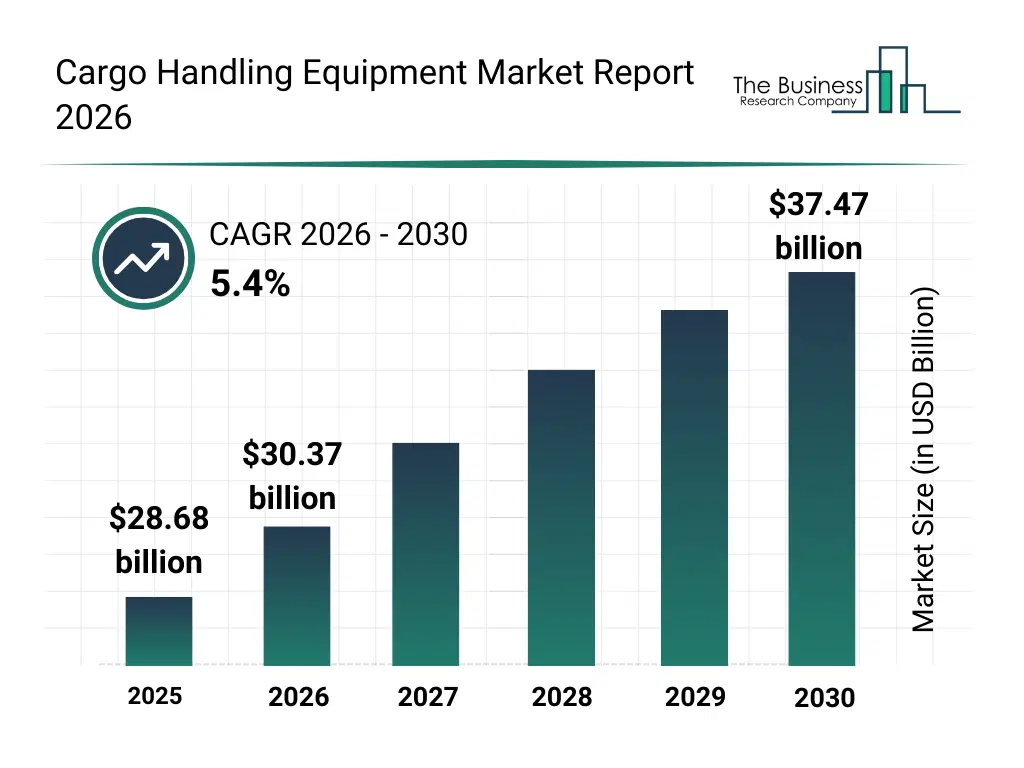
What Is The Cargo Handling Equipment Market Size and Share 2026?
The cargo handling equipment market size has grown strongly in recent years. It will grow from $28.68 billion in 2025 to $30.37 billion in 2026 at a compound annual growth rate (CAGR) of 5.9%. The growth in the historic period can be attributed to expansion of global trade volumes, growth of port and airport infrastructure, increasing warehouse automation adoption, rising demand for faster cargo turnaround, availability of heavy-duty material handling equipment.What Is The Cargo Handling Equipment Market Growth Forecast?
The cargo handling equipment market size is expected to see strong growth in the next few years. It will grow to $37.47 billion in 2030 at a compound annual growth rate (CAGR) of 5.4%. The growth in the forecast period can be attributed to increasing investments in smart logistics infrastructure, rising demand for autonomous cargo handling solutions, expansion of e-commerce driven warehousing, growing focus on low-emission material handling equipment, increasing integration of digital fleet management systems. Major trends in the forecast period include increasing adoption of automated material handling systems, rising demand for electric and hybrid cargo equipment, growing deployment of agvs in warehouses and ports, expansion of high-capacity container handling solutions, enhanced focus on operational safety and load stability.Tariff Impact On Cargo Handling Equipment Market
Tariffs are impacting the cargo handling equipment market by increasing costs of imported steel structures, electric drivetrains, hydraulic systems, control units, and automation components used across forklifts, cranes, conveyors, and AGVs. Port operators, logistics hubs, and manufacturing facilities in North America and Europe are most affected due to dependence on imported heavy equipment, while Asia-Pacific faces cost pressure on export-oriented manufacturing. These tariffs are raising capital expenditure and slowing fleet expansion plans. However, they are also encouraging domestic manufacturing, regional supplier development, and increased investment in locally assembled cargo handling equipment.
Global Cargo Handling Equipment Market Segmentation
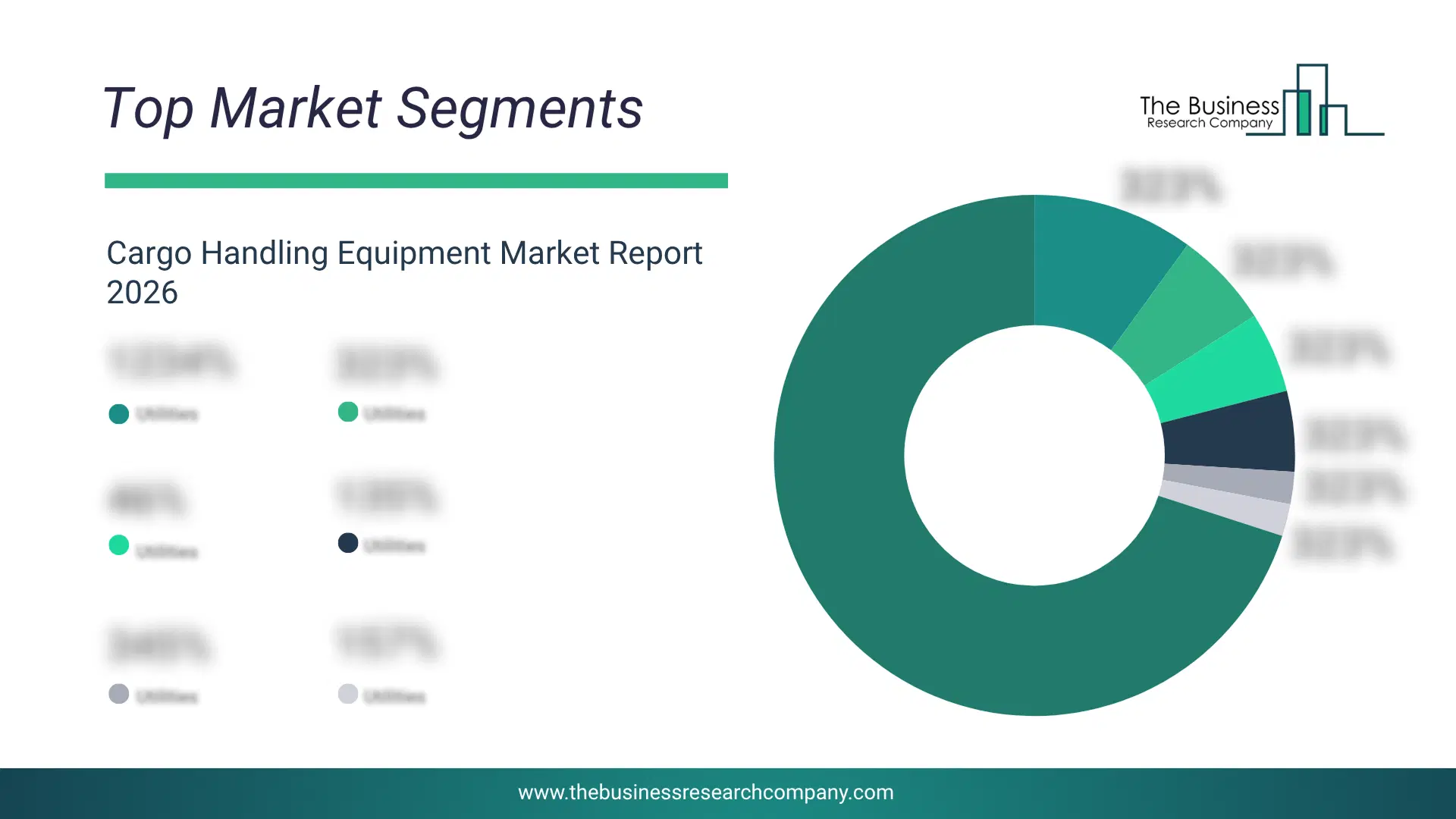
1) By Equipment Type: Aviation Dollies, Stacker, Pallet Jacks, Loaders, Conveyor System, Automated Guided Vehicle, Forklift Trucks, Cranes, Rubber Tired Gantry Cranes, Other Equipment Types 2) By Technology: Manual, Semi-Automated, Fully Automated 3) By Propulsion Type: Diesel, Electric, Other Propulsion Types 4) By Application: Air Cargo, Marine Cargo, Land Cargo 5) By End User: Automotive, Consumer And Retail, Energy Resources, Manufacturing, Transportation, Other End-Users Subsegments: 1) By Aviation Dollies: Aircraft Towing Dollies, Pushback Dollies, Cargo Dollies 2) By Stacker: Manual Stackers, Electric Stackers, Semi-Electric Stackers 3) By Pallet Jacks: Manual Pallet Jacks, Electric Pallet Jacks, High-Lift Pallet Jacks 4) By Loaders: Front-End Loaders, Telescopic Loaders, Articulated Loaders 5) By Conveyor System: Roller Conveyors, Belt Conveyors, Chain Conveyors, Pneumatic Conveyors 6) By Automated Guided Vehicle (AGV): Laser-Guided AGVs, Vision-Guided AGVs, Magnetic Tape AGVs 7) By Forklift Trucks: Electric Forklifts, Internal Combustion Forklifts, Reach Trucks, Pallet Forklifts 8) By Cranes: Overhead Cranes, Gantry Cranes, Jib Cranes, Tower Cranes 9) By Rubber Tired Gantry Cranes (RTG): Standard RTG Cranes, Electric RTG Cranes, Hybrid RTG Cranes 10) By Other Equipment Types: Dock Levelers, Container Handling Equipment, Lifting Tables, PalletizersWhat Is The Driver Of The Cargo Handling Equipment Market?
The rising import and export activities are expected to propel the growth of the cargo handling equipment market going forward. Import and export activities involve the movement of goods across international borders, facilitating trade and supply chain operations globally. The volume of import and export activities is increasing due to globalization, expanding supply chains, and rising demand for cross-border trade. Cargo handling equipment supports these operations by enabling efficient loading, unloading, storage, and transportation of goods at ports, freight terminals, airports, and logistics hubs. For example, in October 2024, according to the UN Trade and Development, a Switzerland-based intergovernmental organization, global maritime trade grew by 2.4% in 2023, recovering from the downturn seen in 2022. Therefore, rising import and export activities are driving the growth of the cargo handling equipment industry going forward.Key Players In The Global Cargo Handling Equipment Market
Major companies operating in the cargo handling equipment market are Siemens AG, ABB Ltd., Komatsu Ltd., Toyota Industries Corporation, HD Hyundai Heavy Industries Co. Ltd., Liebherr-International Deutschland GmbH, KION Group AG, Sany Heavy Industry Co. Ltd., Doosan Industrial Vehicle BG, Jungheinrich AG, Mitsubishi Logisnext Co. Ltd., Shanghai Zhenhua Heavy Industries Company Limited, Terex Corporation, Crown Equipment Corporation, Cargotec Oyj, Hyster-Yale Materials Handling Inc., Konecranes Oyj, Anhui Heli Co. Ltd., Hangcha Group Co, Manitowoc Company Inc., John Bean Technologies Corporation, Kalmar Corporation, The Taylor Group Inc, CVS ferrari S.P.A.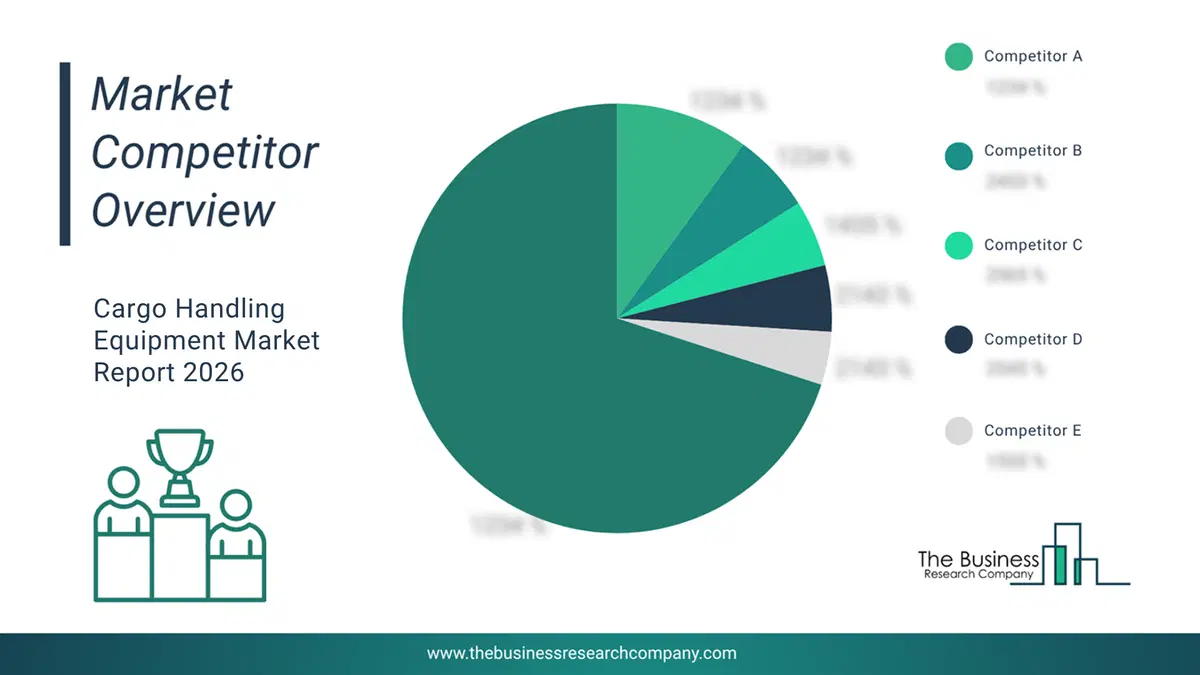
This chart is for illustrative purposes; the full report includes a detailed competitor analysis and comprehensive overview of the top 10 companies in the market.
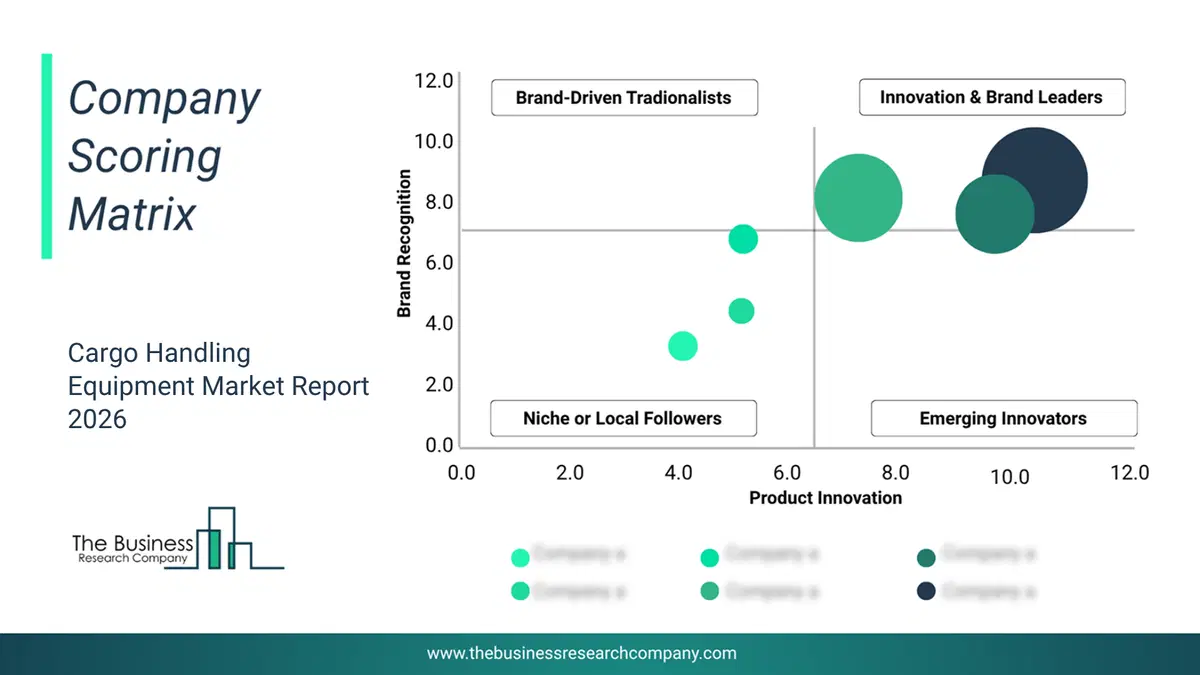
This chart maps companies by product innovation and brand strength, with bubble size indicating relative revenue, helping identify market leaders, challengers, and niche players. This is an illustrative chart; the full report provides a complete and accurate competitive analysis.
Global Cargo Handling Equipment Market Trends and Insights
Major companies operating in the cargo handling equipment market are introducing advanced forklift models to improve efficiency, incorporate advanced automation features, and tackle sustainability issues with electric and hybrid technologies. A forklift refers to a small industrial vehicle with a power-operated pronged platform that can be raised and lowered for insertion under a load to lift or move it. For instance, in May 2023, Toyota Material Handling, a US-based machinery manufacturing company, launched three electric forklift models. Three new electric forklift models include the Side-Entry End Rider for efficient cross-warehouse operations, the versatile Center Rider Stacker that combines three functions in one, and the powerful Industrial Tow Tractor designed for towing heavy loads with ease and efficiency. All three models feature AC drive motors for smooth, quiet operation, adjustable controls for operator comfort, and optional features like cold storage conditioning and PIN code access for enhanced customization and security.What Are Latest Mergers And Acquisitions In The Cargo Handling Equipment Market?
In February 2024, Taylor Group, a US-based industrial equipment manufacturing company, acquired CVS Ferrari for an undisclosed amount. The acquisition aims to enhance the Taylor Group's global market presence and combine the strengths of both organizations, enabling access to new markets, product innovation, and improved service and support capabilities. CVS Ferrari is an Italy-based machinery manufacturing company specializing in high-quality mobile container handling and heavy cargo handling equipment, including reach stackers and high-capacity forklifts.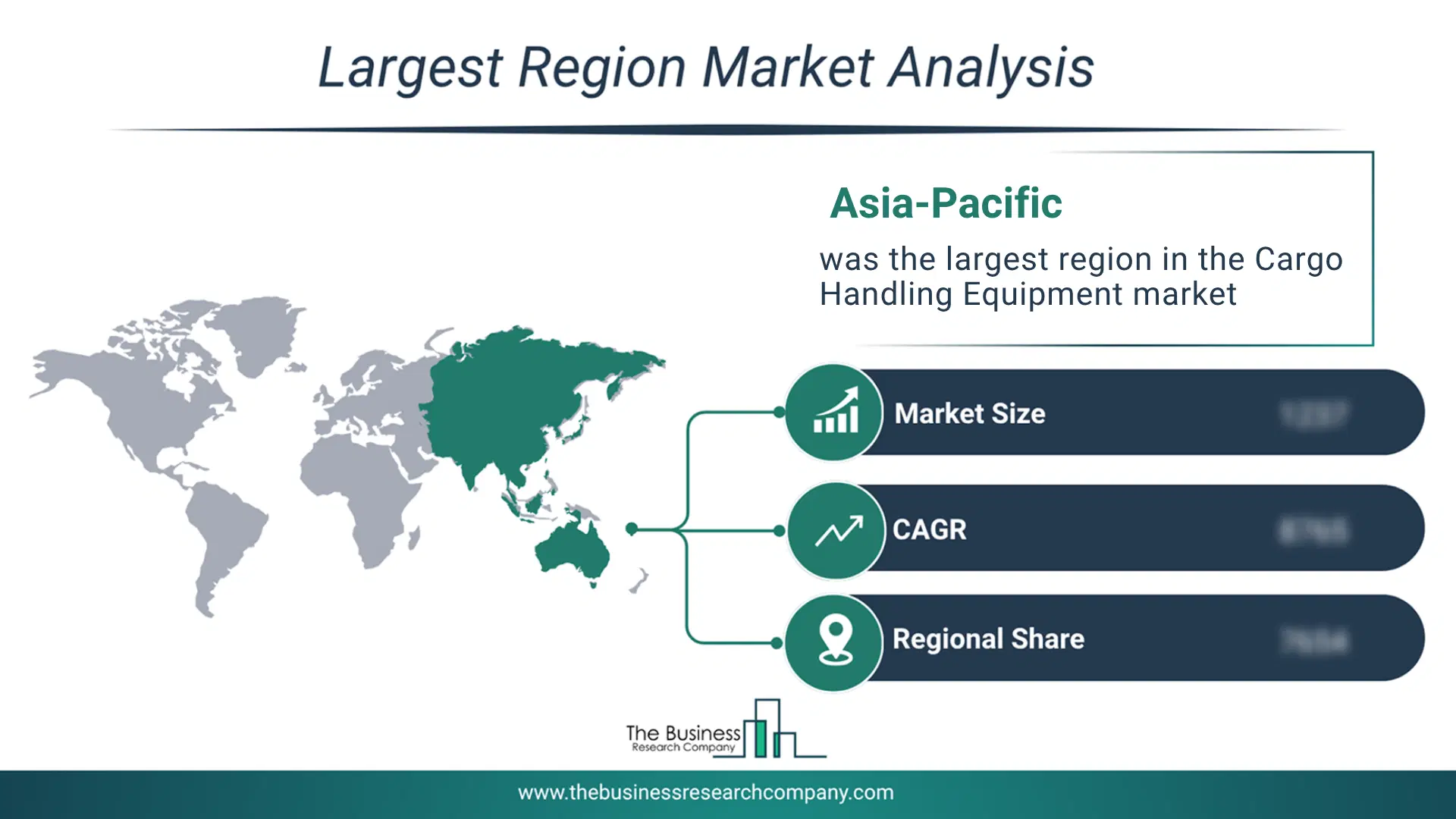
Regional Outlook
Asia-Pacific was the largest region in the cargo handling equipment market in 2025. The regions covered in this market report are Asia-Pacific, South East Asia, Western Europe, Eastern Europe, North America, South America, Middle East, Africa The countries covered in this market report are Australia, Brazil, China, France, Germany, India, Indonesia, Japan, Taiwan, Russia, South Korea, UK, USA, Canada, Italy, Spain.What Defines the Cargo Handling Equipment Market?
The cargo handling equipment market consists of revenues earned by entities by providing services such as loading and unloading goods from ships, handling and moving cargo within ports and terminals, and managing logistics operations efficiently. The market value includes the value of related goods sold by the service provider or included within the service offering. The cargo handling equipment market also includes sales of palletizers, terminal tractors, lift trucks, container, and bulk handling equipment. Values in this market are ‘factory gate’ values, that is the value of goods sold by the manufacturers or creators of the goods, whether to other entities (including downstream manufacturers, wholesalers, distributors and retailers) or directly to end customers. The value of goods in this market includes related services sold by the creators of the goods.How is Market Value Defined and Measured?
The market value is defined as the revenues that enterprises gain from the sale of goods and/or services within the specified market and geography through sales, grants, or donations in terms of the currency (in USD unless otherwise specified). The revenues for a specified geography are consumption values that are revenues generated by organizations in the specified geography within the market, irrespective of where they are produced. It does not include revenues from resales along the supply chain, either further along the supply chain or as part of other products.
This chart presents market attractiveness based on a quantitative evaluation of growth, competition, strategic alignment, and risk, offering a clear view of opportunity areas for decision-making. This chart is for illustrative purposes; the full report contains the complete analysis.

This chart highlights the Total Addressable Market (TAM) by estimating the maximum revenue opportunity using an assumption-driven approach, supporting strategic planning and opportunity sizing across markets. The chart is illustrative; the full report provides a more comprehensive analysis.
What Key Data and Analysis Are Included in the Cargo Handling Equipment Market Report 2026?
The cargo handling equipment market research report is one of a series of new reports from The Business Research Company that provides market statistics, including industry global market size, regional shares, competitors with the market share, detailed market segments, market trends and opportunities, and any further data you may need to thrive in the cargo handling equipment industry. The market research report delivers a complete perspective of everything you need, with an in-depth analysis of the current and future state of the industry.Cargo Handling Equipment Market Report Forecast Analysis
| Report Attribute | Details |
|---|---|
| Market Size Value In 2026 | $30.37 billion |
| Revenue Forecast In 2030 | $37.47 billion |
| Growth Rate | CAGR of 5.4% from 2026 to 2030 |
| Base Year For Estimation | 2025 |
| Actual Estimates/Historical Data | 2020-2025 |
| Forecast Period | 2026 - 2030 |
| Market Representation | Revenue in USD Billion and CAGR from 2026 to 2030 |
| Segments Covered | Equipment Type, Technology, Propulsion Type, Application, End User |
| Regional Scope | Asia-Pacific, Western Europe, Eastern Europe, North America, South America, Middle East, Africa |
| Key Companies Profiled | Siemens AG, ABB Ltd., Komatsu Ltd., Toyota Industries Corporation, HD Hyundai Heavy Industries Co. Ltd., Liebherr-International Deutschland GmbH, KION Group AG, Sany Heavy Industry Co. Ltd., Doosan Industrial Vehicle BG, Jungheinrich AG, Mitsubishi Logisnext Co. Ltd., Shanghai Zhenhua Heavy Industries Company Limited, Terex Corporation, Crown Equipment Corporation, Cargotec Oyj, Hyster-Yale Materials Handling Inc., Konecranes Oyj, Anhui Heli Co. Ltd., Hangcha Group Co, Manitowoc Company Inc., John Bean Technologies Corporation, Kalmar Corporation, The Taylor Group Inc, CVS ferrari S.P.A. |
| Customization Scope | Request for Customization |
| Pricing And Purchase Options | Explore Purchase Options |