
Cell Culture Media Ingredients Market Report 2026
Global Outlook – By Type (Amino Acids, Vitamins, Sugars, Salts, Buffers, Other Types), By Form (Liquid, Powder), By Application (Biopharmaceutical Production, Vaccine Production, Drug Discovery And Development, Regenerative Medicine, Cell And Gene Therapy, Diagnostics, Toxicology Testing, Other Applications), By End Users (Biotechnology Companies, Pharmaceutical Companies, Academic And Research Institutes, Contract Research Organizations) – Market Size, Trends, Strategies, and Forecast to 2035
Cell Culture Media Ingredients Market Overview
• Cell Culture Media Ingredients market size has reached to $2.78 billion in 2025 • Expected to grow to $4.81 billion in 2030 at a compound annual growth rate (CAGR) of 11.6% • Growth Driver: Increasing Demand For Biopharmaceutical Production Fueling Market Growth Due To Expanding Biologics Pipeline And Rising Drug Development Activity • Market Trend: Technological Advancement In Serum-Free Media Development Supports Cost Efficiency And Process Consistency • North America was the largest region in 2025 and Asia-Pacific is the fastest growing region.What Is Covered Under Cell Culture Media Ingredients Market?
Cell culture media ingredients are the essential components used to formulate nutrient-rich solutions that support the growth, proliferation, and maintenance of cells in vitro. These ingredients are designed to provide the necessary nutrients and physiological conditions required for research, biopharmaceutical production, vaccine development, and other biotechnology applications. The main types of cell culture media ingredients include amino acids, vitamins, sugars, salts, buffers, and other type. Amino acids refer to essential building blocks used in cell culture media to support protein synthesis, cell growth, and metabolic functions in controlled biological environments. These solutions are available in liquid and powder form. They find application in biopharmaceutical production, vaccine production, drug discovery and development, regenerative medicine, cell and gene therapy, diagnostics, toxicology testing, and other application, and they are used by several end users such as biotechnology companies, pharmaceutical companies, academic and research institutes, and contract research organizations.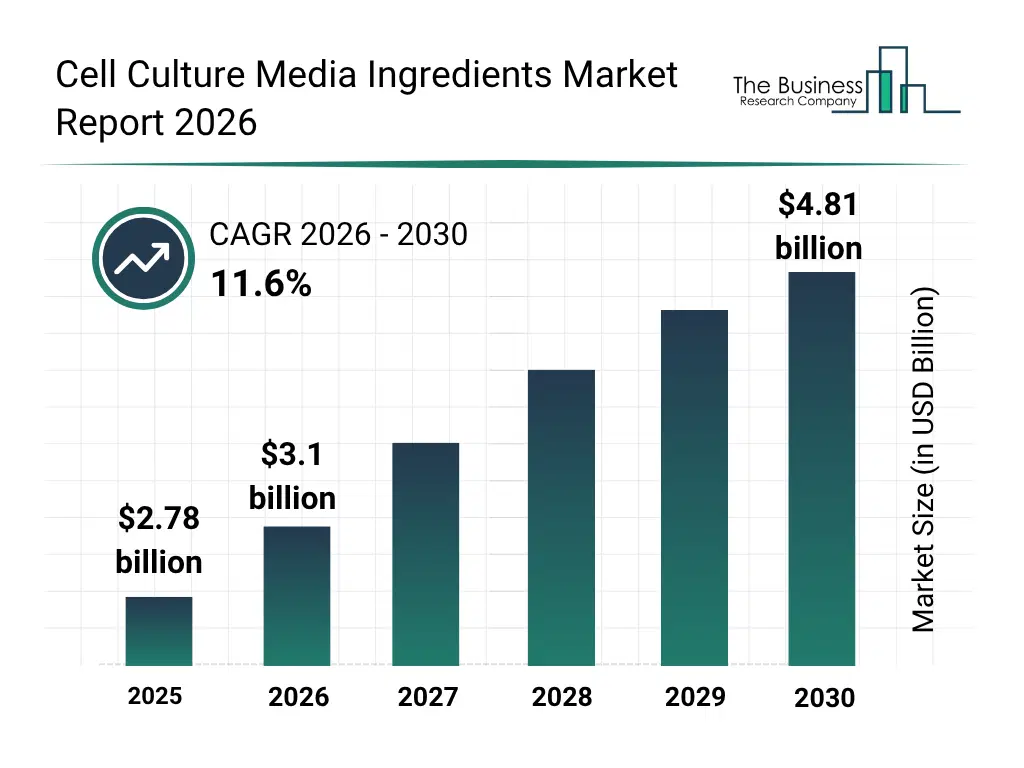
What Is The Cell Culture Media Ingredients Market Size and Share 2026?
The cell culture media ingredients market size has grown rapidly in recent years.It will grow from $2.78 billion in 2025 to $3.1 billion in 2026 at a compound annual growth rate (CAGR) of 11.4%. The growth in the historic period can be attributed to rising adoption of cell culture techniques in research, growth in biopharmaceutical manufacturing demand, expansion of vaccine development programs, increasing academic and clinical research activity, growth of contract research organizations.What Is The Cell Culture Media Ingredients Market Growth Forecast?
The cell culture media ingredients market size is expected to see rapid growth in the next few years.It will grow to $4.81 billion by 2030 at a compound annual growth rate (CAGR) of 11.6%. The growth in the forecast period can be attributed to expansion of cell and gene therapy pipelines, rising demand for personalized medicine, increased use of recombinant proteins and growth factors, adoption of single-use bioprocessing technologies, advancements in optimized and custom media formulations.Major trends in the forecast period include serum-free and chemically defined media adoption, expansion of single-use bioprocessing systems, increasing demand for contamination-free aseptic processing, rise in high-throughput cell culture screening platforms, growing adoption of 3d cell culture and organoid systems.
Global Cell Culture Media Ingredients Market Segmentation
1) By Type: Amino Acids, Vitamins, Sugars, Salts, Buffers, Other Types 2) By Form: Liquid, Powder 3) By Application: Biopharmaceutical Production, Vaccine Production, Drug Discovery And Development, Regenerative Medicine, Cell And Gene Therapy, Diagnostics, Toxicology Testing, Other Applications 4) By End Users: Biotechnology Companies, Pharmaceutical Companies, Academic And Research Institutes, Contract Research Organizations Subsegments: 1) By Amino Acids: Essential Amino Acids, Non Essential Amino Acids, Conditionally Essential Amino Acids, Branched Chain Amino Acids 2) By Vitamins: Fat Soluble Vitamins, Water Soluble Vitamins, Vitamin B Complex, Vitamin C 3) By Sugars: Monosaccharides, Disaccharides, Polysaccharides, Sugar Alcohols 4) By Salts: Inorganic Salts, Organic Salts, Trace Element Salts, Balanced Salt Solutions 5) By Buffers: Phosphate Buffers, Bicarbonate Buffers, Organic Buffers, Zwitterionic Buffers 6) By Other Types: Growth Factors, Hormones, Lipids, Proteins, Serum AdditivesWhat Is The Driver Of The Cell Culture Media Ingredients Market?
The increasing demand for biopharmaceutical production is expected to significantly contribute to the growth of the cell culture media ingredients industry.Biopharmaceutical production involves the large-scale manufacturing of biologic-based medicines, including monoclonal antibodies, vaccines, and cell and gene therapies, using living cells.This demand is rising due to the rapid expansion of biologics pipelines, which require advanced cell culture systems for both development and manufacturing.Cell culture media ingredients support these processes by providing essential nutrients, growth factors, and supplements necessary for optimal cell growth, viability, and productivity.For instance, in December 2024, according to the International Federation of Pharmaceutical Manufacturers & Associations, a Switzerland-based global industry association, over 12,700 medicines are in various stages of clinical development globally, with approximately half classified as biologics.This expanding pipeline is expected to increase manufacturing demand, with around 700 new medicines projected to be launched by 2035.Therefore, the increasing demand for biopharmaceutical production is driving the growth of the cell culture media ingredients industry.Key Players In The Global Cell Culture Media Ingredients Market
Major companies operating in the cell culture media ingredients market are Thermo Fisher Scientific Inc., Merck KGaA, FUJIFILM Wako Pure Chemical Corporation, Danaher Corporation, GE Healthcare Life Sciences (Cytiva), Becton Dickinson and Company, Corning Incorporated, Lonza Group AG, Avantor Inc., Agilent Technologies Inc., Sartorius AG, Bio-Rad Laboratories Inc., STEMCELL Technologies Inc., Miltenyi Biotec B. V. & Co. KG, Takara Bio Inc., Imperial Life Sciences Pvt. Ltd., PromoCell GmbH, BioLamina AB, Equitech-Bio Inc., Axol Bioscience Ltd., Nucleus Biologics LLC, Plant Cell Technology Inc., Cell Applications Inc.Global Cell Culture Media Ingredients Market Trends and Insights
Major companies operating in the cell culture media ingredients market are focusing on technological advancement in serum-free media development, such as efficient-pro medium (+) insulin, to improve production efficiency, reduce variability, and lower dependence on animal-derived components. Efficient-Pro Medium (+) Insulin refers to a next-generation serum-free and animal-origin-free cell culture medium that integrates essential nutrients and growth-supporting components, including insulin, directly into the formulation to enhance cell growth and protein production while eliminating the need for external supplementation. For instance, in September 2025, Thermo Fisher Scientific, a US-based life sciences company, launched Gibco Efficient-Pro Medium (+) Insulin. The product delivers up to 61% higher protein titers, supports high viable cell densities with consistent quality, and incorporates advanced granulation technology for rapid reconstitution and scalability, making it highly suitable for biopharmaceutical manufacturing workflows.What Are Latest Mergers And Acquisitions In The Cell Culture Media Ingredients Market?
In October 2025, The Good Food Institute, a US-based nonprofit organization focused on advancing alternative proteins and cultivated meat technologies, acquired SCiFi Foods’ cell lines and growth media for an undisclosed amount. With this acquisition, The Good Food Institute aims to accelerate cultivated meat research by making high-quality cell lines and serum-free media broadly accessible to academic and industry stakeholders, thereby reducing development costs and time. SCiFi Foods is a US-based cultivated meat company that developed bovine cell lines and serum-free growth media optimized for high-efficiency suspension culture systems.Regional Insights
North America was the largest region in the cell culture media ingredients market in 2025. Asia-Pacific is expected to be the fastest-growing region in the forecast period. The regions covered in this market report are Asia-Pacific, South East Asia, Western Europe, Eastern Europe, North America, South America, Middle East and Africa. The countries covered in this market report are Australia, Brazil, China, France, Germany, India, Indonesia, Japan, Taiwan, Russia, South Korea, UK, USA, Canada, Italy, Spain.What Defines the Cell Culture Media Ingredients Market?
The cell culture media ingredients market consists of sales of sera, growth factors, cytokines, hormones, inorganic salts, buffers, and other supplements used in the preparation of cell culture media. Values in this market are ‘factory gate’ values, that is, the value of goods sold by the manufacturers or creators of the goods, whether to other entities (including downstream manufacturers, biopharmaceutical companies, contract research organizations, distributors, and retailers) or directly to end customers. The value of goods in this market includes related services sold by the creators of the goods.What is the Market Assessment and Strategic Outlook for the Cell Culture Media Ingredients Industry?
The cell culture media ingredients market research report is one of a series of new reports from The Business Research Company that provides market statistics, including industry global market size, regional shares, competitors with the market share, detailed market segments, market trends and opportunities, and any further data you may need to thrive in the cell culture media ingredients industry. The market research report delivers a complete perspective of everything you need, with an in-depth analysis of the current and future state of the industry.What is the Market Assessment and Strategic Outlook for the Cell Culture Media Ingredients Market Report 2026?
The cell culture media ingredients market research report is one of a series of new reports from The Business Research Company that provides cell culture media ingredients market statistics, including cell culture media ingredients industry global market size, regional shares, competitors with a cell culture media ingredients market share, detailed cell culture media ingredients market segments, market trends and opportunities, and any further data you may need to thrive in the cell culture media ingredients industry. This cell culture media ingredients market research report delivers a complete perspective of everything you need, with an in-depth analysis of the current and future scenario of the industry.Cell Culture Media Ingredients Market Report Forecast Analysis
| Report Attribute | Details |
|---|---|
| Market Size Value In 2026 | $3.1 billion |
| Revenue Forecast In 2035 | $4.81 billion |
| Growth Rate | CAGR of 11.6% from 2026 to 2035 |
| Base Year For Estimation | 2025 |
| Actual Estimates/Historical Data | 2020-2025 |
| Forecast Period | 2026 - 2030 - 2035 |
| Market Representation | Revenue in USD Billion and CAGR from 2026 to 2035 |
| Segments Covered | Type, Form, Application, End Users |
| Regional Scope | Asia-Pacific, Western Europe, Eastern Europe, North America, South America, Middle East, Africa |
| Country Scope | The countries covered in the report are Australia, Brazil, China, France, Germany, India, Indonesia, Japan, Taiwan, Russia, South Korea, UK, USA, Canada, Italy, Spain. |
| Key Companies Profiled | Thermo Fisher Scientific Inc., Merck KGaA, FUJIFILM Wako Pure Chemical Corporation, Danaher Corporation, GE Healthcare Life Sciences (Cytiva), Becton Dickinson and Company, Corning Incorporated, Lonza Group AG, Avantor Inc., Agilent Technologies Inc., Sartorius AG, Bio-Rad Laboratories Inc., STEMCELL Technologies Inc., Miltenyi Biotec B. V. & Co. KG, Takara Bio Inc., Imperial Life Sciences Pvt. Ltd., PromoCell GmbH, BioLamina AB, Equitech-Bio Inc., Axol Bioscience Ltd., Nucleus Biologics LLC, Plant Cell Technology Inc., Cell Applications Inc. |
| Customization Scope | Request for Customization |
| Pricing And Purchase Options | Explore Purchase Options |