
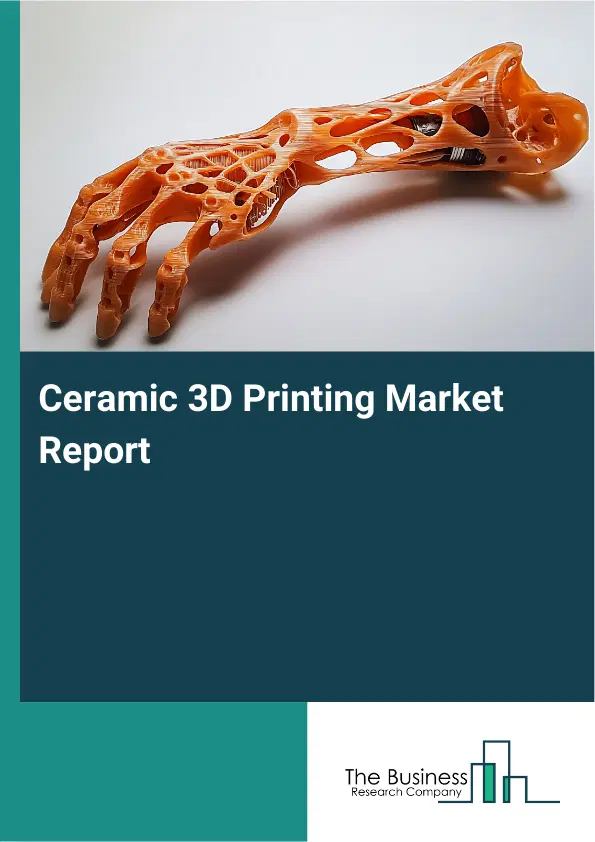
Ceramic 3D Printing Market Report 2026
Global Outlook – By Form (Powder, Resin, Filament), By Technology (Digital Printing, Analog Printing), By Formulation (Water-Based, Solvent-Based, Oil-Based), By Application (Rapid Prototyping, Tooling, Part Manufacturing), By End-User (Healthcare, Aerospace And Defense, Automotive, Manufacturing, Construction, Other End-Users) – Market Size, Trends, Strategies, and Forecast to 2030
Ceramic 3D Printing Market Overview
• Ceramic 3D Printing market size has reached to $2.78 billion in 2025 • Expected to grow to $3.5 billion in 2030 at a compound annual growth rate (CAGR) of 4.7% • Growth Driver: Rising Automotive Production On The Market Growth Driving Demand Due To Advanced Technologies And Supply Chain Expansion • Market Trend: Advancements With Roland DG's New Binder Jet Printers • North America was the largest region in 2025 and Asia-Pacific is the fastest growing region.What Is Covered Under Ceramic 3D Printing Market?
Ceramic 3D printing is an additive manufacturing process that uses a 3D printer to build up layers of ceramic materials, such as clay, porcelain, or alumina, to create objects with intricate designs and structures. The process typically involves printing a model layer by layer, followed by a firing process to harden the material and achieve the final ceramic properties. The main types of forms in ceramic 3D printing are powder, resin, and filament. Powder refers to the ceramic material in powdered form that is used in 3D printing processes like binder jetting and selective laser sintering. It includes various technologies such as digital printing and analog printing for various formulations, including water-based, solvent-based, and oil-based. It is applicable for rapid prototyping, tooling, and part manufacturing, catering to various end users, including healthcare, aerospace and defense, automotive, manufacturing, construction, and others.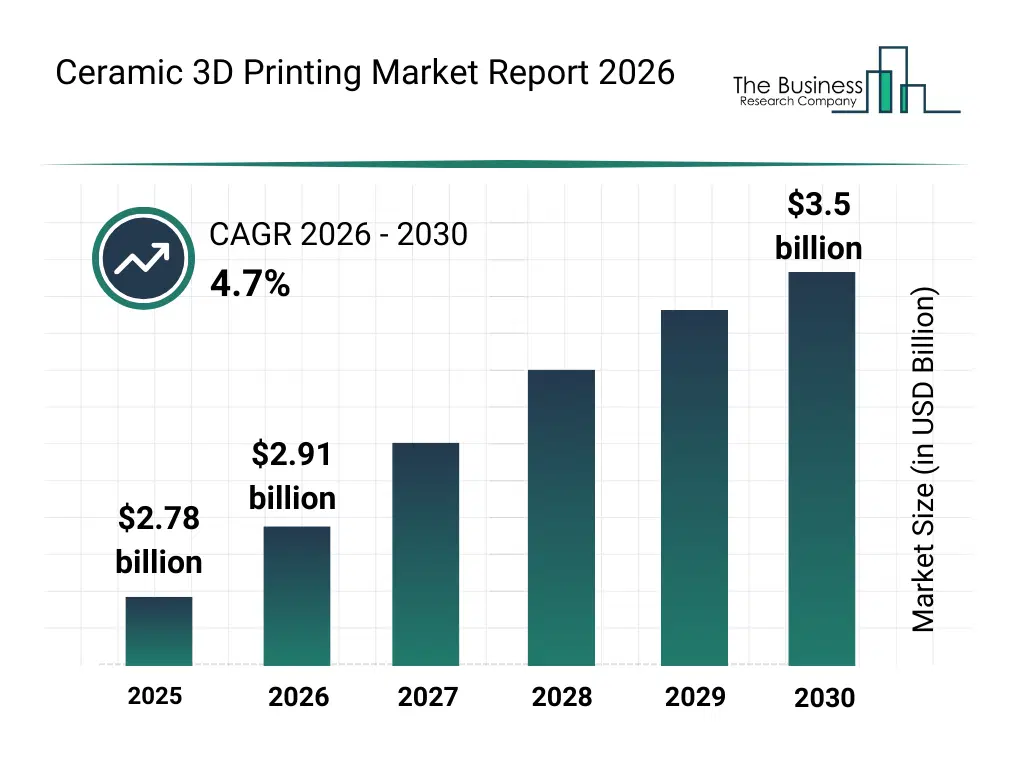
What Is The Ceramic 3D Printing Market Size and Share 2026?
The ceramic 3d printing market size has grown steadily in recent years. It will grow from $2.78 billion in 2025 to $2.91 billion in 2026 at a compound annual growth rate (CAGR) of 4.7%. The growth in the historic period can be attributed to advancements in additive manufacturing technologies, increasing demand for high-performance ceramic parts, growth of rapid prototyping applications, rising adoption in industrial tooling, availability of advanced ceramic materials.What Is The Ceramic 3D Printing Market Growth Forecast?
The ceramic 3d printing market size is expected to see steady growth in the next few years. It will grow to $3.5 billion in 2030 at a compound annual growth rate (CAGR) of 4.7%. The growth in the forecast period can be attributed to increasing investments in advanced manufacturing, rising adoption of lightweight and high-temperature materials, expansion of medical implant applications, growing focus on sustainable manufacturing processes, increasing integration of digital design tools. Major trends in the forecast period include increasing adoption of ceramic additive manufacturing, rising demand for complex geometry components, growing use in aerospace and medical applications, expansion of rapid prototyping with ceramics, enhanced material performance optimization.Tariff Impact On Ceramic 3D Printing Market
Tariffs are impacting the ceramic 3d printing market by increasing costs of imported ceramic powders, resins, specialized printers, and precision control electronics. Manufacturing hubs in North America and Europe are most affected due to reliance on imported materials, while Asia-Pacific faces higher costs for export-oriented printer production. These tariffs are raising equipment and material costs and slowing adoption among small manufacturers. However, they are also encouraging local material production, regional printer assembly, and innovation in alternative ceramic feedstocks.
Global Ceramic 3D Printing Market Segmentation
1) By Form: Powder, Resin, Filament 2) By Technology: Digital Printing, Analog Printing 3) By Formulation: Water-Based, Solvent-Based, Oil-Based 4) By Application: Rapid Prototyping, Tooling, Part Manufacturing 5) By End-User: Healthcare, Aerospace And Defense, Automotive, Manufacturing, Construction, Other End-Users Subsegments: 1) By Powder: Alumina, Zirconia, Silicon Carbide, Titanium Dioxide, Other Ceramic Powders 2) By Resin: Epoxy Resin, Acrylic Resin, Polyurethane Resin, Other Ceramic Resins 3) By Filament: PLA-Based Filament, ABS-Based Filament, PCL-Based Filament, Other Ceramic FilamentsWhat Is The Driver Of The Ceramic 3D Printing Market?
The rising automotive production is expected to propel the growth of the ceramic 3D printing market going forward. Automotive production refers to manufacturing motor vehicles and their components, including cars, trucks, buses, and automotive parts. The rise in automotive production is due to growing demand for electric vehicles, advancements in manufacturing technology, increasing consumer demand, and expansion in commercial fleets. Ceramic 3D printing in automotive creates high-performance, heat-resistant components like brake parts, engine components, and battery insulators, improving durability and efficiency. For instance, in March 2024, according to the European Automobile Manufacturers' Association, a Belgium-based trade organization, in 2023, global car manufacturing reached approximately 76 million units, a 10.2% increase from 2022. Therefore, the rising automotive production is driving the growth of the ceramic 3D printing industry.Key Players In The Global Ceramic 3D Printing Market
Major companies operating in the ceramic 3d printing market are KYOCERA Corporation, SiNAPTIC Technologies Inc., Schunk GmbH, Calix Inc., Formlabs Inc., Prodways Group, The ExOne Company, CADdent GmbH, Lithoz GmbH, PERFECT-3D LLC, XJet Ltd., 3D Matters Pte. Ltd., 3D-Alchemy Ltd., Creatz3D Pte. Ltd., Steinbach AG, Tethon 3D Inc., 3D Potter, Fortify Inc., WASP, Hilgenberg-Ceramics GmbH & Co. KG, Doit Industries India Pvt. Ltd., 3DCeram Sinto, SINTX Technologies Inc., Voxeljet AG, Eazao
This chart is for illustrative purposes; the full report includes a detailed competitor analysis and comprehensive overview of the top 10 companies in the market.
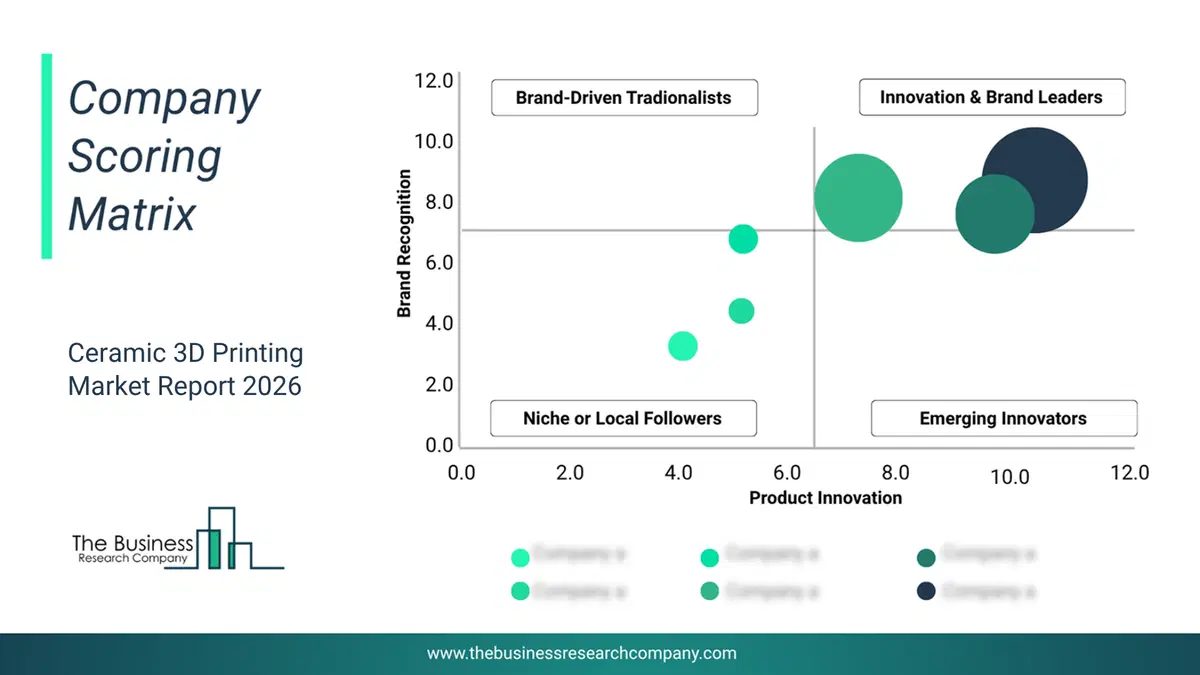
This chart maps companies by product innovation and brand strength, with bubble size indicating relative revenue, helping identify market leaders, challengers, and niche players. This is an illustrative chart; the full report provides a complete and accurate competitive analysis.
Global Ceramic 3D Printing Market Trends and Insights
Major companies operating in the ceramic 3D printing market are focusing on developing technologically advanced solutions, such as binder jet-type 3D printers, to enhance precision, scalability, and production efficiency. Binder jet-type 3D printers are additive manufacturing systems that use a liquid binder to fuse powdered materials layer by layer, creating complex 3D structures with high precision and efficiency. For instance, in January 2025, Roland DG Corporation, a Japan-based manufacturer of wide-format inkjet printers, introduced two new binder jet-type 3D printers, the PB-600 and PB-400, designed explicitly for ceramic object production. The PB series employs advanced binder jet technology, layering Brightorb artificial ceramic powder and binding it with a liquid binder to fabricate intricate three-dimensional structures. These innovative printers enable the creation of highly detailed ceramic designs previously unachievable through traditional manual techniques or milling processes. Their applications span artistic interior décor, ceramic panels, fine art replicas, and various forms of earthenware and crafts.What Are Latest Mergers And Acquisitions In The Ceramic 3D Printing Market?
In March 2025, Tethon 3D, a US-based provider of ceramic 3D printers and photopolymer 3D printing resins, acquired Technology Assessment and Transfer (TA&T) for an undisclosed amount. With this acquisition, Tethon 3D aims to bolster its manufacturing capabilities, expand its resin portfolio, and enhance its global market share in the ceramic additive manufacturing sector. TA&T is a US-based provider of materials expertise, specializing in silicon nitride ceramics and advanced ceramic processing solutions.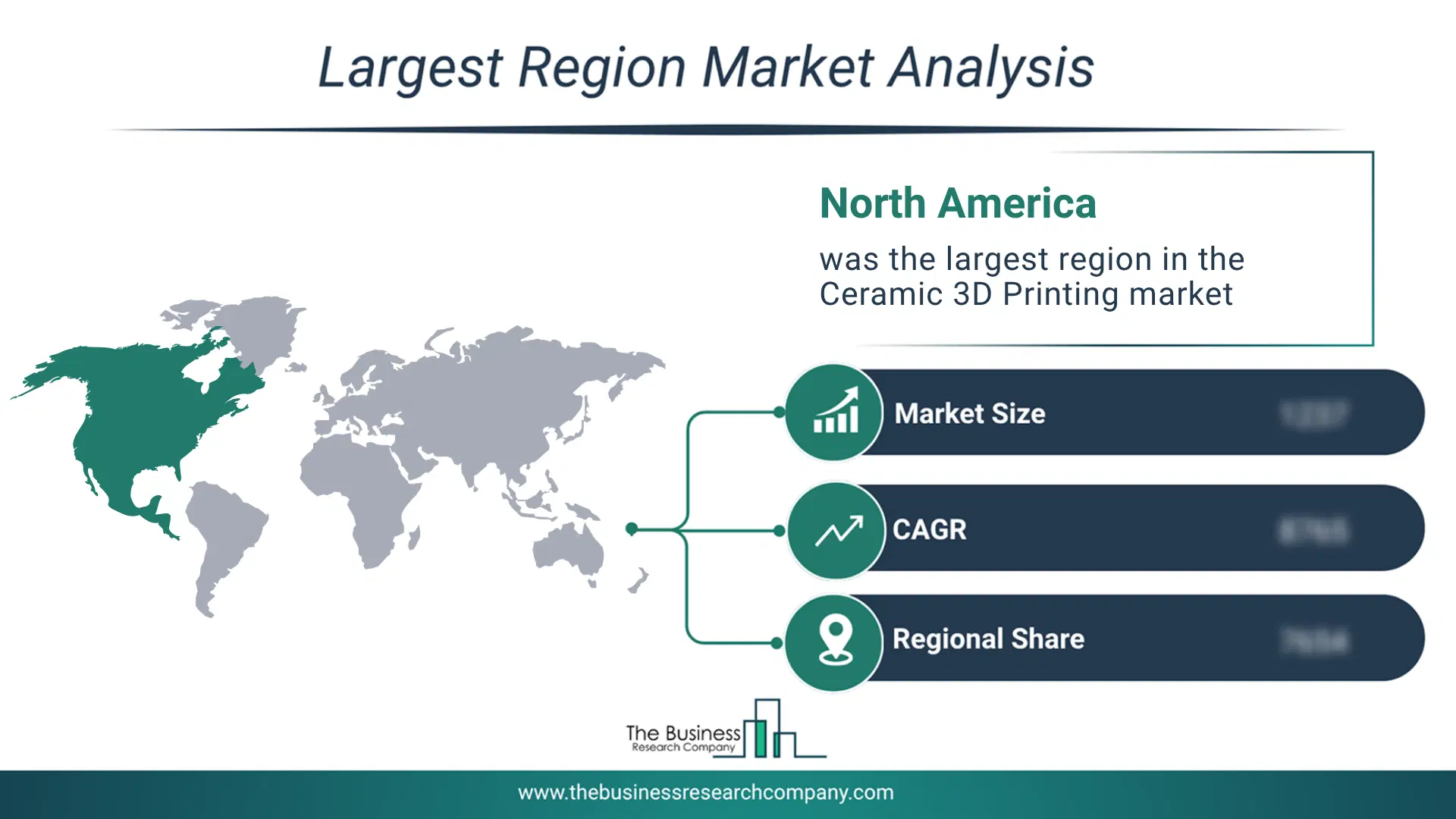
Regional Outlook
North America was the largest region in the ceramic 3D printing market in 2025. Asia-Pacific is expected to be the fastest-growing region in the forecast period. The regions covered in this market report are Asia-Pacific, South East Asia, Western Europe, Eastern Europe, North America, South America, Middle East, Africa The countries covered in this market report are Australia, Brazil, China, France, Germany, India, Indonesia, Japan, Taiwan, Russia, South Korea, UK, USA, Canada, Italy, Spain.What Defines the Ceramic 3D Printing Market?
The ceramic 3D printing market consists of revenues earned by entities by providing services such as custom ceramic part design, additive manufacturing, material development, and post-processing of printed ceramic objects. The market value includes the value of related goods sold by the service provider or included within the service offering. The ceramic 3D printing market also includes sales of 3D printers, ceramic materials, binders, printheads, and software for design and printing management. Values in this market are ‘factory gate’ values, that is the value of goods sold by the manufacturers or creators of the goods, whether to other entities (including downstream manufacturers, wholesalers, distributors and retailers) or directly to end customers. The value of goods in this market includes related services sold by the creators of the goods.How is Market Value Defined and Measured?
The market value is defined as the revenues that enterprises gain from the sale of goods and/or services within the specified market and geography through sales, grants, or donations in terms of the currency (in USD unless otherwise specified). The revenues for a specified geography are consumption values that are revenues generated by organizations in the specified geography within the market, irrespective of where they are produced. It does not include revenues from resales along the supply chain, either further along the supply chain or as part of other products.
This chart presents market attractiveness based on a quantitative evaluation of growth, competition, strategic alignment, and risk, offering a clear view of opportunity areas for decision-making. This chart is for illustrative purposes; the full report contains the complete analysis.

This chart highlights the Total Addressable Market (TAM) by estimating the maximum revenue opportunity using an assumption-driven approach, supporting strategic planning and opportunity sizing across markets. The chart is illustrative; the full report provides a more comprehensive analysis.
What Key Data and Analysis Are Included in the Ceramic 3D Printing Market Report 2026?
The ceramic 3d printing market research report is one of a series of new reports from The Business Research Company that provides market statistics, including industry global market size, regional shares, competitors with the market share, detailed market segments, market trends and opportunities, and any further data you may need to thrive in the ceramic 3d printing industry. The market research report delivers a complete perspective of everything you need, with an in-depth analysis of the current and future state of the industry.Ceramic 3D Printing Market Report Forecast Analysis
| Report Attribute | Details |
|---|---|
| Market Size Value In 2026 | $2.91 billion |
| Revenue Forecast In 2030 | $3.5 billion |
| Growth Rate | CAGR of 4.7% from 2026 to 2030 |
| Base Year For Estimation | 2025 |
| Actual Estimates/Historical Data | 2020-2025 |
| Forecast Period | 2026 - 2030 |
| Market Representation | Revenue in USD Billion and CAGR from 2026 to 2030 |
| Segments Covered | Form, Technology, Formulation, Application, End-User |
| Regional Scope | Asia-Pacific, Western Europe, Eastern Europe, North America, South America, Middle East, Africa |
| Key Companies Profiled | KYOCERA Corporation, SiNAPTIC Technologies Inc., Schunk GmbH, Calix Inc., Formlabs Inc., Prodways Group, The ExOne Company, CADdent GmbH, Lithoz GmbH, PERFECT-3D LLC, XJet Ltd., 3D Matters Pte. Ltd., 3D-Alchemy Ltd., Creatz3D Pte. Ltd., Steinbach AG, Tethon 3D Inc., 3D Potter, Fortify Inc., WASP, Hilgenberg-Ceramics GmbH & Co. KG, Doit Industries India Pvt. Ltd., 3DCeram Sinto, SINTX Technologies Inc., Voxeljet AG, Eazao |
| Customization Scope | Request for Customization |
| Pricing And Purchase Options | Explore Purchase Options |