
Clean Energy Market Report 2026
Global Outlook – By Product (Solar Panels, Wind Turbines, Hydroelectric Generators, Geothermal Heat Pumps, Biomass Boilers, Wave Energy Converters, Hydrogen Fuel Cells, Nuclear Reactors), By Installation Type (Rooftop, Ground-Mounted, Building-Integrated, Off-Grid, Grid-Connected, Retrofitting, New Construction), By Technology (Photovoltaic, Concentrated Solar Power, Horizontal Axis Wind Turbines, Vertical Axis Wind Turbines, Run-Of-The-River, Binary Cycle Power Plants, Anaerobic Digestion, Tidal Stream), By Deployment (Onshore, Offshore, Floating, Distributed, Centralized, Micro grid, Standalone), By Application (Residential, Commercial, Industrial, Utility, Transportation, Agriculture, Marine) – Market Size, Trends, Strategies, and Forecast to 2030
Clean Energy Market Overview
• Clean Energy market size has reached to $959.44 billion in 2025 • Expected to grow to $1563.39 billion in 2030 at a compound annual growth rate (CAGR) of 10.2% • Growth Driver: Surge In Energy Demand Driving Market Growth Through Sustainable Clean Energy Solutions • Market Trend: Advancements In High-Efficiency Energy Conversion Technologies Driving The Transition To Low-Carbon Power Systems • Asia-Pacific was the largest region in 2025.What Is Covered Under Clean Energy Market?
Clean energy refers to energy that is produced through methods that do not release pollutants into the environment, particularly greenhouse gases. It comes from renewable sources such as wind, solar, hydro, and geothermal power, which have minimal environmental impact compared to fossil fuels. The main products in the clean energy are solar panels, wind turbines, hydroelectric generators, geothermal heat pumps, biomass boilers, wave energy converters, hydrogen fuel cells, and nuclear reactors. Solar panels use semiconductor materials to capture sunlight and convert it into electricity. These systems can be installed in various ways, such as rooftop, ground-mounted, building-integrated, off-grid, grid-connected, for retrofitting, and in new construction. Key technologies include photovoltaic (PV), concentrated solar power (CSP), horizontal and vertical axis wind turbines, run-of-the-river hydro, binary cycle geothermal plants, anaerobic digestion, and tidal stream. These are deployed through various deployment models that include onshore, offshore, floating, distributed, centralized, microgrid, and standalone. These are used for various applications such as residential, commercial, industrial, utility-scale, transportation, agriculture, and marine industries.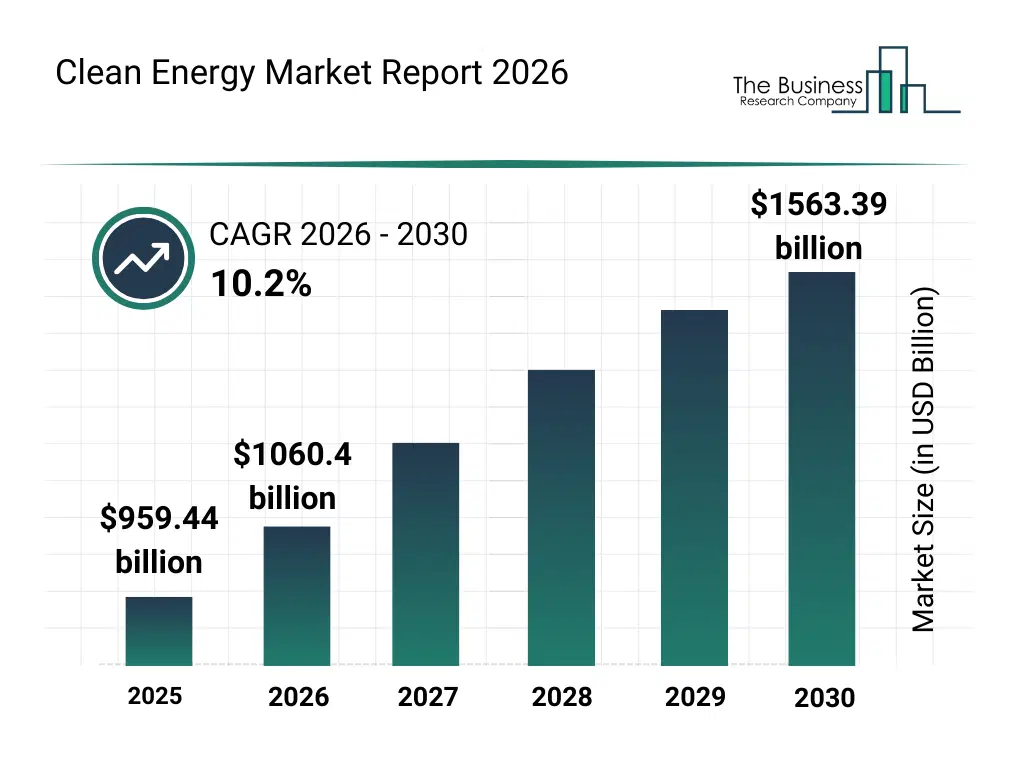
What Is The Clean Energy Market Size and Share 2026?
The clean energy market size has grown rapidly in recent years. It will grow from $959.44 billion in 2025 to $1060.4 billion in 2026 at a compound annual growth rate (CAGR) of 10.5%. The growth in the historic period can be attributed to expansion of renewable energy capacity additions, declining costs of solar and wind technologies, government incentives for clean energy projects, increasing electricity demand, early adoption of grid-scale renewables.What Is The Clean Energy Market Growth Forecast?
The clean energy market size is expected to see rapid growth in the next few years. It will grow to $1563.39 billion in 2030 at a compound annual growth rate (CAGR) of 10.2%. The growth in the forecast period can be attributed to increasing electrification of transportation and industry, rising investments in energy storage technologies, expansion of hydrogen and hybrid energy systems, growing demand for grid flexibility solutions, increasing focus on net-zero energy targets. Major trends in the forecast period include expansion of utility-scale renewable installations, rising deployment of distributed energy resources, growing integration of energy storage systems, increased adoption of grid-connected renewable solutions, enhanced focus on clean power reliability.
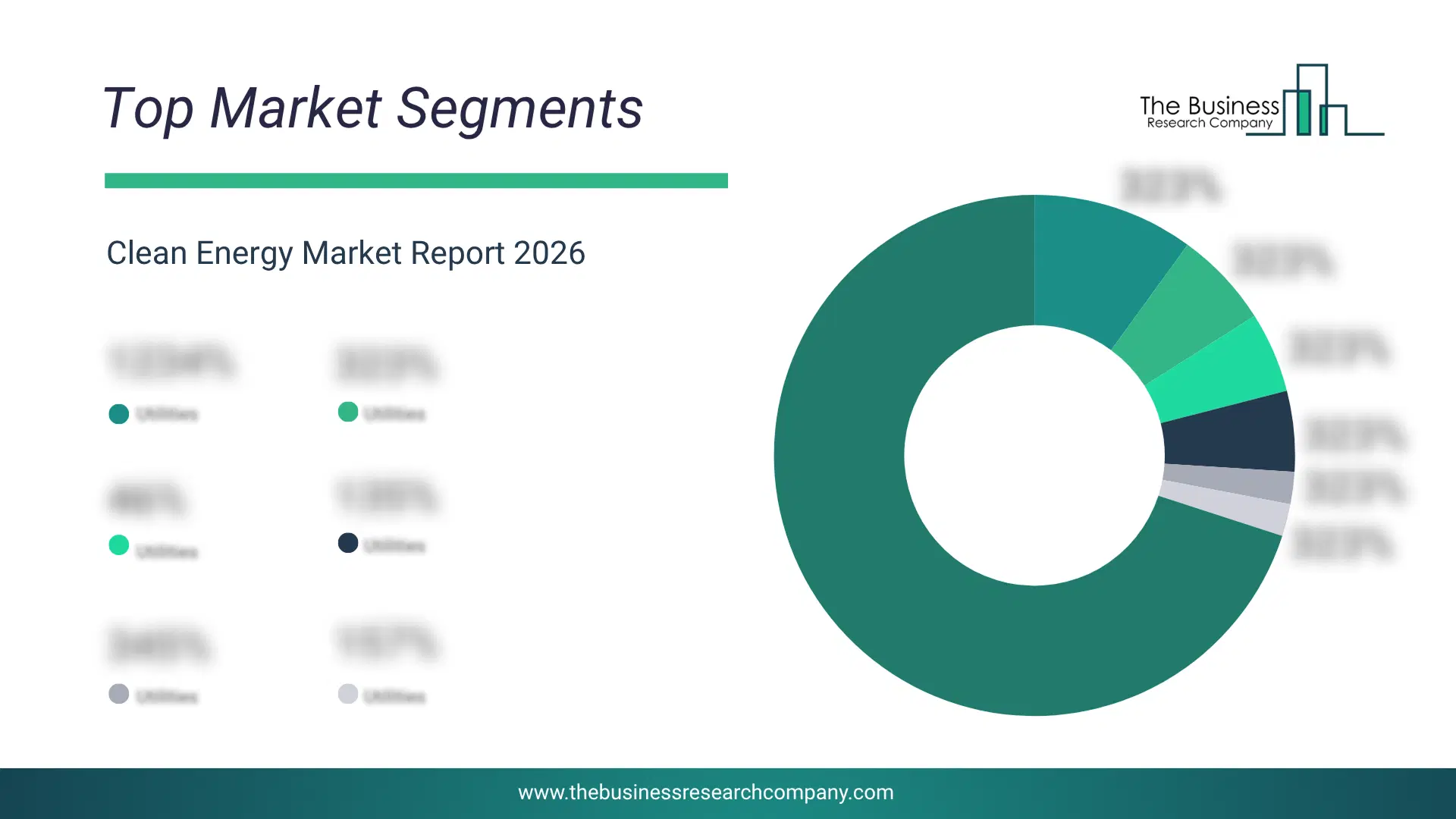
Global Clean Energy Market Segmentation
1) By Product: Solar Panels, Wind Turbines, Hydroelectric Generators, Geothermal Heat Pumps, Biomass Boilers, Wave Energy Converters, Hydrogen Fuel Cells, Nuclear Reactors 2) By Installation Type: Rooftop, Ground-Mounted, Building-Integrated, Off-Grid, Grid-Connected, Retrofitting, New Construction 3) By Technology: Photovoltaic, Concentrated Solar Power, Horizontal Axis Wind Turbines, Vertical Axis Wind Turbines, Run-Of-The-River, Binary Cycle Power Plants, Anaerobic Digestion, Tidal Stream 4) By Deployment: Onshore, Offshore, Floating, Distributed, Centralized, Micro grid, Standalone 5) By Application: Residential, Commercial, Industrial, Utility, Transportation, Agriculture, Marine Subsegments: 1) By Solar Panels: Monocrystalline Solar Panels, Polycrystalline Solar Panels, Thin-film Solar Panels, Bifacial Solar Panels, Concentrated Solar Panels 2) By Wind Turbines: Onshore Wind Turbines, Offshore Wind Turbines, Vertical Axis Wind Turbines (VAWT), Horizontal Axis Wind Turbines (HAWT) 3) By Hydroelectric Generators: Large Hydroelectric Generators, Small Hydroelectric Generators, Micro Hydroelectric Generators, Pumped Storage Hydroelectric Generators 4) By Geothermal Heat Pumps: Closed Loop Geothermal Heat Pumps (Horizontal Closed Loop Systems, Vertical Closed Loop Systems, Pond/Lake Closed Loop Systems), Open Loop Geothermal Heat Pumps 5) By Biomass Boilers: Wood Pellet Boilers, Wood Chip Boilers, Biomass Gasification Boilers, Combined Heat and Power (CHP) Biomass Boilers 6) By Wave Energy Converters: Oscillating Water Column Converters, Oscillating Body Converters, Overtopping Converters, Point Absorber Buoys 7) By Hydrogen Fuel Cells: Proton Exchange Membrane Fuel Cells (PEMFC), Solid Oxide Fuel Cells (SOFC), Alkaline Fuel Cells (AFC), Phosphoric Acid Fuel Cells (PAFC) 8) By Nuclear Reactors: Pressurized Water Reactors (PWR), Boiling Water Reactors (BWR), Fast Neutron Reactors (FNR), Small Modular Reactors (SMR), Advanced Gas-cooled Reactors (AGR)What Is The Driver Of The Clean Energy Market?
The rise in energy demand is expected to propel the growth of the clean energy market going forward. Energy is the ability to do work or cause change and exists in various forms, including heat, light, motion, electrical, chemical, and nuclear energy, all of which are essential for powering physical processes and systems. Energy demand is increasing due to growing populations, expanding economies, and accelerating technological adoption drive higher energy consumption. Clean energy is used as energy by converting natural resources like sunlight, wind, and water into electricity or heat for homes, industries, and transportation. For instance, in February 2025, according to the World Resources Institute, a US-based non-profit organization, in 2024, solar energy set a new record by adding an estimated 39.6 gigawatts (GW) of capacity, surpassing the 27.4 GW installed in 2023. Therefore, the rise in energy demand is driving the clean energy industry.Key Players In The Global Clean Energy Market
Major companies operating in the clean energy market are Enel Spa, Siemens AG, General Electric Company, ABB Ltd., Next Era Energy Partners, Acconia SA, Orsted A/S, Jinko Solar Holding Co., Vestas Wind Systems, Trina Solar Limited, JA Solar Technology Co., Canadian Solar, Nordex SE, Renewable Energy Group, First Solar Inc., Sun Power Corporation, Suzlon Energy Ltd., Plug Power, Neoen Pty Ltd., Scatec ASA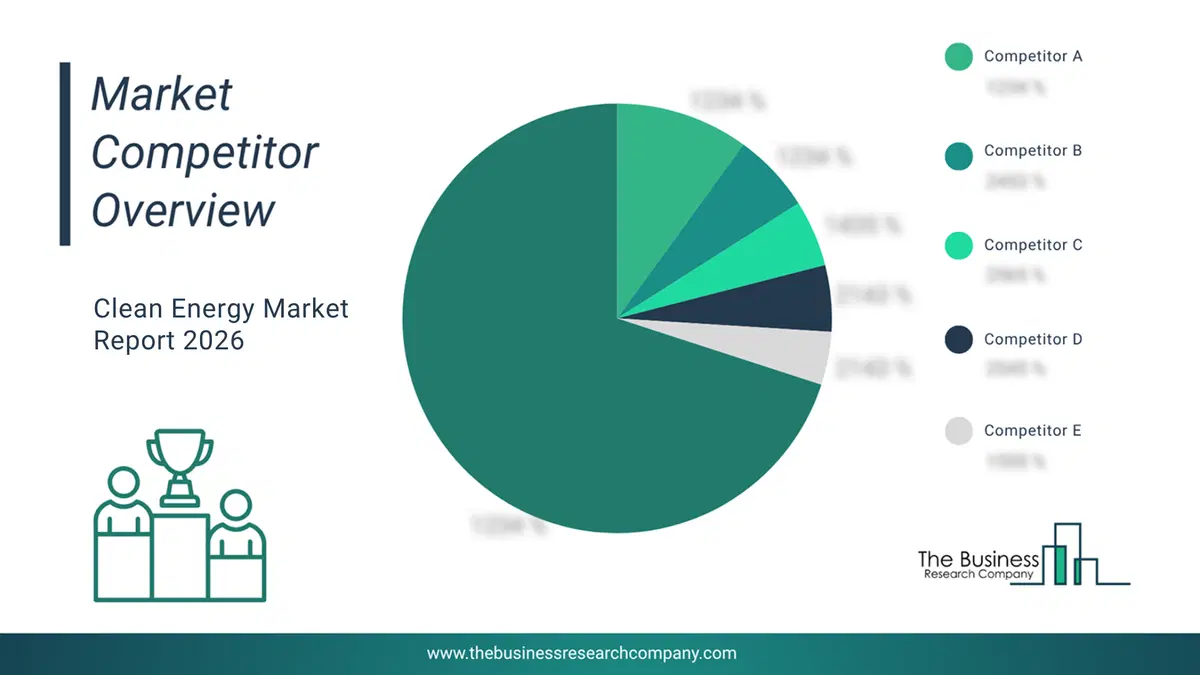
This chart is for illustrative purposes; the full report includes a detailed competitor analysis and comprehensive overview of the top 10 companies in the market.
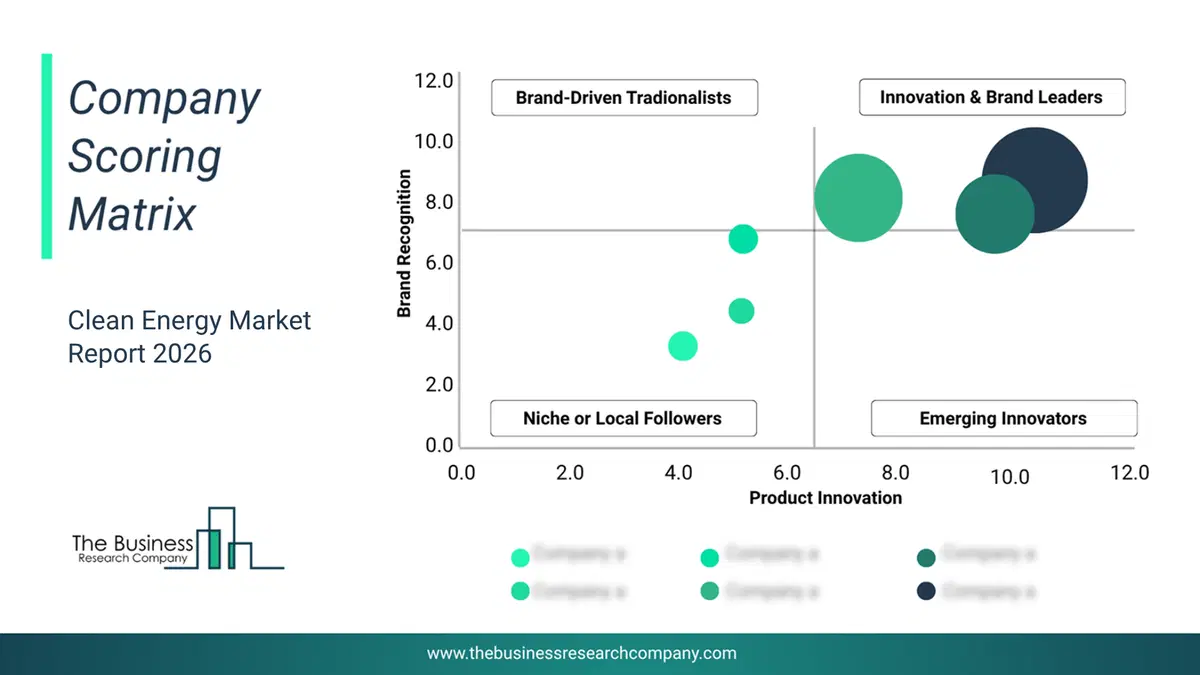
This chart maps companies by product innovation and brand strength, with bubble size indicating relative revenue, helping identify market leaders, challengers, and niche players. This is an illustrative chart; the full report provides a complete and accurate competitive analysis.
Global Clean Energy Market Trends and Insights
Major companies operating in the clean energy market are focusing on developing innovative solutions, such as solid oxide fuel cell and electrolysis manufacturing technologies, to enhance efficiency, reduce emissions, and accelerate the transition to a sustainable energy future. Solid oxide fuel cells (SOFC) and solid oxide electrolysis cells (SOEC) are electrochemical devices that operate at high temperatures to convert fuels (like hydrogen) into electricity or split water into hydrogen and oxygen with high efficiency and low emissions compared with traditional combustion-based power generation, offering advantages such as fuel flexibility, modular scalability, and integration with renewable energy sources. For instance, in September 2025, Elcogen AS, an UK-based clean energy technology manufacturer, launched its ELCO I high-volume solid oxide fuel cell and electrolyzer production facility, a state-of-the-art 14,000 m² manufacturing plant designed to scale production capacity from 10 MW to 360 MW annually to address global demand for efficient clean energy solutions. This facility supports production of SOFC and SOEC cells, stacks, and modules that can be integrated into distributed energy systems, green hydrogen production, off-grid and stationary power solutions, and Power-to-X applications, with advanced automation and sustainable design features that reduce emissions and improve output consistency.What Are Latest Mergers And Acquisitions In The Clean Energy Market?
In September 2023, Repsol S.A., a Spain-based energy company, acquired Connect Gen, a for an undisclosed amount. With this acquisition, Repsol aimed to expand its renewable energy footprint and accelerate its entry into the U.S. onshore wind market while advancing its strategic targets for global renewable capacity growth. Connect Gen LLC is a US-based renewable developer that specializes in developing a large pipeline of onshore wind, solar, and energy storage projects across the United States.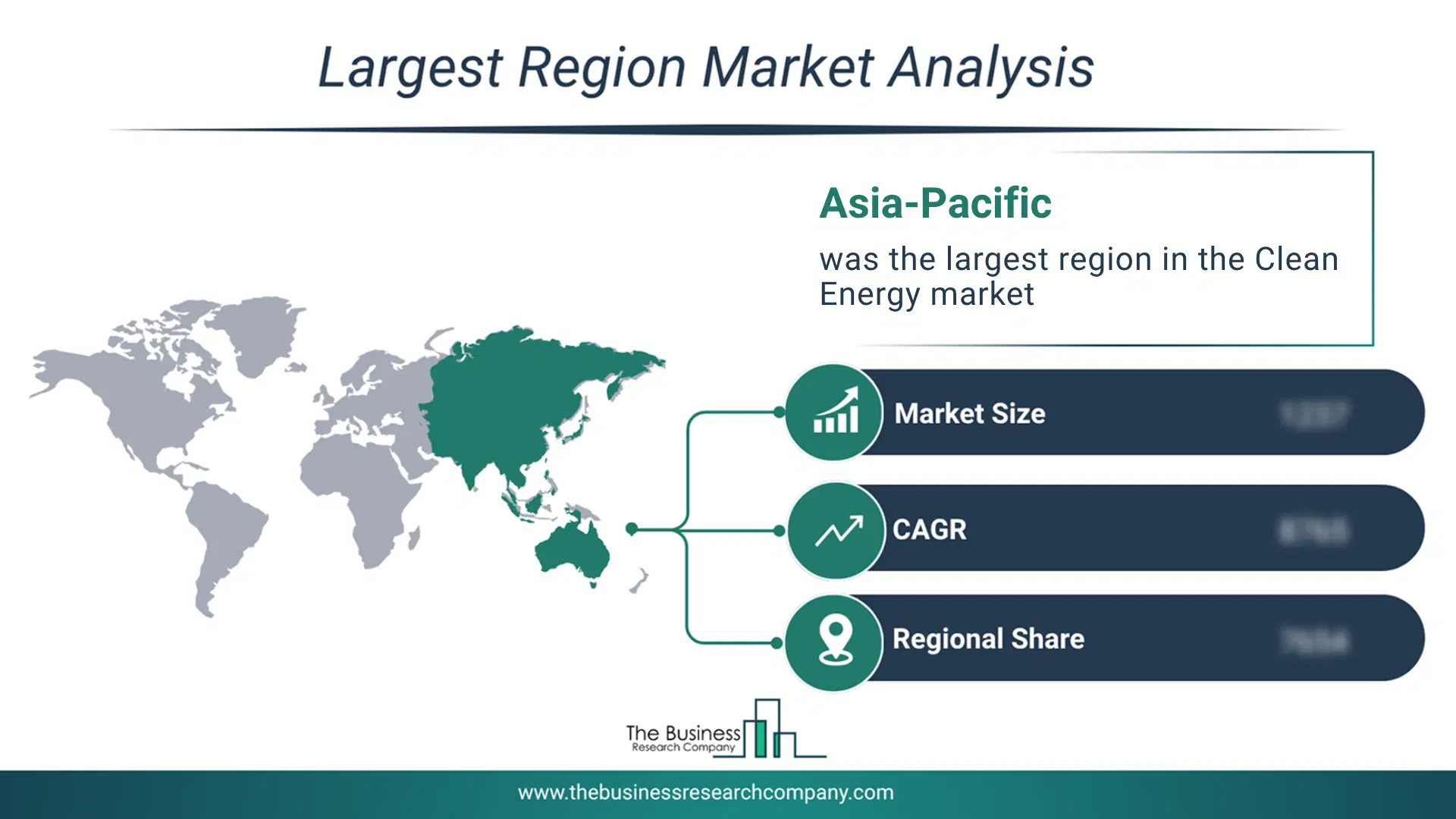
Regional Outlook
Asia-Pacific was the largest region in the clean energy market in 2025. The regions covered in this market report are Asia-Pacific, South East Asia, Western Europe, Eastern Europe, North America, South America, Middle East, Africa. The countries covered in this market report are Australia, Brazil, China, France, Germany, India, Indonesia, Japan, Taiwan, Russia, South Korea, UK, USA, Canada, Italy, SpainWhat Defines the Clean Energy Market?
The clean energy market consists of revenues earned by entities by providing services such as energy storage solutions, grid integration and management, energy efficiency consulting, and microgrid and distributed energy services. The market value includes the value of related goods sold by the service provider or included within the service offering. The clean energy market also includes sales of solar panels and solar power systems, wind turbines, hydrogen fuel cells and electrolyzers, and geothermal and biomass systems. Values in this market are ‘factory gate’ values, that is, the value of goods sold by the manufacturers or creators of the goods, whether to other entities (including downstream manufacturers, wholesalers, distributors, and retailers) or directly to end customers. The value of goods in this market includes related services sold by the creators of the goods.How is Market Value Defined and Measured?
The market value is defined as the revenues that enterprises gain from the sale of goods and/or services within the specified market and geography through sales, grants, or donations in terms of the currency (in USD unless otherwise specified). The revenues for a specified geography are consumption values that are revenues generated by organizations in the specified geography within the market, irrespective of where they are produced. It does not include revenues from resales along the supply chain, either further along the supply chain or as part of other products.
This chart presents market attractiveness based on a quantitative evaluation of growth, competition, strategic alignment, and risk, offering a clear view of opportunity areas for decision-making. This chart is for illustrative purposes; the full report contains the complete analysis.

This chart highlights the Total Addressable Market (TAM) by estimating the maximum revenue opportunity using an assumption-driven approach, supporting strategic planning and opportunity sizing across markets. The chart is illustrative; the full report provides a more comprehensive analysis.
What Key Data and Analysis Are Included in the Clean Energy Market Report 2026?
The clean energy market research report is one of a series of new reports from The Business Research Company that provides market statistics, including Market Report 2026?global market size, regional shares, competitors with the market share, detailed market segments, market trends and opportunities, and any further data you may need to thrive in the clean energy Market Report 2026? The market research report delivers a complete perspective of everything you need, with an in-depth analysis of the current and future state of the Market Report 2026?Clean Energy Market Report Forecast Analysis
| Report Attribute | Details |
|---|---|
| Market Size Value In 2026 | $1060.4 billion |
| Revenue Forecast In 2030 | $1563.39 billion |
| Growth Rate | CAGR of 10.5% from 2026 to 2030 |
| Base Year For Estimation | 2025 |
| Actual Estimates/Historical Data | 2020-2025 |
| Forecast Period | 2026 - 2030 - 2030 |
| Market Representation | Revenue in USD Billion and CAGR from 2026 to 2030 |
| Segments Covered | Product, Installation Type, Technology, Deployment, Application |
| Regional Scope | Asia-Pacific, Western Europe, Eastern Europe, North America, South America, Middle East, Africa |
| Country Scope | The countries covered in the report are Australia, Brazil, China, France, Germany, India, Indonesia, Japan, Taiwan, Russia, South Korea, UK, USA, Canada, Italy, Spain. |
| Key Companies Profiled | Enel Spa, Siemens AG, General Electric Company, ABB Ltd., Next Era Energy Partners, Acconia SA, Orsted A/S, Jinko Solar Holding Co., Vestas Wind Systems, Trina Solar Limited, JA Solar Technology Co., Canadian Solar, Nordex SE, Renewable Energy Group, First Solar Inc., Sun Power Corporation, Suzlon Energy Ltd., Plug Power, Neoen Pty Ltd., Scatec ASA |
| Customization Scope | Request for Customization |
| Pricing And Purchase Options | Explore Purchase Options |