
Clinical-Grade Wearable For Pharma And Biotech Market Report 2026
Global Outlook – By Device Type (Biosensors, Electrocardiogram Monitors, Continuous Glucose Monitors, Sleep Monitors, Respiratory Monitors), By Mode Of Use (In Clinic Monitoring, Home Based Monitoring, Hybrid Monitoring), By Distribution Channel (Direct Sales, Online Channels, Pharmacies Or Offline Retail), By Application (Clinical Trials, Remote Patient Monitoring, Real World Evidence Generation, Chronic Disease Management), By End User (Pharmaceutical Companies, Contract Research Organizations, Hospitals, Academic Research Centers) – Market Size, Trends, Strategies, and Forecast to 2030
Clinical-Grade Wearable For Pharma And Biotech Market Overview
• Clinical-Grade Wearable For Pharma And Biotech market size has reached to $2.83 billion in 2025 • Expected to grow to $7.48 billion in 2030 at a compound annual growth rate (CAGR) of 21.5% • Growth Driver: Surging Demand For Remote Patient Monitoring Driving The Market Due To Increasing Prevalence Of Chronic Conditions • Market Trend: Advancing Biologic Drug Delivery Through Next-Generation Wearable Injection Systems • North America was the largest region in 2025 and Asia-Pacific is the fastest growing region.What Is Covered Under Clinical-Grade Wearable For Pharma And Biotech Market?
Clinical-grade wearable for pharma and biotech refers to a medical-grade, sensor-equipped device designed to continuously monitor physiological or biological data with the accuracy and reliability required for clinical research, drug development, and regulatory use. It is used to generate real-world, high-quality patient data that supports clinical trials, safety monitoring, and therapeutic evaluation in pharmaceutical and biotechnology applications. The main device types of clinical-grade wearable for pharma and biotech include biosensors, electrocardiogram monitors, continuous glucose monitors, sleep monitors, and respiratory monitors. Biosensors refer to wearable devices that continuously collect physiological and biochemical data for clinical research and patient monitoring purposes. These devices are used through modes including in clinic monitoring, home based monitoring, and hybrid and are distributed through direct sales, online channels, and pharmacies or offline retail. The various applications involved are clinical trials, remote patient monitoring, real world evidence generation, and chronic disease management, and they are used by several end users such as pharmaceutical companies, contract research organizations, hospitals, and academic research centers.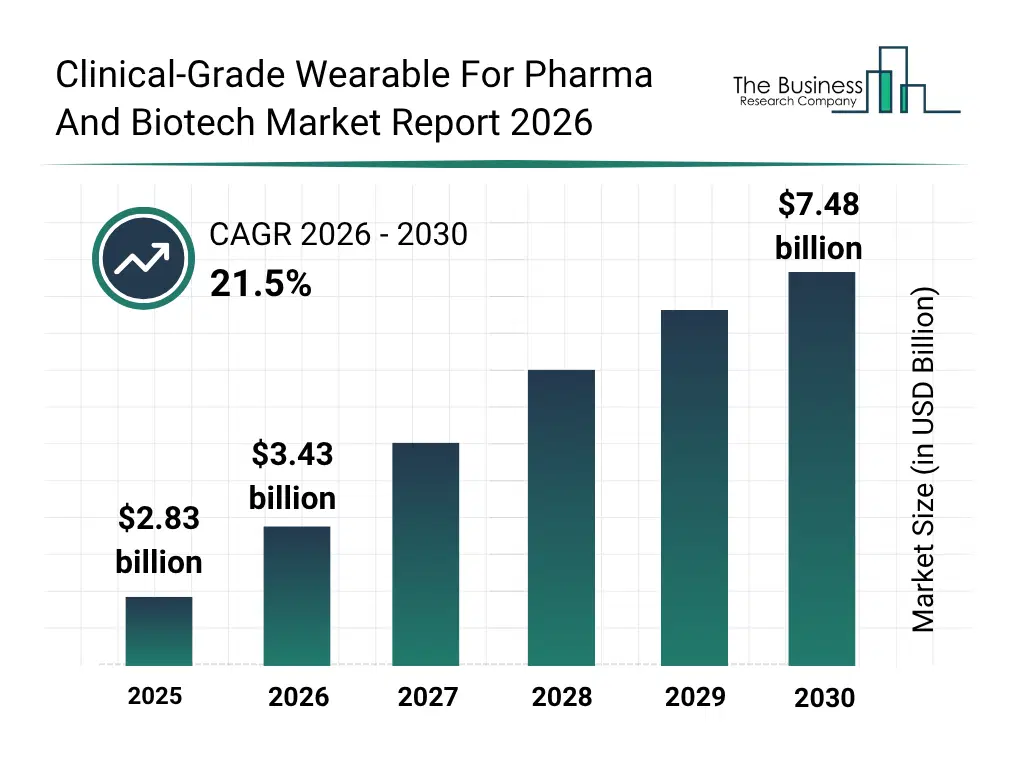
What Is The Clinical-Grade Wearable For Pharma And Biotech Market Size and Share 2026?
The clinical-grade wearable for pharma and biotech market size has grown exponentially in recent years. It will grow from $2.83 billion in 2025 to $3.43 billion in 2026 at a compound annual growth rate (CAGR) of 21.3%. The growth in the historic period can be attributed to rising adoption of wearable medical devices in clinical trials, increasing demand for real world patient data, growth in decentralized clinical trials, advancements in biosensor technologies, expansion of digital healthcare infrastructure.What Is The Clinical-Grade Wearable For Pharma And Biotech Market Growth Forecast?
The clinical-grade wearable for pharma and biotech market size is expected to see exponential growth in the next few years. It will grow to $7.48 billion in 2030 at a compound annual growth rate (CAGR) of 21.5%. The growth in the forecast period can be attributed to integration of AI in clinical data interpretation, growth in personalized drug development approaches, expansion of remote patient monitoring in trials, increasing regulatory acceptance of real world evidence, development of next generation clinical grade wearable sensors. Major trends in the forecast period include AI driven clinical wearable data analytics platforms for pharma trials, iot enabled continuous patient biosignal monitoring systems, cloud based real world evidence generation platforms, precision medicine integrated wearable biomarker tracking systems, industry 4.0 enabled smart medical device manufacturing systems.
Global Clinical-Grade Wearable For Pharma And Biotech Market Segmentation
1) By Device Type: Biosensors, Electrocardiogram Monitors, Continuous Glucose Monitors, Sleep Monitors, Respiratory Monitors 2) By Mode Of Use: In Clinic Monitoring, Home Based Monitoring, Hybrid Monitoring 3) By Distribution Channel: Direct Sales, Online Channels, Pharmacies Or Offline Retail 4) By Application: Clinical Trials, Remote Patient Monitoring, Real World Evidence Generation, Chronic Disease Management 5) By End User: Pharmaceutical Companies, Contract Research Organizations, Hospitals, Academic Research Centers Subsegments: 1) By Biosensors: Wearable Patch Biosensors, Implantable Biosensors, Smart Textile Biosensors, Sweat Analysis Biosensors, Multi Parameter Biosensors 2) By Electrocardiogram Monitors: Resting Electrocardiogram Monitors, Holter Monitors, Event Monitors, Wearable Patch Electrocardiogram Monitors, Mobile Cardiac Telemetry Devices 3) By Continuous Glucose Monitors: Real Time Continuous Glucose Monitors, Intermittently Scanned Continuous Glucose Monitors, Implantable Continuous Glucose Monitors, Wearable Continuous Glucose Monitoring Systems 4) By Sleep Monitors: Wearable Sleep Trackers, Polysomnography Devices, Actigraphy Devices, Bedside Sleep Monitoring Devices 5) By Respiratory Monitors: Pulse Oximeters, Capnography Monitors, Spirometry Devices, Wearable Respiratory Rate Monitors, Smart Inhaler Monitoring DevicesWhat Is The Driver Of The Clinical-Grade Wearable For Pharma And Biotech Market?
The surging demand for remote patient monitoring is expected to propel the growth of the clinical-grade wearable for pharma and biotech market going forward. Remote patient monitoring (RPM) refers to the use of digital technologies and electronic devices to collect patients’ health data outside of traditional healthcare settings, allowing healthcare providers to monitor, track, and manage their health remotely. The demand for remote patient monitoring is rising as more people are living with chronic conditions such as heart disease, diabetes, and hypertension, which require continuous monitoring and timely medical interventions to manage effectively. Clinical-grade wearable for pharma and biotech enables continuous, real-time physiological data capture that strengthens remote patient monitoring by allowing clinicians to track patient health trends, detect early deterioration, and adjust treatments without in-person visits. For instance, in August 2023, according to Vivalink, a US-based healthcare technology company, a recent survey revealed that 84% of respondents currently using RPM plan to increase their usage in 2024, 45% of providers utilize RPM for acute monitoring such as hospital-at-home programs, and 77% predict that RPM-based care will outpace traditional in-patient hospital care within the next five years. Therefore, the surging demand for remote patient monitoring is driving the growth of the clinical-grade wearable for pharma and biotech industry.Key Players In The Global Clinical-Grade Wearable For Pharma And Biotech Market
Major companies operating in the clinical-grade wearable for pharma and biotech market are Abbott Laboratories, Medtronic plc, GE HealthCare Technologies Inc., Koninklijke Philips N.V., Boston Scientific Corporation, DexCom Inc., iRhythm Technologies Inc., Insulet Corporation, Tandem Diabetes Care Inc., Ypsomed AG, Oura Health Oy, Whoop Inc., Biofourmis Inc., BioSerenity, AliveCor Inc., VitalConnect Inc., Empatica Inc., Sibel Health Inc., VivaLNK Inc., Blue Spark Technologies Inc., BioBeat Technologies Ltd., Carré Technologies Inc.Global Clinical-Grade Wearable For Pharma And Biotech Market Trends and Insights
Major companies operating in the clinical-grade wearable for pharma and biotech market are focusing on developing advanced solutions, such as wearable injector technologies, to improve biologic drug delivery, support self-administration, and enhance patient convenience. Wearable injector technology refers to a drug delivery system designed to administer large-volume and high-viscosity biologic therapies subcutaneously through a body-worn device, enabling patients to receive treatment outside hospital settings. For instance, in July 2025, Becton, Dickinson and Company, a US-based medical technology company, announced the first pharma-sponsored clinical trial using its BD Libertas wearable injector technology for biologic drugs. The BD Libertas wearable injector is a prefilled, patient-ready-to-use drug delivery system designed for subcutaneous delivery of complex biologics. The platform supports delivery of high-viscosity biologics up to 50 centipoise and is available in 2–5 mL and 5–10 mL configurations, enabling flexibility for multiple therapeutic applications. The technology selection followed successful outcomes from more than 50 BD-conducted pre-clinical and clinical studies, including a clinical study in which 100% of participants stated they would likely use the device if prescribed.What Are Latest Mergers And Acquisitions In The Clinical-Grade Wearable For Pharma And Biotech Market?
In March 2026, Thermo Fisher Scientific Inc., a US-based life sciences and biotechnology company, acquired Clario Holdings Inc. for $8.875 billion. Through this acquisition, Thermo Fisher aims to strengthen its clinical research and digital capabilities by integrating advanced endpoint data solutions, enabling faster and more informed drug development. Clario Holdings Inc. is a US-based company that provides clinical-grade wearables and connected devices specifically for pharma, biotech, and medical device partners.Regional Outlook
North America was the dominated region in the clinical-grade wearable for pharma and biotech market in 2025. Asia-Pacific is expected to be the fastest-growing region in the forecast period. The regions covered in this market report are Australia, Brazil, China, France, Germany, India, Indonesia, Japan, Taiwan, Russia, South Korea, UK, USA, Canada, Italy, Spain. The countries covered in this market report are Australia, Brazil, China, France, Germany, India, Indonesia, Japan, Taiwan, Russia, South Korea, UK, USA, Canada, Italy, Spain.What Defines the Clinical-Grade Wearable For Pharma And Biotech Market?
The clinical-grade wearable for pharma and biotech market consists of sales of ambulatory blood pressure monitors, inertial measurement unit motion trackers, smart medication adherence wearables, and neuromodulation wearables. Values in this market are ‘factory gate’ values, that is the value of goods sold by the manufacturers or creators of the goods, whether to other entities (including downstream manufacturers, wholesalers, distributors and retailers) or directly to end customers. The value of goods in this market includes related services sold by the creators of the goods.How is Market Value Defined and Measured?
The market value is defined as the revenues that enterprises gain from the sale of goods and/or services within the specified market and geography through sales, grants, or donations in terms of the currency (in USD unless otherwise specified). The revenues for a specified geography are consumption values that are revenues generated by organizations in the specified geography within the market, irrespective of where they are produced. It does not include revenues from resales along the supply chain, either further along the supply chain or as part of other products.What Key Data and Analysis Are Included in the Clinical-Grade Wearable For Pharma And Biotech Market Report 2026?
The clinical-grade wearable for pharma and biotech market research report is one of a series of new reports from The Business Research Company that provides clinical-grade wearable for pharma and biotech market statistics, including clinical-grade wearable for pharma and biotech industry global market size, regional shares, competitors with a clinical-grade wearable for pharma and biotech market share, detailed clinical-grade wearable for pharma and biotech market segments, market trends and opportunities, and any further data you may need to thrive in the clinical-grade wearable for pharma and biotech industry. This clinical-grade wearable for pharma and biotech market research report delivers a complete perspective of everything you need, with an in-depth analysis of the current and future scenario of the industry.Clinical-Grade Wearable For Pharma And Biotech Market Report Forecast Analysis
| Report Attribute | Details |
|---|---|
| Market Size Value In 2026 | $3.43 billion |
| Revenue Forecast In 2030 | $7.48 billion |
| Growth Rate | CAGR of 21.5% from 2026 to 2030 |
| Base Year For Estimation | 2025 |
| Actual Estimates/Historical Data | 2020-2025 |
| Forecast Period | 2026 - 2030 |
| Market Representation | Revenue in USD Billion and CAGR from 2026 to 2030 |
| Segments Covered | Device Type, Mode Of Use, Distribution Channel, Application, End User |
| Regional Scope | Asia-Pacific, Western Europe, Eastern Europe, North America, South America, Middle East, Africa |
| Country Scope | The countries covered in the clinical-grade wearable for pharma and biotech market report are Australia, Brazil, China, France, Germany, India, Indonesia, Japan, Taiwan, Russia, South Korea, UK, USA, Canada, Italy, Spain. |
| Key Companies Profiled | Abbott Laboratories, Medtronic plc, GE HealthCare Technologies Inc., Koninklijke Philips N.V., Boston Scientific Corporation, DexCom Inc., iRhythm Technologies Inc., Insulet Corporation, Tandem Diabetes Care Inc., Ypsomed AG, Oura Health Oy, Whoop Inc., Biofourmis Inc., BioSerenity, AliveCor Inc., VitalConnect Inc., Empatica Inc., Sibel Health Inc., VivaLNK Inc., Blue Spark Technologies Inc., BioBeat Technologies Ltd., Carré Technologies Inc. |
| Customization Scope | Request for Customization |
| Pricing And Purchase Options | Explore Purchase Options |