
Coastal Surveillance Market Report 2026
Global Outlook – By Type (X-Band, S-Band, X-Band And S-Band, Other Types), By Component (Command And Control, Intelligence, Reconnaissance, Electronics Warfare), By Platform (Large Scale Surveillance, Moderate Scale Surveillance), By Application (Command And Control (C,, Computers, Communication, Intelligence, Surveillance, And Reconnaissance (ISR), Other Applications), By End-User (Ports, Harbour, Oil And Gas, Maritime Protection Agencies) – Market Size, Trends, Strategies, and Forecast to 2030
Coastal Surveillance Market Overview
• Coastal Surveillance market size has reached to $36.32 billion in 2025 • Expected to grow to $52.58 billion in 2030 at a compound annual growth rate (CAGR) of 7.6% • Growth Driver: Increasing Defense Expenditure Fueling The Growth Of The Market Due To Rising Geopolitical Tensions And Regional Security Challenges • Market Trend: Next-Gen Surveillance Solutions Provide 100 Nautical Miles Coverage In All Weather Conditions • North America was the largest region in 2025 and Asia-Pacific is the fastest growing region.What Is Covered Under Coastal Surveillance Market?
Coastal surveillance refers to the monitoring and observation of coastal areas to detect and respond to potential threats or illegal activities, such as smuggling, unauthorized vessel movements, or environmental hazards. Coastal surveillance is useful for enhancing maritime security by detecting suspicious activities, preventing illegal trafficking, and ensuring the safety of coastal borders and maritime resources. The main types of coastal surveillance are X-band, S-band, X-band and S-band, and other types. X-band refers to a segment of the microwave radio spectrum in the frequency range of approximately 8 to 12 GHz. These are used for various components, including command and control, intelligence, reconnaissance, and electronic warfare. They encompass large-scale and moderate-scale surveillance system platforms used for applications such as command and control (C2), computers, communication, intelligence, surveillance, reconnaissance (ISR), and others. These systems serve multiple end users, including ports, harbors, oil and gas, and maritime protection agencies.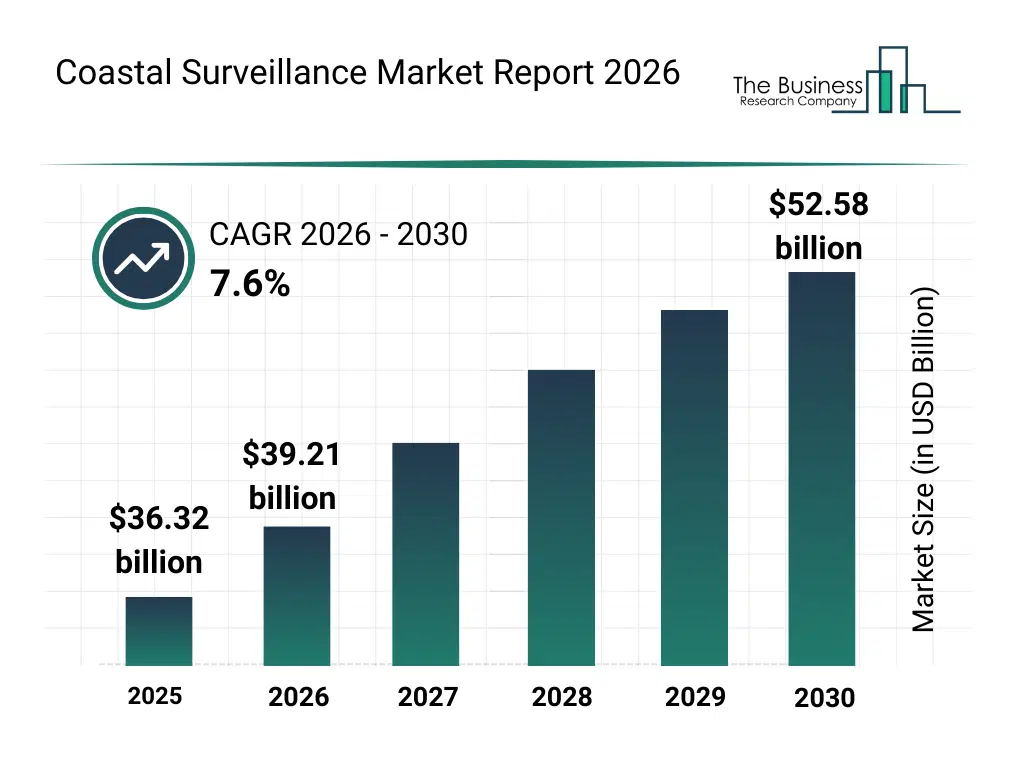
What Is The Coastal Surveillance Market Size and Share 2026?
The coastal surveillance market size has grown strongly in recent years. It will grow from $36.32 billion in 2025 to $39.21 billion in 2026 at a compound annual growth rate (CAGR) of 8.0%. The growth in the historic period can be attributed to increased adoption of radar and electro-optic systems for maritime border monitoring, expansion of coastal patrol operations due to rising smuggling and illegal fishing activities, integration of ais technologies for enhanced vessel identification and tracking, deployment of uavs to support extended-range coastal surveillance missions, investment in coastal security infrastructure driven by geopolitical tensions and maritime disputes.What Is The Coastal Surveillance Market Growth Forecast?
The coastal surveillance market size is expected to see strong growth in the next few years. It will grow to $52.58 billion in 2030 at a compound annual growth rate (CAGR) of 7.6%. The growth in the forecast period can be attributed to advancements in AI-enabled threat detection and real-time maritime analytics, growing use of integrated multi-sensor surveillance platforms for comprehensive coastal monitoring, increasing demand for autonomous and long-endurance uavs for persistent coastal observation, expansion of coastal surveillance systems to support environmental and disaster monitoring functions, rising government spending on modernization of maritime domain awareness capabilities. Major trends in the forecast period include increasing deployment of integrated coastal surveillance systems, rising government investment in maritime domain awareness, growing need for long-range coastal detection solutions, expansion of multi-sensor fusion surveillance systems, adoption of unmanned assets for persistent coastal monitoring.
Global Coastal Surveillance Market Segmentation
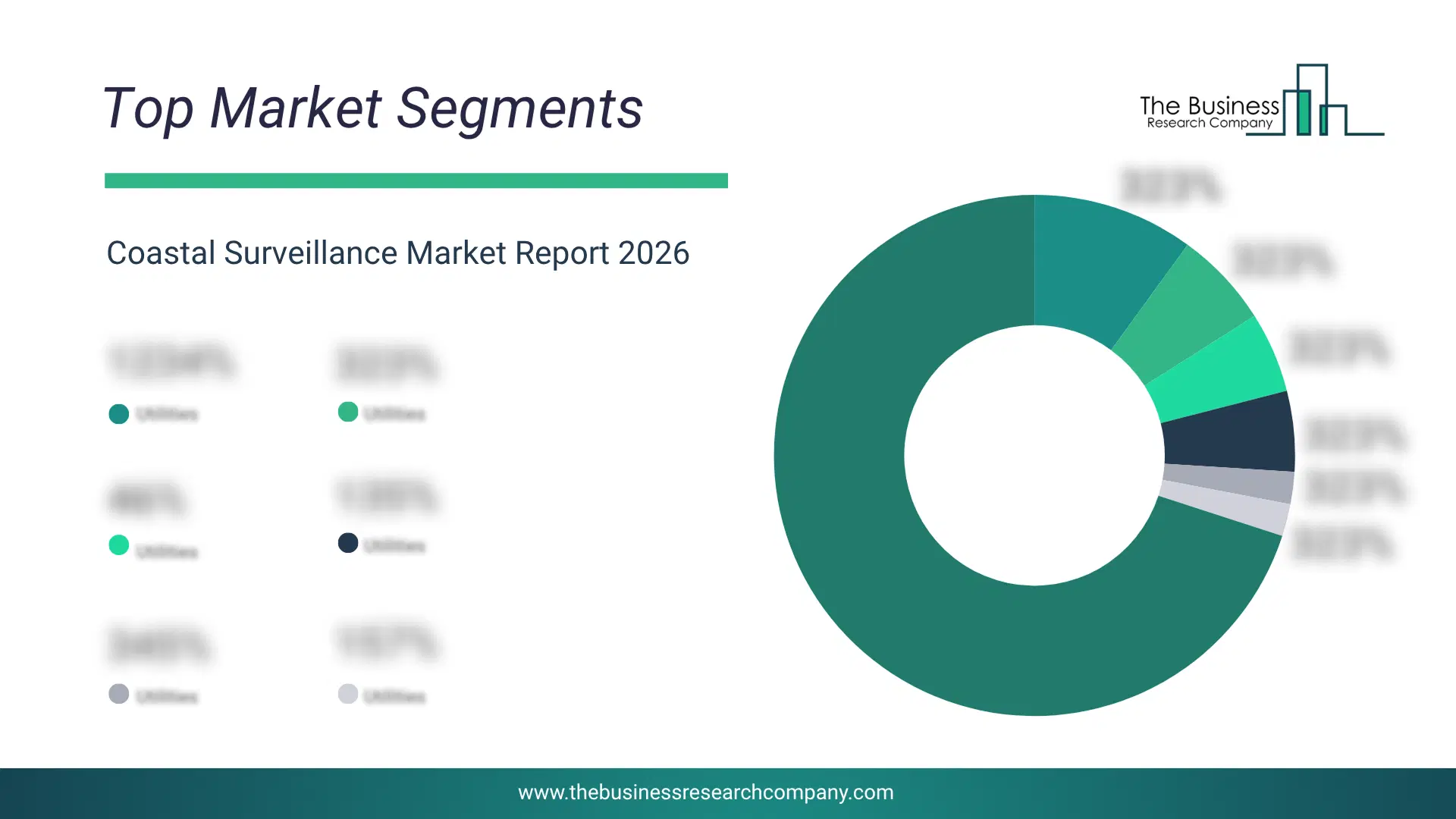
1) By Type: X-Band, S-Band, X-Band And S-Band, Other Types 2) By Component: Command And Control, Intelligence, Reconnaissance, Electronics Warfare 3) By Platform: Large Scale Surveillance, Moderate Scale Surveillance 4) By Application: Command And Control (C2), Computers, Communication, Intelligence, Surveillance, And Reconnaissance (ISR), Other Applications 5) By End-User: Ports, Harbour, Oil And Gas, Maritime Protection Agencies Subsegments: 1) By X-Band: Marine Vessel Tracking, Coastal Border Monitoring, Weather And Sea Condition Surveillance, Search And Rescue Operations Support 2) By S-Band: Long-Range Coastal Monitoring, Maritime Traffic Control, Environmental Monitoring, Early Warning Systems 3) By X-Band And S-Band: Integrated Coastal Surveillance Systems, Hybrid Radar Solutions, Multi-Band Maritime Security, Combined Weather And Vessel Tracking 4) By Other Types: L-Band Radar Systems, Ku-Band Coastal Surveillance, Passive Radar Systems, Satellite-Based Coastal MonitoringWhat Is Driver Of The Coastal Surveillance Market?
The increasing defense expenditure is expected to propel the growth of the coastal surveillance market going forward. Defense expenditure refers to the total amount of financial resources a country allocates and spends on its military forces and defense-related activities, including personnel, equipment, operations, maintenance, and research. The increasing defense expenditure is due to rising geopolitical tensions due to escalating conflicts and regional security challenges worldwide. Defense expenditure enhances coastal surveillance by funding advanced technologies and equipment, strengthening maritime security capabilities, and enabling timely detection and response to threats along coastlines. For instance, in April 2024, according to the Stockholm International Peace Research Institute (SIPRI), a Sweden-based non-government organization, global military spending reached $2,443 billion in 2023, marking a 6.8% increase compared to 2022. Therefore, the increasing defense expenditure is expected to propel the growth of the coastal surveillance industry.Key Players In The Global Coastal Surveillance Market
Major companies operating in the coastal surveillance market are RTX Corporation , Lockheed Martin Corporation, Northrop Grumman Corporation, Thales S.A., L3Harris Technologies Inc., Wärtsilä Corporation, Elbit Systems Ltd., SAAB Aktiebolag, Indra Sistemas S.A., Kongsberg Gruppen ASA, Leonardo S.p.A., HENSOLDT AG, Frequentis AG, HAVELSAN Inc. , Terma A/S, Tokyo Keiki Inc., Selex ES S.p.A. , HGH Systèmes Infrarouges SAS, Controp Precision Technologies Ltd., Kelvin Hughes Ltd.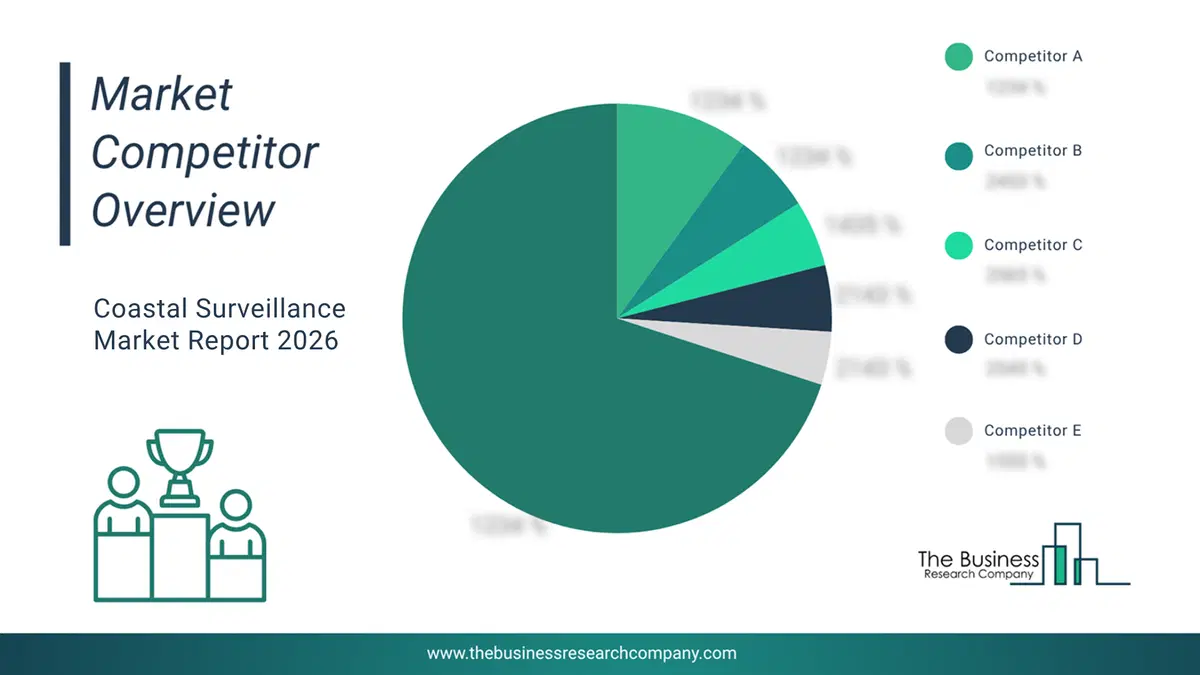
This chart is for illustrative purposes; the full report includes a detailed competitor analysis and comprehensive overview of the top 10 companies in the market.
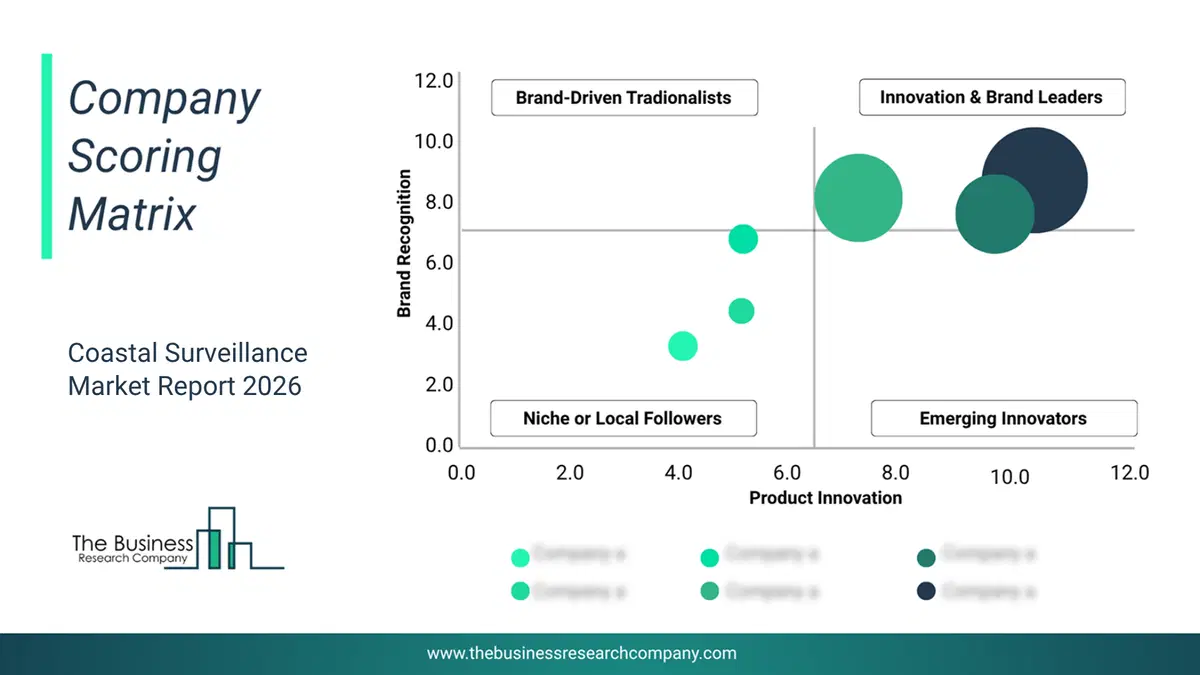
This chart maps companies by product innovation and brand strength, with bubble size indicating relative revenue, helping identify market leaders, challengers, and niche players. This is an illustrative chart; the full report provides a complete and accurate competitive analysis.
Global Coastal Surveillance Market Trends and Insights
Major companies operating in the coastal surveillance market are focusing on developing technologically advanced solutions, such as advanced coastal surveillance systems, to enhance maritime security and improve situational awareness. Advanced coastal surveillance system refers to a sophisticated technology setup designed to monitor, detect, and manage activities along coastlines and maritime borders. For instance, in November 2024, Thales S.A., a France-based aerospace company, launched CoastShield, designed to monitor and detect coastal activities in real-time, from the shore to the open sea, as well as the lower-altitude airspace. CoastShield’s unique features include modular and scalable architecture, advanced sensor integration such as the CoastWatcher 100 radar, real-time artificial intelligence-driven situational awareness, and the ability to monitor and detect coastal activities across surface and lower-altitude airspace up to 100 nautical miles in all weather conditions.What Are Latest Mergers And Acquisitions In The Coastal Surveillance Market? CLS Group Expands Capabilities With Acquisition Of SAT ONE
In September 2023, CLS Group, a US-based financial infrastructure company, acquired SAT ONE for an undisclosed amount. With this acquisition, CLS Group aims to enhance its technological capabilities and expand its service offerings in the foreign exchange and financial technology sectors. SAT ONE is an Australia-based LEO satellite company enabling reliable satellite communication for enhanced coastal surveillance.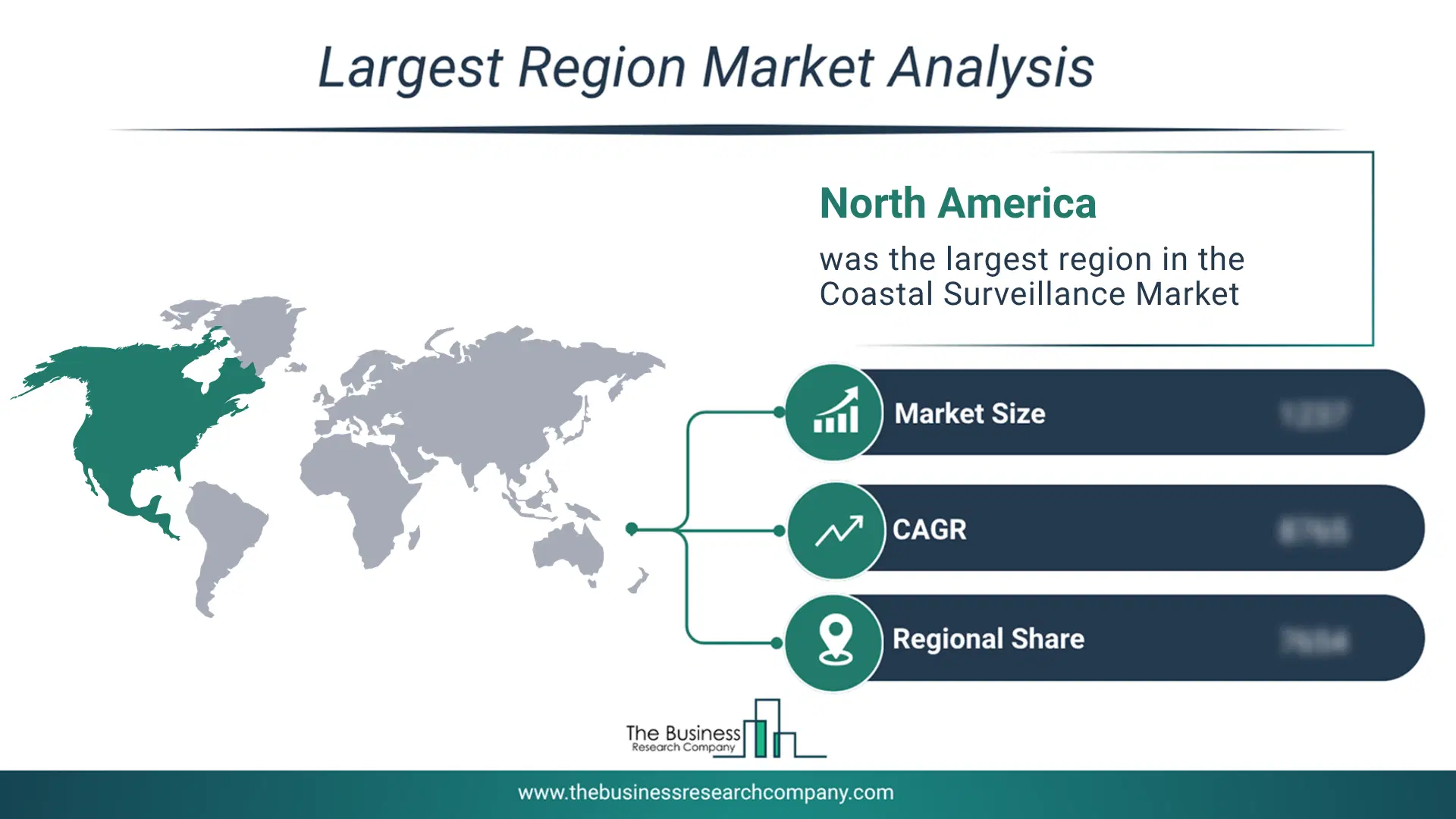
Regional Insights
North America was the largest region in the coastal surveillance market in 2025. Asia-Pacific is expected to be the fastest-growing region in the forecast period. The regions covered in the coastal surveillance market report are Asia-Pacific, South East Asia, Western Europe, Eastern Europe, North America, South America, Middle East, Africa. The countries covered in the coastal surveillance market report are Australia, Brazil, China, France, Germany, India, Indonesia, Japan, Taiwan, Russia, South Korea, UK, USA, Canada, Italy, SpainWhat Defines the Coastal Surveillance Market?
The coastal surveillance market consists of revenues earned by entities by providing services such as maritime patrol, radar monitoring, vessel tracking, threat detection, and coastal area monitoring. The market value includes the value of related goods sold by the service provider or included within the service offering. The coastal surveillance market also includes sales of radar systems, electro-optic sensors, automatic identification systems (AIS), unmanned aerial vehicles (UAVs) and surveillance cameras. Values in this market are ‘factory gate’ values, that is the value of goods sold by the manufacturers or creators of the goods, whether to other entities (including downstream manufacturers, wholesalers, distributors and retailers) or directly to end customers. The value of goods in this market includes related services sold by the creators of the goods.How is Market Value Defined and Measured?
The market value is defined as the revenues that enterprises gain from the sale of goods and/or services within the specified market and geography through sales, grants, or donations in terms of the currency (in USD unless otherwise specified). The revenues for a specified geography are consumption values that are revenues generated by organizations in the specified geography within the market, irrespective of where they are produced. It does not include revenues from resales along the supply chain, either further along the supply chain or as part of other products.
This chart presents market attractiveness based on a quantitative evaluation of growth, competition, strategic alignment, and risk, offering a clear view of opportunity areas for decision-making. This chart is for illustrative purposes; the full report contains the complete analysis.

This chart highlights the Total Addressable Market (TAM) by estimating the maximum revenue opportunity using an assumption-driven approach, supporting strategic planning and opportunity sizing across markets. The chart is illustrative; the full report provides a more comprehensive analysis.
What Key Data and Analysis Are Included in the Coastal Surveillance Market Report 2026?
The coastal surveillance market research report is one of a series of new reports from The Business Research Company that provides market statistics, including industry global market size, regional shares, competitors with the market share, detailed market segments, market trends and opportunities, and any further data you may need to thrive in the coastal surveillance industry. The market research report delivers a complete perspective of everything you need, with an in-depth analysis of the current and future state of the industry.Coastal Surveillance Market Report Forecast Analysis
| Report Attribute | Details |
|---|---|
| Market Size Value In 2026 | $39.21 billion |
| Revenue Forecast In 2030 | $52.58 billion |
| Growth Rate | CAGR of 7.6% from 2026 to 2030 |
| Base Year For Estimation | 2025 |
| Actual Estimates/Historical Data | 2020-2025 |
| Forecast Period | 2026 - 2030 |
| Market Representation | Revenue in USD Billion and CAGR from 2026 to 2030 |
| Segments Covered | Type, Component, Platform, Application, End-User |
| Regional Scope | Asia-Pacific, Western Europe, Eastern Europe, North America, South America, Middle East, Africa |
| Country Scope | The countries covered in the coastal surveillance market report are Australia, Brazil, China, France, Germany, India, Indonesia, Japan, Taiwan, Russia, South Korea, UK, USA, Canada, Italy, Spain |
| Key Companies Profiled | RTX Corporation , Lockheed Martin Corporation, Northrop Grumman Corporation, Thales S.A., L3Harris Technologies Inc., Wärtsilä Corporation, Elbit Systems Ltd., SAAB Aktiebolag, Indra Sistemas S.A., Kongsberg Gruppen ASA, Leonardo S.p.A., HENSOLDT AG, Frequentis AG, HAVELSAN Inc. , Terma A/S, Tokyo Keiki Inc., Selex ES S.p.A. , HGH Systèmes Infrarouges SAS, Controp Precision Technologies Ltd., Kelvin Hughes Ltd. |
| Customization Scope | Request for Customization |
| Pricing And Purchase Options | Explore Purchase Options |