
Maritime Security Market Report 2026
Global Outlook – By Component (Solution, Service), By Security Type Outlook (Port And Critical Infrastructure Security, Vessel Security, Coastal Surveillance), By Service (Risk Assessment And Investigation, Consulting, Maintenance And Support, Training, Other Services), By Technology (Access Control, Detectors, Geographic Information Systems, Communications, Supervisory Control And Data Acquisition (SCADA), Screening And Scanning, Smart Containers, Surveillance And Tracking, Weather Monitoring) – Market Size, Trends, Strategies, and Forecast to 2030
Maritime Security Market Overview
• Maritime Security market size has reached to $31.33 billion in 2025 • Expected to grow to $39.03 billion in 2030 at a compound annual growth rate (CAGR) of 4.4% • Growth Driver: Emerging Maritime Threats Fuel Growth in the Maritime Security Market • Market Trend: Enhancing Maritime Safety With Vessel Traffic Management Information System (VTMIS) • Asia-Pacific was the largest region and fastest growing region.What Is Covered Under Maritime Security Market?
Maritime security refers to the protection of vessels, ports, and other maritime infrastructure from various threats, including terrorism, piracy, robbery, illegal trafficking of goods and people, and illegal fishing. It ensures the safety and security of maritime transportation, trade, and the marine environment. The main types of components in maritime security are solutions and services. A solution refers to a comprehensive set of technologies, processes, and services designed to address cybersecurity challenges at the network edge. It includes various security services such as port and critical infrastructure security, vessel security, and coastal surveillance, and also provides services such as risk assessment and investigation, consulting, maintenance and support, training, and others. and it used various technologies such as access control, detectors, geographic information systems, communications, supervisory control and data acquisition (SCADA), screening and scanning, smart containers, surveillance and tracking, and weather monitoring.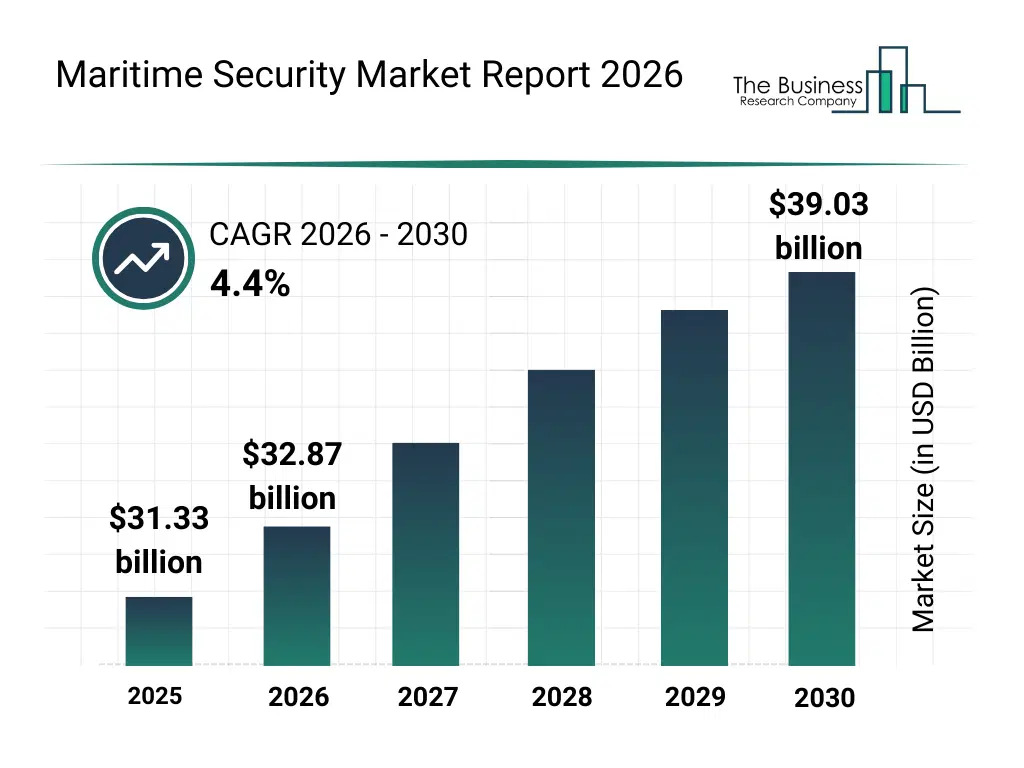
What Is The Maritime Security Market Size and Share 2026?
The maritime security market size has grown steadily in recent years. It will grow from $31.33 billion in 2025 to $32.87 billion in 2026 at a compound annual growth rate (CAGR) of 4.9%. The growth in the historic period can be attributed to increasing maritime piracy incidents, expansion of global seaborne trade, early adoption of surveillance technologies, rising port security concerns, growth in illegal maritime activities.What Is The Maritime Security Market Growth Forecast?
The maritime security market size is expected to see steady growth in the next few years. It will grow to $39.03 billion in 2030 at a compound annual growth rate (CAGR) of 4.4%. The growth in the forecast period can be attributed to increasing focus on critical infrastructure protection, adoption of smart surveillance technologies, rising cyber threats to maritime systems, expansion of coastal monitoring networks, growth in managed security services. Major trends in the forecast period include integrated coastal surveillance systems, advanced vessel threat detection, port infrastructure security modernization, cyber-physical maritime security integration, real-time maritime risk monitoring.
Global Maritime Security Market Segmentation
1) By Component: Solution, Service 2) By Security Type Outlook: Port And Critical Infrastructure Security, Vessel Security, Coastal Surveillance 3) By Service: Risk Assessment And Investigation, Consulting, Maintenance And Support, Training, Other Services 4) By Technology: Access Control, Detectors, Geographic Information Systems, Communications, Supervisory Control And Data Acquisition (SCADA), Screening And Scanning, Smart Containers, Surveillance And Tracking, Weather Monitoring Subsegments: 1) By Solution: Surveillance Systems, Access Control Systems, Cybersecurity Solutions, Intrusion Detection Systems 2) By Service: Consulting Services, Training And Education, Maintenance And Support, Managed Security ServicesWhat Is The Driver Of The Maritime Security Market?
The rising maritime threats are expected to propel the growth of the maritime security market going forward. Maritime threats refer to a range of potential dangers, risks, or illegal activities that pose a hazard to maritime security, navigational safety, or the lawful use of the seas and oceans. It arises due to various factors, such as increased illegal, unregulated, and unreported (IUU) fishing, and intensifying pressure on ports. Marine security is used in maritime threats to protect lives, property, trade, infrastructure, safety, security, and sustainability of maritime operations and to promote the prosperity of coastal communities and nations. For instance, in January 2024, according to the ICC International Maritime Bureau, a UK-based non-profit, specialised division of the International Chamber of Commerce, in its annual report, the number of reported piracy and armed robbery incidents against ships increased to 120 in 2023, up from 115 in 2022. Therefore, the rising maritime threats are driving the growth of the maritime security industry.Key Players In The Global Maritime Security Market
Major companies operating in the maritime security market are Cobham plc; Rapiscan Systems; Raytheon Technologies; Airbus SE; Lockheed Martin; General Dynamics Corporation; Northrop Grumman Corporation; BAE Systems; Safran SA; Thales Group; L3Harris Technologies; Leonardo SpA; Leidos; Motorola Solutions Inc; Booz Allen Hamilton Inc; Elbit Systems; Rheinmetall AG; CACI International Inc; Teledyne Technologies; Macquarie Group Limited; Israel Aerospace Industries; Saab AB; Palantir Technologies; Cubic Corporation; Smiths Detection; OSI Systems Inc
This chart is for illustrative purposes; the full report includes a detailed competitor analysis and comprehensive overview of the top 10 companies in the market.
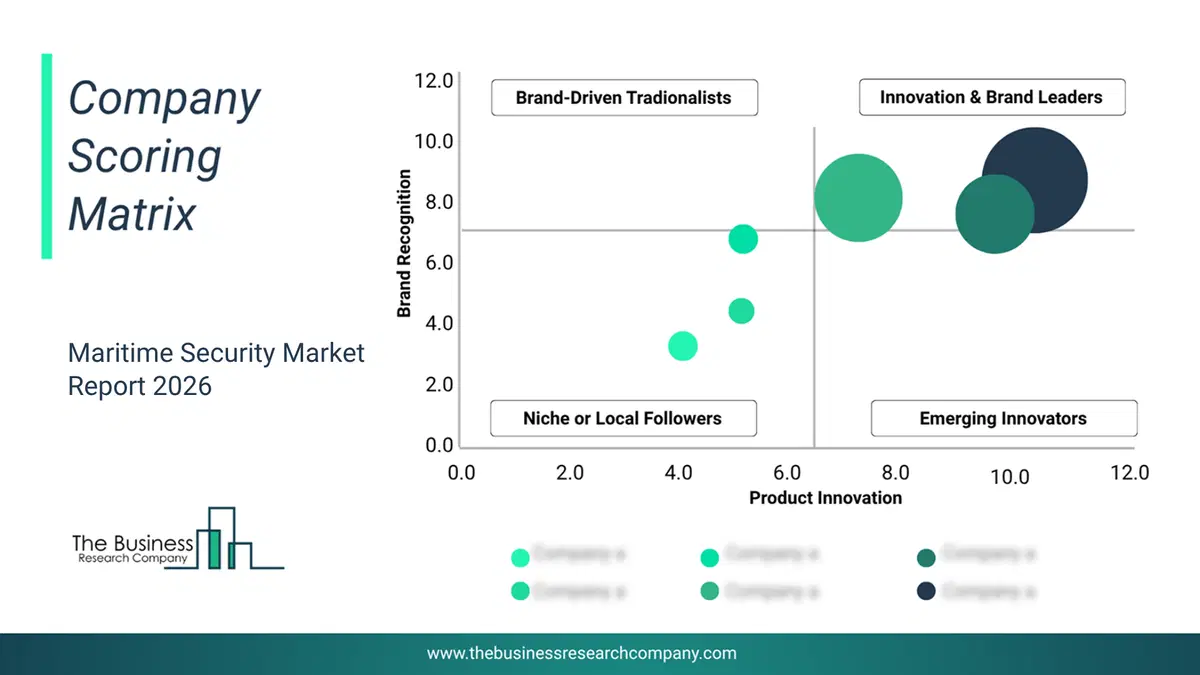
This chart maps companies by product innovation and brand strength, with bubble size indicating relative revenue, helping identify market leaders, challengers, and niche players. This is an illustrative chart; the full report provides a complete and accurate competitive analysis.
Global Maritime Security Market Trends and Insights
Major companies operating in the maritime security market are concentrating on new technological innovations, such as the vessel traffic management information system (VTMIS), to enhance maritime safety and efficiency. It is a state-of-the-art technology that integrates and links all assets in a port and marine environment, such as radar, CCTV, radios, meteorological systems, and radio direction finders. For instance, in March 2023, AD Ports Group, a US-based integrated business enabling global logistics trade organisation, launched a vessel traffic management information system (VTMIS) across its UAE operations to enhance maritime safety. The VTMIS integrates and links all assets in a port and marine environment, providing real-time data and enhancing vessel-to-vessel and vessel-to-shore contact. It is designed to enhance safety, security, and efficiency in maritime traffic management. It acts as the central nervous system of waterways, monitoring vessel movements, providing crucial information, and facilitating coordination between various stakeholders.What Are Latest Mergers And Acquisitions In The Maritime Security Market?
In July 2024, Saltchuk, a US-based diversified transportation and distribution company, acquired Overseas Shipholding Group, Inc. (OSG) for a deal of $950 million. This acquisition OSG, Saltchuk, expands its portfolio to include energy shipping, enhancing its diverse lines of business that already encompass domestic and international shipping, logistics, marine services, and air cargo. Overseas Shipholding Group, Inc. (OSG) is a US-based provider of maritime security.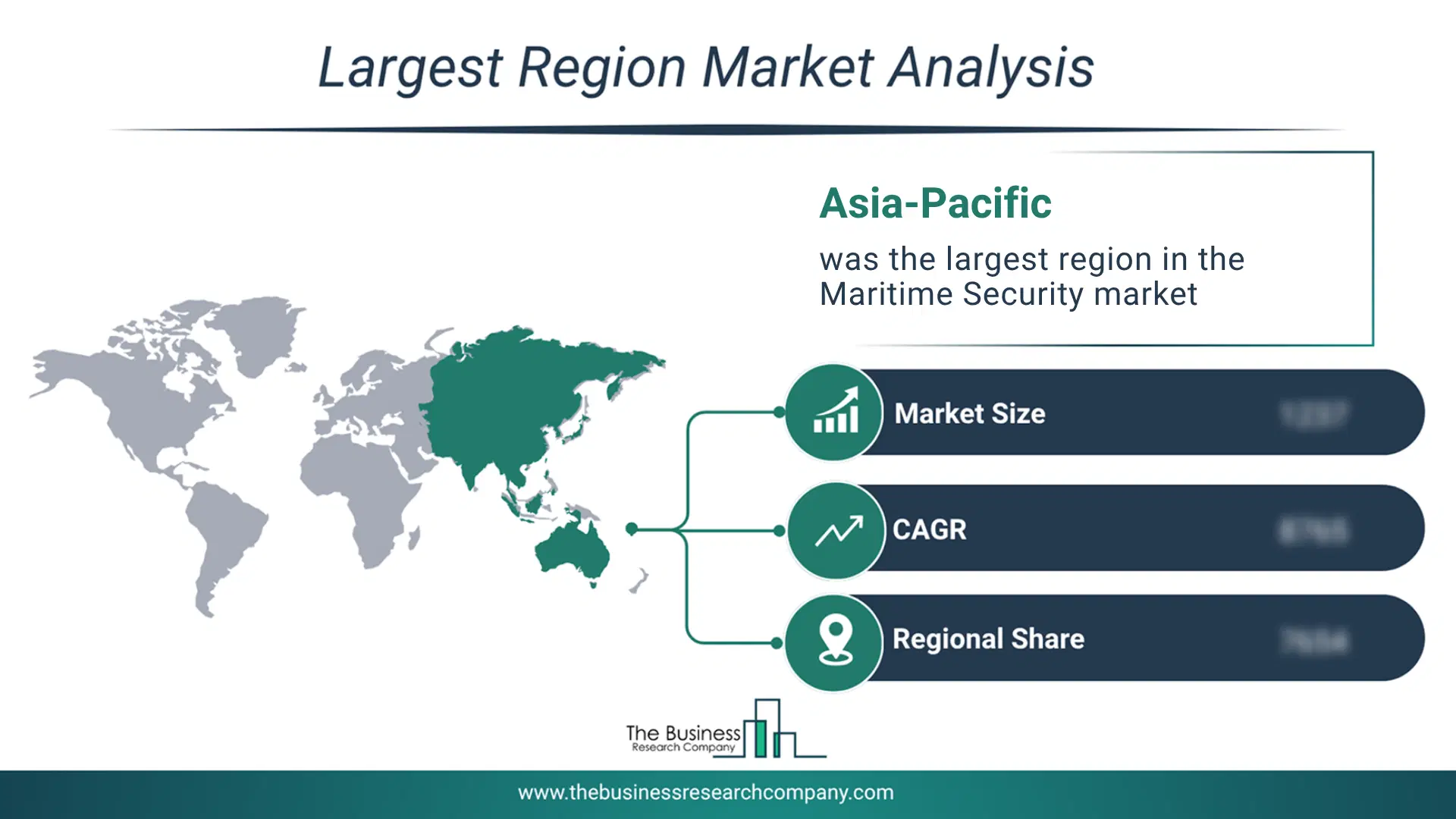
Regional Insights
Asia-Pacific was the largest region in the maritime security market in 2025. Asia-Pacific is expected to be the fastest-growing region in the forecast period. The regions covered in this market report are Asia-Pacific, South East Asia, Western Europe, Eastern Europe, North America, South America, Middle East, Africa. The countries covered in this market report are Australia, Brazil, China, France, Germany, India, Indonesia, Japan, Taiwan, Russia, South Korea, UK, USA, Canada, Italy, SpainWhat Defines the Maritime Security Market?
The maritime security market consists of revenues earned by entities providing services such as vessel escort services, port security, risk assessment and intelligence sharing, and search and rescue operations. The market value includes the value of related goods sold by the service provider or included within the service offering. The maritime security market also includes sales of vessel tracking systems, surveillance and monitoring equipment, physical security equipment, and communication systems. Values in this market are ‘factory gate’ values, that is, the value of goods sold by the manufacturers or creators of the goods, whether to other entities (including downstream manufacturers, wholesalers, distributors, and retailers) or directly to end customers. The value of goods in this market includes related services sold by the creators of the goods.How is Market Value Defined and Measured?
The market value is defined as the revenues that enterprises gain from the sale of goods and/or services within the specified market and geography through sales, grants, or donations in terms of the currency (in USD unless otherwise specified). The revenues for a specified geography are consumption values that are revenues generated by organizations in the specified geography within the market, irrespective of where they are produced. It does not include revenues from resales along the supply chain, either further along the supply chain or as part of other products.
This chart presents market attractiveness based on a quantitative evaluation of growth, competition, strategic alignment, and risk, offering a clear view of opportunity areas for decision-making. This chart is for illustrative purposes; the full report contains the complete analysis.

This chart highlights the Total Addressable Market (TAM) by estimating the maximum revenue opportunity using an assumption-driven approach, supporting strategic planning and opportunity sizing across markets. The chart is illustrative; the full report provides a more comprehensive analysis.
What Key Data and Analysis Are Included in the Maritime Security Market Report 2026?
The maritime security market research report is one of a series of new reports from The Business Research Company that provides market statistics, including industry global market size, regional shares, competitors with the market share, detailed market segments, market trends and opportunities, and any further data you may need to thrive in the maritime security industry. The market research report delivers a complete perspective of everything you need, with an in-depth analysis of the current and future state of the industry.Maritime Security Market Report Forecast Analysis
| Report Attribute | Details |
|---|---|
| Market Size Value In 2026 | $32.87 billion |
| Revenue Forecast In 2030 | $39.03 billion |
| Growth Rate | CAGR of 4.4% from 2026 to 2030 |
| Base Year For Estimation | 2025 |
| Actual Estimates/Historical Data | 2020-2025 |
| Forecast Period | 2026 - 2030 |
| Market Representation | Revenue in USD Billion and CAGR from 2026 to 2030 |
| Segments Covered | Component, Security Type Outlook, Service, Technology |
| Regional Scope | Asia-Pacific, Western Europe, Eastern Europe, North America, South America, Middle East, Africa |
| Country Scope | The Countries Covered In This Market Report Are Australia, Brazil, China, France, Germany, India, Indonesia, Japan, Taiwan, Russia, South Korea, Uk, Usa, Canada, Italy, Spain. |
| Key Companies Profiled | Cobham plc, Rapiscan Systems, Raytheon Technologies, Airbus SE, Lockheed Martin, General Dynamics Corporation, Northrop Grumman Corporation, BAE Systems, Safran SA, Thales Group, L3Harris Technologies, Leonardo SpA, Leidos, Motorola Solutions Inc, Booz Allen Hamilton Inc, Elbit Systems, Rheinmetall AG, CACI International Inc, Teledyne Technologies, Macquarie Group Limited, Israel Aerospace Industries, Saab AB, Palantir Technologies, Cubic Corporation, Smiths Detection, OSI Systems Inc |
| Customization Scope | Request for Customization |
| Pricing And Purchase Options | Explore Purchase Options |