
Cold Chain Micro-Fulfillment Hub Networks Market Report 2026
Global Outlook – By Component (Temperature-Controlled Storage Systems, Hardware And Infrastructure, Software And Monitoring Solutions), By Network Format (Store Attached Cold Micro Hubs, Dark Store Cold Hubs, Stand Alone Urban Cold Micro Fulfillment Nodes, Hybrid City Network Models), By Temperature Scope (Chilled And Ambient Integrated Hubs, Frozen And Chilled Hubs, Multi Temperature Grocery Hubs, Specialized Fresh Produce Hubs), By Deployment Mode (Cloud Connected Networked Hubs, On Premise Managed Systems, Hybrid Control Models), By End Use (Grocery And E Grocery, Quick Commerce Food Delivery, Meal Kits And Prepared Foods, Pharmacy And Health Retail, Specialty Perishables) – Market Size, Trends, Strategies, and Forecast to 2030
Cold Chain Micro-Fulfillment Hub Networks Market Overview
• Cold Chain Micro-Fulfillment Hub Networks market size has reached to $0.67 billion in 2025 • Expected to grow to $1.48 billion in 2030 at a compound annual growth rate (CAGR) of 17.2% • Growth Driver: Surge In Demand For Fresh And Perishable Food Products Fueling The Growth Of The Market Due To Increasing Health-conscious Consumption And Preference For Nutrient-rich, Minimally Processed Foods • Market Trend: Expansion Of Temperature-Controlled Distribution Hubs Strengthens Cold Chain Micro-Fulfillment Hub Networks • North America was the largest region in 2025 and Asia-Pacific is the fastest growing region.What Is Covered Under Cold Chain Micro-Fulfillment Hub Networks Market?
Cold chain micro-fulfillment hub networks are decentralized logistics systems that combine temperature-controlled storage with localized fulfillment centers for rapid distribution of perishable and temperature-sensitive products. These networks maintain precise environmental conditions throughout storage, handling, and transportation to ensure product quality and safety. The main components of cold chain micro-fulfillment hub networks include temperature-controlled storage systems, hardware and infrastructure, and software and monitoring solutions. Temperature-controlled storage systems refer to specialized facilities and equipment designed to maintain precise temperature conditions for storing and handling perishable products. These networks are structured through formats including store attached cold micro hubs, dark store cold hubs, stand alone urban cold micro fulfillment nodes, and hybrid city network models and support temperature scopes such as chilled and ambient integrated hubs, frozen and chilled hubs, multi temperature grocery hubs, and specialized fresh produce hubs. They are deployed through cloud connected networked hubs, on premise managed systems, and hybrid control models and they are utilized by end use including grocery and e grocery, quick commerce food delivery, meal kits and prepared foods, pharmacy and health retail, and specialty perishables.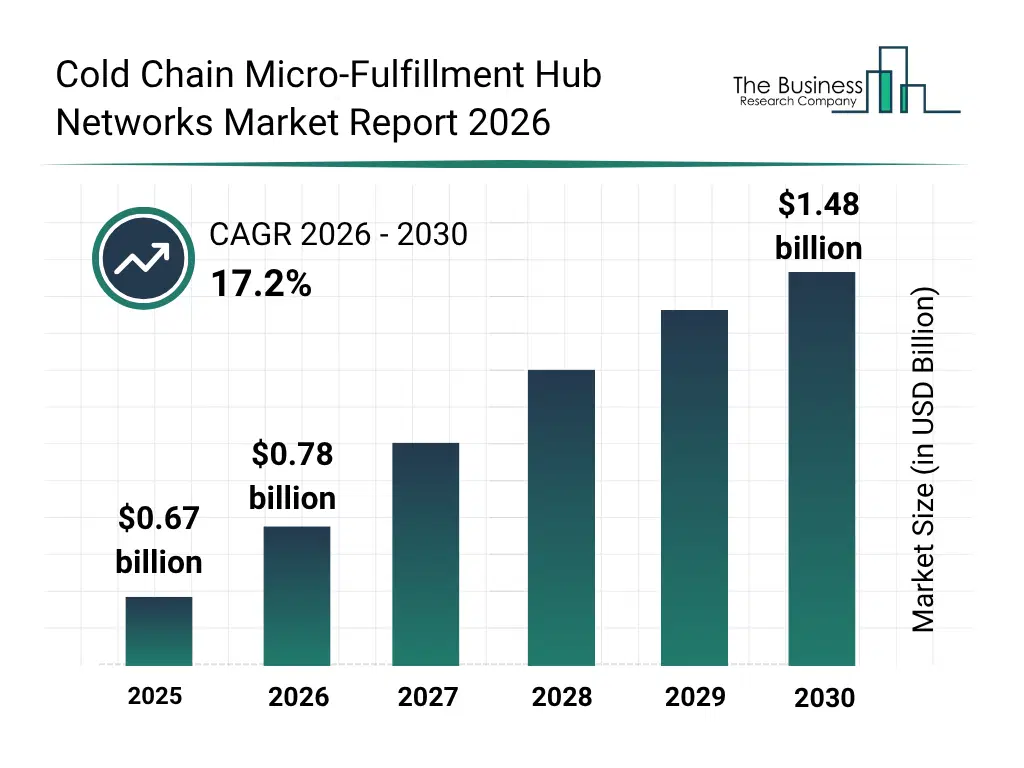
What Is The Cold Chain Micro-Fulfillment Hub Networks Market Size and Share 2026?
The cold chain micro-fulfillment hub networks market size has grown rapidly in recent years. It will grow from $0.67 billion in 2025 to $0.78 billion in 2026 at a compound annual growth rate (CAGR) of 17.0%. The growth in the historic period can be attributed to rising demand for perishable food distribution efficiency, expansion of e grocery and quick commerce platforms, increasing pharmaceutical cold chain requirements, growth in urban logistics infrastructure, improvements in refrigeration and storage technologies.What Is The Cold Chain Micro-Fulfillment Hub Networks Market Growth Forecast?
The cold chain micro-fulfillment hub networks market size is expected to see rapid growth in the next few years. It will grow to $1.48 billion in 2030 at a compound annual growth rate (CAGR) of 17.2%. The growth in the forecast period can be attributed to expansion of automated micro fulfillment networks, integration of AI based logistics optimization systems, growth in temperature sensitive pharmaceutical distribution, increasing adoption of sustainable cold chain infrastructure, rising demand for hyperlocal delivery ecosystems. Major trends in the forecast period include iot enabled real time cold chain monitoring and tracking systems, AI driven demand forecasting and inventory optimization for cold hubs, cloud based temperature controlled logistics orchestration platforms, robotic automated cold storage and warehouse fulfillment systems, sustainable low energy refrigeration and green cold chain infrastructure solutions.
Global Cold Chain Micro-Fulfillment Hub Networks Market Segmentation
1) By Component: Temperature-Controlled Storage Systems, Hardware And Infrastructure, Software And Monitoring Solutions 2) By Network Format: Store Attached Cold Micro Hubs, Dark Store Cold Hubs, Stand Alone Urban Cold Micro Fulfillment Nodes, Hybrid City Network Models 3) By Temperature Scope: Chilled And Ambient Integrated Hubs, Frozen And Chilled Hubs, Multi Temperature Grocery Hubs, Specialized Fresh Produce Hubs 4) By Deployment Mode: Cloud Connected Networked Hubs, On Premise Managed Systems, Hybrid Control Models 5) By End Use: Grocery And E Grocery, Quick Commerce Food Delivery, Meal Kits And Prepared Foods, Pharmacy And Health Retail, Specialty Perishables Subsegments: 1) By Temperature-Controlled Storage Systems: Refrigeration Units, Freezing Units, Insulated Storage Chambers, Cold Rooms, Blast Chillers, Temperature Controlled Shelving Systems, Thermal Packaging Systems, Refrigerated Containers 2) By Hardware And Infrastructure: Automated Storage And Retrieval Systems, Conveyor And Sorting Systems, Pallet Racking Systems, Refrigerated Transport Equipment, Material Handling Equipment, Docking And Loading Systems, Power Backup Systems, Modular Warehouse Structures 3) By Software And Monitoring Solutions: Warehouse Management Software, Inventory Tracking Software, Temperature Monitoring Software, Route Optimization Software, Predictive Analytics Platforms, Internet Of Things Monitoring Systems, Cloud-Based Logistics PlatformsWhat Are The Drivers Of The Cold Chain Micro-Fulfillment Hub Networks Market?
The growing demand for fresh and perishable food products is expected to propel the growth of cold chain micro-fulfillment hub networks going forward. Fresh and perishable food products refer to foods such as fruits, vegetables, meat, dairy, seafood, and bakery items that have a limited shelf life and require temperature-controlled storage and transport to maintain quality and safety. The growing demand for fresh and perishable food products is driven by increasing health consciousness, as consumers prefer nutrient-rich, minimally processed foods such as fruits, vegetables, dairy, and lean proteins to support healthier diets. Cold chain micro-fulfillment hub networks help fresh and perishable food products by enabling fast, localized storage and distribution under temperature-controlled conditions, which reduces spoilage, maintains product freshness, and ensures quicker last-mile delivery to consumers. For instance, in March 2025, according to the Australian Bureau of Statistics, a Australia-based government department, in 2023–24, meat and poultry consumption rose by 2.3%, while average dietary energy remained stable at around 8,667 kJ per capita per day and discretionary foods accounted for 38.5% of total energy, similar to the previous year. Therefore, the growing demand for fresh and perishable food products is driving the growth of the cold chain micro-fulfillment hub networks industry. The rapid growth of quick commerce and same-day delivery is expected to propel the growth of cold chain micro-fulfillment hub networks going forward. Quick commerce and same-day delivery refer to ultra-fast retail fulfillment models that enable consumers to receive ordered goods within minutes to a few hours, typically through hyperlocal warehouses and optimized last-mile logistics. The rapid growth of quick commerce and same-day delivery is driven by increasing consumer demand for instant gratification, as customers prefer faster delivery of essential goods with minimal waiting time. Cold chain micro-fulfillment hub networks help quick commerce and same-day delivery by enabling decentralized, temperature-controlled storage close to end consumers, ensuring faster order processing, reduced delivery times, and preservation of product quality. For instance, in March 2026, according to SellersCommerce, a US-based software company, by 2026, the United States is projected to handle approximately 66.8 million package deliveries daily, equivalent to nearly 773 parcels being delivered every second. Therefore, the rapid growth of quick commerce and same-day delivery is driving the growth of the cold chain micro-fulfillment hub networks industry.Key Players In The Global Cold Chain Micro-Fulfillment Hub Networks Market
Major companies operating in the cold chain micro-fulfillment hub networks market are Carrier Global Corporation, Lineage Inc., Dematic (KION Group), Americold Realty Trust Inc., Swisslog Holding AG, KNAPP AG, Nichirei Logistics Group Inc., Thermo King, Culina Group Limited, AutoStore AS, NewCold Advanced Cold Logistics B.V., ORBCOMM Inc., Snowman Logistics Limited, FreezPak Logistics LLC, Coldman Logistics Pvt. Ltd., Smart Warehousing LLC, RLS Logistics Inc., Constellation Cold Logistics, Fabric (CommonSense Robotics), GND SolutionsGlobal Cold Chain Micro-Fulfillment Hub Networks Market Trends and Insights
Major companies operating in the cold chain micro-fulfillment hub networks market are focusing on expanding temperature-controlled distribution hubs to enhance last-mile delivery efficiency, improve inventory management, and support the growing demand for real-time delivery of perishable products. Temperature-controlled distribution hubs are specialized logistics facilities designed to store, process, and distribute perishable goods under controlled environmental conditions while enabling faster and efficient fulfillment operations. For instance, in August 2025, ColdStar Logistics, an India-based temperature-controlled supply chain solutions provider, launched a new distribution hub in Visakhapatnam, India. The facility supports the marine, pharmaceutical, and FMCG industries with advanced cold chain services such as sourcing, cross-docking, reverse logistics, and last-mile delivery. With a capacity of more than 3,500 pallets, the hub improves cold storage connectivity and enables faster and more efficient deliveries across the region.Regional Outlook
North America was the largest region in the cold chain micro-fulfillment hub networks market in 2025. Asia-Pacific is expected to be the fastest-growing region in the forecast period. The regions covered in this market report are Australia, Brazil, China, France, Germany, India, Indonesia, Japan, Taiwan, Russia, South Korea, UK, USA, Canada, Italy, Spain. The countries covered in this market report are Australia, Brazil, China, France, Germany, India, Indonesia, Japan, Taiwan, Russia, South Korea, UK, USA, Canada, Italy, Spain.What Defines the Cold Chain Micro-Fulfillment Hub Networks Market?
The cold chain micro-fulfillment hub networks market consists of revenues earned by entities by providing services such as real-time temperature monitoring, cold chain logistics, demand forecasting, and distribution management. The market value includes the value of related goods sold by the service provider or included within the service offering. The cold chain micro-fulfillment hub networks market also includes sales of portable coolers, humidity control devices, and insulated courier bags. Values in this market are ‘factory gate’ values, that is, the value of goods sold by the manufacturers or creators of the goods, whether to other entities (including downstream manufacturers, wholesalers, distributors, and retailers) or directly to end customers. The value of goods in this market includes related services sold by the creators of the goods.How is Market Value Defined and Measured?
The market value is defined as the revenues that enterprises gain from the sale of goods and/or services within the specified market and geography through sales, grants, or donations in terms of the currency (in USD unless otherwise specified). The revenues for a specified geography are consumption values that are revenues generated by organizations in the specified geography within the market, irrespective of where they are produced. It does not include revenues from resales along the supply chain, either further along the supply chain or as part of other products.What Key Data and Analysis Are Included in the Cold Chain Micro-Fulfillment Hub Networks Market Report 2026?
The cold chain micro-fulfillment hub networks market research report is one of a series of new reports from The Business Research Company that provides cold chain micro-fulfillment hub networks market statistics, including cold chain micro-fulfillment hub networks industry global market size, regional shares, competitors with a cold chain micro-fulfillment hub networks market share, detailed cold chain micro-fulfillment hub networks market segments, market trends and opportunities, and any further data you may need to thrive in the cold chain micro-fulfillment hub networks industry. This cold chain micro-fulfillment hub networks market research report delivers a complete perspective of everything you need, with an in-depth analysis of the current and future scenario of the industry.Cold Chain Micro-Fulfillment Hub Networks Market Report Forecast Analysis
| Report Attribute | Details |
|---|---|
| Market Size Value In 2026 | $0.78 billion |
| Revenue Forecast In 2030 | $1.48 billion |
| Growth Rate | CAGR of 17.2% from 2026 to 2030 |
| Base Year For Estimation | 2025 |
| Actual Estimates/Historical Data | 2020-2025 |
| Forecast Period | 2026 - 2030 |
| Market Representation | Revenue in USD Billion and CAGR from 2026 to 2030 |
| Segments Covered | Component, Network Format, Temperature Scope, Deployment Mode, End Use |
| Regional Scope | Asia-Pacific, Western Europe, Eastern Europe, North America, South America, Middle East, Africa |
| Country Scope | The countries covered in the cold chain micro-fulfillment hub networks market report are Australia, Brazil, China, France, Germany, India, Indonesia, Japan, Taiwan, Russia, South Korea, UK, USA, Canada, Italy, Spain. |
| Key Companies Profiled | Carrier Global Corporation, Lineage Inc., Dematic (KION Group), Americold Realty Trust Inc., Swisslog Holding AG, KNAPP AG, Nichirei Logistics Group Inc., Thermo King, Culina Group Limited, AutoStore AS, NewCold Advanced Cold Logistics B.V., ORBCOMM Inc., Snowman Logistics Limited, FreezPak Logistics LLC, Coldman Logistics Pvt. Ltd., Smart Warehousing LLC, RLS Logistics Inc., Constellation Cold Logistics, Fabric (CommonSense Robotics), GND Solutions |
| Customization Scope | Request for Customization |
| Pricing And Purchase Options | Explore Purchase Options |