
Micro Fulfillment Market Report 2026
Global Outlook – By Types (AutoStore, Shuttle Based), By Technology (Mobile AMR, Piece Picking Robots), By Applications (Grocery, General Merchandise), By End-User (E-Commerce, General Stores) – Market Size, Trends, Strategies, and Forecast to 2030
Micro Fulfillment Market Overview
• Micro Fulfillment market size has reached to $9.12 billion in 2025 • Expected to grow to $55.18 billion in 2030 at a compound annual growth rate (CAGR) of 43.2% • Growth Driver: E-Commerce Expansion Propels Micro Fulfillment Market Growth • Market Trend: Spearheading Technological Advancements In Warehouse Automation • North America was the largest region in 2025 and Asia-Pacific is the fastest growing region.Market Gains By 2030 – Top Opportunities By Segment
Market Gain identifies the most promising market opportunities by highlighting the segments or products expected to generate the highest incremental revenue growth over the next five years.
What Is Covered Under Micro Fulfillment Market?
Micro fulfillment refers to a method that deploys small-scale warehousing facilities closer to the consumer in highly populated urban areas to enhance delivery times. A micro fulfillment center (or MFC) is a small-scale storage facility that e-commerce retailers use to store inventory closer to the end consumer to cut costs and transit times. These fulfillment centers are frequently highly automated, which aids in operational efficiency. The main types of micro fulfillment are autoStore, shuttle-based, and others. AutoStore refers to a middle-tier application used in the corporate environment to capture, handle, and route paper and electronic documents. AutoStore is a low-cost investment that provides the productivity boost needed to stay competitive. Its robotic technology, modular components, smart software, and easy-to-use controls enable it to stay on top of the supply chain and keep consumers happy. The technologies of micro-fulfillment include traditional WMS, mobile AMR, and piece-picking robots that are suitable for small-size and large-size warehouses. These are used for grocery, general merchandise, and others by e-commerce, industries, and general stores.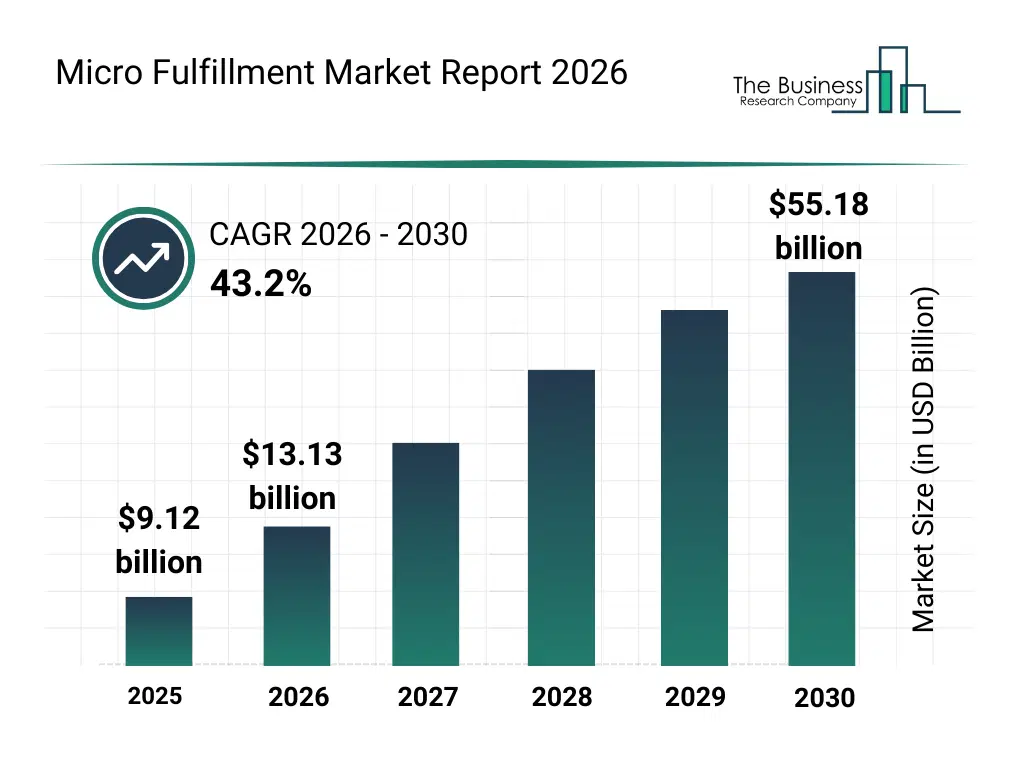
What Is The Micro Fulfillment Market Size and Share 2026?
The micro fulfillment market size has grown exponentially in recent years. It will grow from $9.12 billion in 2025 to $13.13 billion in 2026 at a compound annual growth rate (CAGR) of 43.9%. The growth in the historic period can be attributed to growth of e commerce activities, rising urban consumer demand, increasing logistics optimization needs, expanding need for faster delivery models, rising warehouse automation initiatives.What Is The Micro Fulfillment Market Growth Forecast?
The micro fulfillment market size is expected to see exponential growth in the next few years. It will grow to $55.18 billion in 2030 at a compound annual growth rate (CAGR) of 43.2%. The growth in the forecast period can be attributed to increasing investment in automated fulfillment, rising demand for ultra fast delivery, expanding adoption of robotic storage systems, growing urban retail infrastructure, rising emphasis on operational efficiency. Major trends in the forecast period include increasing adoption of automated urban fulfillment centers, growing demand for faster last mile delivery solutions, rising use of robotics and automated storage systems, expanding implementation of compact warehousing models, increasing focus on reducing logistics costs and delivery time.
Global Micro Fulfillment Market Segmentation
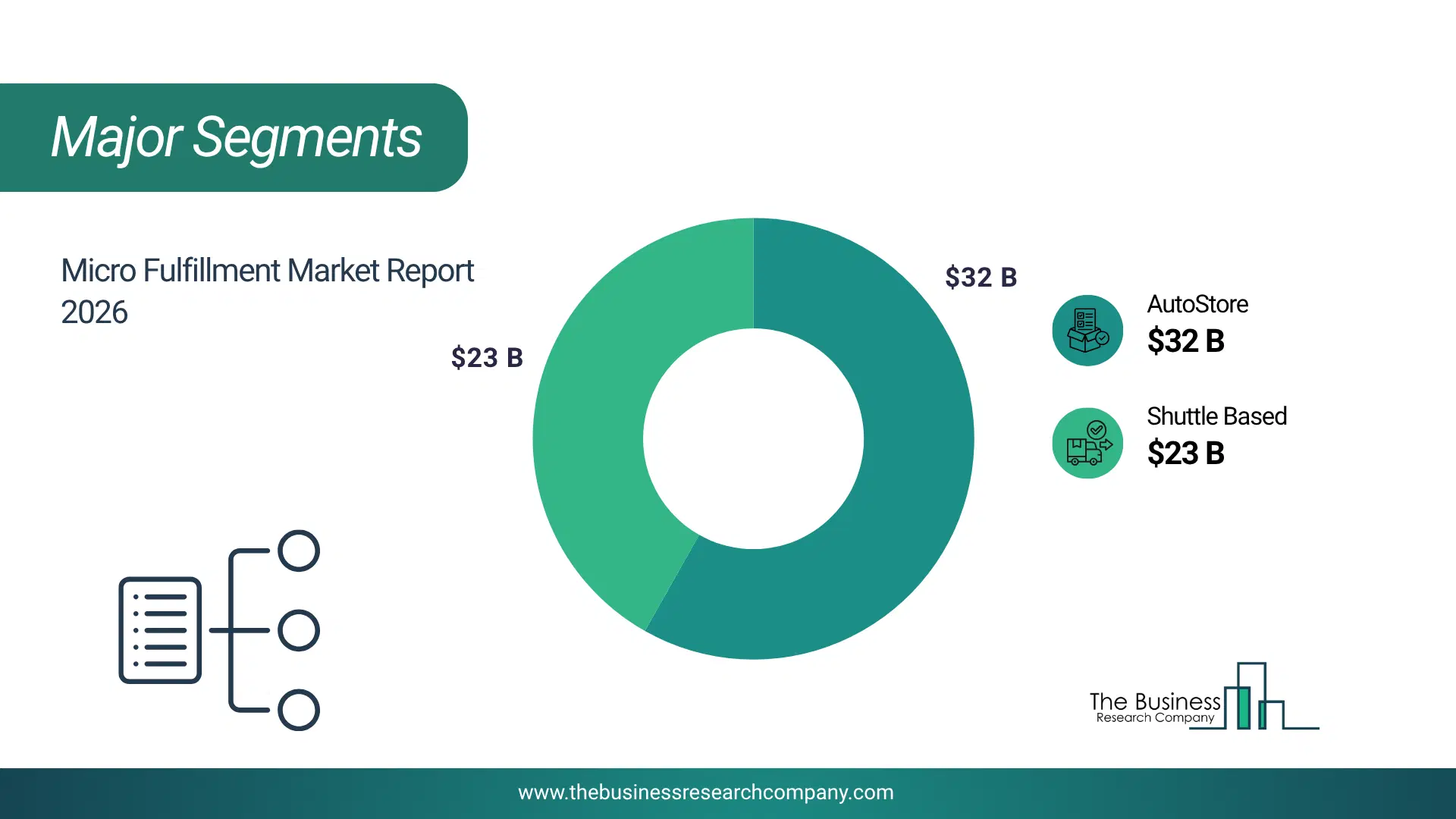
1) By Types: AutoStore, Shuttle Based 2) By Technology: Mobile AMR, Piece Picking Robots 3) By Applications: Grocery, General Merchandise 4) By End-User: E-Commerce, General Stores Subsegments: 1) By AutoStore: AutoStore Robots, AutoStore Storage Systems 2) By Shuttle-Based: Single-Shuttle Systems, Multi-Shuttle Systems The top segments in the micro fulfillment market will be: • AutoStore will reach $32.05 Billion by 2030. • Shuttle Based will reach $22.87 Billion by 2030.What Is The Driver Of The Micro Fulfillment Market?
The growing demand for the e-commerce sector is expected to propel the growth of the micro fulfillment market going forward. The e-commerce industry refers to the online purchase and sale of goods and services. It includes a wide range of information, processes, and tools for online consumers and sellers, such as smartphone shopping and online payment encryption. E-commerce fulfillment manages the logistics of delivering an online order to a customer's door, eliminating the requirement for an individual to envelope, address, and ship each order individually. The increasing demand for the e-commerce sector will contribute to the growth of the micro fulfillment market. For instance, in August 2025, according to the U.S. Census Bureau, US-Based statistical agency, in 2025, estimated e-commerce sales for the second quarter increased by 5.3% (±1.2%) compared with the same period in 2024, while total retail sales rose by 3.9% (±0.4%) over the same timeframe. Therefore, the growing demand for the e-commerce sector drives the micro fulfillment industry.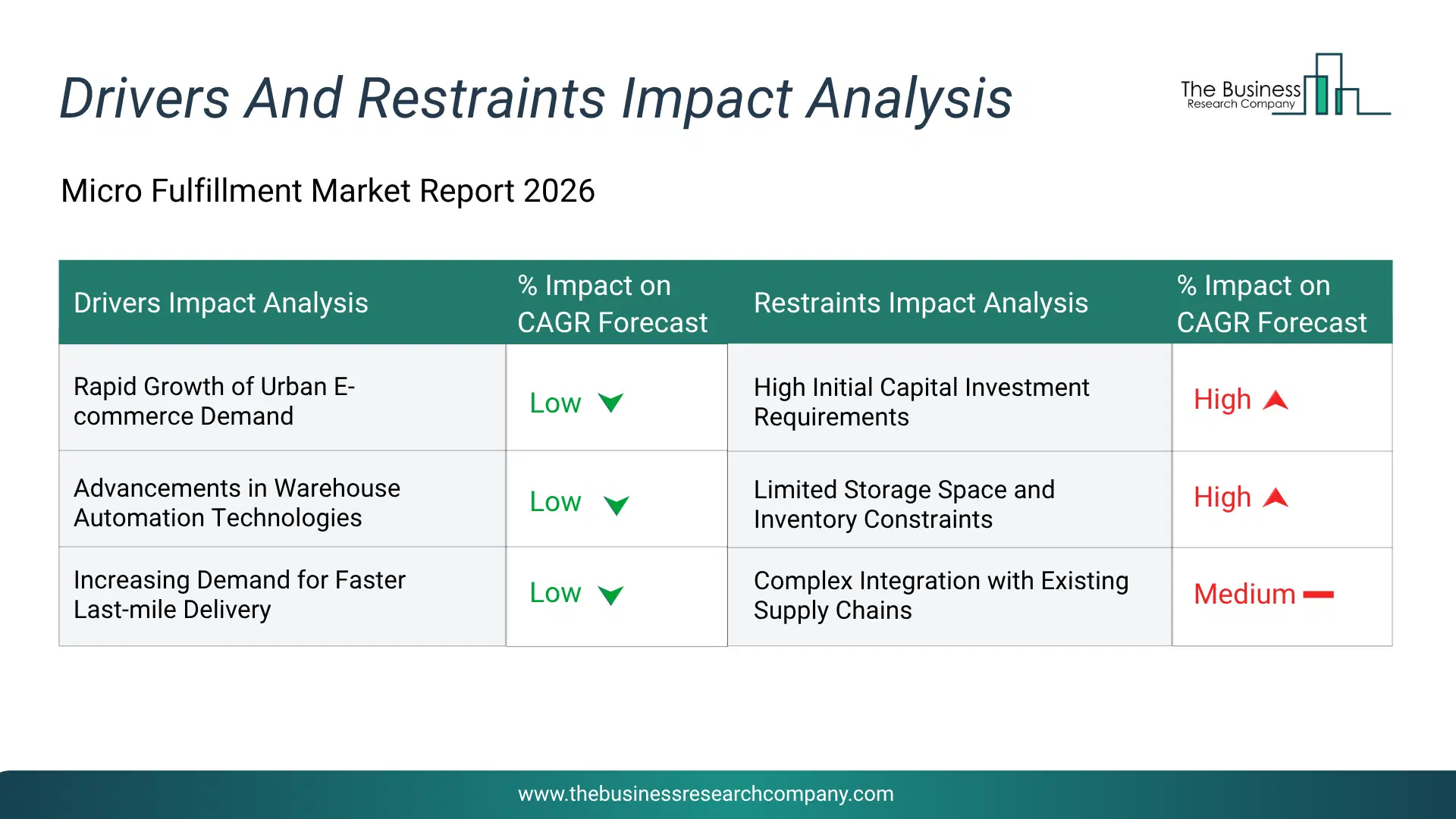
Infographic Chart Showing Key Market Drivers Analysis And Restraints For Micro Fulfillment Market
The chart presents an impact analysis of key drivers and restraints, quantifying their relative influence on the market's growth rate and helping assess the balance between growth enablers and limiting factors. This chart offers a high-level perspective; the full report contains more detailed insights.
How Will The Drivers Impact Growth In The Global Micro Fulfillment Market?
• Rapid Growth of Urban E-commerce Demand (Low) – During the forecast period, the rapid growth of urban e-commerce demand is expected to become a key growth driver for the micro fulfillment market by 2030. The continuous rise in urban e-commerce demand is a primary driver of micro fulfillment adoption. Increasing internet penetration, smartphone usage, and digital payment systems have accelerated online shopping in densely populated areas. Consumers now expect faster delivery timelines, which traditional warehouses cannot efficiently meet. Micro fulfillment centers located closer to consumers enable quicker order processing and reduced delivery times. This proximity enhances customer satisfaction and supports high-frequency ordering patterns. The expansion of e-grocery and quick commerce services further strengthens demand for localized fulfillment. As urban buying behavior shifts toward convenience, micro fulfillment becomes essential for operational efficiency. • Advancements in Warehouse Automation Technologies (Low) – During the forecast period, the advancements in warehouse automation technologies are expected to emerge as a major factor driving the expansion of the micro fulfillment market by 2030. Technological advancements in automation significantly support the expansion of micro fulfillment solutions. Integration of robotics, artificial intelligence, and machine learning improves picking accuracy, speed, and inventory handling. Automation reduces dependency on manual labor and minimizes operational errors. It also allows efficient use of limited urban warehouse space, making small-scale facilities viable. Data analytics enhances demand forecasting and stock management, ensuring product availability. These systems increase throughput and reduce operational costs over time. As automation becomes more scalable and cost-effective, adoption of micro fulfillment centers continues to grow. • Increasing Demand for Faster Last-mile Delivery (Low) – During the forecast period, the increasing demand for faster last-mile delivery is expected to act as a key growth catalyst for the micro fulfillment market by 2030. The growing need for rapid last-mile delivery is a major factor driving the micro fulfillment market. Consumers increasingly expect same-day or instant delivery, especially for groceries and essential goods. Traditional supply chains struggle to meet these expectations due to longer delivery distances. Micro fulfillment centers reduce transit time by positioning inventory near customers. This enables efficient route planning and lower logistics costs. Faster delivery improves customer experience and strengthens brand loyalty. As competition intensifies, businesses adopt micro fulfillment to meet evolving delivery expectations.How Will The Restraints Impact Growth In The Global Micro Fulfillment Market?
• High Initial Capital Investment Requirements (Low) – During the forecast period, high initial capital investment requirements are significantly restricting the growth of the micro fulfillment market. Substantial costs associated with setting up automated micro fulfillment centers, robotics systems, and advanced inventory management solutions are limiting adoption, especially among small and medium-sized retailers. • Limited Storage Space and Inventory Constraints (Low) – During the forecast period, limited storage space and inventory constraints are significantly restricting the growth of the micro fulfillment market. Space limitations in urban environments restrict SKU variety and inventory depth, creating operational inefficiencies and challenges in meeting fluctuating consumer demand. • Complex Integration with Existing Supply Chains (Low) – During the forecast period, complex integration with existing supply chains is significantly restricting the growth of the micro fulfillment market. Difficulties in aligning micro fulfillment systems with legacy logistics infrastructure, inventory systems, and retailer networks are increasing implementation complexity and slowing widespread adoption.Key Players In The Global Micro Fulfillment Market
Major companies operating in the micro fulfillment market report are Dematic GmbH, TGW Logistics Group GmbH, Swisslog Holding AG, Exotec SAS, Alert Innovation Inc, Takeoff Technologies Inc, Fabric Inc, DaVinci Micro Fulfillment Inc, Berkshire Grey Inc, OPEX Corporation, StrongPoint ASA, AutoStore AS, Cimcorp Oy, Witron Logistik + Informatik GmbH, KNAPP AG, Symbotic LLC, GreyOrange Pte Ltd, Ocado Technology Ltd, HIK Robotics Co Ltd, Element Logic AB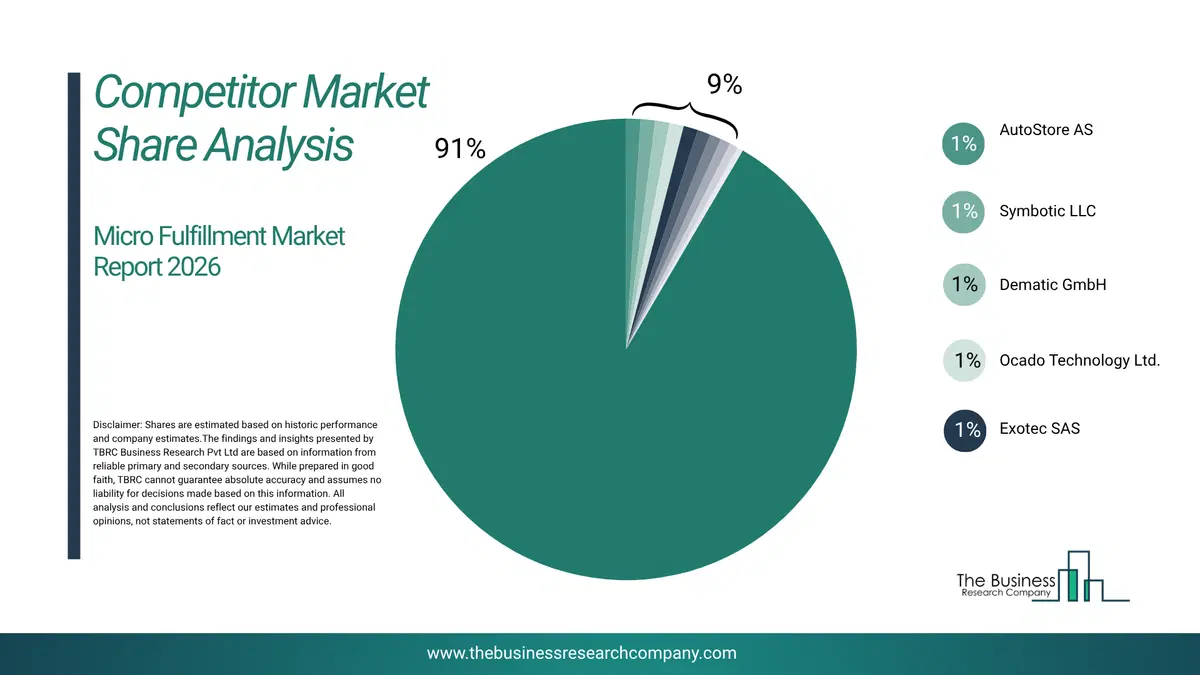
This chart is for illustrative purposes; the full report includes a detailed competitor analysis and comprehensive overview of the top 10 companies in the market.
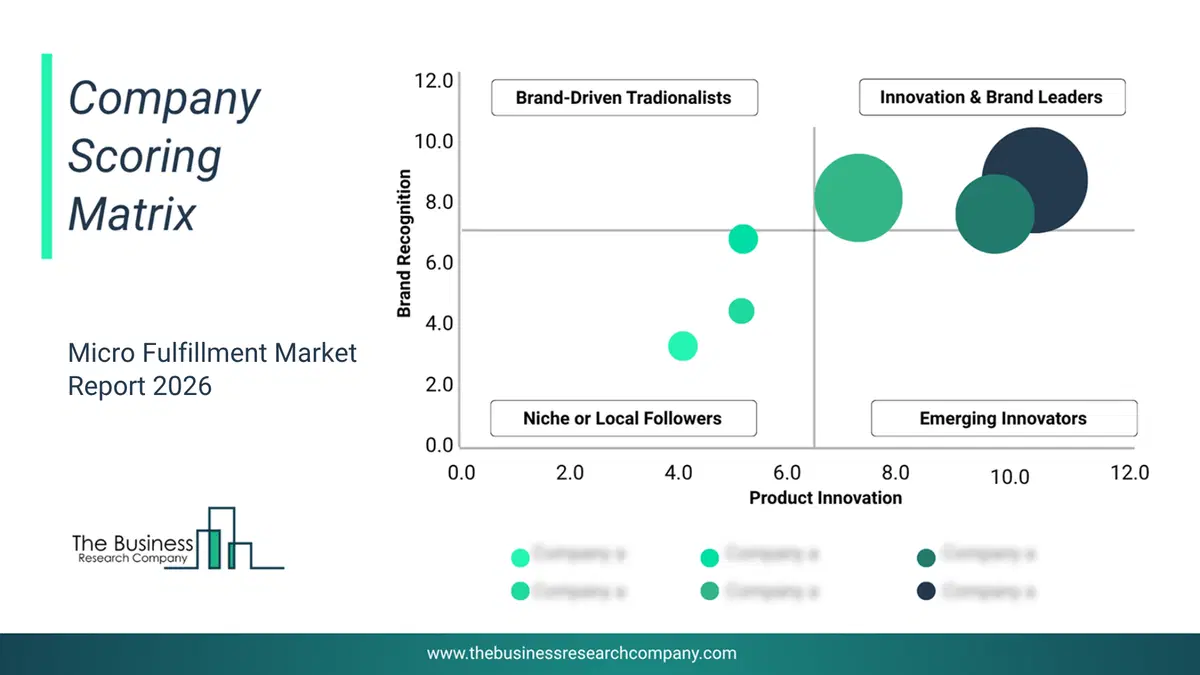
This chart maps companies by product innovation and brand strength, with bubble size indicating relative revenue, helping identify market leaders, challengers, and niche players. This is an illustrative chart; the full report provides a complete and accurate competitive analysis.
Global Micro Fulfillment Market Trends and Insights
Major companies operating in the micro fulfillment market are focusing on developing innovative solutions such as automated micro-fulfillment centers to enhance order processing and delivery efficiency. Automated micro-fulfillment centers are facilities that leverage advanced robotics and automation technologies to streamline operations, minimize manual labor, and reduce fulfillment times, particularly in high-demand urban areas. For instance, in October 2024, Amazon Inc, a US-based e-commerce company, launched its first automated micro-fulfillment center. This new fulfillment center is designed to streamline order processing and improve delivery speeds by integrating advanced robotics and automation technologies. The facility is expected to enhance Amazon's efficiency in handling orders, particularly in high-demand urban areas, by minimizing manual labor and reducing fulfillment times.What Are Latest Mergers And Acquisitions In The Micro Fulfillment Market?
In August 2024, Woolworths Group, an Australia-based retail company, acquired Takeoff Technologies for an undisclosed amount. With this acquisition, Woolworths Group aims to enhance its technological capabilities by securing automated micro-fulfillment centers (MFCs) to accelerate online grocery order processing and improve operational efficiency. Takeoff Technologies Inc. is a US-based technology company that specializes in providing automated micro-fulfillment center solutions for the retail and grocery sector.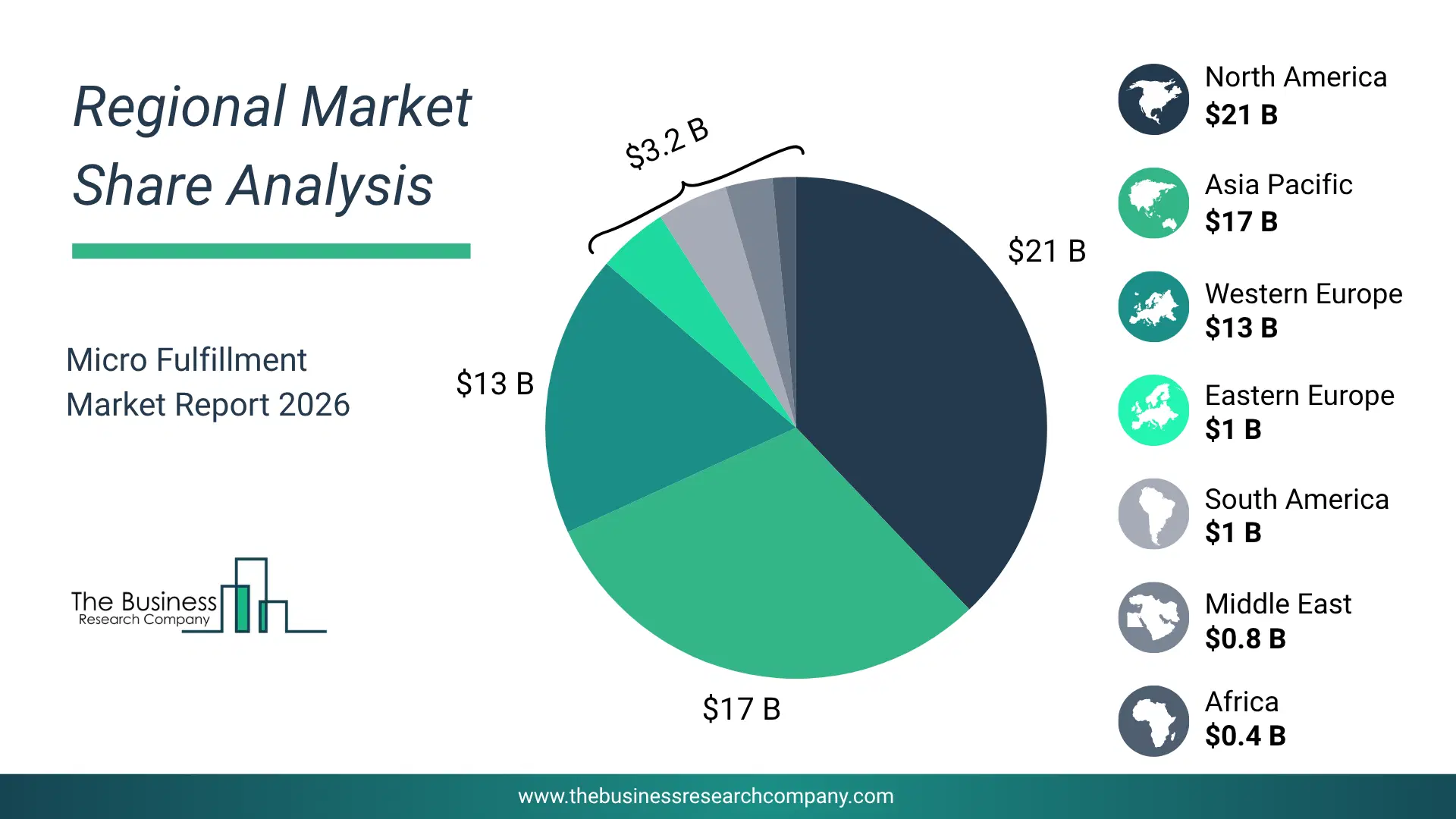
Regional Outlook
North America was the largest region in the micro fulfillment market in 2025. Asia-Pacific is expected to be the fastest-growing region in the forecast period. The regions covered in this market report are Asia-Pacific, South East Asia, Western Europe, Eastern Europe, North America, South America, Middle East, Africa. The countries covered in this market report are Australia, Brazil, China, France, Germany, India, Indonesia, Japan, Taiwan, Russia, South Korea, UK, USA, Canada, Italy, SpainWhat Defines the Micro Fulfillment Market?
The micro fulfillment market includes revenues earned by entities by providing warehouse automation, e-grocery micro fulfillment solutions, and e-commerce fulfillment services. The market value includes the value of related goods sold by the service provider or included within the service offering. Only goods and services traded between entities or sold to end consumers are included.How is Market Value Defined and Measured?
The market value is defined as the revenues that enterprises gain from the sale of goods and/or services within the specified market and geography through sales, grants, or donations in terms of the currency (in USD unless otherwise specified). The revenues for a specified geography are consumption values that are revenues generated by organizations in the specified geography within the market, irrespective of where they are produced. It does not include revenues from resales along the supply chain, either further along the supply chain or as part of other products.
This chart presents market attractiveness based on a quantitative evaluation of growth, competition, strategic alignment, and risk, offering a clear view of opportunity areas for decision-making. This chart is for illustrative purposes; the full report contains the complete analysis.

This chart highlights the Total Addressable Market (TAM) by estimating the maximum revenue opportunity using an assumption-driven approach, supporting strategic planning and opportunity sizing across markets. The chart is illustrative; the full report provides a more comprehensive analysis.
What Key Data and Analysis Are Included in the Micro Fulfillment Market Report 2026?
The micro fulfillment market research report is one of a series of new reports from The Business Research Company that provides market statistics, including industry global market size, regional shares, competitors with the market share, detailed market segments, market trends and opportunities, and any further data you may need to thrive in the micro fulfillment industry. The market research report delivers a complete perspective of everything you need, with an in-depth analysis of the current and future state of the industry.Micro Fulfillment Market Report Forecast Analysis
| Report Attribute | Details |
|---|---|
| Market Size Value In 2026 | $13.13 billion |
| Revenue Forecast In 2030 | $55.18 billion |
| Growth Rate | CAGR of 43.9% from 2026 to 2030 |
| Base Year For Estimation | 2025 |
| Actual Estimates/Historical Data | 2020-2025 |
| Forecast Period | 2026 - 2030 |
| Market Representation | Revenue in USD Billion and CAGR from 2026 to 2030 |
| Segments Covered | Types, Technology, Applications, End-User |
| Regional Scope | Asia-Pacific, Western Europe, Eastern Europe, North America, South America, Middle East, Africa |
| Country Scope | The countries covered in the report are Australia, Brazil, China, France, Germany, India, Indonesia, Japan, Taiwan, Russia, South Korea, UK, USA, Canada, Italy, Spain. |
| Key Companies Profiled | Dematic GmbH, TGW Logistics Group GmbH, Swisslog Holding AG, Exotec SAS, Alert Innovation Inc, Takeoff Technologies Inc, Fabric Inc, DaVinci Micro Fulfillment Inc, Berkshire Grey Inc, OPEX Corporation, StrongPoint ASA, AutoStore AS, Cimcorp Oy, Witron Logistik + Informatik GmbH, KNAPP AG, Symbotic LLC, GreyOrange Pte Ltd, Ocado Technology Ltd, HIK Robotics Co Ltd, Element Logic AB |
| Customization Scope | Request for Customization |
| Pricing And Purchase Options | Explore Purchase Options |