
Commercial Aircraft Airframe Materials Market Report 2026
Global Outlook – By Type (Aluminum Alloys, Titanium Alloys, Composites, Steel Alloys), By Application (Narrow-Body Aircraft, Wide-Body Aircraft, Regional Aircraft, Other Applications) – Market Size, Trends, Strategies, and Forecast to 2030
Commercial Aircraft Airframe Materials Market Overview
• Commercial Aircraft Airframe Materials market size has reached to $8.09 billion in 2025 • Expected to grow to $12.95 billion in 2030 at a compound annual growth rate (CAGR) of 9.7% • Growth Driver: Elevated Fleet Size Propels Growth In Commercial Aircraft Airframe Materials Market • Market Trend: Adoption Of Advanced Composite Materials In Aerospace • Middle East was the largest region in 2025 and Asia-Pacific is the fastest growing region.What Is Covered Under Commercial Aircraft Airframe Materials Market?
The commercial aircraft airframe materials are materials used to form the structure of a commercial aircraft. The lightweight airframe components and structural designs offer increased strength at a lower weight and are resilient to the heat associated with flight. Due to their lightweight, aluminum and magnesium have long been employed as airframe materials. The main types of commercial aircraft airframe materials are aluminum alloys, titanium alloys, composites, and steel alloys. Aluminum alloys are used in commercial aircraft airframe construction to develop high-strength parts for jet engines and airframes where high pressure, temperature, and vibration are heavily taken into account throughout their design and manufacturing. The different applications include narrow-body aircraft, wide-body aircraft, regional aircraft, and others.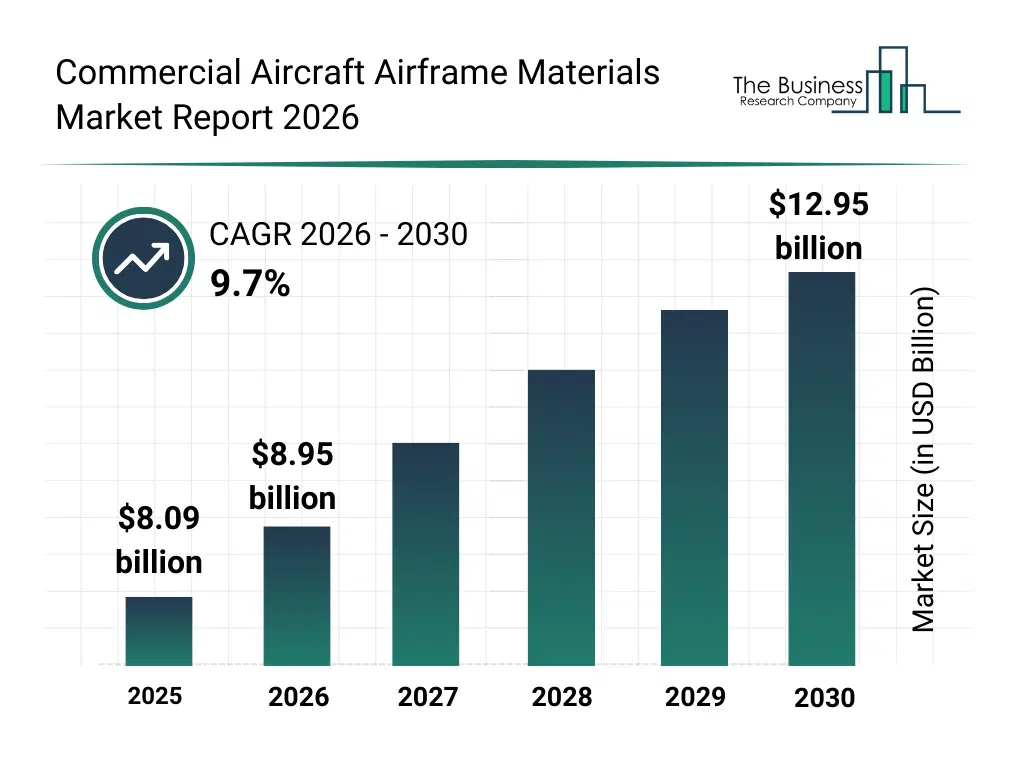
What Is The Commercial Aircraft Airframe Materials Market Size and Share 2026?
The commercial aircraft airframe materials market size has grown rapidly in recent years. It will grow from $8.09 billion in 2025 to $8.95 billion in 2026 at a compound annual growth rate (CAGR) of 10.7%. The growth in the historic period can be attributed to growing deployment of surveillance and reconnaissance systems to support real-time battlefield intelligence, increased adoption of adaptive sensors for improved situational awareness, modernization of command and control platforms integrating advanced communications and computing, expansion of satellite-based communication networks enhancing military operational capabilities, rising use of mission management and support equipment to coordinate complex defense operations.What Is The Commercial Aircraft Airframe Materials Market Growth Forecast?
The commercial aircraft airframe materials market size is expected to see strong growth in the next few years. It will grow to $12.95 billion in 2030 at a compound annual growth rate (CAGR) of 9.7%. The growth in the forecast period can be attributed to increasing integration of AI-driven ISR analytics for predictive intelligence and decision support, expansion of secure next-generation communication networks across defense forces, rising demand for interoperable c4ISR systems enabling joint and coalition operations, growing investment in advanced adaptive sensors with enhanced detection and range capabilities, continued modernization of military platforms requiring upgraded mission management and support systems. Major trends in the forecast period include growing adoption of aluminum-lithium alloys for weight reduction, increasing demand for nickel and high-temperature alloys for engine and hot-section structural parts, wider use of additive manufacturing (metal 3d printing) for complex structural components and forgings, rising uptake of advanced surface treatments and corrosion-resistant coatings for longer airframe life, regional supply-chain localization and strategic sourcing of critical alloy feedstocks.
Global Commercial Aircraft Airframe Materials Market Segmentation
1) By Type: Aluminum Alloys, Titanium Alloys, Composites, Steel Alloys 2) By Application: Narrow-Body Aircraft, Wide-Body Aircraft, Regional Aircraft, Other Applications Subsegments: 1) By Aluminum Alloys: 2000 Series Aluminum Alloys, 5000 Series Aluminum Alloys, 6000 Series Aluminum Alloys 2) By Titanium Alloys: Alpha Titanium Alloys, Beta Titanium Alloys, Alpha-Beta Titanium Alloys 3) By Composites: Carbon Fiber Reinforced Polymer (CFRP), Glass Fiber Reinforced Polymer (GFRP), Aramid Fiber Reinforced Polymer (AFRP) 4) By Steel Alloys: Stainless Steel Alloys, Carbon Steel Alloys, High-Strength Low-Alloy Steel (HSLA)What Is Driver Of The Commercial Aircraft Airframe Materials Market?
The increase in fleet size of commercial aircraft is expected to contribute to the growth of the commercial aircraft airframe materials market. Commercial aircraft are those aircraft that are used to transport people and cargo between specific airports regularly. Increasing fleet size requires aircraft airframe materials to form the structure of an aircraft, thereby promoting the growth of commercial aircraft airframe materials. For instance, in January 2024, according to Airbus, a Netherland-based aircraft manufacturer published that in 2023, Airbus delivered 735 commercial aircraft, marking an 11% rise compared to 2022. Therefore, the elevated fleet size is driving the growth of the commercial aircraft airframe materials industry.Key Players In The Global Commercial Aircraft Airframe Materials Market
Major companies operating in the commercial aircraft airframe materials market are Solvay S.A, Constellium SE, Arconic Corporation, Toray Industries Inc., Teijin Limited, Southwest Aluminium, Hexcel Corporation, VSMPO-AVISMA Corporation, HITCO Carbon Composites Inc, Kobe Steel Ltd., Alcoa Corporation, AMG Advanced Metallurgical Group NV, Dupopnt de Nemours Inc., The Boeing Company, Lockheed Martin Corporation, Commercial Aircraft Corporation of China (COMAC), Airbus SE, TATA Advanced Systems Ltd., Spirit AeroSystems Inc., Mitsubishi Chemical Corporation, Owens Corning, Koninklijke Ten Cate BV, Henkel AG & Co. KGaA, Huntsman Corporation, SGL Carbon SE, BASF SE, Evonik Industries AG, Norsk Titanium AS, Aleris Corporation, Kaiser Aluminum Corporation, Materion Corporation, Precision Castparts Corp., ThyssenKrupp Aerospace
This chart is for illustrative purposes; the full report includes a detailed competitor analysis and comprehensive overview of the top 10 companies in the market.
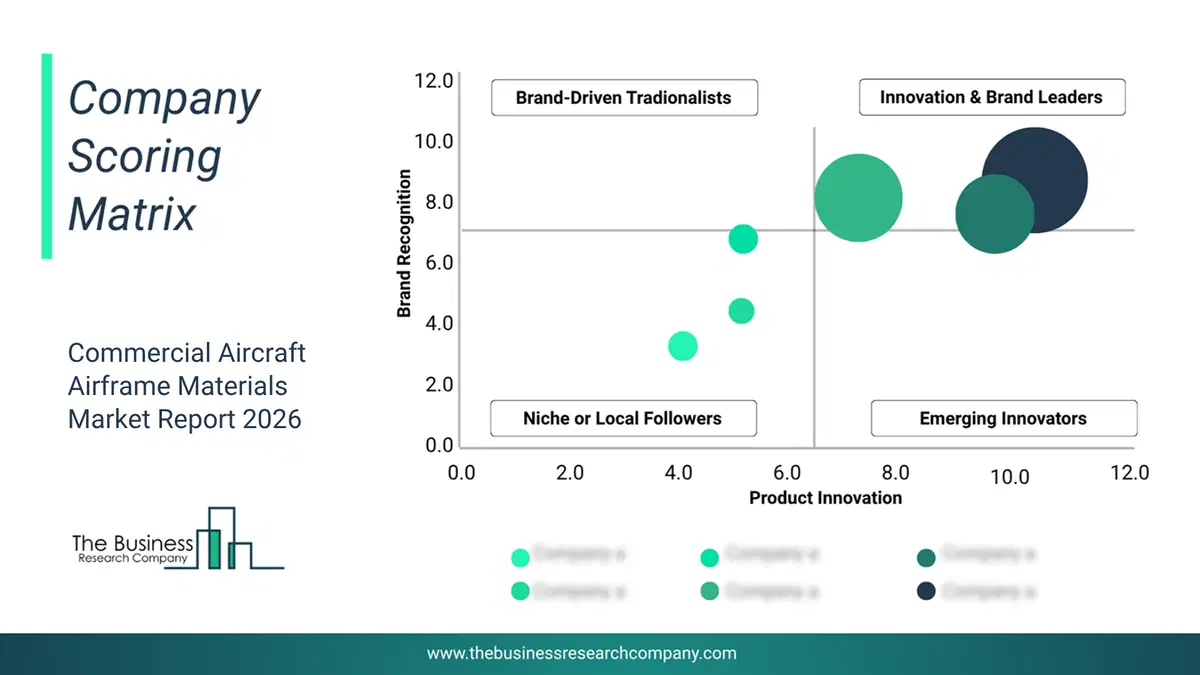
This chart maps companies by product innovation and brand strength, with bubble size indicating relative revenue, helping identify market leaders, challengers, and niche players. This is an illustrative chart; the full report provides a complete and accurate competitive analysis.
Global Commercial Aircraft Airframe Materials Market Trends and Insights
Major companies operating in the commercial aircraft airframe materials market are focused on research and development to enhance material strength, reduce weight, and improve fuel efficiency while ensuring sustainability and cost-effectiveness in aircraft manufacturing. The research and development of commercial aircraft airframe materials are pivotal in advancing the aviation industry, focusing on enhancing fuel efficiency, reducing environmental impact, and improving overall aircraft performance. For instance, in March 2023, the National Aeronautics and Space Administration, a US-based independent agency responsible for the civil space program, aeronautics research, and space research, issued $50 million in awards to 14 organizations to develop manufacturing processes and advanced composite materials for aircraft structures. These green technologies hold the potential to help reduce aviation carbon emissions. The awards are from NASA’s Hi-Rate Composite Aircraft Manufacturing (HiCAM) project, aiming to lower costs and boost the production of U.S.-made composite structures.What Are Latest Mergers And Acquisitions In The Commercial Aircraft Airframe Materials Market? Boeing Acquires Aerospace Composites Malaysia To Strengthen Manufacturing Footprint And Composite Capabilities In Southeast Asia
In January 2024, The Boeing Company, a US-based aerospace and defense manufacturing company, acquired Aerospace Composites Malaysia Sdn Bhd (ACM) for an undisclosed amount. With this acquisition, Boeing aims to strengthen its manufacturing footprint in Southeast Asia and enhance its composite materials capabilities to support aircraft production efficiency, streamline supply chain integration, and advance the company’s long-term strategy of increasing production resilience, cost competitiveness, and technological innovation across its commercial airplane programs. Aerospace Composites Malaysia is a Malaysia-based manufacturing company that specializes in providing commercial aircraft airframe materials.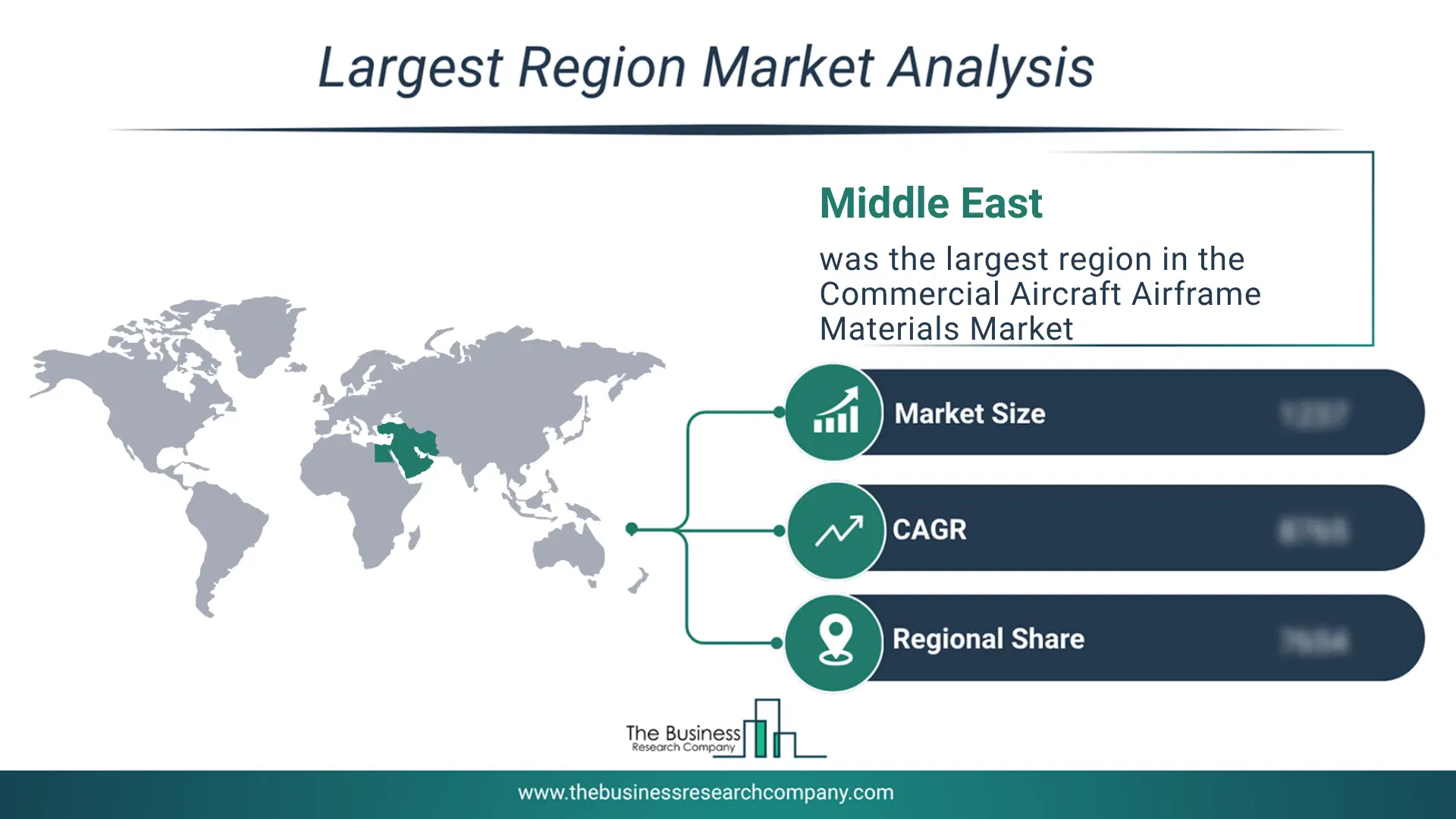
Regional Insights
Middle East was the largest region in the commercial aircraft airframe materials market in 2025. Asia-Pacific is expected to be the fastest-growing region in the forecast period. The regions covered in the commercial aircraft airframe materials market report are Asia-Pacific, South East Asia, Western Europe, Eastern Europe, North America, South America, Middle East, Africa. The countries covered in the commercial aircraft airframe materials market report are Australia, Brazil, China, France, Germany, India, Indonesia, Japan, Taiwan, Russia, South Korea, UK, USA, Canada, Italy, SpainWhat Defines the Commercial Aircraft Airframe Materials Market?
The commercial aircraft airframe materials market consists of sales of commercial aircraft airframe materials such as nickel alloys, and magnesium alloys. Values in this market are ‘factory gate’ values, that is the value of goods sold by the manufacturers or creators of the goods, whether to other entities (including downstream manufacturers, wholesalers, distributors, and retailers) or directly to end customers. The value of goods in this market includes related services sold by the creators of the goods.How is Market Value Defined and Measured?
The market value is defined as the revenues that enterprises gain from the sale of goods and/or services within the specified market and geography through sales, grants, or donations in terms of the currency (in USD unless otherwise specified). The revenues for a specified geography are consumption values that are revenues generated by organizations in the specified geography within the market, irrespective of where they are produced. It does not include revenues from resales along the supply chain, either further along the supply chain or as part of other products.
This chart presents market attractiveness based on a quantitative evaluation of growth, competition, strategic alignment, and risk, offering a clear view of opportunity areas for decision-making. This chart is for illustrative purposes; the full report contains the complete analysis.

This chart highlights the Total Addressable Market (TAM) by estimating the maximum revenue opportunity using an assumption-driven approach, supporting strategic planning and opportunity sizing across markets. The chart is illustrative; the full report provides a more comprehensive analysis.
What Key Data and Analysis Are Included in the Commercial Aircraft Airframe Materials Market Report 2026?
The commercial aircraft airframe materials market research report is one of a series of new reports from The Business Research Company that provides market statistics, including industry global market size, regional shares, competitors with the market share, detailed market segments, market trends and opportunities, and any further data you may need to thrive in the commercial aircraft airframe materials industry. The market research report delivers a complete perspective of everything you need, with an in-depth analysis of the current and future state of the industry.Commercial Aircraft Airframe Materials Market Report Forecast Analysis
| Report Attribute | Details |
|---|---|
| Market Size Value In 2026 | $8.95 billion |
| Revenue Forecast In 2030 | $12.95 billion |
| Growth Rate | CAGR of 9.7% from 2026 to 2030 |
| Base Year For Estimation | 2025 |
| Actual Estimates/Historical Data | 2020-2025 |
| Forecast Period | 2026 - 2030 |
| Market Representation | Revenue in USD Billion and CAGR from 2026 to 2030 |
| Segments Covered | Type, Application |
| Regional Scope | Asia-Pacific, Western Europe, Eastern Europe, North America, South America, Middle East, Africa |
| Country Scope | The countries covered in the commercial aircraft airframe materials market report are Australia, Brazil, China, France, Germany, India, Indonesia, Japan, Taiwan, Russia, South Korea, UK, USA, Canada, Italy, Spain |
| Key Companies Profiled | Solvay S.A, Constellium SE, Arconic Corporation, Toray Industries Inc., Teijin Limited, Southwest Aluminium, Hexcel Corporation, VSMPO-AVISMA Corporation, HITCO Carbon Composites Inc, Kobe Steel Ltd., Alcoa Corporation, AMG Advanced Metallurgical Group NV, Dupopnt de Nemours Inc., The Boeing Company, Lockheed Martin Corporation, Commercial Aircraft Corporation of China (COMAC), Airbus SE, TATA Advanced Systems Ltd., Spirit AeroSystems Inc., Mitsubishi Chemical Corporation, Owens Corning, Koninklijke Ten Cate BV, Henkel AG & Co. KGaA, Huntsman Corporation, SGL Carbon SE, BASF SE, Evonik Industries AG, Norsk Titanium AS, Aleris Corporation, Kaiser Aluminum Corporation, Materion Corporation, Precision Castparts Corp., ThyssenKrupp Aerospace |
| Customization Scope | Request for Customization |
| Pricing And Purchase Options | Explore Purchase Options |