

Composite Materials Market Report 2026
Global Outlook – By Type (Fiber Reinforced Plastic Composites, Resins), By Matrices (Polymer Matrix Composite (PMC), Metal Matrix Composite (MMC), Ceramic Matrix Composites (CMC)), By Method (Open Molding, Closed Molding, Other Methods), By Form (Fiber Tow, Unidirectional Tape, Cloth), By End Use (Aerospace And Defense, Automotive And Transportation, Marine, Electrical And Electronics, Building And Construction, Renewable Energy, Other End Users) – Market Size, Trends, Strategies, and Forecast to 2030
Composite Materials Market Overview
• Composite Materials market size has reached to $11.24 billion in 2025 • Expected to grow to $12.26 billion in 2030 at a compound annual growth rate (CAGR) of 9.3% • Growth Driver: Surge In Demand For Lightweight Materials In Aerospace And Defence Fueling The Growth Of The Market Due To Improved Fuel Efficiency, Reduced Structural Weight, And Enhanced Aircraft Performance Through Advanced Composite Adoption • Market Trend: Advanced Automated Composite System Boosts High-Precision Rocket Manufacturing • North America was the largest region in 2025 and Asia-Pacific is the fastest growing region.What Is Covered Under Composite Materials Market?
Composite materials refer to engineered materials made by combining two or more distinct constituents, such as fibres and resins, to achieve enhanced physical and chemical properties that are superior to those of the individual components. These materials are designed to provide high strength-to-weight ratio, durability, corrosion resistance, and design flexibility. They are widely used to improve performance, efficiency, and longevity in various structural and non-structural applications. The main types of composite materials include fiber reinforced plastic composites and resins. Fiber reinforced plastic composites refer to materials made by combining a polymer matrix with reinforcing fibers to enhance strength, durability, and lightweight properties. These materials are categorized based on matrices into polymer matrix composite, metal matrix composite, and ceramic matrix composites. They are manufactured using methods such as open molding, closed molding, and other methods. They are available in forms including fiber tow, unidirectional tape, and cloth, and they are used by several end users such as aerospace and defense, automotive and transportation, marine, electrical and electronics, building and construction, renewable energy, and other end users.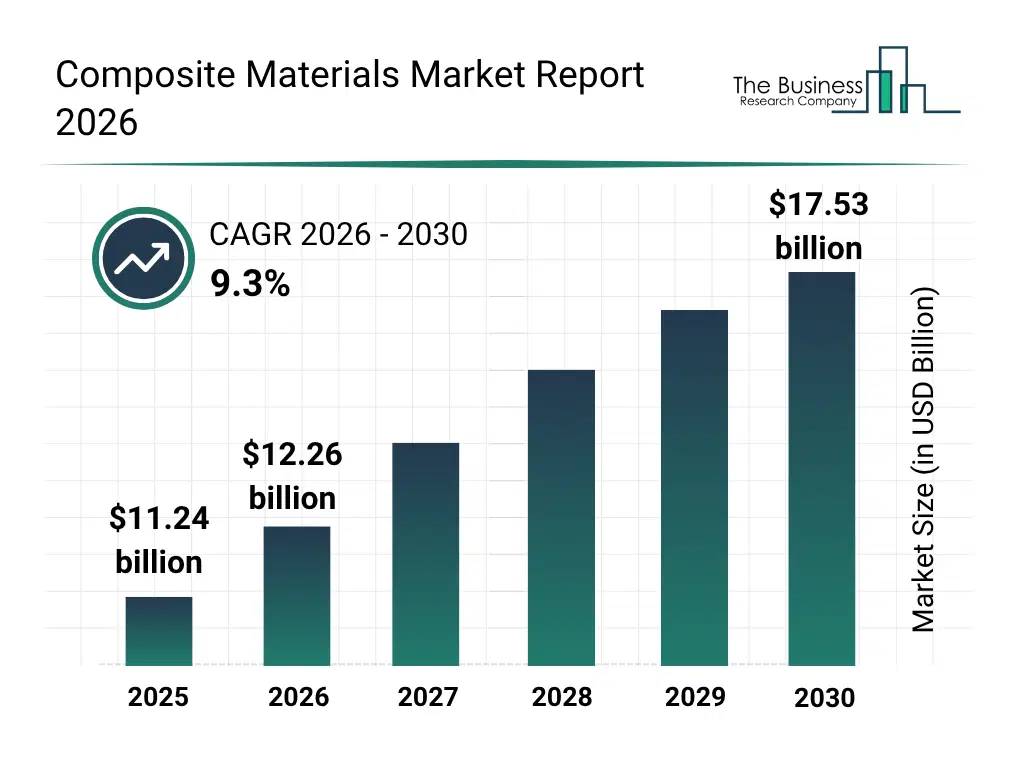
What Is The Composite Materials Market Size and Share 2026?
The composite materials market size has grown strongly in recent years. It will grow from $11.24 billion in 2025 to $12.26 billion in 2026 at a compound annual growth rate (CAGR) of 9.1%. The growth in the historic period can be attributed to growth of aerospace composite applications, rising demand for lightweight automotive materials, expansion of wind energy installations, increasing use of glass fiber composites in construction, development of basic polymer matrix composites.What Is The Composite Materials Market Growth Forecast?
The composite materials market size is expected to see strong growth in the next few years. It will grow to $17.53 billion by 2030 at a compound annual growth rate (CAGR) of 9.3%. The growth in the forecast period can be attributed to rising adoption of carbon fiber composites in mobility sector, expansion of electric vehicle manufacturing, increasing demand for sustainable composite materials, growth in aerospace modernization programs, adoption of advanced automated composite manufacturing technologies. Major trends in the forecast period include increasing use of lightweight composite materials in electric vehicles and aerospace applications, rising adoption of carbon fiber composites for high performance structural applications, growth of sustainable and bio based composite material development, expansion of automated manufacturing processes for composite production, rising demand for high strength and corrosion resistant materials in construction and wind energy.
Global Composite Materials Market Segmentation
1) By Type: Fiber Reinforced Plastic Composites, Resins 2) By Matrices: Polymer Matrix Composite (PMC), Metal Matrix Composite (MMC), Ceramic Matrix Composites (CMC) 3) By Method: Open Molding, Closed Molding, Other Methods 4) By Form: Fiber Tow, Unidirectional Tape, Cloth 5) By End Use: Aerospace And Defense, Automotive And Transportation, Marine, Electrical And Electronics, Building And Construction, Renewable Energy, Other End Users Subsegments: 1) By Fiber Reinforced Plastic Composites: Glass Fiber Reinforced Composites, Carbon Fiber Reinforced Composites, Aramid Fiber Reinforced Composites, Natural Fiber Reinforced Composites, Hybrid Fiber Reinforced Composites 2) By Resins: Epoxy Resins, Polyester Resins, Vinyl Ester Resins, Phenolic Resins, Polyurethane Resins, Polyimide ResinsWhat Is The Driver Of The Composite Materials Market?
The rising demand for lightweight materials in aerospace and defence is expected to propel the growth of the composite materials market going forward. Lightweight materials in aerospace and defense refer to advanced materials designed to reduce structural weight while maintaining high strength, durability, and performance to improve fuel efficiency and operational effectiveness. The rising demand for lightweight materials in aerospace and defence is driven by improved fuel efficiency and reduced aircraft weight, which enhances performance and lowers operational costs. Composite materials help lightweight materials in aerospace and defense by combining high strength with low weight, enabling reduced structural mass, improved fuel efficiency, and enhanced overall aircraft performance without compromising durability. For instance, in January 2023, according to the Airbus SE, a Netherlands-based Aircraft manufacturing company, the A350 uses around 70% advanced materials to achieve the lowest operating weight per seat and deliver up to 25% lower fuel consumption and operating costs in the upper widebody segment. Therefore, the rising demand for lightweight materials in aerospace and defence is driving the growth of the composite materials industry.Key Players In The Global Composite Materials Market
Major companies operating in the composite materials market are Saudi Arabian Oil Company, BASF SE, ADNOC International Germany Holding AG, Mitsubishi Chemical Group Corporation, 3M Company, Wanhua Chemical Group Co. Ltd., Toray Industries Inc., DuPont de Nemours Inc., DSM-Firmenich AG, Arkema SA, Lanxess AG, Teijin Limited, Syensqo SA, Huntsman Corporation, Avient Corporation, Hexcel Corporation, SGL Carbon SE, Trex Company Inc., Gurit Holding AG, Hyosung Advanced Materials Corporation.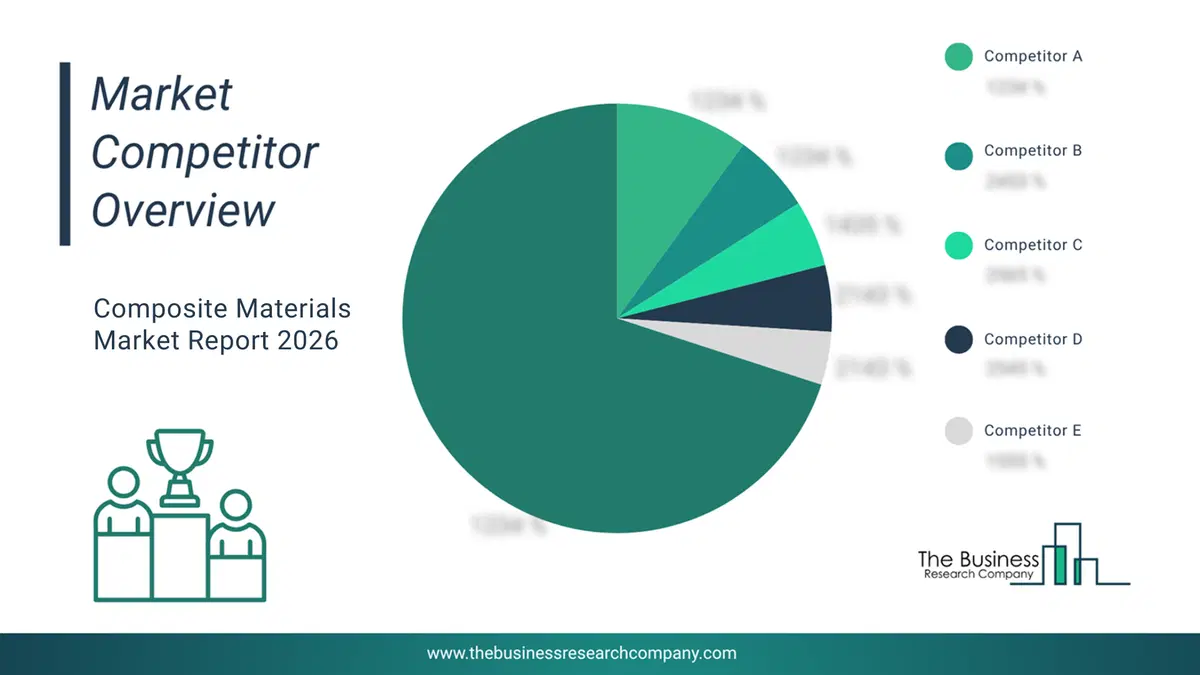
This chart is for illustrative purposes; the full report includes a detailed competitor analysis and comprehensive overview of the top 10 companies in the market.
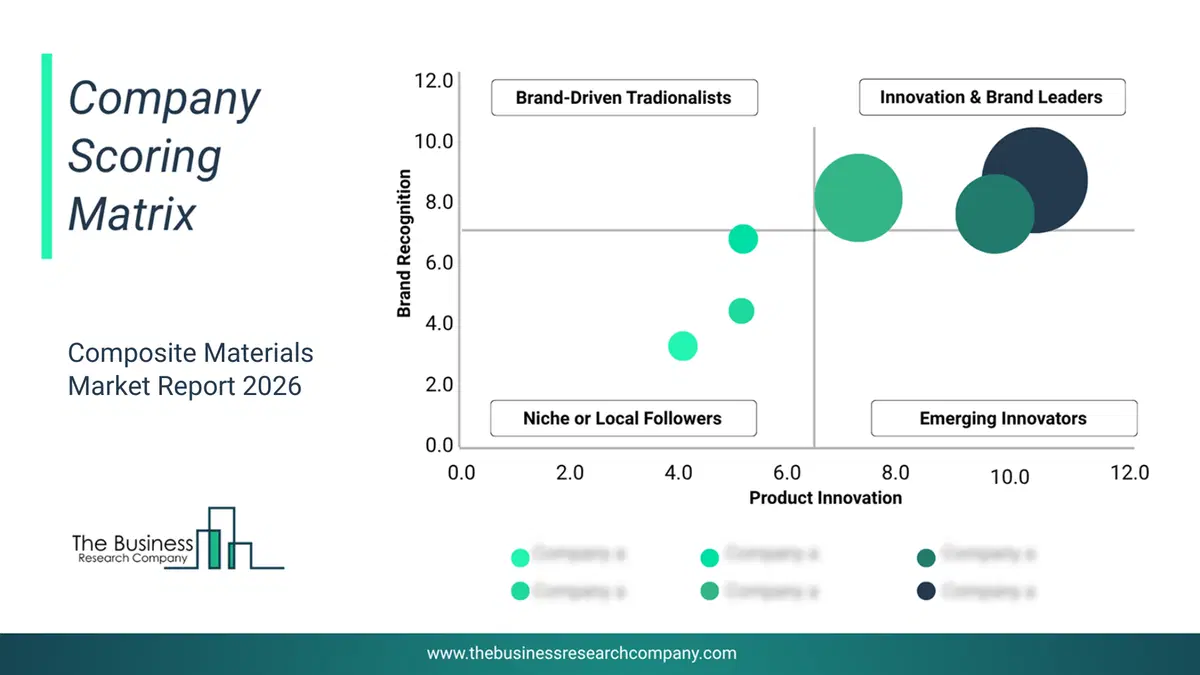
This chart maps companies by product innovation and brand strength, with bubble size indicating relative revenue, helping identify market leaders, challengers, and niche players. This is an illustrative chart; the full report provides a complete and accurate competitive analysis.
Global Composite Materials Market Trends and Insights
Major companies operating in the composite materials market are focusing on developing advanced manufacturing solutions, such as large-scale carbon composite production systems, to enhance structural performance, reduce weight, and improve production efficiency in aerospace and industrial applications. Large-scale carbon composite production systems refer to advanced automated manufacturing setups designed to mass-produce high-strength, lightweight carbon fiber–reinforced composite structures with high precision and efficiency. For instance, in August 2024, Rocket Lab, a US-based aerospace manufacturer, began installation of a large carbon composite rocket building machine to expand its composite manufacturing capabilities. Designed to support the production of advanced lightweight rocket structures, the system enables high-precision fabrication of carbon composite components, improving structural efficiency, reducing launch vehicle weight, and enhancing overall performance in space missions.What Are Latest Mergers And Acquisitions In The Composite Materials Market?
In January 2024, Boeing, a US-based provider of commercial airplanes, defense systems, space platforms, and aviation services, acquired Aerospace Composites Malaysia for an undisclosed amount. With this acquisition, Boeing aims to strengthen its in-house composite manufacturing capabilities, deepen its production footprint in Southeast Asia, and improve supply chain control for commercial aircraft structures and subassemblies. Aerospace Composites Malaysia is a Malaysia-based provider of composite products and subassemblies used on all current Boeing commercial airplanes.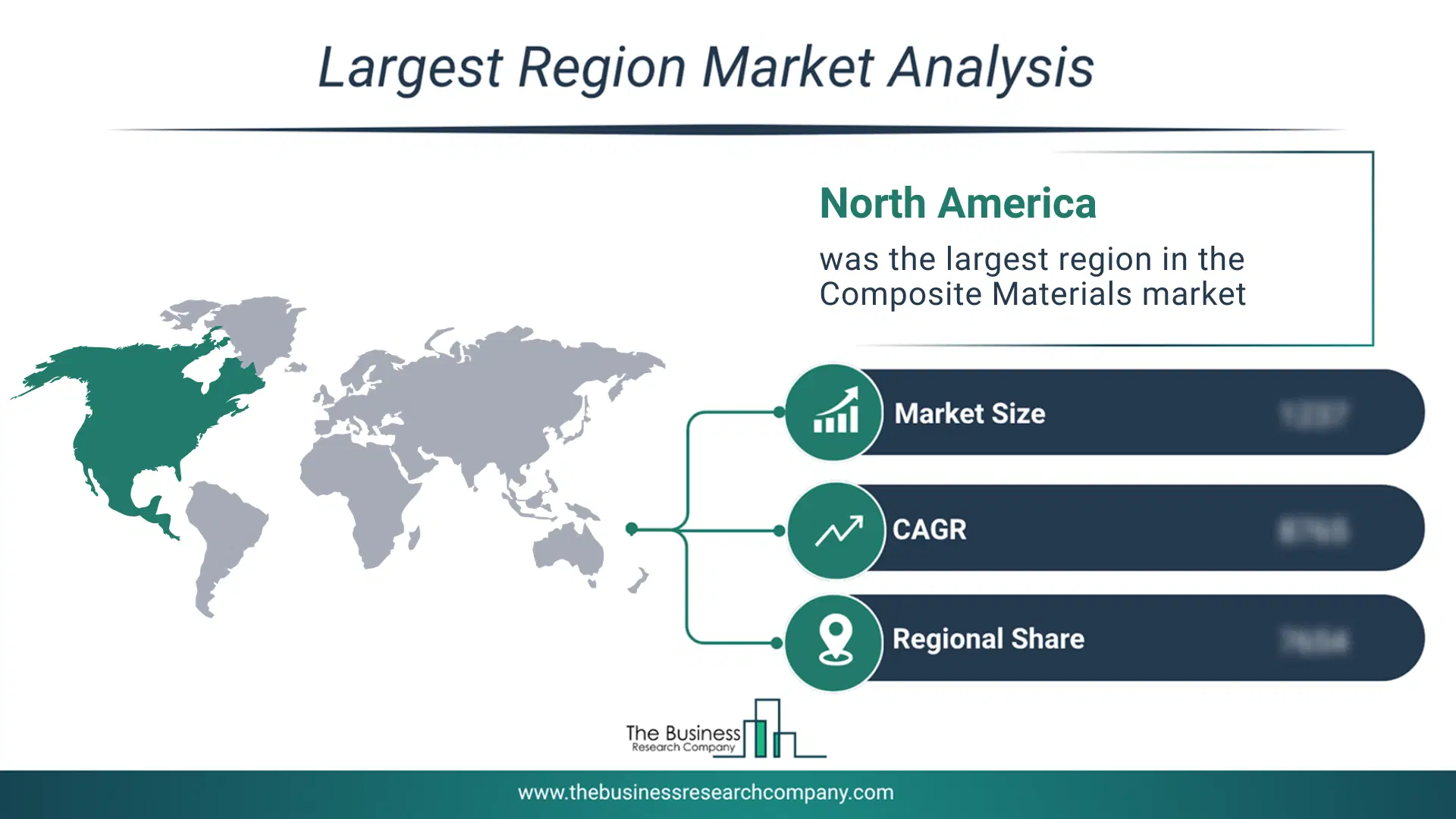
Regional Insights
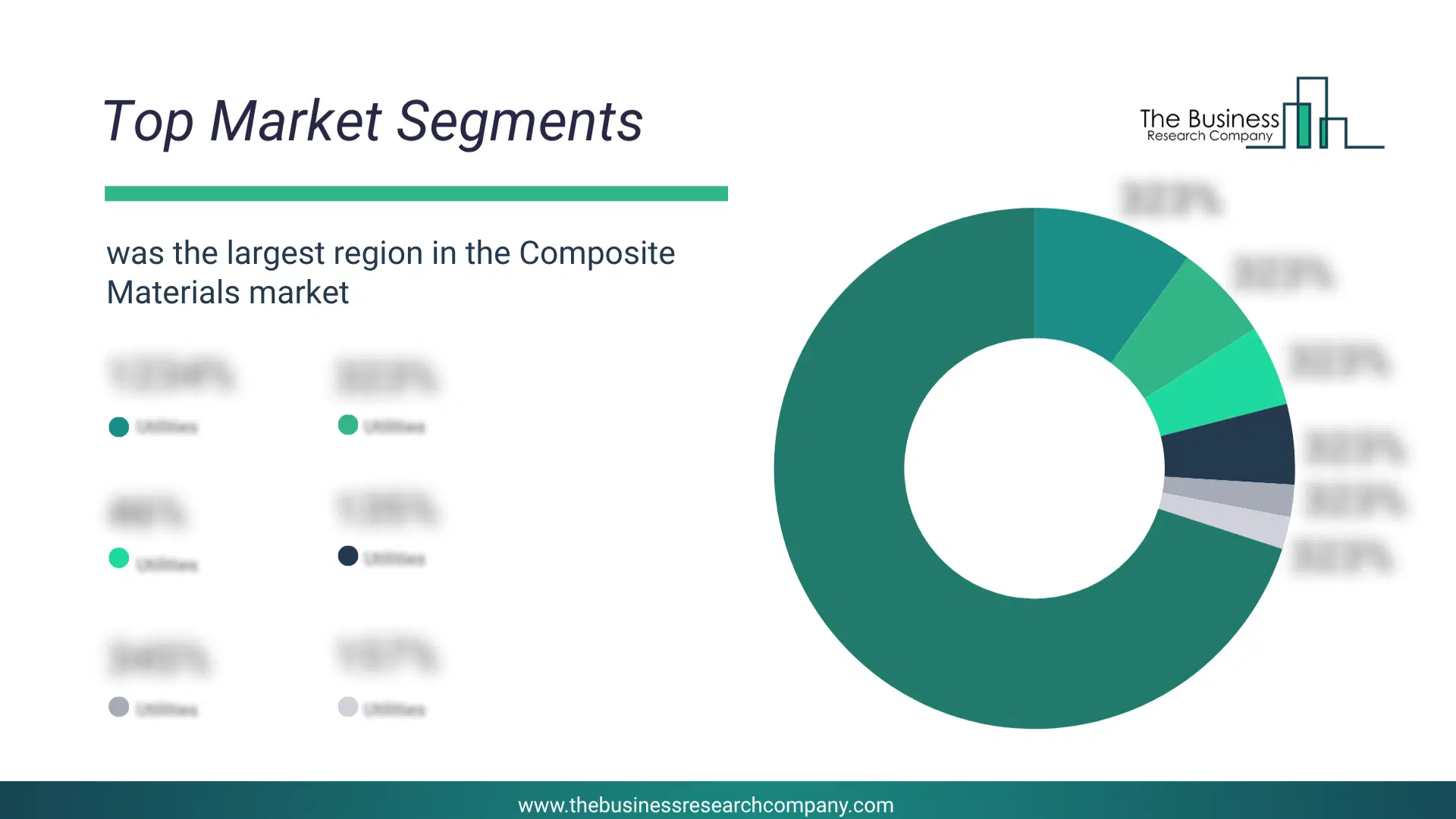
North America was the largest region in the composite materials market in 2025. Asia-Pacific is expected to be the fastest-growing region in the forecast period. The regions covered in this market report are Asia-Pacific, South East Asia, Western Europe, Eastern Europe, North America, South America, Middle East, Africa. The countries covered in this market report are Australia, Brazil, China, France, Germany, India, Indonesia, Japan, Taiwan, Russia, South Korea, UK, USA, Canada, Italy, Spain.What Defines the Composite Materials Market?
The composite materials market consists of sales of composite decking panels, insulation panels, ballistic composite panels, and structural laminate panels. Values in this market are ‘factory gate’ values, that is, the value of goods sold by the manufacturers or creators of the goods, whether to other entities (including downstream manufacturers, wholesalers, distributors, and retailers) or directly to end customers. The value of goods in this market includes related services sold by the creators of the goods.How is Market Value Defined and Measured?
The market value is defined as the revenues that enterprises gain from the sale of goods and/or services within the specified market and geography through sales, grants, or donations in terms of the currency (in USD unless otherwise specified). The revenues for a specified geography are consumption values that are revenues generated by organizations in the specified geography within the market, irrespective of where they are produced. It does not include revenues from resales along the supply chain, either further along the supply chain or as part of other products.
This chart presents market attractiveness based on a quantitative evaluation of growth, competition, strategic alignment, and risk, offering a clear view of opportunity areas for decision-making. This chart is for illustrative purposes; the full report contains the complete analysis.

This chart highlights the Total Addressable Market (TAM) by estimating the maximum revenue opportunity using an assumption-driven approach, supporting strategic planning and opportunity sizing across markets. The chart is illustrative; the full report provides a more comprehensive analysis.
What Key Data and Analysis Are Included in the Composite Materials Market Report 2026?
The composite materials market research report is one of a series of new reports from The Business Research Company that provides market statistics, including industry global market size, regional shares, competitors with the market share, detailed market segments, market trends and opportunities, and any further data you may need to thrive in the composite materials industry. The market research report delivers a complete perspective of everything you need, with an in-depth analysis of the current and future state of the industry.Composite Materials Market Report Forecast Analysis
| Report Attribute | Details |
|---|---|
| Market Size Value In 2026 | $12.26 billion |
| Revenue Forecast In 2030 | $17.53 billion |
| Growth Rate | CAGR of 9.30% from 2026 to 2030 |
| Base Year For Estimation | 2025 |
| Actual Estimates/Historical Data | 2020-2025 |
| Forecast Period | 2026 - 2030 |
| Market Representation | Revenue in USD Billion and CAGR from 2026 to 2030 |
| Segments Covered | Type, Matrices, Method, Form, End Use |
| Regional Scope | Asia-Pacific, Western Europe, Eastern Europe, North America, South America, Middle East, Africa |
| Country Scope | The countries covered in this market report are Australia, Brazil, China, France, Germany, India, Indonesia, Japan, Taiwan, Russia, South Korea, UK, USA, Canada, Italy, Spain |
| Key Companies Profiled | Saudi Arabian Oil Company, BASF SE, ADNOC International Germany Holding AG, Mitsubishi Chemical Group Corporation, 3M Company, Wanhua Chemical Group Co. Ltd., Toray Industries Inc., DuPont de Nemours Inc., DSM-Firmenich AG, Arkema SA, Lanxess AG, Teijin Limited, Syensqo SA, Huntsman Corporation, Avient Corporation, Hexcel Corporation, SGL Carbon SE, Trex Company Inc., Gurit Holding AG, Hyosung Advanced Materials Corporation. |
| Customization Scope | Request for Customization |
| Pricing And Purchase Options | Explore Purchase Options |