

Contraceptive Devices Market Report 2026
Global Outlook – By Product Type (Male Contraceptive Devices, Female Contraceptive Devices, Female Condoms, Diaphragms And Sponges, Vaginal Rings, Intrauterine Devices, Sub-Dermal Implants, Others Product Types), By Technology (Hormonal Contraceptives, Barrier Contraceptives), By Distribution Channel (Hospital Pharmacy, Retail Pharmacy, Clinics, Online Channels, Public Channel And Non-Governmental Organization (NGO), Other Distribution Channels) – Market Size, Trends, Strategies, and Forecast to 2030
Contraceptive Devices Market Overview
• Contraceptive Devices market size has reached to $13.55 billion in 2025 • Expected to grow to $18.31 billion in 2030 at a compound annual growth rate (CAGR) of 6.2% • Growth Driver: Rising Prevalence Of STDs Propels The Contraceptive Devices Market • Market Trend: Innovative Products In The Contraceptive Device Market • North America was the largest region in 2025 and Asia-Pacific is the fastest growing region.What Is Covered Under Contraceptive Devices Market?
Contraceptive devices are medical devices designed to prevent pregnancy. They come in various forms, each with different mechanisms and effectiveness. Contraceptive devices are used primarily to prevent unintended pregnancies and, in some cases, to provide protection against sexually transmitted infections (STIs). The main contraceptive devices are male contraceptive devices, female contraceptive devices, female condoms, diaphragms and sponges, vaginal rings, intrauterine devices, sub-dermal implants, and others. Male contraceptive devices are methods used by men to prevent pregnancy, including condoms and vasectomy procedures. It provides both hormonal contraceptives and barrier contraceptives and it is sold through various distribution channels such as hospital pharmacy, retail pharmacy, clinics, online channels, public channel and non-governmental organization (NGO), and others.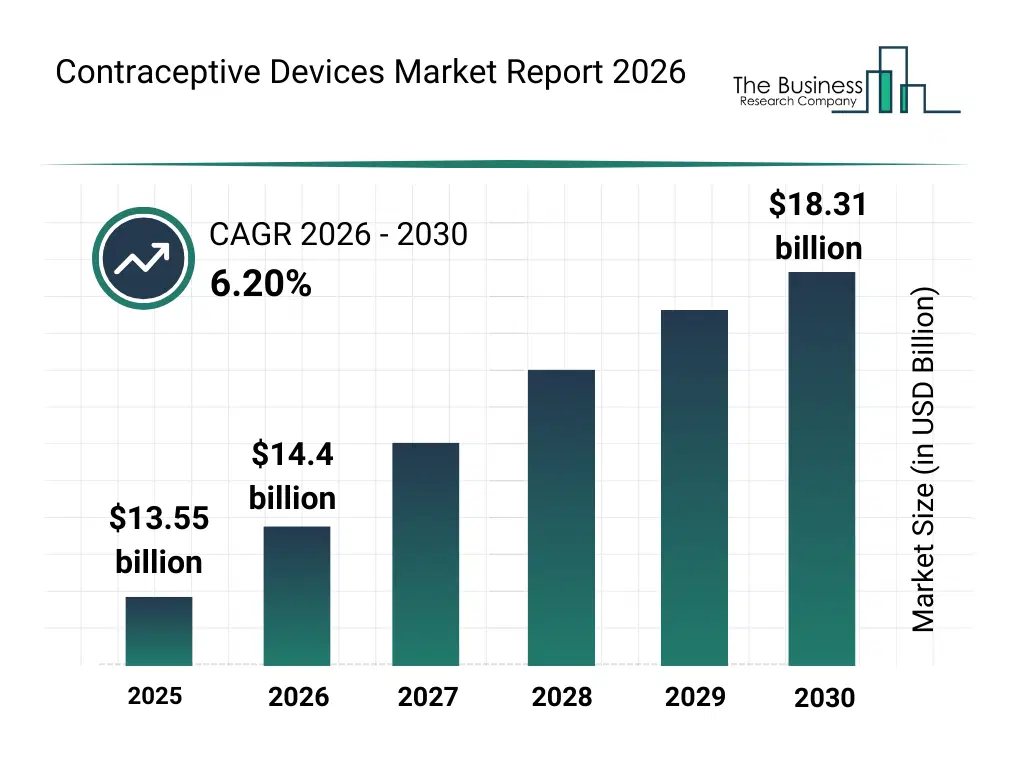
What Is The Contraceptive Devices Market Size and Share 2026?
The contraceptive devices market size has grown strongly in recent years. It will grow from $13.55 billion in 2025 to $14.4 billion in 2026 at a compound annual growth rate (CAGR) of 6.3%. The growth in the historic period can be attributed to rising awareness of family planning methods, government-supported population control programs, increasing prevalence of unintended pregnancies, expansion of reproductive health services, growing availability of over-the-counter contraceptive products.What Is The Contraceptive Devices Market Growth Forecast?
The contraceptive devices market size is expected to see strong growth in the next few years. It will grow to $18.31 billion in 2030 at a compound annual growth rate (CAGR) of 6.2%. The growth in the forecast period can be attributed to increasing focus on reproductive autonomy and women’s health, rising demand for long-term and low-maintenance contraception, expansion of digital health and online pharmacy platforms, growing adoption of male contraceptive solutions, increasing public and ngo-led sexual health initiatives. Major trends in the forecast period include rising adoption of long-acting reversible contraceptives, increasing demand for female-controlled contraceptive options, growing acceptance of non-hormonal contraceptive devices, expansion of contraceptive access through online and public channels, increasing focus on dual protection against pregnancy and stis.
Global Contraceptive Devices Market Segmentation
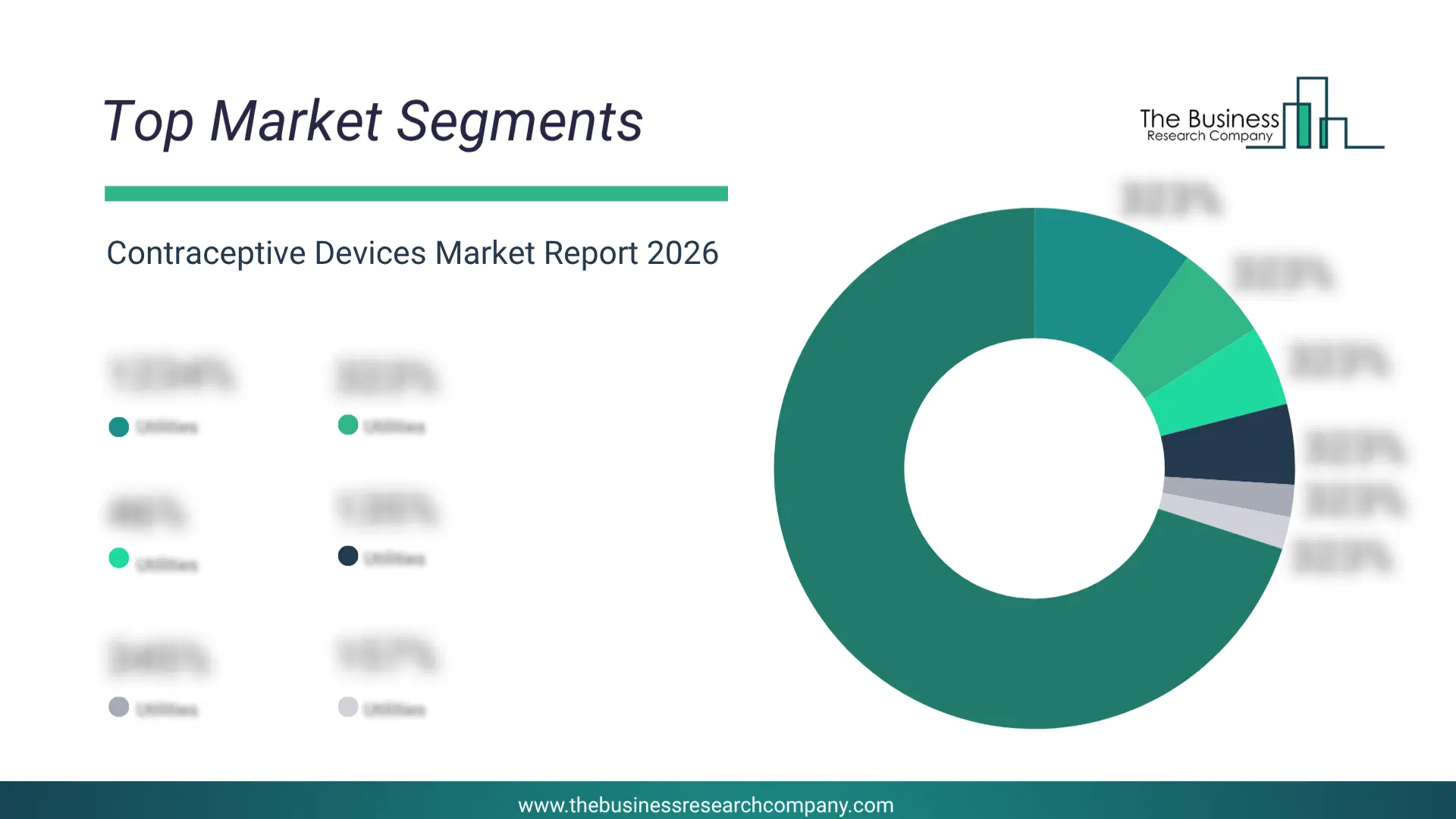
1) By Product Type: Male Contraceptive Devices, Female Contraceptive Devices, Female Condoms, Diaphragms And Sponges, Vaginal Rings, Intrauterine Devices, Sub-Dermal Implants, Others Product Types 2) By Technology: hormonal contraceptives, Barrier Contraceptives 3) By Distribution Channel: Hospital Pharmacy, Retail Pharmacy, Clinics, Online Channels, Public Channel And Non-Governmental Organization (NGO), Other Distribution Channels Subsegments: 1) By Male Contraceptive Devices: Male Condoms, Vasectomy Devices, Male Contraceptive Injections, Male Contraceptive Pills 2) By Female Contraceptive Devices: Female Condoms, Diaphragms And Sponges, Vaginal Rings, Intrauterine Devices (IUDs), Sub-Dermal Implants, Emergency Contraceptive Devices 3) By Female Condoms: Internal Latex Female Condoms, Non-Latex Female Condoms 4) By Diaphragms And Sponges: Silicone Diaphragms, Latex Diaphragms, Contraceptive Sponges 5) By Vaginal Rings: NuvaRing (And Other Hormonal Vaginal Rings), Non-Hormonal Vaginal Rings 6) By Intrauterine Devices (IUDs): Copper IUDs, Hormonal IUDs, Non-Hormonal IUDs 7) By Sub-Dermal Implants: Hormonal Implants, Non-Hormonal Implants 8) By Other Product Types: Contraceptive Patches, Contraceptive Injections, Contraceptive Pills, Contraceptive Gel And CreamsWhat Is The Driver Of The Contraceptive Devices Market?
The growing prevalence of sexually transmitted diseases is expected to propel the growth of the contraceptive device market going forward. Sexually transmitted diseases (STDs) are infections transmitted primarily through sexual contact, affecting various body parts and potentially leading to a range of symptoms and health complications. Sexually transmitted diseases are rising due to increased sexual activity, a lack of proper protection, insufficient sexual health education, and challenges in access to healthcare and testing. Contraceptive devices, especially condoms, are required for sexually transmitted diseases because they provide a barrier that reduces the risk of transmission by preventing direct contact with infectious fluids and lesions. For instance, in July 2024, according to a report published by the UK Health Security Agency, a UK-based government agency, in England, there were 401,800 new STI diagnoses in 2023, marking a 4.7% increase from the 383,789 cases reported in 2022. Diagnoses of gonorrhea rose by 7.5%, from 79,268 in 2022 to 85,223 in 2023. Meanwhile, infectious syphilis diagnoses saw a 9.4% increase, rising from 8,693 in 2022 to 9,513 in 2023. Therefore, the growing prevalence of sexually transmitted diseases is driving the growth of the contraceptive device industry.Key Players In The Global Contraceptive Devices Market
Major companies operating in the contraceptive devices market are Pfizer Inc., Johnson & Johnson Services Inc., Bayer AG, Teva Pharmaceutical Industries Ltd., Mylan N.V., Organon Group, Hologic Inc., CooperSurgical Inc., Cipla Inc., Mankind Pharma Ltd., TTK HealthCare Ltd., Merck Sharp & Dohme Corp., Evofem Biosciences Inc., Veru Inc., Agile Therapeutics Inc., Janssen Global Services LLC, HLL Lifecare Ltd., Mayer Laboratories Inc., V-Care Pharma Pvt. Ltd., Vardhaman Lifecare Pvt. Ltd., Actavis Pharma LLC, Pregna International Limited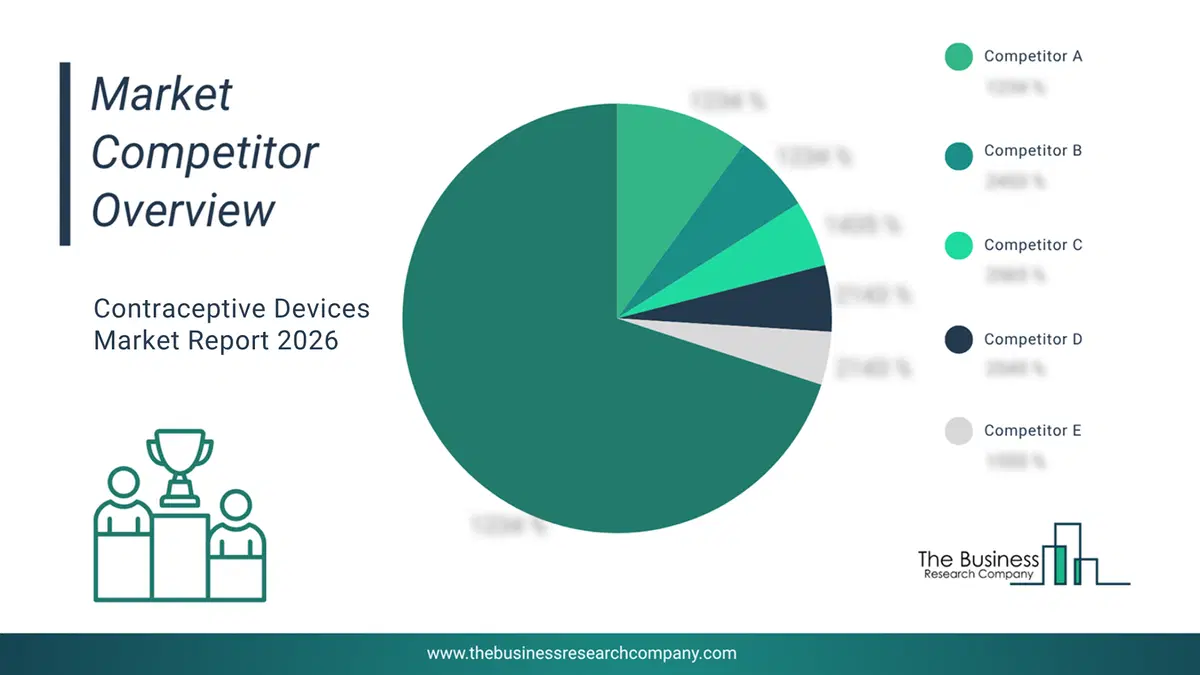
This chart is for illustrative purposes; the full report includes a detailed competitor analysis and comprehensive overview of the top 10 companies in the market.
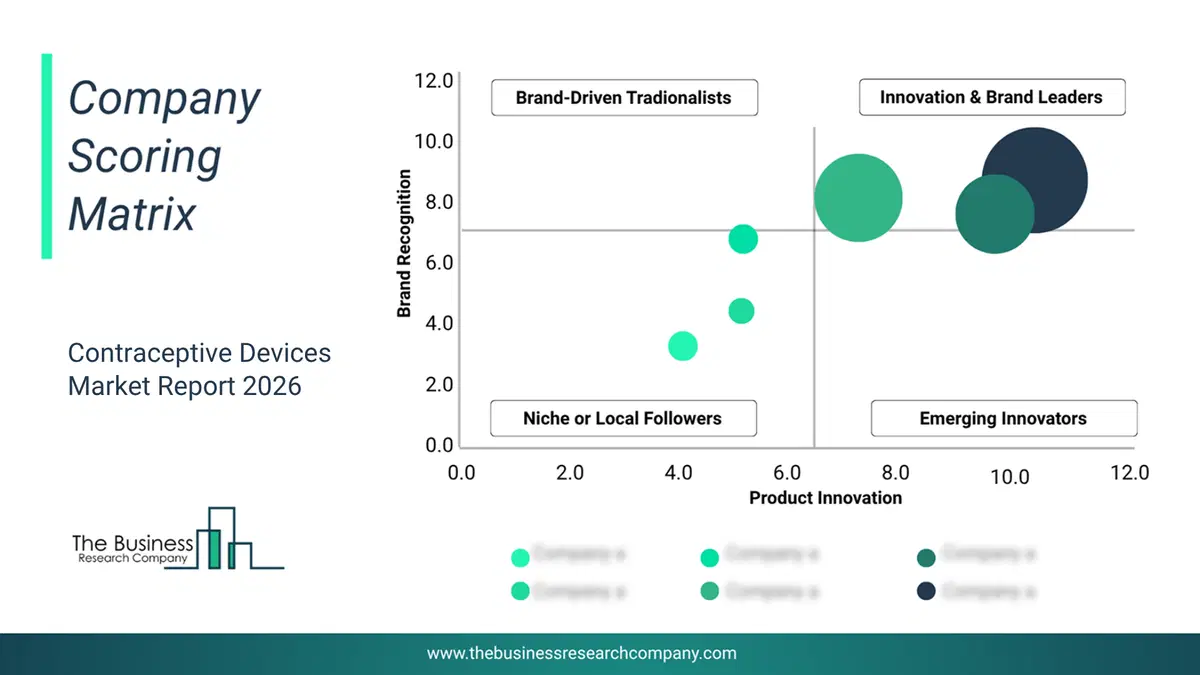
This chart maps companies by product innovation and brand strength, with bubble size indicating relative revenue, helping identify market leaders, challengers, and niche players. This is an illustrative chart; the full report provides a complete and accurate competitive analysis.
Global Contraceptive Devices Market Trends and Insights
Major companies operating in the contraceptive device market are developing innovative products, such as contraceptive vaginal rings, to provide a convenient, low-maintenance method of birth control with a once-a-month insertion. A contraceptive vaginal ring is a flexible, hormone-releasing device inserted into the vagina that prevents pregnancy by continuously releasing hormones to inhibit ovulation and thicken cervical mucus. For instance, in October 2023, Xiromed LLC, a US-based pharmaceuticals company, launched the EnilloRing. The EnilloRing, developed by Xiromed, is a contraceptive vaginal ring that combines etonogestrel and ethinyl estradiol. It is designed for long-term use, remaining in place for three weeks. After this period, it is followed by a one-week ring-free interval to effectively prevent pregnancy.What Are Latest Mergers And Acquisitions In The Contraceptive Devices Market?
In December 2023, Aditxt, a US-based life sciences company, acquired Evofem Biosciences for a deal of $100 million. This acquisition includes Evofem's FDA-approved hormone-free contraceptive gel, Phexxi (lactic acid, citric acid, and potassium bitartrate). Aditxt aims to leverage this acquisition to enhance its focus on innovations in autoimmunity, health metrics, life-extending transplant technologies, population health, and women's health. This move strengthens Aditxt's collaborative ecosystem, maximizing the potential of each subsidiary. Evofem Biosciences is a US-based manufacturer of contraceptive devices.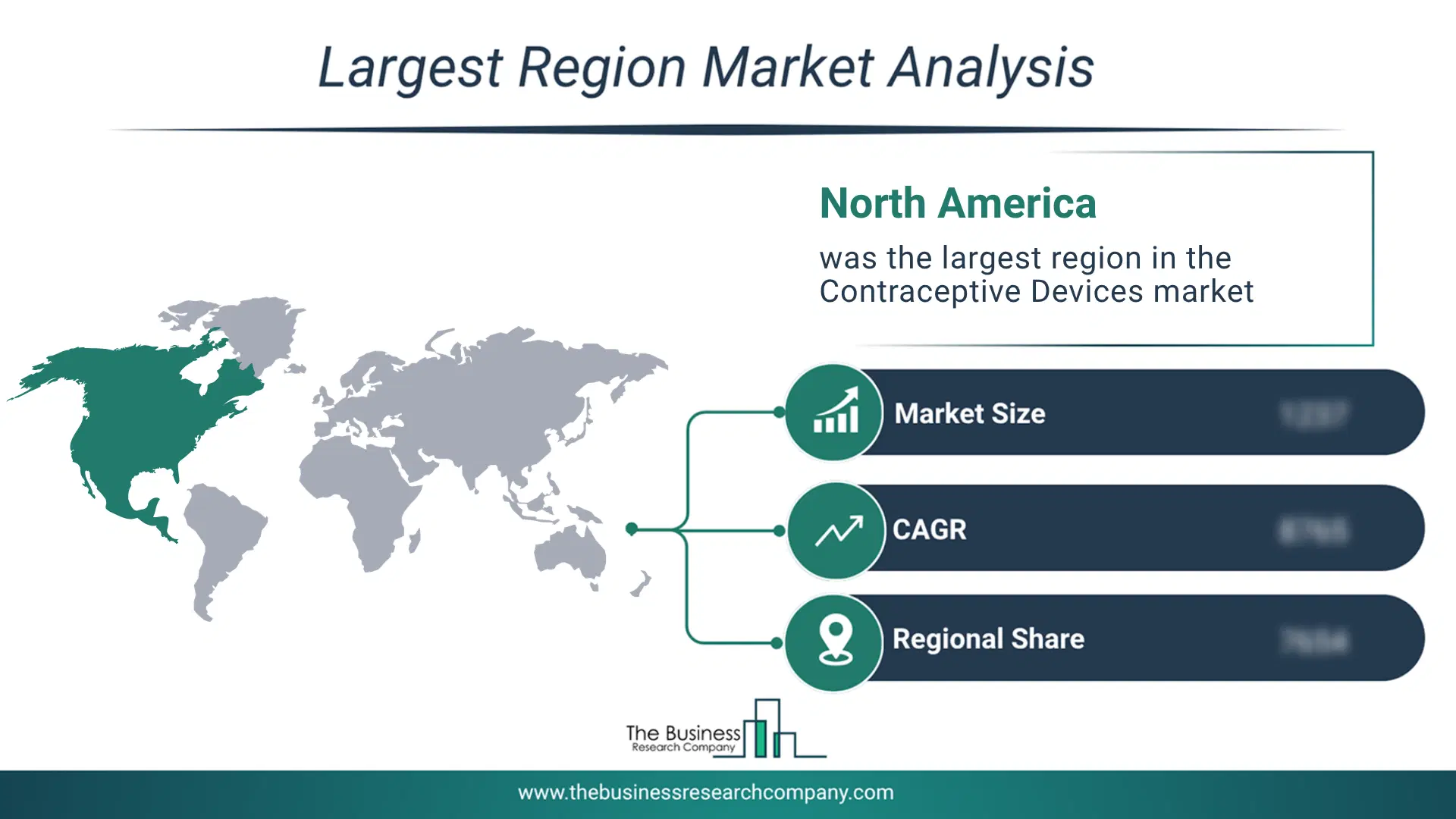
Regional Outlook
North America was the largest region in the contraceptive devices market in 2025. Asia-Pacific is expected to be the fastest-growing region in the forecast period. The regions covered in this market report are Asia-Pacific, South East Asia, Western Europe, Eastern Europe, North America, South America, Middle East, Africa. The countries covered in this market report are Australia, Brazil, China, France, Germany, India, Indonesia, Japan, Taiwan, Russia, South Korea, UK, USA, Canada, Italy, SpainWhat Defines the Contraceptive Devices Market?
The contraceptive devices market consists of sales of cervical caps, hormonal injections, emergency contraceptive devices and sterilization products. Values in this market are ‘factory gate’ values, that is the value of goods sold by the manufacturers or creators of the goods, whether to other entities (including downstream manufacturers, wholesalers, distributors and retailers) or directly to end customers. The value of goods in this market includes related services sold by the creators of the goods.How is Market Value Defined and Measured?
The market value is defined as the revenues that enterprises gain from the sale of goods and/or services within the specified market and geography through sales, grants, or donations in terms of the currency (in USD unless otherwise specified). The revenues for a specified geography are consumption values that are revenues generated by organizations in the specified geography within the market, irrespective of where they are produced. It does not include revenues from resales along the supply chain, either further along the supply chain or as part of other products.
This chart presents market attractiveness based on a quantitative evaluation of growth, competition, strategic alignment, and risk, offering a clear view of opportunity areas for decision-making. This chart is for illustrative purposes; the full report contains the complete analysis.

This chart highlights the Total Addressable Market (TAM) by estimating the maximum revenue opportunity using an assumption-driven approach, supporting strategic planning and opportunity sizing across markets. The chart is illustrative; the full report provides a more comprehensive analysis.
What Key Data and Analysis Are Included in the Contraceptive Devices Market Report 2026?
The contraceptive devices market research report is one of a series of new reports from The Business Research Company that provides market statistics, including industry global market size, regional shares, competitors with the market share, detailed market segments, market trends and opportunities, and any further data you may need to thrive in the contraceptive devices industry. The market research report delivers a complete perspective of everything you need, with an in-depth analysis of the current and future state of the industry.Contraceptive Devices Market Report Forecast Analysis
| Report Attribute | Details |
|---|---|
| Market Size Value In 2026 | $14.4 billion |
| Revenue Forecast In 2030 | $18.31 billion |
| Growth Rate | CAGR of 6.2% from 2026 to 2030 |
| Base Year For Estimation | 2025 |
| Actual Estimates/Historical Data | 2020-2025 |
| Forecast Period | 2026 - 2030 |
| Market Representation | Revenue in USD Billion and CAGR from 2026 to 2030 |
| Segments Covered | Product Type, Technology, Distribution Channel |
| Regional Scope | Asia-Pacific, Western Europe, Eastern Europe, North America, South America, Middle East, Africa |
| Country Scope | The countries covered in the report are Australia, Brazil, China, France, Germany, India, Indonesia, Japan, Taiwan, Russia, South Korea, UK, USA, Canada, Italy, Spain. |
| Key Companies Profiled | Pfizer Inc., Johnson & Johnson Services Inc., Bayer AG, Teva Pharmaceutical Industries Ltd., Mylan N.V., Organon Group, Hologic Inc., CooperSurgical Inc., Cipla Inc., Mankind Pharma Ltd., TTK HealthCare Ltd., Merck Sharp & Dohme Corp., Evofem Biosciences Inc., Veru Inc., Agile Therapeutics Inc., Janssen Global Services LLC, HLL Lifecare Ltd., Mayer Laboratories Inc., V-Care Pharma Pvt. Ltd., Vardhaman Lifecare Pvt. Ltd., Actavis Pharma LLC, Pregna International Limited |
| Customization Scope | Request for Customization |
| Pricing And Purchase Options | Explore Purchase Options |