
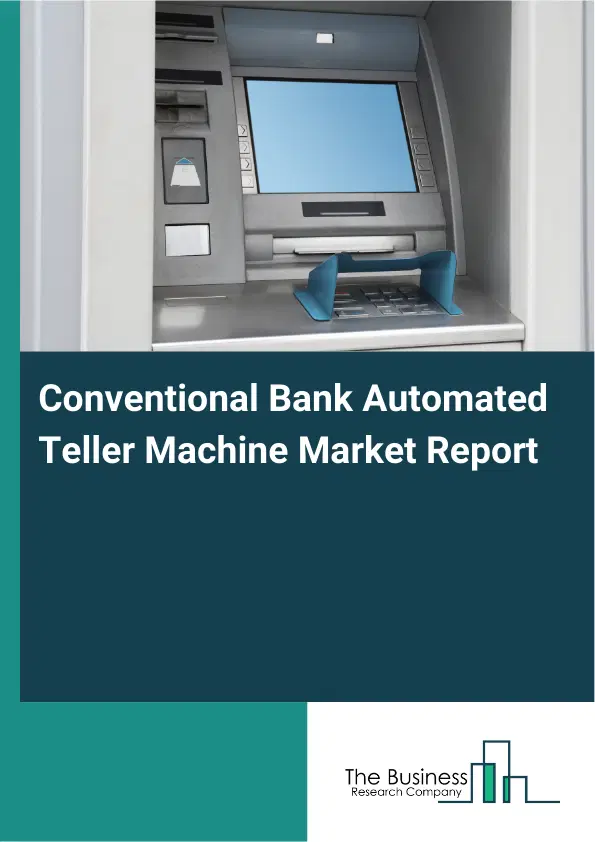
Conventional Bank Automated Teller Machine Market Report 2026
Global Outlook – By Type (Stand-Alone Automated Teller Machines (ATMs), Wall-Mounted Automated Teller Machines (ATMs), Floorstanding Automated Teller Machines (ATMs)), By Component (Hardware, Software, Services), By Transaction Types (Cash Withdrawals, Balance Inquiries, Fund Transfers, Bill Payments, Check Deposits), By Technology Usage (Conventional Automated Teller Machines (ATMs), Semi-Interactive Automated Teller Machines (ATMs), Fully Interactive Automated Teller Machines (ATMs), Contactless Automated Teller Machines (ATMs), Mobile-Integrated Automated Teller Machines (ATMs)), By End User (Banking, Retail, Government, Hospitals, Other End Users) – Market Size, Trends, Strategies, and Forecast to 2030
Conventional Bank Automated Teller Machine Market Overview
• Conventional Bank Automated Teller Machine market size has reached to $28.4 billion in 2025 • Expected to grow to $36.42 billion in 2030 at a compound annual growth rate (CAGR) of 5% • Growth Driver: Rising Demand For Cash Transactions Fueling The Growth Of The Market Due To Limited Digital Access In Rural Areas • Market Trend: Innovative Upgradable ATMs Revolutionizing Conventional Banking Services • North America was the largest region in 2025 and Asia-Pacific is the fastest growing region.What Is Covered Under Conventional Bank Automated Teller Machine Market?
A conventional bank automated teller machine (ATM) refers to a computerized banking terminal installed by financial institutions that allows customers to interact with their bank accounts through a secure interface using a card and personal identification number. It is designed as an independent, self-contained system that operates under the bank’s network to authenticate users and process financial instructions without the involvement of human staff. The main types of conventional bank automated teller machines are stand-alone automated teller machines (ATMs), wall-mounted automated teller machines (ATMs), and floor-standing automated teller machines (ATMs). Stand-alone ATMs are self-contained machines that operate independently without requiring integration into a wall or structure. It includes various components, such as hardware, software, services, and transaction types, including cash withdrawals, balance inquiries, fund transfers, bill payments, and check deposits. It includes various technology usages such as conventional automated teller machines (ATMs), semi-interactive automated teller machines (ATMs), fully interactive automated teller machines (ATMs), contactless automated teller machines (ATMs), and mobile-integrated automated teller machines (ATMs) that cater to diverse end users, including banking, retail, government, hospitals, and others.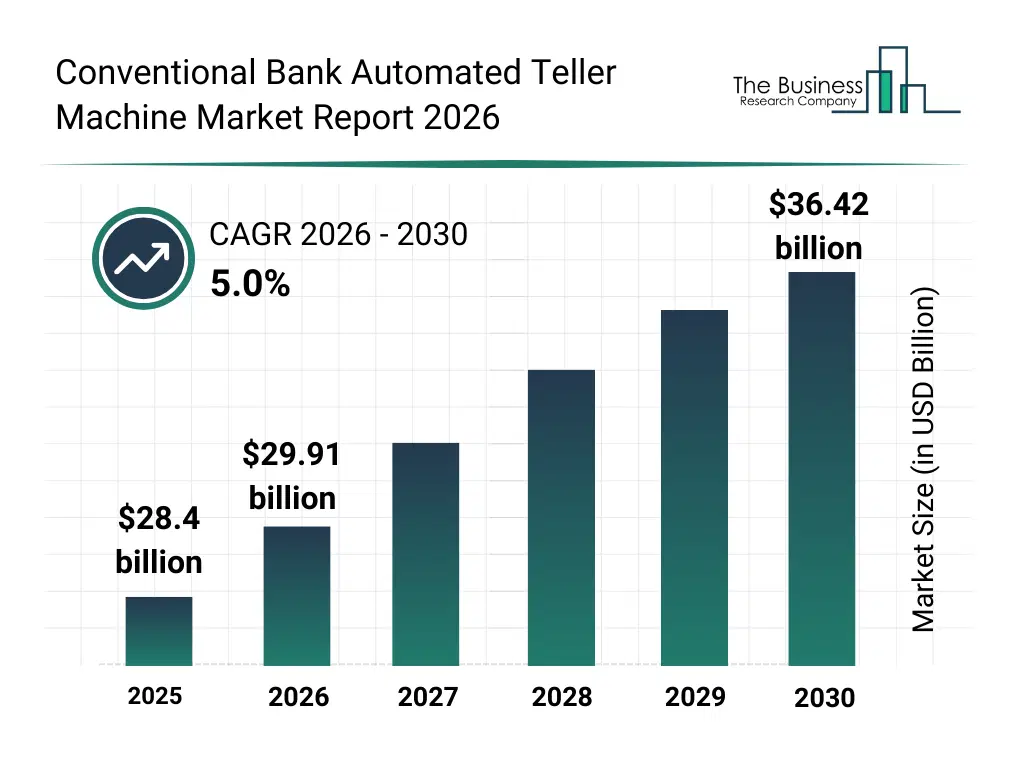
What Is The Conventional Bank Automated Teller Machine Market Size and Share 2026?
The conventional bank automated teller machine market size has grown strongly in recent years. It will grow from $28.4 billion in 2025 to $29.91 billion in 2026 at a compound annual growth rate (CAGR) of 5.3%. The growth in the historic period can be attributed to expansion of retail banking networks, rising demand for self-service banking channels, increased urban and semi-urban atm installations, improvements in transaction processing systems, widespread card-based banking usage.What Is The Conventional Bank Automated Teller Machine Market Growth Forecast?
The conventional bank automated teller machine market size is expected to see strong growth in the next few years. It will grow to $36.42 billion in 2030 at a compound annual growth rate (CAGR) of 5.0%. The growth in the forecast period can be attributed to increasing demand for secure cash access points, rising investments in atm modernization, expansion of hybrid physical-digital banking models, growing focus on fraud prevention technologies, continued need for financial inclusion infrastructure. Major trends in the forecast period include increasing deployment of contactless atm interfaces, rising integration of advanced security features, growing adoption of software-driven atm upgrades, expansion of multi-function atm capabilities, enhanced focus on network reliability and uptime.
Global Conventional Bank Automated Teller Machine Market Segmentation
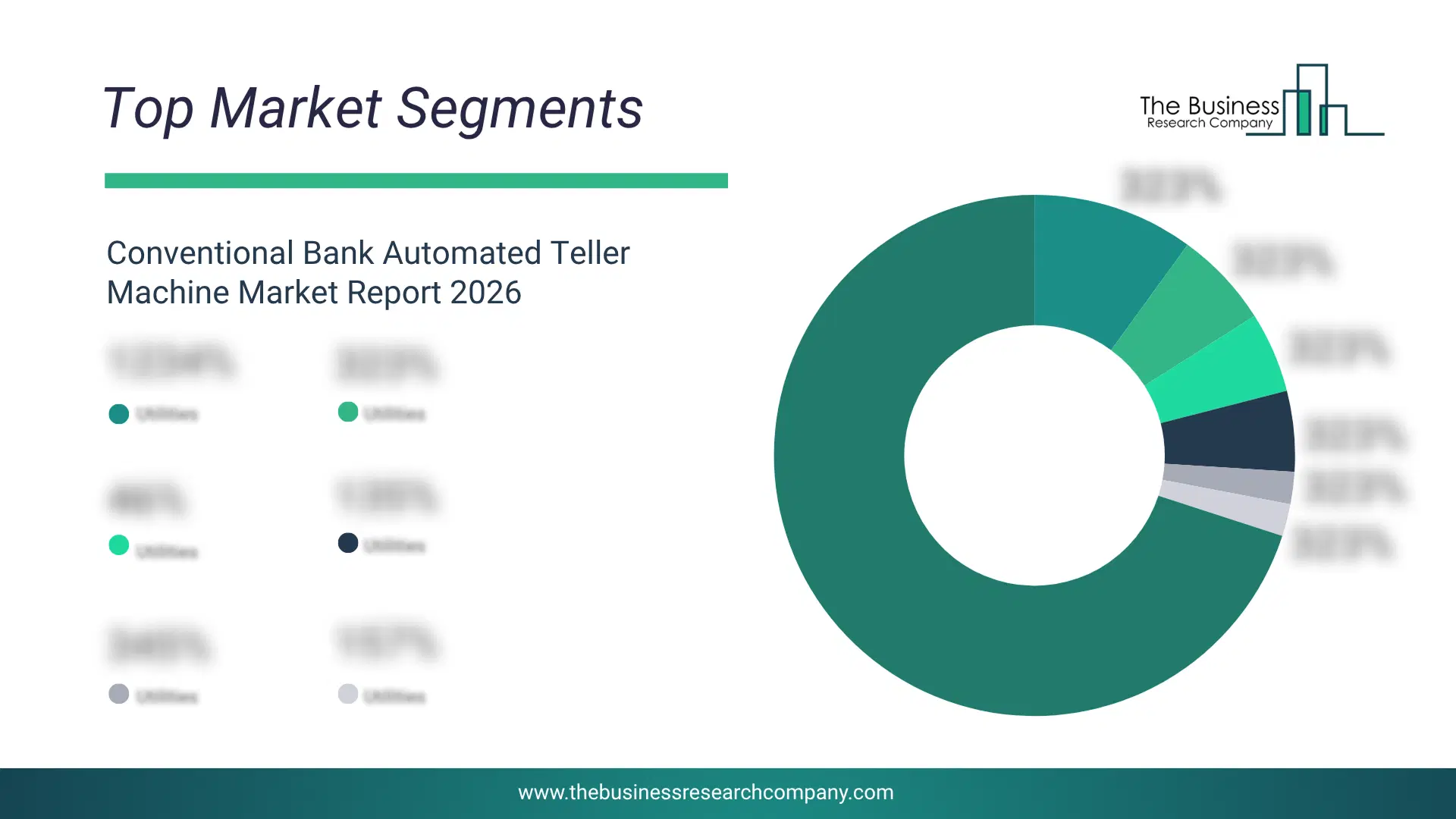
1) By Type: Stand-Alone Automated Teller Machines (ATMs), Wall-Mounted Automated Teller Machines (ATMs), Floorstanding Automated Teller Machines (ATMs) 2) By Component: Hardware, Software, Services 3) By Transaction Types: Cash Withdrawals, Balance Inquiries, Fund Transfers, Bill Payments, Check Deposits 4) By Technology Usage: Conventional Automated Teller Machines (ATMs), Semi-Interactive Automated Teller Machines (ATMs), Fully Interactive Automated Teller Machines (ATMs), Contactless Automated Teller Machines (ATMs), Mobile-Integrated Automated Teller Machines (ATMs) 5) By End User: Banking, Retail, Government, Hospitals, Other End Users Subsegments: 1) By Stand-Alone Automated Teller Machines: Compact Stand-Alone Automated Teller Machine, Weather-Resistant Stand-Alone Automated Teller Machine, Drive-Up Stand-Alone Automated Teller Machine 2) By Wall-Mounted Automated Teller Machines: Indoor Wall-Mounted Automated Teller Machine, Outdoor Wall-Mounted Automated Teller Machine, Recessed Wall-Mounted Automated Teller Machine 3) By Floorstanding Automated Teller Machines: Lobby Floorstanding Automated Teller Machine, Through-The-Wall Floorstanding Automated Teller Machine, Island Floorstanding Automated Teller MachineWhat Is The Driver Of The Conventional Bank Automated Teller Machine Market?
The rising demand for cash transactions is expected to propel the growth of the conventional bank automated teller machine market going forward. Cash transactions refer to payments made using physical currency, such as coins or banknotes, instead of digital or electronic methods. The demand for cash transactions is rising in rural areas due to limited access to digital infrastructure and unreliable internet connectivity, making physical currency a more dependable option for everyday purchases. Conventional bank automated teller machines are useful for cash transactions, as they allow users to conveniently withdraw or deposit physical currency without visiting a bank branch. For instance, in January 2025, according to CashEssentials, a Greece-based independent think tank, there were around 32.8 million cash withdrawals across its 1,260 ATMs and 605 branches in 2024, reflecting a 10% rise compared to 2023. Therefore, the rising demand for cash transactions is driving the growth of the conventional bank automated teller machine industry.Key Players In The Global Conventional Bank Automated Teller Machine Market
Major companies operating in the conventional bank automated teller machine market are Hitachi Ltd., Fujitsu Limited, NCR Corporation, Diebold Nixdorf Incorporated, Euronet Worldwide Inc., Tietoevry Corporation, OKI Electric Industry Co. Ltd., Genmega Inc., Hyosung TNS Inc., ACI Worldwide Inc., GRG Banking Equipment Co. Ltd., KEBA AG, Nautilus Hyosung America Inc., Auriga SpA, KAL ATM Software GmbH, Sigma S.p.A, Vortex Engineering Pvt Ltd, Automated Transaction Delivery Ltd., Ark Technologies Group, CMS Info Systems Ltd., Triton Systems of Delaware LLC, Puloon Technology Co. Ltd.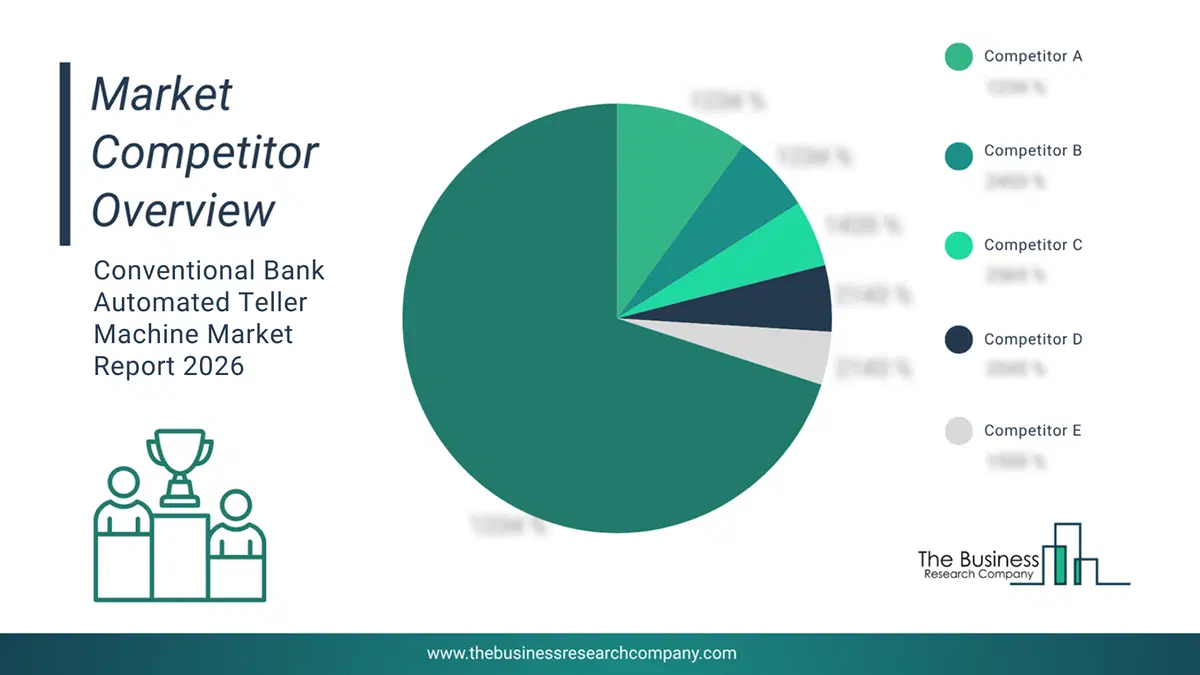
This chart is for illustrative purposes; the full report includes a detailed competitor analysis and comprehensive overview of the top 10 companies in the market.
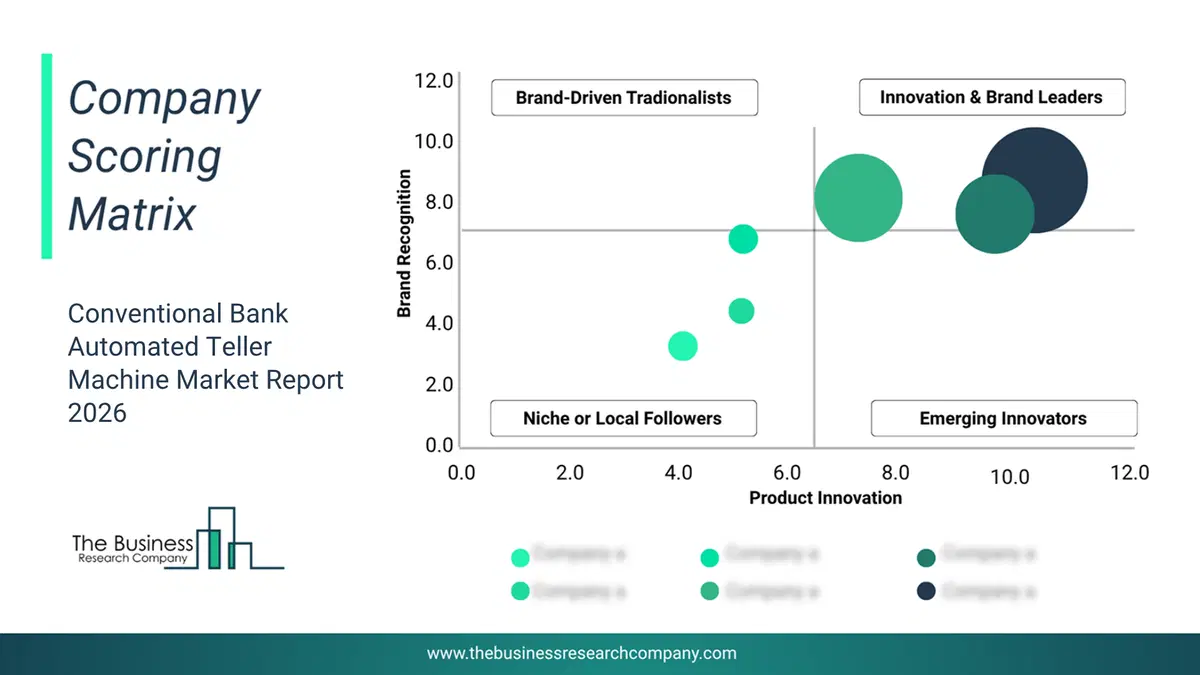
This chart maps companies by product innovation and brand strength, with bubble size indicating relative revenue, helping identify market leaders, challengers, and niche players. This is an illustrative chart; the full report provides a complete and accurate competitive analysis.
Global Conventional Bank Automated Teller Machine Market Trends and Insights
Major companies operating in the conventional bank automated teller machine market are focusing on introducing advanced ATM solutions, such as upgradable automated teller machines, to enhance functionality, reduce operational costs, and meet evolving customer and regulatory demands. Upgradable automated teller machines refer to modular ATMs that can be enhanced with new hardware or software features, allowing banks to adapt to evolving technologies and customer needs without replacing the entire unit. For instance, in April 2024, Hitachi Payment Services Ltd., a Japan-based company that provides a range of payment solutions, launched India's first upgradable ATM, a machine that initially offers cash withdrawal services and can be efficiently upgraded to a high-performance cash recycling machine (CRM) whenever needed. This upgrade, which takes just about 4 hours, avoids the costly and time-consuming process of replacing ATMs, allowing banks to safeguard their investment and expand services such as cash deposits at non-branch locations based on market conditions. Designed under the Make in India initiative, these ATMs also support UPI-based cash withdrawals and deposits, aligning with recent RBI policies, making banking more flexible, and improving financial inclusion in underserved regions.What Are Latest Mergers And Acquisitions In The Conventional Bank Automated Teller Machine Market?
In April 2025, BRIDGE Bank, a US-based investment bank that provides business banking products and services, partnered with BTI Payments Cambodia to enhance automated teller machine services. This partnership aims to collaboratively enhance and expand BRIDGE Bank’s ATM and self-service banking infrastructure by deploying advanced technologies, improving service availability, and ultimately providing customers with a more convenient, efficient, and seamless digital banking experience through innovative and reliable automated teller machines and support services. BTI Payments Cambodia is a Cambodia-based company that specializes in providing financial services, particularly through the deployment and management of ATMs.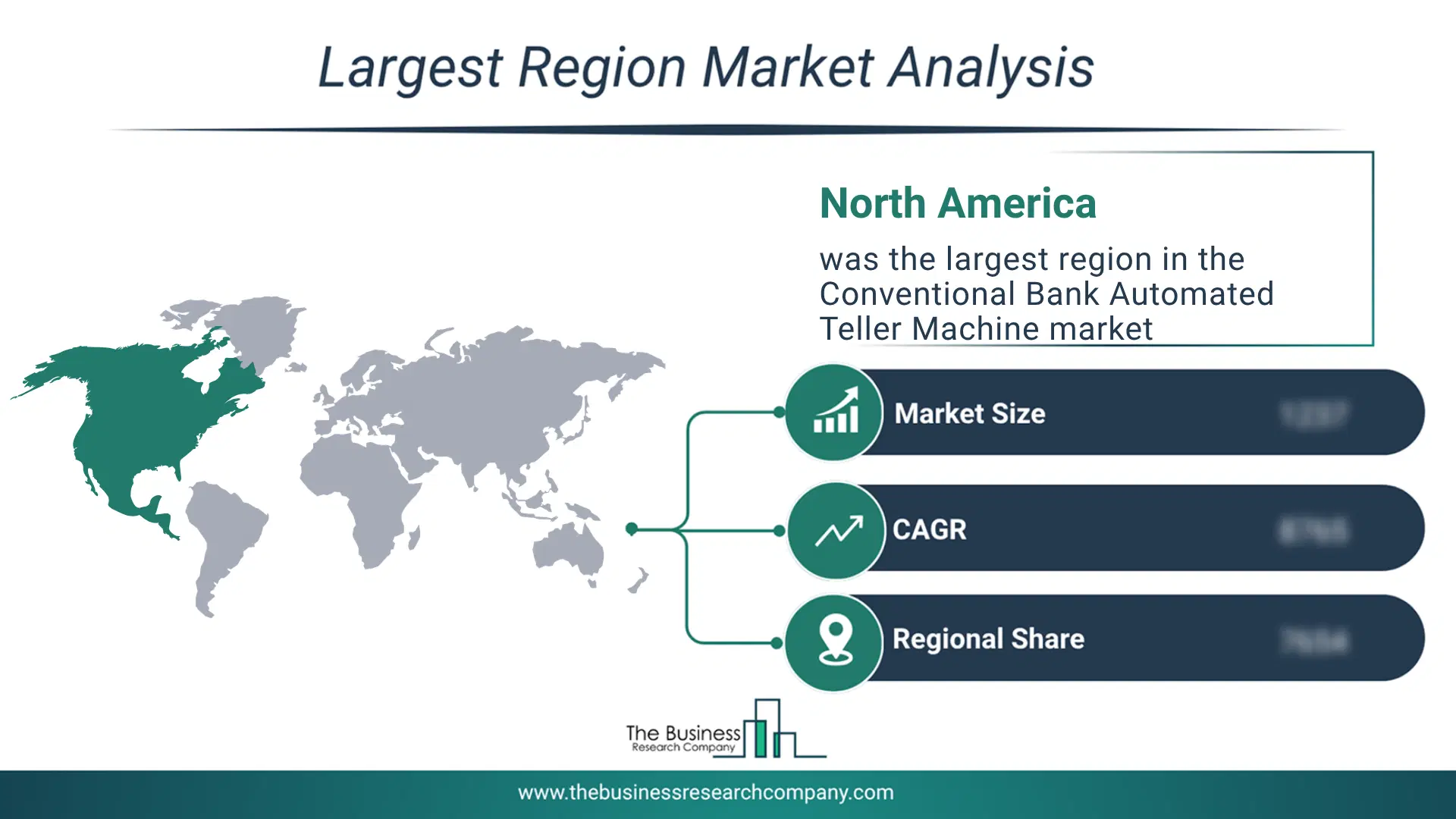
Regional Outlook
North America was the largest region in the conventional bank automated teller machine market in 2025. Asia-Pacific is expected to be the fastest-growing region in the forecast period. The regions covered in this market report are Asia-Pacific, South East Asia, Western Europe, Eastern Europe, North America, South America, Middle East, Africa. The countries covered in this market report are Australia, Brazil, China, France, Germany, India, Indonesia, Japan, Taiwan, Russia, South Korea, UK, USA, Canada, Italy, Spain.What Defines the Conventional Bank Automated Teller Machine Market?
The conventional bank automated teller machine market consists of revenues earned by entities by providing services such as cash withdrawal, balance inquiry, mini statement, fund transfer, and cash deposit. The market value includes the value of related goods sold by the service provider or included within the service offering. The conventional bank automated teller machine market also includes sales of banknotes, transaction receipts, mini statement printouts, and cheque deposit envelopes. Values in this market are ‘factory gate’ values, that is, the value of goods sold by the manufacturers or creators of the goods, whether to other entities (including downstream manufacturers, wholesalers, distributors, and retailers) or directly to end customers. The value of goods in this market includes related services sold by the creators of the goods.How is Market Value Defined and Measured?
The market value is defined as the revenues that enterprises gain from the sale of goods and/or services within the specified market and geography through sales, grants, or donations in terms of the currency (in USD unless otherwise specified). The revenues for a specified geography are consumption values that are revenues generated by organizations in the specified geography within the market, irrespective of where they are produced. It does not include revenues from resales along the supply chain, either further along the supply chain or as part of other products.
This chart presents market attractiveness based on a quantitative evaluation of growth, competition, strategic alignment, and risk, offering a clear view of opportunity areas for decision-making. This chart is for illustrative purposes; the full report contains the complete analysis.

This chart highlights the Total Addressable Market (TAM) by estimating the maximum revenue opportunity using an assumption-driven approach, supporting strategic planning and opportunity sizing across markets. The chart is illustrative; the full report provides a more comprehensive analysis.
What Key Data and Analysis Are Included in the Conventional Bank Automated Teller Machine Market Report 2026?
The conventional bank automated teller machine market research report is one of a series of new reports from The Business Research Company that provides market statistics, including Market Report 2026?global market size, regional shares, competitors with the market share, detailed market segments, market trends and opportunities, and any further data you may need to thrive in the conventional bank automated teller machine Market Report 2026? The market research report delivers a complete perspective of everything you need, with an in-depth analysis of the current and future state of the Market Report 2026?Conventional Bank Automated Teller Machine Market Report Forecast Analysis
| Report Attribute | Details |
|---|---|
| Market Size Value In 2026 | $29.91 billion |
| Revenue Forecast In 2030 | $36.42 billion |
| Growth Rate | CAGR of 5.3% from 2026 to 2030 |
| Base Year For Estimation | 2025 |
| Actual Estimates/Historical Data | 2020-2025 |
| Forecast Period | 2026 - 2030 |
| Market Representation | Revenue in USD Billion and CAGR from 2026 to 2030 |
| Segments Covered | Type, Component, Transaction Types, Technology Usage, End User |
| Regional Scope | Asia-Pacific, Western Europe, Eastern Europe, North America, South America, Middle East, Africa |
| Country Scope | The countries covered in the report are Australia, Brazil, China, France, Germany, India, Indonesia, Japan, Taiwan, Russia, South Korea, UK, USA, Canada, Italy, Spain. |
| Key Companies Profiled | Hitachi Ltd., Fujitsu Limited, NCR Corporation, Diebold Nixdorf Incorporated, Euronet Worldwide Inc., Tietoevry Corporation, OKI Electric Industry Co. Ltd., Genmega Inc., Hyosung TNS Inc., ACI Worldwide Inc., GRG Banking Equipment Co. Ltd., KEBA AG, Nautilus Hyosung America Inc., Auriga SpA, KAL ATM Software GmbH, Sigma S.p.A, Vortex Engineering Pvt Ltd, Automated Transaction Delivery Ltd., Ark Technologies Group, CMS Info Systems Ltd., Triton Systems of Delaware LLC, Puloon Technology Co. Ltd. |
| Customization Scope | Request for Customization |
| Pricing And Purchase Options | Explore Purchase Options |