
Coolant Corrosion Inhibitor Market Report 2026
Global Outlook – By Product Type (Organic Acid Technology, Hybrid Organic Acid Technology, Inorganic Additive Technology, Other Product Types), By Form (Liquid, Powder, Tablet), By Distribution Channel (Original Equipment Manufacturers, Aftermarket, Online Retail, Other Distribution Channels), By Application (Automotive, Industrial, Marine, Aerospace, Other Applications), By End-User (Passenger Vehicles, Commercial Vehicles, Industrial Equipment, Other End-Users) – Market Size, Trends, Strategies, and Forecast to 2035
Coolant Corrosion Inhibitor Market Overview
• Coolant Corrosion Inhibitor market size has reached to $3.39 billion in 2025 • Expected to grow to $4.48 billion in 2030 at a compound annual growth rate (CAGR) of 5.8% • Growth Driver: Rising Automotive Production Is Driving The Market Due To Greater Demand For Corrosion Protection In Vehicle Cooling Systems During Manufacturing • Market Trend: Advancements In Phosphated Organic Acid Technology Enhances Coolant Corrosion Protection And Service Life • North America was the largest region in 2025 and Asia-Pacific is the fastest growing region.What Is Covered Under Coolant Corrosion Inhibitor Market?
A coolant corrosion inhibitor is a chemical additive used in engine coolants to protect metal components such as radiators, water pumps, and engine blocks from corrosion. It creates a protective film that minimizes oxidation and rust formation. A coolant corrosion inhibitor enhances cooling system durability, improves heat transfer efficiency, and prevents damage from scale buildup, pitting, and electrochemical reactions. The main product types of coolant corrosion inhibitor include organic acid technology, hybrid organic acid technology, inorganic additive technology, and other product types. Organic acid technology refers to advanced chemical formulations designed to prevent corrosion in engine cooling systems by forming a protective layer on metal surfaces. These products are available in forms such as liquid, powder, and tablet and are distributed through original equipment manufacturers, aftermarket, online retail, and other distribution channels. The various applications involved are automotive, industrial, marine, aerospace, and others, and they are used by several end users such as passenger vehicles, commercial vehicles, industrial equipment, and others.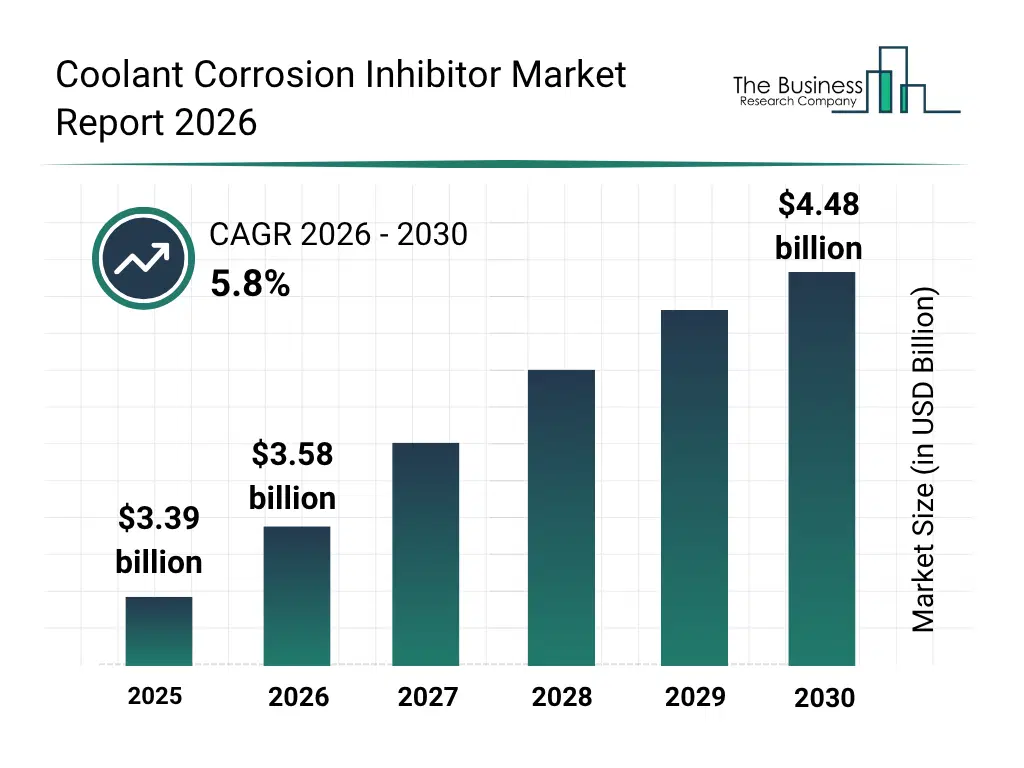
What Is The Coolant Corrosion Inhibitor Market Size and Share 2026?
The coolant corrosion inhibitor market size has grown strongly in recent years.It will grow from $3.39 billion in 2025 to $3.58 billion in 2026 at a compound annual growth rate (CAGR) of 5.6%. The growth in the historic period can be attributed to growing automotive production and vehicle parc expansion, increasing use of aluminum and mixed metal engine components, rising demand for engine cooling system durability, expansion of industrial equipment requiring advanced cooling systems, adoption of extended life coolant technologies.What Is The Coolant Corrosion Inhibitor Market Growth Forecast?
The coolant corrosion inhibitor market size is expected to see strong growth in the next few years.It will grow to $4.48 billion by 2030 at a compound annual growth rate (CAGR) of 5.8%. The growth in the forecast period can be attributed to increasing demand for thermal management solutions in electric vehicles, rising adoption of eco friendly and bio based coolant additives, growing investments in industrial automation cooling systems, expansion of heavy duty commercial vehicle fleets, increasing focus on preventive maintenance and cooling efficiency optimization.Major trends in the forecast period include increasing adoption of long life corrosion protection coolant formulations, rising demand for multi metal compatible coolant corrosion inhibitors, growing use of scale and deposit prevention additives in cooling systems, expansion of high performance coolants for extreme temperature applications, increasing preference for extended drain interval cooling system solutions.
Global Coolant Corrosion Inhibitor Market Segmentation
1) By Product Type: Organic Acid Technology, Hybrid Organic Acid Technology, Inorganic Additive Technology, Other Product Types 2) By Form: Liquid, Powder, Tablet 3) By Distribution Channel: Original Equipment Manufacturers, Aftermarket, Online Retail, Other Distribution Channels 4) By Application: Automotive, Industrial, Marine, Aerospace, Other Applications 5) By End-User: Passenger Vehicles, Commercial Vehicles, Industrial Equipment, Other End-Users Subsegments: 1) By Organic Acid Technology: Carboxylate Based Corrosion Inhibitors, Long Life Organic Acid Formulations, Silicate Free Organic Coolant Additives, Phosphate Free Organic Corrosion Inhibitors, Extended Drain Organic Coolant Solutions 2) By Hybrid Organic Acid Technology: Silicate Containing Hybrid Formulations, Phosphate Containing Hybrid Coolants, Low Silicate Hybrid Corrosion Inhibitors, Nitrite Enhanced Hybrid Coolant Additives, Multi Metal Protection Hybrid Formulations 3) By Inorganic Additive Technology: Silicate Based Corrosion Inhibitors, Phosphate Based Coolant Additives, Borate Based Corrosion Protection Solutions, Nitrite Based Cooling System Inhibitors, Molybdate Based Corrosion Inhibitors 4) By Other Product Types: Bio Based Corrosion Inhibitors, Nanotechnology Based Coolant Additives, Multi Functional Corrosion Protection Fluids, Custom Formulated Coolant Additives, Specialty Application Corrosion InhibitorsWhat Is The Driver Of The Coolant Corrosion Inhibitor Market?
The growth in automotive production is expected to propel the growth of the coolant corrosion inhibitor industry going forward.Automotive production is the process of manufacturing and assembling vehicles such as cars, trucks, and buses in factories using raw materials and components.Automotive production is increasing due to rising vehicle demand driven by higher incomes and rapid urbanization.Coolant corrosion inhibitors help automotive production by protecting engine cooling systems and metal components from rust, scaling, and corrosion, thereby improving vehicle durability and reliability during manufacturing and long-term use.For instance, in January 2025, according to the China Association of Automobile Manufacturers (CAAM), a China-based nonprofit industry association, in 2024, China’s vehicle production reached approximately 31.282 million units, representing a 3.7% increase compared to 2023.Therefore, the growth in automotive production is driving the growth of the coolant corrosion inhibitor industry.Key Players In The Global Coolant Corrosion Inhibitor Market
Major companies operating in the coolant corrosion inhibitor market are Sinopec Corporation, ExxonMobil Corporation, Shell plc, TotalEnergies SE, Chevron Corporation, BASF SE, Dow Inc., LyondellBasell Industries N. V., Cummins Inc., The Lubrizol Corporation, Huntsman Corporation, Clariant AG, Ashland Global Holdings Inc., Quaker Houghton, Afton Chemical Corporation, Valvoline Inc., Old World Industries LLC, PETRONAS Lubricants International (PLI), Gulf Oil International, Recochem Inc., KOST USA Inc., Motul S. A., Lukoil, Millers Oils Ltd., Prestone Products Corporation, Arteco NVGlobal Coolant Corrosion Inhibitor Market Trends and Insights
Major companies operating in the coolant corrosion inhibitor market are focusing on developing technological advancements, such as phosphated organic acid technology, to improve corrosion protection efficiency, extend coolant service life, enhance metal compatibility, and meet stricter environmental and performance standards. Phosphated organic acid technology is a coolant corrosion inhibitor system that uses organic acids and phosphates to form a protective layer on metal surfaces and prevent corrosion in engine cooling systems. For instance, in June 2025, FUCHS LUBRICANTES, a Germany-based manufacturing company, launched a FRICOFIN AV, a new multifunctional coolant based on P-OAT (phosphated organic acid) technology designed for modern automotive cooling systems. It is a high-quality coolant concentrate made from monoethylene glycol, designed to offer long-lasting protection for light, heavy-duty, hybrid, and electric vehicles (as long as there are no special electrical conductivity needs). It is free of silicates, borates, nitrites, amines, and 2-EHA, which helps reduce deposits and compatibility issues in mixed-material engine cooling systems.What Are Latest Mergers And Acquisitions In The Coolant Corrosion Inhibitor Market?
In November 2024, FUCHS Group, a Germany-based manufacturing company, acquired STRUB & Co. AG for an undisclosed amount. With this acquisition, FUCHS aimed to secure direct market access in Switzerland, consolidate its Swiss area lubricants activities, and strengthen its regional research, production, and innovation capabilities in industrial lubricants. STRUB & Co. AG is a Switzerland-based manufacturing company that offers coolant corrosion inhibitors.Regional Insights
North America was the largest region in the coolant corrosion inhibitor market in 2025. Asia-Pacific is expected to be the fastest-growing region in the forecast period. The regions covered in this market report are Asia-Pacific, South East Asia, Western Europe, Eastern Europe, North America, South America, Middle East and Africa. The countries covered in this market report are Australia, Brazil, China, France, Germany, India, Indonesia, Japan, Taiwan, Russia, South Korea, UK, USA, Canada, Italy, Spain.What Defines the Coolant Corrosion Inhibitor Market?
The coolant corrosion inhibitor market consists of sales of silicate-based coolant additives, amine-based corrosion inhibitor blends, and multi-metal compatible extended-life coolant additives. Values in this market are ‘factory gate’ values, that is, the value of goods sold by the manufacturers or creators of the goods, whether to other entities (including downstream manufacturers, wholesalers, distributors, and retailers) or directly to end customers. The value of goods in this market includes related services sold by the creators of the goods.What is the Market Assessment and Strategic Outlook for the Coolant Corrosion Inhibitor Industry?
The coolant corrosion inhibitor market research report is one of a series of new reports from The Business Research Company that provides market statistics, including industry global market size, regional shares, competitors with the market share, detailed market segments, market trends and opportunities, and any further data you may need to thrive in the coolant corrosion inhibitor industry. The market research report delivers a complete perspective of everything you need, with an in-depth analysis of the current and future state of the industry.What is the Market Assessment and Strategic Outlook for the Coolant Corrosion Inhibitor Market Report 2026?
The coolant corrosion inhibitor market research report is one of a series of new reports from The Business Research Company that provides coolant corrosion inhibitor market statistics, including coolant corrosion inhibitor industry global market size, regional shares, competitors with a coolant corrosion inhibitor market share, detailed coolant corrosion inhibitor market segments, market trends and opportunities, and any further data you may need to thrive in the coolant corrosion inhibitor industry. This coolant corrosion inhibitor market research report delivers a complete perspective of everything you need, with an in-depth analysis of the current and future scenario of the industry.Coolant Corrosion Inhibitor Market Report Forecast Analysis
| Report Attribute | Details |
|---|---|
| Market Size Value In 2026 | $3.58 billion |
| Revenue Forecast In 2035 | $4.48 billion |
| Growth Rate | CAGR of 5.8% from 2026 to 2035 |
| Base Year For Estimation | 2025 |
| Actual Estimates/Historical Data | 2020-2025 |
| Forecast Period | 2026 - 2030 - 2035 |
| Market Representation | Revenue in USD Billion and CAGR from 2026 to 2035 |
| Segments Covered | Product Type, Form, Distribution Channel, Application, End-User |
| Regional Scope | Asia-Pacific, Western Europe, Eastern Europe, North America, South America, Middle East, Africa |
| Country Scope | The countries covered in the report are Australia, Brazil, China, France, Germany, India, Indonesia, Japan, Taiwan, Russia, South Korea, UK, USA, Canada, Italy, Spain. |
| Key Companies Profiled | Sinopec Corporation, ExxonMobil Corporation, Shell plc, TotalEnergies SE, Chevron Corporation, BASF SE, Dow Inc., LyondellBasell Industries N. V., Cummins Inc., The Lubrizol Corporation, Huntsman Corporation, Clariant AG, Ashland Global Holdings Inc., Quaker Houghton, Afton Chemical Corporation, Valvoline Inc., Old World Industries LLC, PETRONAS Lubricants International (PLI), Gulf Oil International, Recochem Inc., KOST USA Inc., Motul S. A., Lukoil, Millers Oils Ltd., Prestone Products Corporation, Arteco NV |
| Customization Scope | Request for Customization |
| Pricing And Purchase Options | Explore Purchase Options |