

Core Satellite Networks Market Report 2026
Global Outlook – By Component (Hardware, Software, Services), By Deployment Model (On-Premises, Cloud-Based, Hybrid), By Frequency Band (L Band, S Band, C Band, X Band, Ku Band, Ka Band), By Application (Communication, Broadcasting, Navigation, Earth Observation, Remote Sensing, Surveillance), By End User (Telecom Operators, Government and Defense, Aerospace Industry, Maritime Industry, Aviation Industry, Energy and Utilities) – Market Size, Trends, Strategies, and Forecast to 2030
Core Satellite Networks Market Overview
• Core Satellite Networks market size has reached to $1.85 billion in 2025 • Expected to grow to $2 billion in 2030 at a compound annual growth rate (CAGR) of 8.3% • Growth Driver: Rising Demand For Global Connectivity Fueling The Growth Of The Market Due To Expanding Digital Services And Need For Reliable Communication In Remote Areas • Market Trend: Integrated Ka-Band Systems Strengthen Core Satellite Network Capabilities • North America was the largest region in 2025 and Asia-Pacific is the fastest growing region.What Is Covered Under Core Satellite Networks Market?
Core satellite networks are the central communication systems that manage data routing, connectivity, and control between satellites, ground stations, and terrestrial networks to ensure seamless global communication coverage. Their purpose is to enable reliable long-distance connectivity, support services such as broadband, navigation, broadcasting, and defense communications, and extend network access to remote or underserved areas. The main components of core satellite networks include hardware, software, and services. Hardware refers to the physical infrastructure such as satellites, ground stations, antennas, transponders, and associated equipment that form the backbone of satellite communication systems. The key deployment models such as on-premises, cloud-based, and hybrid. They are frequency bands such as L Band, S Band, C Band, X Band, Ku Band, and Ka Band and the key applications include communication, broadcasting, navigation, earth observation, remote sensing, and surveillance and the key end users include telecom operators, government and defense, aerospace industry, maritime industry, aviation industry, and energy and utilities.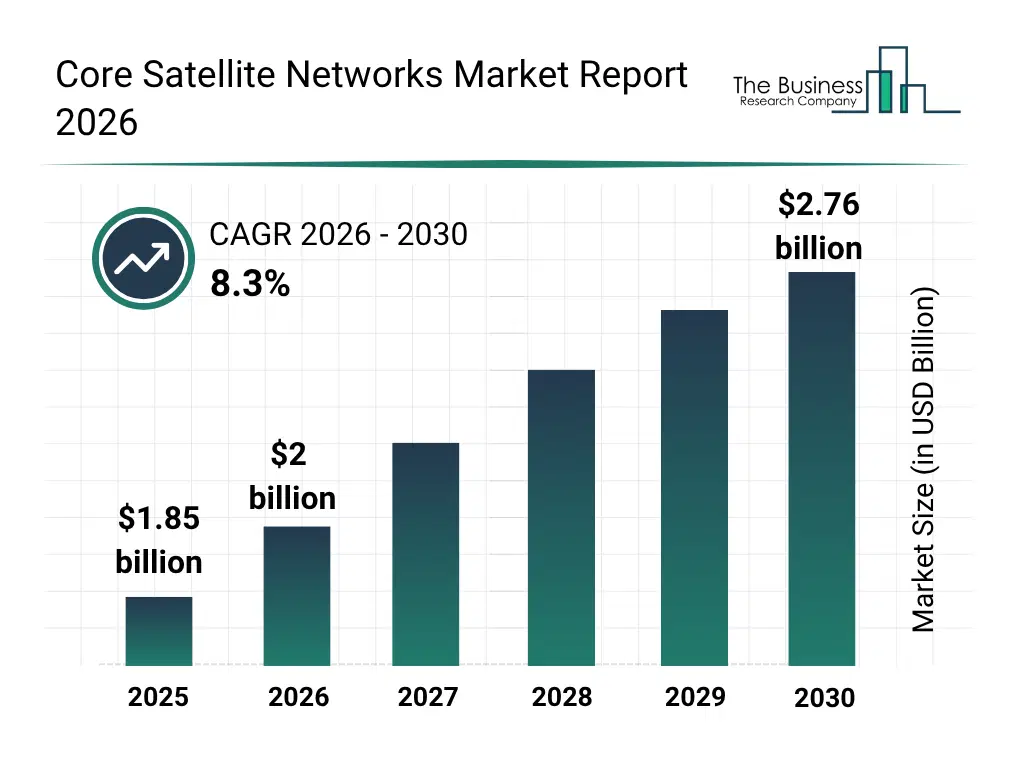
What Is The Core Satellite Networks Market Size and Share 2026?
The core satellite networks market size has grown strongly in recent years. It will grow from $1.85 billion in 2025 to $2 billion in 2026 at a compound annual growth rate (CAGR) of 8.1%. The growth in the historic period can be attributed to geostationary satellite dominance, limited bandwidth capacity, high launch costs, analog signal routing systems, fragmented ground station infrastructure.What Is The Core Satellite Networks Market Growth Forecast?
The core satellite networks market size is expected to see strong growth in the next few years. It will grow to $2.76 billion by 2030 at a compound annual growth rate (CAGR) of 8.3%. The growth in the forecast period can be attributed to leo satellite constellation expansion, rising global broadband demand, increasing defense satellite communication requirements, growth in remote sensing data traffic, adoption of SDN-based satellite networks. Major trends in the forecast period include multi-orbit satellite network integration, leo mega-constellations expansion, direct-to-device satellite connectivity, high-throughput satellites with advanced beamforming and frequency reuse, satellite-based broadband expansion for aviation and maritime mobility services.
Global Core Satellite Networks Market Segmentation
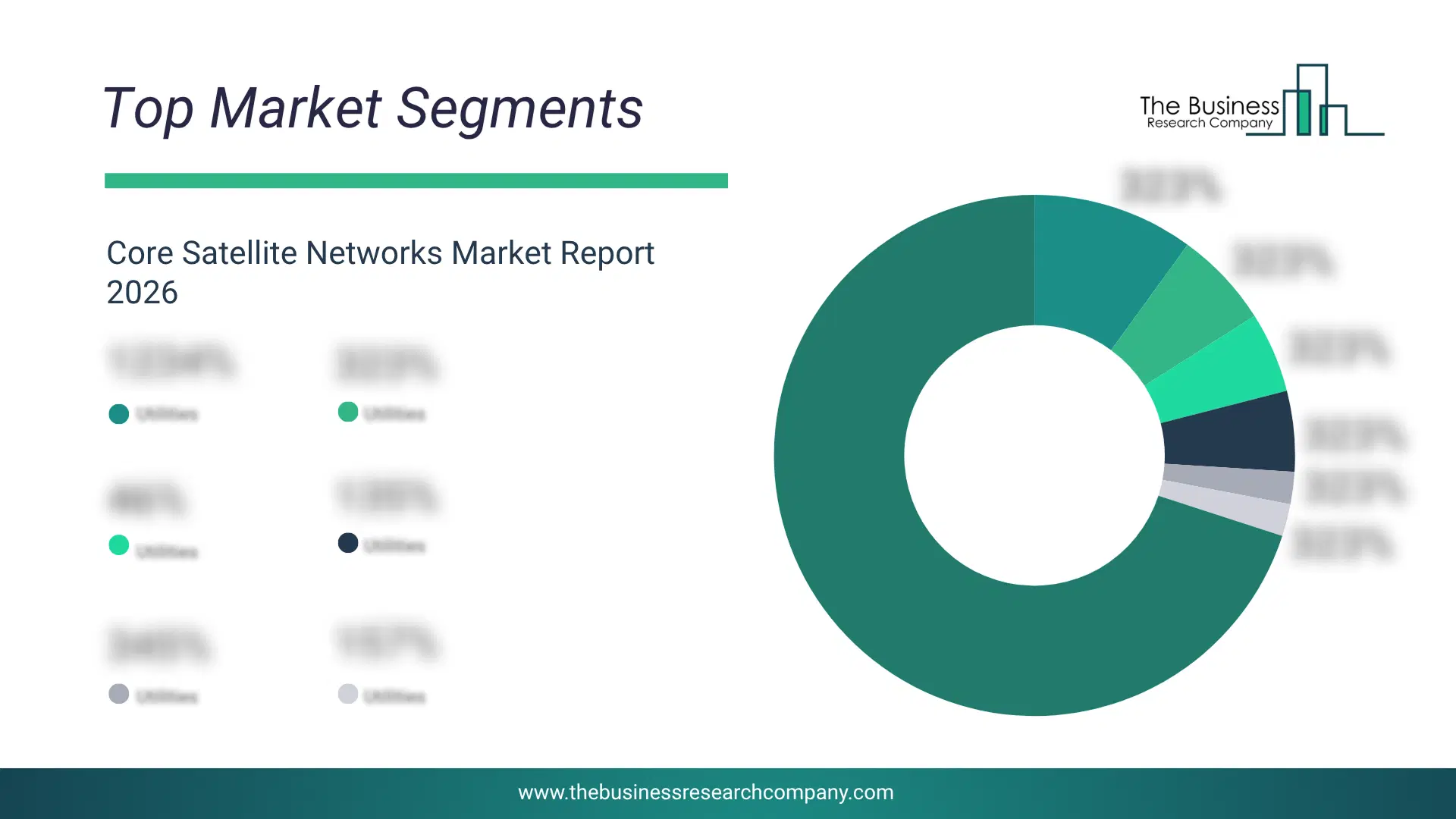
1) By Component: Hardware, Software, Services 2) By Deployment Model: On-Premises, Cloud-Based, Hybrid 3) By Frequency Band: L Band, S Band, C Band, X Band, Ku Band, Ka Band 4) By Application: Communication, Broadcasting, Navigation, Earth Observation, Remote Sensing, Surveillance 5) By End User: Telecom Operators, Government and Defense, Aerospace Industry, Maritime Industry, Aviation Industry, Energy and Utilities Subsegments: 1) By Hardware: Satellite Communication Equipment, Ground Station Equipment, Antenna Systems, Network Infrastructure Devices, Signal Transmission Equipment 2) By Software: Network Management Software, Traffic Management Software, Network Security Software, Data Processing Software, Monitoring and Control Software 3) By Services: Installation Services, Integration Services, Maintenance Services, Consulting Services, Support ServicesWhat Is The Driver Of The Core Satellite Networks Market?
The rising demand for global connectivity is expected to propel the growth of the core satellite networks market going forward. Global connectivity refers to the ability to provide seamless communication services across regions, including remote and underserved areas, through advanced communication technologies. The demand for global connectivity is increasing due to the expansion of digital services and the need for reliable communication infrastructure worldwide. Core satellite networks support global connectivity by enabling wide-area coverage, high-speed data transmission, and communication access in areas where terrestrial networks are limited. For instance, in October 2023, according to the International Telecommunication Union, a Switzerland-based specialized agency of the United Nations for information and communication technologies, approximately 67% of the global population (around 5.4 billion people) were using the internet in 2023, compared to about 64% in 2022, highlighting the increasing demand for global connectivity and digital access. Therefore, the rising demand for global connectivity is driving the growth of the core satellite networks industry.Key Players In The Global Core Satellite Networks Market
Major companies operating in the core satellite networks market are Amazon.com Inc., Huawei Technologies Co. Ltd., The Boeing Company, Airbus SE, Lockheed Martin Corporation, Northrop Grumman Corporation, Fujitsu Limited, Telefonaktiebolaget LM Ericsson, NEC Corporation, Nokia Corporation, Thales S.A., L3Harris Technologies Inc., ZTE Corporation, Space Exploration Technologies Corp., Viasat Inc., Kratos Defense & Security Solutions Inc., Iridium Communications Inc., Comtech Telecommunications Corp., Gilat Satellite Networks Ltd., AST SpaceMobile Inc., KVH Industries Inc., Telesat Corporation, Thaicom Public Company Limited, Druid Software Limited, Skylo Technologies Inc., ArkEdge Space Inc., Lynk Global Inc.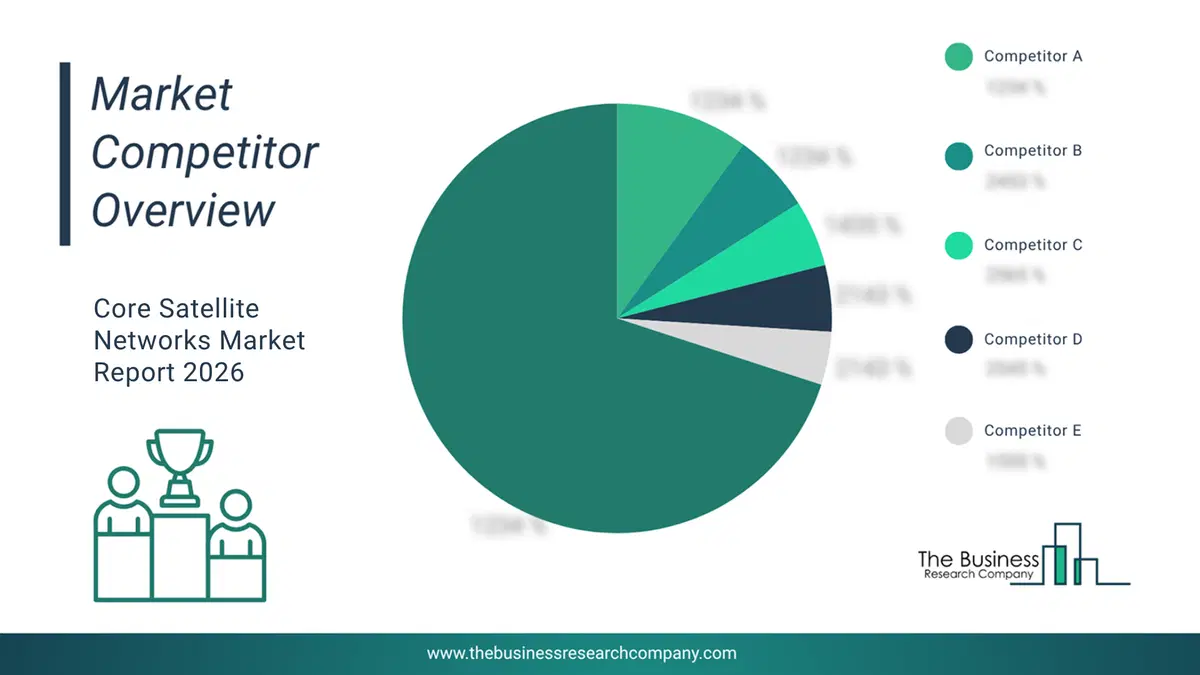
This chart is for illustrative purposes; the full report includes a detailed competitor analysis and comprehensive overview of the top 10 companies in the market.
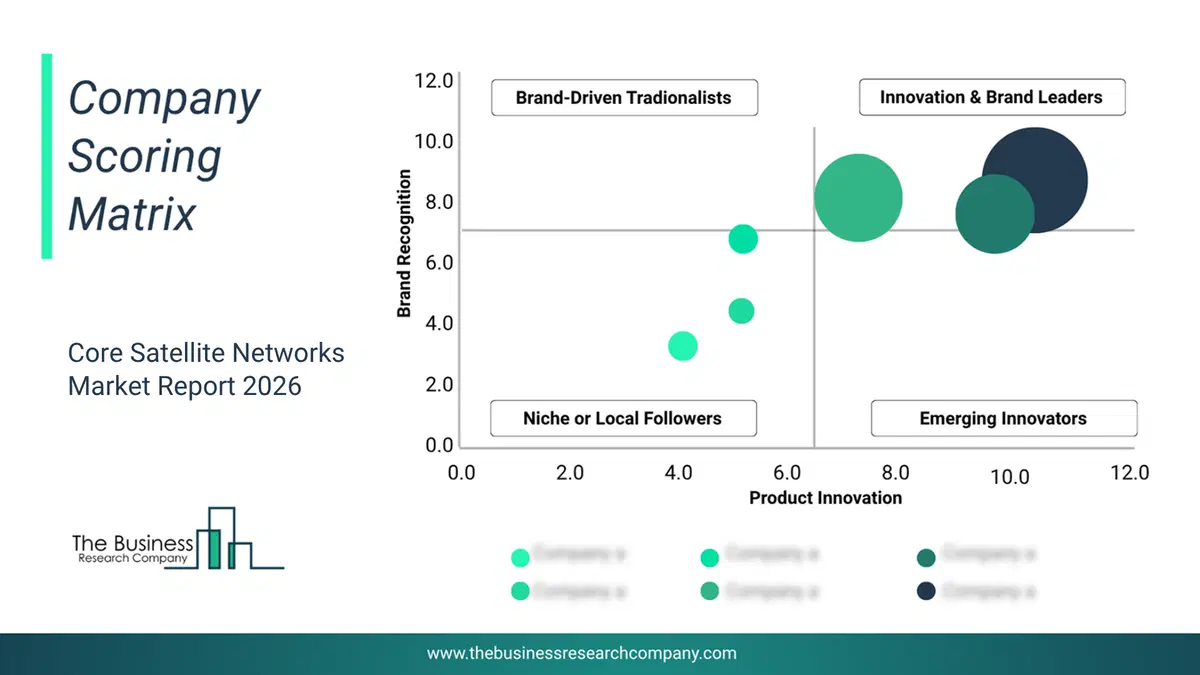
This chart maps companies by product innovation and brand strength, with bubble size indicating relative revenue, helping identify market leaders, challengers, and niche players. This is an illustrative chart; the full report provides a complete and accurate competitive analysis.
Global Core Satellite Networks Market Trends and Insights
Major companies operating in the core satellite networks market are focusing on technological advancements in integrated multi-orbit satellite communication networks, such as unified Ka-band satellite connectivity systems, to enhance global coverage, improve network resiliency, and deliver seamless connectivity for mission-critical operations. Unified Ka-band satellite connectivity systems integrate multiple satellite networks into a single platform to deliver continuous high-speed broadband across air, land, and sea. For instance, in December 2025, Viasat, Inc., a US-based satellite communications company, announced a significant evolution of its network for government customers by integrating Viasat Ka-band satellites, the Global Xpress satellite fleet, and select partner satellites into a fully integrated global Ka-band satellite communications network, providing seamless global multi-orbit connectivity for government and military users.What Are Latest Mergers And Acquisitions In The Core Satellite Networks Market?
In July 2025, SES S.A., a Luxembourg-based satellite telecommunications provider, acquired Intelsat S.A. for $3.1 billion. This acquisition strengthens SES’s position in the global satellite communications market by creating a major multi-orbit connectivity provider with combined GEO and MEO satellite assets, enhancing global coverage, network resilience, and broadband service capabilities. Intelsat S.A. is a Luxembourg-based satellite network operator that delivers secure communications, media distribution, and broadband connectivity services worldwide.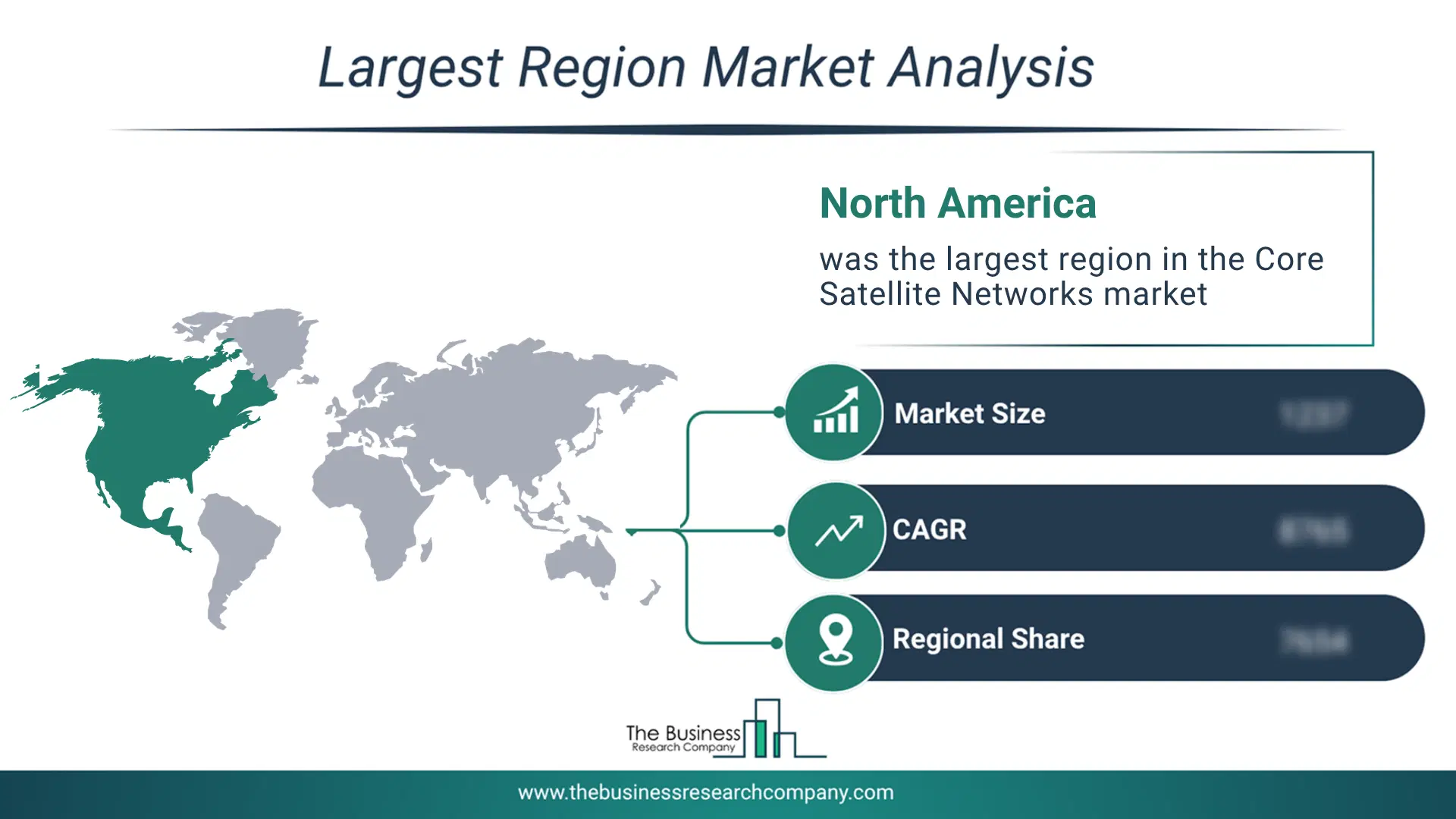
Regional Insights
North America was the largest region in the core satellite networks market in 2025. Asia-Pacific is expected to be the fastest-growing region in the forecast period. The regions covered in this market report are Asia-Pacific, South East Asia, Western Europe, Eastern Europe, North America, South America, Middle East, Africa. The countries covered in this market report are Australia, Brazil, China, France, Germany, India, Indonesia, Japan, Taiwan, Russia, South Korea, UK, USA, Canada, Italy, Spain.What Defines the Core Satellite Networks Market?
The core satellite networks market consists of revenues earned by entities by providing services such as satellite backhaul services, broadband connectivity services, satellite network management services, secure government and defense communication services, and managed satellite communication services. The market value includes the value of related goods sold by the service provider or included within the service offering. The core satellite networks market also includes sales of antennas, transponders, receivers, transmitters, and satellite communication terminals. Values in this market are ‘factory gate’ values, that is, the value of goods sold by the manufacturers or creators of the goods, whether to other entities (including telecom operators, service providers, distributors, and system integrators) or directly to end customers. The value of goods in this market includes related services sold by the creators of the goods.How is Market Value Defined and Measured?
The market value is defined as the revenues that enterprises gain from the sale of goods and/or services within the specified market and geography through sales, grants, or donations in terms of the currency (in USD unless otherwise specified). The revenues for a specified geography are consumption values that are revenues generated by organizations in the specified geography within the market, irrespective of where they are produced. It does not include revenues from resales along the supply chain, either further along the supply chain or as part of other products.
This chart presents market attractiveness based on a quantitative evaluation of growth, competition, strategic alignment, and risk, offering a clear view of opportunity areas for decision-making. This chart is for illustrative purposes; the full report contains the complete analysis.

This chart highlights the Total Addressable Market (TAM) by estimating the maximum revenue opportunity using an assumption-driven approach, supporting strategic planning and opportunity sizing across markets. The chart is illustrative; the full report provides a more comprehensive analysis.
What Key Data and Analysis Are Included in the Core Satellite Networks Market Report 2026?
The core satellite networks market research report is one of a series of new reports from The Business Research Company that provides market statistics, including industry global market size, regional shares, competitors with the market share, detailed market segments, market trends and opportunities, and any further data you may need to thrive in the core satellite networks industry. The market research report delivers a complete perspective of everything you need, with an in-depth analysis of the current and future state of the industry.Core Satellite Networks Market Report Forecast Analysis
| Report Attribute | Details |
|---|---|
| Market Size Value In 2026 | $2 billion |
| Revenue Forecast In 2030 | $2.76 billion |
| Growth Rate | CAGR of 8.3% from 2026 to 2030 |
| Base Year For Estimation | 2025 |
| Actual Estimates/Historical Data | 2020-2025 |
| Forecast Period | 2026 - 2030 |
| Market Representation | Revenue in USD Billion and CAGR from 2026 to 2030 |
| Segments Covered | Component, Deployment Model, Frequency Band, Application, End User |
| Regional Scope | Asia-Pacific, Western Europe, Eastern Europe, North America, South America, Middle East, Africa |
| Country Scope | The Countries Covered In This Market Report Are Australia, Brazil, China, France, Germany, India, Indonesia, Japan, Taiwan, Russia, South Korea, Uk, Usa, Canada, Italy, Spain. |
| Key Companies Profiled | Amazon.com Inc., Huawei Technologies Co. Ltd., The Boeing Company, Airbus SE, Lockheed Martin Corporation, Northrop Grumman Corporation, Fujitsu Limited, Telefonaktiebolaget LM Ericsson, NEC Corporation, Nokia Corporation, Thales S.A., L3Harris Technologies Inc., ZTE Corporation, Space Exploration Technologies Corp., Viasat Inc., Kratos Defense & Security Solutions Inc., Iridium Communications Inc., Comtech Telecommunications Corp., Gilat Satellite Networks Ltd., AST SpaceMobile Inc., KVH Industries Inc., Telesat Corporation, Thaicom Public Company Limited, Druid Software Limited, Skylo Technologies Inc., ArkEdge Space Inc., Lynk Global Inc. |
| Customization Scope | Request for Customization |
| Pricing And Purchase Options | Explore Purchase Options |