
Remote Sensing Technology Market Report 2026
Global Outlook – By Technology (Active Remote Sensing, Passive Remote Sensing), By Platform (Satellite, Aerial Systems), By Application (Landscape Assessment, Security, Air Quality, Hydrology, Forestry, Floodplain Mapping And Emergency Management), By End User (Military And Intelligence, Weather, Disaster Management, Agriculture And Living Resources, Infrastructure) – Market Size, Trends, Strategies, and Forecast to 2030
Remote Sensing Technology Market Overview
• Remote Sensing Technology market size has reached to $18.37 billion in 2025 • Expected to grow to $32.9 billion in 2030 at a compound annual growth rate (CAGR) of 12.4% • Growth Driver: Precision Farming Drives Growth In Remote Sensing Technology Market • Market Trend: Azista Bst Aerospace Launches Afr Satellite TO Enhance Remote Sensing Capabilities FOR Agriculture And environmental monitoring • North America was the largest region in 2025.What Is Covered Under Remote Sensing Technology Market?
The remote sensing technology refers to active and passive sensing technology used to collect the information and analyze its physical characteristics. The purpose of remote sensing technology is to detect and track an area by physical characteristics at a distance by measuring its reflected and emitted radiation. It includes Lidar, unique cameras, radar scanning, and others. The main types of technologies in the remote sensing technology market are active remote sensing and passive remote sensing. The active remote sensing technology transmits a coherent electromagnetic (EM) wave at a target, which can be celestial or pointed toward the ground. The reflected radiation is detected and measured by the sensor from that target. Remote sensing technology uses two platforms namely satellite and aerial systems and used in military and intelligence, weather, disaster management, agriculture and living resources and infrastructure. It has most application in landscape assessment, security, air quality, hydrology, forestry, floodplain mapping and emergency management and healthcare.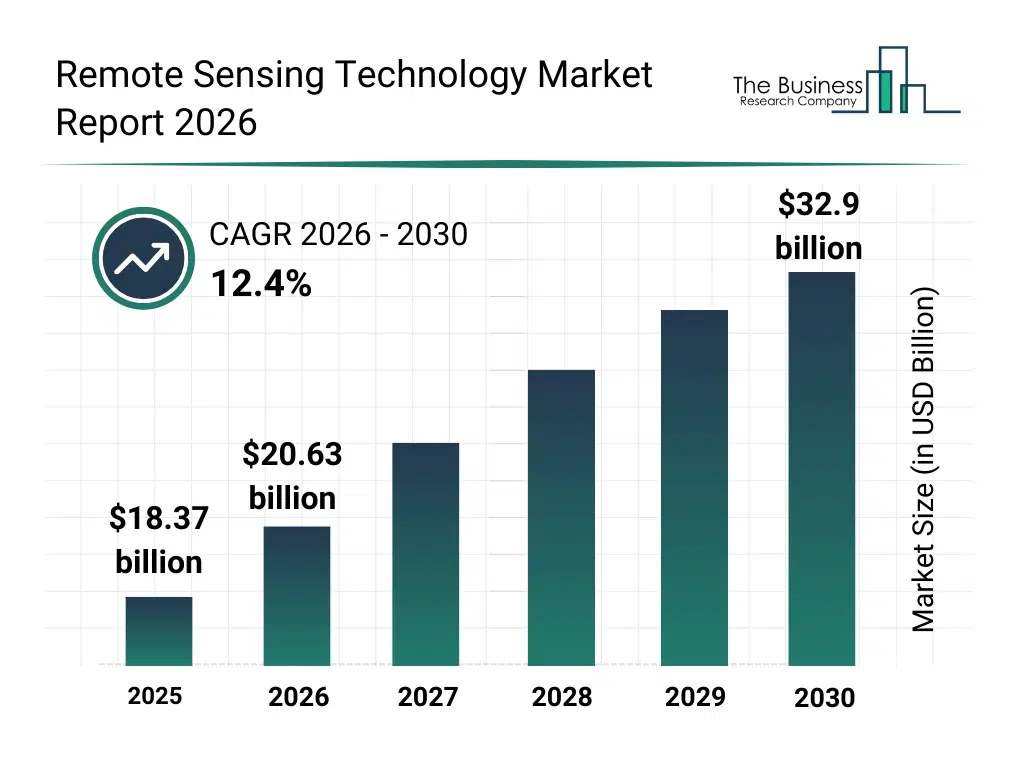
What Is The Remote Sensing Technology Market Size and Share 2026?
The remote sensing technology market size has grown rapidly in recent years. It will grow from $18.37 billion in 2025 to $20.63 billion in 2026 at a compound annual growth rate (CAGR) of 12.3%. The growth in the historic period can be attributed to development of satellite imaging programs, increasing use of aerial survey systems, adoption of remote sensing in defense applications, expansion of weather monitoring networks, growth of geospatial data usage.What Is The Remote Sensing Technology Market Growth Forecast?
The remote sensing technology market size is expected to see rapid growth in the next few years. It will grow to $32.9 billion in 2030 at a compound annual growth rate (CAGR) of 12.4%. The growth in the forecast period can be attributed to increasing demand for climate monitoring solutions, rising adoption in smart agriculture, expansion of disaster management applications, integration with ai-driven analytics, growth of commercial satellite constellations. Major trends in the forecast period include increasing use of satellite-based earth observation systems, rising deployment of lidar and radar technologies, growing integration of remote sensing with gis platforms, expansion of environmental monitoring applications, enhanced focus on high-resolution data analytics.
Global Remote Sensing Technology Market Segmentation
1) By Technology: Active Remote Sensing, Passive Remote Sensing 2) By Platform: Satellite, Aerial Systems 3) By Application: Landscape Assessment, Security, Air Quality, Hydrology, Forestry, Floodplain Mapping And Emergency Management 4) By End User: Military And Intelligence, Weather, Disaster Management, Agriculture And Living Resources, Infrastructure Subsegments: 1) By Active Remote Sensing: Radar Systems, Lidar 2) By Passive Remote Sensing: Optical Sensors, Infrared Sensors, Multispectral And Hyperspectral SensorsWhat Is The Driver Of The Remote Sensing Technology Market?
The growing adoption of precision farming technology is driving the growth of the remote sensing technology market. Due to rapid global population growth and climate change, the farming industry is undergoing massive transformations, placing an added burden on the food supply chain. Precision farming is the planning of food production through the use of technologies delivering the economic benefits of cost reduction in farming and increasing production levels and also helps in environmental benefits. For instance, in January 2024, according to the United States Government Accountability Office, a US-based government agency published that, in 2023, 27% of U.S. farms and ranches utilized precision agriculture techniques for managing crops or livestock. Thus, the growing adoption of precision farming technology is driving the remote sensing technology industry growth.Key Players In The Global Remote Sensing Technology Market
Major companies operating in the remote sensing technology market are Thales Group; Hexagon AB; Maxar Technologies; Planet Labs PBC; Airbus SE; L3Harris Technologies Inc.; Trimble Inc.; Lockheed Martin Corporation; Raytheon Technologies Corporation; Teledyne Technologies Incorporated; Leidos Inc.; General Dynamics Mission Systems Inc.; Environmental Systems Research Institute Inc.; Orbital Insight Inc.; Cognitive Space Inc.; Sensera Systems Inc.; Resonon Inc.; Muon Space Inc.; Array Labs Inc.; Satyukt Analytics Pvt Ltd.; Chloris Geospatial; LongPath Technologies Inc.
This chart is for illustrative purposes; the full report includes a detailed competitor analysis and comprehensive overview of the top 10 companies in the market.
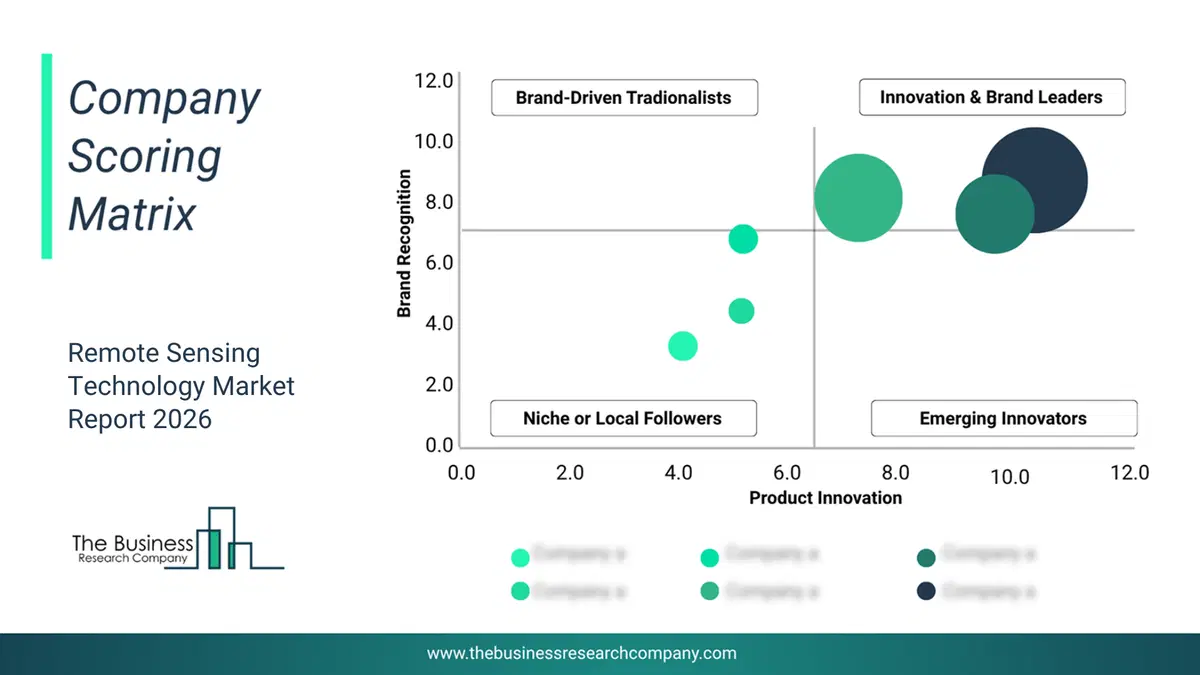
This chart maps companies by product innovation and brand strength, with bubble size indicating relative revenue, helping identify market leaders, challengers, and niche players. This is an illustrative chart; the full report provides a complete and accurate competitive analysis.
Global Remote Sensing Technology Market Trends and Insights
Major companies operating in the remote sensing technology market are adopting new technological products, such as Azista BST Aerospace First Runner (AFR), to sustain their position in the market. Azista BST Aerospace First Runner (AFR) is the remote sensing satellite launched by the company and is built on a modular bus platform, hosting a wide-swath optical remote sensing payload with both panchromatic and multispectral imaging capabilities. For instance, in June 2023, Azista BST Aerospace, an Indian-based Developer of satellite components and subsystems launched Azista BST Aerospace First Runner (AFR). Azista BST Aerospace First Runner (AFR) is designed to provide remote sensing services for agriculture mapping, disaster monitoring, and environmental observations around the clock, immune to changes in lighting or the presence of clouds that would thwart visible light cameras. It is also capable of esolving surface features smaller than a yard across when zoomed in on a specific target.What Are Latest Mergers And Acquisitions In The Remote Sensing Technology Market?
In July 2024, Sanborn Map Company Inc., a U.S.-based geospatial solutions provider, acquired the assets of VeriDaaS. With this acquisition, Sanborn will strengthen its ability to offer comprehensive and advanced technological solutions and services to its customers. VeriDaaS is a US-based remote sensing technology company specializing in Geiger-mode lidar.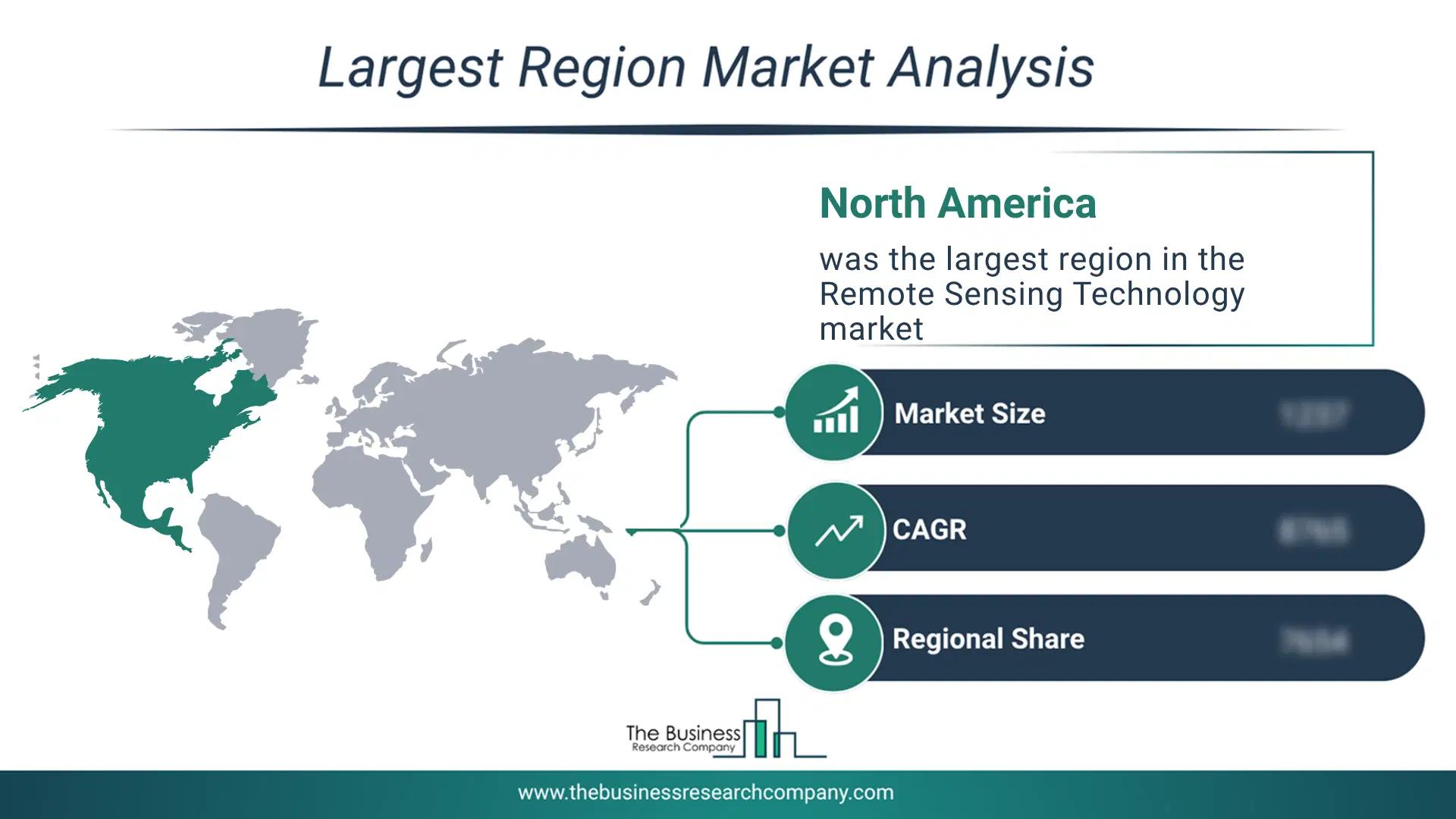
Regional Insights
North America was the largest region in the remote sensing technology market in 2025. The regions covered in this market report are Asia-Pacific, South East Asia, Western Europe, Eastern Europe, North America, South America, Middle East, Africa. The countries covered in this market report are Australia, Brazil, China, France, Germany, India, Indonesia, Japan, Taiwan, Russia, South Korea, UK, USA, Canada, Italy, SpainWhat Defines the Remote Sensing Technology Market?
The remote sensing technology market includes revenues earned by entities by providing services such as agricultural mapping, mining and geology mapping, environmental impact assessment mapping, clutter data for wireless telecommunication network planning. The market value includes the value of related goods sold by the service provider or included within the service offering. Only goods and services traded between entities or sold to end consumers are included.How is Market Value Defined and Measured?
The market value is defined as the revenues that enterprises gain from the sale of goods and/or services within the specified market and geography through sales, grants, or donations in terms of the currency (in USD unless otherwise specified). The revenues for a specified geography are consumption values that are revenues generated by organizations in the specified geography within the market, irrespective of where they are produced. It does not include revenues from resales along the supply chain, either further along the supply chain or as part of other products.
This chart presents market attractiveness based on a quantitative evaluation of growth, competition, strategic alignment, and risk, offering a clear view of opportunity areas for decision-making. This chart is for illustrative purposes; the full report contains the complete analysis.

This chart highlights the Total Addressable Market (TAM) by estimating the maximum revenue opportunity using an assumption-driven approach, supporting strategic planning and opportunity sizing across markets. The chart is illustrative; the full report provides a more comprehensive analysis.
What Key Data and Analysis Are Included in the Remote Sensing Technology Market Report 2026?
The remote sensing technology market research report is one of a series of new reports from The Business Research Company that provides market statistics, including industry global market size, regional shares, competitors with the market share, detailed market segments, market trends and opportunities, and any further data you may need to thrive in the remote sensing technology industry. The market research report delivers a complete perspective of everything you need, with an in-depth analysis of the current and future state of the industry.Remote Sensing Technology Market Report Forecast Analysis
| Report Attribute | Details |
|---|---|
| Market Size Value In 2026 | $20.63 billion |
| Revenue Forecast In 2030 | $32.9 billion |
| Growth Rate | CAGR of 12.4% from 2026 to 2030 |
| Base Year For Estimation | 2025 |
| Actual Estimates/Historical Data | 2020-2025 |
| Forecast Period | 2026 - 2030 |
| Market Representation | Revenue in USD Billion and CAGR from 2026 to 2030 |
| Segments Covered | Technology, Platform, Application, End User |
| Regional Scope | Asia-Pacific, Western Europe, Eastern Europe, North America, South America, Middle East, Africa |
| Country Scope | The Countries Covered In This Market Report Are Australia, Brazil, China, France, Germany, India, Indonesia, Japan, Taiwan, Russia, South Korea, Uk, Usa, Canada, Italy, Spain. |
| Key Companies Profiled | Thales Group, Hexagon AB, Maxar Technologies, Planet Labs PBC, Airbus SE, L3Harris Technologies Inc., Trimble Inc., Lockheed Martin Corporation, Raytheon Technologies Corporation, Teledyne Technologies Incorporated, Leidos Inc., General Dynamics Mission Systems Inc., Environmental Systems Research Institute Inc., Orbital Insight Inc., Cognitive Space Inc., Sensera Systems Inc., Resonon Inc., Muon Space Inc., Array Labs Inc., Satyukt Analytics Pvt Ltd., Chloris Geospatial, LongPath Technologies Inc. |
| Customization Scope | Request for Customization |
| Pricing And Purchase Options | Explore Purchase Options |