
Satellite-Based Earth Observation Market Report 2026
Global Outlook – By Product Type (Earth Observation (EO) Data, Value Added Services), By Satellite Orbit (Low Earth Orbit, Medium Earth Orbit, Geostationary Orbit), By Technology (Optical, Synthetic Aperture Radar), By Payload Type (Electro-Optical Or Infra-Red (EO Or IR), Imaging, Navigation), By End-User (Defense And Intelligence, Infrastructure And Engineering, Agriculture, Energy And Power, Other End-Users) – Market Size, Trends, Strategies, and Forecast to 2030
Satellite-Based Earth Observation Market Overview
• Satellite-Based Earth Observation market size has reached to $7.03 billion in 2025 • Expected to grow to $10.02 billion in 2030 at a compound annual growth rate (CAGR) of 7.3% • Growth Driver: Satellite Launches Drive Growth In Earth Observation Market • Market Trend: Technological Innovations In Synthetic Aperture Radar (SAR) Enhance Imaging Precision And Operational Reliability In Satellite-Based Earth Observation • North America was the largest region in 2025.What Is Covered Under Satellite-Based Earth Observation Market?
Satellite-based earth observation refers to satellites orbiting around the Earth to view, observe, and identify environmental change, map making, and other applications. The process utilizes remote sensing techniques to collect information on the Earth's chemical, physical, and biological aspects. The main product types of the satellite-based earth observation include earth observation (EO) data and value-added services. Earth observation (EO) data refers to raw and processed imagery and datasets collected by satellites, which are used to monitor land, oceans, and atmosphere, enabling applications such as environmental monitoring, climate analysis, disaster management, and resource assessment. The satellite orbits include low earth orbit, medium earth orbit, and geostationary orbit. The key technologies comprise optical and synthetic aperture radar. The payload types include electro-optical or infra-red (EO or IR), imaging, and navigation, and they are used by several end-users such as defense and intelligence, infrastructure and engineering, agriculture, energy and power, and others.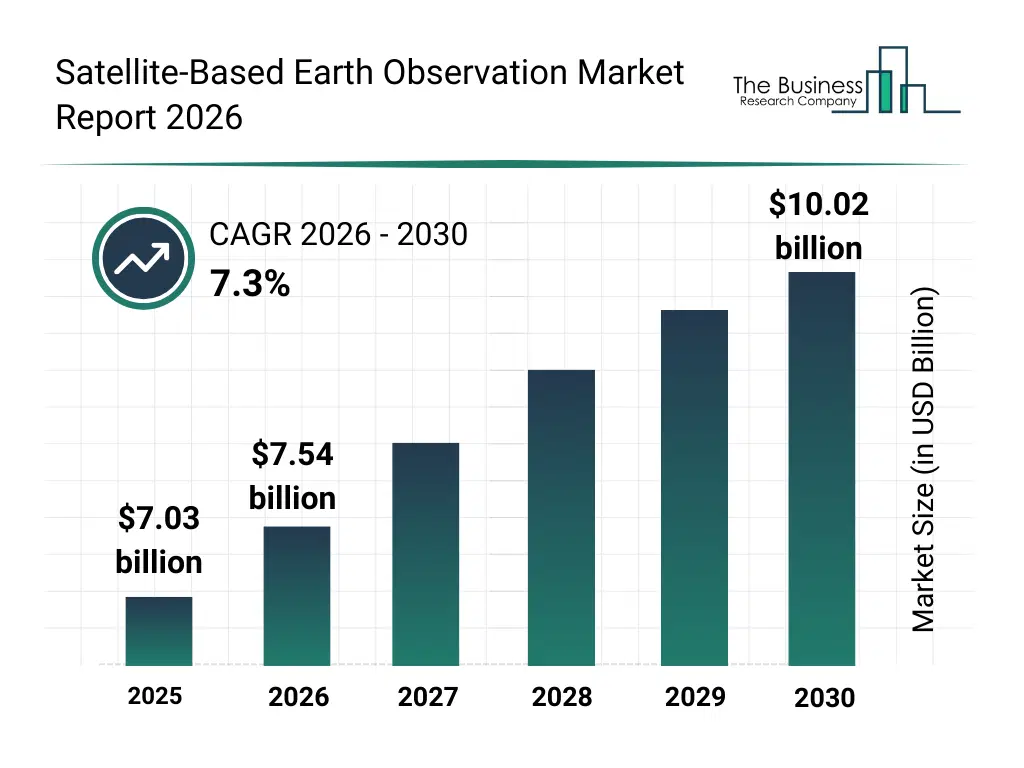
What Is The Satellite-Based Earth Observation Market Size and Share 2026?
The satellite-based earth observation market size has grown strongly in recent years. It will grow from $7.03 billion in 2025 to $7.54 billion in 2026 at a compound annual growth rate (CAGR) of 7.4%. The growth in the historic period can be attributed to increased demand for weather forecasting services driving deployment of earth observation satellites, rising adoption of environmental monitoring applications supporting climate and ecosystem analysis, growth in urban planning needs boosting utilization of high-resolution satellite imagery, expansion of disaster studies and emergency response operations leveraging real-time observational data, advancements in remote sensing technologies enhancing accuracy and data quality for earth observation services.What Is The Satellite-Based Earth Observation Market Growth Forecast?
The satellite-based earth observation market size is expected to see strong growth in the next few years. It will grow to $10.02 billion in 2030 at a compound annual growth rate (CAGR) of 7.3%. The growth in the forecast period can be attributed to development of next-generation high-resolution and hyperspectral satellites improving analytical capabilities, rising adoption of satellite analytics in agriculture, energy, and infrastructure sectors expanding market applications, increasing integration of AI and machine learning enhancing processing of earth observation data, growth in commercial smallsat constellations boosting revisit rates and service availability, expanding international collaborations driving deployment of shared earth observation platforms. Major trends in the forecast period include growing demand for real-time environmental monitoring, expansion in disaster management and risk assessment, increasing use in urban planning and smart city development, adoption in precision agriculture and resource management, development of multi-sensor and high-resolution imaging satellites.
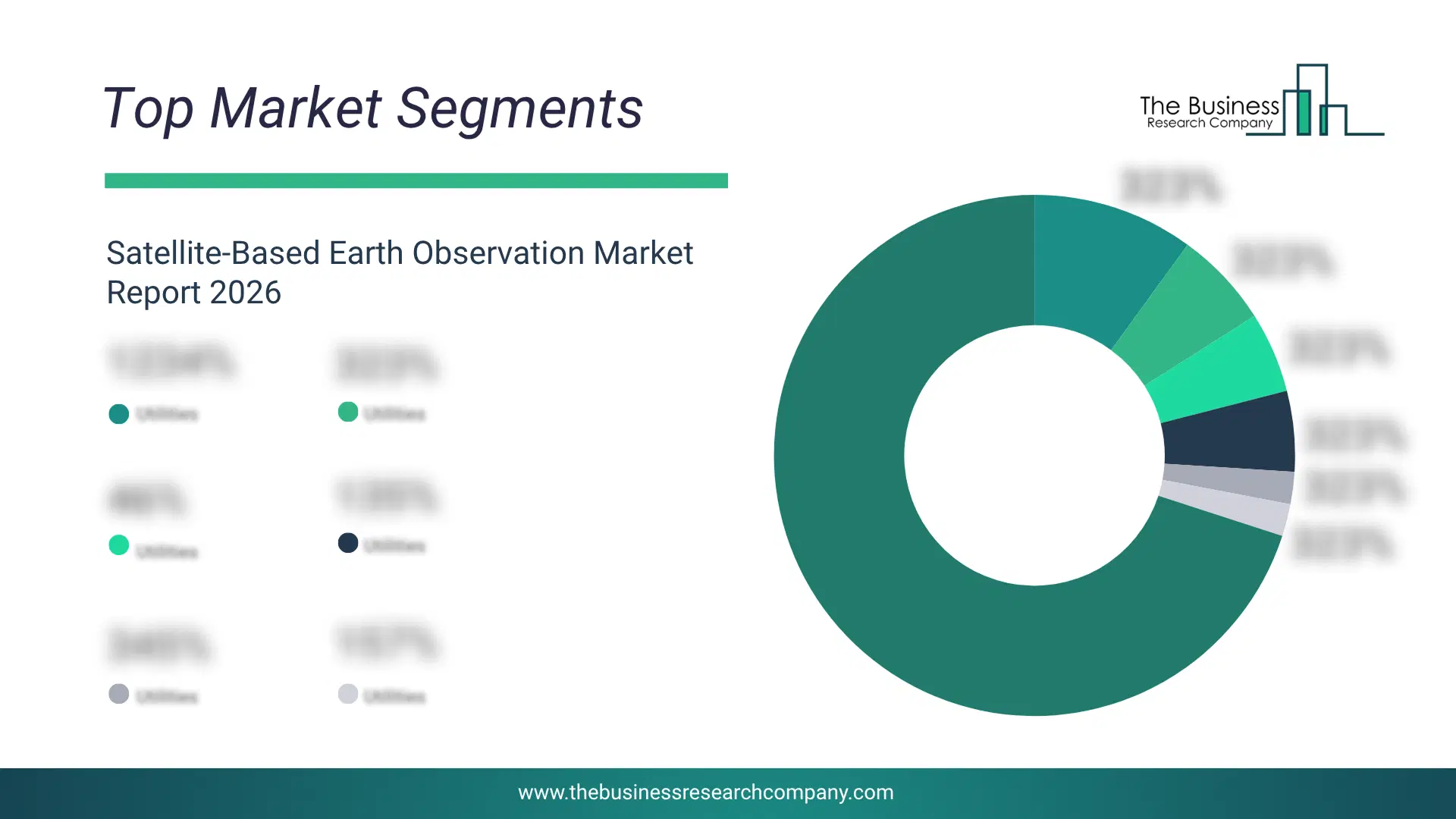
Global Satellite-Based Earth Observation Market Segmentation
1) By Product Type: Earth Observation (EO) Data, Value Added Services 2) By Satellite Orbit: Low Earth Orbit, Medium Earth Orbit, Geostationary Orbit 3) By Technology: Optical, Synthetic Aperture Radar 4) By Payload Type: Electro-Optical Or Infra-Red (EO Or IR), Imaging, Navigation 5) By End-User: Defense And Intelligence, Infrastructure And Engineering, Agriculture, Energy And Power, Other End-Users Subsegments: 1) By Earth Observation (EO) Data: Optical Satellite Data, Radar Satellite Data, Hyperspectral Satellite Data, Thermal Infrared Satellite Data, LiDAR Data 2) By Value Added Services: Data Processing and Analysis, Geographic Information Systems (GIS) Services, Data Visualization Services, Consulting Services, Custom Application DevelopmentWhat Is Driver Of The Satellite-Based Earth Observation Market?
The increasing number of satellite launches is expected to propel the growth of the satellite-based earth observation market going forward. A satellite refers to a device launched into orbit around Earth or another celestial body for various purposes, including collecting information, navigation, and scientific research. Satellites are equipped with sensors to monitor and capture images of the Earth's surface for multiple uses, including weather forecasting and environmental and climate change monitoring. For instance, in June 2025, according to the Orbital Today, a UK-based specializing in space industry news, with a primary focus on the UK and European space sectors, reported that Global satellite launches between January and April 2025 have surged dramatically to historical highs, with a total exceeding 1,200 satellites. This marks a roughly 50% year-on-year increase compared to approximately the 800 satellites launched during the same months in 2024. Therefore, the increasing number of satellite launches is driving the growth of the satellite-based earth observation industry .Key Players In The Global Satellite-Based Earth Observation Market
Major companies operating in the satellite-based earth observation market are Raytheon Technologies Corporation, Lockheed Martin Corp., Airbus SE, BAE Systems Plc, Thales Group, L3Harris Technologies Inc., Israel Aerospace Industries Ltd., Viasat, Maxar Technologies Inc., MDA Corporation, Planet Labs Inc., Spire Global, BlackSky Global, Iceye, EOS Data Analytics, RS Metrics, D-Orbit, Descartes Labs, UrtheCast, Orbital Insight, GHGSat, Satellogic SA, GomSpace, SkyWatch Inc., Global Surface Intelligence Ltd., PlanetiQ Inc., GeoOptics Inc., ImageSat International N.V, Capella Space, HawkEye 360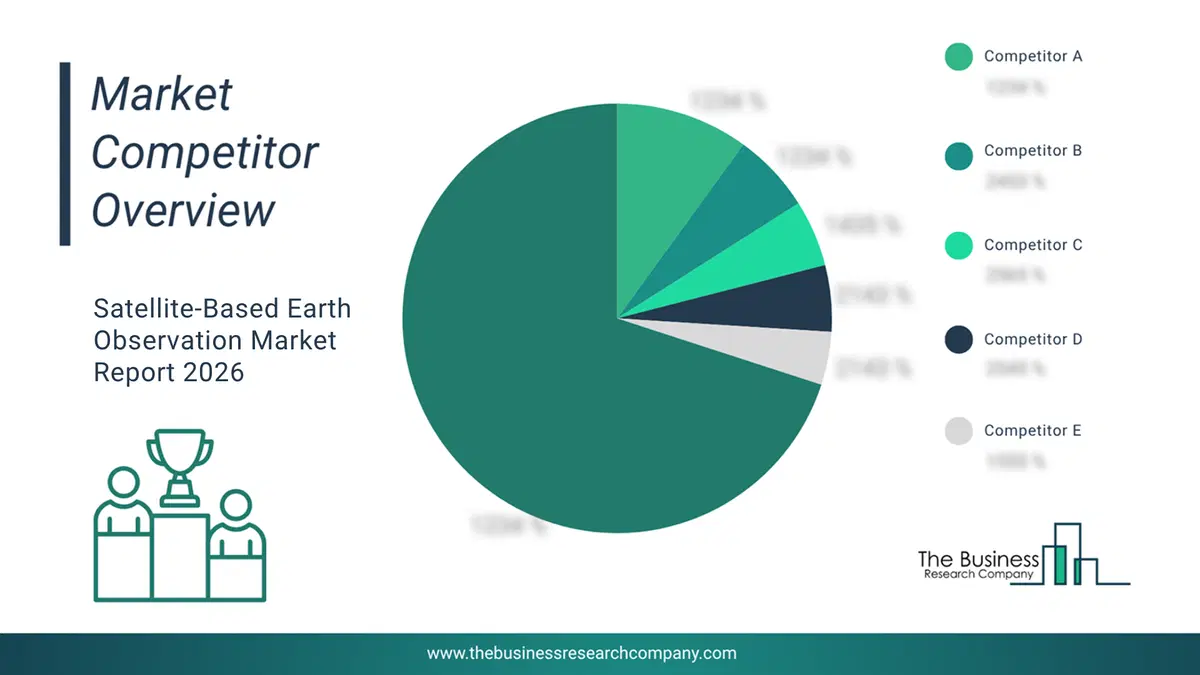
This chart is for illustrative purposes; the full report includes a detailed competitor analysis and comprehensive overview of the top 10 companies in the market.
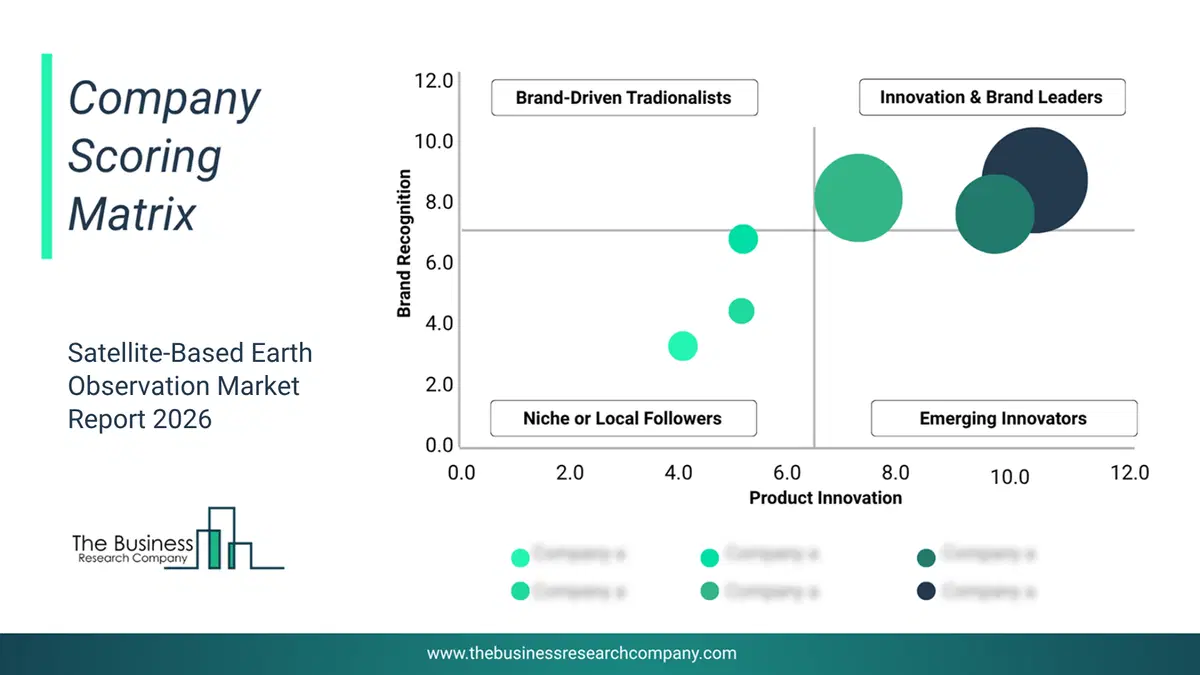
This chart maps companies by product innovation and brand strength, with bubble size indicating relative revenue, helping identify market leaders, challengers, and niche players. This is an illustrative chart; the full report provides a complete and accurate competitive analysis.
Global Satellite-Based Earth Observation Market Trends and Insights
Major companies operating in the satellite-based Earth observation market are focusing on developing advanced solutions, such as high-resolution SAR imaging, to improve data accuracy, expand mission versatility, and strengthen real-time monitoring capabilities. High-resolution SAR refers to a technology that captures detailed surface imagery regardless of weather or lighting conditions, enabling continuous observation for defense, intelligence, and environmental applications. For instance, in September 2025, ICEYE, a Finland-based satellite imaging company, introduced its Generation 4 Synthetic Aperture Radar satellite, offering 25 cm resolution imaging for precise target detection. The system provides all-weather, day-and-night observation capability and enhanced support for strategic monitoring needs. Designed to deliver superior imaging performance and operational resilience.What Are Latest Mergers And Acquisitions In The Satellite-Based Earth Observation Market? Advent International And BCI's Acquisition Of Maxar Technologies
In May 2023, Advent International, a US-based private equity company, and British Columbia Investment Management Corporation (BCI), a Canada-based investment company, acquired Maxar Technologies Inc. for $6.4 billion. The acquisition will help Advent International and British Columbia Investment Management Corporation (BCI) expand their long-term growth and wealth creation. Maxar will continue to be controlled, owned, and run out of the United States. Maxar Technologies Inc. is a US-based space technology company that manufactures Earth observation satellites.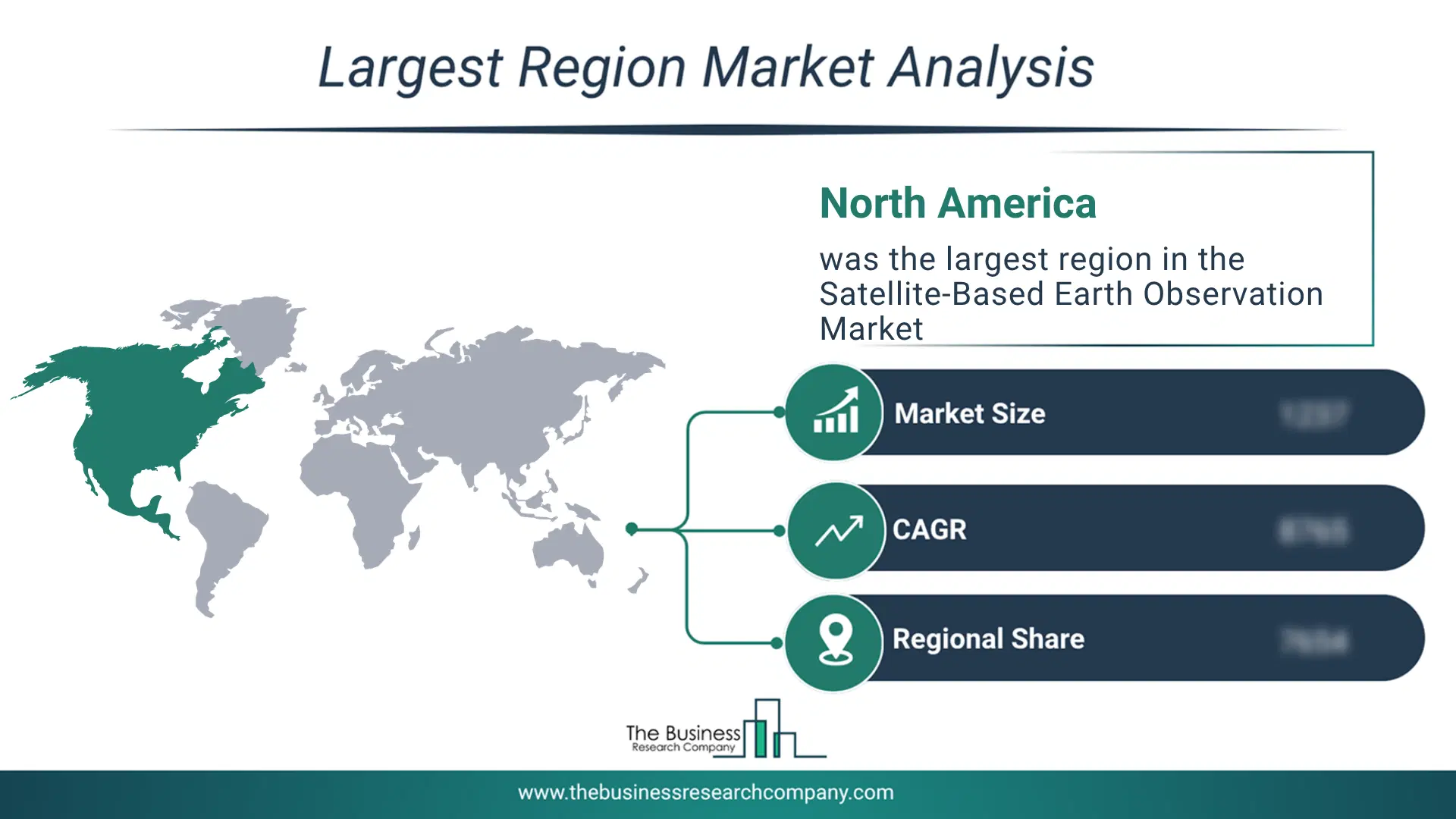
Regional Insights
North America was the largest region in the satellite-based earth observation market in 2025. The regions covered in this market report are Asia-Pacific, South East Asia, Western Europe, Eastern Europe, North America, South America, Middle East, Africa. The countries covered in this market report are Australia, Brazil, China, France, Germany, India, Indonesia, Japan, Taiwan, Russia, South Korea, UK, USA, Canada, Italy, SpainWhat Defines the Satellite-Based Earth Observation Market?
The satellite-based earth observation market includes revenues earned by entities by providing weather forecasting, environmental monitoring, urban planning, and disaster studies. The market value includes the value of related goods sold by the service provider or included within the service offering. Only goods and services traded between entities or sold to end consumers are included.How is Market Value Defined and Measured?
The market value is defined as the revenues that enterprises gain from the sale of goods and/or services within the specified market and geography through sales, grants, or donations in terms of the currency (in USD unless otherwise specified). The revenues for a specified geography are consumption values that are revenues generated by organizations in the specified geography within the market, irrespective of where they are produced. It does not include revenues from resales along the supply chain, either further along the supply chain or as part of other products.
This chart presents market attractiveness based on a quantitative evaluation of growth, competition, strategic alignment, and risk, offering a clear view of opportunity areas for decision-making. This chart is for illustrative purposes; the full report contains the complete analysis.

This chart highlights the Total Addressable Market (TAM) by estimating the maximum revenue opportunity using an assumption-driven approach, supporting strategic planning and opportunity sizing across markets. The chart is illustrative; the full report provides a more comprehensive analysis.
What Key Data and Analysis Are Included in the Satellite-Based Earth Observation Market Report 2026?
The satellite-based earth observation market research report is one of a series of new reports from The Business Research Company that provides market statistics, including industry global market size, regional shares, competitors with the market share, detailed market segments, market trends and opportunities, and any further data you may need to thrive in the satellite-based earth observation industry. The market research report delivers a complete perspective of everything you need, with an in-depth analysis of the current and future state of the industry.Satellite-Based Earth Observation Market Report Forecast Analysis
| Report Attribute | Details |
|---|---|
| Market Size Value In 2026 | $7.54 billion |
| Revenue Forecast In 2030 | $10.02 billion |
| Growth Rate | CAGR of 7.3% from 2026 to 2030 |
| Base Year For Estimation | 2025 |
| Actual Estimates/Historical Data | 2020-2025 |
| Forecast Period | 2026 - 2030 |
| Market Representation | Revenue in USD Billion and CAGR from 2026 to 2030 |
| Segments Covered | Product Type, Satellite Orbit, Technology, Payload Type, End-User |
| Regional Scope | Asia-Pacific, Western Europe, Eastern Europe, North America, South America, Middle East, Africa |
| Country Scope | The countries covered in the satellite-based earth observation market report are Australia, Brazil, China, France, Germany, India, Indonesia, Japan, Taiwan, Russia, South Korea, UK, USA, Canada, Italy, Spain |
| Key Companies Profiled | Raytheon Technologies Corporation, Lockheed Martin Corp., Airbus SE, BAE Systems Plc, Thales Group, L3Harris Technologies Inc., Israel Aerospace Industries Ltd., Viasat, Maxar Technologies Inc., MDA Corporation, Planet Labs Inc., Spire Global, BlackSky Global, Iceye, EOS Data Analytics, RS Metrics, D-Orbit, Descartes Labs, UrtheCast, Orbital Insight, GHGSat, Satellogic SA, GomSpace, SkyWatch Inc., Global Surface Intelligence Ltd., PlanetiQ Inc., GeoOptics Inc., ImageSat International N.V, Capella Space, HawkEye 360 |
| Customization Scope | Request for Customization |
| Pricing And Purchase Options | Explore Purchase Options |