
Cosmetic Jars Market Report 2026
Global Outlook – By Type (Plastic, Glass, Metal, Wood Or Bamboo, Ceramic And Biodegradable), By Closure Type (Screw Cap, Flip Top, Pump Dispenser, Spray Top), By Capacity (Less Than 50ml, 50ml To 100ml, 100ml To 200ml, More Than 200ml), By Application (Skin Care Products, Hair Care Products, Makeup And Cosmetics, Fragrance, Other Applications), By End User (Personal Care And Beauty, Professional Or Salon Use, Pharmaceutical, Other End Users) – Market Size, Trends, Strategies, and Forecast to 2030
Cosmetic Jars Market Overview
• Cosmetic Jars market size has reached to $4.85 billion in 2025 • Expected to grow to $6.51 billion in 2030 at a compound annual growth rate (CAGR) of 6% • Growth Driver: Increasing Demand For Sustainable Packaging Solutions Fueling The Growth Of The Market Due To Rising Consumer Preference For Eco-Friendly Products • Market Trend: Technologically Advanced Eco-Friendly Cosmetic Jars Gain Popularity • North America was the largest region in 2025.What Is Covered Under Cosmetic Jars Market?
Cosmetic jars are packaging containers specifically designed to hold beauty and personal care products, such as face creams, moisturizers, masks, and serums. They provide safe storage, preserve product quality, and often contribute to the product’s aesthetic appeal and brand identity. The main types of cosmetic jars are plastic, glass, metal, wood or bamboo, ceramic, and biodegradable. Plastic jars are made from synthetic polymers, offering lightweight, durable, and cost-effective solutions. They feature various closure options such as screw cap, flip top, pump dispenser, and spray top and are available in capacities ranging from less than 50 ml to 50 ml to 100 ml to 100 ml to 200 ml to more than 200 ml. These jars are used for applications including skin care products, hair care products, makeup and cosmetics, fragrance, and others, catering primarily to end users in personal care and beauty, professional or salon use, pharmaceuticals, and others.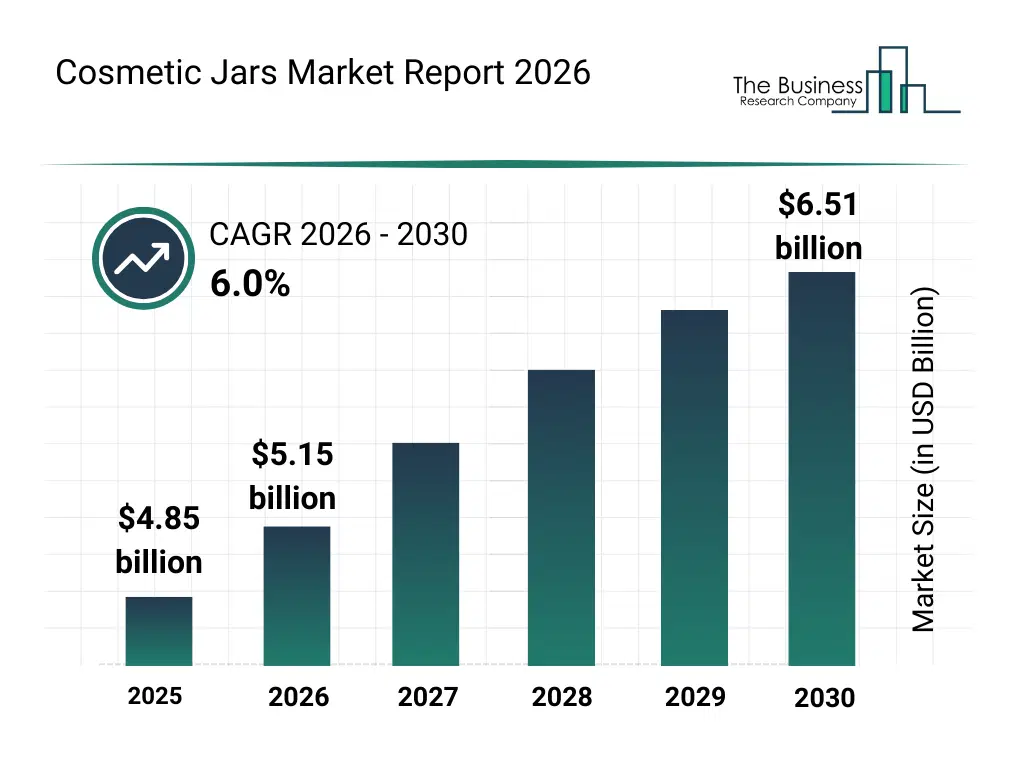
What Is The Cosmetic Jars Market Size and Share 2026?
The cosmetic jars market size has grown strongly in recent years. It will grow from $4.85 billion in 2025 to $5.15 billion in 2026 at a compound annual growth rate (CAGR) of 6.3%. The growth in the historic period can be attributed to growth of personal care and cosmetics consumption, expansion of premium skincare segments, rising focus on product shelf life preservation, increased branding and packaging investments, availability of diverse packaging materials.What Is The Cosmetic Jars Market Growth Forecast?
The cosmetic jars market size is expected to see strong growth in the next few years. It will grow to $6.51 billion in 2030 at a compound annual growth rate (CAGR) of 6.0%. The growth in the forecast period can be attributed to rising demand for eco-friendly cosmetic packaging, increasing adoption of refillable and reusable jars, growth of indie and luxury beauty brands, expansion of online beauty retail, innovation in biodegradable packaging materials. Major trends in the forecast period include increasing adoption of sustainable packaging materials, rising demand for premium and customized jar designs, growing use of airless and protective packaging solutions, expansion of lightweight and durable jar formats, enhanced focus on brand differentiation through packaging.
Global Cosmetic Jars Market Segmentation
1) By Type: Plastic, Glass, Metal, Wood Or Bamboo, Ceramic And Biodegradable 2) By Closure Type: Screw Cap, Flip Top, Pump Dispenser, Spray Top 3) By Capacity: Less Than 50ml, 50ml To 100ml, 100ml To 200ml, More Than 200ml 4) By Application: Skin Care Products, Hair Care Products, Makeup And Cosmetics, Fragrance, Other Applications 5) By End User: Personal Care And Beauty, Professional Or Salon Use, Pharmaceutical, Other End Users Subsegments: 1) By Plastic: Polypropylene (PP), Polyethylene Terephthalate (PET), High-Density Polyethylene (HDPE) 2) By Glass: Clear Glass, Colored Glass, Frosted Glass 3) By Metal: Aluminum, Tin, Stainless Steel 4) By Wood Or Bamboo: Bamboo, Natural Wood, Engineered Wood 5) By Ceramic And Biodegradable: Ceramic, Biodegradable Plastics, Compostable MaterialsWhat Is The Driver Of The Cosmetic Jars Market?
The increasing demand for sustainable packaging solutions is expected to propel the growth of the cosmetic jars market going forward. Sustainable packaging solutions refer to packaging methods and materials designed to minimize environmental impact throughout their lifecycle. The demand for sustainable packaging solutions is increasing due to growing consumer awareness and preference for eco-friendly products to reduce environmental impact. Cosmetic jars enhance sustainable packaging solutions by offering eco-friendly designs, making them ideal for creams, lotions, and other personal care products. They reduce environmental impact by using biodegradable and recyclable materials, improving brand sustainability and consumer appeal. For instance, in January 2023, according to Protega Global Limited, a UK-based sustainable packaging solutions company, 81% of consumers are demanding sustainable packaging, marking a significant increase compared to the previous year. Therefore, the increasing demand for sustainable packaging solutions is driving the growth of the cosmetic jars industry.Key Players In The Global Cosmetic Jars Market
Major companies operating in the cosmetic jars market are Berry Global Inc, Gerresheimer AG, Amcor plc, Quadpack Industries, Berlin Packaging LLC, Stoelzle Glass Group, HCP Packaging, Eurovetrocap, Silgan Holdings Inc, Albea S.A, AptarGroup Inc, LUMSON S.p.A, Hangzhou ABC Packaging Co Ltd, APackaging Group Inc, Virospack SL, Heinz‑Glas GmbH, Thousand Peak Cosmetic Jars, Seme Packaging, Lisson Packaging, Jarsking
This chart is for illustrative purposes; the full report includes a detailed competitor analysis and comprehensive overview of the top 10 companies in the market.
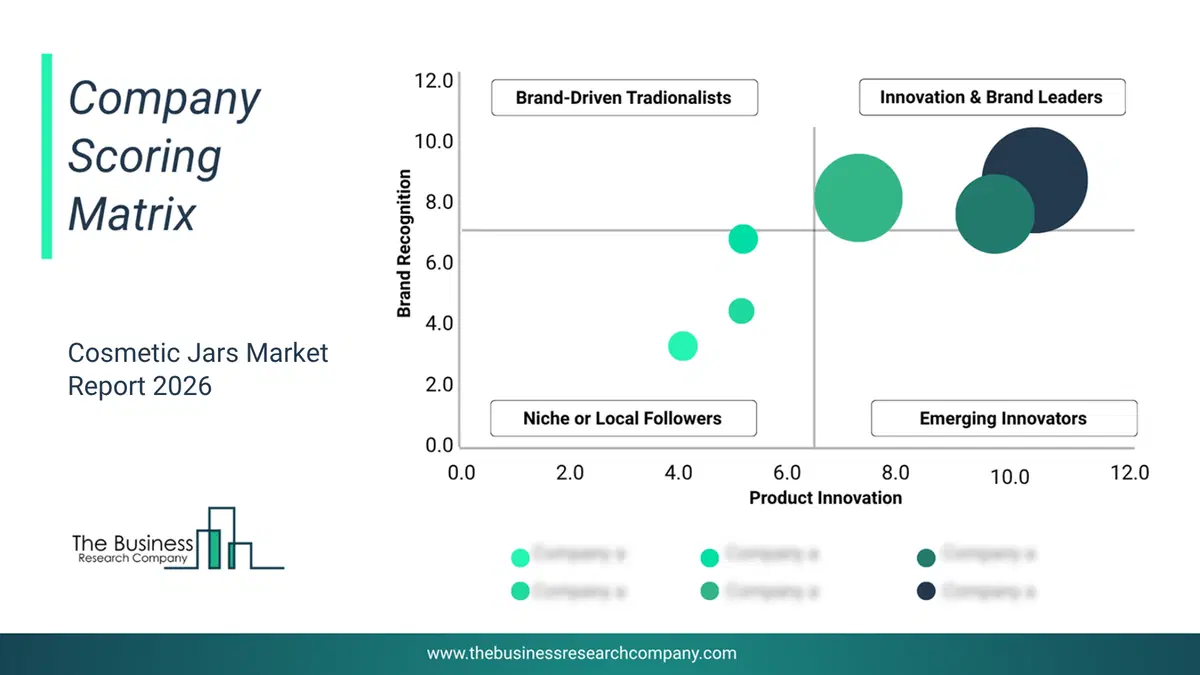
This chart maps companies by product innovation and brand strength, with bubble size indicating relative revenue, helping identify market leaders, challengers, and niche players. This is an illustrative chart; the full report provides a complete and accurate competitive analysis.
Global Cosmetic Jars Market Trends and Insights
Major companies operating in the cosmetic jars market are focusing on developing technologically advanced solutions, such as bio-based and industrially compostable packaging, to enhance sustainability, reduce environmental impact, and meet growing consumer demand for eco-friendly beauty products. Biobased and industrially compostable packaging refers to packaging made from renewable, plant-derived materials that can break down safely under controlled industrial composting conditions, minimizing environmental impact and reducing plastic waste. For instance, in May 2024, Nissha Advanced Technology GmbH, a Japan-based manufacturing company, launched a 50 ml cosmetics jar made from bio-based and compostable Sulapac material, offering a sustainable alternative for eco-friendly packaging. This industrially compostable packaging solution is made from natural wood and binders, designed to replace conventional plastic without compromising on quality or aesthetics. It offers excellent protection for water-based cosmetics with a patented barrier that prevents evaporation while being fully biodegradable and microplastic-free, significantly reducing environmental impact. Its natural look and compatibility with existing production lines make it an ideal choice for eco-conscious brands aiming to meet growing consumer and regulatory demands for sustainable beauty packaging.What Are Latest Mergers And Acquisitions In The Cosmetic Jars Market?
In February 2023, TriMas Corp., a US-based manufacturing company, acquired Aarts Packaging B.V. for an undisclosed amount. With this acquisition, TriMas Corp. aims to broaden its presence in beauty packaging, expand into food and medical markets, leverage innovative design and production capabilities, and accelerate global growth opportunities for its packaging business. Aarts Packaging B.V. is a Netherlands-based manufacturing company that offers cosmetic jars.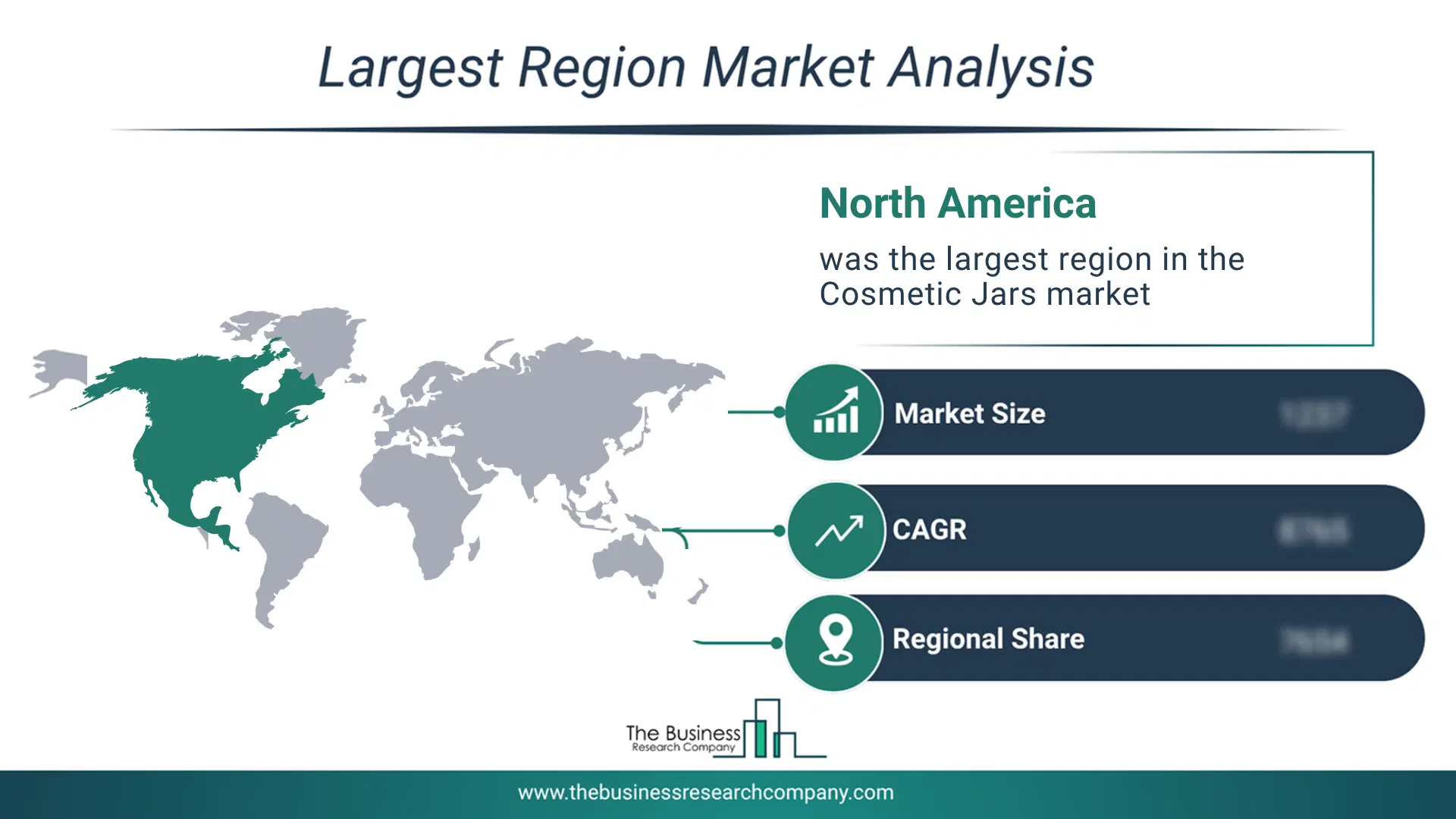
Regional Outlook
North America was the largest region in the cosmetic jars market in 2025. The regions covered in this market report are Asia-Pacific, South East Asia, Western Europe, Eastern Europe, North America, South America, Middle East, Africa. The countries covered in this market report are Australia, Brazil, China, France, Germany, India, Indonesia, Japan, Taiwan, Russia, South Korea, UK, USA, Canada, Italy, Spain.What Defines the Cosmetic Jars Market?
The cosmetic jars market consists of sales of airless cosmetic jars, acrylic cosmetic jars, and double-walled cosmetic jars. Values in this market are ‘factory gate’ values; that is, the value of goods sold by the manufacturers or creators of the goods, whether to other entities (including downstream manufacturers, wholesalers, distributors, and retailers) or directly to end customers. The value of goods in this market includes related services sold by the creators of the goods.How is Market Value Defined and Measured?
The market value is defined as the revenues that enterprises gain from the sale of goods and/or services within the specified market and geography through sales, grants, or donations in terms of the currency (in USD unless otherwise specified). The revenues for a specified geography are consumption values that are revenues generated by organizations in the specified geography within the market, irrespective of where they are produced. It does not include revenues from resales along the supply chain, either further along the supply chain or as part of other products.
This chart presents market attractiveness based on a quantitative evaluation of growth, competition, strategic alignment, and risk, offering a clear view of opportunity areas for decision-making. This chart is for illustrative purposes; the full report contains the complete analysis.

This chart highlights the Total Addressable Market (TAM) by estimating the maximum revenue opportunity using an assumption-driven approach, supporting strategic planning and opportunity sizing across markets. The chart is illustrative; the full report provides a more comprehensive analysis.
What Key Data and Analysis Are Included in the Cosmetic Jars Market Report 2026?
The cosmetic jars market research report is one of a series of new reports from The Business Research Company that provides market statistics, including Market Report 2026?global market size, regional shares, competitors with the market share, detailed market segments, market trends and opportunities, and any further data you may need to thrive in the cosmetic jars Market Report 2026? The market research report delivers a complete perspective of everything you need, with an in-depth analysis of the current and future state of the Market Report 2026?Cosmetic Jars Market Report Forecast Analysis
| Report Attribute | Details |
|---|---|
| Market Size Value In 2026 | $5.15 billion |
| Revenue Forecast In 2030 | $6.51 billion |
| Growth Rate | CAGR of 6.3% from 2026 to 2030 |
| Base Year For Estimation | 2025 |
| Actual Estimates/Historical Data | 2020-2025 |
| Forecast Period | 2026 - 2030 |
| Market Representation | Revenue in USD Billion and CAGR from 2026 to 2030 |
| Segments Covered | Type, Closure Type, Capacity, Application, End User |
| Regional Scope | Asia-Pacific, Western Europe, Eastern Europe, North America, South America, Middle East, Africa |
| Country Scope | The countries covered in the report are Australia, Brazil, China, France, Germany, India, Indonesia, Japan, Taiwan, Russia, South Korea, UK, USA, Canada, Italy, Spain. |
| Key Companies Profiled | Berry Global Inc, Gerresheimer AG, Amcor plc, Quadpack Industries, Berlin Packaging LLC, Stoelzle Glass Group, HCP Packaging, Eurovetrocap, Silgan Holdings Inc, Albea S.A, AptarGroup Inc, LUMSON S.p.A, Hangzhou ABC Packaging Co Ltd, APackaging Group Inc, Virospack SL, Heinz‑Glas GmbH, Thousand Peak Cosmetic Jars, Seme Packaging, Lisson Packaging, Jarsking |
| Customization Scope | Request for Customization |
| Pricing And Purchase Options | Explore Purchase Options |