
Cosmic Infrastructure Maintenance Market Report 2026
Global Outlook – By Service Type (Structural Repairs, System Upgrades, Debris Management, Other Service Types), By Technology (Robotics, AI And Machine Learning, Remote Sensing, Other Technologies), By Application (Satellites, Space Stations, Spacecraft, Other Applications), By End-User (Government, Commercial, Defense, Other End-Users) – Market Size, Trends, Strategies, and Forecast to 2030
Cosmic Infrastructure Maintenance Market Overview
• Cosmic Infrastructure Maintenance market size has reached to $9.01 billion in 2025 • Expected to grow to $15.41 billion in 2030 at a compound annual growth rate (CAGR) of 11.3% • Growth Driver: The Rise In Space Debris Is Expected To Drive The Market Due To Increasing Demand For Orbital Safety • Market Trend: Next-Generation Orbital Service Vehicles Advancing Sustainable Space Infrastructure Management • North America was the largest region in 2025 and Asia-Pacific is the fastest growing region.What Is Covered Under Cosmic Infrastructure Maintenance Market?
Cosmic infrastructure maintenance refers to the systematic upkeep, repair, and functional optimization of man-made assets and structural systems operating in outer space, encompassing activities designed to sustain operational integrity, extend mission lifespans, and prevent failures within orbital and deep-space environments. This discipline is essential for ensuring the long-term viability, safety, and cost-efficiency of space-based infrastructure across governmental, commercial, and scientific missions. The main service types in cosmic infrastructure maintenance are structural repairs, system upgrades, debris management, and others. Structural repairs refer to the restoration or reinforcement of physical components of space-based assets such as satellites or space stations to correct damage and ensure structural integrity for continued safe operation. The technologies used in this are robotics, AI and machine learning, remote sensing, and others in applications such as satellites, space stations, spacecraft, and others. It is used by several end-users, including government, commercial, defense, and others.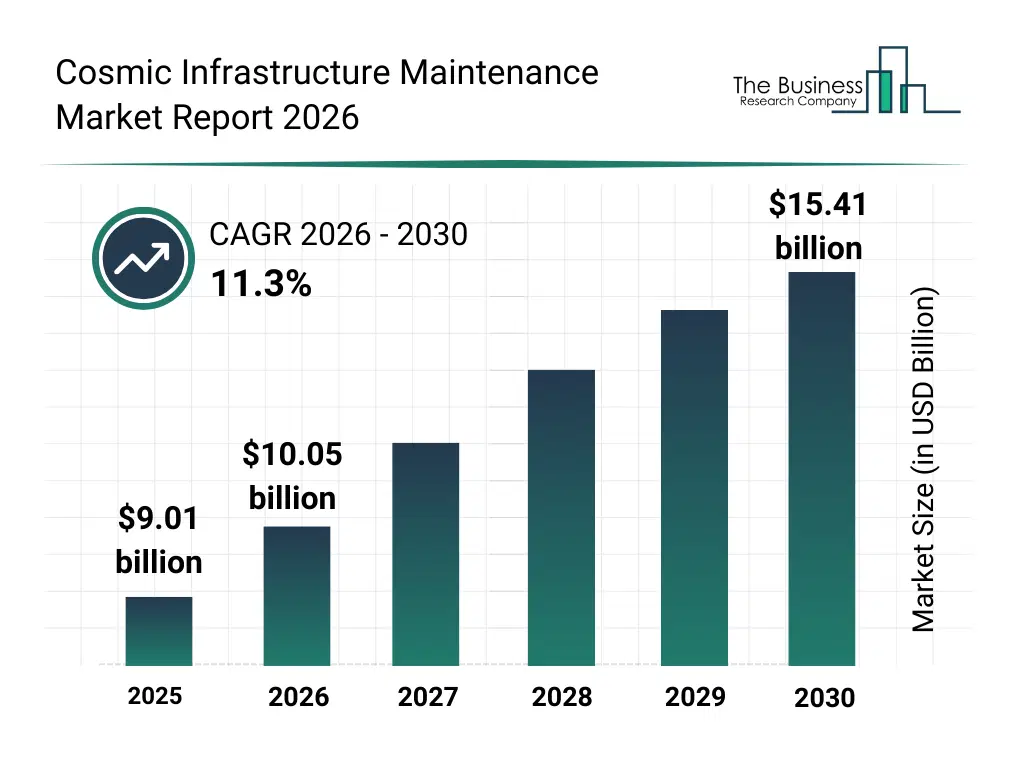
What Is The Cosmic Infrastructure Maintenance Market Size and Share 2026?
The cosmic infrastructure maintenance market size has grown rapidly in recent years. It will grow from $9.01 billion in 2025 to $10.05 billion in 2026 at a compound annual growth rate (CAGR) of 11.5%. The growth in the historic period can be attributed to growth of satellite launches, rising space asset replacement costs, increasing orbital congestion, expansion of government space programs, advancements in robotics technology.What Is The Cosmic Infrastructure Maintenance Market Growth Forecast?
The cosmic infrastructure maintenance market size is expected to see rapid growth in the next few years. It will grow to $15.41 billion in 2030 at a compound annual growth rate (CAGR) of 11.3%. The growth in the forecast period can be attributed to commercial space station development, growth of satellite mega constellations, demand for cost efficient space missions, innovation in robotic servicing technologies, increasing private sector space investments. Major trends in the forecast period include growing deployment of autonomous in orbit servicing robots, rising focus on satellite life extension services, expansion of active space debris management solutions, increasing use of AI driven predictive maintenance systems, higher demand for in orbit inspection and diagnostics.
Global Cosmic Infrastructure Maintenance Market Segmentation
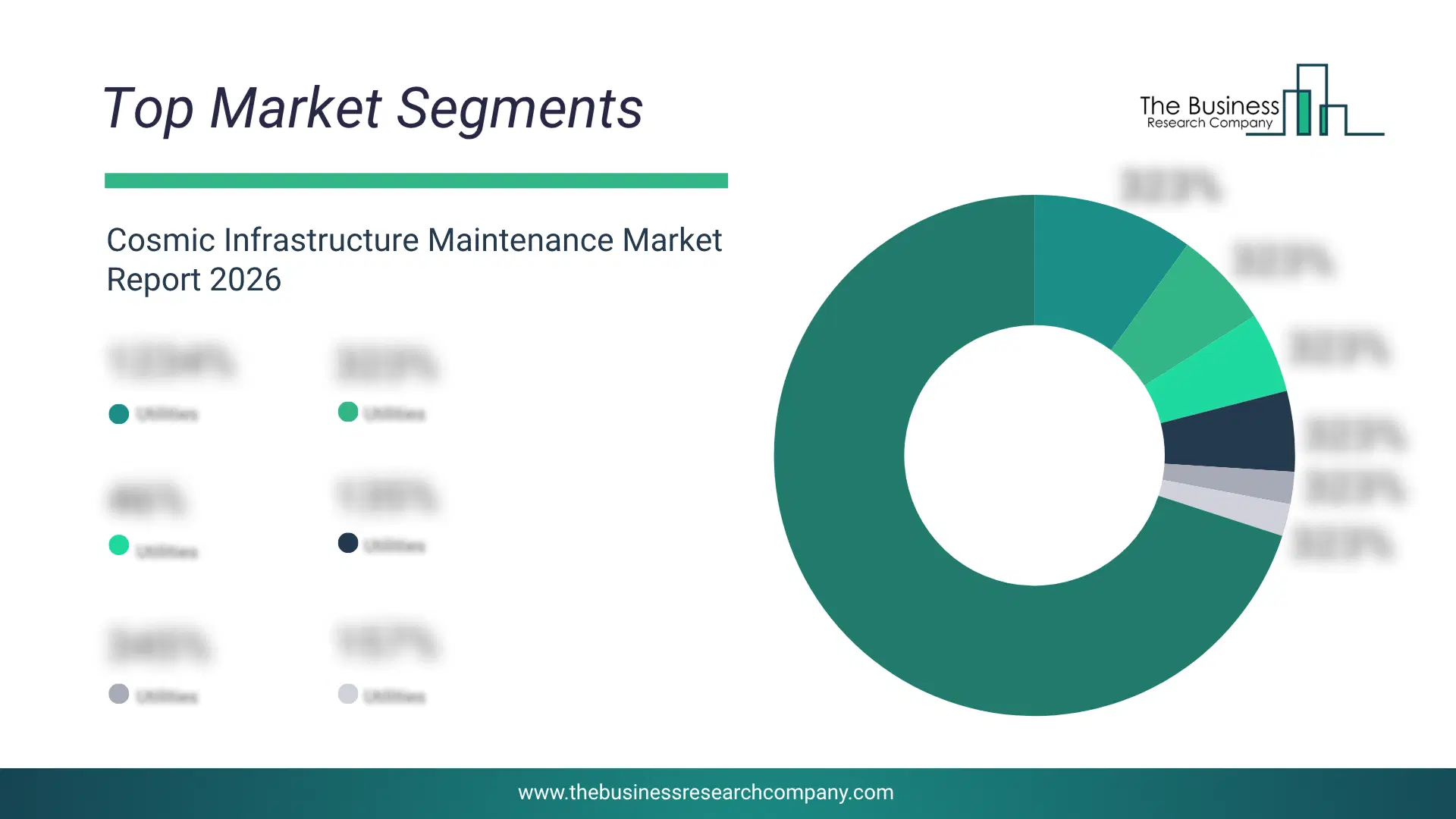
1) By Service Type: Structural Repairs, System Upgrades, Debris Management, Other Service Types 2) By Technology: Robotics, AI And Machine Learning, Remote Sensing, Other Technologies 3) By Application: Satellites, Space Stations, Spacecraft, Other Applications 4) By End-User: Government, Commercial, Defense, Other End-Users Subsegments: 1) By Structural Repairs: In-Orbit Component Replacement, Surface Micrometeoroid Damage Repair, Thermal Protection System Restoration, Hull Reinforcement And Sealing, Joint And Hinge Reconditioning 2) By System Upgrades: Power System Enhancement, Propulsion Retrofitting, Communication System Modernization, Software Patch Deployment, Sensor Suite Augmentation 3) By Debris Management: Active Debris Removal, Collision Avoidance Maneuvering, Debris Tracking And Cataloging, End-Of-Life Deorbiting Services, Tethered Capture Systems 4) By Other Service Types: Refueling And Resource Replenishment, Inspection And Diagnostics, Orbital Repositioning And Towing, Life-Extension Servicing, Environmental Monitoring For Maintenance SupportWhat Is The Driver Of The Cosmic Infrastructure Maintenance Market?
The rise in space debris is expected to drive the growth of the cosmic infrastructure maintenance market going forward. Space debris, also known as orbital debris, refers to defunct human-made objects in Earth's orbit, including non-functional satellites, spent rocket stages, and fragments resulting from collisions or disintegration events. The rise in space debris is primarily driven by the rapid expansion of satellite deployments, particularly within low Earth orbit, along with limited adherence to post-mission disposal protocols and an increasing frequency of in-orbit collisions. Cosmic infrastructure maintenance plays a critical role in mitigating this issue by enabling active debris tracking, in-orbit servicing, and end-of-life satellite removal, thereby enhancing orbital safety and supporting the long-term viability of space activities. For instance, in July 2024, according to the European Space Agency (ESA), a France-based intergovernmental organization, orbiting space debris is rapidly increasing, with 35,000 objects currently tracked, of which 26,000 are debris over 10 cm and 9,100 are active payloads, while 2023 saw record-high satellite launches, mostly contributing to dense commercial constellations, with over 6,000 active satellites now concentrated between 500 and 600 km altitude. Therefore, the rise in space debris is driving the growth of the cosmic infrastructure maintenance industry.Key Players In The Global Cosmic Infrastructure Maintenance Market
Major companies operating in the cosmic infrastructure maintenance market are RTX Corporation, The Boeing Company, Airbus SE, Mitsubishi Electric Corporation, Northrop Grumman Corporation, Honeywell Aerospace, BAE Systems plc, Safran S.A., Thales Group, Leonardo S.p.A., Space Exploration Technologies Corp., Sierra Nevada Corporation, OHB SE, Maxar Technologies Inc. (Advent International), Momentus Inc., ClearSpace SA, Orbit Fab Inc., Astroscale Holdings Inc., Kurs Orbital, Rogue Space Systems Corporation.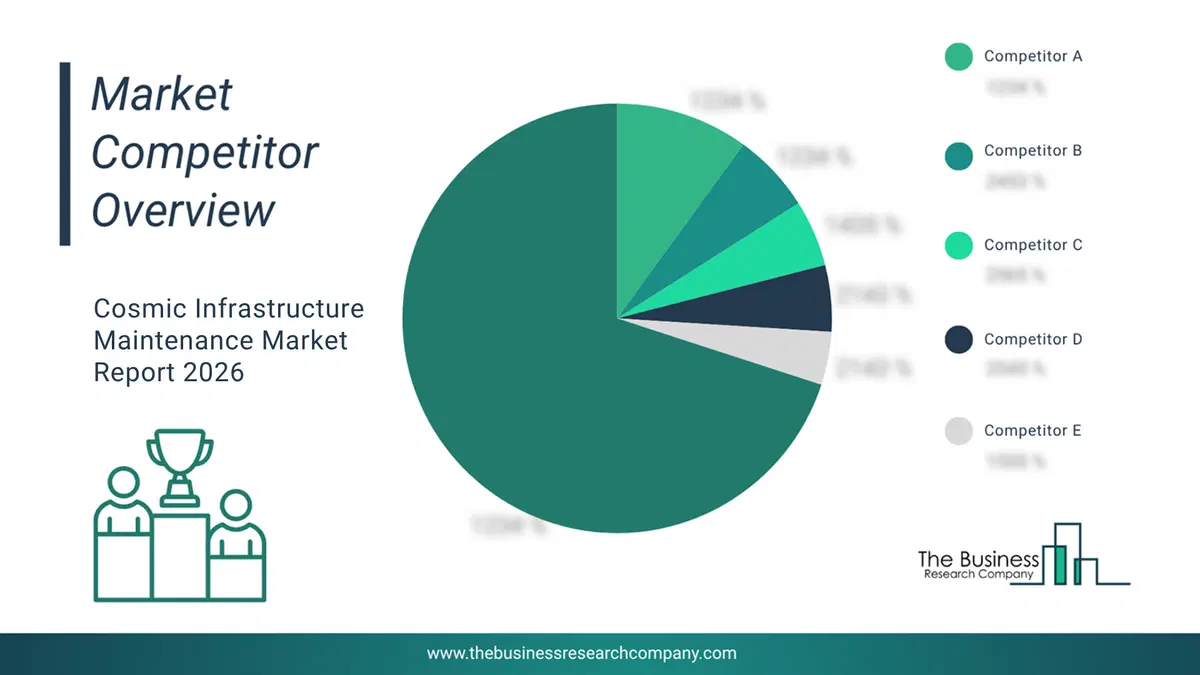
This chart is for illustrative purposes; the full report includes a detailed competitor analysis and comprehensive overview of the top 10 companies in the market.
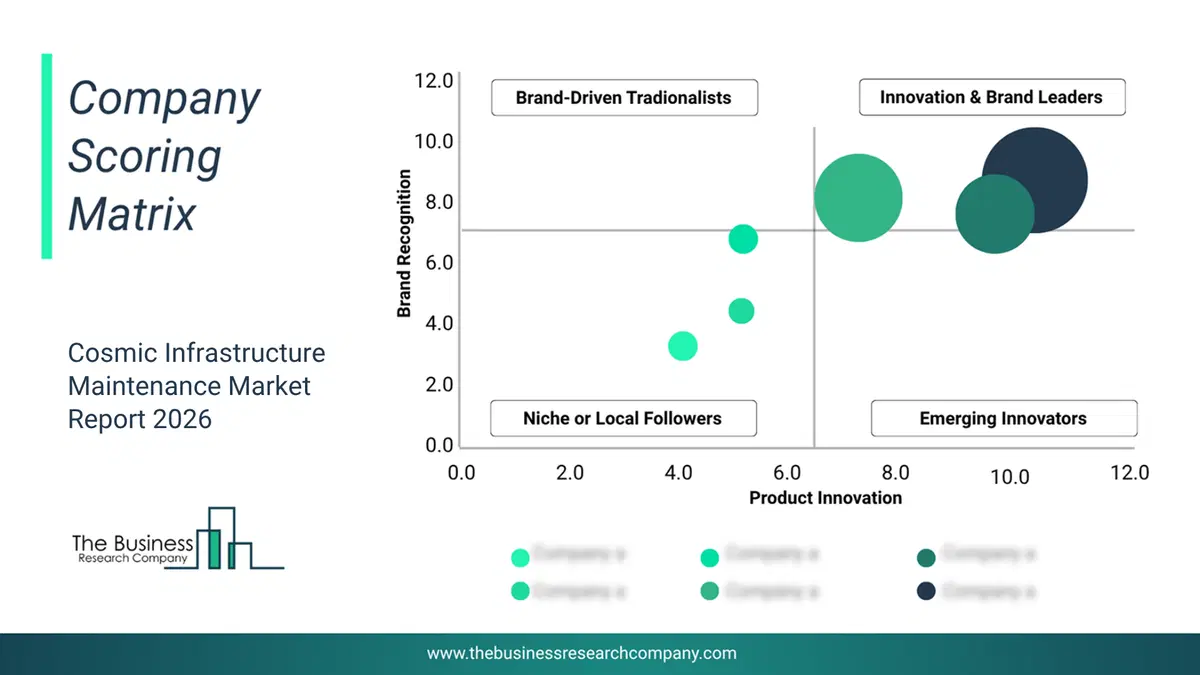
This chart maps companies by product innovation and brand strength, with bubble size indicating relative revenue, helping identify market leaders, challengers, and niche players. This is an illustrative chart; the full report provides a complete and accurate competitive analysis.
Global Cosmic Infrastructure Maintenance Market Trends and Insights
Major companies operating in the cosmic infrastructure maintenance market are focusing on developing advanced solutions, such as orbital service vehicles, to support long-term orbital sustainability. An orbital service vehicle is a spacecraft designed to perform a range of in-orbit support functions such as satellite maintenance, refueling, repositioning, and end-of-life management to sustain and extend the functionality of space infrastructure. For instance, in February 2024, Space Machines Company, an Australia-based space logistics enterprise, launched Optimus, a cutting-edge orbital servicing vehicle. Optimus is designed to provide on-demand services such as satellite repair, refueling, and system upgrades, promoting more efficient and sustainable management of space assets. It is equipped with a space-grade digital fiber-optic gyroscope-based inertial navigation system, enabling the high-precision maneuvers essential for safe docking and complex orbital operations.What Are Latest Mergers And Acquisitions In The Cosmic Infrastructure Maintenance Market?
In February 2025, Chugach Government Solutions (CGS), a US-based government contracting company, collaborated with Amentum Services, Inc., to strengthen the operational resilience and long-term sustainability of national space infrastructure. This partnership aims to support NASA’s Stennis Space Center and Michoud Assembly Facility by providing facility management, engineering, and manufacturing services, logistics, and environmental solutions aimed at modernizing and sustaining mission-critical space infrastructure. Amentum Services Inc. is a US-based engineering and technology solutions provider within the environment and energy, space, intelligence, and defense sectors.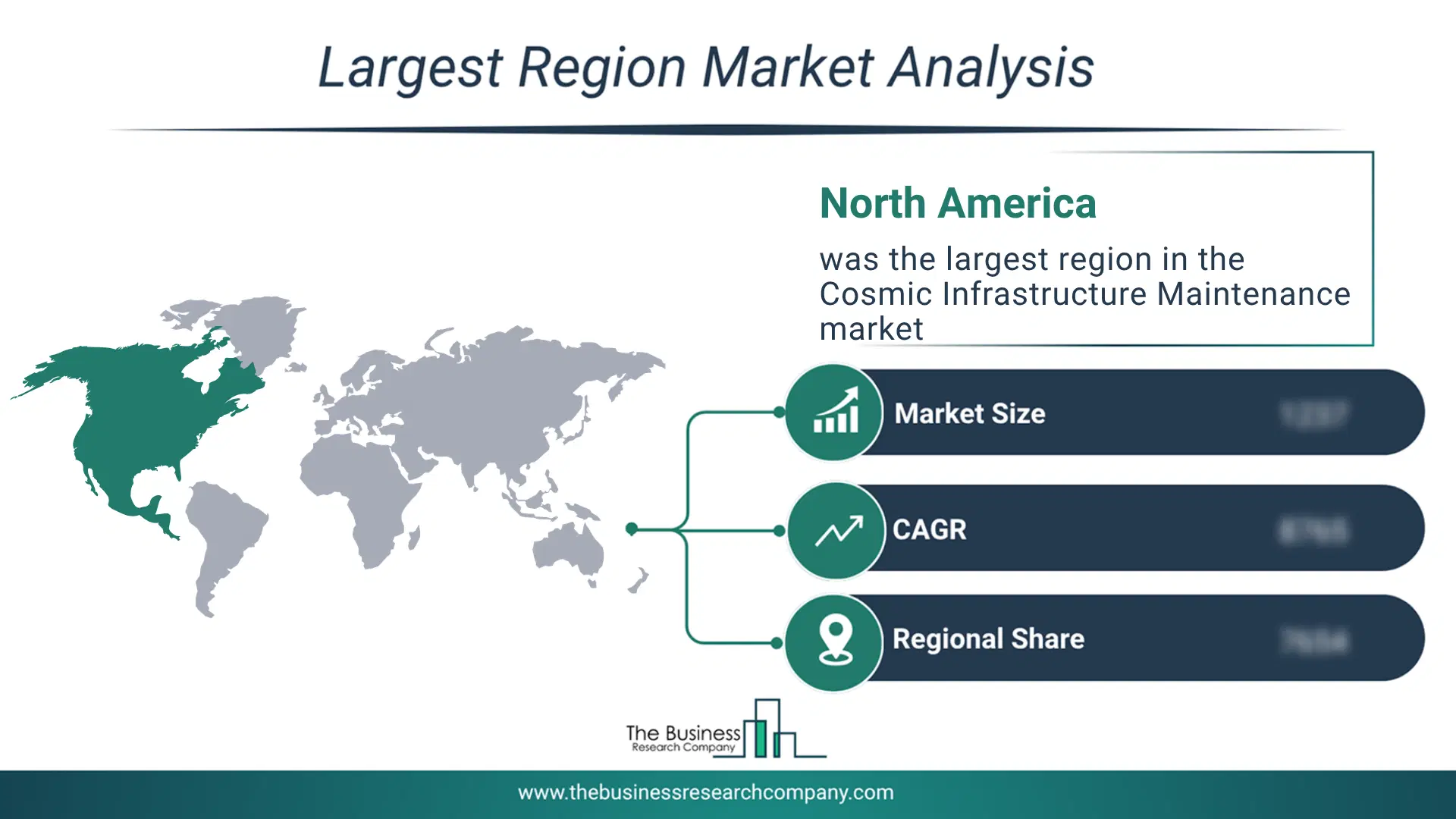
Regional Insights
North America was the largest region in the cosmic infrastructure maintenance market in 2025, and it is expected to be the fastest-growing region in the forecast period. The regions covered in this market report are Asia-Pacific, South East Asia, Western Europe, Eastern Europe, North America, South America, Middle East, Africa The countries covered in this market report are Australia, Brazil, China, France, Germany, India, Indonesia, Japan, Taiwan, Russia, South Korea, UK, USA, Canada, Italy, SpainWhat Defines the Cosmic Infrastructure Maintenance Market?
The cosmic infrastructure maintenance market consists of revenues earned by entities by providing services such as autonomous docking assistance, mission lifecycle planning services, space infrastructure health monitoring, orbital traffic management services, and post-launch servicing logistics. The market value includes the value of related goods sold by the service provider or included within the service offering. The cosmic infrastructure maintenance market also includes sales of autonomous navigation units, orbital servicing toolkits, modular interface adapters, advanced thermal control hardware, refueling couplers and valves, and in-space inspection payloads. Values in this market are ‘factory gate’ values, that is, the value of goods sold by the manufacturers or creators of the goods, whether to other entities (including downstream manufacturers, wholesalers, distributors, and retailers) or directly to end customers. The value of goods in this market includes related services sold by the creators of the goods.How is Market Value Defined and Measured?
The market value is defined as the revenues that enterprises gain from the sale of goods and/or services within the specified market and geography through sales, grants, or donations in terms of the currency (in USD unless otherwise specified). The revenues for a specified geography are consumption values that are revenues generated by organizations in the specified geography within the market, irrespective of where they are produced. It does not include revenues from resales along the supply chain, either further along the supply chain or as part of other products.
This chart presents market attractiveness based on a quantitative evaluation of growth, competition, strategic alignment, and risk, offering a clear view of opportunity areas for decision-making. This chart is for illustrative purposes; the full report contains the complete analysis.

This chart highlights the Total Addressable Market (TAM) by estimating the maximum revenue opportunity using an assumption-driven approach, supporting strategic planning and opportunity sizing across markets. The chart is illustrative; the full report provides a more comprehensive analysis.
What Key Data and Analysis Are Included in the Cosmic Infrastructure Maintenance Market Report 2026?
The cosmic infrastructure maintenance market research report is one of a series of new reports from The Business Research Company that provides market statistics, including industry global market size, regional shares, competitors with the market share, detailed market segments, market trends and opportunities, and any further data you may need to thrive in the cosmic infrastructure maintenance industry. The market research report delivers a complete perspective of everything you need, with an in-depth analysis of the current and future state of the industry.Cosmic Infrastructure Maintenance Market Report Forecast Analysis
| Report Attribute | Details |
|---|---|
| Market Size Value In 2026 | $10.05 billion |
| Revenue Forecast In 2030 | $15.41 billion |
| Growth Rate | CAGR of 11.5% from 2026 to 2030 |
| Base Year For Estimation | 2025 |
| Actual Estimates/Historical Data | 2020-2025 |
| Forecast Period | 2026 - 2030 |
| Market Representation | Revenue in USD Billion and CAGR from 2026 to 2030 |
| Segments Covered | Service Type, Technology, Application, End-User |
| Regional Scope | Asia-Pacific, Western Europe, Eastern Europe, North America, South America, Middle East, Africa |
| Country Scope | The countries covered in this market report are Australia, Brazil, China, France, Germany, India, Indonesia, Japan, Taiwan, Russia, South Korea, UK, USA, Canada, Italy, Spain |
| Key Companies Profiled | RTX Corporation, The Boeing Company, Airbus SE, Mitsubishi Electric Corporation, Northrop Grumman Corporation, Honeywell Aerospace, BAE Systems plc, Safran S.A., Thales Group, Leonardo S.p.A., Space Exploration Technologies Corp., Sierra Nevada Corporation, OHB SE, Maxar Technologies Inc. (Advent International), Momentus Inc., ClearSpace SA, Orbit Fab Inc., Astroscale Holdings Inc., Kurs Orbital, Rogue Space Systems Corporation. |
| Customization Scope | Request for Customization |
| Pricing And Purchase Options | Explore Purchase Options |