

Dark Factories Market Report 2026
Global Outlook – By Type (Industrial Robotics, Additive Manufacturing, Industrial Internet of Things (IIoT), Automated Guided Vehicles (AGVs)), By Deployment (Greenfield Projects, Brownfield Projects), By End-User (Automotive, Pharmaceuticals, Aerospace, Electronics, Other End-Users) – Market Size, Trends, Strategies, and Forecast to 2030
Dark Factories Market Overview
• Dark Factories market size has reached to $54.64 billion in 2025 • Expected to grow to $88.12 billion in 2030 at a compound annual growth rate (CAGR) of 10% • Growth Driver: Increasing Adoption Of Industrial Robotics Fueling The Growth Of The Market Due To Enhancing Automation And Boosting Efficiency • Market Trend: AI-Driven Automation Enhancing Precision And Operational Efficiency • North America was the largest region in 2025 and Asia-Pacific is the fastest growing region.Market Gains By 2030 – Top Opportunities By Segment
Market Gain identifies the most promising market opportunities by highlighting the segments or products expected to generate the highest incremental revenue growth over the next five years.
What Is Covered Under Dark Factories Market?
Dark factories are fully automated manufacturing facilities that operate without human intervention and often in complete darkness. These factories rely entirely on robotics, artificial intelligence (AI), and automated systems to perform production tasks. The primary purpose of dark factories is to maximize efficiency, reduce labor costs, and enable continuous, 24/7 production with minimal downtime. The main types of dark factories include industrial robotics, additive manufacturing, the Industrial Internet of Things (IIoT), and automated guided vehicles (AGVs). Industrial robotics refers to the use of automated, programmable machines to perform tasks in manufacturing environments. These technologies are deployed in both greenfield and brownfield projects, catering to end-users such as the automotive, pharmaceutical, aerospace, and electronics, and others.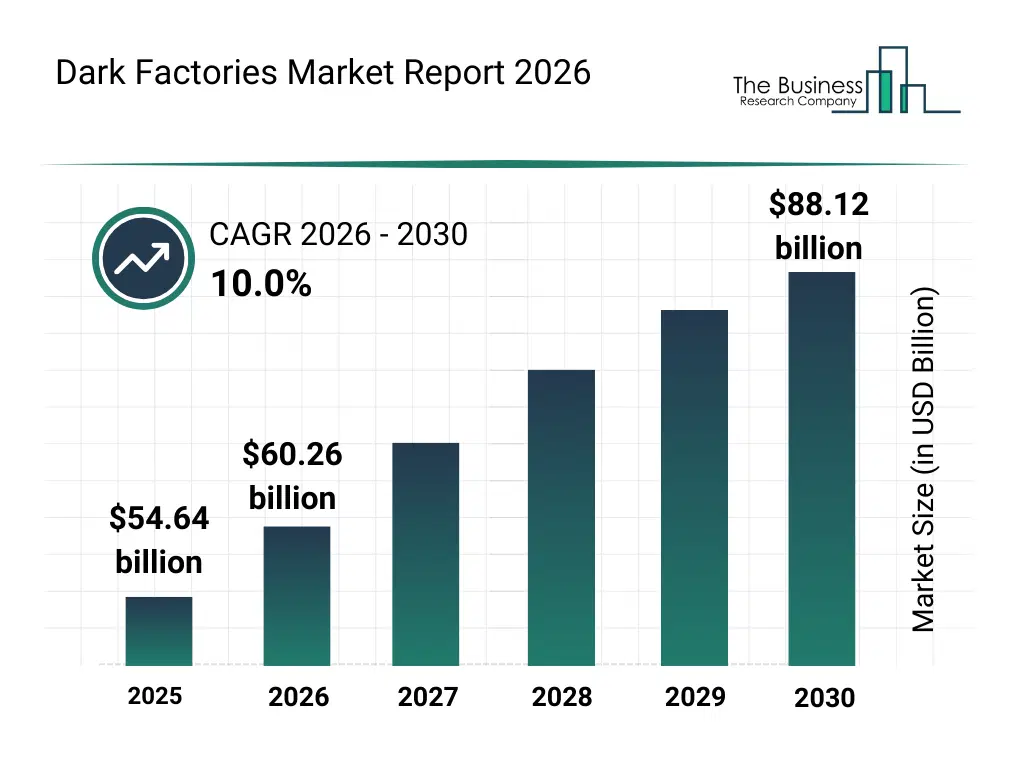
What Is The Dark Factories Market Size and Share 2026?
The dark factories market size has grown rapidly in recent years. It will grow from $54.64 billion in 2025 to $60.26 billion in 2026 at a compound annual growth rate (CAGR) of 10.3%. The growth in the historic period can be attributed to labor cost pressures, demand for operational efficiency, robotics technology maturity, quality consistency requirements, industrial automation investments.What Is The Dark Factories Market Growth Forecast?
The dark factories market size is expected to see strong growth in the next few years. It will grow to $88.12 billion in 2030 at a compound annual growth rate (CAGR) of 10.0%. The growth in the forecast period can be attributed to AI driven manufacturing, shortage of skilled labor, 24 by 7 production demand, smart factory initiatives, cost optimization strategies. Major trends in the forecast period include expansion of fully automated manufacturing plants, rising use of industrial robotics and cobots, integration of IIoT and predictive analytics, growth of lights out production models, increased adoption of autonomous material handling.
Global Dark Factories Market Segmentation
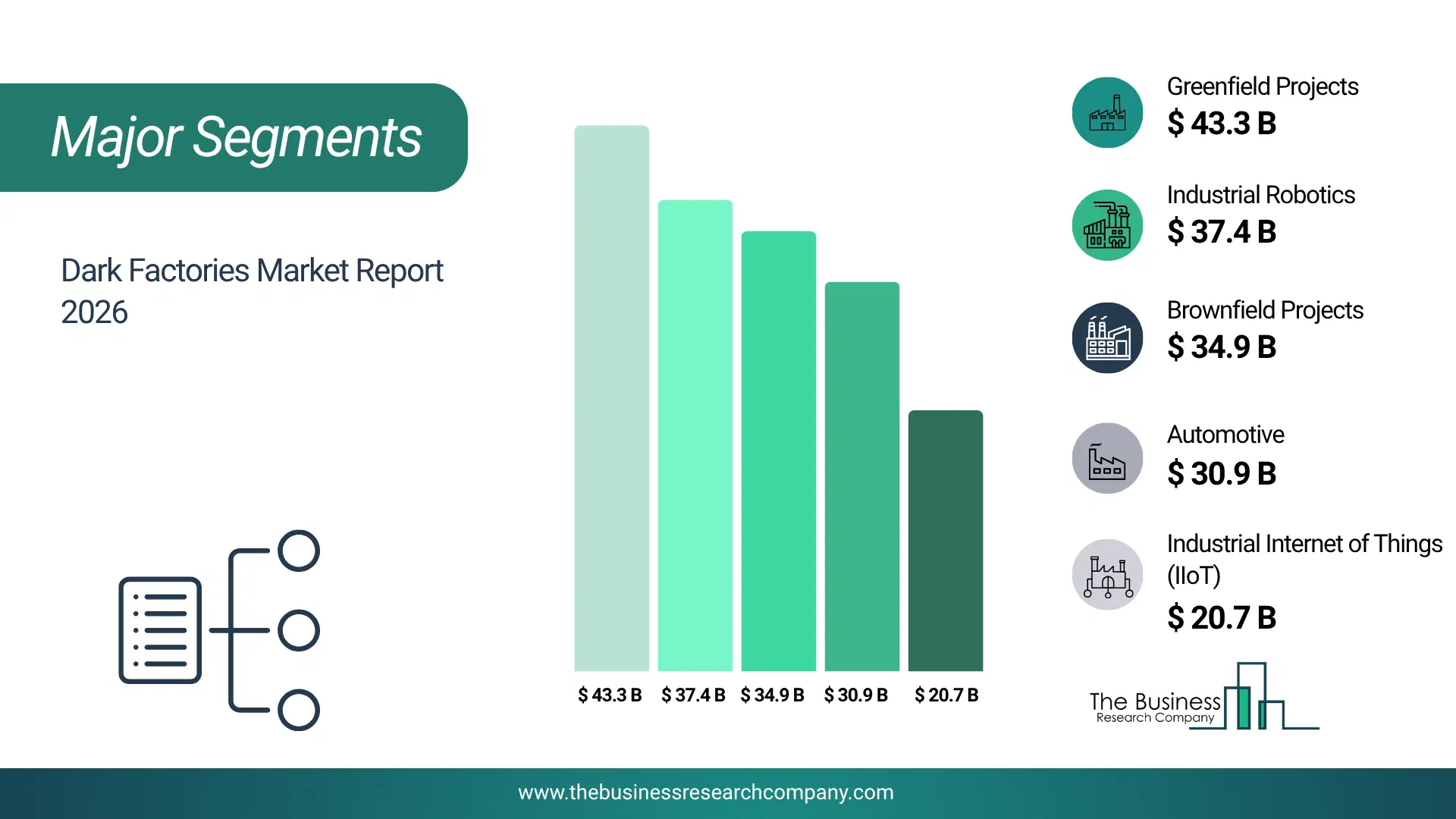
1) By Type: Industrial Robotics, Additive Manufacturing, Industrial Internet of Things (IIoT), Automated Guided Vehicles (AGVs) 2) By Deployment: Greenfield Projects, Brownfield Projects 3) By End-User: Automotive, Pharmaceuticals, Aerospace, Electronics, Other End-Users Subsegments: 1) By Industrial Robotics: Articulated Robots, Cartesian Robots, SCARA Robots, Cylindrical Robots, Delta Robots, Collaborative Robots (Cobots) 2) By Additive Manufacturing: Fused Deposition Modeling (FDM), Stereolithography (SLA), Selective Laser Sintering (SLS), Electron Beam Melting (EBM), Direct Metal Laser Sintering (DMLS), Binder Jetting, Powder Bed Fusion (PBF) 3) By Industrial Internet of Things (IIoT): Smart Sensors, Asset Tracking and Management, Predictive Maintenance, Remote Monitoring, Industrial Cloud Computing, Machine-to-Machine (M2M) Communication, Edge Computing 4) By Automated Guided Vehicles (AGVs): Automated Towing Vehicles (ATVs), Unit Load Automated Guided Vehicles, Automated Forklifts, Autonomous Mobile Robots (AMRs), Tow Tractors, Hybrid Automated Guided Vehicles The top segments in the dark factories market will be: • Greenfield Projects will reach $43351.13 Million by 2030. • Industrial Robotics will reach $37468.99 Million by 2030. • Brownfield Projects will reach $34989.92 Million by 2030. • Automotive will reach $30911.84 Million by 2030. • Industrial Internet of Things (IIoT) will reach $20769.85 Million by 2030.What Is The Driver Of The Dark Factories Market?
The increasing adoption of industrial robotics is expected to propel the growth of the dark factories market going forward. Industrial robotics refers to the use of programmable, automated machines designed to perform manufacturing tasks with high precision and efficiency. The rising adoption of industrial robotics is due to the precision and reliability of robots, which ensure consistent quality and reduce human error in manufacturing. Industrial robotics enhances dark factories by enabling fully automated production, eliminating the need for human intervention. They ensure precision, consistency, and round-the-clock operation, significantly improving manufacturing efficiency and reducing operational costs. For instance, in September 2025, according to the International Federation of Robotics, a Germany-based non-profit research and industry association, the total number of industrial robots in operational use worldwide reached 4,664,000 units in 2024, reflecting a 9 percent increase compared with the previous year, and around 542,000 industrial robots were newly installed globally in 2024. Therefore, the increasing adoption of industrial robotics is driving the growth of the dark factories industry.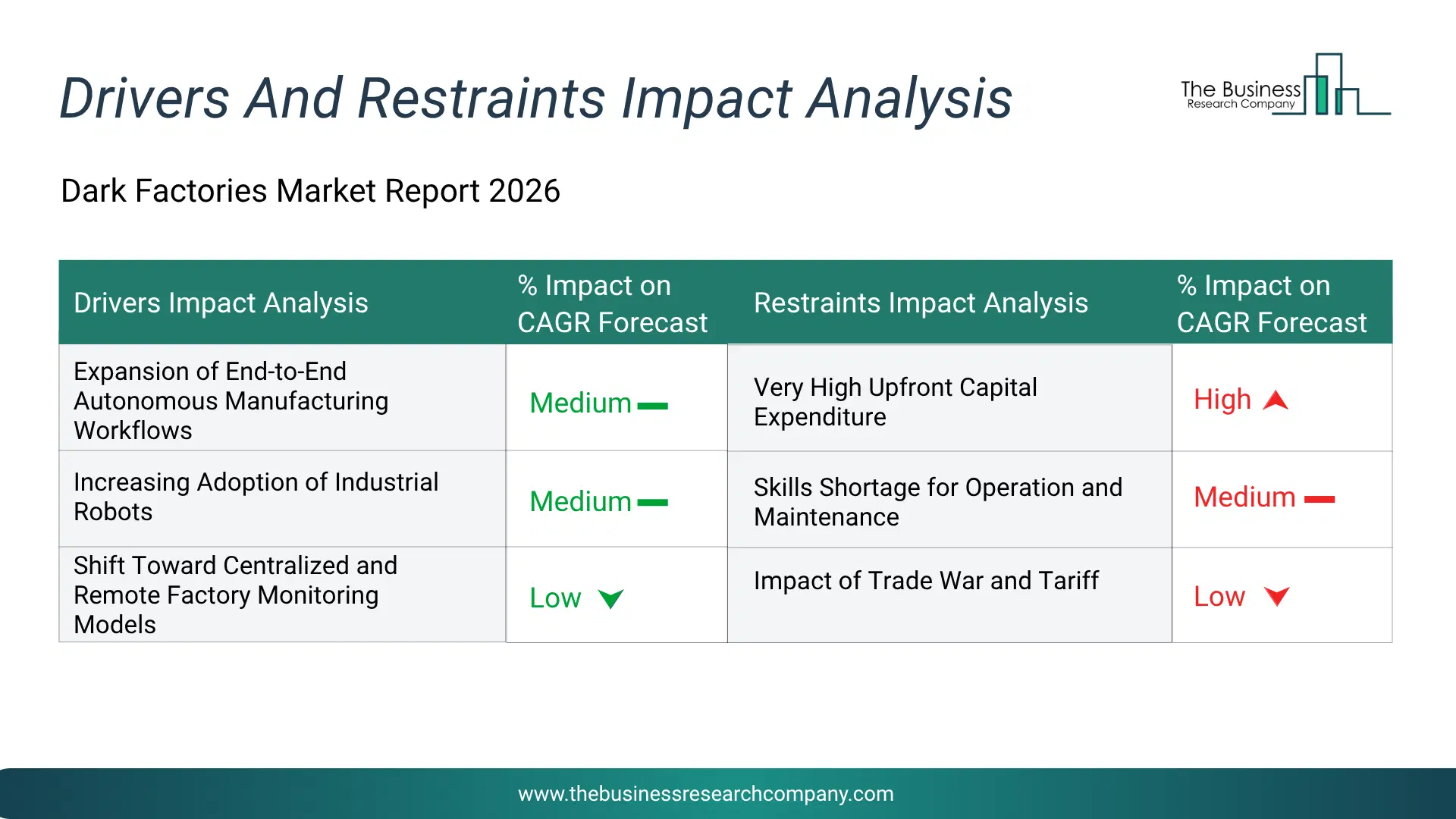
Infographic Chart Showing Key Market Drivers Analysis And Restraints For Dark Factories Market
The chart presents an impact analysis of key drivers and restraints, quantifying their relative influence on the market's growth rate and helping assess the balance between growth enablers and limiting factors. This chart offers a high-level perspective; the full report contains more detailed insights.
How Will The Drivers Impact Growth In The Global Dark Factories Market?
• Expansion of End-to-End Autonomous Manufacturing Workflows (Medium) – During the forecast period, the expansion of end-to-end autonomous manufacturing workflows is expected to be a key driver of the growth of the dark factories market in the forecast period. as manufacturers increasingly adopt fully integrated production processes where machines, robots, and software systems perform all manufacturing steps without human intervention, the adoption of autonomous workflows drives the need for seamless, continuous, and high precision operations. industry projections indicate that the implementation of autonomous manufacturing systems across sectors is rising steadily year on year, reflecting a broader trend toward fully automated, interconnected production environments. as organizations deploy advanced robotics, real time data processing, and closed loop control systems that span material input to final inspection, dark factories enable optimized throughput, reduced cycle times, and consistent product quality, thereby significantly driving demand for end to end autonomous manufacturing solutions. as a result, expansion of end-to-end autonomous manufacturing workflows is anticipated to contributing to a 2.0% annual growth in the market. • Increasing Adoption of Industrial Robots (Medium) – During the forecast period, the increasing adoption of industrial robots is expected to be a key driver of the growth of the dark factories market in the forecast period. as manufacturers increasingly deploy programmable robots to perform repetitive tasks with precision, speed, and reliability, the widespread use of these machines drives the need for fully automated production systems capable of operating continuously without human supervision. industry trends indicate that the deployment of industrial robots worldwide continues to expand year on year, reflecting a broader move toward autonomous and highly efficient manufacturing operations. as factories integrate larger fleets of robots into end-to-end production workflows, the use of dark factory systems becomes essential to coordinate operations, optimize productivity, and maintain consistent quality, thereby significantly driving demand for robotic automation in manufacturing environments. consequently, increasing adoption of industrial robots is projected to contributing to a 1.5% annual growth in the market. • Shift Toward Centralized and Remote Factory Monitoring Models (Low) – During the forecast period, the shift toward centralized and remote factory monitoring models is expected to be a key driver of the growth of the dark factories market in the forecast period. as manufacturers increasingly implement digital platforms to observe, control, and optimize production processes from off site locations, the adoption of centralized monitoring drives the need for integrated systems that ensure operational visibility and continuous oversight. industry projections indicate that manufacturers worldwide are increasingly investing in remote monitoring and digital factory management technologies year on year, reflecting a broader trend toward automated, connected production environments. as organizations deploy more advanced monitoring frameworks that link autonomous machines, sensors, and control systems, dark factories enable real time performance tracking, predictive maintenance, and operational efficiency, thereby significantly driving demand for automated, remotely supervised manufacturing solutions. therefore, shift toward centralized and remote factory monitoring models is projected to contributing to a 1.0% annual growth in the market. • Increasing Emphasis on Sustainable Manufacturing (Low) – During the forecast period, the increasing emphasis on sustainable manufacturing promotes is driving increased demand for dark factories. as manufacturers adopt production systems that minimize environmental impact, conserve energy, and reduce waste, the focus on sustainability drives the need for automation technologies that optimize resource efficiency and lower emissions. industry projections indicate that global industrial initiatives to implement sustainable production practices are expanding year on year, reflecting a broader trend toward environmentally responsible and resource-efficient manufacturing. as organizations deploy energy-efficient automated systems and predictive maintenance frameworks, dark factories enable reduced energy consumption, improved resource utilization, and lower carbon footprints, thereby significantly driving demand for sustainable, automated manufacturing solutions. the increasing emphasis on sustainable manufacturing promotes growth contribution during the forecast period in 2025 is 0.5%.How Will The Restraints Impact Growth In The Global Dark Factories Market?
• Very High Upfront Capital Expenditure (Medium) – During the forecast period, the very high upfront capital expenditure remains a significant barrier to market expansion. deploying fully automated manufacturing systems requires substantial initial investments in robotics, ai integration, sensors, and smart factory infrastructure, which create a major financial barrier for many manufacturers. these steep capital requirements can delay or prevent companies from adopting dark factory solutions, especially small and medium-sized enterprises that may have limited access to financing or budget flexibility. very high upfront capital expenditure also raises the financial risk of moving from conventional production methods to fully automated operations, as manufacturers must ensure that expected efficiency gains outweigh the initial costs. as a result, companies may postpone or scale back the implementation of dark factory solutions due to these significant financial obligations, thereby restricting the growth of the dark factories market. growth affected by very high upfront capital expenditure during the forecast period in 2025 is -2.5%. • Skills Shortage for Operation and Maintenance (Medium) – During the forecast period, the skills shortage for operation and maintenance a significant barrier to market expansion. limited availability of trained personnel capable of operating, maintaining, and troubleshooting advanced automated systems increases the complexity and risk of deploying fully automated manufacturing facilities. this shortage is driven by the rapid adoption of robotics, ai, and machine vision technologies, which outpaces the supply of skilled technicians and engineers able to manage these systems effectively. as a result, manufacturers may postpone or scale back investments in dark factories due to concerns over operational reliability, unexpected downtime, and insufficient in-house expertise to handle complex automation infrastructures. consequently, enterprises face constraints in realizing the full potential of automation technologies, thereby restricting the growth of the dark factories market. growth affected by skills shortage for operation and maintenance during the forecast period in 2025 is -1.8%. • Impact of Trade War and Tariff (Low) – During the forecast period, the impact of trade war and tariffs remains a significant barrier to market expansion. escalating global trade tensions and the imposition of steep tariffs on key automation components, such as precision parts, sensors, and robotics hardware, increase production costs and create uncertainty for manufacturers planning large-scale automation investments. tariff-related disruptions to supply chains can delay deployment of automated production lines, including integration of robotics, ai-driven control systems, and monitoring solutions, and may force manufacturers to reallocate budgets from expansion initiatives to offset increased expenses and mitigate risks. as a result, manufacturers may postpone or scale back the adoption of dark factory technologies in the face of heightened geopolitical and economic uncertainties, thereby restricting the growth of the dark factories market. growth affected by impact of trade war and tariffs during the forecast period in 2025 is -0.3%.Key Players In The Global Dark Factories Market
Major companies operating in the dark factories market are Siemens AG, Schneider Electric, Mitsubishi Electric, Honeywell International, ABB Ltd, Toshiba Infrastructure Systems & Solutions, Bosch Rexroth, Rockwell Automation, Omron Corporation, Keyence Corporation, FANUC Corporation, Dassault Systèmes, Autodesk, Yaskawa Electric Corporation, KUKA AG, Teradyne, Nachi-Fujikoshi Corp, Staubli Robotics, Beckhoff Automation, Universal Robots, Mobile Industrial Robots (MiR), Denso Wave.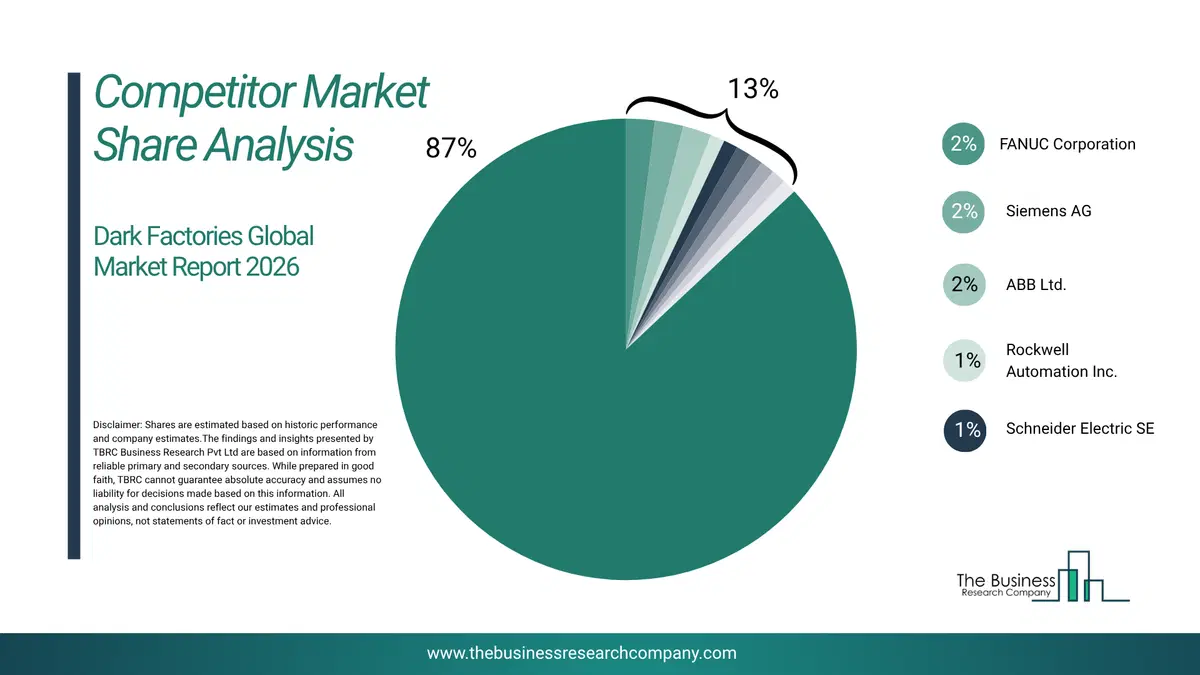
This chart is for illustrative purposes; the full report includes a detailed competitor analysis and comprehensive overview of the top 10 companies in the market.
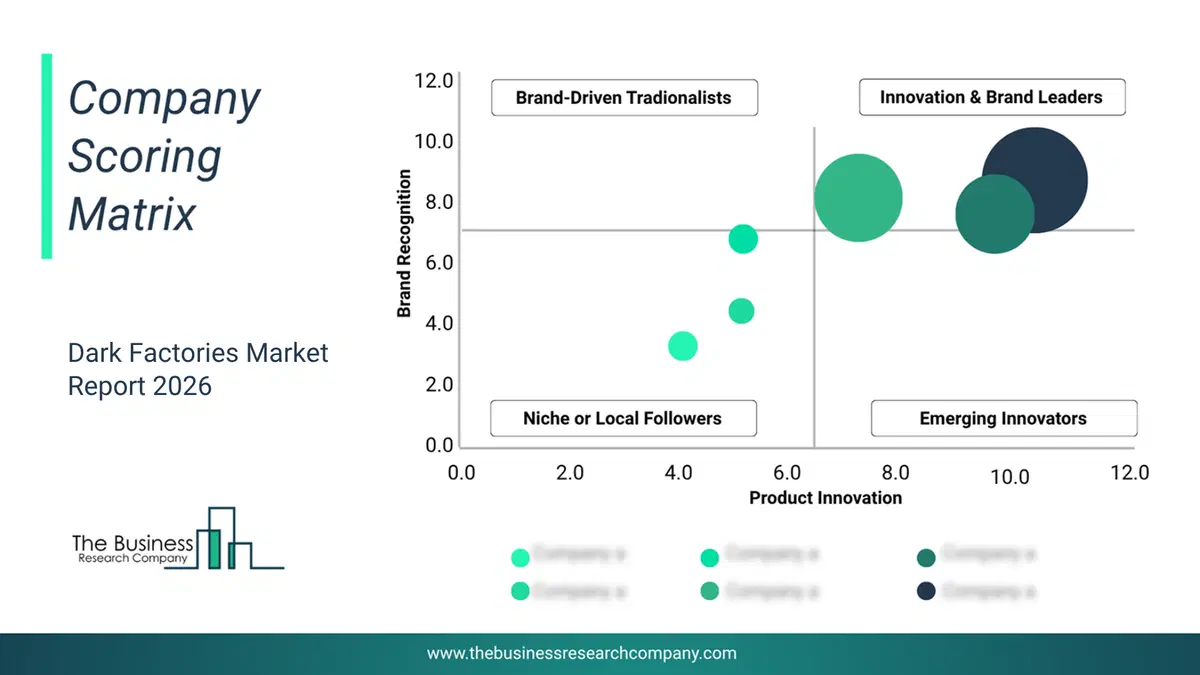
This chart maps companies by product innovation and brand strength, with bubble size indicating relative revenue, helping identify market leaders, challengers, and niche players. This is an illustrative chart; the full report provides a complete and accurate competitive analysis.
Global Dark Factories Market Trends and Insights
Major companies operating in the dark factories market are focusing on developing technologically advanced solutions such as the hyper-intelligent manufacturing platform (HyperIMP) to enable fully autonomous, round-the-clock production with enhanced efficiency, precision, and minimal human intervention. A hyper-intelligent manufacturing platform is an advanced, artificial intelligence (AI)-driven system that integrates automation, machine learning, and real-time data analytics to optimize, control, and autonomously manage end-to-end manufacturing processes. For instance, in August 2024, Xiaomi Corporation, a China-based electronics company, launched a next-generation smart factory in Changping. This facility operates 24/7 without human workers or lighting, utilizing a hyper-intelligent manufacturing platform (HyperIMP). The factory integrates artificial intelligence (AI), the internet of things (IoT), and real-time data analytics to enable self-perception, autonomous decision-making, and predictive maintenance, while also featuring micron-level dust removal and intelligent quality control systems for high-precision, defect-free production.What Are Latest Mergers And Acquisitions In The Dark Factories Market?
In October 2024, Mpac Group plc, a UK-based packaging automation company, acquired CSi Palletising for $60 million (€56 million). With this acquisition, Mpac enhances its capabilities in end-of-line automation, expanding its portfolio in high-efficiency palletizing solutions for various industries. CSi Palletising is a Netherlands-based industrial automation company specializing in robotic palletizing solutions, with expertise in dark factory operations.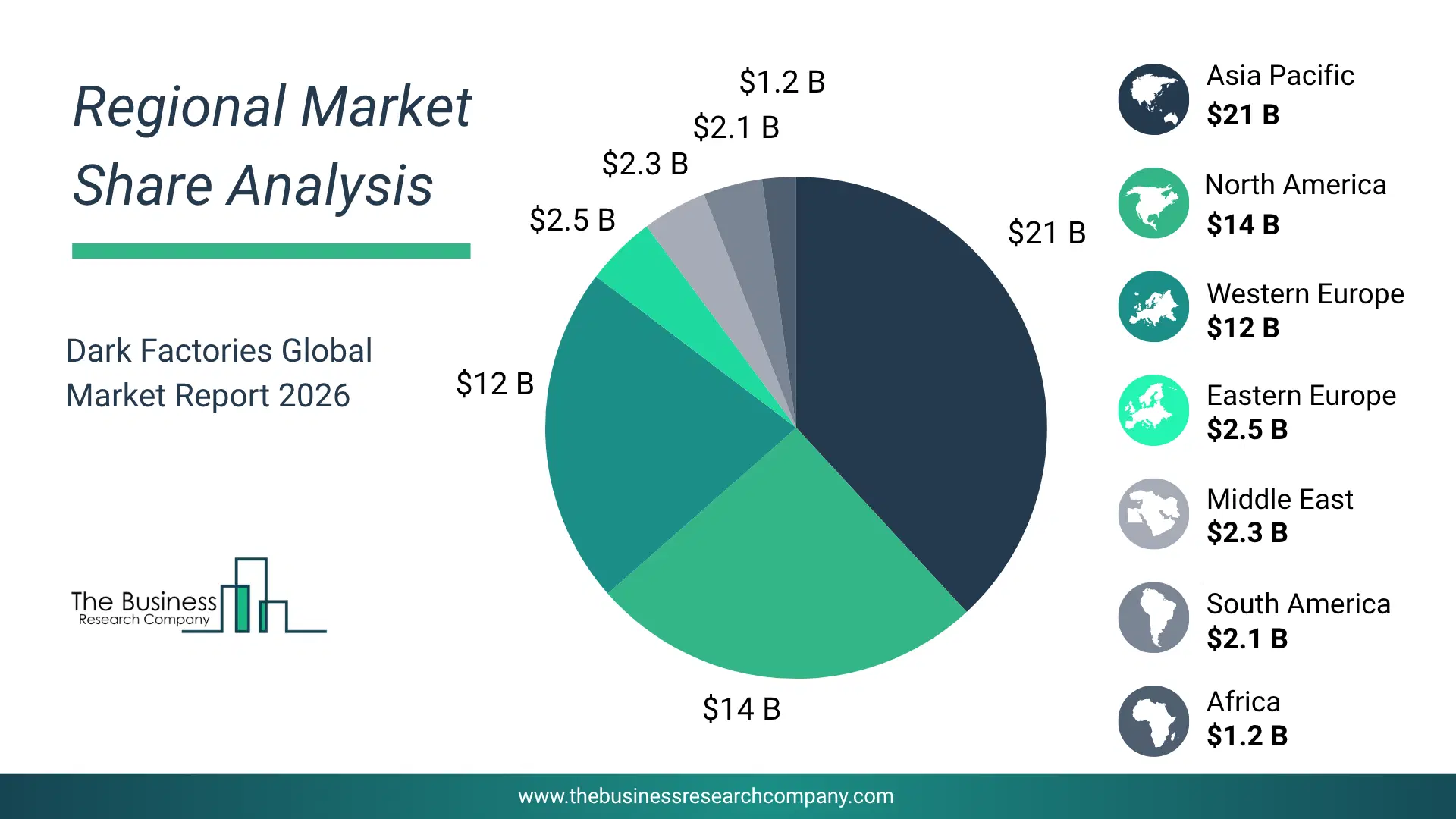
Regional Outlook
North America was the largest region in the dark factories market in 2025. Asia-Pacific is expected to be the fastest-growing region in the forecast period. The regions covered in this market report are Asia-Pacific, South East Asia, Western Europe, Eastern Europe, North America, South America, Middle East, Africa The countries covered in this market report are Australia, Brazil, China, France, Germany, India, Indonesia, Japan, Taiwan, Russia, South Korea, UK, USA, Canada, Italy, Spain.What Defines the Dark Factories Market?
The dark factories market consists of revenues earned by entities by providing services such as continuous production, real-time quality control, predictive maintenance, inventory management, and automated packaging. The market value includes the value of related goods sold by the service provider or included within the service offering. The dark factories market also includes sales of machine vision systems, digital twin platforms, remote monitoring systems, industrial sensors, and actuators. Values in this market are ‘factory gate’ values, that is the value of goods sold by the manufacturers or creators of the goods, whether to other entities (including downstream manufacturers, wholesalers, distributors and retailers) or directly to end customers. The value of goods in this market includes related services sold by the creators of the goods.How is Market Value Defined and Measured?
The market value is defined as the revenues that enterprises gain from the sale of goods and/or services within the specified market and geography through sales, grants, or donations in terms of the currency (in USD unless otherwise specified). The revenues for a specified geography are consumption values that are revenues generated by organizations in the specified geography within the market, irrespective of where they are produced. It does not include revenues from resales along the supply chain, either further along the supply chain or as part of other products.
This chart presents market attractiveness based on a quantitative evaluation of growth, competition, strategic alignment, and risk, offering a clear view of opportunity areas for decision-making. This chart is for illustrative purposes; the full report contains the complete analysis.

This chart highlights the Total Addressable Market (TAM) by estimating the maximum revenue opportunity using an assumption-driven approach, supporting strategic planning and opportunity sizing across markets. The chart is illustrative; the full report provides a more comprehensive analysis.
What Key Data and Analysis Are Included in the Dark Factories Market Report 2026?
The dark factories market research report is one of a series of new reports from The Business Research Company that provides market statistics, including industry global market size, regional shares, competitors with the market share, detailed market segments, market trends and opportunities, and any further data you may need to thrive in the dark factories industry. The market research report delivers a complete perspective of everything you need, with an in-depth analysis of the current and future state of the industry.Dark Factories Market Report Forecast Analysis
| Report Attribute | Details |
|---|---|
| Market Size Value In 2026 | $60.26 billion |
| Revenue Forecast In 2030 | $88.12 billion |
| Growth Rate | CAGR of 10.3% from 2026 to 2030 |
| Base Year For Estimation | 2025 |
| Actual Estimates/Historical Data | 2020-2025 |
| Forecast Period | 2026 - 2030 - 2035 |
| Market Representation | Revenue in USD Billion and CAGR from 2026 to 2030 |
| Segments Covered | Type, Deployment, End-User |
| Regional Scope | Asia-Pacific, Western Europe, Eastern Europe, North America, South America, Middle East, Africa |
| Country Scope | The countries covered in the report are Australia, Brazil, China, France, Germany, India, Indonesia, Japan, Taiwan, Russia, South Korea, UK, USA, Canada, Italy, Spain. |
| Key Companies Profiled | Siemens AG, Schneider Electric, Mitsubishi Electric, Honeywell International, ABB Ltd, Toshiba Infrastructure Systems & Solutions, Bosch Rexroth, Rockwell Automation, Omron Corporation, Keyence Corporation, FANUC Corporation, Dassault Systèmes, Autodesk, Yaskawa Electric Corporation, KUKA AG, Teradyne, Nachi-Fujikoshi Corp, Staubli Robotics, Beckhoff Automation, Universal Robots, Mobile Industrial Robots (MiR), Denso Wave. |
| Customization Scope | Request for Customization |
| Pricing And Purchase Options | Explore Purchase Options |