
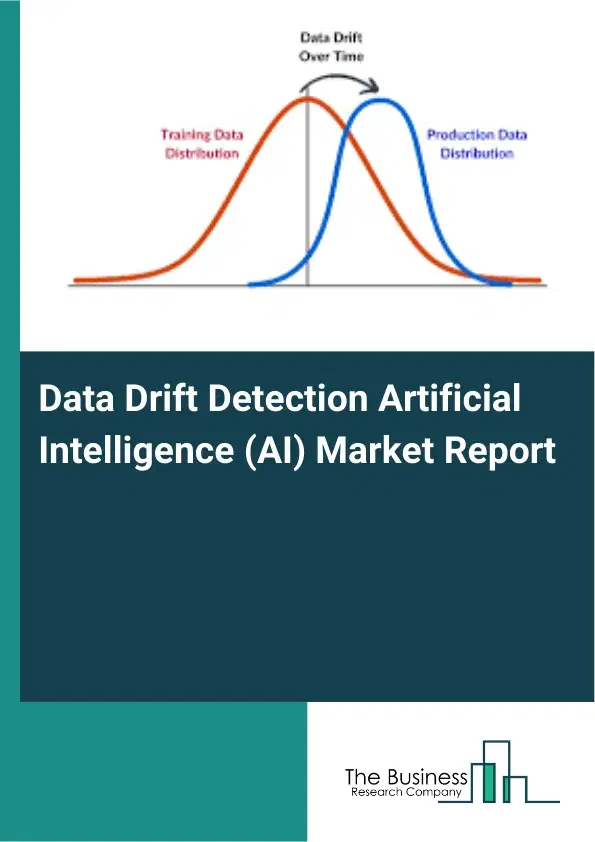
Data Drift Detection Artificial Intelligence (AI) Market Report 2026
Global Outlook – By Component (Software, Hardware, Services), By Deployment (Cloud Based, On Premises, Hybrid, Other Deployment Modes), By Enterprise Size (Small And Medium Enterprises (SMEs), Large Enterprises), By Application (Fraud Detection And Risk Management, Customer Experience Optimization, Predictive Maintenance, Healthcare Diagnostics, Supply Chain And Inventory Management, Other Applications), By End User (Banking, Financial Services And Insurance (BFSI), Healthcare, Retail And E-Commerce, Manufacturing, Information Technology (IT) And Telecommunications, Other End Users) – Market Size, Trends, Strategies, and Forecast to 2030
Data Drift Detection Artificial Intelligence (AI) Market Overview
• Data Drift Detection Artificial Intelligence (AI) market size has reached to $2.01 billion in 2025 • Expected to grow to $7.62 billion in 2030 at a compound annual growth rate (CAGR) of 30.5% • Growth Driver: Surge In Rise In Data Volumes And Complexity Fueling The Growth Of The Market Due To Exponential Data Creation And Usage • Market Trend: Acceldata Launched Agentic Data Management Platform To Enhance Automated Data Drift Detection • North America was the largest region in 2025 and Asia-Pacific is the fastest growing region.What Is Covered Under Data Drift Detection Artificial Intelligence (AI) Market?
Data drift detection artificial intelligence (AI) refers to the ecosystem of technologies and solutions designed to identify, monitor, and analyze changes in data patterns that can impact the performance and reliability of machine learning models over time. It focuses on detecting shifts in input data, feature distributions, and statistical properties that may cause model degradation or unexpected outcomes, enabling organizations to maintain model accuracy, stability, and trustworthiness in dynamic, real-world environments. The main components of data drift detection artificial intelligence (AI) are software, hardware, and services. Software refers to AI-driven solutions that continuously monitor, identify, and analyze changes in data patterns and model behavior to ensure accuracy and reliability of machine learning systems. These solutions are deployed through various deployment modes, including cloud-based, on-premises, hybrid, and other deployment modes, and are designed for different enterprise sizes, such as small and medium enterprises (SMEs) and large enterprises. They are used across multiple applications, including fraud detection and risk management, customer experience optimization, predictive maintenance, healthcare diagnostics, supply chain and inventory management, and other applications, and cater to diverse end users, such as banking, financial services and insurance (BFSI), healthcare, retail and e-commerce, manufacturing, information technology (IT) and telecommunications, and other end users.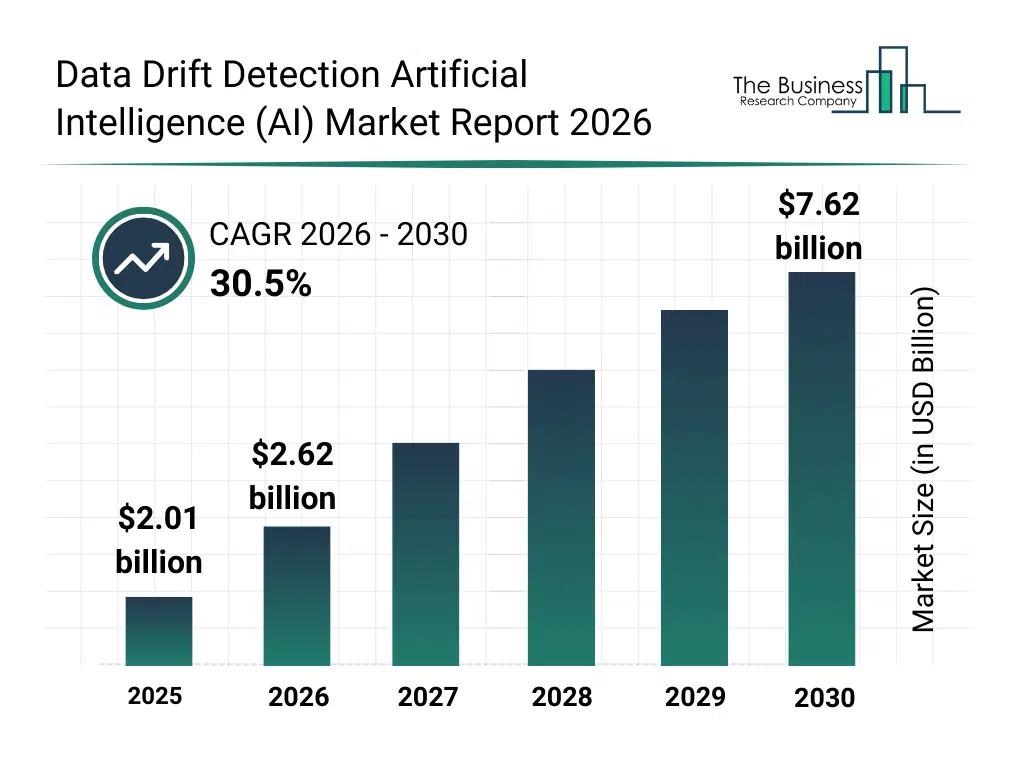
What Is The Data Drift Detection Artificial Intelligence (AI) Market Size and Share 2026?
The data drift detection artificial intelligence (AI) market size has grown exponentially in recent years. It will grow from $2.01 billion in 2025 to $2.62 billion in 2026 at a compound annual growth rate (CAGR) of 30.3%. The growth in the historic period can be attributed to increasing deployment of machine learning models in production, growth in data-driven decision systems, rising complexity of real-world data environments, increased awareness of model degradation risks, availability of monitoring software tools.What Is The Data Drift Detection Artificial Intelligence (AI) Market Growth Forecast?
The data drift detection artificial intelligence (AI) market size is expected to see exponential growth in the next few years. It will grow to $7.62 billion in 2030 at a compound annual growth rate (CAGR) of 30.5%. The growth in the forecast period can be attributed to increasing regulatory scrutiny of AI systems, rising demand for trustworthy and explainable AI, expansion of real-time AI monitoring use cases, growing investments in MLOps platforms, increasing need for continuous model reliability assurance. Major trends in the forecast period include increasing adoption of model performance monitoring platforms, rising use of automated drift alerting systems, growing integration of root cause analysis tools, expansion of continuous model validation practices, enhanced focus on regulatory compliance monitoring.
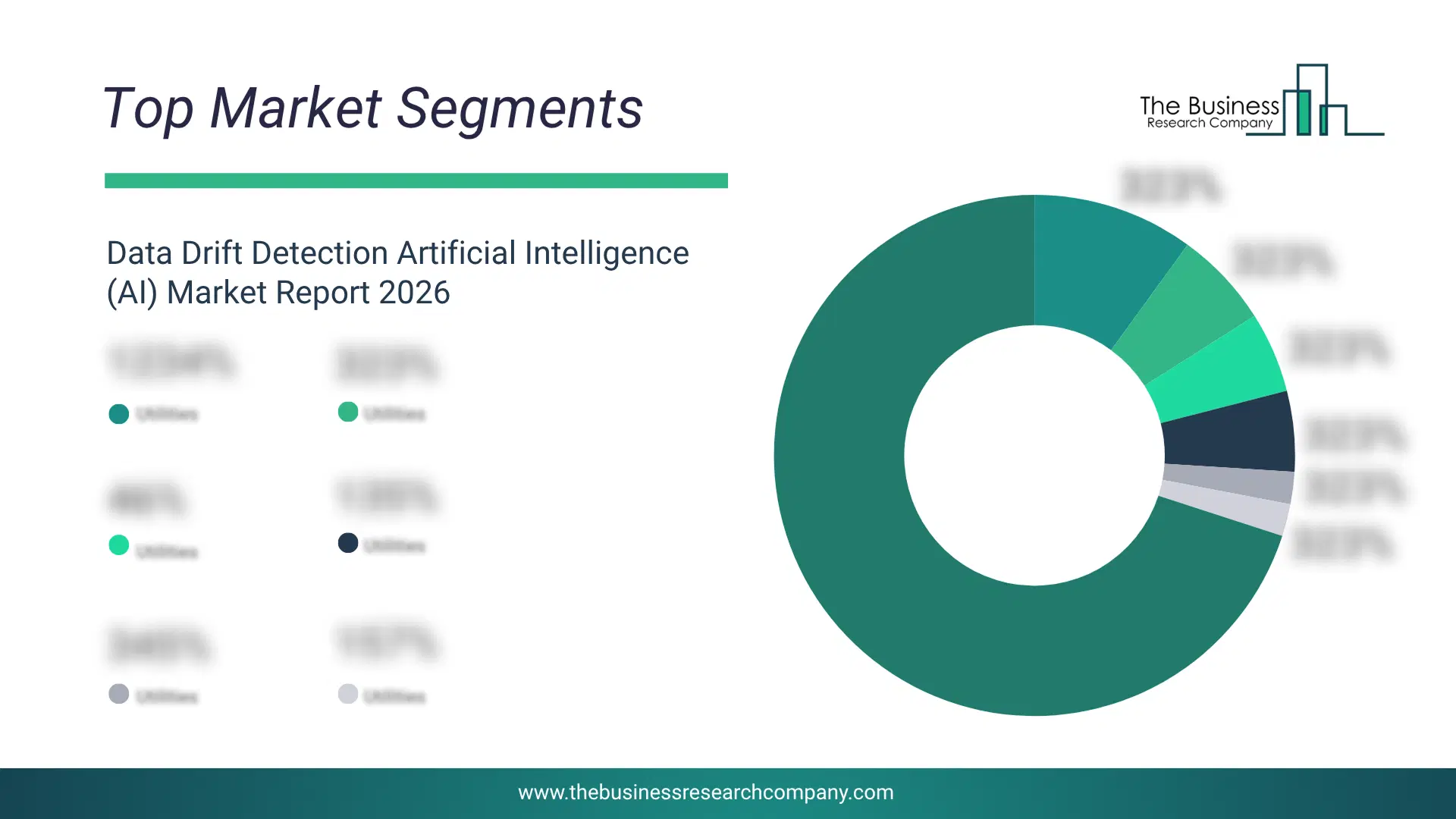
Global Data Drift Detection Artificial Intelligence (AI) Market Segmentation
1) By Component: Software; Hardware; Services 2) By Deployment: Cloud Based; On Premises; Hybrid; Other Deployment Modes 3) By Enterprise Size: Small And Medium Enterprises (SMEs); Large Enterprises 4) By Application: Fraud Detection And Risk Management; Customer Experience Optimization; Predictive Maintenance; Healthcare Diagnostics; Supply Chain And Inventory Management; Other Applications 5) By End User: Banking, Financial Services And Insurance (BFSI); Healthcare; Retail And E-Commerce; Manufacturing; Information Technology (IT) And Telecommunications; Other End Users Subsegments: 1) By Software: Statistical Drift Detection Software; Data Quality Monitoring Software; Model Performance Monitoring Software; Anomaly Detection Software; Visualization And Reporting Software 2) By Hardware: Central Processing Units (CPU); Graphics Processing Units (GPU); Edge Computing Devices; High Performance Computing Servers 3) By Services: Integration And Deployment Services; Consulting And Advisory Services; Maintenance And Support Services; Training And Education Services; Managed Monitoring ServicesWhat Is The Driver Of The Data Drift Detection Artificial Intelligence (AI) Market?
The rise in data volumes and complexity is expected to propel the growth of the data drift detection artificial intelligence (AI) market going forward. Data volumes and complexity refer to the continually expanding quantity of digital information generated globally and the increasing diversity of data types and sources that make data environments more challenging to manage and process. Data volumes and complexity are rising as enterprises increasingly digitize core operations and customer interactions, which continuously generates large, high-velocity, and heterogeneous data streams that expand faster than traditional data management and analytics capabilities can scale. Data drift detection artificial intelligence (AI) helps manage rising data volumes and complexity by continuously monitoring incoming data for distributional changes, enabling early identification of anomalies that could degrade model performance in dynamic, large-scale data environments. For instance, in September 2024, according to a report published by CTIA (The Wireless Association), a US-based trade association, in 2023, wireless networks experienced unprecedented growth in data traffic, handling an impressive 100.1 trillion megabytes, while nearly 40% of all wireless devices were equipped with 5G connectivity, a 34% increase compared to the previous year. Therefore, a rise in data volumes and complexity is expected to drive the growth of the data drift detection artificial intelligence (AI) industry.Key Players In The Global Data Drift Detection Artificial Intelligence (AI) Market
Major companies operating in the data drift detection artificial intelligence (AI) market are Amazon Web Services Inc., Accenture plc, IBM Corporation, Oracle Corporation, KPMG International Limited, SAP SE, Infosys Limited, HCL Technologies Limited, SAS Institute Inc., Databricks Inc., Datadog Inc., Censius Inc., DataRobot Inc, Collibra Inc., H2O.AI Inc., Domino Data Lab Inc., Arize AI Inc., Arthur AI Inc., Evidently AI Inc., Seldon Technologies Ltd., InsightFinder Inc., Openlayer Inc., Helicone Inc., Neysa AI Pvt. Ltd.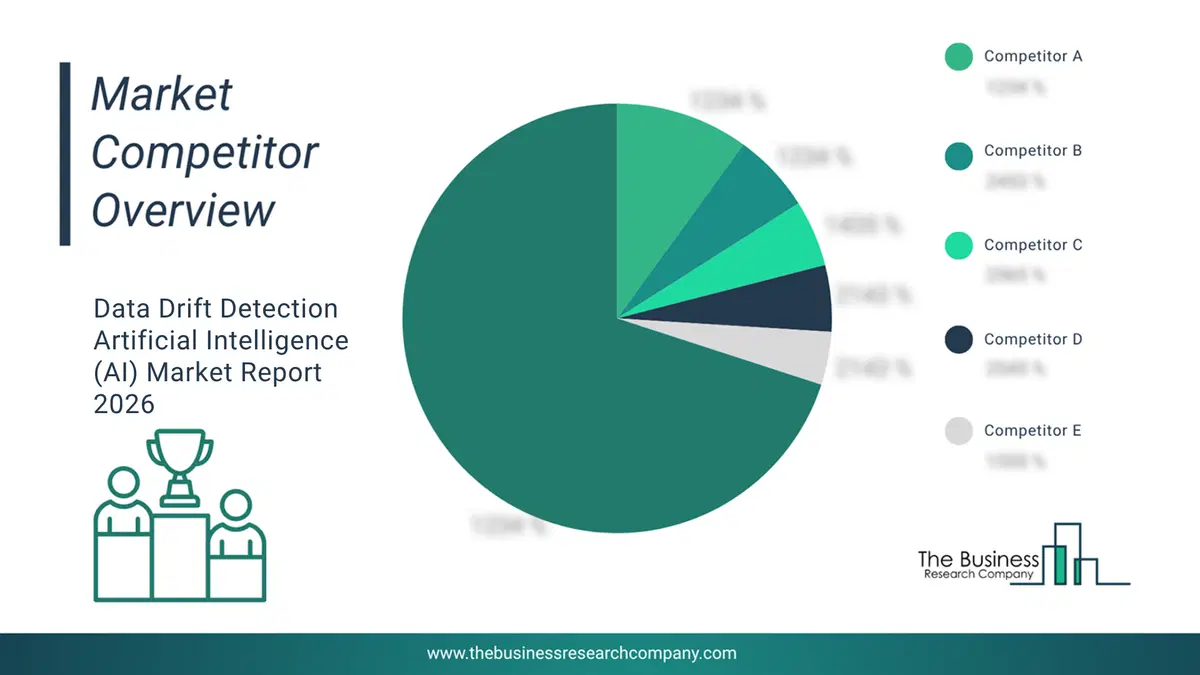
This chart is for illustrative purposes; the full report includes a detailed competitor analysis and comprehensive overview of the top 10 companies in the market.
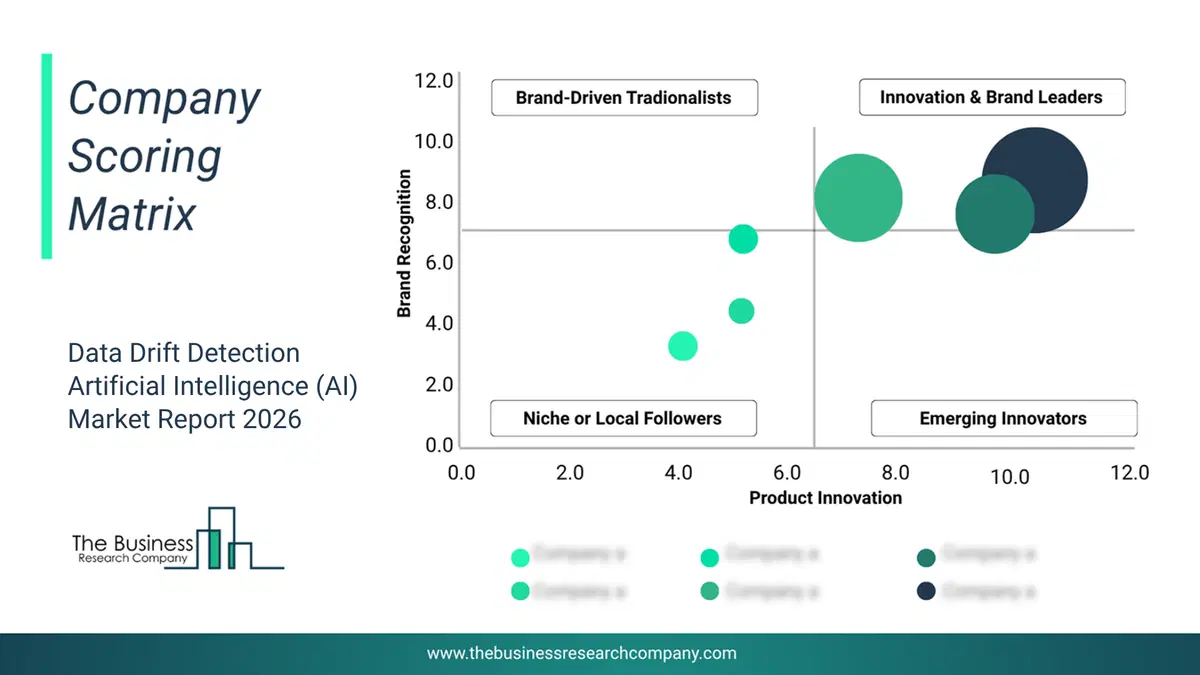
This chart maps companies by product innovation and brand strength, with bubble size indicating relative revenue, helping identify market leaders, challengers, and niche players. This is an illustrative chart; the full report provides a complete and accurate competitive analysis.
Global Data Drift Detection Artificial Intelligence (AI) Market Trends and Insights
Major companies operating in the data drift detection artificial intelligence (AI) market are focusing on developing innovative solutions, such as the xLake reasoning engine, to autonomously detect, diagnose, and resolve data drift across complex, large-scale data pipelines in real time. xLake reasoning engine is an AI-driven analytics component that continuously analyzes data flowing across data lakes and pipelines to identify patterns, detect anomalies and data drift, determine root causes, and recommend or trigger corrective actions in complex data environments. For instance, in February 2025, Acceldata, a US-based software company, launched the agentic data management (agentic DM) platform to autonomously detect data drift, diagnose root causes, and orchestrate corrective actions across enterprise data pipelines in real time. It is an AI-first, autonomous data management solution designed to help enterprises govern, optimize, and operationalize data for AI and analytics at scale. It uses intelligent AI agents to understand data context, detect anomalies (including data drift), and take corrective actions automatically or with human oversight. At its core, the xLake Reasoning Engine enables AI-aware data processing across cloud, on-prem, and hyperscaler environments, proven at exabyte scale. The platform also includes a natural language business notebook that improves transparency by explaining reasoning and enabling collaboration.What Are Latest Mergers And Acquisitions In The Data Drift Detection Artificial Intelligence (AI) Market?
In December 2024, Coralogix Inc., a US-based provider of observability and security analytics platforms, acquired Aporia for an undisclosed amount. With this acquisition, Coralogix aimed to strengthen its capabilities in AI observability, including monitoring and detecting data drift, model performance degradation, and production AI issues at scale, expanding support for enterprise AI teams. Aporia is an Israeli company that provides machine learning observability solutions for production ML systems, including drift detection, anomaly monitoring, model performance tracking, and alerting tools.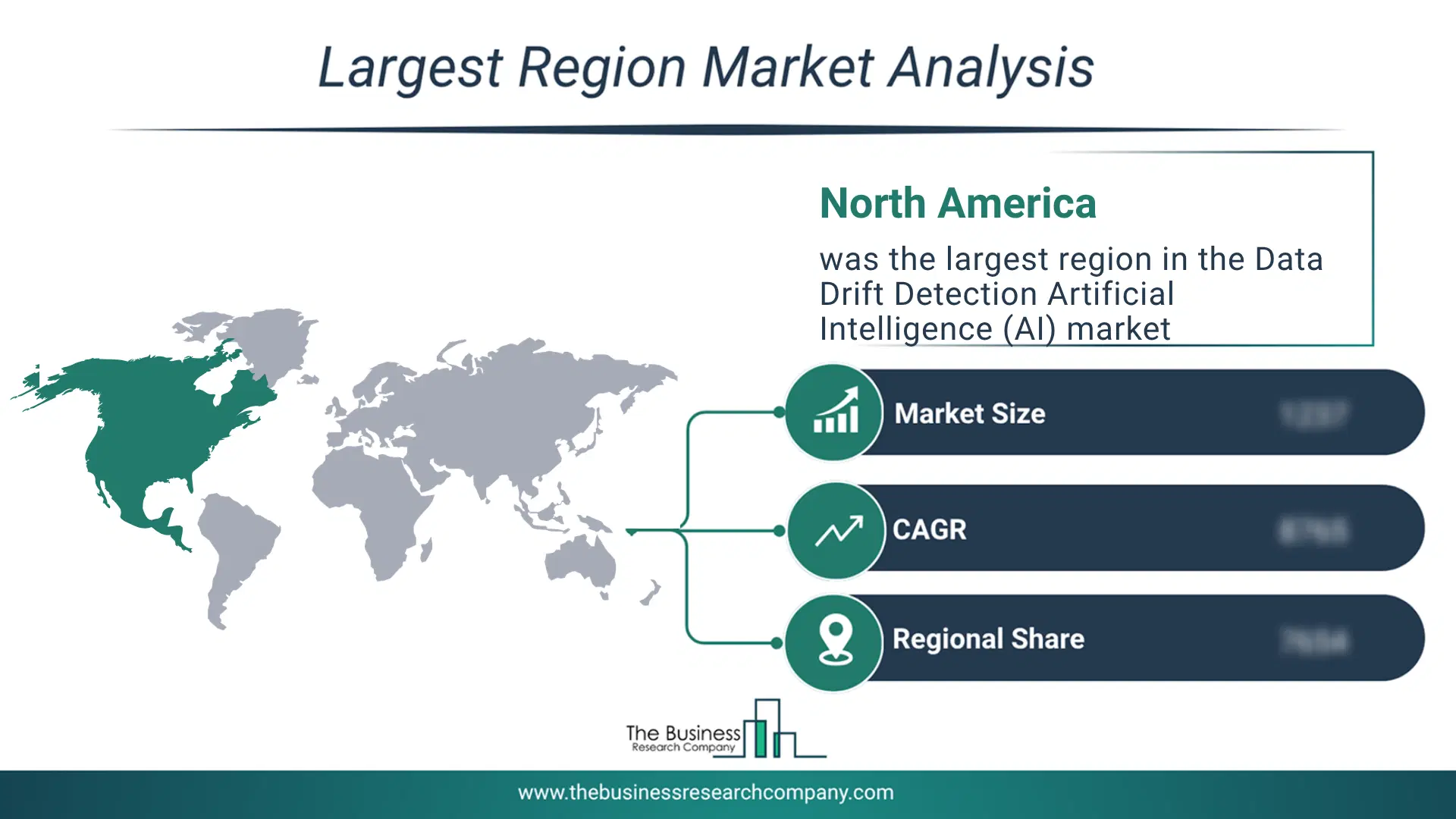
Regional Insights
North America was the largest region in the data drift detection artificial intelligence (AI) market in 2025. Asia-Pacific is expected to be the fastest-growing region in the forecast period. The regions covered in this market report are Asia-Pacific, South East Asia, Western Europe, Eastern Europe, North America, South America, Middle East, Africa. The countries covered in this market report are Australia, Brazil, China, France, Germany, India, Indonesia, Japan, Taiwan, Russia, South Korea, UK, USA, Canada, Italy, Spain.What Defines the Data Drift Detection Artificial Intelligence (AI) Market?
The data drift detection artificial intelligence (AI) consists of revenues earned by entities by providing services such as model performance tracking, anomaly detection, statistical analysis of feature distributions, root cause analysis of drift, alerting and reporting services, model retraining and update advisory, and compliance and audit support. The market value includes the value of related goods sold by the service provider or included within the service offering. The data drift detection artificial intelligence (AI) includes sales of model performance tracking tools, anomaly detection platforms, feature distribution analysis products, root cause analysis tools, and alerting and reporting systems. Values in this market are ‘factory gate’ values, that is, the value of goods sold by the manufacturers or creators of the goods, whether to other entities (including downstream manufacturers, wholesalers, distributors, and retailers) or directly to end customers. The value of goods in this market includes related services sold by the creators of the goods.How is Market Value Defined and Measured?
The market value is defined as the revenues that enterprises gain from the sale of goods and/or services within the specified market and geography through sales, grants, or donations in terms of the currency (in USD unless otherwise specified). The revenues for a specified geography are consumption values that are revenues generated by organizations in the specified geography within the market, irrespective of where they are produced. It does not include revenues from resales along the supply chain, either further along the supply chain or as part of other products.
This chart presents market attractiveness based on a quantitative evaluation of growth, competition, strategic alignment, and risk, offering a clear view of opportunity areas for decision-making. This chart is for illustrative purposes; the full report contains the complete analysis.

This chart highlights the Total Addressable Market (TAM) by estimating the maximum revenue opportunity using an assumption-driven approach, supporting strategic planning and opportunity sizing across markets. The chart is illustrative; the full report provides a more comprehensive analysis.
What Key Data and Analysis Are Included in the Data Drift Detection Artificial Intelligence (AI) Market Report 2026?
The data drift detection artificial intelligence (ai) market research report is one of a series of new reports from The Business Research Company that provides market statistics, including industry global market size, regional shares, competitors with the market share, detailed market segments, market trends and opportunities, and any further data you may need to thrive in the data drift detection artificial intelligence (ai) industry. The market research report delivers a complete perspective of everything you need, with an in-depth analysis of the current and future state of the industry.Data Drift Detection Artificial Intelligence (AI) Market Report Forecast Analysis
| Report Attribute | Details |
|---|---|
| Market Size Value In 2026 | $2.62 billion |
| Revenue Forecast In 2030 | $7.62 billion |
| Growth Rate | CAGR of 30.5% from 2026 to 2030 |
| Base Year For Estimation | 2025 |
| Actual Estimates/Historical Data | 2020-2025 |
| Forecast Period | 2026 - 2030 |
| Market Representation | Revenue in USD Billion and CAGR from 2026 to 2030 |
| Segments Covered | Component, Deployment, Enterprise Size, Application, End User |
| Regional Scope | Asia-Pacific, Western Europe, Eastern Europe, North America, South America, Middle East, Africa |
| Country Scope | The Countries Covered In This Market Report Are Australia, Brazil, China, France, Germany, India, Indonesia, Japan, Taiwan, Russia, South Korea, Uk, Usa, Canada, Italy, Spain. |
| Key Companies Profiled | Amazon Web Services Inc., Accenture plc, IBM Corporation, Oracle Corporation, KPMG International Limited, SAP SE, Infosys Limited, HCL Technologies Limited, SAS Institute Inc., Databricks Inc., Datadog Inc., Censius Inc., DataRobot Inc, Collibra Inc., H2O.AI Inc., Domino Data Lab Inc., Arize AI Inc., Arthur AI Inc., Evidently AI Inc., Seldon Technologies Ltd., InsightFinder Inc., Openlayer Inc., Helicone Inc., Neysa AI Pvt. Ltd. |
| Customization Scope | Request for Customization |
| Pricing And Purchase Options | Explore Purchase Options |