

Data Fusion Market Report 2026
Global Outlook – By Component (Software, Hardware, Services), By Deployment (On-Premises Systems, Cloud-Based Systems, Edge Computing Systems), By Enterprise Size (Small And Medium Enterprises, Large Enterprises), By Application (Defense And Security, Transportation And Logistics, Energy And Utilities, Information Technology And Telecommunications, Other Applications), By End User (Government, Banking Financial Services And Insurance, Healthcare, Retail, Manufacturing, Other End Users) – Market Size, Trends, Strategies, and Forecast to 2030
Data Fusion Market Overview
• Data Fusion market size has reached to $13.5 billion in 2025 • Expected to grow to $29.4 billion in 2030 at a compound annual growth rate (CAGR) of 16.9% • Growth Driver: Rising Adoption Of Internet Of Things (IoT) And Connected Devices Fueling The Growth Of The Market Due To Increasing Demand For Real-Time Data Integration • Market Trend: Advancing AI Infrastructure Platforms For Real-Time Data Integration And Intelligent Decision-Making • North America was the largest region in 2025 and Asia-Pacific is the fastest growing region.What Is Covered Under Data Fusion Market?
Data fusion refers to the process of integrating data from multiple sources, formats, or systems to produce more consistent, accurate, and comprehensive information. It is used to improve decision-making, enhance situational awareness, support predictive analytics, and enable more efficient operations across industries such as healthcare, defense, automotive, and industrial automation. The main components of data fusion include software, hardware, and services. Software refers to platforms and analytical tools used to integrate, process, and interpret data from multiple sources for improved decision-making. These solutions are deployed through on-premises systems, cloud-based systems, and edge computing systems and are adopted by enterprises including small and medium enterprises and large enterprises. The key applications of defense and security, healthcare and life sciences, transportation and logistics, energy and utilities, information technology and telecommunications, and others, while the end-user includes government, banking financial services and insurance, healthcare, retail, manufacturing, and others.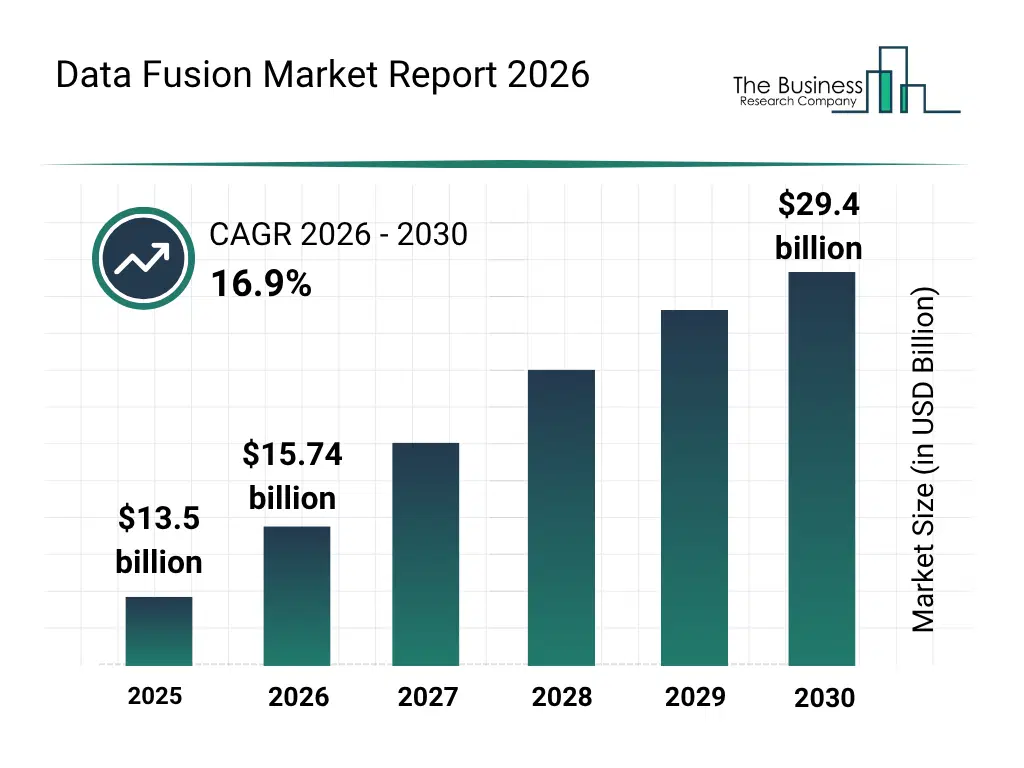
What Is The Data Fusion Market Size and Share 2026?
The data fusion market size has grown rapidly in recent years. It will grow from $13.5 billion in 2025 to $15.74 billion in 2026 at a compound annual growth rate (CAGR) of 16.7%. The growth in the historic period can be attributed to growth of enterprise digitization and multi system data generation, increasing adoption of basic analytics and business intelligence tools, expansion of industrial automation and sensor deployments, rising need for centralized data management systems, early adoption of cloud computing for data storage and processing.What Is The Data Fusion Market Growth Forecast?
The data fusion market size is expected to see rapid growth in the next few years. It will grow to $29.4 billion in 2030 at a compound annual growth rate (CAGR) of 16.9%. The growth in the forecast period can be attributed to rapid expansion of AI driven autonomous decision making systems, increasing deployment of iot enabled smart infrastructure generating massive data streams, growth in edge computing for real time data processing, rising demand for predictive analytics across industries, expansion of cross platform interoperability and integrated data ecosystems. Major trends in the forecast period include AI enabled real time multi source data integration and contextual decision intelligence platforms, edge based data fusion systems for low latency analytics and operations, cloud native data integration and interoperability frameworks across enterprise ecosystems, increased adoption of sensor driven real time fusion in industrial and defense applications, advanced AI powered predictive analytics using heterogeneous data aggregation models.
Global Data Fusion Market Segmentation
1) By Component: Software, Hardware, Services 2) By Deployment: On-Premises Systems, Cloud-Based Systems, Edge Computing Systems 3) By Enterprise Size: Small And Medium Enterprises, Large Enterprises 4) By Application: Defense And Security, Transportation And Logistics, Energy And Utilities, Information Technology And Telecommunications, Other Applications 5) By End User: Government, Banking Financial Services And Insurance, Healthcare, Retail, Manufacturing, Other End Users Subsegments: 1) By Software: Data Integration Software, Sensor Fusion Software, Analytics And Visualization Software, AI/ML-Based Fusion Platforms, Real-Time Data Processing Software, Data Management And Middleware Solutions, Decision Support Software 2) By Hardware: Sensors And Sensor Networks, Edge Computing Devices, Data Acquisition Systems, Embedded Processing Units, Servers And Storage Systems, Communication And Networking Equipment, GPUs/High-Performance Computing Hardware 3) By Services: Consulting Services, System Integration And Deployment Services, Managed Services, Support And Maintenance Services, Training And Education Services, Data Engineering Services, Custom Development And Implementation ServicesWhat Is The Driver Of The Data Fusion Market?
The rising adoption of internet of things (IoT) and connected devices is expected to propel the growth of the data fusion market going forward. Internet of things (IoT) and connected devices refer to a network of physical objects that are embedded with sensors, software, and communication technology, which can collect, exchange, and act on data over the internet. The rise of internet of things (IoT) and connected devices is due to people wanting more convenience, automation, and real-time control over everyday objects and systems for better efficiency and time-saving solutions. Data fusion helps the internet of things (IoT) and connected devices by allowing integration of data from multiple sensors to improve accuracy, decision-making, and system performance. For instance, in October 2025, according to IoT Analytics GmbH, a Germany-based company that provides internet of things data statistics, there were approximately 18.5 billion connected IoT devices globally in 2024, compared to about 16.6 billion devices in 2023, representing an increase of around 12%. Therefore, the rising adoption of internet of things (IoT) and connected devices is driving the growth of the data fusion industry.Key Players In The Global Data Fusion Market
Major companies operating in the data fusion market are Microsoft Corporation, Amazon Web Services Inc., IBM Corporation, Oracle Corporation, NVIDIA Corporation, Alphabet Inc. (Google), RTX Corporation, Lockheed Martin Corporation, Northrop Grumman Corporation, BAE Systems plc, General Dynamics Corporation, Thales SA, L3Harris Technologies Inc., Palantir Technologies Inc., SAP SE, Leonardo SpA, Leidos Holdings Inc., Booz Allen Hamilton Holding Corporation, Rheinmetall AG, Science Applications International Corporation, CACI International Inc., Elbit Systems Ltd., Saab AB, Robert Bosch GmbH, QinetiQ Group plc, Kratos Defense & Security Solutions Inc., K2view Ltd.Global Data Fusion Market Trends and Insights
Major companies operating in the data fusion market are focusing on developing innovative solutions, such as artificial intelligence (AI) infrastructure platforms, to enhance real-time data integration, improve predictive analytics, and support faster, data-driven decision-making across complex digital environments. An AI infrastructure platform is a system that provides the hardware, software, and data processing capabilities required to build, train, and deploy artificial intelligence applications. For instance, in April 2026, UltiSim Inc., a US-based technology company, launched a Data Fusion Plane, an artificial intelligence (AI) infrastructure platform for mid-market enterprises and governments. The platform connects, transforms, and accesses siloed data for AI applications without moving data outside the organization's firewall. It acts as a sovereign AI operating system, integrating generative AI, symbolic AI, and retrieval-augmented generation (RAG) while avoiding vendor lock-in.What Are Latest Mergers And Acquisitions In The Data Fusion Market?
In June 2025, Raft, a US-based defense technology company, acquired N3bula Systems for an undisclosed sum. With this acquisition, Raft aims to integrate N3bula Systems' data fusion technology with its agentic AI products to accelerate mission-critical AI defense innovation and create a unified backbone for faster joint force operations. N3bula Systems is a US-based company that specializes in the development of data fusion and defense infrastructure technologies.Regional Outlook
North America was the largest region in the data fusion market in 2025. Asia-Pacific is expected to be the fastest-growing region in the forecast period. The regions covered in this market report are Australia, Brazil, China, France, Germany, India, Indonesia, Japan, Taiwan, Russia, South Korea, UK, USA, Canada, Italy, Spain. The countries covered in this market report are Australia, Brazil, China, France, Germany, India, Indonesia, Japan, Taiwan, Russia, South Korea, UK, USA, Canada, Italy, Spain.What Defines the Data Fusion Market?
The data fusion market includes revenues earned by entities by providing services such as data integration services, data aggregation and consolidation, and real-time data processing. The market value includes the value of related goods sold by the service provider or included within the service offering. Only goods and services traded between entities or sold to end consumers are included. The data fusion market consists of sales of sensor fusion systems, data visualization tools, and real-time monitoring systems. Values in this market are ‘factory gate’ values, that is, the value of goods sold by the manufacturers or creators of the goods, whether to other entities (including downstream manufacturers, wholesalers, distributors, and retailers) or directly to end customers. The value of goods in this market includes related services sold by the creators of the goods.How is Market Value Defined and Measured?
The market value is defined as the revenues that enterprises gain from the sale of goods and/or services within the specified market and geography through sales, grants, or donations in terms of the currency (in USD unless otherwise specified). The revenues for a specified geography are consumption values that are revenues generated by organizations in the specified geography within the market, irrespective of where they are produced. It does not include revenues from resales along the supply chain, either further along the supply chain or as part of other products.What Key Data and Analysis Are Included in the Data Fusion Market Report 2026?
The data fusion market research report is one of a series of new reports from The Business Research Company that provides data fusion market statistics, including data fusion industry global market size, regional shares, competitors with a data fusion market share, detailed data fusion market segments, market trends and opportunities, and any further data you may need to thrive in the data fusion industry. This data fusion market research report delivers a complete perspective of everything you need, with an in-depth analysis of the current and future scenario of the industry.Data Fusion Market Report Forecast Analysis
| Report Attribute | Details |
|---|---|
| Market Size Value In 2026 | $15.74 billion |
| Revenue Forecast In 2030 | $29.4 billion |
| Growth Rate | CAGR of 16.9% from 2026 to 2030 |
| Base Year For Estimation | 2025 |
| Actual Estimates/Historical Data | 2020-2025 |
| Forecast Period | 2026 - 2030 |
| Market Representation | Revenue in USD Billion and CAGR from 2026 to 2030 |
| Segments Covered | Component, Deployment, Enterprise Size, Application, End User |
| Regional Scope | Asia-Pacific, Western Europe, Eastern Europe, North America, South America, Middle East, Africa |
| Country Scope | The countries covered in the data fusion market report are Australia, Brazil, China, France, Germany, India, Indonesia, Japan, Taiwan, Russia, South Korea, UK, USA, Canada, Italy, Spain. |
| Key Companies Profiled | Microsoft Corporation, Amazon Web Services Inc., IBM Corporation, Oracle Corporation, NVIDIA Corporation, Alphabet Inc. (Google), RTX Corporation, Lockheed Martin Corporation, Northrop Grumman Corporation, BAE Systems plc, General Dynamics Corporation, Thales SA, L3Harris Technologies Inc., Palantir Technologies Inc., SAP SE, Leonardo SpA, Leidos Holdings Inc., Booz Allen Hamilton Holding Corporation, Rheinmetall AG, Science Applications International Corporation, CACI International Inc., Elbit Systems Ltd., Saab AB, Robert Bosch GmbH, QinetiQ Group plc, Kratos Defense & Security Solutions Inc., K2view Ltd. |
| Customization Scope | Request for Customization |
| Pricing And Purchase Options | Explore Purchase Options |