
Data Sovereignty For Cross-Border Telematics Market Report 2026
Global Outlook – By Component (Software, Hardware, Services), By Deployment Mode (On Premises, Cloud), By Data Type (Personal Data, Operational Data, Location Data, Other Data Types), By Application (Fleet Management, Vehicle Tracking, Insurance Telematics, Remote Diagnostics, Other Applications), By End User (Automotive, Transportation and Logistics, Insurance, Government, Other End Users) – Market Size, Trends, Strategies, and Forecast to 2030
Data Sovereignty For Cross-Border Telematics Market Overview
• Data Sovereignty For Cross-Border Telematics market size has reached to $3.84 billion in 2025 • Expected to grow to $8.49 billion in 2030 at a compound annual growth rate (CAGR) of 17.3% • Growth Driver: Growth In Electric Vehicle (EV) Adoption Driving The Market Growth Due To Increasing Cross-Border Vehicle Data Management Requirements • Market Trend: Advancements In Data Spaces And Digital Ecosystems Strengthen Data Sovereignty In Cross-Border Telematics • Europe was the largest region in 2025 and Asia-Pacific is the fastest growing region.What Is Covered Under Data Sovereignty For Cross-Border Telematics Market?
Data sovereignty for cross-border telematics refers to the policies, technologies, and control mechanisms that govern how telematics data is collected, stored, processed, and shared across national boundaries. It ensures that vehicle, fleet, driver, and location data generated in one jurisdiction complies with the data protection, residency, and regulatory requirements of each involved country. It helps to enable compliant cross-border telematics operations while protecting sensitive data, maintaining regulatory adherence, and reducing legal and operational risks. The main components of data sovereignty for cross-border telematics are software, hardware, and services. Software refers to solutions that manage, secure, and monitor data across borders, ensuring compliance with local data sovereignty regulations. These solutions are deployed through on-premises and cloud deployment modes, and handle different data types, including personal data, operational data, location data, and other data types. They are applied across multiple applications, such as fleet management, vehicle tracking, insurance telematics, remote diagnostics, and other applications, and serve various end-users, including automotive, transportation and logistics, insurance, government, and other end users.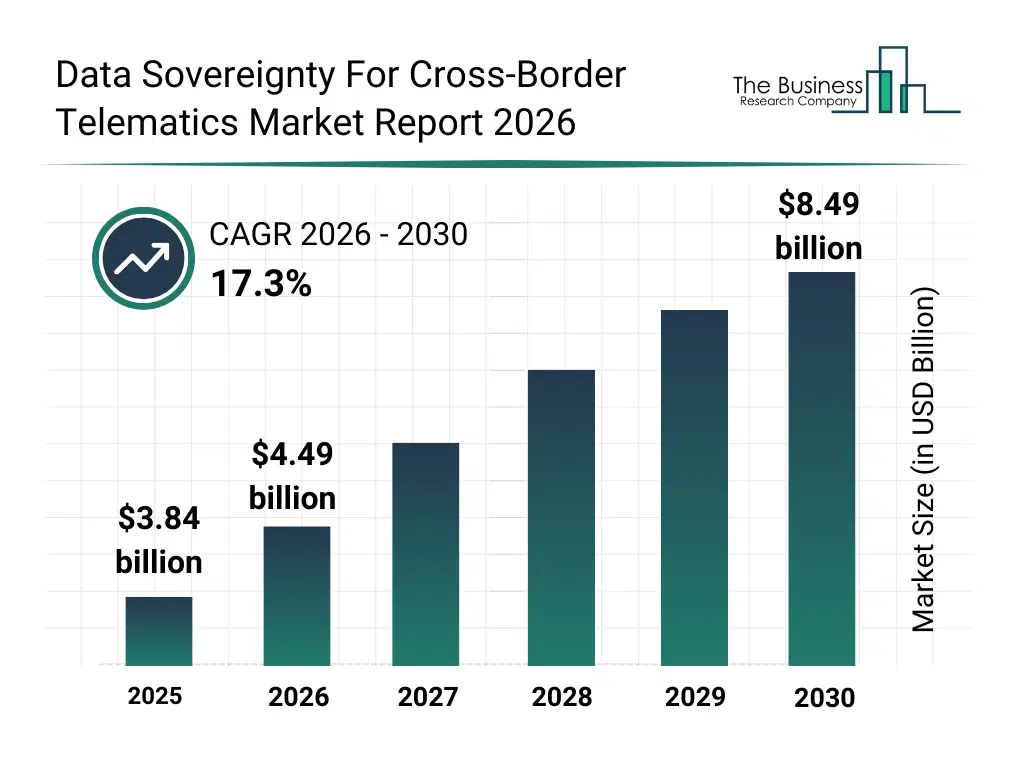
What Is The Data Sovereignty For Cross-Border Telematics Market Size and Share 2026?
The data sovereignty for cross-border telematics market size has grown rapidly in recent years. It will grow from $3.84 billion in 2025 to $4.49 billion in 2026 at a compound annual growth rate (CAGR) of 17.0%. The growth in the historic period can be attributed to growth of connected vehicles, early telematics adoption, cross border logistics expansion, insurance telematics growth, data privacy regulation emergence.What Is The Data Sovereignty For Cross-Border Telematics Market Growth Forecast?
The data sovereignty for cross-border telematics market size is expected to see rapid growth in the next few years. It will grow to $8.49 billion in 2030 at a compound annual growth rate (CAGR) of 17.3%. The growth in the forecast period can be attributed to expansion of smart mobility, stricter cross border data laws, fleet digitization growth, AI driven telematics analytics, government mobility regulations. Major trends in the forecast period include cross border telematics data governance, jurisdiction aware fleet data management, secure vehicle data transfer controls, regulatory compliant telematics platforms, consent driven data access.
Global Data Sovereignty For Cross-Border Telematics Market Segmentation
1) By Component: Software, Hardware, Services 2) By Deployment Mode: On Premises, Cloud 3) By Data Type: Personal Data, Operational Data, Location Data, Other Data Types 4) By Application: Fleet Management, Vehicle Tracking, Insurance Telematics, Remote Diagnostics, Other Applications 5) By End User: Automotive, Transportation and Logistics, Insurance, Government, Other End Users Subsegments: 1) By Software: Robot Operating Systems And Firmware, Simulation And Digital-Twin Software, Motion Planning And Path Optimization, Artificial Intelligence And Machine Learning Software, Vision And Perception Software, Cell And Fleet Management Software, Manufacturing Execution System Or Enterprise Resource Planning Integration Software, Predictive Maintenance And Analytics, Cybersecurity Software, Low-Code Or No-Code Programming Tools 2) By Hardware: Robot Arms And Manipulators, Collaborative Robots (Cobots), End-Effectors And Grippers, Sensors And Perception Hardware, Actuators And Drives, Machine Vision Systems, Controllers And Programmable Logic Controllers, Automated Guided Vehicles And Autonomous Mobile Robots, Safety Systems And Fencing, Power And Cabling Infrastructure 3) By Services: System Design And Engineering, Integration And Commissioning, Maintenance And Field Support, Training And Skill Development, Retrofit And Modernization Services, Custom Application Development, Robotics-As-A-Service, Validation And Testing Services, Consulting And Return On Investment Analysis, R&D And Co-Innovation ServicesWhat Is The Driver Of The Data Sovereignty For Cross-Border Telematics Market?
The growth in electric vehicle (EV) adoption is expected to propel the growth of data sovereignty for the cross-border telematics market going forward. An electric vehicle (EV) is a vehicle that is powered partially or entirely by electricity, using one or more electric motors and energy stored in rechargeable batteries, instead of relying solely on traditional gasoline or diesel engines. The growth in EV adoption is driven by declining battery costs and expanding manufacturer incentives, as vehicle manufacturers have significantly reduced electric vehicle prices while introducing more affordable models across popular vehicle segments to capture market share. Growing EV adoption increases the need for systems that ensure vehicle telematics data generated across international borders complies with regional data protection regulations while maintaining connectivity for remote diagnostics, software updates, and fleet management operations. For instance, in May 2024, according to the U.S. Department of Energy, a US-based federal agency, hybrid electric vehicle sales saw strong momentum in 2023, rising by 53% compared to 2022 and hitting a new record of almost 1.2 million units sold. Therefore, the growth in electric vehicle adoption is driving the growth of data sovereignty for the cross-border telematics market.Key Players In The Global Data Sovereignty For Cross-Border Telematics Market
Major companies operating in the data sovereignty for cross-border telematics market are Google LLC, Microsoft Corporation, Verizon Communications Incorporated, AT&T Incorporated, Alibaba Cloud Computing Limited, Amazon Web Services Inc, Huawei Technologies Co Ltd, Siemens AG, International Business Machines Corporation, Cisco Systems Inc, Oracle Corporation, Vodafone Group Public Limited Company, Telefónica Sociedad Anónima, SAP SE, Telefonaktiebolaget LM Ericsson, Thales S.A., Trimble Incorporated, Hitachi Vantara LLC, Tata Communications Limited, PTC Incorporated, Geotab Incorporated, and TomTom Naamloze Vennootschap.
This chart is for illustrative purposes; the full report includes a detailed competitor analysis and comprehensive overview of the top 10 companies in the market.
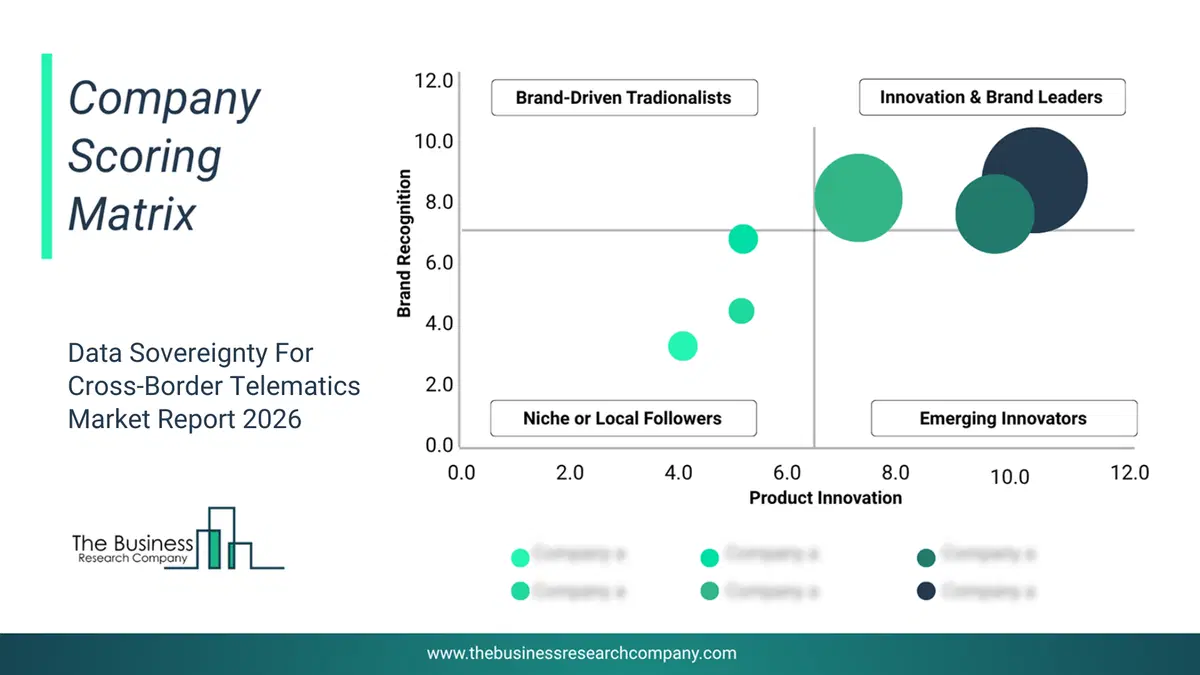
This chart maps companies by product innovation and brand strength, with bubble size indicating relative revenue, helping identify market leaders, challengers, and niche players. This is an illustrative chart; the full report provides a complete and accurate competitive analysis.
Global Data Sovereignty For Cross-Border Telematics Market Trends and Insights
Major companies operating in the data sovereignty for the cross-border telematics market are focusing on developing federated data spaces and trusted digital ecosystems to ensure secure data sharing, interoperability, and compliance with data sovereignty requirements across regions. Federated data spaces enable secure decentralized data sharing under common rules, while trusted digital ecosystems support compliant and collaborative digital interactions across organizations and borders. For instance, in November 2025, Gaia-X, a Belgium-based European initiative for data infrastructure and digital sovereignty, entered Season Two of its data spaces and digital ecosystems program with the formal release of the Gaia-X Trust Framework 3.0 Danube. This framework introduced extensible mechanisms for domain- and geography-specific compliance, automated trust federation, and cross-sector interoperability across industries such as aerospace, energy, and manufacturing. By enabling scalable, AI-ready infrastructures while prioritizing European data control, this milestone marked Gaia-X’s transition from pilot projects to operational deployment. As highlighted by CEO Ulrich Ahle, the development aligns closely with EU strategies for sovereign digital collaboration, reinforcing this trend as a key driver of market evolution.What Are Latest Mergers And Acquisitions In The Data Sovereignty For Cross-Border Telematics Market?
In June 2025, Catena‑X, a Germany-based automotive data ecosystem company that supports data sovereignty for cross-border telematics, partnered with the Automotive Industry Action Group (AIAG) to enable secure, standardized, and sovereign cross-border sharing of automotive telematics data. The partnership aims to establish an interoperable, privacy-compliant telematics data framework that ensures data sovereignty across borders while facilitating seamless collaboration among North American automotive manufacturers and suppliers. Automotive Industry Action Group (AIAG) is a US-based automotive standards organization.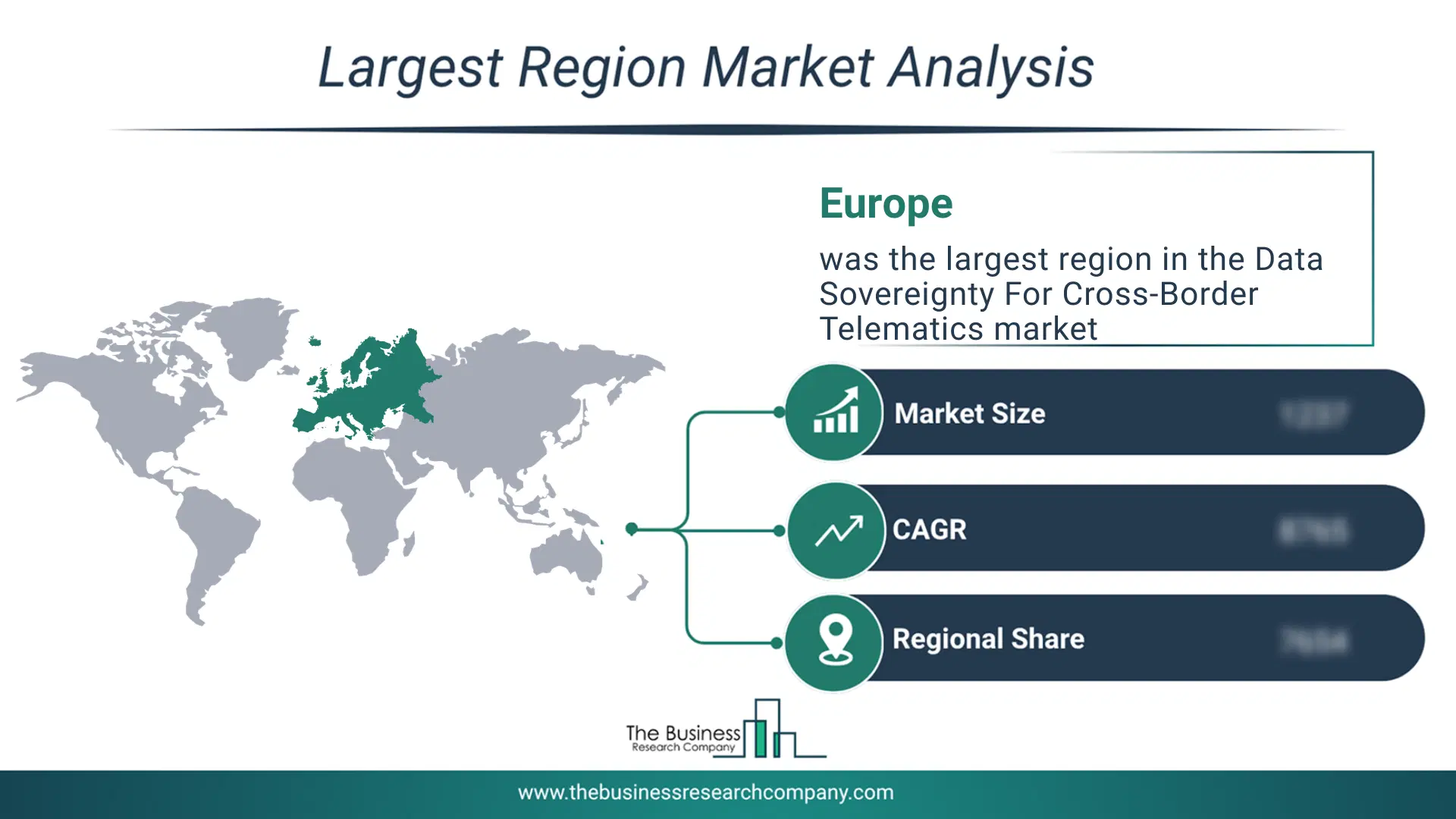
Regional Outlook
Europe was the largest region in the data sovereignty for cross-border telematics market in 2025. Asia-Pacific is expected to be the fastest-growing region in the forecast period. The regions covered in this market report are Asia-Pacific, South East Asia, Western Europe, Eastern Europe, North America, South America, Middle East, Africa. The countries covered in this market report are Australia, Brazil, China, France, Germany, India, Indonesia, Japan, Taiwan, Russia, South Korea, UK, USA, Canada, Italy, Spain.What Defines the Data Sovereignty For Cross-Border Telematics Market?
The data sovereignty for cross-border telematics consists of revenues earned by entities by providing services such as cross-border data transfer management, data sovereignty policy enforcement, telematics data governance, jurisdiction-based access control, audit and compliance reporting, regulatory compliance consulting, incident response services, and data localization management. The market value includes the value of related goods sold by the service provider or included within the service offering. The data sovereignty for cross-border telematics consists of sales of secure telematics data gateways, encryption and cryptographic key management systems, cross-border data transfer control solutions, consent and access management tools, and data classification and tagging products. Values in this market are ‘factory gate’ values, that is, the value of goods sold by the manufacturers or creators of the goods, whether to other entities (including downstream manufacturers, wholesalers, distributors, and retailers) or directly to end customers. The value of goods in this market includes related services sold by the creators of the goods.How is Market Value Defined and Measured?
The market value is defined as the revenues that enterprises gain from the sale of goods and/or services within the specified market and geography through sales, grants, or donations in terms of the currency (in USD unless otherwise specified). The revenues for a specified geography are consumption values that are revenues generated by organizations in the specified geography within the market, irrespective of where they are produced. It does not include revenues from resales along the supply chain, either further along the supply chain or as part of other products.
This chart presents market attractiveness based on a quantitative evaluation of growth, competition, strategic alignment, and risk, offering a clear view of opportunity areas for decision-making. This chart is for illustrative purposes; the full report contains the complete analysis.

This chart highlights the Total Addressable Market (TAM) by estimating the maximum revenue opportunity using an assumption-driven approach, supporting strategic planning and opportunity sizing across markets. The chart is illustrative; the full report provides a more comprehensive analysis.
What Key Data and Analysis Are Included in the Data Sovereignty For Cross-Border Telematics Market Report 2026?
The data sovereignty for cross-border telematics market research report is one of a series of new reports from The Business Research Company that provides market statistics, including industry global market size, regional shares, competitors with the market share, detailed market segments, market trends and opportunities, and any further data you may need to thrive in the data sovereignty for cross-border telematics industry. The market research report delivers a complete perspective of everything you need, with an in-depth analysis of the current and future state of the industry.Data Sovereignty For Cross-Border Telematics Market Report Forecast Analysis
| Report Attribute | Details |
|---|---|
| Market Size Value In 2026 | $4.49 billion |
| Revenue Forecast In 2030 | $8.49 billion |
| Growth Rate | CAGR of 17.0% from 2026 to 2030 |
| Base Year For Estimation | 2025 |
| Actual Estimates/Historical Data | 2020-2025 |
| Forecast Period | 2026 - 2030 - 2030 |
| Market Representation | Revenue in USD Billion and CAGR from 2026 to 2030 |
| Segments Covered | Component, Deployment Mode, Data Type, Application, End User |
| Regional Scope | Asia-Pacific, Western Europe, Eastern Europe, North America, South America, Middle East, Africa |
| Country Scope | The countries covered in the report are Australia, Brazil, China, France, Germany, India, Indonesia, Japan, Taiwan, Russia, South Korea, UK, USA, Canada, Italy, Spain. |
| Key Companies Profiled | Google LLC, Microsoft Corporation, Verizon Communications Incorporated, AT&T Incorporated, Alibaba Cloud Computing Limited, Amazon Web Services Inc, Huawei Technologies Co Ltd, Siemens AG, International Business Machines Corporation, Cisco Systems Inc, Oracle Corporation, Vodafone Group Public Limited Company, Telefónica Sociedad Anónima, SAP SE, Telefonaktiebolaget LM Ericsson, Thales S.A., Trimble Incorporated, Hitachi Vantara LLC, Tata Communications Limited, PTC Incorporated, Geotab Incorporated, and TomTom Naamloze Vennootschap. |
| Customization Scope | Request for Customization |
| Pricing And Purchase Options | Explore Purchase Options |