
Data Sovereignty For Warehouse Systems Market Report 2026
Global Outlook – By Component (Software, Hardware, Services), By Deployment Mode (On Premises, Cloud), By Organization Size (Small And Medium Enterprises, Large Enterprises), By Application (Inventory Management, Order Fulfillment, Supply Chain Optimization, Compliance Management, Other Applications), By End User (Retail, Manufacturing, Logistics, Food And Beverage, Healthcare, Other End Users) – Market Size, Trends, Strategies, and Forecast to 2030
Data Sovereignty For Warehouse Systems Market Overview
• Data Sovereignty For Warehouse Systems market size has reached to $2.58 billion in 2025 • Expected to grow to $5.86 billion in 2030 at a compound annual growth rate (CAGR) of 17.8% • Growth Driver: The Growing Cross-Border Data Transfer Restrictions Fueling The Growth Of The Market Due To Strengthening Data Protection Regulations • Market Trend: Innovations In Data Sovereignty Strengthen Compliance And Governance In Cloud-Based Warehouse Systems • North America was the largest region in 2025 and Asia-Pacific is the fastest growing region.What Is Covered Under Data Sovereignty For Warehouse Systems Market?
Data sovereignty for warehouse systems refers to the principle that data stored, processed, and managed within data warehouses is governed by the laws, regulations, and policies of the country or region where the data resides. It is used for ensuring regulatory compliance, protecting sensitive business and customer information, and controlling data access, storage location, and cross-border data movement. The main components of data sovereignty for warehouse systems are software, hardware, and services. Software refers to solutions that ensure data generated, stored, and processed in warehouse systems complies with regional and organizational data residency and sovereignty requirements. These solutions can be deployed on-premises or in the cloud and are adopted by organizations of different sizes, including small and medium enterprises and large enterprises. These are used to various applications such as inventory management, order fulfillment, supply chain optimization, compliance management, and other applications, and serve various end-users such as data sovereignty for warehouse systems include retail, manufacturing, logistics, food and beverage, healthcare, and other end users.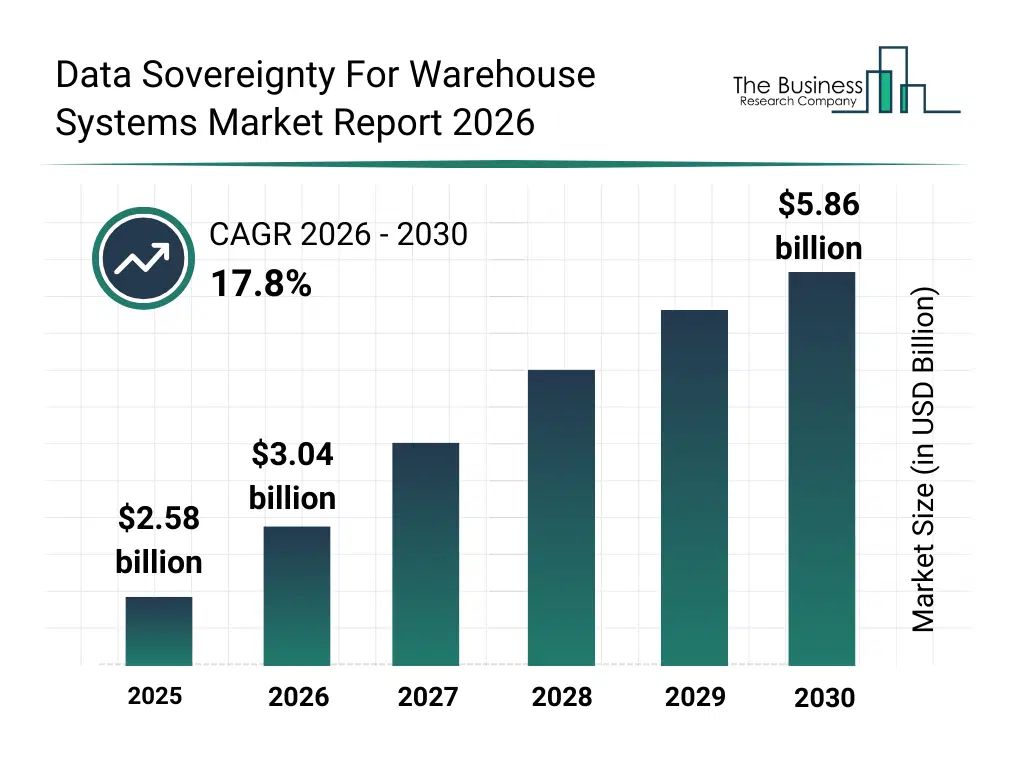
What Is The Data Sovereignty For Warehouse Systems Market Size and Share 2026?
The data sovereignty for warehouse systems market size has grown rapidly in recent years. It will grow from $2.58 billion in 2025 to $3.04 billion in 2026 at a compound annual growth rate (CAGR) of 17.6%. The growth in the historic period can be attributed to warehouse automation adoption, early industrial data governance, supply chain digitization, regulatory audits, cybersecurity risks.What Is The Data Sovereignty For Warehouse Systems Market Growth Forecast?
The data sovereignty for warehouse systems market size is expected to see rapid growth in the next few years. It will grow to $5.86 billion in 2030 at a compound annual growth rate (CAGR) of 17.8%. The growth in the forecast period can be attributed to smart warehouse expansion, stricter industrial data laws, AI driven inventory analytics, sovereign manufacturing initiatives, regional logistics growth. Major trends in the forecast period include warehouse data localization controls, jurisdiction based access management, secure inventory data governance, compliance driven warehouse systems, sovereign industrial data platforms.
Global Data Sovereignty For Warehouse Systems Market Segmentation
1) By Component: Software, Hardware, Services 2) By Deployment Mode: On Premises, Cloud 3) By Organization Size: Small And Medium Enterprises, Large Enterprises 4) By Application: Inventory Management, Order Fulfillment, Supply Chain Optimization, Compliance Management, Other Applications 5) By End User: Retail, Manufacturing, Logistics, Food And Beverage, Healthcare, Other End Users Subsegments: 1) By Software: Data Residency Management Software, Policy Enforcement And Governance Software, Encryption And Access Control Software, Audit And Compliance Reporting Software, Data Classification And Metadata Management Software 2) By Hardware: Sovereign Data Center Infrastructure, Secure Storage Systems, Dedicated Compute Servers, Hardware Security Modules, Network Isolation Equipment 3) By Services: Consulting And Regulatory Advisory Services, Implementation And Integration Services, Data Localization And Migration Services, Monitoring And Compliance Management Services, Support And Maintenance ServicesWhat Is The Driver Of The Data Sovereignty For Warehouse Systems Market?
The growing cross-border data transfer restrictions are expected to propel the growth of data sovereignty for the warehouse systems market going forward. Cross-border data transfer restrictions refer to regulatory frameworks and controls that govern how data is stored, accessed, and transferred across national boundaries to ensure data privacy, security, and compliance with local laws. The increase in cross-border data transfer restrictions is driven by the strengthening of data protection and privacy regulations, as governments aim to safeguard national data sovereignty and minimize the risks of unauthorized access or misuse across jurisdictions. Data sovereignty for warehouse systems supports regulatory compliance by ensuring that sensitive data remains within domestic boundaries while improving data governance and security. For instance, in January 2025, according to the Department for Science, Innovation and Technology (DSIT), a UK-based ministerial government department, international data transfers were essential to their operations, with all 22 interviewed companies confirming regular cross-border data sharing, primarily with Europe and the United States. Therefore, the growing cross-border data transfer restrictions are driving the growth of the data sovereignty for the warehouse systems market.Key Players In The Global Data Sovereignty For Warehouse Systems Market
Major companies operating in the data sovereignty for warehouse systems market are Google LLC, Microsoft Corporation, Alibaba Cloud Computing Ltd., Amazon Web Services Inc., Huawei Technologies Co. Ltd., Dell Technologies Inc., Tencent Holdings Limited, International Business Machines Corporation, Oracle Corporation, Salesforce Inc., SAP SE, Hewlett Packard Enterprise Company, Atos SE, NetApp Inc., OpenText Corporation, Snowflake Inc., Databricks Inc., Teradata Corporation, Hitachi Vantara LLC, Aruba S.p.A., Dremio Corporation, Scaleway SAS, and OVH Groupe SAS.
This chart is for illustrative purposes; the full report includes a detailed competitor analysis and comprehensive overview of the top 10 companies in the market.
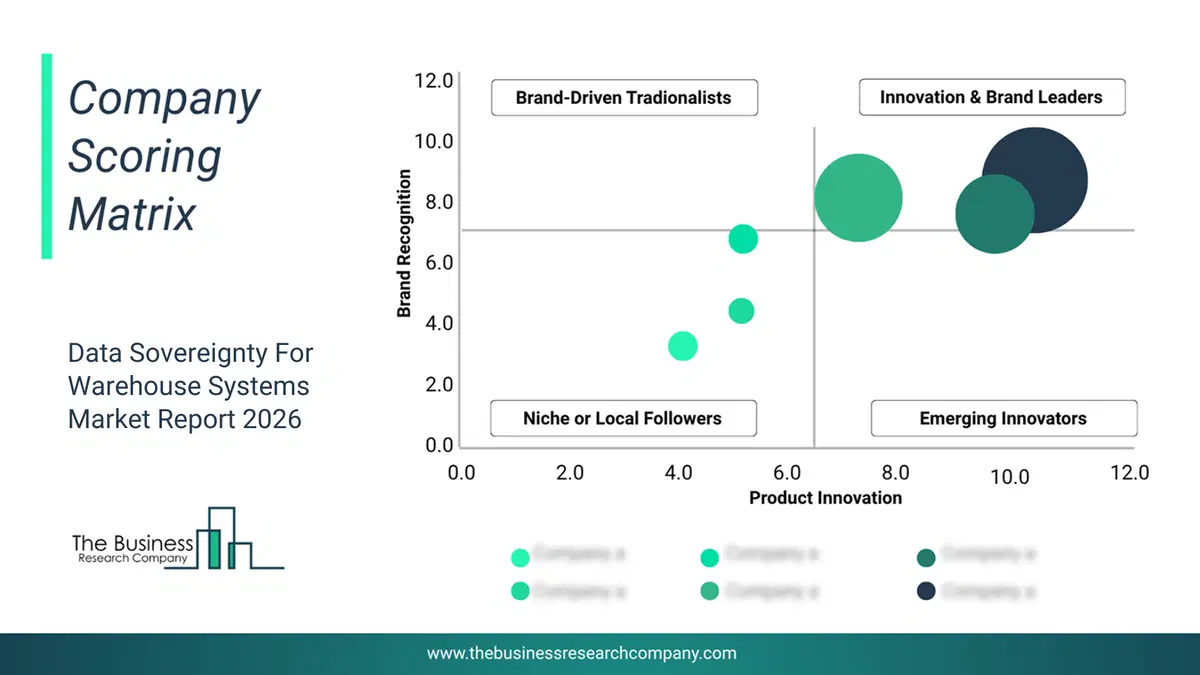
This chart maps companies by product innovation and brand strength, with bubble size indicating relative revenue, helping identify market leaders, challengers, and niche players. This is an illustrative chart; the full report provides a complete and accurate competitive analysis.
Global Data Sovereignty For Warehouse Systems Market Trends and Insights
Major companies operating in the data sovereignty for warehouse systems market are focusing on developing sovereign cloud solutions to enhance data residency, regulatory compliance, and operational transparency across sensitive workloads. Sovereign cloud solutions are cloud environments built to keep data storage, processing, and management fully governed by local laws and authorities. They ensure assured data residency, regulatory compliance, and regional control over cloud operations. For instance, in January 2026, Amazon Web Services, a US-based cloud computing company, launched the AWS European Sovereign Cloud, a dedicated cloud infrastructure designed to support European customers with strict data sovereignty and compliance requirements. The sovereign cloud is architected to ensure that customer data remains within the European Union and is operated independently by EU-based personnel, enabling organizations to securely deploy data warehouses, analytics, and enterprise workloads while meeting regional regulatory standards such as GDPR and sector-specific compliance mandates.What Are Latest Mergers And Acquisitions In The Data Sovereignty For Warehouse Systems Market?
In May 2024, STACKIT, a Germany-based unified lakehouse platform for self-service analytics and AI, partnered with Dremio to deliver secure, high-performance, data-sovereign warehouse and lakehouse analytics within regulated regional boundaries. The collaboration aims to combine STACKIT’s sovereign cloud infrastructure with Dremio’s lakehouse and SQL analytics platform to enable compliant, data-resident storage, processing, and analytics for enterprises operating under strict data protection regulations. Dremio is a US-based company that supports data sovereignty requirements for warehouse-style data systems.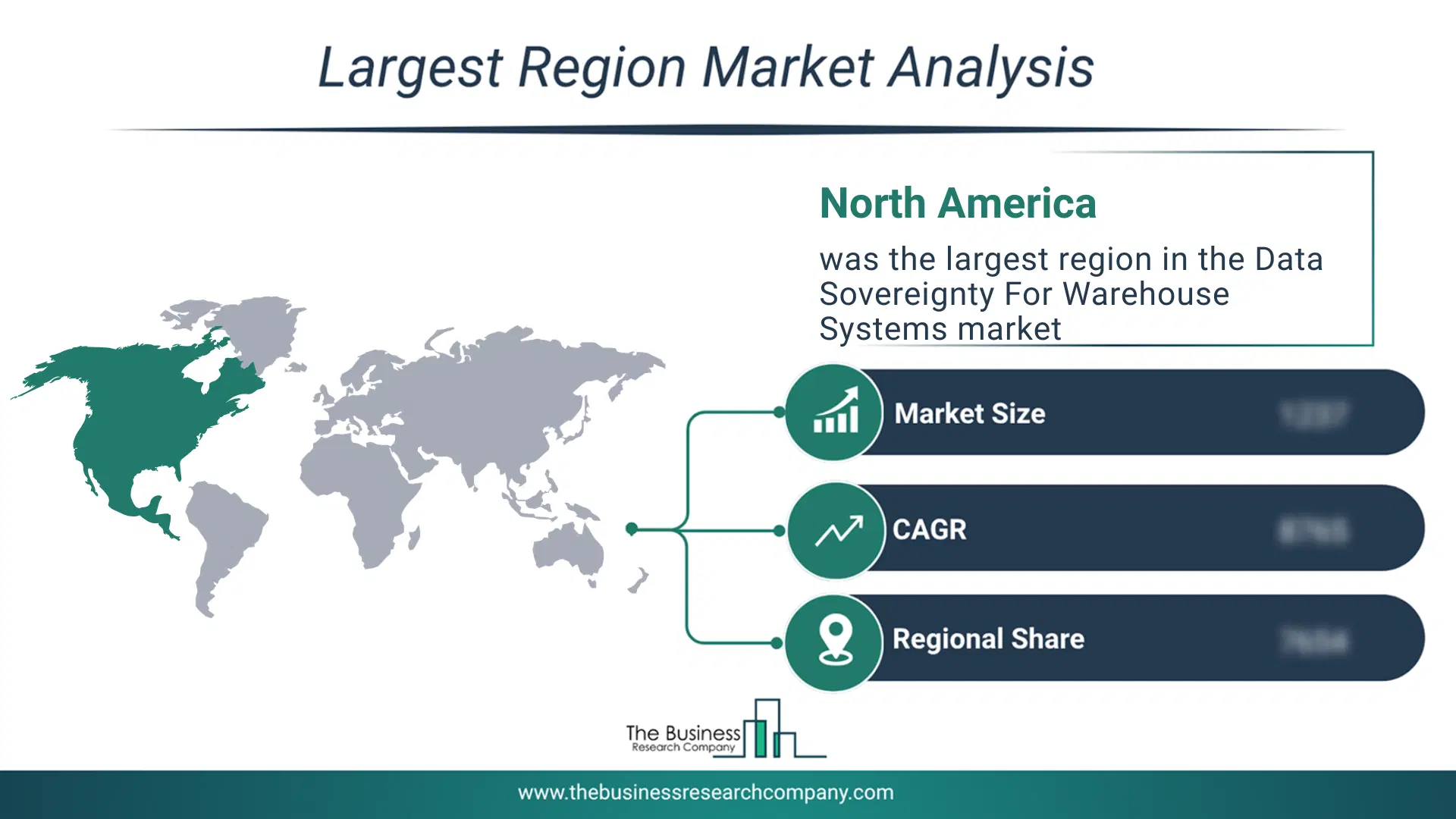
Regional Outlook
North America was the largest region in the data sovereignty for warehouse systems market in 2025. Asia-Pacific is expected to be the fastest-growing region in the forecast period. The regions covered in this market report are Asia-Pacific, South East Asia, Western Europe, Eastern Europe, North America, South America, Middle East, Africa. The countries covered in this market report are Australia, Brazil, China, France, Germany, India, Indonesia, Japan, Taiwan, Russia, South Korea, UK, USA, Canada, Italy, Spain.What Defines the Data Sovereignty For Warehouse Systems Market?
The data sovereignty for warehouse systems market consists of revenues earned by entities by providing services such as data sovereignty assessment, data localization management, cloud compliance monitoring, encryption key management services, identity and access management services, and backup and disaster recovery services. The market value includes the value of related goods sold by the service provider or included within the service offering. The data sovereignty for warehouse systems market includes sales of hardware security modules, encryption appliances, secure gateways, backup appliances, and industrial IoT gateways. Values in this market are ‘factory gate’ values, that is, the value of goods sold by the manufacturers or creators of the goods, whether to other entities (including downstream manufacturers, wholesalers, distributors, and retailers) or directly to end customers. The value of goods in this market includes related services sold by the creators of the goods.How is Market Value Defined and Measured?
The market value is defined as the revenues that enterprises gain from the sale of goods and/or services within the specified market and geography through sales, grants, or donations in terms of the currency (in USD unless otherwise specified). The revenues for a specified geography are consumption values that are revenues generated by organizations in the specified geography within the market, irrespective of where they are produced. It does not include revenues from resales along the supply chain, either further along the supply chain or as part of other products.
This chart presents market attractiveness based on a quantitative evaluation of growth, competition, strategic alignment, and risk, offering a clear view of opportunity areas for decision-making. This chart is for illustrative purposes; the full report contains the complete analysis.

This chart highlights the Total Addressable Market (TAM) by estimating the maximum revenue opportunity using an assumption-driven approach, supporting strategic planning and opportunity sizing across markets. The chart is illustrative; the full report provides a more comprehensive analysis.
What Key Data and Analysis Are Included in the Data Sovereignty For Warehouse Systems Market Report 2026?
The data sovereignty for warehouse systems market research report is one of a series of new reports from The Business Research Company that provides market statistics, including industry global market size, regional shares, competitors with the market share, detailed market segments, market trends and opportunities, and any further data you may need to thrive in the data sovereignty for warehouse systems industry. The market research report delivers a complete perspective of everything you need, with an in-depth analysis of the current and future state of the industry.Data Sovereignty For Warehouse Systems Market Report Forecast Analysis
| Report Attribute | Details |
|---|---|
| Market Size Value In 2026 | $3.04 billion |
| Revenue Forecast In 2030 | $5.86 billion |
| Growth Rate | CAGR of 17.6% from 2026 to 2030 |
| Base Year For Estimation | 2025 |
| Actual Estimates/Historical Data | 2020-2025 |
| Forecast Period | 2026 - 2030 |
| Market Representation | Revenue in USD Billion and CAGR from 2026 to 2030 |
| Segments Covered | Component, Deployment Mode, Organization Size, Application, End User |
| Regional Scope | Asia-Pacific, Western Europe, Eastern Europe, North America, South America, Middle East, Africa |
| Country Scope | The countries covered in the report are Australia, Brazil, China, France, Germany, India, Indonesia, Japan, Taiwan, Russia, South Korea, UK, USA, Canada, Italy, Spain. |
| Key Companies Profiled | Google LLC, Microsoft Corporation, Alibaba Cloud Computing Ltd., Amazon Web Services Inc., Huawei Technologies Co. Ltd., Dell Technologies Inc., Tencent Holdings Limited, International Business Machines Corporation, Oracle Corporation, Salesforce Inc., SAP SE, Hewlett Packard Enterprise Company, Atos SE, NetApp Inc., OpenText Corporation, Snowflake Inc., Databricks Inc., Teradata Corporation, Hitachi Vantara LLC, Aruba S.p.A., Dremio Corporation, Scaleway SAS, and OVH Groupe SAS. |
| Customization Scope | Request for Customization |
| Pricing And Purchase Options | Explore Purchase Options |