
Deep-Space Communication Market Report 2026
Global Outlook – By Component (Transponders, Antennas, Transceivers, Modulators, Other Components), By Technology (Radio Frequency Communication, Optical Communication, Other Technologies), By Application (Space Exploration, Earth Observation, Satellite Communication, Other Applications), By End-User (Government And Military, Commercial, Other End-Users) – Market Size, Trends, Strategies, and Forecast to 2030
Deep-Space Communication Market Overview
• Deep-Space Communication market size has reached to $1.92 billion in 2025 • Expected to grow to $3.15 billion in 2030 at a compound annual growth rate (CAGR) of 10.4% • Growth Driver: Growing Number Of Satellites Fueling The Growth Of The Market Due To Rising Demand For Global Connectivity • Market Trend: Advanced Deep Space Optical Communications (DSOC) To Revolutionize Interplanetary Data Transmission • North America was the largest region in 2025.What Is Covered Under Deep-Space Communication Market?
Deep-space communication refers to the transmission of signals over extremely long distances between Earth and spacecraft that travel far beyond the Earth's orbit. It involves maintaining a reliable exchange of data across vast expanses of space, often spanning millions or even billions of kilometers. The main purpose is to enable command, control, and data exchange, such as scientific data transmission and telemetry for deep-space missions such as planetary exploration and interstellar probes. The main components of deep-space communication include transponders, antennas, transceivers, modulators, and others. Transponders refers to a satellite subsystem that receives uplink signals, amplifies and shifts their frequency, and then retransmits them to Earth. It uses various technologies such as radio frequency communication, optical communication, and others and is applied for space exploration, earth observation, satellite communication, and others. It is used by several end-users, including government and military, commercial, and others.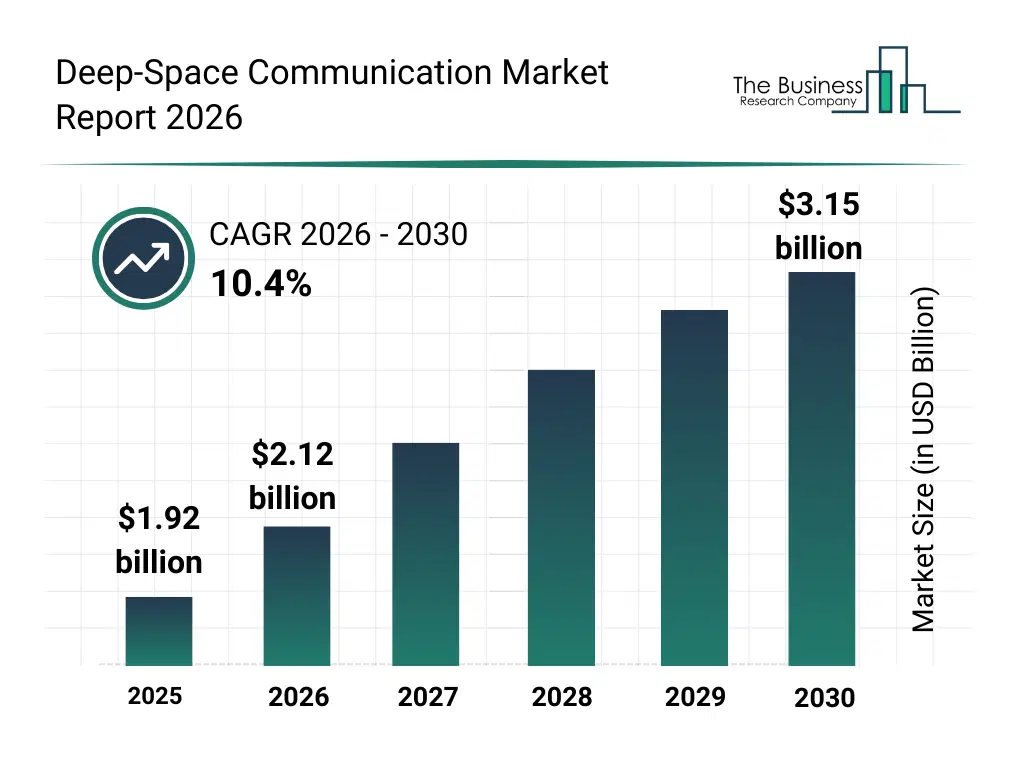
What Is The Deep-Space Communication Market Size and Share 2026?
The deep-space communication market size has grown rapidly in recent years. It will grow from $1.92 billion in 2025 to $2.12 billion in 2026 at a compound annual growth rate (CAGR) of 10.4%. The growth in the historic period can be attributed to increasing deployment of deep-space missions requiring long-distance signal transmission infrastructure, development of low-noise amplifiers and tracking receivers to support weak signal detection, expansion of planetary exploration programs driving demand for telemetry and data relay systems, early adoption of demodulators and advanced modulation techniques for high-fidelity communication, international collaboration in deep-space networks enhancing mission planning and navigation support.What Is The Deep-Space Communication Market Growth Forecast?
The deep-space communication market size is expected to see rapid growth in the next few years. It will grow to $3.15 billion in 2030 at a compound annual growth rate (CAGR) of 10.4%. The growth in the forecast period can be attributed to growing need for high-bandwidth communication solutions to support data-intensive deep-space missions, rising demand for autonomous navigation support systems integrated with communication networks, development of next-generation telemetry units for long-duration interplanetary probes, expansion of commercial deep-space ventures increasing requirements for reliable communication services, advancements in signal processing technologies improving long-range data transmission efficiency. Major trends in the forecast period include increasing demand for high-gain antennas, growth of deep-space optical communication, expansion of interplanetary data relay networks, rising need for radiation-hardened communication electronics, increased deployment of deep-space telemetry networks.
Global Deep-Space Communication Market Segmentation
1) By Component: Transponders, Antennas, Transceivers, Modulators, Other Components 2) By Technology: Radio Frequency Communication, Optical Communication, Other Technologies 3) By Application: Space Exploration, Earth Observation, Satellite Communication, Other Applications 4) By End-User: Government And Military, Commercial, Other End-Users Subsegments: 1) By Transponders: Radio Frequency (RF) Transponders, Optical Transponders, Microwave Transponders 2) By Antennas: High-Gain Antennas, Low-Gain Antennas, Phased Array Antennas, Parabolic Reflector Antennas 3) By Transceivers: RF Transceivers, Optical Transceivers, Software-Defined Transceivers 4) By Modulators: Analog Modulators, Digital Modulators, Frequency Modulators, Phase Modulators 5) By Other Components: Amplifiers, Oscillators, Filters, WaveguidesWhat Is Driver Of The Deep-Space Communication Market?
The growing number of satellites is expected to propel the growth of the deep-space communication market going forward. Satellites refer to man-made objects launched into orbit around Earth or other celestial bodies to perform specific functions such as communication, navigation, Earth observation, scientific research, and military surveillance. The number of satellites is increasing due to the rising demand for global connectivity through satellite-based internet services, as ground networks are often unable to reach remote and underserved areas. Deep-space communication aids satellites by enabling reliable data transmission over vast interplanetary distances, ensuring continuous contact with Earth-based stations. It supports satellite navigation, telemetry, and control operations, enhancing mission success and operational efficiency in space exploration. For instance, in May 2024, according to the National Space Operations Centre (NSpOC), a UK-based government agency, the number of active satellites in orbit, as of April 2024, reached over 9,000 and some reports suggest that by 2030, we could have more than 60,000 active satellites in space. Therefore, the growing number of satellites is driving the growth of the deep-space communication industry.Key Players In The Global Deep-Space Communication Market
Major companies operating in the deep-space communication market are RTX Corporation, Honeywell International Inc., Thales Group, Echostar Corporation, L3Harris Technologies Inc., Elbit Systems Ltd., ST Engineering Ltd., SpaceX Corp., General Dynamics Mission Systems Inc., Viasat Inc., SES SA, Aselsan A.S., Maxar Technologies Holdings Inc., Iridium Communications Inc., Cobham Ltd., Calian Group Ltd., Gilat Satellite Networks, Continental Electronics Corporation, Campbell Scientific Inc., ND SatCom GmbH, Intellian Technologies Inc., Quasar Satellite Technologies.
This chart is for illustrative purposes; the full report includes a detailed competitor analysis and comprehensive overview of the top 10 companies in the market.
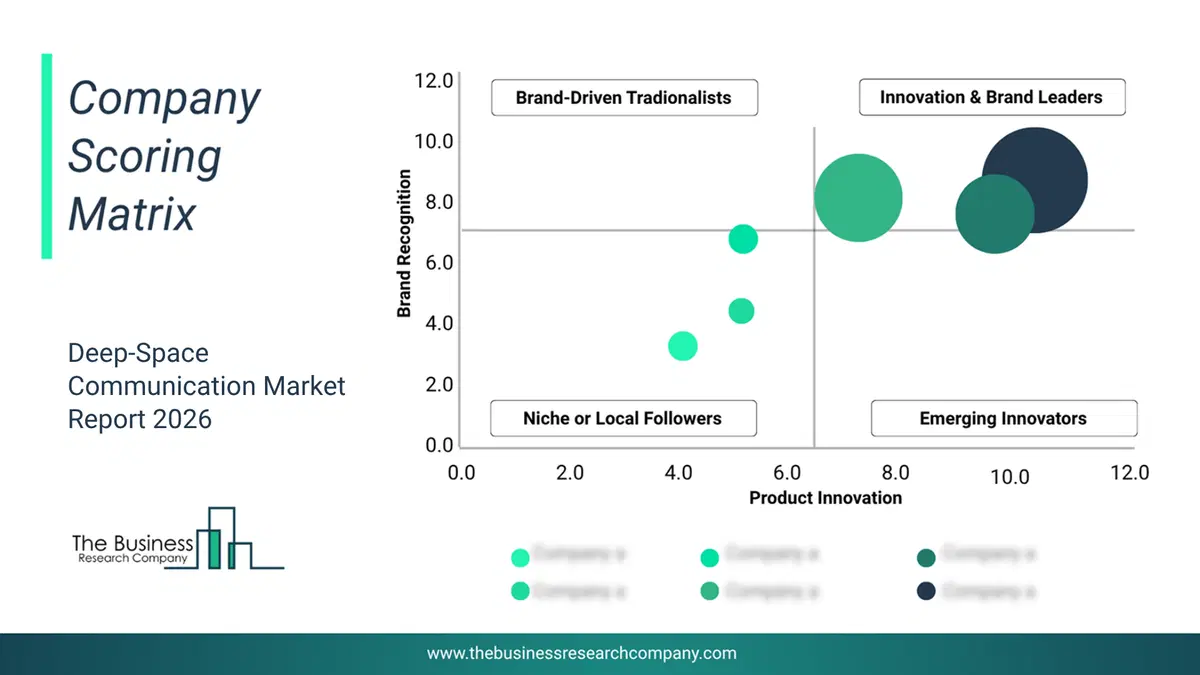
This chart maps companies by product innovation and brand strength, with bubble size indicating relative revenue, helping identify market leaders, challengers, and niche players. This is an illustrative chart; the full report provides a complete and accurate competitive analysis.
Global Deep-Space Communication Market Trends and Insights
Major companies operating in the deep-space communication market are focusing on developing innovative solutions, such as laser-based optical communication systems to increase data transfer rates and extend communication distances in space. Laser-based optical communication systems use lasers to transmit data as light beams instead of radio waves, helping enable higher data rates, longer-range communication, and more efficient bandwidth use for deep-space missions. For instance, in September 2025, the National Aeronautics and Space Administration (NASA), a US-based federal government agency, successfully completed its Deep Space Optical Communications (DSOC) technology demonstration aboard the Psyche spacecraft. The experiment demonstrated that laser-based communication could reliably transmit and receive data over hundreds of millions of miles, achieving data rates comparable to household broadband and setting new records for deep-space communication. The milestone highlights the potential of optical communication systems to support future missions to Mars and beyond, enabling faster transmission of high-definition images, scientific data, and real-time video from distant spacecraft.What Are Latest Mergers And Acquisitions In The Deep-Space Communication Market? SSC Partners With VUAS And VIRATEC For Lunar Mission Support
In July 2023, Swedish Space Corporation (SSC), a Sweden-based space services company, partnered with Ventspils University of Applied Sciences (VUAS) and VIRATEC to broaden its network infrastructure for lunar mission support. This partnership aims to enhance ground station capabilities and strengthen communication support for upcoming lunar exploration missions, enabling more reliable data transmission and extended coverage for deep-space operations. Ventspils University of Applied Sciences (VUAS) is a Latvia-based vocational university actively involved in deep-space communication research and infrastructure, and VIRATEC is a Latvia-based company specializing in deep-space communication.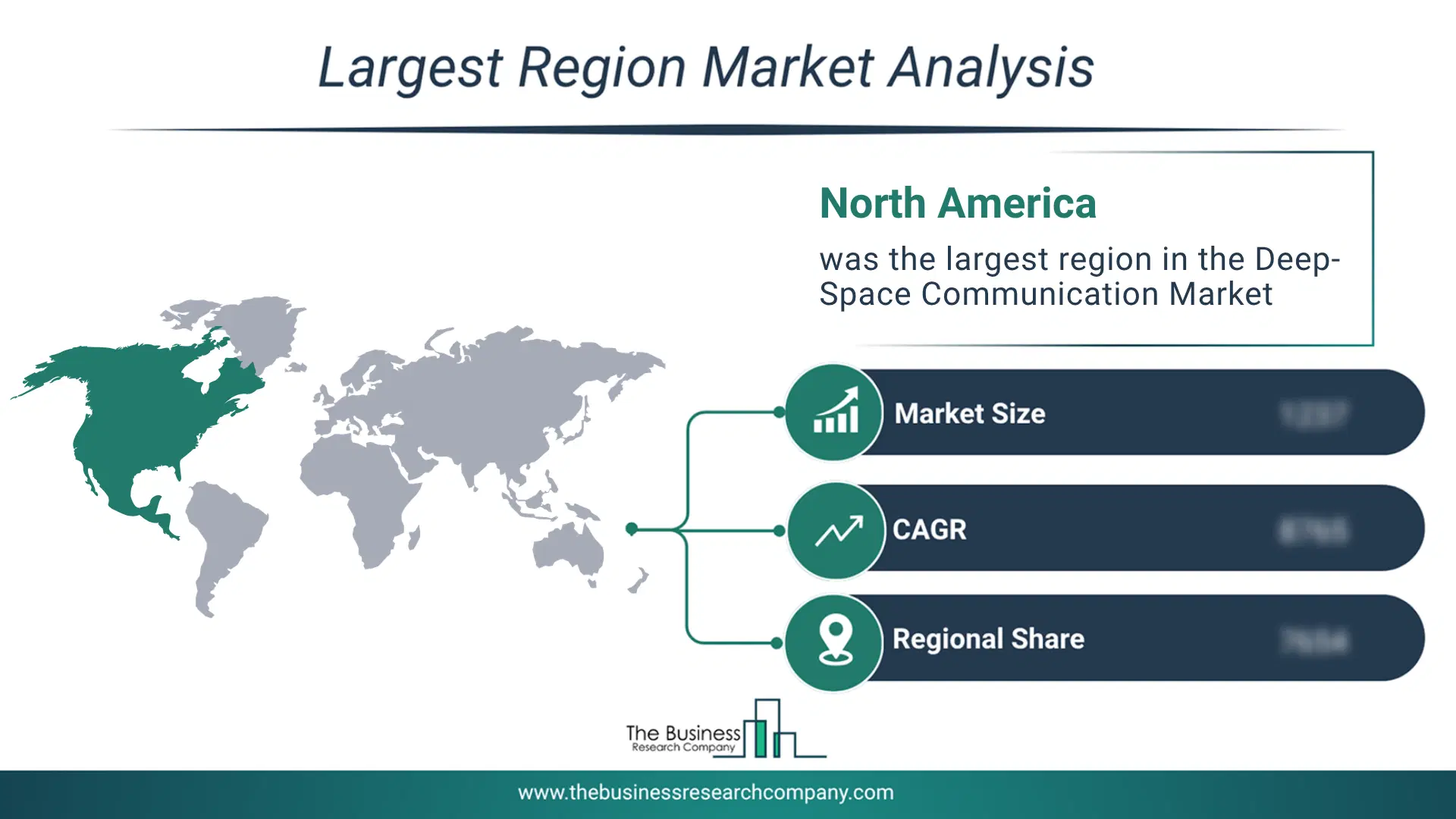
Regional Insights
North America was the largest region in the deep-space communication market in 2025. The regions covered in this market report are Asia-Pacific, South East Asia, Western Europe, Eastern Europe, North America, South America, Middle East, Africa. The countries covered in this market report are Australia, Brazil, China, France, Germany, India, Indonesia, Japan, Taiwan, Russia, South Korea, UK, USA, Canada, Italy, SpainWhat Defines the Deep-Space Communication Market?
The deep-space communication market consists of revenues earned by entities by providing services such as long-distance signal transmission, navigation support, data relay services, and mission planning support. The market value includes the value of related goods sold by the service provider or included within the service offering. The deep-space communication market also includes sales of low-noise amplifiers, demodulators, tracking receivers, and telemetry units. Values in this market are ‘factory gate’ values, that is the value of goods sold by the manufacturers or creators of the goods, whether to other entities (including downstream manufacturers, wholesalers, distributors and retailers) or directly to end customers. The value of goods in this market includes related services sold by the creators of the goods.How is Market Value Defined and Measured?
The market value is defined as the revenues that enterprises gain from the sale of goods and/or services within the specified market and geography through sales, grants, or donations in terms of the currency (in USD unless otherwise specified). The revenues for a specified geography are consumption values that are revenues generated by organizations in the specified geography within the market, irrespective of where they are produced. It does not include revenues from resales along the supply chain, either further along the supply chain or as part of other products.
This chart presents market attractiveness based on a quantitative evaluation of growth, competition, strategic alignment, and risk, offering a clear view of opportunity areas for decision-making. This chart is for illustrative purposes; the full report contains the complete analysis.

This chart highlights the Total Addressable Market (TAM) by estimating the maximum revenue opportunity using an assumption-driven approach, supporting strategic planning and opportunity sizing across markets. The chart is illustrative; the full report provides a more comprehensive analysis.
What Key Data and Analysis Are Included in the Deep-Space Communication Market Report 2026?
The deep-space communication market research report is one of a series of new reports from The Business Research Company that provides market statistics, including industry global market size, regional shares, competitors with the market share, detailed market segments, market trends and opportunities, and any further data you may need to thrive in the deep-space communication industry. The market research report delivers a complete perspective of everything you need, with an in-depth analysis of the current and future state of the industry.Deep-Space Communication Market Report Forecast Analysis
| Report Attribute | Details |
|---|---|
| Market Size Value In 2026 | $2.12 billion |
| Revenue Forecast In 2030 | $3.15 billion |
| Growth Rate | CAGR of 10.4% from 2026 to 2030 |
| Base Year For Estimation | 2025 |
| Actual Estimates/Historical Data | 2020-2025 |
| Forecast Period | 2026 - 2030 |
| Market Representation | Revenue in USD Billion and CAGR from 2026 to 2030 |
| Segments Covered | Component, Technology, Application, End-User |
| Regional Scope | Asia-Pacific, Western Europe, Eastern Europe, North America, South America, Middle East, Africa |
| Country Scope | The countries covered in the deep-space communication market report are Australia, Brazil, China, France, Germany, India, Indonesia, Japan, Taiwan, Russia, South Korea, UK, USA, Canada, Italy, Spain |
| Key Companies Profiled | RTX Corporation, Honeywell International Inc., Thales Group, Echostar Corporation, L3Harris Technologies Inc., Elbit Systems Ltd., ST Engineering Ltd., SpaceX Corp., General Dynamics Mission Systems Inc., Viasat Inc., SES SA, Aselsan A.S., Maxar Technologies Holdings Inc., Iridium Communications Inc., Cobham Ltd., Calian Group Ltd., Gilat Satellite Networks, Continental Electronics Corporation, Campbell Scientific Inc., ND SatCom GmbH, Intellian Technologies Inc., Quasar Satellite Technologies. |
| Customization Scope | Request for Customization |
| Pricing And Purchase Options | Explore Purchase Options |