
Deep Space Exploration Market Report 2026
Global Outlook – By Component (Spacecraft, Launch Vehicles, Rovers, Space Probes, Other Components), By Mission Type (Manned Missions, Unmanned Missions), By Application (Moon Exploration, Transportation, Mars Exploration, Orbital Infrastructure, Other Applications), By End-User (Government, Commercial, Other End-Users) – Market Size, Trends, Strategies, and Forecast to 2030
Deep Space Exploration Market Overview
• Deep Space Exploration market size has reached to $16.09 billion in 2025 • Expected to grow to $28.99 billion in 2030 at a compound annual growth rate (CAGR) of 12.5% • Growth Driver: Increasing Space Mission Demand Fueling Market Growth Due To Rising Need For Satellite Communication And Data Transmission • Market Trend: Innovative Space Exploration Telescopes Driving Breakthroughs In Deep Space Research • North America was the largest region in 2025.What Is Covered Under Deep Space Exploration Market?
Deep space exploration refers to the investigation and study of regions of outer space beyond Earth's immediate vicinity, typically beyond the Moon and into the solar system and interstellar space. It involves sending robotic spacecraft or, in the future, crewed missions to distant planets, moons, asteroids, and comets to gather scientific data, search for signs of life, and better understand the origins and evolution of the solar system and the universe. Deep space exploration requires advanced technologies for long-duration missions, autonomous navigation, and communication across vast distances. The main types of components in deep space exploration are spacecraft, launch vehicles, rovers, space probes, and others. Spacecraft refers to vehicles or machines designed for travel or operation in outer space. It includes various mission types, such as manned missions and unmanned missions, and is used for applications such as moon exploration, transportation, Mars exploration, orbital infrastructure, and others. It serves various end users, including government, commercial, and others.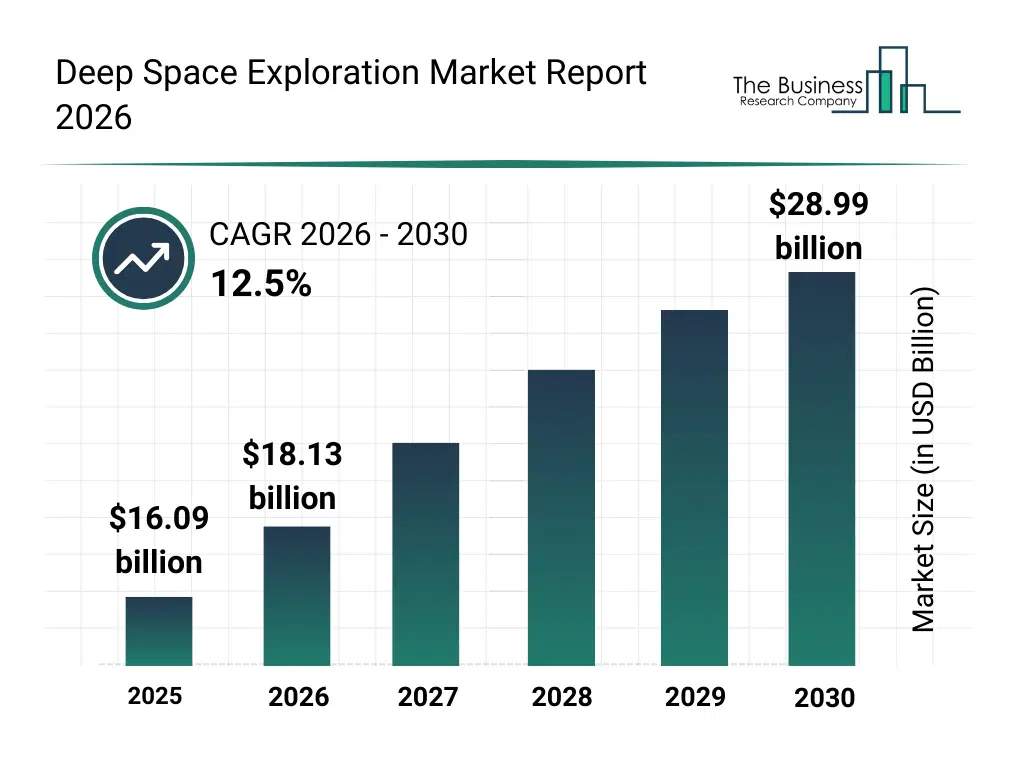
What Is The Deep Space Exploration Market Size and Share 2026?
The deep space exploration market size has grown rapidly in recent years. It will grow from $16.09 billion in 2025 to $18.13 billion in 2026 at a compound annual growth rate (CAGR) of 12.7%. The growth in the historic period can be attributed to increasing investment in robotic planetary missions driving demand for deep space communication systems, development of advanced navigation and tracking technologies to support interplanetary spacecraft, expansion of earth observation and satellite programs forming the technological base for deep space systems, progress in power supply units such as radioisotope generators enabling long-duration missions, international space agency collaborations accelerating scientific data collection and exploration initiatives.What Is The Deep Space Exploration Market Growth Forecast?
The deep space exploration market size is expected to see rapid growth in the next few years. It will grow to $28.99 billion in 2030 at a compound annual growth rate (CAGR) of 12.5%. The growth in the forecast period can be attributed to growing need for autonomous navigation technologies for future crewed and uncrewed missions beyond the moon, rising commercial participation in deep space ventures expanding demand for communication and tracking services, development of next-generation deep space communication networks supporting high-bandwidth data transmission, increasing deployment of robotic exploration systems for missions to asteroids, mars, and outer planets, advancements in durable power and propulsion technologies enabling extended interplanetary operations. Major trends in the forecast period include increasing demand for deep space robotic missions, growth of public–private partnerships in space exploration, rising investment in interplanetary communication networks, expansion of reusable spacecraft and rover platforms, surge in lunar and mars surface mobility development.
Global Deep Space Exploration Market Segmentation
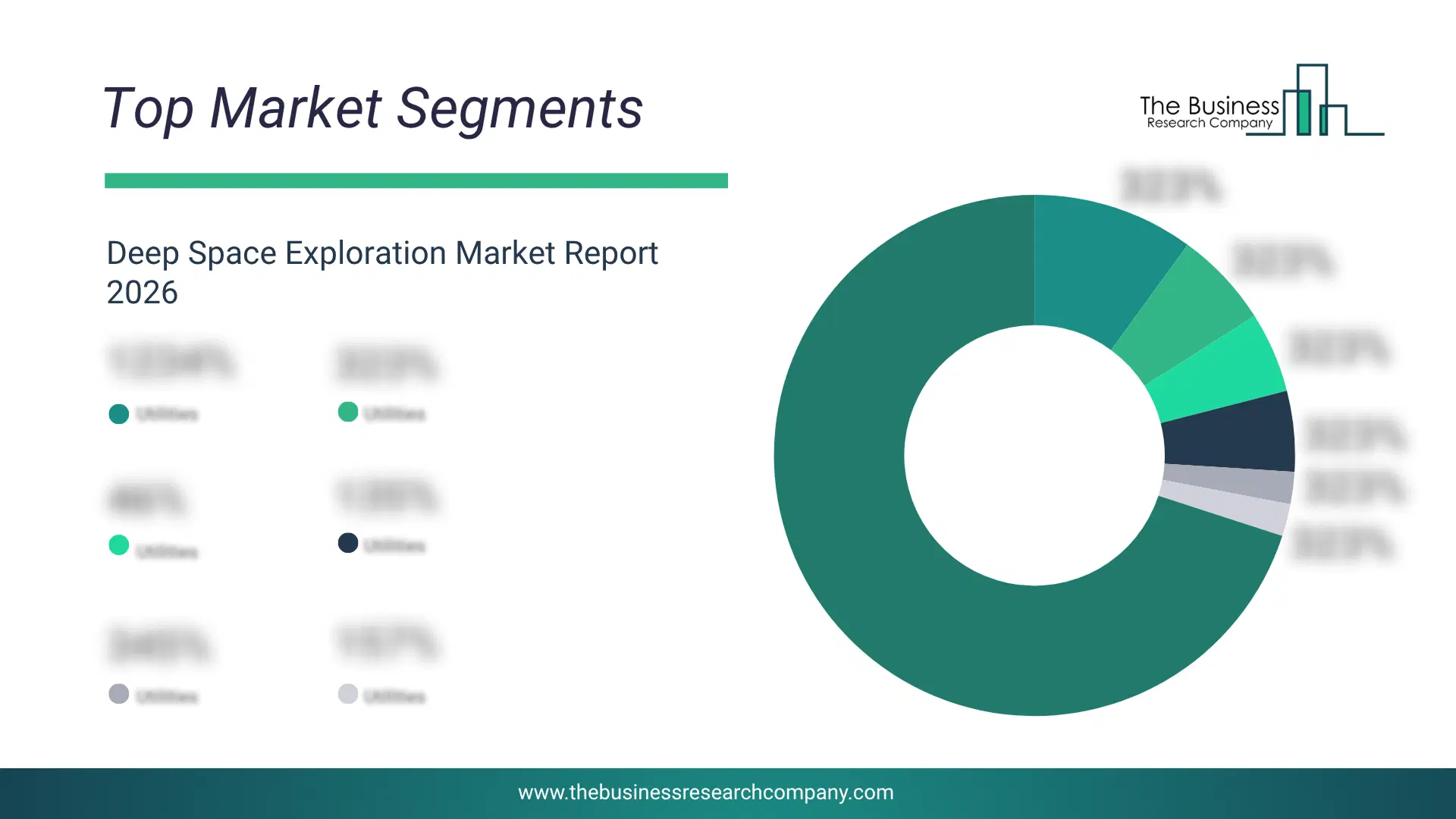
1) By Component: Spacecraft, Launch Vehicles, Rovers, Space Probes, Other Components 2) By Mission Type: Manned Missions, Unmanned Missions 3) By Application: Moon Exploration, Transportation, Mars Exploration, Orbital Infrastructure, Other Applications 4) By End-User: Government, Commercial, Other End-Users Subsegments: 1) By Spacecraft: Manned Spacecraft, Unmanned Spacecraft, Orbital Spacecraft, Interplanetary Spacecraft 2) By Launch Vehicles: Expendable Launch Vehicles, Reusable Launch Vehicles, Heavy-Lift Launch Vehicles, Medium-Lift Launch Vehicles 3) By Rovers: Autonomous Rovers, Remote-Controlled Rovers, Hybrid Rovers 4) By Space Probes: Flyby Probes, Orbiter Probes, Lander Probes, Atmospheric Probes 5) By Other Components: Satellite Systems, Space Telescopes, Deep Space Communication Systems, Navigation And Guidance SystemsWhat Is Driver Of The Deep Space Exploration Market?
The increasing demand for space missions is expected to propel the growth of the deep space exploration market going forward. Space missions are planned journeys or projects involving spacecraft sent into space to explore, study, or utilize outer space. The demand for space missions is increasing due to the growing need for satellite-based communication services as governments and private companies seek to expand global internet coverage and enhance data transmission. Space missions are crucial for deep space exploration to deploy spacecraft and probes that gather valuable data on distant celestial bodies and cosmic phenomena beyond Earth's orbit. For instance, in January 2025, according to the Space Foundation, a US-based non-profit organization, in 2024, there were 259 launches, averaging one launch every 34 hours, five hours more frequently than in 2023. Therefore, the increasing demand for space missions is driving the growth of the deep space exploration industry.Key Players In The Global Deep Space Exploration Market
Major companies operating in the deep space exploration market are The Boeing Company, Lockheed Martin Corporation, Northrop Grumman Corporation, L3Harris Technologies Inc., Airbus Defence and Space GmbH, Space Exploration Technologies Corp., Blue Origin LLC, Thales Alenia Space SAS, Maxar Technologies Inc., Sierra Nevada Corporation, Relativity Space Inc., Rocket Lab USA Inc., Firefly Aerospace Inc., Axiom Space Inc., Impulse Space Inc., ispace Inc., Astrobotic Technology Inc., Vast Space LLC, Pan Galactic Ltd., WeSpace Technologies Co. Ltd.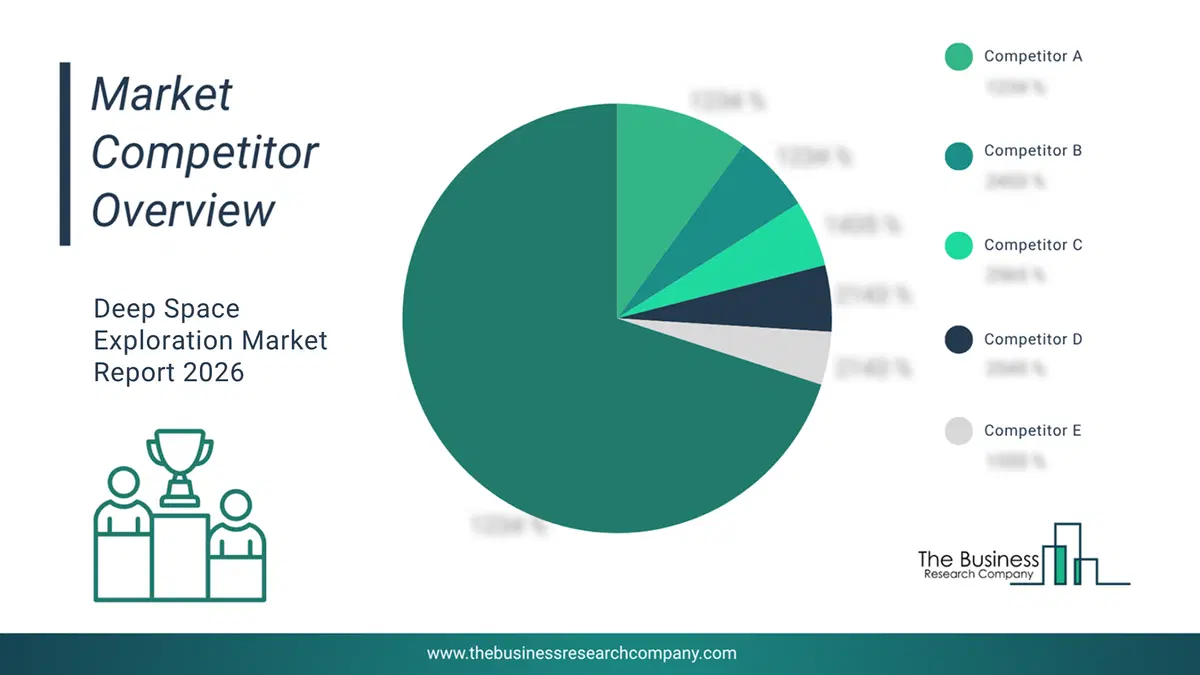
This chart is for illustrative purposes; the full report includes a detailed competitor analysis and comprehensive overview of the top 10 companies in the market.

This chart maps companies by product innovation and brand strength, with bubble size indicating relative revenue, helping identify market leaders, challengers, and niche players. This is an illustrative chart; the full report provides a complete and accurate competitive analysis.
Global Deep Space Exploration Market Trends and Insights
Major companies operating in the deep space exploration market are focusing on introducing innovative solutions, such as space exploration telescopes, to enhance the detection and study of distant celestial bodies and exoplanets. A space exploration telescope is a space-based optical instrument designed to capture high-resolution images and data of distant celestial bodies, free from atmospheric distortions. For instance, in March 2025, the National Aeronautics and Space Administration, a US-based space agency, launched the SPHEREx space telescope to map the sky in 102 infrared colors over a planned two-year mission. SPHEREx will collect data on more than 450 million galaxies and over 100 million stars in the Milky Way, creating a detailed 3D map of the cosmos to investigate the origins of the universe, the history, and evolution of galaxies, and the presence of water and organic molecules, key ingredients for life in our galaxy. SPHEREx aims to shed light on cosmic inflation, the rapid expansion that occurred just after the Big Bang, and provide new insights into how the universe and planetary systems evolved.What Are Latest Mergers And Acquisitions In The Deep Space Exploration Market? Intuitive Machines Acquires KinetX Aerospace to Enhance Deep-Space Navigation Capabilities
In October 2025, Intuitive Machines Inc., a US-based space technology, infrastructure, and services company, acquired KinetX, Inc. for $30 million. With this acquisition, Intuitive Machines aims to combine its data services with KinetX’s deep space navigation expertise to provide secure, precise, and reliable communications and navigation for lunar and interplanetary missions, enhance its ability to support complex space operations, and deliver end-to-end data relay solutions from the Moon to Mars. KinetX, Inc. is a US-based defense and space company that specializes in deep space exploration.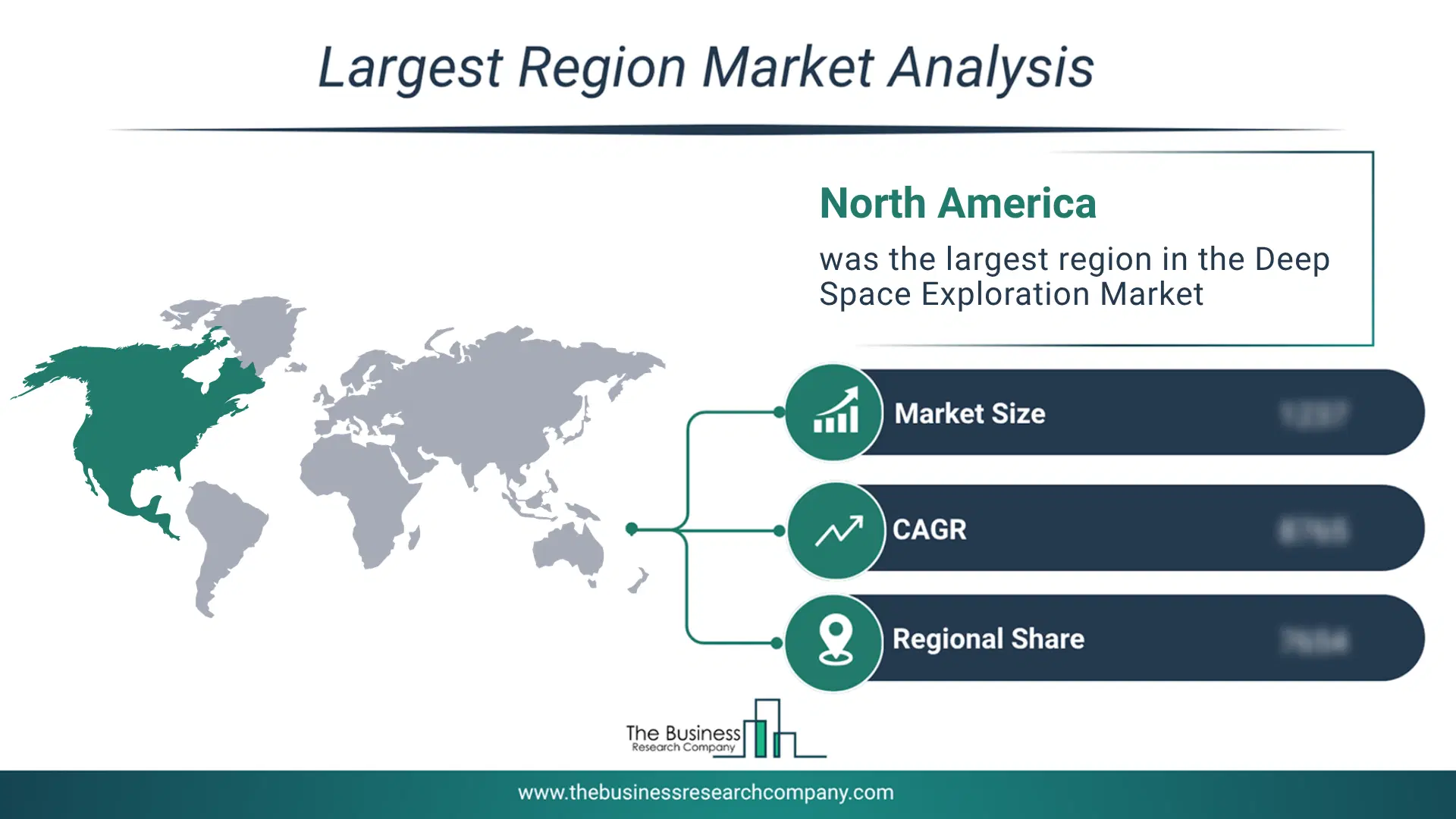
Regional Insights
North America was the largest region in the deep space exploration market in 2025. The regions covered in this market report are Asia-Pacific, South East Asia, Western Europe, Eastern Europe, North America, South America, Middle East, Africa. The countries covered in this market report are Australia, Brazil, China, France, Germany, India, Indonesia, Japan, Taiwan, Russia, South Korea, UK, USA, Canada, Italy, SpainWhat Defines the Deep Space Exploration Market?
The deep space exploration market includes revenues earned by entities by providing services such as deep space navigation and tracking, scientific data collection, robotic exploration services, and interplanetary communication services. The market value includes the value of related goods sold by the service provider or included within the service offering. The deep space exploration market also consists of sales of products including global positioning systems, earth observation satellites, deep space communication systems, and power supply units. Values in this market are ‘factory gate’ values, that is, the value of goods sold by the manufacturers or creators of the goods, whether to other entities (including downstream manufacturers, wholesalers, distributors, and retailers) or directly to end customers. The value of goods in this market includes related services sold by the creators of the goods.How is Market Value Defined and Measured?
The market value is defined as the revenues that enterprises gain from the sale of goods and/or services within the specified market and geography through sales, grants, or donations in terms of the currency (in USD unless otherwise specified). The revenues for a specified geography are consumption values that are revenues generated by organizations in the specified geography within the market, irrespective of where they are produced. It does not include revenues from resales along the supply chain, either further along the supply chain or as part of other products.
This chart presents market attractiveness based on a quantitative evaluation of growth, competition, strategic alignment, and risk, offering a clear view of opportunity areas for decision-making. This chart is for illustrative purposes; the full report contains the complete analysis.

This chart highlights the Total Addressable Market (TAM) by estimating the maximum revenue opportunity using an assumption-driven approach, supporting strategic planning and opportunity sizing across markets. The chart is illustrative; the full report provides a more comprehensive analysis.
What Key Data and Analysis Are Included in the Deep Space Exploration Market Report 2026?
The deep space exploration market research report is one of a series of new reports from The Business Research Company that provides market statistics, including industry global market size, regional shares, competitors with the market share, detailed market segments, market trends and opportunities, and any further data you may need to thrive in the deep space exploration industry. The market research report delivers a complete perspective of everything you need, with an in-depth analysis of the current and future state of the industry.Deep Space Exploration Market Report Forecast Analysis
| Report Attribute | Details |
|---|---|
| Market Size Value In 2026 | $18.13 billion |
| Revenue Forecast In 2030 | $28.99 billion |
| Growth Rate | CAGR of 12.5% from 2026 to 2030 |
| Base Year For Estimation | 2025 |
| Actual Estimates/Historical Data | 2020-2025 |
| Forecast Period | 2026 - 2030 |
| Market Representation | Revenue in USD Billion and CAGR from 2026 to 2030 |
| Segments Covered | Component, Mission Type, Application, End-User |
| Regional Scope | Asia-Pacific, Western Europe, Eastern Europe, North America, South America, Middle East, Africa |
| Country Scope | The countries covered in the deep space exploration market report are Australia, Brazil, China, France, Germany, India, Indonesia, Japan, Taiwan, Russia, South Korea, UK, USA, Canada, Italy, Spain |
| Key Companies Profiled | The Boeing Company, Lockheed Martin Corporation, Northrop Grumman Corporation, L3Harris Technologies Inc., Airbus Defence and Space GmbH, Space Exploration Technologies Corp., Blue Origin LLC, Thales Alenia Space SAS, Maxar Technologies Inc., Sierra Nevada Corporation, Relativity Space Inc., Rocket Lab USA Inc., Firefly Aerospace Inc., Axiom Space Inc., Impulse Space Inc., ispace Inc., Astrobotic Technology Inc., Vast Space LLC, Pan Galactic Ltd., WeSpace Technologies Co. Ltd. |
| Customization Scope | Request for Customization |
| Pricing And Purchase Options | Explore Purchase Options |